What Are Integers ?
Integers are the numbers that comprise of both
negative numbers and positive numbers.
Example - -5 , -4 -3 , -2 , -1 , 0 , 1 , 2 , 3 , 4 , 5 , etc.
We can do all the four operations – addition,
subtraction, multiplication, and division on it. We can
also represent them on the number line and perform
BODMAS with them. Positive Integers are always
greater than negative integers.
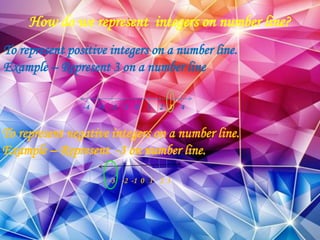
How do we represent integers on number line?
To represent positive integers on a number line.
Example – Represent 3 on a number line
-4 -3 -2 -1 0 1 2 3 4
To represent negative integers on a number line.
Example – Represent -3 on number line.
-3 -2 -1 0 1 2 3
Absolute Value of an integer
To find the absolute value of integers , look at the following
examples:
Q. Find the absolute value of the following integers.
a. 3
The absolute value of 3 = 3
b. -3
The absolute value of -3 = 3
c. -10
The absolute value of -10 = 10
Comparison Between Integers
To compare between two integers , look at the following
examples:
Q. Compare the following integers.
a. 3 and 5
As, 5 lies on the right of 3 and the value of integers
increase on going to the right . So, 3<5.
b. -3 and -5
As, -5 lies on the left of -3 and the value of integers
increase on going to the right . So, -5 < -3 .
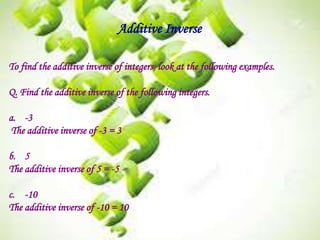
Additive Inverse
To find the additive inverse of integers, look at the following examples.
Q. Find the additive inverse of the following integers.
a. -3
The additive inverse of -3 = 3
b. 5
The additive inverse of 5 = -5
c. -10
The additive inverse of -10 = 10
Operations on integers
The operations which can be done on integers are:
Addition
 Subtraction
 Multiplication
 Division
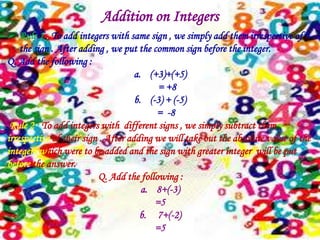
Addition on Integers
 Rule 1 : To add integers with same sign , we simply add them irrespective of
the sign . After adding , we put the common sign before the integer.
Q. Add the following :
a. (+3)+(+5)
= +8
b. (-3) + (-5)
= -8
Rule 2 : To add integers with different signs , we simply subtract them
irrespective of their sign . After adding we will take out the absolute value of the
integers which were to be added and the sign with greater integer will be put
before the answer.
Q. Add the following :
a. 8+(-3)
=5
b. 7+(-2)
=5
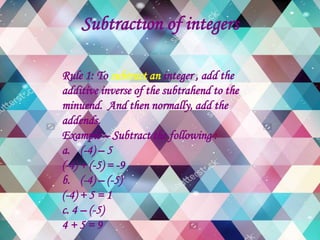
Subtraction of integers
Rule 1: To subtract an integer , add the
additive inverse of the subtrahend to the
minuend. And then normally, add the
addends.
Example – Subtract the following :
a. (-4) – 5
(-4) + (-5) = -9
b. (-4) – (-5)
(-4) + 5 = 1
c. 4 – (-5)
4 + 5 = 9
v
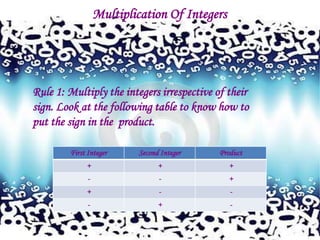
Multiplication Of Integers
Rule 1: Multiply the integers irrespective of their
sign. Look at the following table to know how to
put the sign in the product.
First Integer Second Integer Product
+ + +
- - +
+ - -
- + -
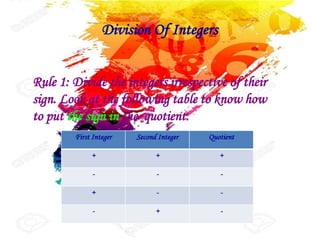
follDivision Of Integers
Rule 1: Divide the integers irrespective of their
sign. Look at the following table to know how
to put the sign in the quotient.
First Integer Second Integer Quotient
+ + +
- - -
+ - -
- + -
-10
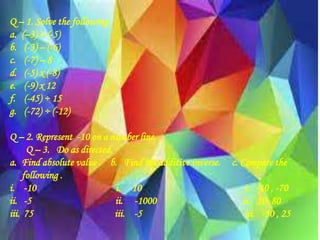
Q – 1. Solve the following .
a. (–3) + (-5)
b. (-3) – (-6)
c. (-7) – 8
d. (-5) x (-8)
e. (-9) x 12
f. (-45) ÷ 15
g. (-72) ÷ (-12)
Q – 2. Represent -10 on a number line.
Q – 3. Do as directed.
a. Find absolute value . b. Find the additive inverse. c. Compare the
following .
i. -10 i. 10 i. -10 , -70
ii. -5 ii. -1000 ii. 10, 80
iii. 75 iii. -5 iii. -50 , 25
Answers
Q – 1.
a. -8 b.-2
c. 3 d. -15
e. 40 f. -108
g. -3 h. 6
Q – 2.
-4 -3 -2 -1 0 1 2 3 4
Q – 3.
a.
i. 20 ii. 5 iii. 75
b.
i. -10 ii. 1000 iii. 5
c.
i. -10 > -70 ii. 10 < 80 iii. -50<25
Maths integers

Maths integers

  • 2.
    What Are Integers? Integers are the numbers that comprise of both negative numbers and positive numbers. Example - -5 , -4 -3 , -2 , -1 , 0 , 1 , 2 , 3 , 4 , 5 , etc. We can do all the four operations – addition, subtraction, multiplication, and division on it. We can also represent them on the number line and perform BODMAS with them. Positive Integers are always greater than negative integers.
  • 3.
    How do werepresent integers on number line? To represent positive integers on a number line. Example – Represent 3 on a number line -4 -3 -2 -1 0 1 2 3 4 To represent negative integers on a number line. Example – Represent -3 on number line. -3 -2 -1 0 1 2 3
  • 4.
    Absolute Value ofan integer To find the absolute value of integers , look at the following examples: Q. Find the absolute value of the following integers. a. 3 The absolute value of 3 = 3 b. -3 The absolute value of -3 = 3 c. -10 The absolute value of -10 = 10
  • 5.
    Comparison Between Integers Tocompare between two integers , look at the following examples: Q. Compare the following integers. a. 3 and 5 As, 5 lies on the right of 3 and the value of integers increase on going to the right . So, 3<5. b. -3 and -5 As, -5 lies on the left of -3 and the value of integers increase on going to the right . So, -5 < -3 .
  • 6.
    Additive Inverse To findthe additive inverse of integers, look at the following examples. Q. Find the additive inverse of the following integers. a. -3 The additive inverse of -3 = 3 b. 5 The additive inverse of 5 = -5 c. -10 The additive inverse of -10 = 10
  • 7.
    Operations on integers Theoperations which can be done on integers are: Addition  Subtraction  Multiplication  Division
  • 8.
    Addition on Integers Rule 1 : To add integers with same sign , we simply add them irrespective of the sign . After adding , we put the common sign before the integer. Q. Add the following : a. (+3)+(+5) = +8 b. (-3) + (-5) = -8 Rule 2 : To add integers with different signs , we simply subtract them irrespective of their sign . After adding we will take out the absolute value of the integers which were to be added and the sign with greater integer will be put before the answer. Q. Add the following : a. 8+(-3) =5 b. 7+(-2) =5
  • 9.
    Subtraction of integers Rule1: To subtract an integer , add the additive inverse of the subtrahend to the minuend. And then normally, add the addends. Example – Subtract the following : a. (-4) – 5 (-4) + (-5) = -9 b. (-4) – (-5) (-4) + 5 = 1 c. 4 – (-5) 4 + 5 = 9
  • 10.
    v Multiplication Of Integers Rule1: Multiply the integers irrespective of their sign. Look at the following table to know how to put the sign in the product. First Integer Second Integer Product + + + - - + + - - - + -
  • 11.
    follDivision Of Integers Rule1: Divide the integers irrespective of their sign. Look at the following table to know how to put the sign in the quotient. First Integer Second Integer Quotient + + + - - - + - - - + -
  • 12.
  • 13.
    Q – 1.Solve the following . a. (–3) + (-5) b. (-3) – (-6) c. (-7) – 8 d. (-5) x (-8) e. (-9) x 12 f. (-45) ÷ 15 g. (-72) ÷ (-12) Q – 2. Represent -10 on a number line. Q – 3. Do as directed. a. Find absolute value . b. Find the additive inverse. c. Compare the following . i. -10 i. 10 i. -10 , -70 ii. -5 ii. -1000 ii. 10, 80 iii. 75 iii. -5 iii. -50 , 25
  • 14.
    Answers Q – 1. a.-8 b.-2 c. 3 d. -15 e. 40 f. -108 g. -3 h. 6 Q – 2. -4 -3 -2 -1 0 1 2 3 4 Q – 3. a. i. 20 ii. 5 iii. 75 b. i. -10 ii. 1000 iii. 5 c. i. -10 > -70 ii. 10 < 80 iii. -50<25

Editor's Notes

  • #5 This is how you find the absolute value of an integer