
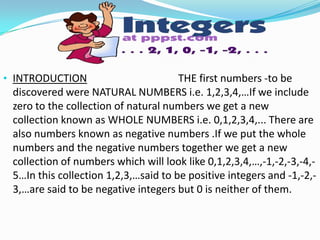
• INTRODUCTION                        THE first numbers -to be
 discovered were NATURAL NUMBERS i.e. 1,2,3,4,…If we include
 zero to the collection of natural numbers we get a new
 collection known as WHOLE NUMBERS i.e. 0,1,2,3,4,... There are
 also numbers known as negative numbers .If we put the whole
 numbers and the negative numbers together we get a new
 collection of numbers which will look like 0,1,2,3,4,…,-1,-2,-3,-4,-
 5…In this collection 1,2,3,…said to be positive integers and -1,-2,-
 3,…are said to be negative integers but 0 is neither of them.
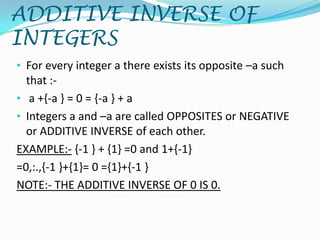
ADDITIVE INVERSE OF
INTEGERS
• For every integer a there exists its opposite –a such
  that :-
• a +{-a } = 0 = {-a } + a
• Integers a and –a are called OPPOSITES or NEGATIVE
  or ADDITIVE INVERSE of each other.
EXAMPLE:- {-1 } + {1} =0 and 1+{-1}
=0,:.,{-1 }+{1}= 0 ={1}+{-1 }
NOTE:- THE ADDITIVE INVERSE OF 0 IS 0.
ABSOLUTE VALUE OF
INTEGERS
 The absolute value of an integer is the numerical
  value of the integer regardless of its sign.
 The absolute value of an integer is denoted by |a|.
OPERATIONS ON
INTEGERS
 The four basic operations namely:-
 ADDITION
 SUBTRACTION
 MULTIPLICATION
 DIVISION
 Can easily be done on integers.
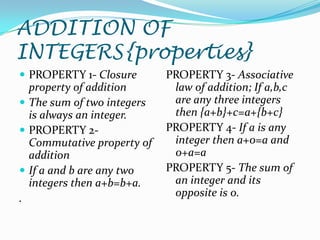
ADDITION OF
INTEGERS{properties}
 PROPERTY 1- Closure       PROPERTY 3- Associative
  property of addition       law of addition; If a,b,c
 The sum of two integers    are any three integers
  is always an integer.      then {a+b}+c=a+{b+c}
 PROPERTY 2-               PROPERTY 4- If a is any
  Commutative property of    integer then a+0=a and
  addition                   0+a=a
 If a and b are any two    PROPERTY 5- The sum of
  integers then a+b=b+a.     an integer and its
.                            opposite is 0.
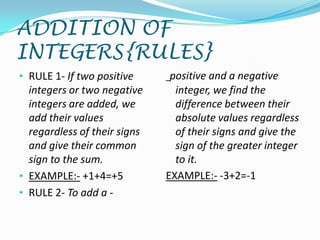
ADDITION OF
INTEGERS{RULES}
• RULE 1- If two positive      positive and a negative
  integers or two negative      integer, we find the
  integers are added, we        difference between their
  add their values              absolute values regardless
  regardless of their signs     of their signs and give the
  and give their common         sign of the greater integer
  sign to the sum.              to it.
• EXAMPLE:- +1+4=+5           EXAMPLE:- -3+2=-1
• RULE 2- To add a -
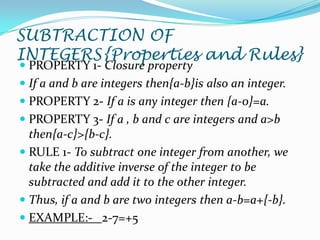
SUBTRACTION OF
INTEGERS{Properties and Rules}
 PROPERTY 1- Closure property
 If a and b are integers then{a-b}is also an integer.
 PROPERTY 2- If a is any integer then {a-0}=a.
 PROPERTY 3- If a , b and c are integers and a>b
  then{a-c}>{b-c}.
 RULE 1- To subtract one integer from another, we
  take the additive inverse of the integer to be
  subtracted and add it to the other integer.
 Thus, if a and b are two integers then a-b=a+{-b}.
 EXAMPLE:- 2-7=+5
MULTIPLICATION OF
INTEGERS{properties}

 PROPERTY 1- Closure property of multiplication ;The
    product of two integers is always an integer.
   PROPERTY 2- Commutative law for multiplication ; For any
    two integers a and b ,we have a*b=b*a.
   PROPERTY 3- Associative law for multiplication ; If a ,b and
    c are any three integers then {a*b}*c=a*{b*c}.
   PROPERTY 4- Distributive law ; If a, b and c are any three
    integers then a*{b + c}=a*b + a*c.
   PROPERTY 5- For any integer a we have a*1=a.1 is known as
    the multiplicative identity for integers.
   PROPERTY 6- For any integer a we have a*0=0.
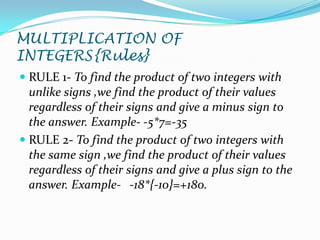
MULTIPLICATION OF
INTEGERS{Rules}
 RULE 1- To find the product of two integers with
  unlike signs ,we find the product of their values
  regardless of their signs and give a minus sign to
  the answer. Example- -5*7=-35
 RULE 2- To find the product of two integers with
  the same sign ,we find the product of their values
  regardless of their signs and give a plus sign to the
  answer. Example- -18*{-10}=+180.
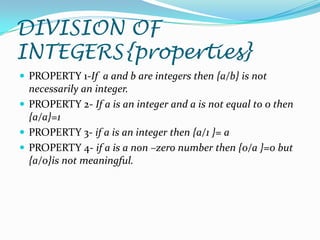
DIVISION OF
INTEGERS{properties}
 PROPERTY 1-If a and b are integers then {a/b} is not
  necessarily an integer.
 PROPERTY 2- If a is an integer and a is not equal to 0 then
  {a/a}=1
 PROPERTY 3- if a is an integer then {a/1 }= a
 PROPERTY 4- if a is a non –zero number then {0/a }=0 but
  {a/0}is not meaningful.
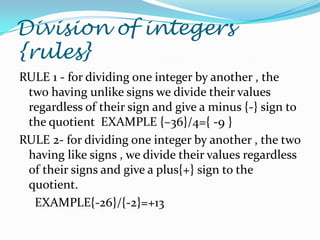
Division of integers
{rules}
RULE 1 - for dividing one integer by another , the
 two having unlike signs we divide their values
 regardless of their sign and give a minus {-} sign to
 the quotient EXAMPLE {–36}/4={ -9 }
RULE 2- for dividing one integer by another , the two
 having like signs , we divide their values regardless
 of their signs and give a plus{+} sign to the
 quotient.
  EXAMPLE{-26}/{-2}=+13

Integers

  • 2.
    • INTRODUCTION THE first numbers -to be discovered were NATURAL NUMBERS i.e. 1,2,3,4,…If we include zero to the collection of natural numbers we get a new collection known as WHOLE NUMBERS i.e. 0,1,2,3,4,... There are also numbers known as negative numbers .If we put the whole numbers and the negative numbers together we get a new collection of numbers which will look like 0,1,2,3,4,…,-1,-2,-3,-4,- 5…In this collection 1,2,3,…said to be positive integers and -1,-2,- 3,…are said to be negative integers but 0 is neither of them.
  • 3.
    ADDITIVE INVERSE OF INTEGERS •For every integer a there exists its opposite –a such that :- • a +{-a } = 0 = {-a } + a • Integers a and –a are called OPPOSITES or NEGATIVE or ADDITIVE INVERSE of each other. EXAMPLE:- {-1 } + {1} =0 and 1+{-1} =0,:.,{-1 }+{1}= 0 ={1}+{-1 } NOTE:- THE ADDITIVE INVERSE OF 0 IS 0.
  • 4.
    ABSOLUTE VALUE OF INTEGERS The absolute value of an integer is the numerical value of the integer regardless of its sign.  The absolute value of an integer is denoted by |a|.
  • 5.
    OPERATIONS ON INTEGERS  Thefour basic operations namely:-  ADDITION  SUBTRACTION  MULTIPLICATION  DIVISION  Can easily be done on integers.
  • 6.
    ADDITION OF INTEGERS{properties}  PROPERTY1- Closure PROPERTY 3- Associative property of addition law of addition; If a,b,c  The sum of two integers are any three integers is always an integer. then {a+b}+c=a+{b+c}  PROPERTY 2- PROPERTY 4- If a is any Commutative property of integer then a+0=a and addition 0+a=a  If a and b are any two PROPERTY 5- The sum of integers then a+b=b+a. an integer and its . opposite is 0.
  • 7.
    ADDITION OF INTEGERS{RULES} • RULE1- If two positive positive and a negative integers or two negative integer, we find the integers are added, we difference between their add their values absolute values regardless regardless of their signs of their signs and give the and give their common sign of the greater integer sign to the sum. to it. • EXAMPLE:- +1+4=+5 EXAMPLE:- -3+2=-1 • RULE 2- To add a -
  • 8.
    SUBTRACTION OF INTEGERS{Properties andRules}  PROPERTY 1- Closure property  If a and b are integers then{a-b}is also an integer.  PROPERTY 2- If a is any integer then {a-0}=a.  PROPERTY 3- If a , b and c are integers and a>b then{a-c}>{b-c}.  RULE 1- To subtract one integer from another, we take the additive inverse of the integer to be subtracted and add it to the other integer.  Thus, if a and b are two integers then a-b=a+{-b}.  EXAMPLE:- 2-7=+5
  • 9.
    MULTIPLICATION OF INTEGERS{properties}  PROPERTY1- Closure property of multiplication ;The product of two integers is always an integer.  PROPERTY 2- Commutative law for multiplication ; For any two integers a and b ,we have a*b=b*a.  PROPERTY 3- Associative law for multiplication ; If a ,b and c are any three integers then {a*b}*c=a*{b*c}.  PROPERTY 4- Distributive law ; If a, b and c are any three integers then a*{b + c}=a*b + a*c.  PROPERTY 5- For any integer a we have a*1=a.1 is known as the multiplicative identity for integers.  PROPERTY 6- For any integer a we have a*0=0.
  • 10.
    MULTIPLICATION OF INTEGERS{Rules}  RULE1- To find the product of two integers with unlike signs ,we find the product of their values regardless of their signs and give a minus sign to the answer. Example- -5*7=-35  RULE 2- To find the product of two integers with the same sign ,we find the product of their values regardless of their signs and give a plus sign to the answer. Example- -18*{-10}=+180.
  • 11.
    DIVISION OF INTEGERS{properties}  PROPERTY1-If a and b are integers then {a/b} is not necessarily an integer.  PROPERTY 2- If a is an integer and a is not equal to 0 then {a/a}=1  PROPERTY 3- if a is an integer then {a/1 }= a  PROPERTY 4- if a is a non –zero number then {0/a }=0 but {a/0}is not meaningful.
  • 12.
    Division of integers {rules} RULE1 - for dividing one integer by another , the two having unlike signs we divide their values regardless of their sign and give a minus {-} sign to the quotient EXAMPLE {–36}/4={ -9 } RULE 2- for dividing one integer by another , the two having like signs , we divide their values regardless of their signs and give a plus{+} sign to the quotient. EXAMPLE{-26}/{-2}=+13