Definitions
Raman Choubay
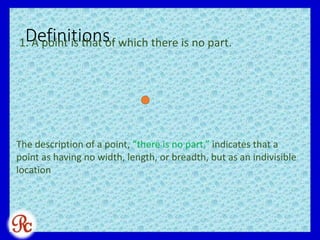
Definitions1. A point is that of which there is no part.
The description of a point, “there is no part,” indicates that a
point as having no width, length, or breadth, but as an indivisible
location
Definitions
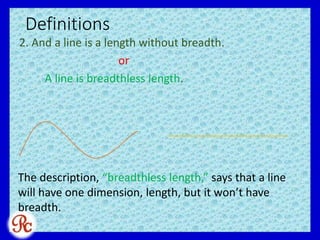
2. And a line is a length without breadth.
or
A line is breadthless length.
The description, “breadthless length,” says that a line
will have one dimension, length, but it won’t have
breadth.
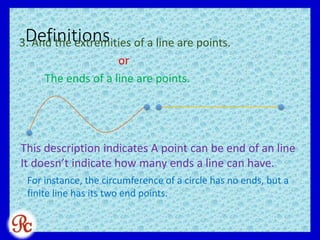
Definitions3. And the extremities of a line are points.
or
The ends of a line are points.
This description indicates A point can be end of an line
It doesn’t indicate how many ends a line can have.
For instance, the circumference of a circle has no ends, but a
finite line has its two end points.
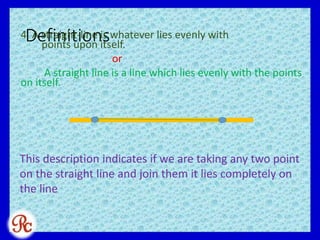
Definitions4. A straight-line is whatever lies evenly with
points upon itself.
or
A straight line is a line which lies evenly with the points
on itself.
This description indicates if we are taking any two point
on the straight line and join them it lies completely on
the line
Definitions5. And a surface is that which has length and breadth alone
or
A surface is that which has length and breadth only.
This statement suggests that a surface has two dimensions
length and breadth namely
Definitions6. And the extremities of a surface are lines.
or
The edges of a surface are lines
This definition allow us to define relation between line and
plane
Definitions7. A plane surface is whatever lies evenly with straight-lines
upon itself.
or
A plane surface is a surface which lies evenly with the
straight lines on itself.
This Definition describe that if we take any two points on the
plane and join it than the line will completely lies on the plane
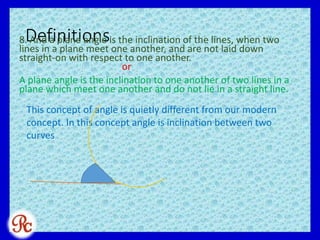
Definitions8. And a plane angle is the inclination of the lines, when two
lines in a plane meet one another, and are not laid down
straight-on with respect to one another.
or
A plane angle is the inclination to one another of two lines in a
plane which meet one another and do not lie in a straight line.
This concept of angle is quietly different from our modern
concept. In this concept angle is inclination between two
curves
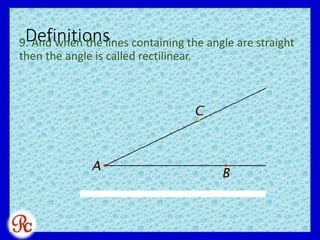
Definitions9. And when the lines containing the angle are straight
then the angle is called rectilinear.
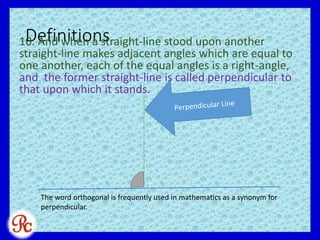
Definitions10. And when a straight-line stood upon another
straight-line makes adjacent angles which are equal to
one another, each of the equal angles is a right-angle,
and the former straight-line is called perpendicular to
that upon which it stands.
The word orthogonal is frequently used in mathematics as a synonym for
perpendicular.
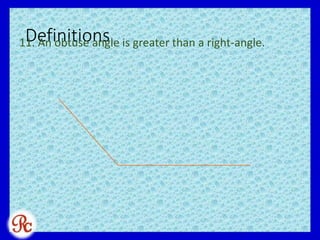
Definitions11. An obtuse angle is greater than a right-angle.
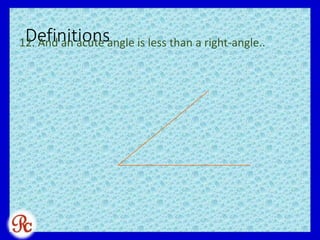
Definitions12. And an acute angle is less than a right-angle..
Definitions13. A boundary is that which is the
extremity of some thing.
The boundary is the extremities of any object like the
boundary of ball is circle
Definitions14. A figure is that which is contained
by some bound or boundaries.
The figure should be bounded that means this
should has the finite area not infinite
Definitions15. A circle is a plane figure contained by a single line
which is called a circumference such that all of the
straight-lines radiating towards the circumference from
a single point lying inside the figure are equal to one
another.
16. And the point is called the center of the circle.
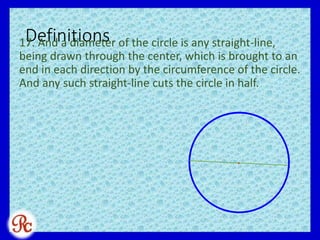
Definitions17. And a diameter of the circle is any straight-line,
being drawn through the center, which is brought to an
end in each direction by the circumference of the circle.
And any such straight-line cuts the circle in half.
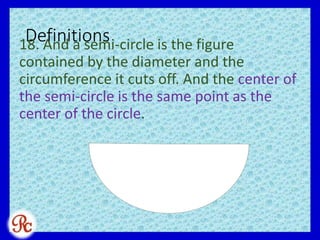
Definitions18. And a semi-circle is the figure
contained by the diameter and the
circumference it cuts off. And the center of
the semi-circle is the same point as the
center of the circle.
Definitions19. Rectilinear figures are those figures contained by
straight-lines: trilateral figures being contained by three
straight-lines, quadrilateral by four, and multilateral by
more than four.
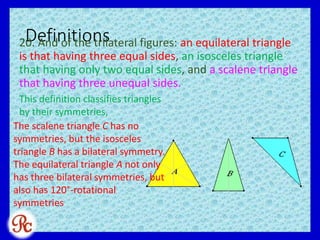
Definitions20. And of the trilateral figures: an equilateral triangle
is that having three equal sides, an isosceles triangle
that having only two equal sides, and a scalene triangle
that having three unequal sides.
This definition classifies triangles
by their symmetries,
The scalene triangle C has no
symmetries, but the isosceles
triangle B has a bilateral symmetry.
The equilateral triangle A not only
has three bilateral symmetries, but
also has 120°-rotational
symmetries
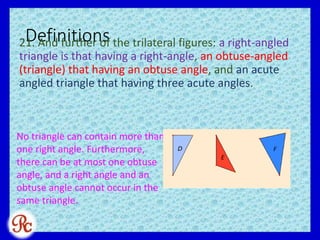
Definitions21. And further of the trilateral figures: a right-angled
triangle is that having a right-angle, an obtuse-angled
(triangle) that having an obtuse angle, and an acute
angled triangle that having three acute angles.
No triangle can contain more than
one right angle. Furthermore,
there can be at most one obtuse
angle, and a right angle and an
obtuse angle cannot occur in the
same triangle.
Definitions22. And of the quadrilateral figures: a square is that
which is right-angled and equilateral, a rectangle that
which is right-angled but not equilateral, a rhombus
that which is equilateral but not right-angled, and a
rhomboid that having opposite sides and angles equal
to one another which is neither right-angled nor
equilateral. And let quadrilateral figures
besides these be called trapezia.
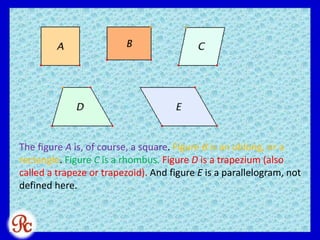
The figure A is, of course, a square. Figure B is an oblong, or a
rectangle. Figure C is a rhombus. Figure D is a trapezium (also
called a trapeze or trapezoid). And figure E is a parallelogram, not
defined here.
Definitions23. Parallel lines are straight-lines which, being in the
same plane, and being produced to infinity in each
direction, meet with one another in neither of these
directions.
Explanation: For the straight lines to be parallel they
should
1. Being in the same plane
2.After producing infinitely they should not meet any
Direction
Created By : Raman Choubay
Email: raman.choubay@gmail.com

Book 1 definition

  • 1.
  • 2.
    Definitions1. A pointis that of which there is no part. The description of a point, “there is no part,” indicates that a point as having no width, length, or breadth, but as an indivisible location
  • 3.
    Definitions 2. And aline is a length without breadth. or A line is breadthless length. The description, “breadthless length,” says that a line will have one dimension, length, but it won’t have breadth.
  • 4.
    Definitions3. And theextremities of a line are points. or The ends of a line are points. This description indicates A point can be end of an line It doesn’t indicate how many ends a line can have. For instance, the circumference of a circle has no ends, but a finite line has its two end points.
  • 5.
    Definitions4. A straight-lineis whatever lies evenly with points upon itself. or A straight line is a line which lies evenly with the points on itself. This description indicates if we are taking any two point on the straight line and join them it lies completely on the line
  • 6.
    Definitions5. And asurface is that which has length and breadth alone or A surface is that which has length and breadth only. This statement suggests that a surface has two dimensions length and breadth namely
  • 7.
    Definitions6. And theextremities of a surface are lines. or The edges of a surface are lines This definition allow us to define relation between line and plane
  • 8.
    Definitions7. A planesurface is whatever lies evenly with straight-lines upon itself. or A plane surface is a surface which lies evenly with the straight lines on itself. This Definition describe that if we take any two points on the plane and join it than the line will completely lies on the plane
  • 9.
    Definitions8. And aplane angle is the inclination of the lines, when two lines in a plane meet one another, and are not laid down straight-on with respect to one another. or A plane angle is the inclination to one another of two lines in a plane which meet one another and do not lie in a straight line. This concept of angle is quietly different from our modern concept. In this concept angle is inclination between two curves
  • 10.
    Definitions9. And whenthe lines containing the angle are straight then the angle is called rectilinear.
  • 11.
    Definitions10. And whena straight-line stood upon another straight-line makes adjacent angles which are equal to one another, each of the equal angles is a right-angle, and the former straight-line is called perpendicular to that upon which it stands. The word orthogonal is frequently used in mathematics as a synonym for perpendicular.
  • 12.
    Definitions11. An obtuseangle is greater than a right-angle.
  • 13.
    Definitions12. And anacute angle is less than a right-angle..
  • 14.
    Definitions13. A boundaryis that which is the extremity of some thing. The boundary is the extremities of any object like the boundary of ball is circle
  • 15.
    Definitions14. A figureis that which is contained by some bound or boundaries. The figure should be bounded that means this should has the finite area not infinite
  • 16.
    Definitions15. A circleis a plane figure contained by a single line which is called a circumference such that all of the straight-lines radiating towards the circumference from a single point lying inside the figure are equal to one another. 16. And the point is called the center of the circle.
  • 17.
    Definitions17. And adiameter of the circle is any straight-line, being drawn through the center, which is brought to an end in each direction by the circumference of the circle. And any such straight-line cuts the circle in half.
  • 18.
    Definitions18. And asemi-circle is the figure contained by the diameter and the circumference it cuts off. And the center of the semi-circle is the same point as the center of the circle.
  • 19.
    Definitions19. Rectilinear figuresare those figures contained by straight-lines: trilateral figures being contained by three straight-lines, quadrilateral by four, and multilateral by more than four.
  • 20.
    Definitions20. And ofthe trilateral figures: an equilateral triangle is that having three equal sides, an isosceles triangle that having only two equal sides, and a scalene triangle that having three unequal sides. This definition classifies triangles by their symmetries, The scalene triangle C has no symmetries, but the isosceles triangle B has a bilateral symmetry. The equilateral triangle A not only has three bilateral symmetries, but also has 120°-rotational symmetries
  • 21.
    Definitions21. And furtherof the trilateral figures: a right-angled triangle is that having a right-angle, an obtuse-angled (triangle) that having an obtuse angle, and an acute angled triangle that having three acute angles. No triangle can contain more than one right angle. Furthermore, there can be at most one obtuse angle, and a right angle and an obtuse angle cannot occur in the same triangle.
  • 22.
    Definitions22. And ofthe quadrilateral figures: a square is that which is right-angled and equilateral, a rectangle that which is right-angled but not equilateral, a rhombus that which is equilateral but not right-angled, and a rhomboid that having opposite sides and angles equal to one another which is neither right-angled nor equilateral. And let quadrilateral figures besides these be called trapezia.
  • 23.
    The figure Ais, of course, a square. Figure B is an oblong, or a rectangle. Figure C is a rhombus. Figure D is a trapezium (also called a trapeze or trapezoid). And figure E is a parallelogram, not defined here.
  • 24.
    Definitions23. Parallel linesare straight-lines which, being in the same plane, and being produced to infinity in each direction, meet with one another in neither of these directions. Explanation: For the straight lines to be parallel they should 1. Being in the same plane 2.After producing infinitely they should not meet any Direction
  • 25.
    Created By :Raman Choubay Email: raman.choubay@gmail.com