Differentiate between linear and exponential functions.
4 3 2 1 0
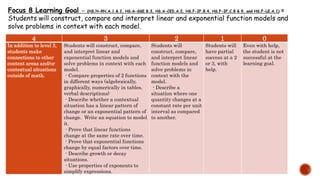
In addition to level 3,
students make
connections to other
content areas and/or
contextual situations
outside of math.
Students will construct, compare,
and interpret linear and
exponential function models and
solve problems in context with each
model.
- Compare properties of 2 functions
in different ways (algebraically,
graphically, numerically in tables,
verbal descriptions)
- Describe whether a contextual
situation has a linear pattern of
change or an exponential pattern of
change. Write an equation to model
it.
- Prove that linear functions
change at the same rate over time.
- Prove that exponential functions
change by equal factors over time.
- Describe growth or decay
situations.
- Use properties of exponents to
simplify expressions.
Students will
construct, compare,
and interpret linear
function models and
solve problems in
context with the
model.
- Describe a
situation where one
quantity changes at a
constant rate per unit
interval as compared
to another.
Students will
have partial
success at a 2
or 3, with
help.
Even with help,
the student is not
successful at the
learning goal.
Focus 8 Learning Goal – (HS.N-RN.A.1 & 2, HS.A-SSE.B.3, HS.A-CED.A.2, HS.F-IF.B.4, HS.F-IF.C.8 & 9, and HS.F-LE.A.1) =
Students will construct, compare and interpret linear and exponential function models and
solve problems in context with each model.
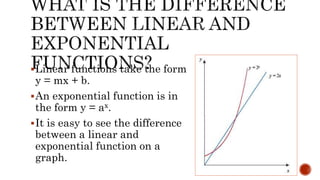
Linear functions take the form
y = mx + b.
An exponential function is in
the form y = ax.
It is easy to see the difference
between a linear and
exponential function on a
graph.
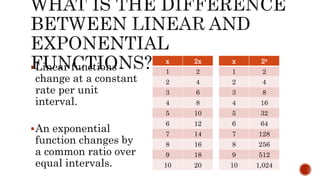
Linear functions
change at a constant
rate per unit
interval.
An exponential
function changes by
a common ratio over
equal intervals.
x 2x
1 2
2 4
3 6
4 8
5 10
6 12
7 14
8 16
9 18
10 20
x 2x
1 2
2 4
3 8
4 16
5 32
6 64
7 128
8 256
9 512
10 1,024
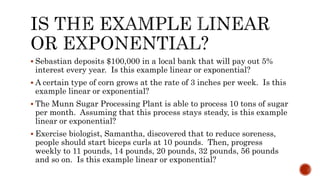
 Sebastian deposits $100,000 in a local bank that will pay out 5%
interest every year. Is this example linear or exponential?
 A certain type of corn grows at the rate of 3 inches per week. Is this
example linear or exponential?
 The Munn Sugar Processing Plant is able to process 10 tons of sugar
per month. Assuming that this process stays steady, is this example
linear or exponential?
 Exercise biologist, Samantha, discovered that to reduce soreness,
people should start biceps curls at 10 pounds. Then, progress
weekly to 11 pounds, 14 pounds, 20 pounds, 32 pounds, 56 pounds
and so on. Is this example linear or exponential?

Linear vs exponential growth (Simplified)

  • 1.
    Differentiate between linearand exponential functions.
  • 2.
    4 3 21 0 In addition to level 3, students make connections to other content areas and/or contextual situations outside of math. Students will construct, compare, and interpret linear and exponential function models and solve problems in context with each model. - Compare properties of 2 functions in different ways (algebraically, graphically, numerically in tables, verbal descriptions) - Describe whether a contextual situation has a linear pattern of change or an exponential pattern of change. Write an equation to model it. - Prove that linear functions change at the same rate over time. - Prove that exponential functions change by equal factors over time. - Describe growth or decay situations. - Use properties of exponents to simplify expressions. Students will construct, compare, and interpret linear function models and solve problems in context with the model. - Describe a situation where one quantity changes at a constant rate per unit interval as compared to another. Students will have partial success at a 2 or 3, with help. Even with help, the student is not successful at the learning goal. Focus 8 Learning Goal – (HS.N-RN.A.1 & 2, HS.A-SSE.B.3, HS.A-CED.A.2, HS.F-IF.B.4, HS.F-IF.C.8 & 9, and HS.F-LE.A.1) = Students will construct, compare and interpret linear and exponential function models and solve problems in context with each model.
  • 3.
    Linear functions takethe form y = mx + b. An exponential function is in the form y = ax. It is easy to see the difference between a linear and exponential function on a graph.
  • 4.
    Linear functions change ata constant rate per unit interval. An exponential function changes by a common ratio over equal intervals. x 2x 1 2 2 4 3 6 4 8 5 10 6 12 7 14 8 16 9 18 10 20 x 2x 1 2 2 4 3 8 4 16 5 32 6 64 7 128 8 256 9 512 10 1,024
  • 5.
     Sebastian deposits$100,000 in a local bank that will pay out 5% interest every year. Is this example linear or exponential?  A certain type of corn grows at the rate of 3 inches per week. Is this example linear or exponential?  The Munn Sugar Processing Plant is able to process 10 tons of sugar per month. Assuming that this process stays steady, is this example linear or exponential?  Exercise biologist, Samantha, discovered that to reduce soreness, people should start biceps curls at 10 pounds. Then, progress weekly to 11 pounds, 14 pounds, 20 pounds, 32 pounds, 56 pounds and so on. Is this example linear or exponential?