Linear Law
    How to the TB question
     for the question 12.
            Pg 183
Note:
 Please do not fast forward to see the
answer, if you want to improve then just
            see it step by step.
                From: TWY
                     GSS
                     5/1
How to solve? Think first
                   x
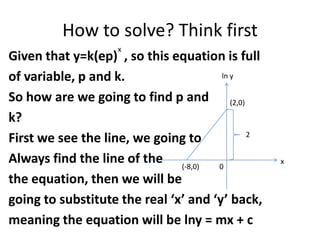
Given that y=k(ep) , so this equation is full
of variable, p and k.                  ln y

So how are we going to find p and (2,0)
k?
                                            2
First we see the line, we going to
Always find the line of the (-8,0) 0             x

the equation, then we will be
going to substitute the real ‘x’ and ‘y’ back,
meaning the equation will be lny = mx + c
Basic of solving question of Linear Law
          Example of basic application:
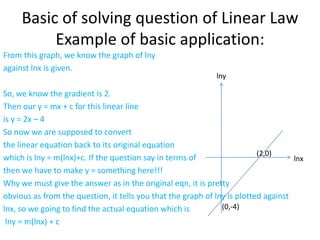
From this graph, we know the graph of lny
against lnx is given.
                                                             lny

So, we know the gradient is 2.
Then our y = mx + c for this linear line
is y = 2x – 4
So now we are supposed to convert
the linear equation back to its original equation
                                                                          (2,0)
which is lny = m(lnx)+c. If the question say in terms of                            lnx
then we have to make y = something here!!!
Why we must give the answer as in the original eqn, it is pretty
obvious as from the question, it tells you that the graph of lny is plotted against
lnx, so we going to find the actual equation which is          (0,-4)
 lny = m(lnx) + c
Continue with the Tb
              problem, question 12.
First to find our K and P, you got to see and
Think. Look at the problem, it says that y = k(ep)          x
Ask yourself, can I find the known equations
with the k, e and p. Yes, we can. Look we have 2
points, to find out the gradient, and to get our
Y – intercept. We know that the equation is the
our original equation as it did not state that the
equation is shown by the graph given. Furthermore,
it has e in it. Probably the equation is rewritten in y as the
Subject.
• So now, we going to find the equation of the
  linear shown in the textbook.
• For the gradient it will be ¼ .
• The y – intercept is 2 shown in the diagram.
• Now we got our linear equation which is:
• y=¼x+2
• Converting back to our Original Equation:
• lny = ¼ x + 2
x
• Now we have this y = k(ep) , and lny = ¼ x + 2
• Now what are we going to do?
                                        x
• So is either you substitute y = k(ep) into
  lny = ¼ x + 2, then you compare
                                          x
• Or you ln both sides for the y = k(ep) , and equate
  both equations together, and compare.
• For the first method one, you will get
           x
  ln[k(ep) ] = ¼ x + 2 then lnk + x(lne + lnp) = ¼ x + 2
After that it will be:
• lne + lnp = ¼ (comparing coefficient of x)
                     -¾
• lnp = - ¾  p = e
• lnk = 2  p = e2
For second method I let you try your own, it is
                              x
same, its just lny = ln[k.(ep) ], then after that
it will be the same. I will not show all steps, you
going to try your own. After that the steps will
be exactly same as method 1, just comparison.
Like your sec 3 surds problems, it ask you to
find your a and b. Example:
(a + b√3)(-3√3 + 5) = 6 - 4 √3
Or you can use substitution like your
Partial Fractions, if needed. Just apply what you
learn and not just simply memorize steps.

Linear law

  • 1.
    Linear Law How to the TB question for the question 12. Pg 183 Note: Please do not fast forward to see the answer, if you want to improve then just see it step by step. From: TWY GSS 5/1
  • 2.
    How to solve?Think first x Given that y=k(ep) , so this equation is full of variable, p and k. ln y So how are we going to find p and (2,0) k? 2 First we see the line, we going to Always find the line of the (-8,0) 0 x the equation, then we will be going to substitute the real ‘x’ and ‘y’ back, meaning the equation will be lny = mx + c
  • 3.
    Basic of solvingquestion of Linear Law Example of basic application: From this graph, we know the graph of lny against lnx is given. lny So, we know the gradient is 2. Then our y = mx + c for this linear line is y = 2x – 4 So now we are supposed to convert the linear equation back to its original equation (2,0) which is lny = m(lnx)+c. If the question say in terms of lnx then we have to make y = something here!!! Why we must give the answer as in the original eqn, it is pretty obvious as from the question, it tells you that the graph of lny is plotted against lnx, so we going to find the actual equation which is (0,-4) lny = m(lnx) + c
  • 4.
    Continue with theTb problem, question 12. First to find our K and P, you got to see and Think. Look at the problem, it says that y = k(ep) x Ask yourself, can I find the known equations with the k, e and p. Yes, we can. Look we have 2 points, to find out the gradient, and to get our Y – intercept. We know that the equation is the our original equation as it did not state that the equation is shown by the graph given. Furthermore, it has e in it. Probably the equation is rewritten in y as the Subject.
  • 5.
    • So now,we going to find the equation of the linear shown in the textbook. • For the gradient it will be ¼ . • The y – intercept is 2 shown in the diagram. • Now we got our linear equation which is: • y=¼x+2 • Converting back to our Original Equation: • lny = ¼ x + 2
  • 6.
    x • Now wehave this y = k(ep) , and lny = ¼ x + 2 • Now what are we going to do? x • So is either you substitute y = k(ep) into lny = ¼ x + 2, then you compare x • Or you ln both sides for the y = k(ep) , and equate both equations together, and compare. • For the first method one, you will get x ln[k(ep) ] = ¼ x + 2 then lnk + x(lne + lnp) = ¼ x + 2 After that it will be: • lne + lnp = ¼ (comparing coefficient of x) -¾ • lnp = - ¾  p = e • lnk = 2  p = e2
  • 7.
    For second methodI let you try your own, it is x same, its just lny = ln[k.(ep) ], then after that it will be the same. I will not show all steps, you going to try your own. After that the steps will be exactly same as method 1, just comparison. Like your sec 3 surds problems, it ask you to find your a and b. Example: (a + b√3)(-3√3 + 5) = 6 - 4 √3 Or you can use substitution like your Partial Fractions, if needed. Just apply what you learn and not just simply memorize steps.