Fundamentals of Accounting
INVENTORY VALUATION
Inventory
Inventory is the one of the largest
current asset of a retail store or of a
whole business merchandise. The sale
of this inventory is the main source of
revenue.
Inventory contains materials/Products in
three forms of conditions
Raw Materials
The materials needed to
make anything are called
raw materials.
The initial condition of
any material is its raw
form.
Some work is needed to
make a raw material into
something useful
Consider we were making
something using steel
Steel in raw
form
WIP (Work in process)
The process of making raw materials into
some useful things
Steel is melted to reshape it
into something useful
Finished Good
The finished product formed after doing some
work on raw material.
The price of finished product is considerably high from
raw material
We can make numerous useful products
using same raw material
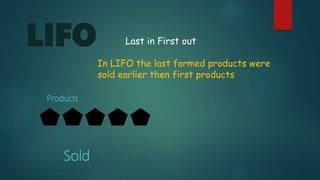
LIFO Last in First out
In LIFO the last formed products were
sold earlier then first products
Products
Sold
Advantages of LIFO
In times of rising
prices LIFO is
beneficial because in
LIFO the last
purchased products
(which were expensive
than older) were sold
Earlier. So the first
products will be sell at
greater profit.
Purchased
Selling Price = 100
80 80 80
Profit
2020 20
Selling Price = 150
130130
Selling Price = 200
180
70 120
To overcome it the
products last purchased
were sold with lower profit
The advantage of lower
profit is that you don’t
have to pay more income-
taxes
But in this way
income-taxes
increases
The more the
profit the more
the income-tax
has to pay
You can also sell first products at
same profit and lower price. So in
this way you can variate your price.
It also happies customers.
Sold at 110
20 20
Sold at 60
LIFO is also beneficial in (Non-Expiring) products.
For example
The price of Rice
increases as it gets
older
Also in Non-Muslim
countries the price of
Wine increases as it
gets older.
So if we’re using
LIFO the cost of
old rice and wine
keeps rising until
we sold them.
FIFO First in First out
In FIFO the first formed products were
sold earlier than last formed products
Products
Sold
Advantages of FIFO
The main advantage of FIFO is that the products were
less likely to expire. Because in FIFO the oldest product is
sold earlier
When you’re using FIFO your
inventory is showing latest prices
of the products because the old
products were already sold.
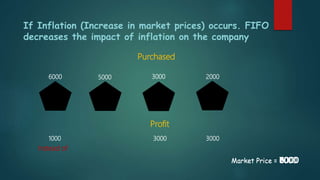
If Inflation (Increase in market prices) occurs. FIFO
decreases the impact of inflation on the company
Purchased
200030005000
Market Price = 2000Market Price = 3000Market Price = 5000
Profit
3000
Market Price = 6000
6000
30001000
Instead of
Market Price = 7000
Inventory
Valuation
is
recorded
in balance
sheet
Purchased Sold Balance
Date Units Unit Cost
Total
Cost Units UnitsUnit Cost Unit Cost Total Cost
Total
Cost
5 Feb 2 1000 2000 2 1000 2000
7 Feb 7 1200 8400
2
7
1000
1200 10400
10 Feb
1 1000
1000
1
7
1000
1200
9400
12 Feb
1 1000
1000 0
7
1000
1200
8400
FIFO
Purchased Sold Balance
Date Units Unit Cost
Total
Cost Units UnitsUnit Cost Unit Cost Total Cost
Total
Cost
5 Feb 2 1000 2000 2 1000 2000
7 Feb 7 1200 8400
2
7
1000
1200 10400
10 Feb
1 1200
1200
2
6
1000
1200
9200
12 Feb
2 1200
2400
2
4
1000
1200
6800
LIFO
Purchased Sold Balance
Date Units Unit Cost
Total
Cost Units UnitsUnit Cost Unit Cost Total Cost
Total
Cost
5 Feb 2 1000 2000 2 1000 2000
7 Feb 3 1200 3600 5 1120 5600
10 Feb 1 1120 1120 4 1120 4480
Average
2000+3600=5600
2+3=5
5600/5=1120
The End

Lifo n fifo

  • 1.
  • 2.
    Inventory Inventory is theone of the largest current asset of a retail store or of a whole business merchandise. The sale of this inventory is the main source of revenue. Inventory contains materials/Products in three forms of conditions
  • 3.
    Raw Materials The materialsneeded to make anything are called raw materials. The initial condition of any material is its raw form. Some work is needed to make a raw material into something useful Consider we were making something using steel Steel in raw form
  • 4.
    WIP (Work inprocess) The process of making raw materials into some useful things Steel is melted to reshape it into something useful
  • 5.
    Finished Good The finishedproduct formed after doing some work on raw material. The price of finished product is considerably high from raw material We can make numerous useful products using same raw material
  • 6.
    LIFO Last inFirst out In LIFO the last formed products were sold earlier then first products Products Sold
  • 7.
    Advantages of LIFO Intimes of rising prices LIFO is beneficial because in LIFO the last purchased products (which were expensive than older) were sold Earlier. So the first products will be sell at greater profit. Purchased Selling Price = 100 80 80 80 Profit 2020 20 Selling Price = 150 130130 Selling Price = 200 180 70 120 To overcome it the products last purchased were sold with lower profit The advantage of lower profit is that you don’t have to pay more income- taxes But in this way income-taxes increases The more the profit the more the income-tax has to pay You can also sell first products at same profit and lower price. So in this way you can variate your price. It also happies customers. Sold at 110 20 20 Sold at 60
  • 8.
    LIFO is alsobeneficial in (Non-Expiring) products. For example The price of Rice increases as it gets older Also in Non-Muslim countries the price of Wine increases as it gets older. So if we’re using LIFO the cost of old rice and wine keeps rising until we sold them.
  • 9.
    FIFO First inFirst out In FIFO the first formed products were sold earlier than last formed products Products Sold
  • 10.
    Advantages of FIFO Themain advantage of FIFO is that the products were less likely to expire. Because in FIFO the oldest product is sold earlier When you’re using FIFO your inventory is showing latest prices of the products because the old products were already sold.
  • 11.
    If Inflation (Increasein market prices) occurs. FIFO decreases the impact of inflation on the company Purchased 200030005000 Market Price = 2000Market Price = 3000Market Price = 5000 Profit 3000 Market Price = 6000 6000 30001000 Instead of Market Price = 7000
  • 12.
  • 13.
    Purchased Sold Balance DateUnits Unit Cost Total Cost Units UnitsUnit Cost Unit Cost Total Cost Total Cost 5 Feb 2 1000 2000 2 1000 2000 7 Feb 7 1200 8400 2 7 1000 1200 10400 10 Feb 1 1000 1000 1 7 1000 1200 9400 12 Feb 1 1000 1000 0 7 1000 1200 8400 FIFO
  • 14.
    Purchased Sold Balance DateUnits Unit Cost Total Cost Units UnitsUnit Cost Unit Cost Total Cost Total Cost 5 Feb 2 1000 2000 2 1000 2000 7 Feb 7 1200 8400 2 7 1000 1200 10400 10 Feb 1 1200 1200 2 6 1000 1200 9200 12 Feb 2 1200 2400 2 4 1000 1200 6800 LIFO
  • 15.
    Purchased Sold Balance DateUnits Unit Cost Total Cost Units UnitsUnit Cost Unit Cost Total Cost Total Cost 5 Feb 2 1000 2000 2 1000 2000 7 Feb 3 1200 3600 5 1120 5600 10 Feb 1 1120 1120 4 1120 4480 Average 2000+3600=5600 2+3=5 5600/5=1120
  • 16.