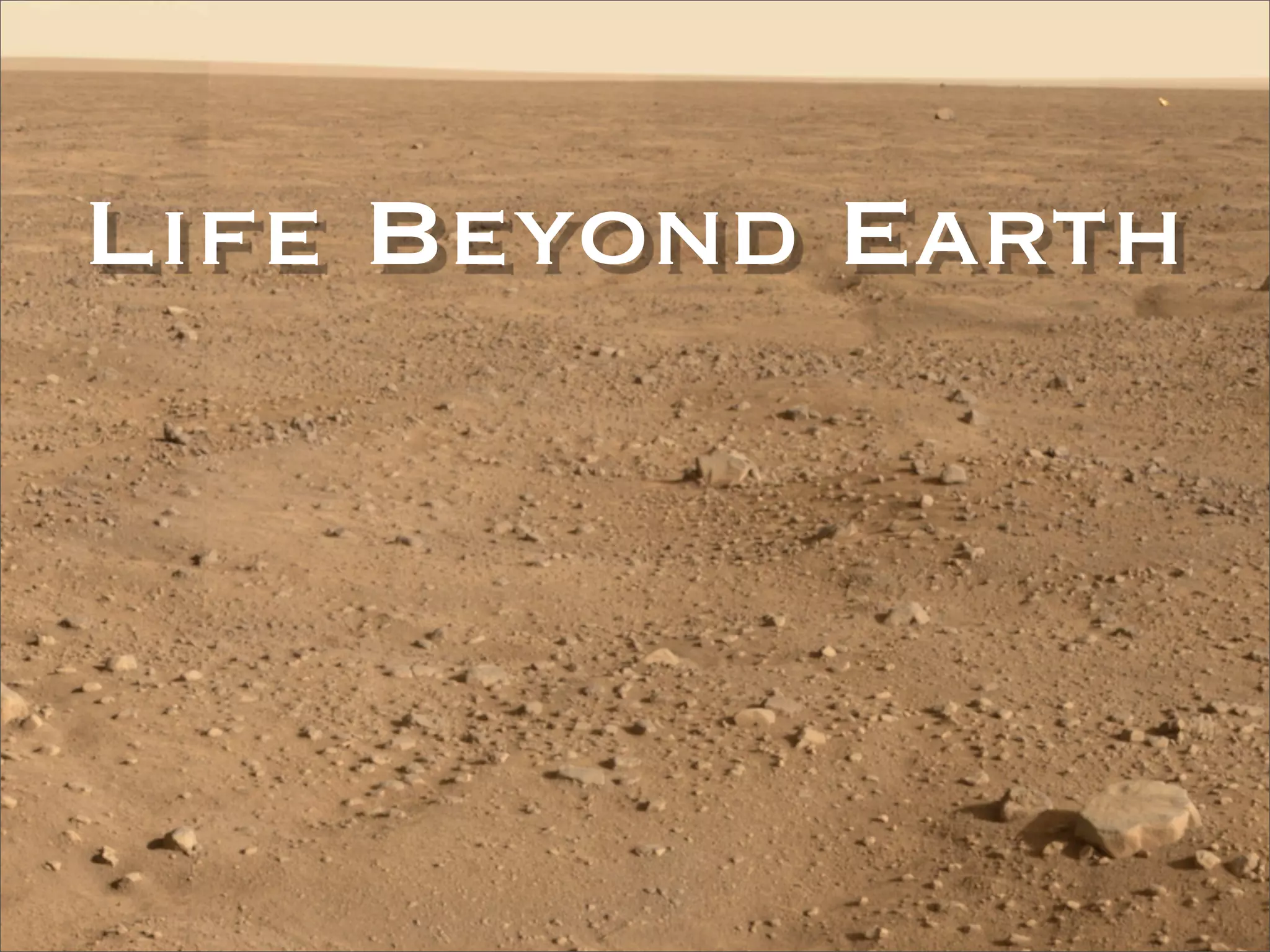
Life Beyond Earth
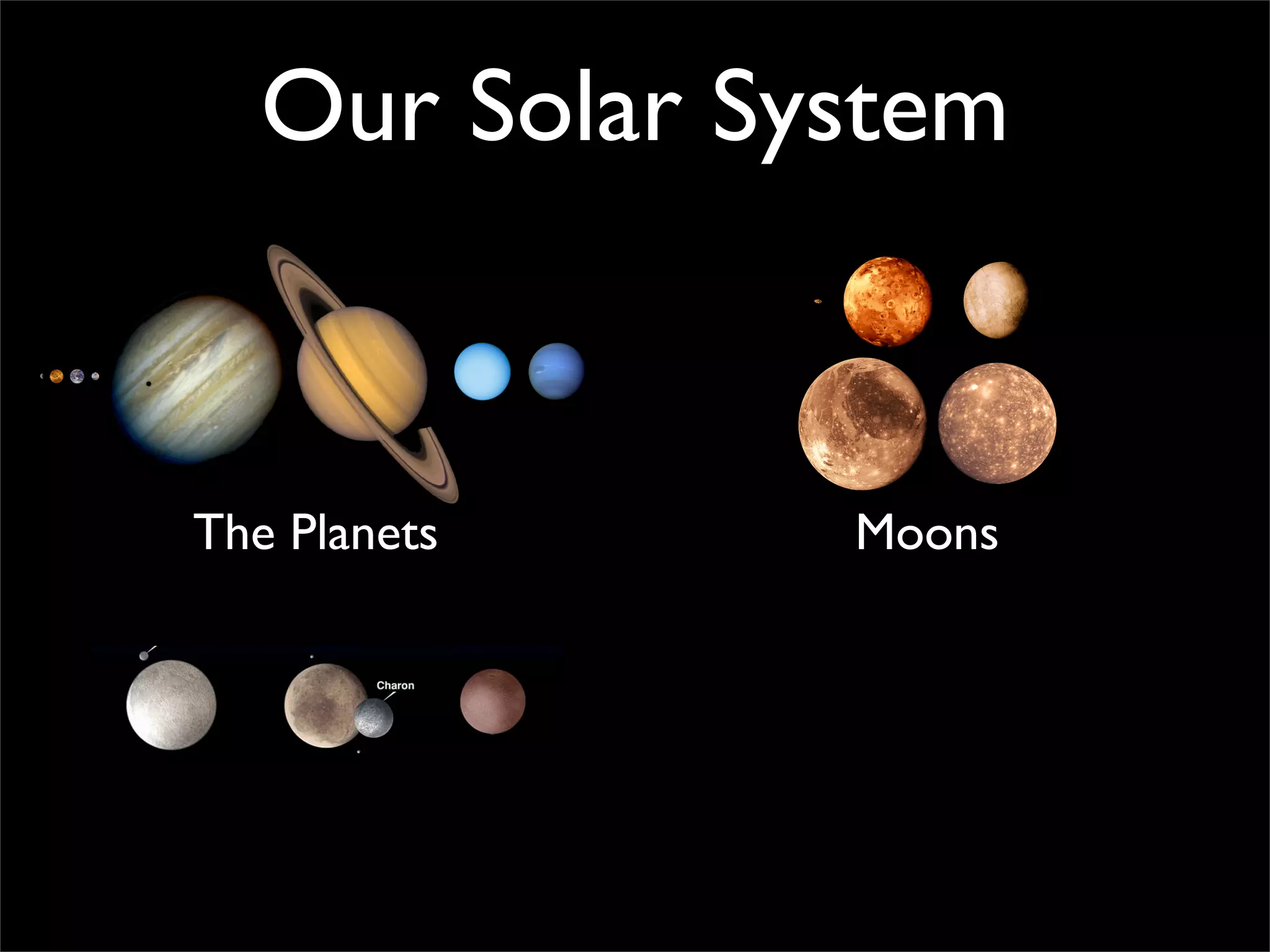
Our Solar System
Our Solar System
Our Solar System


The Planets
Our Solar System


The Planets
Our Solar System


The Planets    Moons
Our Solar System


The Planets    Moons
Our Solar System


 The Planets    Moons


Dwarf Planets
Our Solar System


 The Planets    Moons


Dwarf Planets
Our Solar System


 The Planets    Moons


Dwarf Planets
Our Solar System


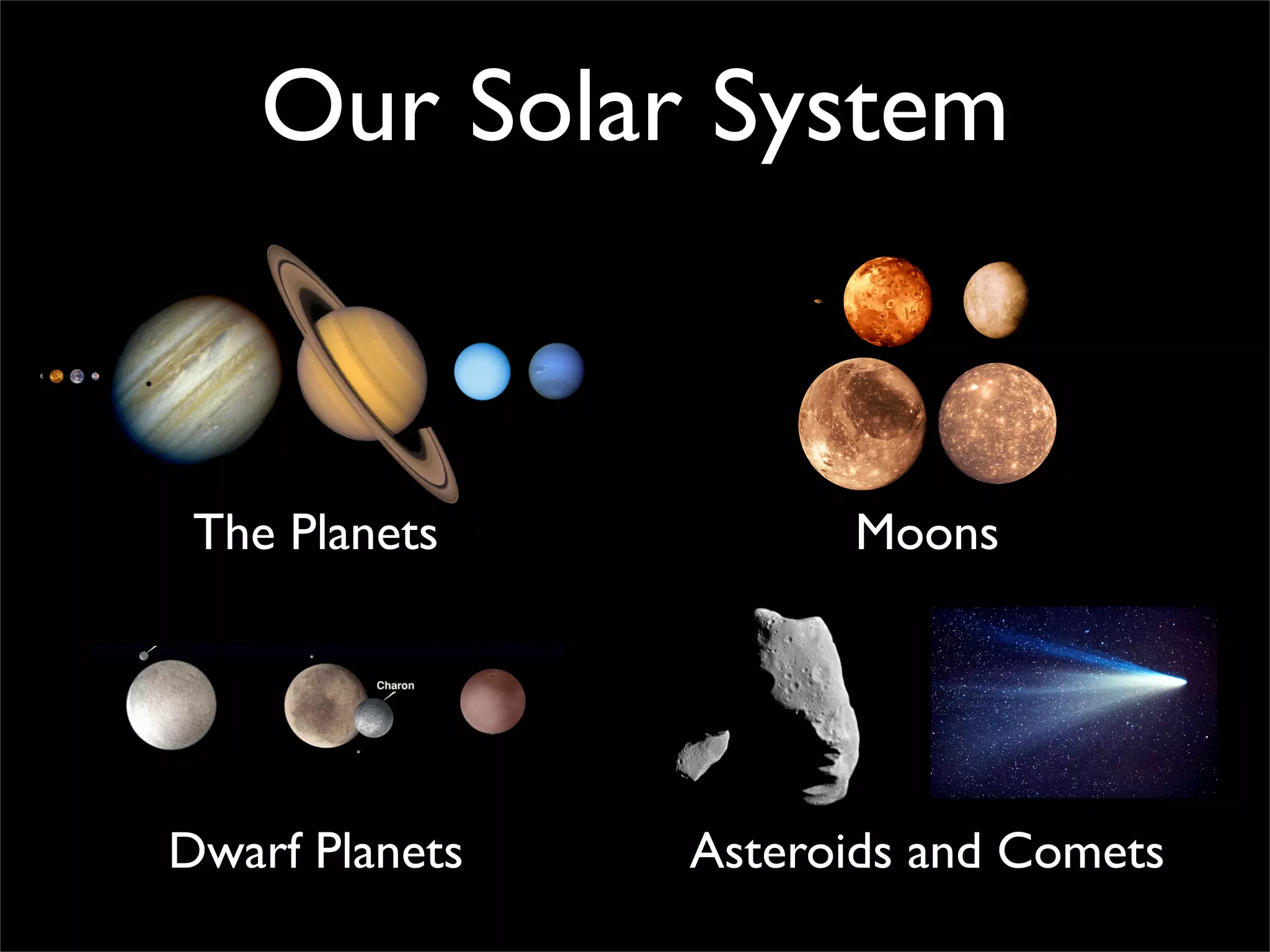
 The Planets          Moons


Dwarf Planets   Asteroids and Comets
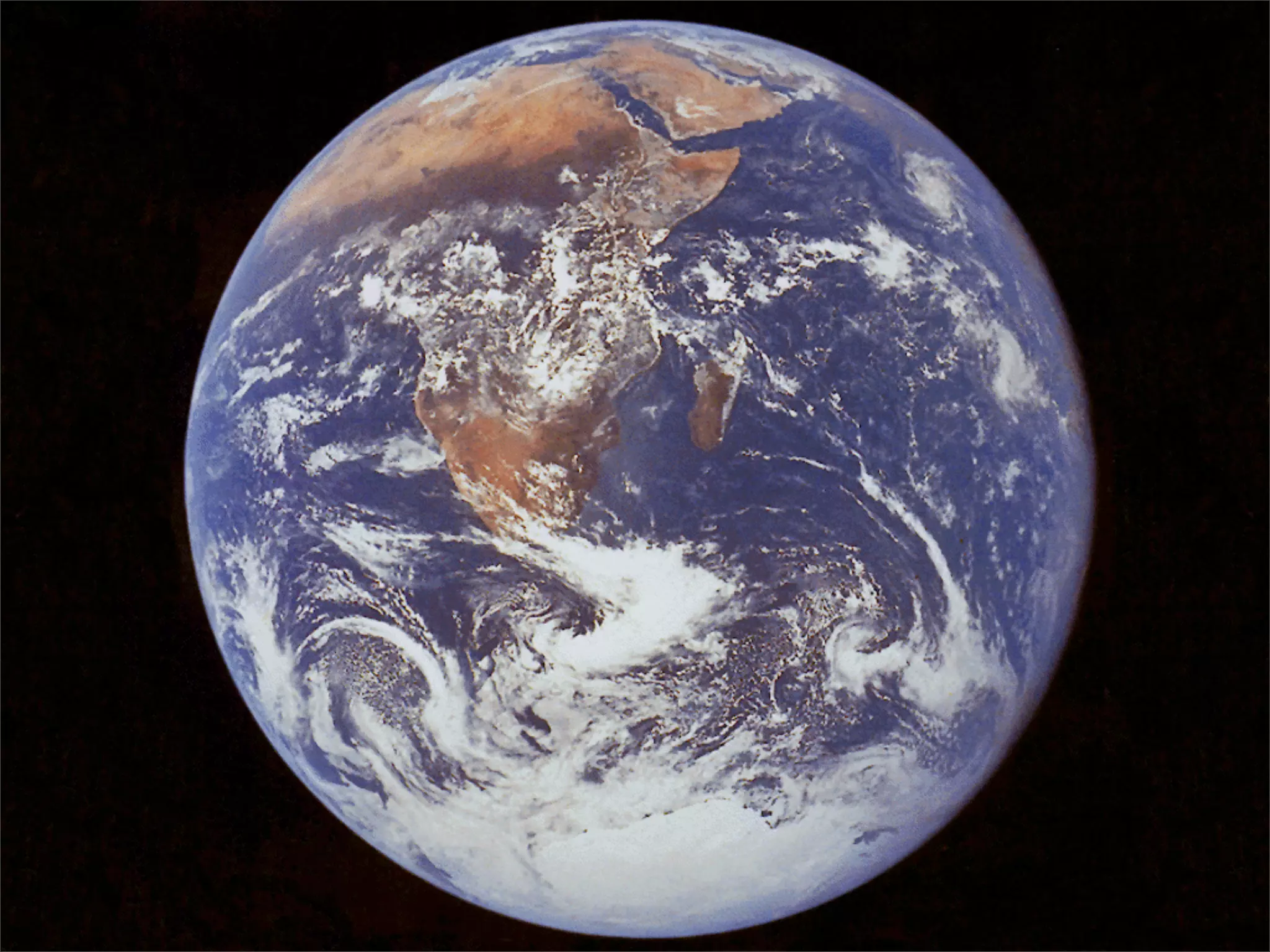
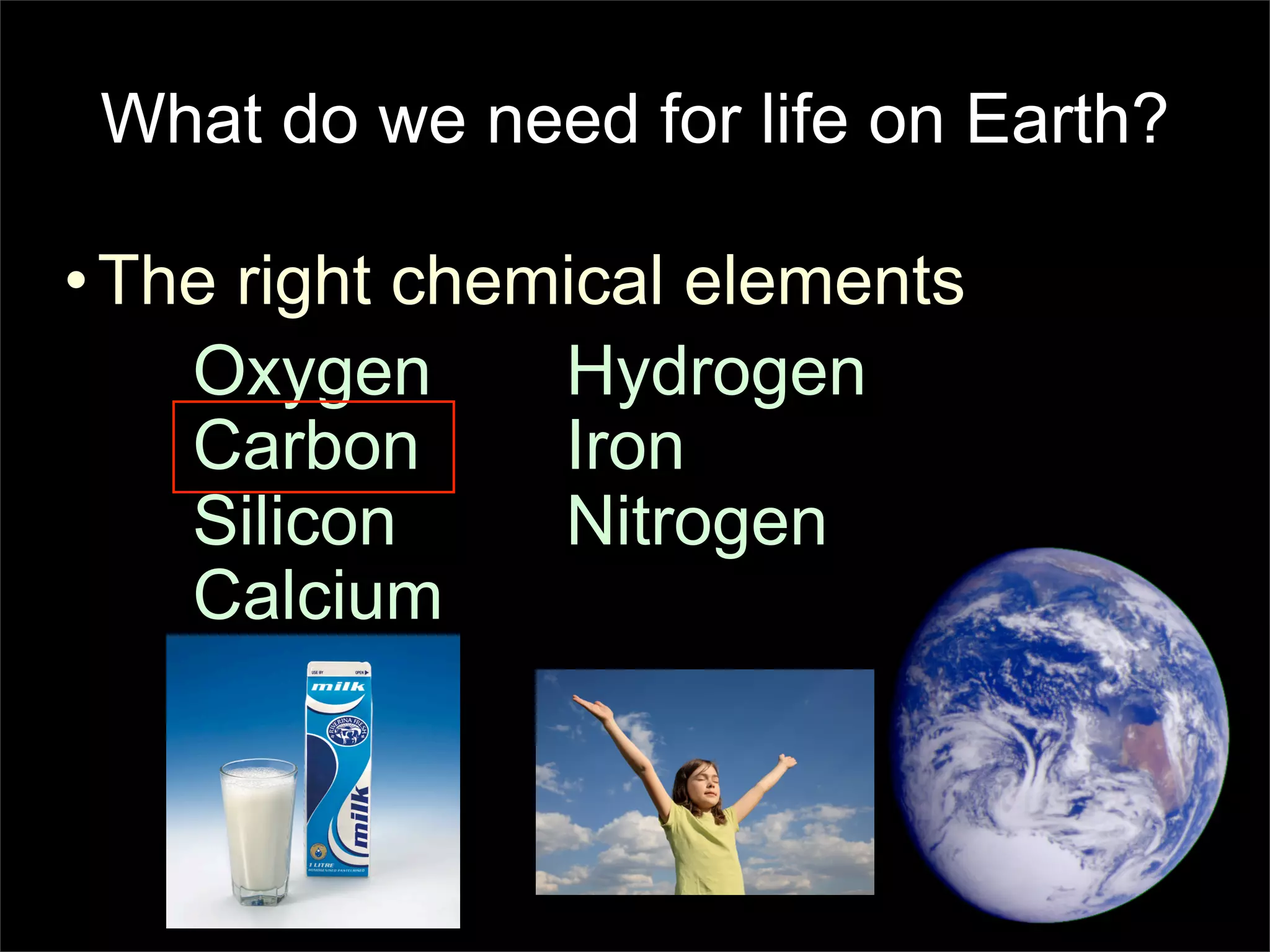
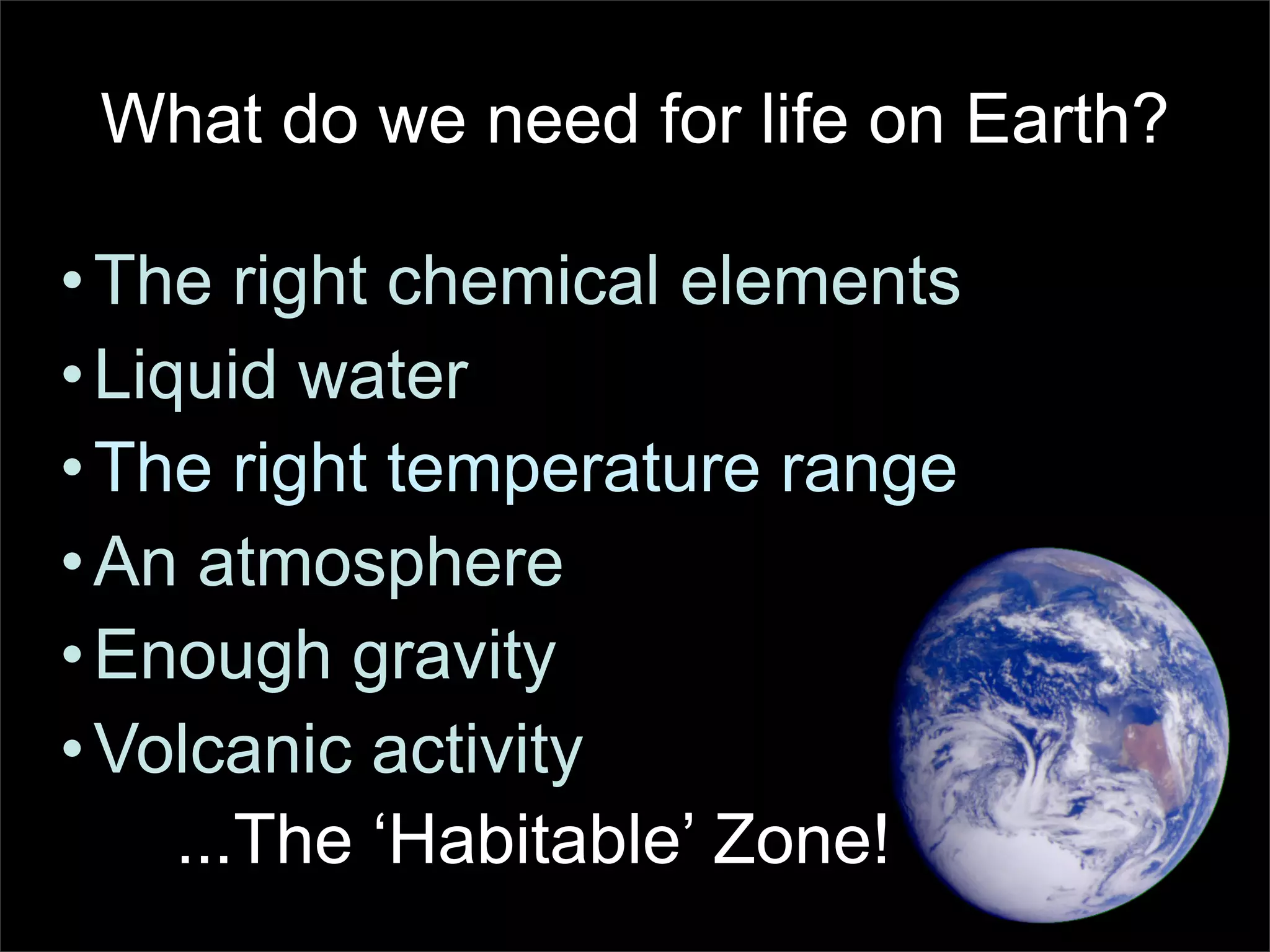
What do we need for life on Earth?

• The right chemical elements
    Oxygen      Hydrogen
    Carbon      Iron
    Silicon     Nitrogen
    Calcium
What do we need for life on Earth?

• The right chemical elements
    Oxygen      Hydrogen
    Carbon      Iron
    Silicon     Nitrogen
    Calcium
What do we need for life on Earth?

• The right chemical elements
• Liquid water
What do we need for life on Earth?

• The right chemical elements
• Liquid water
• The right temperature range
       0 - 100 Celsius
What do we need for life on Earth?

• The right chemical elements
• Liquid water
• The right temperature range
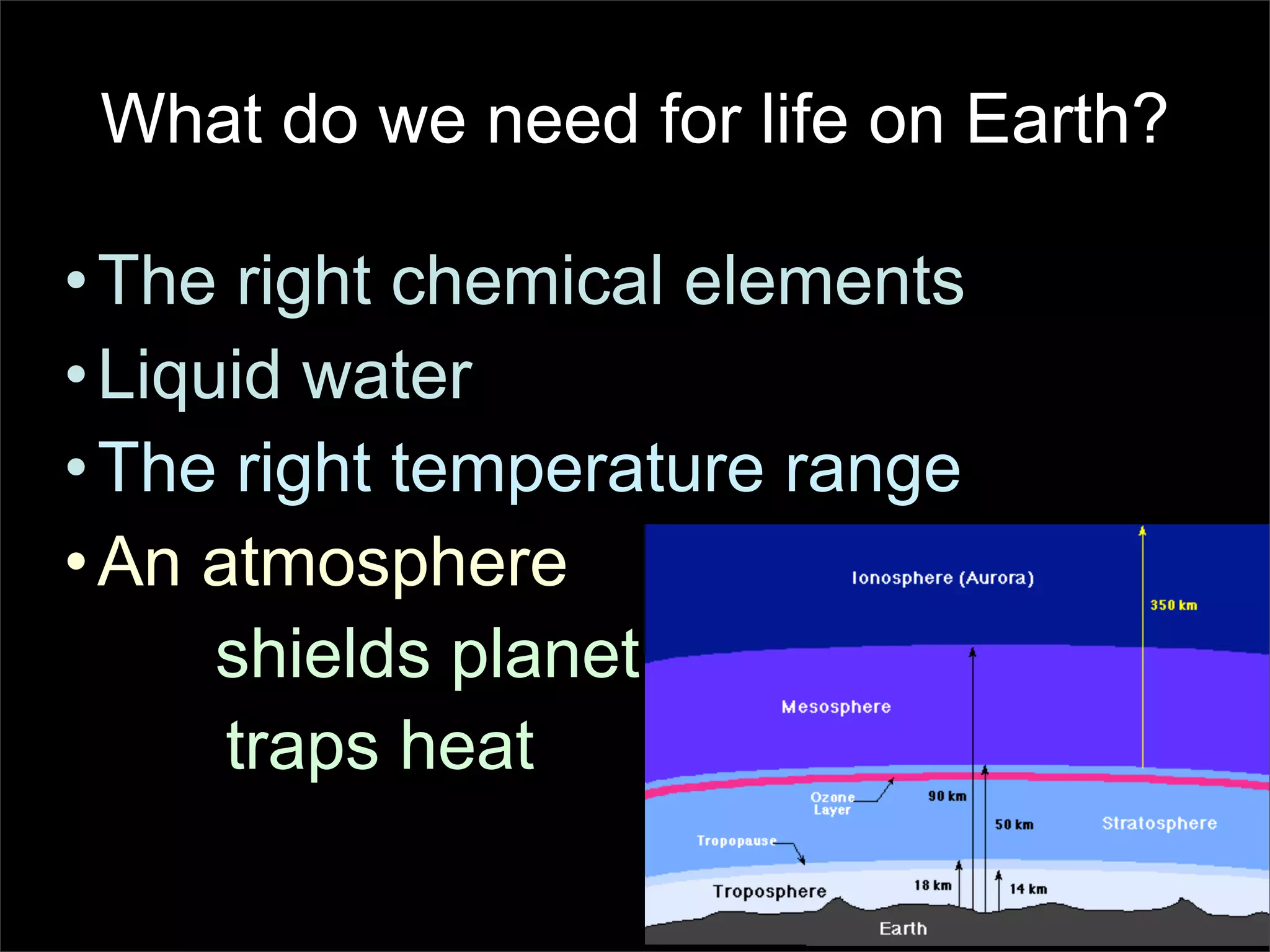
• An atmosphere
      shields planet
      traps heat
What do we need for life on Earth?

• The right chemical elements
• Liquid water
• The right temperature range
• An atmosphere
• Enough gravity
What do we need for life on Earth?

• The right chemical elements
• Liquid water
• The right temperature range
• An atmosphere
• Enough gravity
• Volcanic activity
What do we need for life on Earth?

• The right chemical elements
• Liquid water
• The right temperature range
• An atmosphere
• Enough gravity
• Volcanic activity
     ...The ‘Habitable’ Zone!
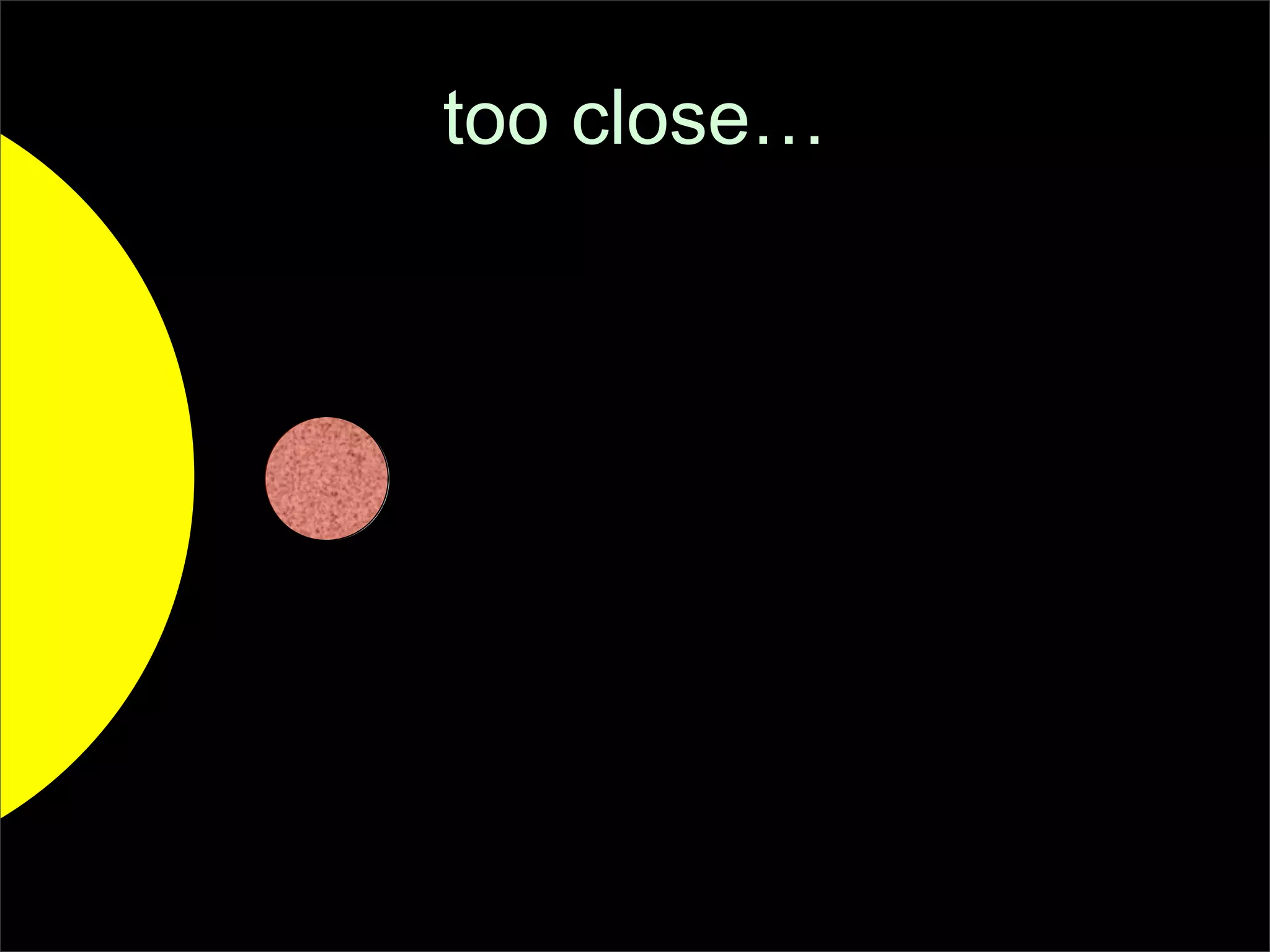
too close…
too far…
just right!
Now that we know what
a planet needs for life...
Now that we know what
a planet needs for life...


            ...what exactly are we
            looking for on other
            planets?
Micro-organisms!
Micro-organisms!
•Dominate terrestrial life
•Existed on Earth for
  over 3.5 billion years
Micro-organisms!
•Dominate terrestrial life
•Existed on Earth for
  over 3.5 billion years
Micro-organisms and extremophiles

Life exists at extremes
  of:
 –acidity / alkalinity
 –salt solution
 –pressure
 –temperature
 –1km below the surface
 –darkness
Antarctica
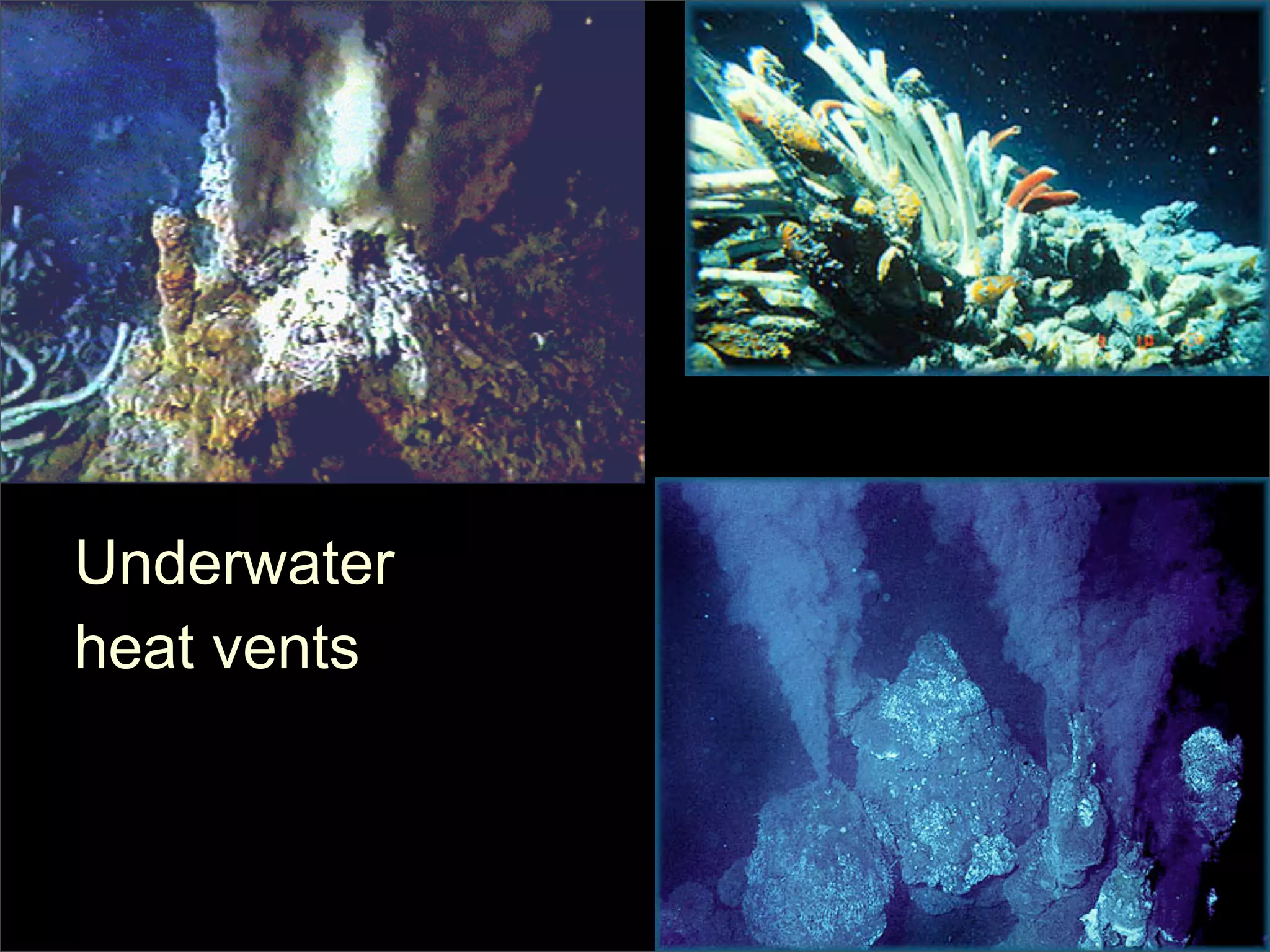
Underwater
heat vents
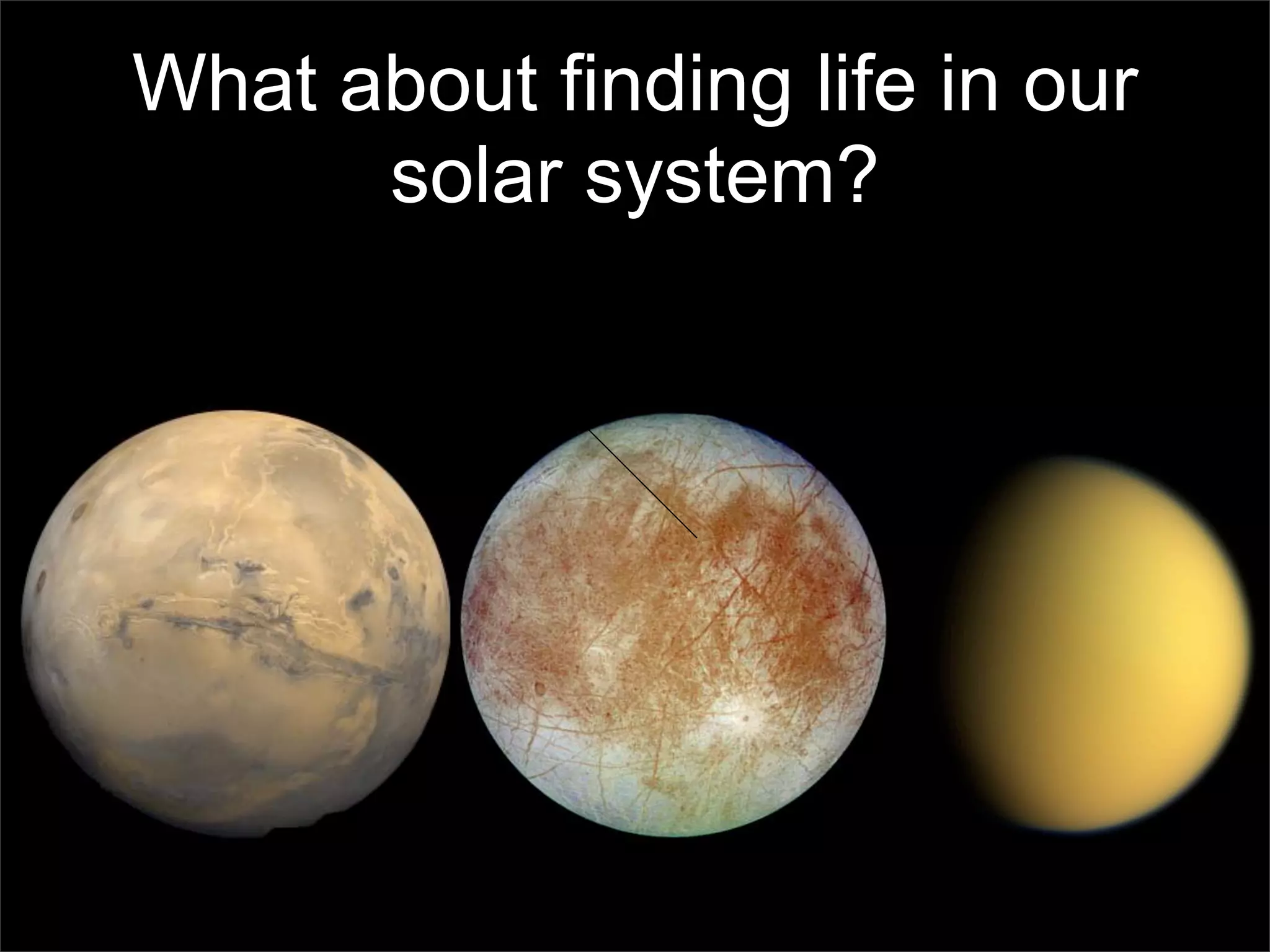
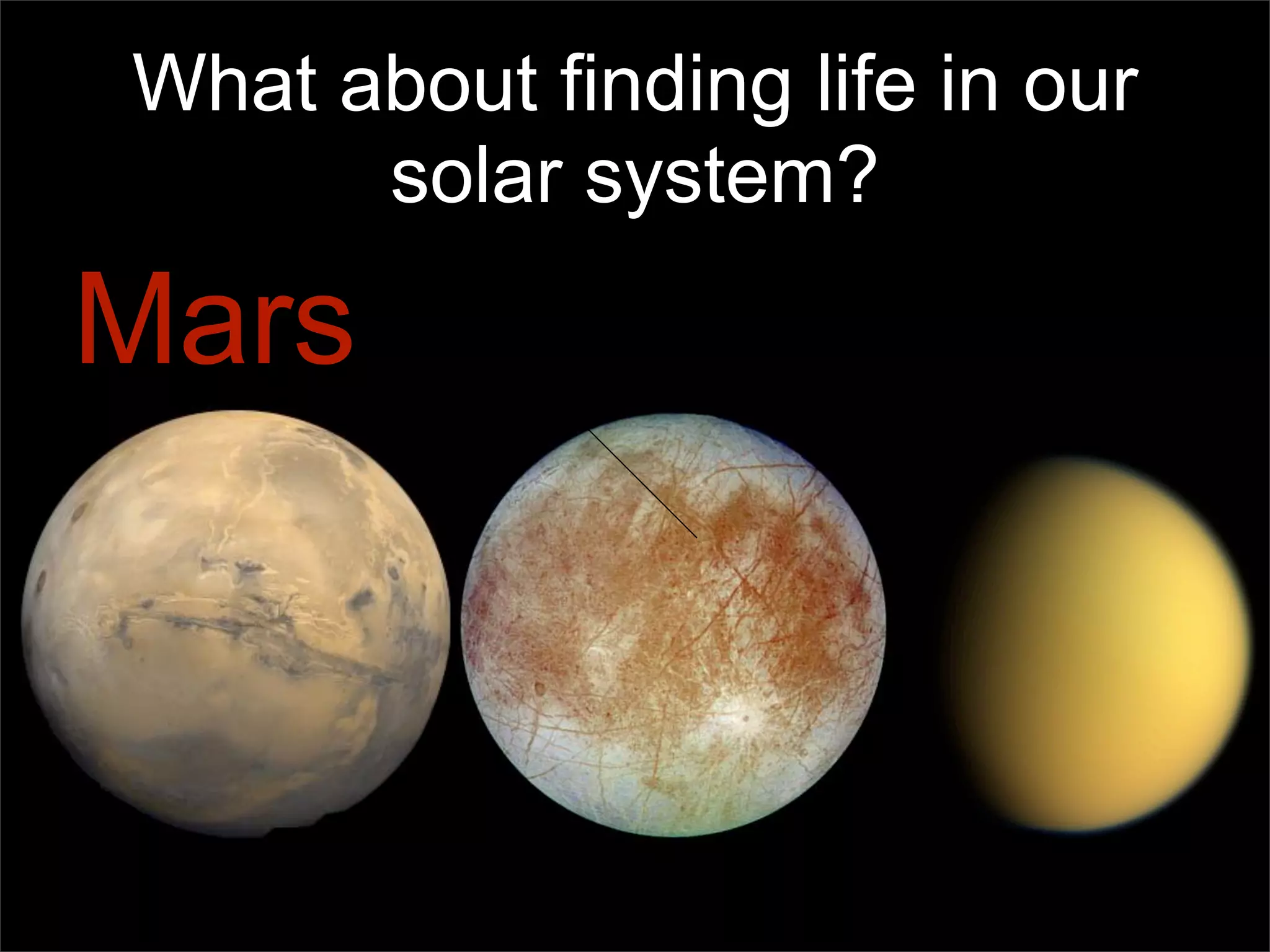
What about finding life in our
      solar system?
What about finding life in our
      solar system?

Mars
What about finding life in our
      solar system?

Mars Europa
What about finding life in our
      solar system?

Mars Europa Titan
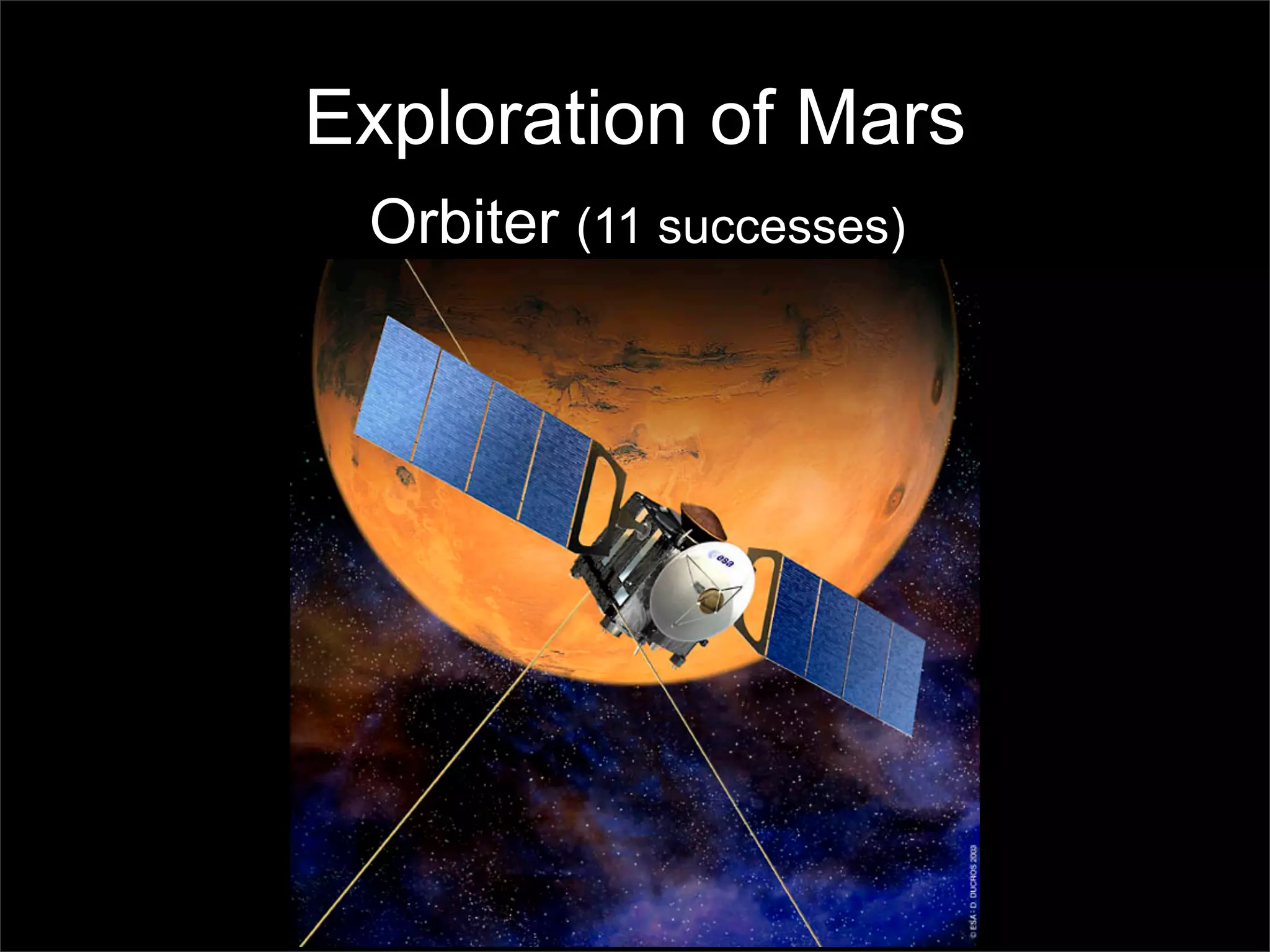
Exploration of Mars
 Flyby (4 successes)
Exploration of Mars
 Orbiter (11 successes)
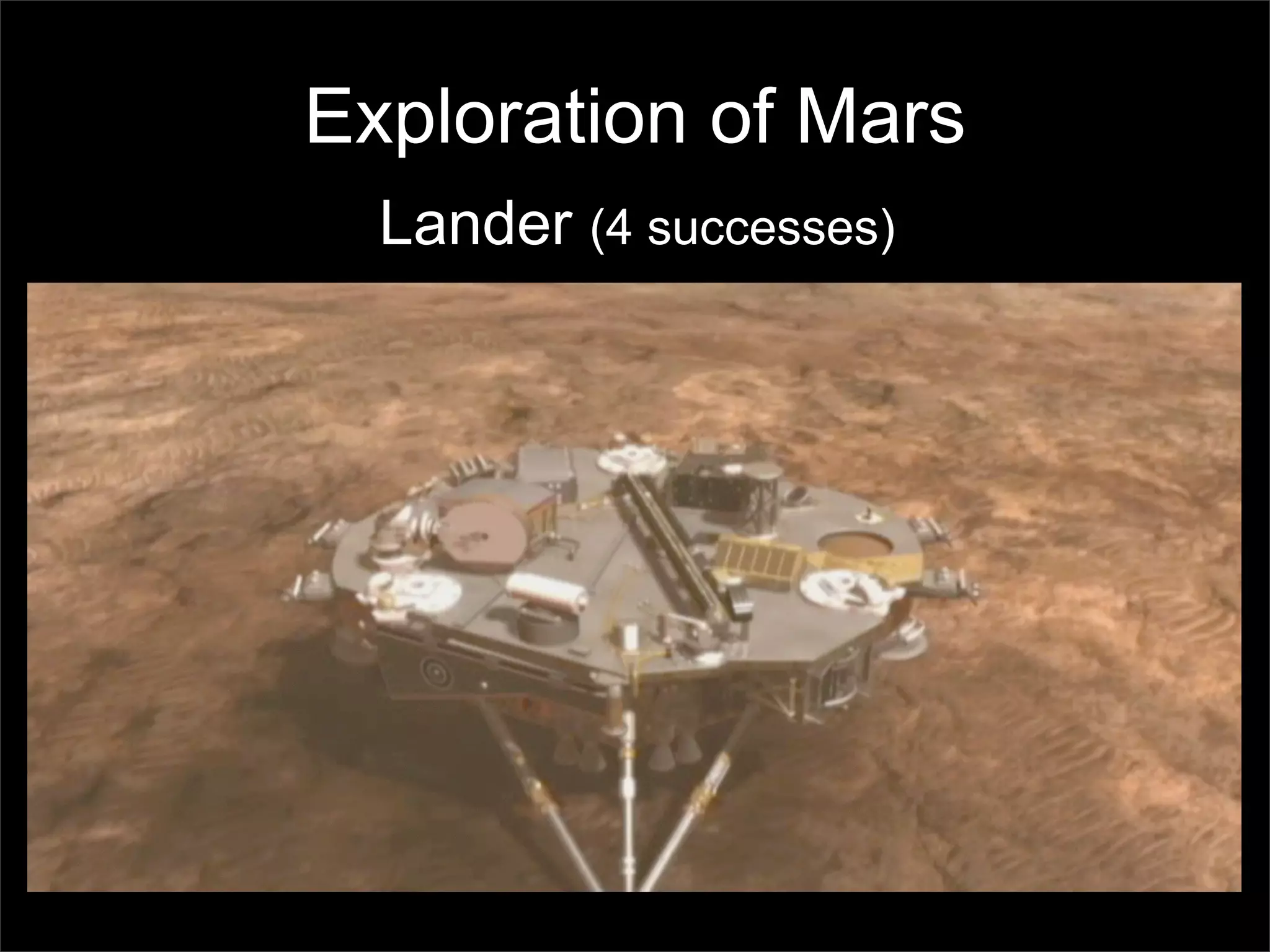
Exploration of Mars
  Lander (4 successes)
Exploration of Mars
  Rover (3 successes)
Exploration of Mars
  Opportunity’s Path
atmosphere
  of CO2
in habitable zone
  T range -127 to 17oC
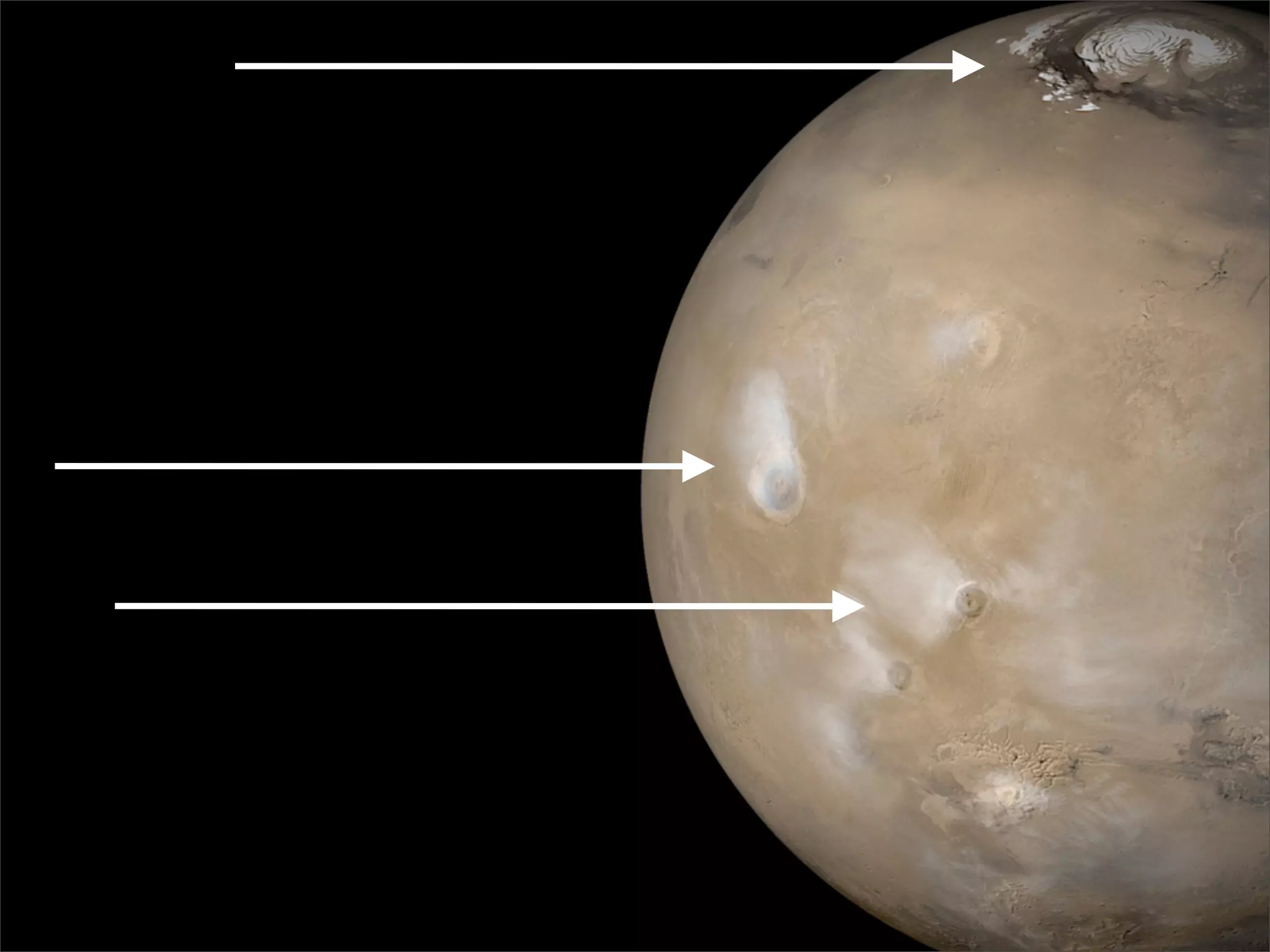
water
  water vapour
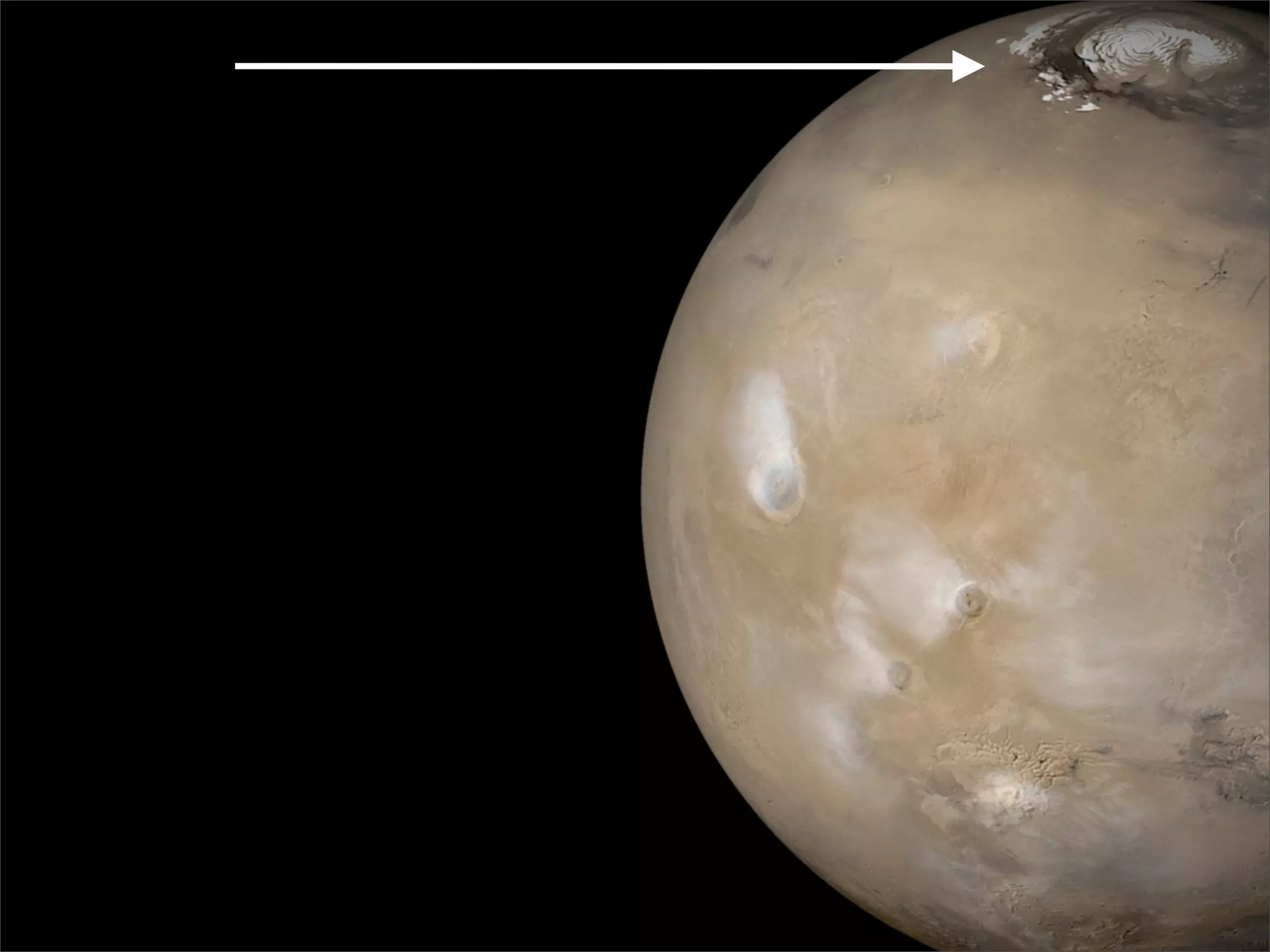
  in ice caps
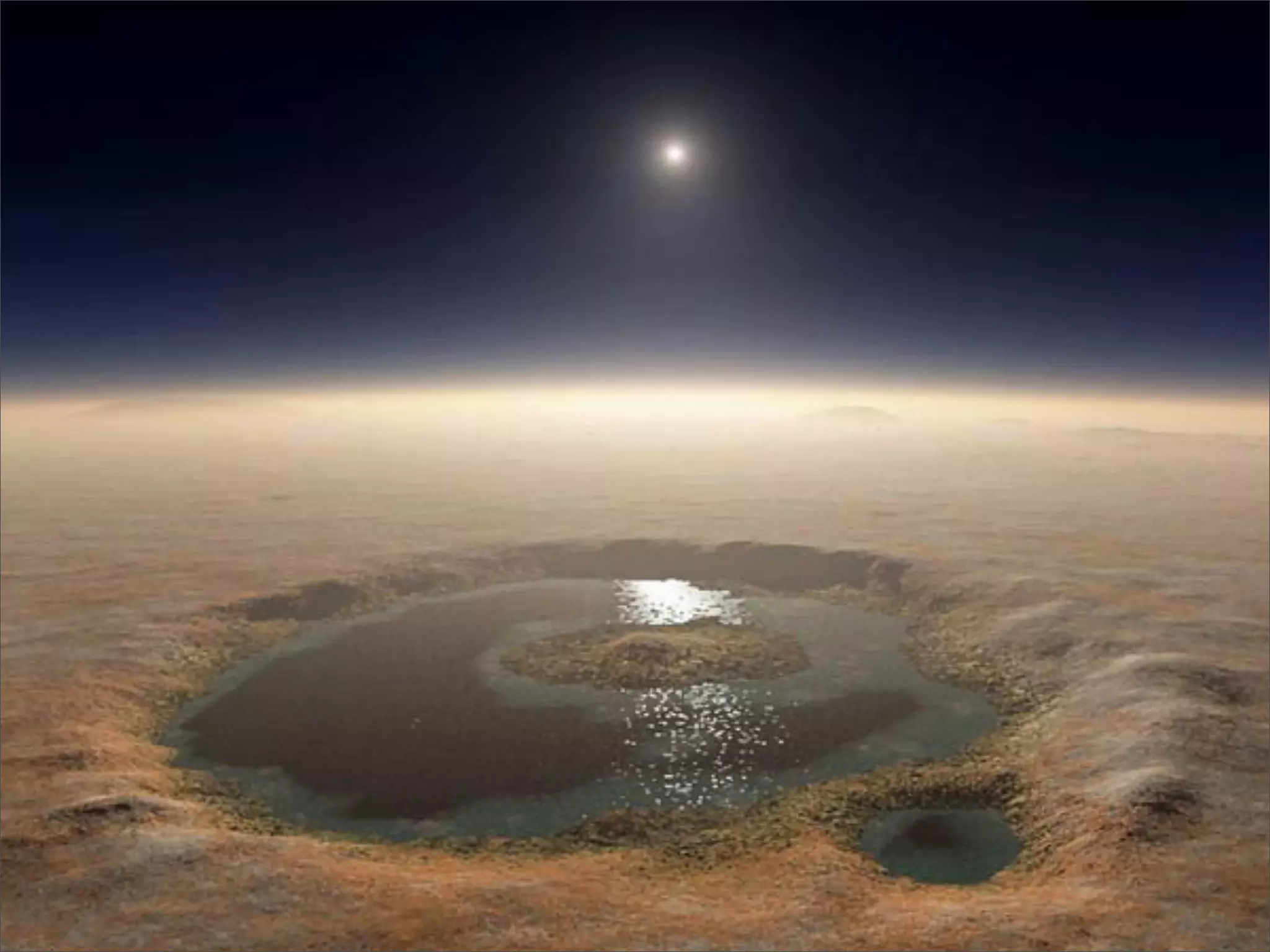
  in craters
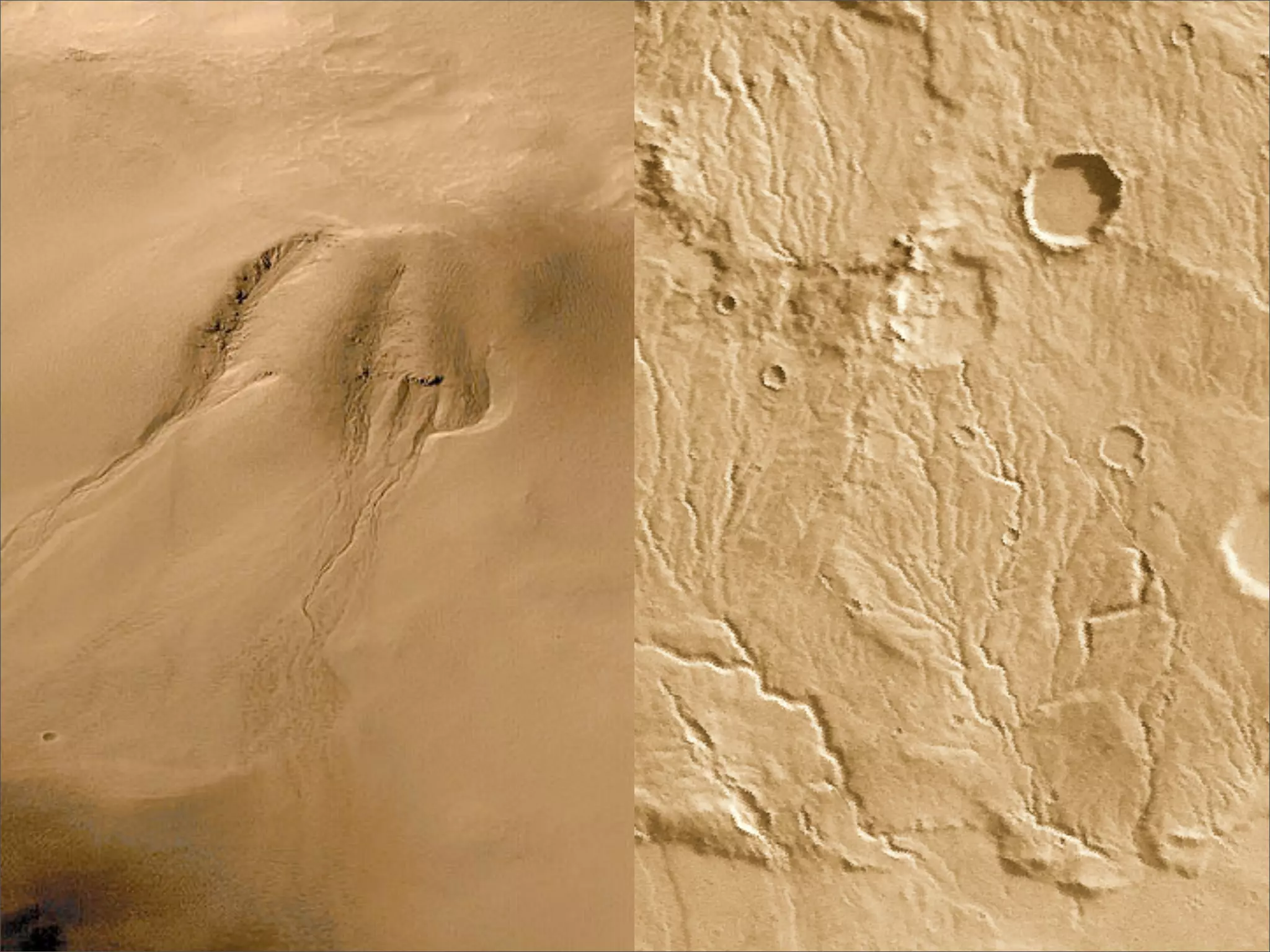
  dry river beds
atmosphere
  of CO2
in habitable zone
  T range -127 to 17oC
water
  water vapour
  in ice caps
  in craters
  dry river beds
Methane on Mars
• Plumes of methane mean something has to
  be generating methane
• Source = subsurface -- geological or
  bacterial?

• http://www.nasa.gov/mission_pages/mars/
  news/marsmethane.html
ESA Exomars (2009)
NASA Mars Science Laboratory (2010+)
Sample return missions (~2014)
Human missions to Mars (~2040)
Europa
Europa
Could
extremophiles
live on Europa?
Drill through ice without contamination = HARD!
NASA Jupiter’s Icy Moons Orbiter 2011+
Titan
Titan
• Thick methane
  atmosphere with lots of
  Nitrogen.
• Only other nitrogen
  domiated atmosphere
  except Earth
• May be pre-biotic
  atmosphere, like early
  Earth.
• Lakes of methane--good
  organic solvent.
Exoplanets
Planets around stars other than our Sun in our galaxy,
                   the Milky Way
Exoplanets
Planets around stars other than our Sun in our galaxy,
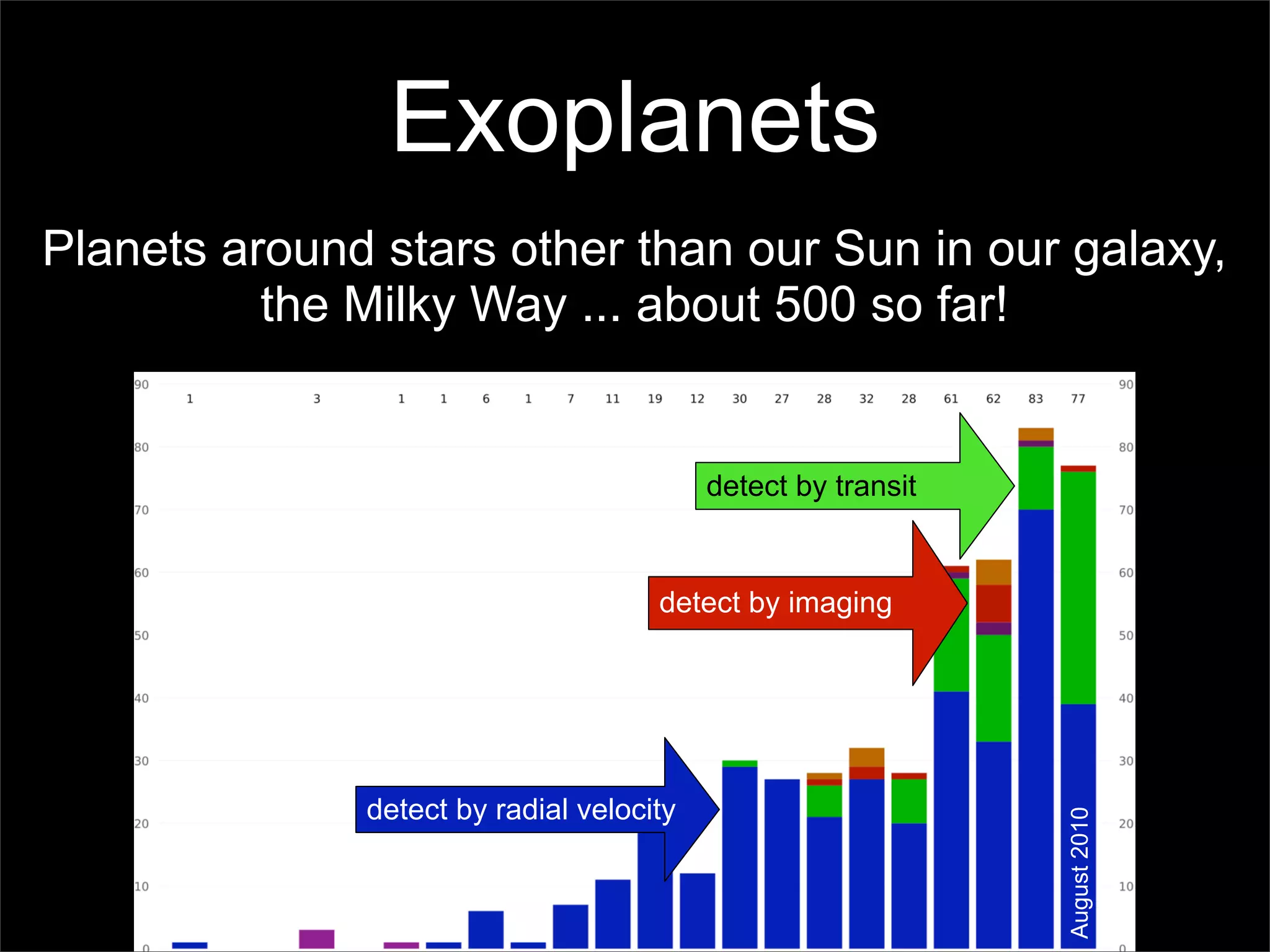
          the Milky Way ... about 500 so far!


                                              August 2010
Exoplanets
Planets around stars other than our Sun in our galaxy,
          the Milky Way ... about 500 so far!


                                          detect by transit


                                     detect by imaging


              detect by radial velocity


                                                              August 2010
Detection Methods:
             radial velocity

• Star moves because of
  planet’s gravity pull
• Measure motion of star
  along our line of sight to
  get period of orbit
Detection Methods:
               transit
• Planet moves in front of star during its orbit
• Light from star is dimmed because planet is
  in front of it
Detection Methods:
           direct imaging
• Take a picture of a planet around a star
• Hard to do because planets are faint and
  stars are bright
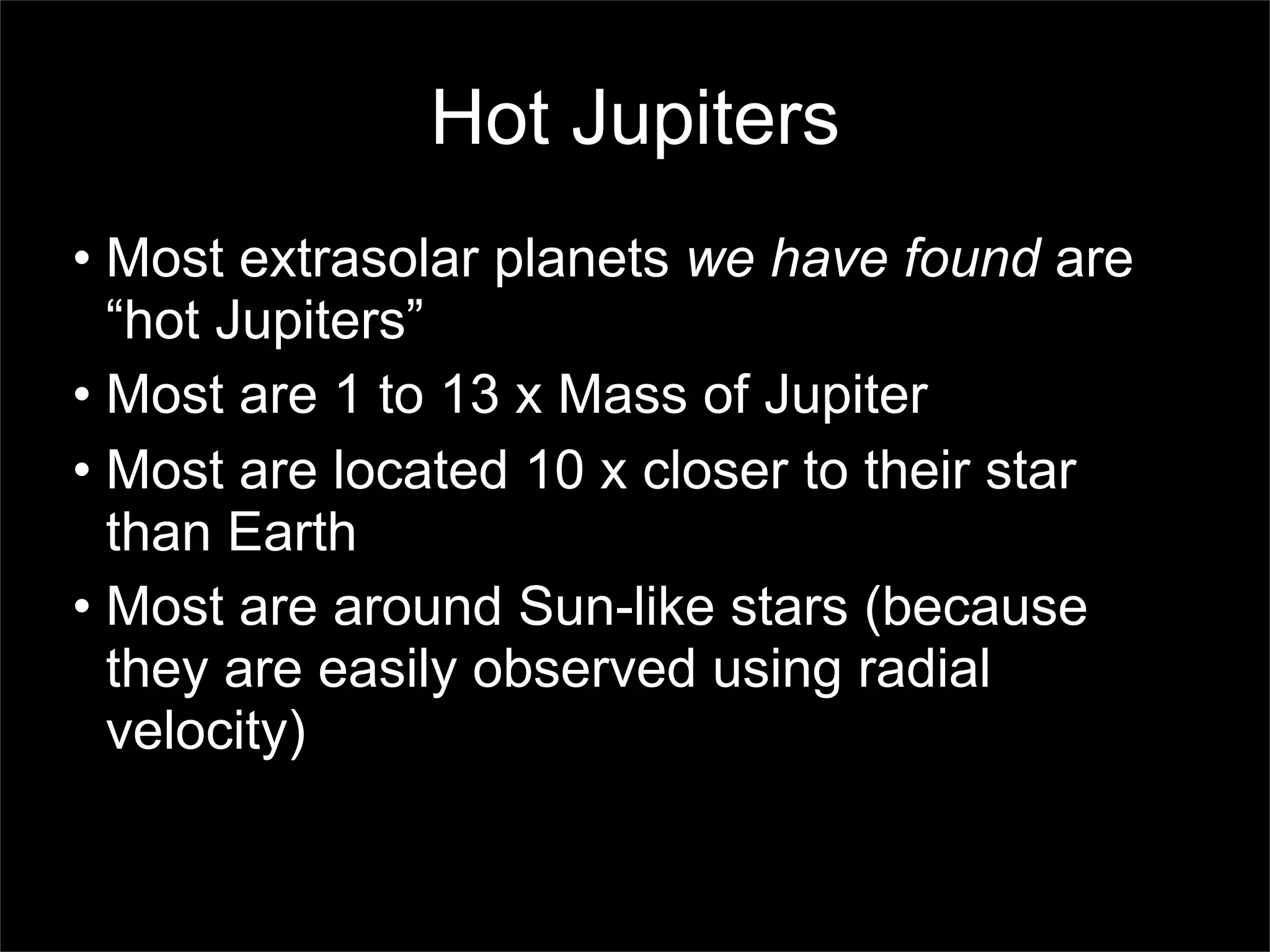
Hot Jupiters
• Most extrasolar planets we have found are
  “hot Jupiters”
• Most are 1 to 13 x Mass of Jupiter
• Most are located 10 x closer to their star
  than Earth
• Most are around Sun-like stars (because
  they are easily observed using radial
  velocity)
Hot Jupiters
• Most extrasolar planets we have found are
  “hot Jupiters”
• Most are 1 to 13 x Mass of Jupiter
• Most are located 10 x closer to their star
  than Earth
Hot Jupiters
• Most extrasolar planets we have found are
  “hot Jupiters”
• Most are 1 to 13 x Mass of Jupiter
• Most are located 10 x closer to their star
  than Earth
• Most are around Sun-like stars (because
  they are easily observed using radial
  velocity)
• Densities are very different
Earth-like Planets
• Kepler Telescope lets us look for Earth-mass
  planets in the habitable zone of other stars
• Also finds “super Earths” which are 1 to 10x
  mass of Earth but are not gas balls
• More common than Jupiter-mass planets but
  VERY new area of research
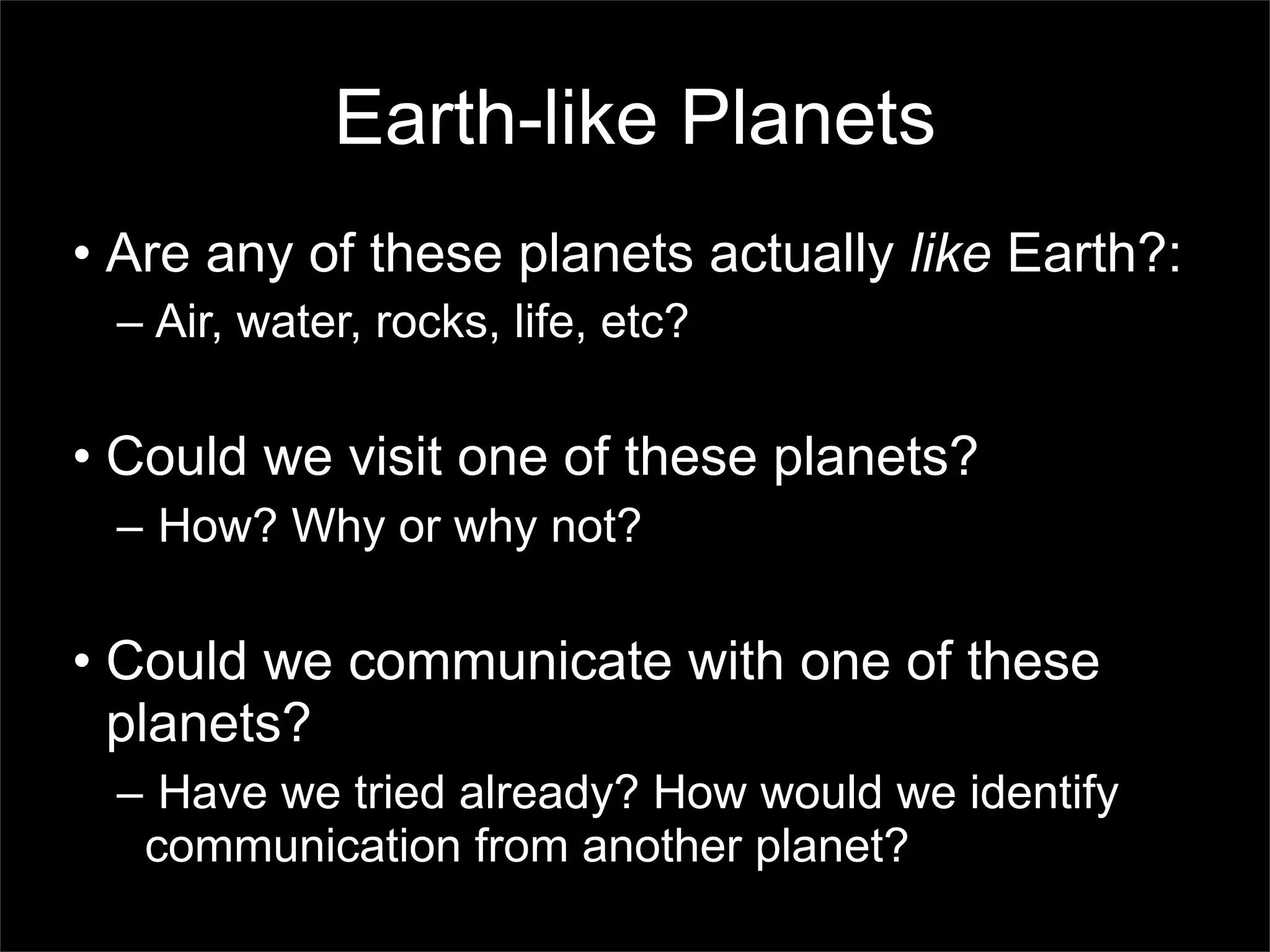
Earth-like Planets
• Are any of these planets actually like Earth?:
 – Air, water, rocks, life, etc?

• Could we visit one of these planets?
 – How? Why or why not?

• Could we communicate with one of these
  planets?
 – Have we tried already? How would we identify
  communication from another planet?
Intelligent Alien Life
–Pioneer probes sent
 out of solar system
–Best chance of
 encountering
 extraterrestrial life
Intelligent Alien Life
 Plaque on Pioneer 10 probe
The End

Life Beyond Earth