IJRET: International Journal of Research in Engineering and Technology eISSN: 2319-1163 | pISSN: 2321-7308
__________________________________________________________________________________________
Volume: 03 Issue: 03 | Mar-2014, Available @ http://www.ijret.org 713
LICENSE PLATE RECOGNITION FOR TOLL PAYMENT APPLICATION
Saranya.K1
, AncyGloria.C2
1
P.G Scholar, Electronics and Communication Engineering, B.S.Abdur Rahman University, Tamilnadu, India
2
Assistant Professor, Electronics and Communication Engineering, B.S.Abdur Rahman University, Tamilnadu, India
Abstract
Automatic License Plate Recognition (ALPR) is the method for the extraction of vehicle license plate information from images. It can
be used on various applications such as Pay-Per -Use roads (Electronic Toll Collection), Parking lots and arterial traffic conditions
monitoring. Automatic License Plate Recognition uses infrared cameras to capture images under varied lighting and weather
conditions. The objective of this paper is to implement K-Means Clustering Algorithm for License plate extraction & Maximally
stable extreme region for license plate segmentation , Template matching method for license plate recognition & also payment in toll
plaza and parking lots automatically by detecting the number plates of vehicles which in turn reduce the traffic and consumption of
time in toll stations.
Keywords: Automatic License Plate Recognition (ALPR), Maximally Stable Extreme Region (MSER), Template matching,
and Character Recognition
---------------------------------------------------------------------***---------------------------------------------------------------------
1. INTRODUCTION
Information technology is widely used in our modern life
caused more demand for intelligent processing. The major
applications of image processing is processing of images and
videos captured for various devices and security system for
transport applications. The information extracted from the
original data has numerous advantages .Extraction of
information can be achieved by a human agent, or by special
out valuable information. There is a need to unite the
transportation system and information systems for the
automated systems. For automated systems, various extraction
and recognition techniques have been improved to support
transport system and one of this is a number plate recognition
system which is used in various traffic and security
applications. The License plate can be recognized from video
by converting the video file to the frame format. The
recognition done by the cost effective manner by using web
camera to capture the images
1.1 Automatic Number Plate Recognition
License Plate Recognition is an image-processing technology
that is used to identify vehicles by their license plates. A
license plate reviewer mechanism works by extracting the
characters from an image. This image processing technology
is used for various applications such as toll plaza, parking lots,
border control, and traffic law enforcement. As a result to the
problem of observing the enormous number of vehicles for
law enforcement and security, this work concentrates to design
a license plate recognition system to make the work more
practical. Our system is designed to detect and identify license
plates without constant human intervention. This will provide
benefit of saving the cost and time to the organization.
The remaining part of this paper is organized as follows:
section II describes the proposed system architecture section
III describes the License Plate Extraction Section IV deals
with the License Plate Segmentation. Section V explains about
the Licence Plate Character Recognition from the image.
Section VI gives the experimental results. Section VII
describes the conclusion part of the proposed system.
2. PROPOSED SYSTEM ARCHITECTURE
2.1 Pre-Processing Steps
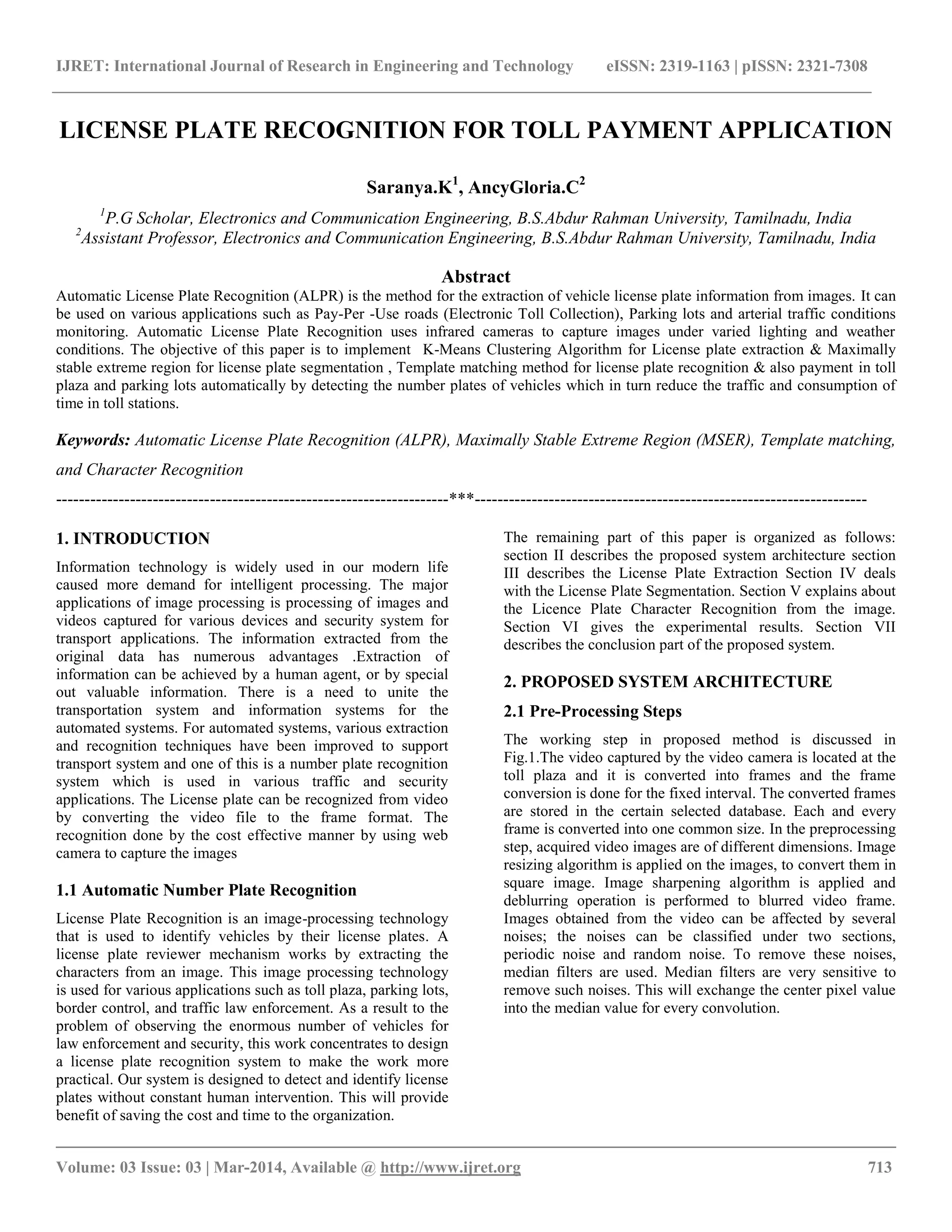
The working step in proposed method is discussed in
Fig.1.The video captured by the video camera is located at the
toll plaza and it is converted into frames and the frame
conversion is done for the fixed interval. The converted frames
are stored in the certain selected database. Each and every
frame is converted into one common size. In the preprocessing
step, acquired video images are of different dimensions. Image
resizing algorithm is applied on the images, to convert them in
square image. Image sharpening algorithm is applied and
deblurring operation is performed to blurred video frame.
Images obtained from the video can be affected by several
noises; the noises can be classified under two sections,
periodic noise and random noise. To remove these noises,
median filters are used. Median filters are very sensitive to
remove such noises. This will exchange the center pixel value
into the median value for every convolution.
IJRET: International Journal of Research in Engineering and Technology eISSN: 2319-1163 | pISSN: 2321-7308
__________________________________________________________________________________________
Volume: 03 Issue: 03 | Mar-2014, Available @ http://www.ijret.org 714
Fig -1: system architecture
3. LICENSE PLATE EXTRACTION
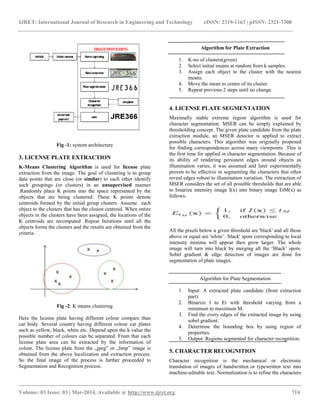
K-Means Clustering Algorithm is used for license plate
extraction from the image. The goal of clustering is to group
data points that are close (or similar) to each other identify
such groupings (or clusters) in an unsupervised manner
.Randomly place K points into the space represented by the
objects that are being clustered. These K points denote
centroids formed by the initial group clusters. Assume each
object to the clusters that has the closest centroid. When entire
objects in the clusters have been assigned, the locations of the
K centroids are recomputed .Repeat Iterations until all the
objects forms the clusters and the results are obtained from the
criteria.
Fig -2: K means clustering
Here the license plate having different colour compare than
car body. Several country having different colour car plates
such as yellow, black, white etc. Depend upon the k value the
possible number of colours can be separated. From that each
license plate area can be extracted by the information of
colour. The license plate from the „jpeg‟ or „bmp‟ image is
obtained from the above localization and extraction process.
So the final image of the process is further proceeded to
Segmentation and Recognition process.
Algorithm for Plate Extraction
1. K-no of clusters(given)
2. Select initial means at random from k samples.
3. Assign each object to the cluster with the nearest
means.
4. Move the mean to centre of its cluster.
5. Repeat previous 2 steps until no change.
4. LICENSE PLATE SEGMENTATION
Maximally stable extreme region algorithm is used for
character segmentation. MSER can be simply explained by
thresholding concept. The given plate candidate from the plate
extraction module, an MSER detector is applied to extract
possible characters. This algorithm was originally proposed
for finding correspondences across many viewpoints .This is
the first time for applied in character segmentation. Because of
its ability of rendering persistent edges around objects as
illumination varies, it was assumed and later experimentally
proven to be effective in segmenting the characters that often
reveal edges robust to illumination variation. The extraction of
MSER considers the set of all possible thresholds that are able
to binarize intensity image I(x) into binary image EtM(x) as
follows:
All the pixels below a given threshold are 'black' and all those
above or equal are 'white‟. 'black' spots corresponding to local
intensity minima will appear then grow larger. The whole
image will turn into black by merging all the „Black‟ spots.
Sobel gradient & edge detection of images are done for
segmentation of plate images.
Algorithm for Plate Segmentation
1. Input: A extracted plate candidate (from extraction
part)
2. Binarize I to Et with threshold varying from a
minimum to maximum M.
3. Find the every edges of the extracted image by using
sobel gradient.
4. Determine the bounding box by using region of
properties.
5. Output: Regions segmented for character recognition.
5. CHARACTER RECOGNITION
Character recognition is the mechanical or electronic
translation of images of handwritten or typewritten text into
machine-editable text. Normalization is to refine the characters
IJRET: International Journal of Research in Engineering and Technology eISSN: 2319-1163 | pISSN: 2321-7308
__________________________________________________________________________________________
Volume: 03 Issue: 03 | Mar-2014, Available @ http://www.ijret.org 715
into a block containing no extra white spaces (pixels) in all the
four sides of the characters. The extracted characters cut from
plate and the characters on database are now equal-sized.
Segmented characters have very much variation in size. In this
phase, all the characters are normalized to predefined height
(vertical length) in pixel. As the characters always have
variable width (horizontal length), each character image is
normalized to a size of 42 X 24, by using “imresize” function.
The extracted characters cut from plate and the characters on
database are now equal-sized and the next step is template
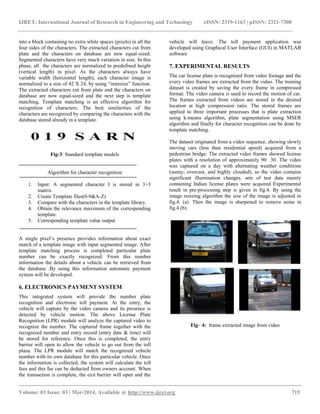
matching. Template matching is an effective algorithm for
recognition of characters. The best similarities of the
characters are recognized by comparing the characters with the
database stored already in a template.
Fig-3: Standard template models
Algorithm for character recognition
1. Input: A segmented character I is stored in 3×3
matrix.
2. Create Template files(0-9&A-Z)
3. Compare with the characters in the template library.
4. Obtain the relevance maximum of the corresponding
template.
5. Corresponding template value output
A single pixel‟s presence provides information about exact
match of a template image with input segmented image. After
template matching process is completed particular plate
number can be exactly recognized. From this number
information the details about a vehicle can be retrieved from
the database .By using this information automatic payment
system will be developed.
6. ELECTRONICS PAYMENT SYSTEM
This integrated system will provide the number plate
recognition and electronic toll payment. At the entry, the
vehicle will capture by the video camera and its presence is
detected by vehicle motion. The above License Plate
Recognition (LPR) module will analyze the captured video to
recognize the number. The captured frame together with the
recognized number and entry record (entry date & time) will
be stored for reference. Once this is completed, the entry
barrier will open to allow the vehicle to go out from the toll
plaza. The LPR module will match the recognized vehicle
number with its own database for this particular vehicle. Once
the information is collected, the system will calculate the toll
fees and this fee can be deducted from owners account. When
the transaction is complete, the exit barrier will open and the
vehicle will leave. The toll payment application was
developed using Graphical User Interface (GUI) in MATLAB
software
7. EXPERIMENTAL RESULTS
The car license plate is recognized from video footage and the
every video frames are extracted from the video. The training
dataset is created by saving the every frame in compressed
format. The video camera is used to record the motion of car.
The frames extracted from videos are stored in the desired
location at high compression ratio. The stored frames are
applied to three important processes that is plate extraction
using k-means algorithm, plate segmentation using MSER
algorithm and finally for character recognition can be done by
template matching.
The dataset originated from a video sequence, showing slowly
moving cars (less than residential speed) acquired from a
pedestrian bridge. The extracted video frames showed license
plates with a resolution of approximately 90 30. The video
was captured on a day with alternating weather conditions
(sunny, overcast, and highly clouded), so the video contains
significant illumination changes. sets of test data mainly
containing Indian license plates were acquired Experimental
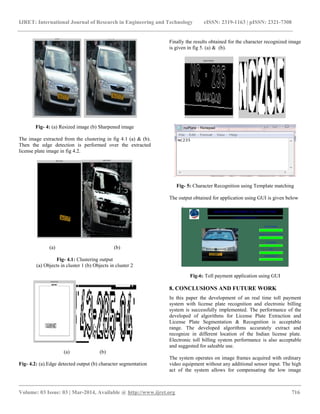
result in pre-processing step is given in fig.4. By using the
image resizing algorithm the size of the image is adjusted in
fig.4. (a). Then the image is sharpened to remove noise in
fig.4.(b).
Fig– 4: frame extracted image from video
IJRET: International Journal of Research in Engineering and Technology eISSN: 2319-1163 | pISSN: 2321-7308
__________________________________________________________________________________________
Volume: 03 Issue: 03 | Mar-2014, Available @ http://www.ijret.org 716
Fig- 4: (a) Resized image (b) Sharpened image
The image extracted from the clustering in fig 4.1 (a) & (b).
Then the edge detection is performed over the extracted
license plate image in fig 4.2.
(a) (b)
Fig- 4.1: Clustering output
(a) Objects in cluster 1 (b) Objects in cluster 2
(a) (b)
Fig- 4.2: (a).Edge detected output (b) character segmentation
Finally the results obtained for the character recognized image
is given in fig 5. (a) & (b).
Fig- 5: Character Recognition using Template matching
The output obtained for application using GUI is given below
Fig-6: Toll payment application using GUI
8. CONCLUSIONS AND FUTURE WORK
In this paper the development of an real time toll payment
system with license plate recognition and electronic billing
system is successfully implemented. The performance of the
developed of algorithms for License Plate Extraction and
License Plate Segmentation & Recognition is acceptable
range. The developed algorithms accurately extract and
recognize in different location of the Indian license plate.
Electronic toll billing system performance is also acceptable
and suggested for saleable use.
The system operates on image frames acquired with ordinary
video equipment without any additional sensor input. The high
act of the system allows for compensating the low image
IJRET: International Journal of Research in Engineering and Technology eISSN: 2319-1163 | pISSN: 2321-7308
__________________________________________________________________________________________
Volume: 03 Issue: 03 | Mar-2014, Available @ http://www.ijret.org 717
resolution by considering the sorting results of subsequent
frames. Due to the complete integration on an embedded
device, the system operates separately, reporting only the final
sorting results to connected operators. Self-evidently, all
advantages and capabilities of dispersed systems apply here as
well.
We are currently functioning on an optimization to the finding
algorithm implementation; our objective is to acclimatize the
algorithm to better fit to the architectural personality of our
platform. In the future we will also have a look at unique
region segmentation methods as the one proposed in and scan
their applicability on our hardware.
REFERENCES
[1]. “Automatic License Plate Recognition[ALPR] : A State-
Of –The- Art Review”, Shan Du; Ibrahim, M ;Shehata,M. ;
Badawv,W. Circuits and Video Technology in IEEE
Transaction on Vol:23,Issue:2. 2013 ,pp.311-325.
[2]. H. Bai and C. Liu, “A hybrid license plate extraction
method based on edge statistics and morphology,” in Proc. Int.
Conf. Pattern Recognit.,vol. 2. 2004, pp. 831–834.
[3]. K. Miyamoto, K. Nagano, M. Tamagawa, I. Fujita, and M.
Yamamoto,“Vehicle license-plate recognition by image
analysis,” in Proc. Int.Conf. Ind. Electron. Control Instrum.,
vol. 3. 1991, pp. 1734–1738.
[4]. E. R. Lee, P. K. Kim, and H. J. Kim, “Automatic
recognition of a car license plate using color image
processing,” in Proc. IEEE Int. Conf.Image Process., vol. 2.
Nov. 1994, pp. 301–305.
[5]. S. Draghici, “A neural network based artificial vision
system for license plate recognition,” Int. J. Neural Syst., vol.
8, no. 1, pp. 113–126, 1997.
[6]. Chitode. J. S, Rupali Kate( 2012), Number Plate
Recognition Using Segmentation, International Journal of
Engineering Research & Technology (IJERT) ,Vol. 1 Issue 9,
ISSN: 2278-0181.
[7]. Parsi.R, Di Claudio E. D, Lucarelli . G, Orlandi. G(1998)
195-198., Car plate recognition by neural networks and image
processing, IEEE International Symposium on Cirucits and
Systems.
[8]. Gang Li, Ruili Zeng, Ling Lin (2006), Research on
vehicle license plate location in First International Conference
on Innovative Computing, Information and Control, Vol
4,pp.345-353.
[9]. Serkan Ozbay, Ergun Ercelebi ( 2005), Automatic Vehicle
Identification by Plate Recognition, ,proceedings of world
academy of science, engineering and technology volume 9 ,
issue 1307-6884.
[10]. Shapiro. V, Gluchehev. G (2004), Multinational license
plate recognition system: segmentation and classification, in:
ICPR, vol. 4, pp.352-355.
[11]. Shi. X, Zhao. W, Shen. Y(2005), Automatic license plate
recognition system based on color image processing, in: O.
Gervasi et al. (Eds.), Lecture Notes on Computer Science,
vol.3483, Springer, New York, pp.1159-1168.
[12]. XU Hong-ke, YU Fu-hua, JIAO Jia-hua, SONG Huan-
sheng(2004), A New Approach of the Vehicle License Plate
location

License plate recognition for toll payment application

  • 1.
    IJRET: International Journalof Research in Engineering and Technology eISSN: 2319-1163 | pISSN: 2321-7308 __________________________________________________________________________________________ Volume: 03 Issue: 03 | Mar-2014, Available @ http://www.ijret.org 713 LICENSE PLATE RECOGNITION FOR TOLL PAYMENT APPLICATION Saranya.K1 , AncyGloria.C2 1 P.G Scholar, Electronics and Communication Engineering, B.S.Abdur Rahman University, Tamilnadu, India 2 Assistant Professor, Electronics and Communication Engineering, B.S.Abdur Rahman University, Tamilnadu, India Abstract Automatic License Plate Recognition (ALPR) is the method for the extraction of vehicle license plate information from images. It can be used on various applications such as Pay-Per -Use roads (Electronic Toll Collection), Parking lots and arterial traffic conditions monitoring. Automatic License Plate Recognition uses infrared cameras to capture images under varied lighting and weather conditions. The objective of this paper is to implement K-Means Clustering Algorithm for License plate extraction & Maximally stable extreme region for license plate segmentation , Template matching method for license plate recognition & also payment in toll plaza and parking lots automatically by detecting the number plates of vehicles which in turn reduce the traffic and consumption of time in toll stations. Keywords: Automatic License Plate Recognition (ALPR), Maximally Stable Extreme Region (MSER), Template matching, and Character Recognition ---------------------------------------------------------------------***--------------------------------------------------------------------- 1. INTRODUCTION Information technology is widely used in our modern life caused more demand for intelligent processing. The major applications of image processing is processing of images and videos captured for various devices and security system for transport applications. The information extracted from the original data has numerous advantages .Extraction of information can be achieved by a human agent, or by special out valuable information. There is a need to unite the transportation system and information systems for the automated systems. For automated systems, various extraction and recognition techniques have been improved to support transport system and one of this is a number plate recognition system which is used in various traffic and security applications. The License plate can be recognized from video by converting the video file to the frame format. The recognition done by the cost effective manner by using web camera to capture the images 1.1 Automatic Number Plate Recognition License Plate Recognition is an image-processing technology that is used to identify vehicles by their license plates. A license plate reviewer mechanism works by extracting the characters from an image. This image processing technology is used for various applications such as toll plaza, parking lots, border control, and traffic law enforcement. As a result to the problem of observing the enormous number of vehicles for law enforcement and security, this work concentrates to design a license plate recognition system to make the work more practical. Our system is designed to detect and identify license plates without constant human intervention. This will provide benefit of saving the cost and time to the organization. The remaining part of this paper is organized as follows: section II describes the proposed system architecture section III describes the License Plate Extraction Section IV deals with the License Plate Segmentation. Section V explains about the Licence Plate Character Recognition from the image. Section VI gives the experimental results. Section VII describes the conclusion part of the proposed system. 2. PROPOSED SYSTEM ARCHITECTURE 2.1 Pre-Processing Steps The working step in proposed method is discussed in Fig.1.The video captured by the video camera is located at the toll plaza and it is converted into frames and the frame conversion is done for the fixed interval. The converted frames are stored in the certain selected database. Each and every frame is converted into one common size. In the preprocessing step, acquired video images are of different dimensions. Image resizing algorithm is applied on the images, to convert them in square image. Image sharpening algorithm is applied and deblurring operation is performed to blurred video frame. Images obtained from the video can be affected by several noises; the noises can be classified under two sections, periodic noise and random noise. To remove these noises, median filters are used. Median filters are very sensitive to remove such noises. This will exchange the center pixel value into the median value for every convolution.
  • 2.
    IJRET: International Journalof Research in Engineering and Technology eISSN: 2319-1163 | pISSN: 2321-7308 __________________________________________________________________________________________ Volume: 03 Issue: 03 | Mar-2014, Available @ http://www.ijret.org 714 Fig -1: system architecture 3. LICENSE PLATE EXTRACTION K-Means Clustering Algorithm is used for license plate extraction from the image. The goal of clustering is to group data points that are close (or similar) to each other identify such groupings (or clusters) in an unsupervised manner .Randomly place K points into the space represented by the objects that are being clustered. These K points denote centroids formed by the initial group clusters. Assume each object to the clusters that has the closest centroid. When entire objects in the clusters have been assigned, the locations of the K centroids are recomputed .Repeat Iterations until all the objects forms the clusters and the results are obtained from the criteria. Fig -2: K means clustering Here the license plate having different colour compare than car body. Several country having different colour car plates such as yellow, black, white etc. Depend upon the k value the possible number of colours can be separated. From that each license plate area can be extracted by the information of colour. The license plate from the „jpeg‟ or „bmp‟ image is obtained from the above localization and extraction process. So the final image of the process is further proceeded to Segmentation and Recognition process. Algorithm for Plate Extraction 1. K-no of clusters(given) 2. Select initial means at random from k samples. 3. Assign each object to the cluster with the nearest means. 4. Move the mean to centre of its cluster. 5. Repeat previous 2 steps until no change. 4. LICENSE PLATE SEGMENTATION Maximally stable extreme region algorithm is used for character segmentation. MSER can be simply explained by thresholding concept. The given plate candidate from the plate extraction module, an MSER detector is applied to extract possible characters. This algorithm was originally proposed for finding correspondences across many viewpoints .This is the first time for applied in character segmentation. Because of its ability of rendering persistent edges around objects as illumination varies, it was assumed and later experimentally proven to be effective in segmenting the characters that often reveal edges robust to illumination variation. The extraction of MSER considers the set of all possible thresholds that are able to binarize intensity image I(x) into binary image EtM(x) as follows: All the pixels below a given threshold are 'black' and all those above or equal are 'white‟. 'black' spots corresponding to local intensity minima will appear then grow larger. The whole image will turn into black by merging all the „Black‟ spots. Sobel gradient & edge detection of images are done for segmentation of plate images. Algorithm for Plate Segmentation 1. Input: A extracted plate candidate (from extraction part) 2. Binarize I to Et with threshold varying from a minimum to maximum M. 3. Find the every edges of the extracted image by using sobel gradient. 4. Determine the bounding box by using region of properties. 5. Output: Regions segmented for character recognition. 5. CHARACTER RECOGNITION Character recognition is the mechanical or electronic translation of images of handwritten or typewritten text into machine-editable text. Normalization is to refine the characters
  • 3.
    IJRET: International Journalof Research in Engineering and Technology eISSN: 2319-1163 | pISSN: 2321-7308 __________________________________________________________________________________________ Volume: 03 Issue: 03 | Mar-2014, Available @ http://www.ijret.org 715 into a block containing no extra white spaces (pixels) in all the four sides of the characters. The extracted characters cut from plate and the characters on database are now equal-sized. Segmented characters have very much variation in size. In this phase, all the characters are normalized to predefined height (vertical length) in pixel. As the characters always have variable width (horizontal length), each character image is normalized to a size of 42 X 24, by using “imresize” function. The extracted characters cut from plate and the characters on database are now equal-sized and the next step is template matching. Template matching is an effective algorithm for recognition of characters. The best similarities of the characters are recognized by comparing the characters with the database stored already in a template. Fig-3: Standard template models Algorithm for character recognition 1. Input: A segmented character I is stored in 3×3 matrix. 2. Create Template files(0-9&A-Z) 3. Compare with the characters in the template library. 4. Obtain the relevance maximum of the corresponding template. 5. Corresponding template value output A single pixel‟s presence provides information about exact match of a template image with input segmented image. After template matching process is completed particular plate number can be exactly recognized. From this number information the details about a vehicle can be retrieved from the database .By using this information automatic payment system will be developed. 6. ELECTRONICS PAYMENT SYSTEM This integrated system will provide the number plate recognition and electronic toll payment. At the entry, the vehicle will capture by the video camera and its presence is detected by vehicle motion. The above License Plate Recognition (LPR) module will analyze the captured video to recognize the number. The captured frame together with the recognized number and entry record (entry date & time) will be stored for reference. Once this is completed, the entry barrier will open to allow the vehicle to go out from the toll plaza. The LPR module will match the recognized vehicle number with its own database for this particular vehicle. Once the information is collected, the system will calculate the toll fees and this fee can be deducted from owners account. When the transaction is complete, the exit barrier will open and the vehicle will leave. The toll payment application was developed using Graphical User Interface (GUI) in MATLAB software 7. EXPERIMENTAL RESULTS The car license plate is recognized from video footage and the every video frames are extracted from the video. The training dataset is created by saving the every frame in compressed format. The video camera is used to record the motion of car. The frames extracted from videos are stored in the desired location at high compression ratio. The stored frames are applied to three important processes that is plate extraction using k-means algorithm, plate segmentation using MSER algorithm and finally for character recognition can be done by template matching. The dataset originated from a video sequence, showing slowly moving cars (less than residential speed) acquired from a pedestrian bridge. The extracted video frames showed license plates with a resolution of approximately 90 30. The video was captured on a day with alternating weather conditions (sunny, overcast, and highly clouded), so the video contains significant illumination changes. sets of test data mainly containing Indian license plates were acquired Experimental result in pre-processing step is given in fig.4. By using the image resizing algorithm the size of the image is adjusted in fig.4. (a). Then the image is sharpened to remove noise in fig.4.(b). Fig– 4: frame extracted image from video
  • 4.
    IJRET: International Journalof Research in Engineering and Technology eISSN: 2319-1163 | pISSN: 2321-7308 __________________________________________________________________________________________ Volume: 03 Issue: 03 | Mar-2014, Available @ http://www.ijret.org 716 Fig- 4: (a) Resized image (b) Sharpened image The image extracted from the clustering in fig 4.1 (a) & (b). Then the edge detection is performed over the extracted license plate image in fig 4.2. (a) (b) Fig- 4.1: Clustering output (a) Objects in cluster 1 (b) Objects in cluster 2 (a) (b) Fig- 4.2: (a).Edge detected output (b) character segmentation Finally the results obtained for the character recognized image is given in fig 5. (a) & (b). Fig- 5: Character Recognition using Template matching The output obtained for application using GUI is given below Fig-6: Toll payment application using GUI 8. CONCLUSIONS AND FUTURE WORK In this paper the development of an real time toll payment system with license plate recognition and electronic billing system is successfully implemented. The performance of the developed of algorithms for License Plate Extraction and License Plate Segmentation & Recognition is acceptable range. The developed algorithms accurately extract and recognize in different location of the Indian license plate. Electronic toll billing system performance is also acceptable and suggested for saleable use. The system operates on image frames acquired with ordinary video equipment without any additional sensor input. The high act of the system allows for compensating the low image
  • 5.
    IJRET: International Journalof Research in Engineering and Technology eISSN: 2319-1163 | pISSN: 2321-7308 __________________________________________________________________________________________ Volume: 03 Issue: 03 | Mar-2014, Available @ http://www.ijret.org 717 resolution by considering the sorting results of subsequent frames. Due to the complete integration on an embedded device, the system operates separately, reporting only the final sorting results to connected operators. Self-evidently, all advantages and capabilities of dispersed systems apply here as well. We are currently functioning on an optimization to the finding algorithm implementation; our objective is to acclimatize the algorithm to better fit to the architectural personality of our platform. In the future we will also have a look at unique region segmentation methods as the one proposed in and scan their applicability on our hardware. REFERENCES [1]. “Automatic License Plate Recognition[ALPR] : A State- Of –The- Art Review”, Shan Du; Ibrahim, M ;Shehata,M. ; Badawv,W. Circuits and Video Technology in IEEE Transaction on Vol:23,Issue:2. 2013 ,pp.311-325. [2]. H. Bai and C. Liu, “A hybrid license plate extraction method based on edge statistics and morphology,” in Proc. Int. Conf. Pattern Recognit.,vol. 2. 2004, pp. 831–834. [3]. K. Miyamoto, K. Nagano, M. Tamagawa, I. Fujita, and M. Yamamoto,“Vehicle license-plate recognition by image analysis,” in Proc. Int.Conf. Ind. Electron. Control Instrum., vol. 3. 1991, pp. 1734–1738. [4]. E. R. Lee, P. K. Kim, and H. J. Kim, “Automatic recognition of a car license plate using color image processing,” in Proc. IEEE Int. Conf.Image Process., vol. 2. Nov. 1994, pp. 301–305. [5]. S. Draghici, “A neural network based artificial vision system for license plate recognition,” Int. J. Neural Syst., vol. 8, no. 1, pp. 113–126, 1997. [6]. Chitode. J. S, Rupali Kate( 2012), Number Plate Recognition Using Segmentation, International Journal of Engineering Research & Technology (IJERT) ,Vol. 1 Issue 9, ISSN: 2278-0181. [7]. Parsi.R, Di Claudio E. D, Lucarelli . G, Orlandi. G(1998) 195-198., Car plate recognition by neural networks and image processing, IEEE International Symposium on Cirucits and Systems. [8]. Gang Li, Ruili Zeng, Ling Lin (2006), Research on vehicle license plate location in First International Conference on Innovative Computing, Information and Control, Vol 4,pp.345-353. [9]. Serkan Ozbay, Ergun Ercelebi ( 2005), Automatic Vehicle Identification by Plate Recognition, ,proceedings of world academy of science, engineering and technology volume 9 , issue 1307-6884. [10]. Shapiro. V, Gluchehev. G (2004), Multinational license plate recognition system: segmentation and classification, in: ICPR, vol. 4, pp.352-355. [11]. Shi. X, Zhao. W, Shen. Y(2005), Automatic license plate recognition system based on color image processing, in: O. Gervasi et al. (Eds.), Lecture Notes on Computer Science, vol.3483, Springer, New York, pp.1159-1168. [12]. XU Hong-ke, YU Fu-hua, JIAO Jia-hua, SONG Huan- sheng(2004), A New Approach of the Vehicle License Plate location