Kill the STRESS, before it kills you.. .
.
Reach your GOAL, before it kicks you…
Live the life, before it leaves you…
Get READY, we will help you.
Developed By
Patel Smit
Acknowledgement
“LIBRARY MANAGEMENT SYSTEM.”
Introduction
 Brain Power Institute that provides teaching class for Students.
 The Institute is an invaluable source for students, researchers and facility of EDUCATION

industry.
 The Institute is established in the 20th March 1992.







Teaching
Research
Consulting
Training
Learning requirement
Activities of the Organization
 The main source for STUDENTS , STAFF and FACULTIES.
 Huge collection of text books, reference books, and etc.
 The library provides peaceful atmosphere.
 Library gives facility.
 Library also provides source of past years’ projects, exam and research papers etc.
 In short, the library is the large source of the knowledge .
Existing System
 To check availability of the book.
 Manual system.
 The librarian has to perform each task automatically.
Existing System
 Time Manipulation.
 Also updating is tedious work.
 Issuing and receiving of the books is also complex.
 penalty is very complex.
Need for a New
System
 As we have seen in earlier topic, the existing system following drawbacks which create

the need for the system.
1) Time-consuming.
2) Searching challenging task.
3) Maintenance tedious work.
4) To calculate penalty for late-coming.
5) Generating reports is complex.
6) Maintaining register is complex.
Project
Profile
Our Aim
 
 Students can easily take and issue books.
 Students delight by delivering on-time

and fast service.
 Maintain for generating various reports.
Objectives Of The Project
Basic Objectives






More Accuracy
Speed improvement
Data inconsistency
Better error handling
Integrity

Other Objectives





 

The System will handle the maintenance of data .
It handle entire transaction of book registration till issue of the book.
Administrator will immediately acknowledged with error message.
The Administrator details of Books, Authors and existing Member etc.
Book wise search can be performed.
Core Components
 
HARDWARE REQUIREMENTS
 





Processer 
Ram 
Memory 
VDU 






Pentium Iv Or Higher
128 Mb Or Higher
50 Mb Free Space
14” Color Monitor

 
SOFTWARE REQUIREMENTS
 
 Language 
 Client Operating  
System 
 Server Operating  
System 

 Visual .net
 Windows 98/Xp
 Windows Server
Requirement
Specification
 Type of software they needed.
They needed the software that built in latest software tool and easy to operate.

 Features they needed in the software.
They needed features like reports, easy information fetching about the students,
publishers, staff, books and many other information.

 Computerized Report Generation.
Easy maintenance and retrieval of data.

 Future Requirement.
Centralized and secure database.

 They can afford for computerized system.
They can afford the computerized system as per our application requirement.
Requirement
Specification
Other Features Specified.
 They want to work as fast as possible as the existing system...
 Improve data inconsistency and integrity for the system.
 More accuracy speed and better error handling feature.
 Member arises search can be performed in the library system...
 Member can check the available details of books, project reports and Journals.
 The system will handle the maintenance of books and member details
Advantages
 This project can be used for any company, for infinite number of products, and for infinite

number of categories as it is totally generic.

 The data of the member would be entered in the database.
 There would be a safe storage of information of the member in the database.
 Quick, easy, flexible generation of the member reports.
 There would be a dynamic and fully computerized system would be developed.
 With the database any data can be added, modified, deleted very quickly.
 Security features are very much provided in the system.
 User friendly environment.
System Flow
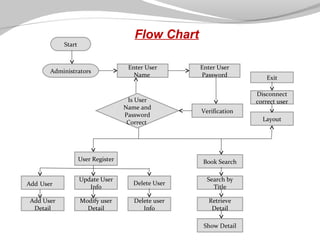
Flow Chart

Start

Administrators

Enter User
Name

Is User
Name and
Password
Correct

User Register

Add User
Add User
Detail

Enter User
Password

Exit
Disconnect
correct user

Verification
Layout

Book Search

Update User
Info

Delete User

Search by
Title

Modify user
Detail

Delete user
Info

Retrieve
Detail
Show Detail
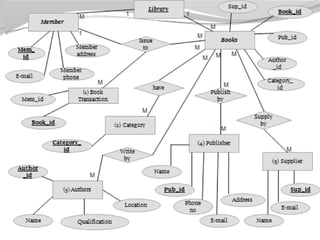
E-R Diagram
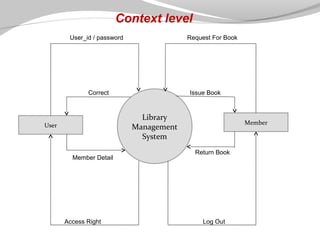
Context level
User_id / password

Request For Book

Correct

Issue Book

Library
Management
System

User

Member Detail

Access Right

Member

Return Book

Log Out
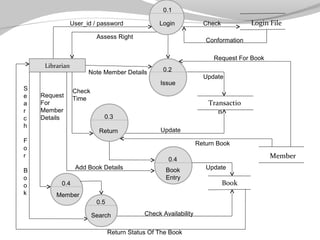
Zero Level
0.1
User_id / password

Login

Assess Right

Login File

Check
Conformation

Request For Book
Librarian
S
e
a
r
c
h

Note Member Details

Issue
Request
For
Member
Details

Check
Time

Return

Update

Transactio
n

0.3

F
o
r
B
o
o
k

0.2

Update
Return Book

Member

0.4
Add Book Details
0.4

Book
Entry

Member
0.5
Search

Check Availability

Return Status Of The Book

Update

Book
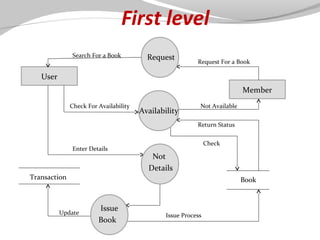
First level
Search For a Book

Request

Request For a Book

User
Member
Check For Availability

Availability

Not Available
Return Status

Enter Details

Transaction

Update

Check

Not
Details
Book

Issue
Book

Issue Process
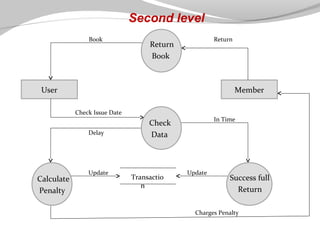
Second level
Book

Return

Return
Book

User

Member
Check Issue Date
Delay

Calculate
Penalty

Update

In Time

Check
Data

Transactio
n

Update

Success full
Return

Charges Penalty
Data Dictionary
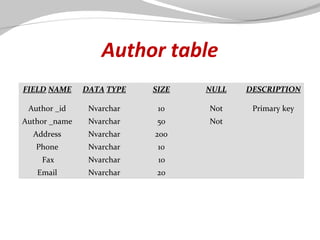
Author table
FIELD NAME

DATA TYPE

SIZE

NULL

DESCRIPTION

Author _id

Nvarchar

10

Not

Primary key

Author _name

Nvarchar

50

Not

Address

Nvarchar

200

Phone

Nvarchar

10

Fax

Nvarchar

10

Email

Nvarchar

20
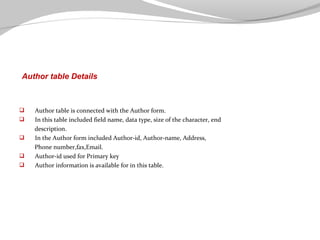
Author table Details







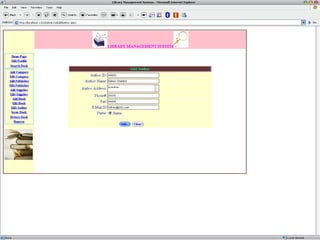
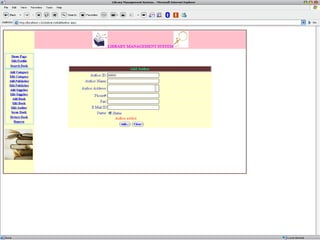
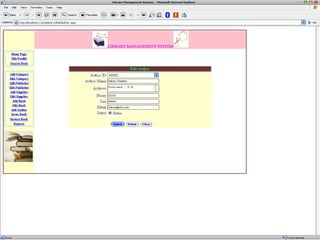
Author table is connected with the Author form.
In this table included field name, data type, size of the character, end
description.
In the Author form included Author-id, Author-name, Address,
Phone number,fax,Email.
Author-id used for Primary key
Author information is available for in this table.
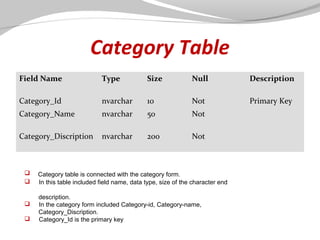
Category Table
Field Name

Type

Size

Null

Description

Category_Id

nvarchar

10

Not

Primary Key

Category_Name

nvarchar

50

Not

Category_Discription

nvarchar

200

Not







Category table is connected with the category form.
In this table included field name, data type, size of the character end
description.
In the category form included Category-id, Category-name,
Category_Discription.
Category_Id is the primary key
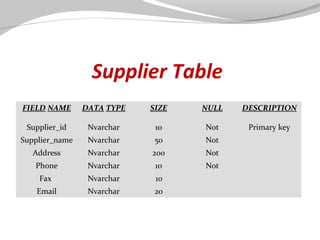
Supplier Table
FIELD NAME

DATA TYPE

SIZE

NULL

DESCRIPTION

Supplier_id

Nvarchar

10

Not

Primary key

Supplier_name

Nvarchar

50

Not

Address

Nvarchar

200

Not

Phone

Nvarchar

10

Not

Fax

Nvarchar

10

Email

Nvarchar

20
Supplier table Details







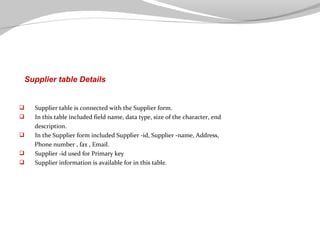
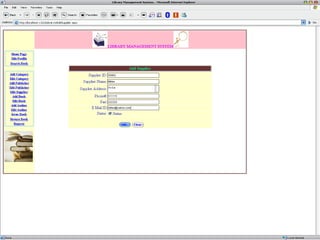
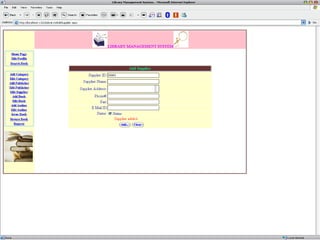
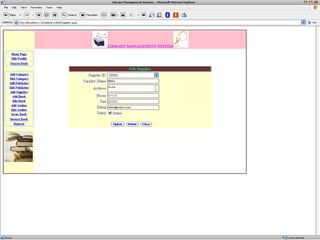
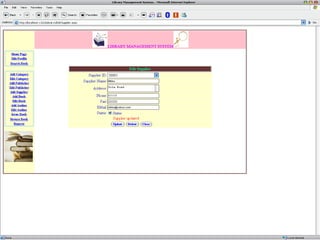
Supplier table is connected with the Supplier form.
In this table included field name, data type, size of the character, end
description.
In the Supplier form included Supplier -id, Supplier -name, Address,
Phone number , fax , Email.
Supplier -id used for Primary key
Supplier information is available for in this table.
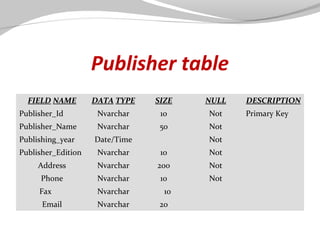
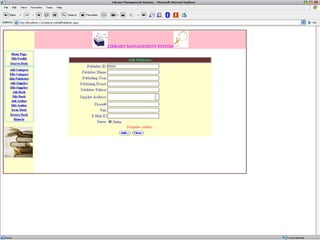
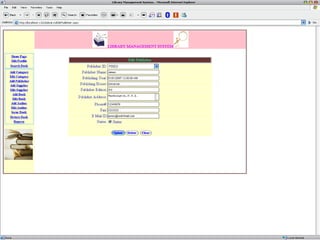
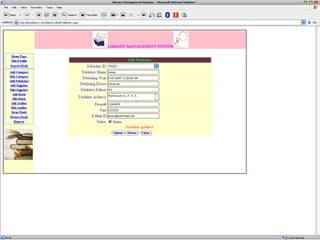
Publisher table
FIELD NAME

DATA TYPE

SIZE

NULL

Publisher_Id

Nvarchar

10

Not

Publisher_Name

Nvarchar

50

Not

Publishing_year

Date/Time

Not

Publisher_Edition

Nvarchar

10

Not

Address

Nvarchar

200

Not

Phone

Nvarchar

10

Not

Fax

Nvarchar

Email

Nvarchar

10
20

DESCRIPTION
Primary Key
Publisher table Details







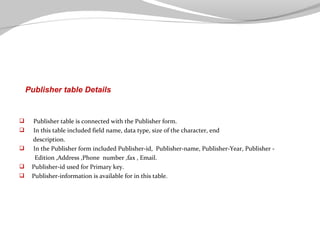
Publisher table is connected with the Publisher form.
In this table included field name, data type, size of the character, end
description.
In the Publisher form included Publisher-id, Publisher-name, Publisher-Year, Publisher Edition ,Address ,Phone number ,fax , Email.
Publisher-id used for Primary key.
Publisher-information is available for in this table.
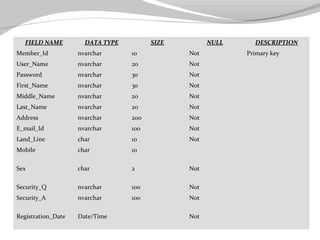
Member table
FIELD NAME

DATA TYPE

SIZE

NULL

Member_Id

nvarchar

10

Not

User_Name

nvarchar

20

Not

Password

nvarchar

30

Not

First_Name

nvarchar

30

Not

Middle_Name

nvarchar

20

Not

Last_Name

nvarchar

20

Not

Address

nvarchar

200

Not

E_mail_Id

nvarchar

100

Not

Land_Line

char

10

Not

Mobile

char

10

Sex

char

2

Not

Security_Q

nvarchar

100

Not

Security_A

nvarchar

100

Not

Registration_Date

Date/Time

Not

DESCRIPTION
Primary key
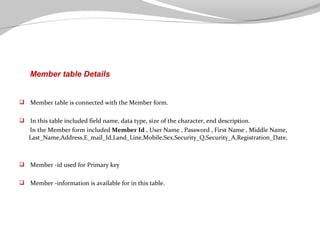
Member table Details

 Member table is connected with the Member form.
 In this table included field name, data type, size of the character, end description.

In the Member form included Member Id . User Name , Password , First Name , Middle Name,
Last_Name,Address,E_mail_Id,Land_Line,Mobile,Sex,Security_Q,Security_A,Registration_Date,

 Member -id used for Primary key
 Member -information is available for in this table.
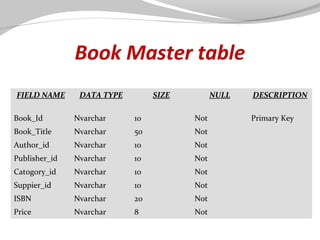
Book Master table
FIELD NAME

DATA TYPE

SIZE

NULL

Book_Id

Nvarchar

10

Not

Book_Title

Nvarchar

50

Not

Author_id

Nvarchar

10

Not

Publisher_id

Nvarchar

10

Not

Catogory_id

Nvarchar

10

Not

Suppier_id

Nvarchar

10

Not

ISBN

Nvarchar

20

Not

Price

Nvarchar

8

Not

DESCRIPTION
Primary Key
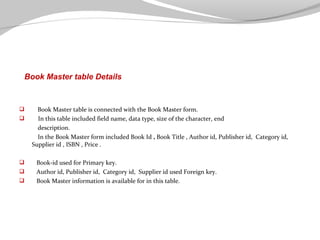
Book Master table Details








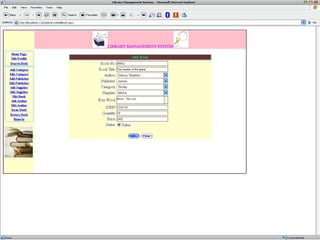
Book Master table is connected with the Book Master form.
In this table included field name, data type, size of the character, end
description.
In the Book Master form included Book Id , Book Title , Author id, Publisher id, Category id,
Supplier id , ISBN , Price .
Book-id used for Primary key.
Author id, Publisher id, Category id, Supplier id used Foreign key.
Book Master information is available for in this table.
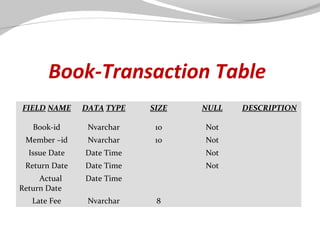
Book-Transaction Table
FIELD NAME

DATA TYPE

SIZE

NULL

Book-id

Nvarchar

10

Not

Member –id

Nvarchar

10

Not

Issue Date

Date Time

Not

Return Date

Date Time

Not

Actual
Return Date

Date Time

Late Fee

Nvarchar

8

DESCRIPTION
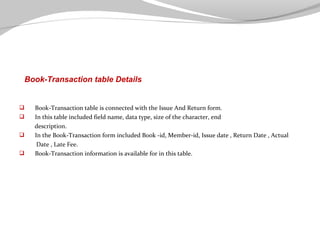
Book-Transaction table Details






Book-Transaction table is connected with the Issue And Return form.
In this table included field name, data type, size of the character, end
description.
In the Book-Transaction form included Book -id, Member-id, Issue date , Return Date , Actual
Date , Late Fee.
Book-Transaction information is available for in this table.
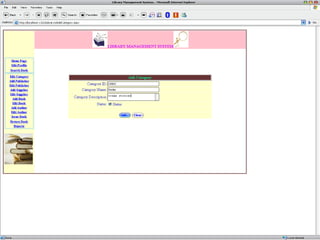
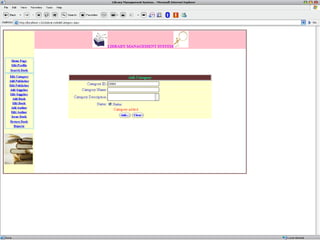
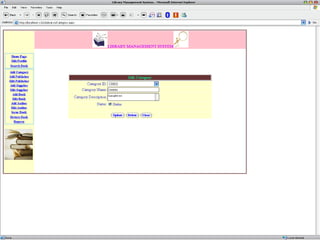
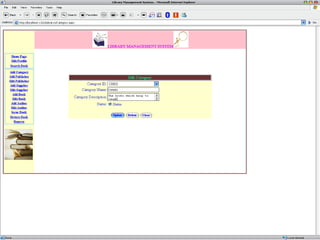
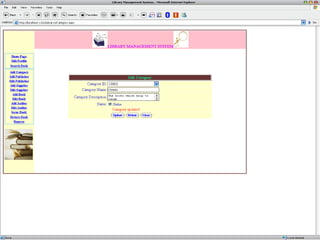
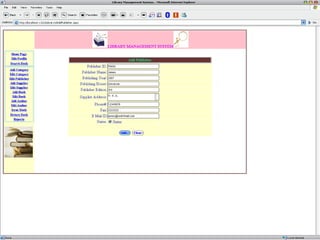
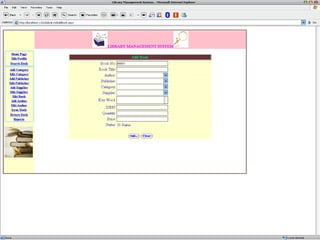
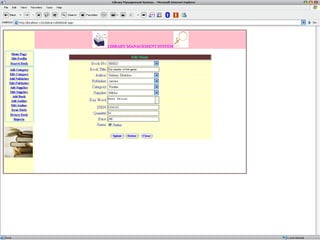
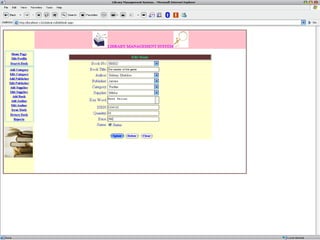
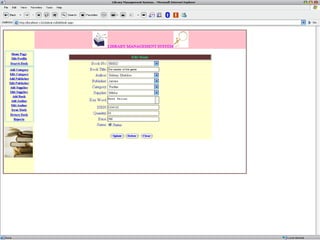
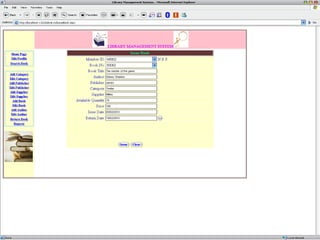
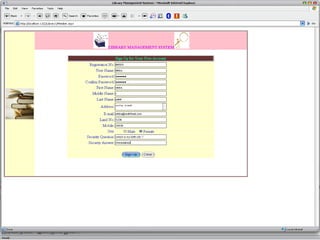
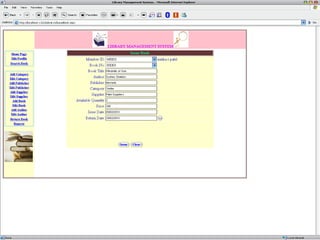
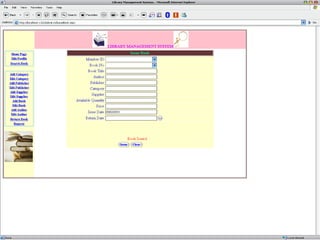
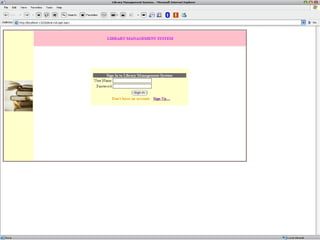
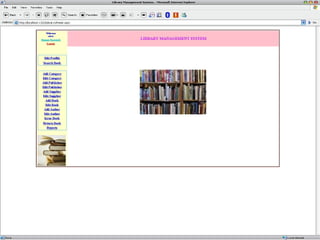
Screen Shots On Menu
Testing
 

APPROACH
 Functional Specifications are thoroughly reviewed for correctness, coverage and completeness.
 Study of Design specification and Review for Requirement coverage.
 Review the design of system components and their integration to give business solution.
 Identification of units of application for testing
 Preparation of database scripts for testing

SCOPE
 
 The system has different type of forms that were used for input, manipulation and output of data. 
 The System will be tested for the usability, functionality, reliability and performance of the application 
as whole and in parts.
Future Enhancements
 In any system there is always chance for its enhancement and extension.
 This system can also be enhanced with the change facilities. Also with the progress of

the Fashion Design system can also be enhance in future.
 More facilities can be added to the system for its growth.
 There is always scope for enhancements in any system, especially in the ever –

changing world of computers.
 The Fashion design System can also be modified according to the feature requirements

the advancement of the technology.
CLR
 

Common Language Runtime (CLR)
       

 The CLR is at the heart of the .Net platform. The CLR is a run-time engine that

compiles IL code into native machine-language code when a Web page or middletier method is invoked. It catches system exceptions, manages memory, and loads
and unloads application code.
 The CLR features automatic memory management, called Garbage Collection.

The .NET runtime decides when to release object references based on usage
patterns. No longer are developers explicitly required to release object references or
free memory. This should mean improved application reliability because fewer
memory leaks can occur.
Why VB.NET?
 Visual Studio .NET is a complete set of development tools for building ASP Web applications,









XML Web services, desktop applications, and mobile applications.
Visual Basic .NET, Visual C++ .NET, and Visual C# .NET all use the same integrated
development environment (IDE), which allows them to share tools and facilitates in the creation of
mixed-language solutions.
In addition, these languages leverage the functionality of the .NET Framework, which provides
access to key technologies that simplify the development of ASP Web applications and XML Web
services.
It is recognizably the descendant of Visual Basic. An existing Visual Basic programmer will feel
immediately familiar with the language.
Its syntax and semantics are simple, straightforward, and easy to understand. The language avoids
unintuitive features.
It gives developers the major features of the .NET Framework and is consistent with the
framework's conventions.
Because the .NET Framework explicitly supports multiple computer languages, it works well in a
Multilanguage environment.
Bibliography
Library management system presentation

Library management system presentation

  • 1.
    Kill the STRESS,before it kills you.. . . Reach your GOAL, before it kicks you… Live the life, before it leaves you… Get READY, we will help you. Developed By Patel Smit
  • 2.
  • 3.
    Introduction  Brain PowerInstitute that provides teaching class for Students.  The Institute is an invaluable source for students, researchers and facility of EDUCATION industry.  The Institute is established in the 20th March 1992.      Teaching Research Consulting Training Learning requirement
  • 4.
    Activities of theOrganization  The main source for STUDENTS , STAFF and FACULTIES.  Huge collection of text books, reference books, and etc.  The library provides peaceful atmosphere.  Library gives facility.  Library also provides source of past years’ projects, exam and research papers etc.  In short, the library is the large source of the knowledge .
  • 5.
    Existing System  Tocheck availability of the book.  Manual system.  The librarian has to perform each task automatically.
  • 6.
    Existing System  TimeManipulation.  Also updating is tedious work.  Issuing and receiving of the books is also complex.  penalty is very complex.
  • 7.
    Need for aNew System  As we have seen in earlier topic, the existing system following drawbacks which create the need for the system. 1) Time-consuming. 2) Searching challenging task. 3) Maintenance tedious work. 4) To calculate penalty for late-coming. 5) Generating reports is complex. 6) Maintaining register is complex.
  • 8.
    Project Profile Our Aim    Studentscan easily take and issue books.  Students delight by delivering on-time and fast service.  Maintain for generating various reports.
  • 9.
    Objectives Of TheProject Basic Objectives      More Accuracy Speed improvement Data inconsistency Better error handling Integrity Other Objectives        The System will handle the maintenance of data . It handle entire transaction of book registration till issue of the book. Administrator will immediately acknowledged with error message. The Administrator details of Books, Authors and existing Member etc. Book wise search can be performed.
  • 10.
    Core Components   HARDWARE REQUIREMENTS       Processer  Ram  Memory  VDU      PentiumIv Or Higher 128 Mb Or Higher 50 Mb Free Space 14” Color Monitor   SOFTWARE REQUIREMENTS    Language   Client Operating   System   Server Operating   System   Visual .net  Windows 98/Xp  Windows Server
  • 11.
    Requirement Specification  Type of software they needed. They neededthe software that built in latest software tool and easy to operate.  Features they needed in the software. They needed features like reports, easy information fetching about the students, publishers, staff, books and many other information.  Computerized Report Generation. Easy maintenance and retrieval of data.  Future Requirement. Centralized and secure database.  They can afford for computerized system. They can afford the computerized system as per our application requirement.
  • 12.
    Requirement Specification Other Features Specified. They want to work as fast as possible as the existing system...  Improve data inconsistency and integrity for the system.  More accuracy speed and better error handling feature.  Member arises search can be performed in the library system...  Member can check the available details of books, project reports and Journals.  The system will handle the maintenance of books and member details
  • 13.
    Advantages  This projectcan be used for any company, for infinite number of products, and for infinite number of categories as it is totally generic.  The data of the member would be entered in the database.  There would be a safe storage of information of the member in the database.  Quick, easy, flexible generation of the member reports.  There would be a dynamic and fully computerized system would be developed.  With the database any data can be added, modified, deleted very quickly.  Security features are very much provided in the system.  User friendly environment.
  • 14.
  • 15.
    Flow Chart Start Administrators Enter User Name IsUser Name and Password Correct User Register Add User Add User Detail Enter User Password Exit Disconnect correct user Verification Layout Book Search Update User Info Delete User Search by Title Modify user Detail Delete user Info Retrieve Detail Show Detail
  • 16.
  • 17.
    Context level User_id /password Request For Book Correct Issue Book Library Management System User Member Detail Access Right Member Return Book Log Out
  • 18.
  • 19.
    0.1 User_id / password Login AssessRight Login File Check Conformation Request For Book Librarian S e a r c h Note Member Details Issue Request For Member Details Check Time Return Update Transactio n 0.3 F o r B o o k 0.2 Update Return Book Member 0.4 Add Book Details 0.4 Book Entry Member 0.5 Search Check Availability Return Status Of The Book Update Book
  • 20.
    First level Search Fora Book Request Request For a Book User Member Check For Availability Availability Not Available Return Status Enter Details Transaction Update Check Not Details Book Issue Book Issue Process
  • 21.
    Second level Book Return Return Book User Member Check IssueDate Delay Calculate Penalty Update In Time Check Data Transactio n Update Success full Return Charges Penalty
  • 22.
  • 23.
    Author table FIELD NAME DATATYPE SIZE NULL DESCRIPTION Author _id Nvarchar 10 Not Primary key Author _name Nvarchar 50 Not Address Nvarchar 200 Phone Nvarchar 10 Fax Nvarchar 10 Email Nvarchar 20
  • 24.
    Author table Details      Authortable is connected with the Author form. In this table included field name, data type, size of the character, end description. In the Author form included Author-id, Author-name, Address, Phone number,fax,Email. Author-id used for Primary key Author information is available for in this table.
  • 25.
    Category Table Field Name Type Size Null Description Category_Id nvarchar 10 Not PrimaryKey Category_Name nvarchar 50 Not Category_Discription nvarchar 200 Not     Category table is connected with the category form. In this table included field name, data type, size of the character end description. In the category form included Category-id, Category-name, Category_Discription. Category_Id is the primary key
  • 26.
    Supplier Table FIELD NAME DATATYPE SIZE NULL DESCRIPTION Supplier_id Nvarchar 10 Not Primary key Supplier_name Nvarchar 50 Not Address Nvarchar 200 Not Phone Nvarchar 10 Not Fax Nvarchar 10 Email Nvarchar 20
  • 27.
    Supplier table Details      Suppliertable is connected with the Supplier form. In this table included field name, data type, size of the character, end description. In the Supplier form included Supplier -id, Supplier -name, Address, Phone number , fax , Email. Supplier -id used for Primary key Supplier information is available for in this table.
  • 28.
    Publisher table FIELD NAME DATATYPE SIZE NULL Publisher_Id Nvarchar 10 Not Publisher_Name Nvarchar 50 Not Publishing_year Date/Time Not Publisher_Edition Nvarchar 10 Not Address Nvarchar 200 Not Phone Nvarchar 10 Not Fax Nvarchar Email Nvarchar 10 20 DESCRIPTION Primary Key
  • 29.
    Publisher table Details      Publishertable is connected with the Publisher form. In this table included field name, data type, size of the character, end description. In the Publisher form included Publisher-id, Publisher-name, Publisher-Year, Publisher Edition ,Address ,Phone number ,fax , Email. Publisher-id used for Primary key. Publisher-information is available for in this table.
  • 30.
  • 31.
  • 32.
    Member table Details Member table is connected with the Member form.  In this table included field name, data type, size of the character, end description. In the Member form included Member Id . User Name , Password , First Name , Middle Name, Last_Name,Address,E_mail_Id,Land_Line,Mobile,Sex,Security_Q,Security_A,Registration_Date,  Member -id used for Primary key  Member -information is available for in this table.
  • 33.
    Book Master table FIELDNAME DATA TYPE SIZE NULL Book_Id Nvarchar 10 Not Book_Title Nvarchar 50 Not Author_id Nvarchar 10 Not Publisher_id Nvarchar 10 Not Catogory_id Nvarchar 10 Not Suppier_id Nvarchar 10 Not ISBN Nvarchar 20 Not Price Nvarchar 8 Not DESCRIPTION Primary Key
  • 34.
    Book Master tableDetails      Book Master table is connected with the Book Master form. In this table included field name, data type, size of the character, end description. In the Book Master form included Book Id , Book Title , Author id, Publisher id, Category id, Supplier id , ISBN , Price . Book-id used for Primary key. Author id, Publisher id, Category id, Supplier id used Foreign key. Book Master information is available for in this table.
  • 35.
    Book-Transaction Table FIELD NAME DATATYPE SIZE NULL Book-id Nvarchar 10 Not Member –id Nvarchar 10 Not Issue Date Date Time Not Return Date Date Time Not Actual Return Date Date Time Late Fee Nvarchar 8 DESCRIPTION
  • 36.
    Book-Transaction table Details     Book-Transactiontable is connected with the Issue And Return form. In this table included field name, data type, size of the character, end description. In the Book-Transaction form included Book -id, Member-id, Issue date , Return Date , Actual Date , Late Fee. Book-Transaction information is available for in this table.
  • 37.
  • 70.
    Testing   APPROACH  Functional Specificationsare thoroughly reviewed for correctness, coverage and completeness.  Study of Design specification and Review for Requirement coverage.  Review the design of system components and their integration to give business solution.  Identification of units of application for testing  Preparation of database scripts for testing SCOPE    The system has different type of forms that were used for input, manipulation and output of data.   The System will be tested for the usability, functionality, reliability and performance of the application  as whole and in parts.
  • 71.
    Future Enhancements  Inany system there is always chance for its enhancement and extension.  This system can also be enhanced with the change facilities. Also with the progress of the Fashion Design system can also be enhance in future.  More facilities can be added to the system for its growth.  There is always scope for enhancements in any system, especially in the ever – changing world of computers.  The Fashion design System can also be modified according to the feature requirements the advancement of the technology.
  • 72.
    CLR   Common Language Runtime (CLR)          The CLRis at the heart of the .Net platform. The CLR is a run-time engine that compiles IL code into native machine-language code when a Web page or middletier method is invoked. It catches system exceptions, manages memory, and loads and unloads application code.  The CLR features automatic memory management, called Garbage Collection. The .NET runtime decides when to release object references based on usage patterns. No longer are developers explicitly required to release object references or free memory. This should mean improved application reliability because fewer memory leaks can occur.
  • 73.
    Why VB.NET?  Visual Studio.NET is a complete set of development tools for building ASP Web applications,       XML Web services, desktop applications, and mobile applications. Visual Basic .NET, Visual C++ .NET, and Visual C# .NET all use the same integrated development environment (IDE), which allows them to share tools and facilitates in the creation of mixed-language solutions. In addition, these languages leverage the functionality of the .NET Framework, which provides access to key technologies that simplify the development of ASP Web applications and XML Web services. It is recognizably the descendant of Visual Basic. An existing Visual Basic programmer will feel immediately familiar with the language. Its syntax and semantics are simple, straightforward, and easy to understand. The language avoids unintuitive features. It gives developers the major features of the .NET Framework and is consistent with the framework's conventions. Because the .NET Framework explicitly supports multiple computer languages, it works well in a Multilanguage environment.
  • 74.