LIBRARY MANAGEMENT
SYSTEM
Introduction
 Library Management System is a
software used to manages the catalog of a
library.
 This helps to keep the records of whole
transactions of the books available in the
library.
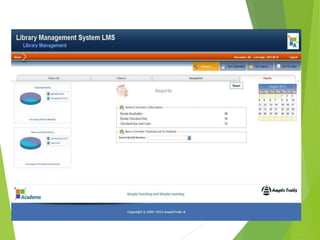
 AmpleTrails provides Library Management
System which is very easy to use and
fulfills all the requirement of a librarian.
Scope of project
 To provide a user friendly envirnoment where user
can be serviced better
 Make functioning of library faster
 To minimize the loss done to book
 To eliminate the paper work in library
 To record every transaction in computerized
system so that problem such as record file missing
won’t be happen.
CONTENTS
1. Entity Relationship Diagram
2. Activity Diagram
3. Use Case Diagram
4. Data Flow Diagram
5. Class Diagram
6. Database Tables
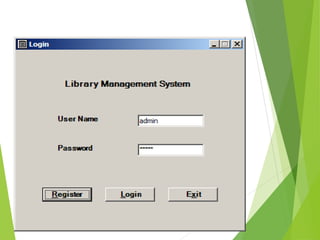
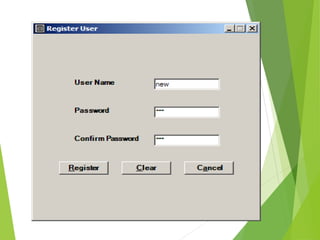
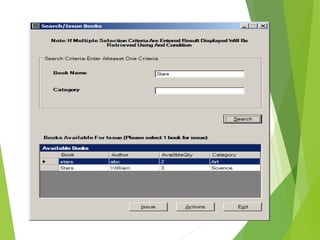
7. Screen Shots
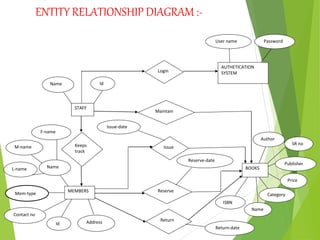
ENTITY RELATION DIAGRAM
 classifying data objects as either entities or
attributes,
 identifying and defining relationships
between entities,
 naming and defining identified entities,
attributes, and relationships,
 documenting this information in the data
document.
Reserve
Reserve-date
Maintain
Keeps
track
Id
STAFF
Name
MEMBERS
Id
Name
F-name
L-name
M-name
Address
Contact no
Login
AUTHETICATION
SYSTEM
User name Password
BOOKS
Author
Publisher
SR no
Price
ISBN
Name
Category
Issue
Issue-date
Return
Return-date
ENTITY RELATIONSHIP DIAGRAM :-
Mem-type
ACTIVITY DIAGRAM
 It captures the dynamic behaviour of the
system.
 Describe the sequence from one activity to
another.
 Describe the parallel, branched and
concurrent flow of the system.
Issue and Return Book :
USE CASE DIAGRAM
 Used to gather requirements of a system.
 Used to get an outside view of a system.
 Identify external and internal factors
influencing the system.
 Show the interacting among the
requirements are actors.
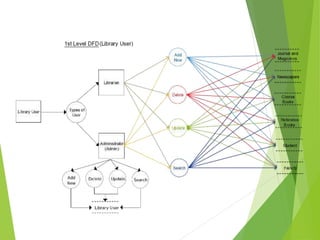
DATA FLOW
 A data flow diagram(DFD) is graphical
representation of the “flow” of data
through an information system.
 A DFD shows what kinds of information will
be input to and output from the system.
 One of the most widely used system
analysis process models is the data flow
diagram.
CLASS DIAGRAM
 Analysis and design of the static view of an
application.
 Describe responsibilities of a system.
 Base for component and deployment
diagrams.
 Forward and reverse engineering.
MEMBER TABLE
Field Name Data Type
mem_id Int(10)
F_name varchar(20)
M_name varchar(20)
L_name varchar(20)
Contact_no varchar(10)
Address varchar(80)
Mem_type varchar(20)
DOB Date
Gender Char(6)
Password varchar(20)
LIBRARY_STAFF TABLE
Field Name Data type
Staff_ID Int(10)
F_name varchar(20)
L_name varchar(20)
Contact_no varchar(20)
DOB Date
Gender Char(6)
Password varchar(20)
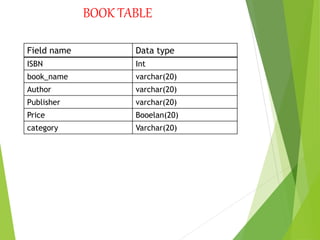
BOOK TABLE
Field name Data type
ISBN Int
book_name varchar(20)
Author varchar(20)
Publisher varchar(20)
Price Booelan(20)
category Varchar(20)
ISSUE-RETURN TABLE
Field Name Data Type
ISBN Int
mem_ID Int
Date_issue date
Date_return date
Expiry_date date
THANK YOU !!!

Library management system

  • 1.
  • 2.
    Introduction  Library ManagementSystem is a software used to manages the catalog of a library.  This helps to keep the records of whole transactions of the books available in the library.  AmpleTrails provides Library Management System which is very easy to use and fulfills all the requirement of a librarian.
  • 4.
    Scope of project To provide a user friendly envirnoment where user can be serviced better  Make functioning of library faster  To minimize the loss done to book  To eliminate the paper work in library  To record every transaction in computerized system so that problem such as record file missing won’t be happen.
  • 5.
    CONTENTS 1. Entity RelationshipDiagram 2. Activity Diagram 3. Use Case Diagram 4. Data Flow Diagram 5. Class Diagram 6. Database Tables 7. Screen Shots
  • 6.
    ENTITY RELATION DIAGRAM classifying data objects as either entities or attributes,  identifying and defining relationships between entities,  naming and defining identified entities, attributes, and relationships,  documenting this information in the data document.
  • 7.
    Reserve Reserve-date Maintain Keeps track Id STAFF Name MEMBERS Id Name F-name L-name M-name Address Contact no Login AUTHETICATION SYSTEM User namePassword BOOKS Author Publisher SR no Price ISBN Name Category Issue Issue-date Return Return-date ENTITY RELATIONSHIP DIAGRAM :- Mem-type
  • 8.
    ACTIVITY DIAGRAM  Itcaptures the dynamic behaviour of the system.  Describe the sequence from one activity to another.  Describe the parallel, branched and concurrent flow of the system.
  • 9.
  • 10.
    USE CASE DIAGRAM Used to gather requirements of a system.  Used to get an outside view of a system.  Identify external and internal factors influencing the system.  Show the interacting among the requirements are actors.
  • 12.
    DATA FLOW  Adata flow diagram(DFD) is graphical representation of the “flow” of data through an information system.  A DFD shows what kinds of information will be input to and output from the system.  One of the most widely used system analysis process models is the data flow diagram.
  • 15.
    CLASS DIAGRAM  Analysisand design of the static view of an application.  Describe responsibilities of a system.  Base for component and deployment diagrams.  Forward and reverse engineering.
  • 17.
    MEMBER TABLE Field NameData Type mem_id Int(10) F_name varchar(20) M_name varchar(20) L_name varchar(20) Contact_no varchar(10) Address varchar(80) Mem_type varchar(20) DOB Date Gender Char(6) Password varchar(20)
  • 18.
    LIBRARY_STAFF TABLE Field NameData type Staff_ID Int(10) F_name varchar(20) L_name varchar(20) Contact_no varchar(20) DOB Date Gender Char(6) Password varchar(20)
  • 19.
    BOOK TABLE Field nameData type ISBN Int book_name varchar(20) Author varchar(20) Publisher varchar(20) Price Booelan(20) category Varchar(20)
  • 20.
    ISSUE-RETURN TABLE Field NameData Type ISBN Int mem_ID Int Date_issue date Date_return date Expiry_date date
  • 26.