2 1
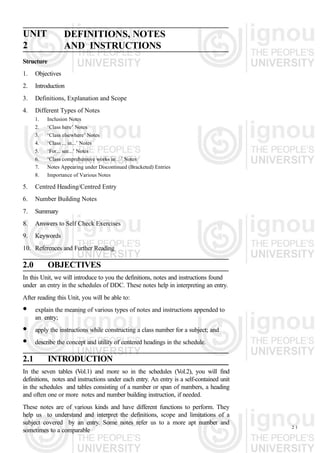
UNIT
2
DEFINITIONS, NOTES
AND INSTRUCTIONS
Structure
1. Objectives
2. Introduction
3. Definitions, Explanation and Scope
4. Different Types of Notes
1. Inclusion Notes
2. ‘Class here’ Notes
3. ‘Class elsewhere’ Notes
4. ‘Class ... in...’ Notes
5. ‘For... see...’ Notes
6. ‘Class comprehensive works in…’ Notes
7. Notes Appearing under Discontinued (Bracketed) Entries
8. Importance of Various Notes
5. Centred Heading/Centred Entry
6. Number Building Notes
7. Summary
8. Answers to Self Check Exercises
9. Keywords
10. References and Further Reading
2.0 OBJECTIVES
In this Unit, we will introduce to you the definitions, notes and instructions found
under an entry in the schedules of DDC. These notes help in interpreting an entry.
After reading this Unit, you will be able to:
 explain the meaning of various types of notes and instructions appended to
an entry;
 apply the instructions while constructing a class number for a subject; and
 describe the concept and utility of centered headings in the schedule.
2.1 INTRODUCTION
In the seven tables (Vol.1) and more so in the schedules (Vol.2), you will find
definitions, notes and instructions under each entry. An entry is a self-contained unit
in the schedules and tables consisting of a number or span of numbers, a heading
and often one or more notes and number building instruction, if needed.
These notes are of various kinds and have different functions to perform. They
help us to understand and interpret the definitions, scope and limitations of a
subject covered by an entry. Some notes refer us to a more apt number and
sometimes to a comparable
Classification-
DDC: 19th
Edition
2 2
and related number. But of greater importance are the notes to extend further a
number called “number building” notes. All these types of instructions have been
explained to you in the following sections of this Unit.
Understanding these notes and instructions is very essential for classification of
documents. Therefore, you have to be familiar with these notes and instructions so
as to become a good classifier.
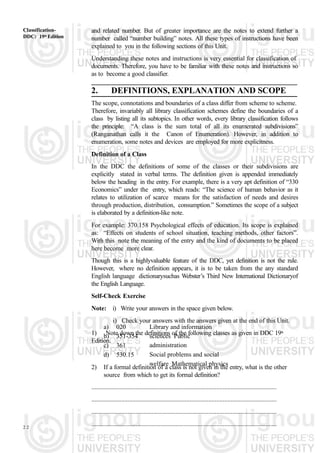
2. DEFINITIONS, EXPLANATION AND SCOPE
The scope, connotations and boundaries of a class differ from scheme to scheme.
Therefore, invariably all library classification schemes define the boundaries of a
class by listing all its subtopics. In other words, every library classification follows
the principle: “A class is the sum total of all its enumerated subdivisions”
(Ranganathan calls it the Canon of Enumeration). However, in addition to
enumeration, some notes and devices are employed for more explicitness.
Definition of a Class
In the DDC the definitions of some of the classes or their subdivisions are
explicitly stated in verbal terms. The definition given is appended immediately
below the heading in the entry. For example, there is a very apt definition of “330
Economics” under the entry, which reads: “The science of human behavior as it
relates to utilization of scarce means for the satisfaction of needs and desires
through production, distribution, consumption.” Sometimes the scope of a subject
is elaborated by a definition-like note.
For example: 370.158 Psychological effects of education. Its scope is explained
as: “Effects on students of school situation, teaching methods, other factors”.
With this note the meaning of the entry and the kind of documents to be placed
here become more clear.
Though this is a highlyvaluable feature of the DDC, yet definition is not the rule.
However, where no definition appears, it is to be taken from the any standard
English language dictionarysuchas Webster’s Third New International Dictionaryof
the English Language.
Self-Check Exercise
Note: i) Write your answers in the space given below.
i) Check your answers with the answers given at the end of this Unit.
1) Note down the definitions of the following classes as given in DDC 19th
Edition.
a) 020
b) 351-354
c) 361
d) 530.15
Library and information
sciences Public
administration
Social problems and social
welfare Mathematical physics
2) If a formal definition of a class is not given in the entry, what is the other
source from which to get its formal definition?
.....................................................................................................................
.....................................................................................................................
.....................................................................................................................
.....................................................................................................................
2 3
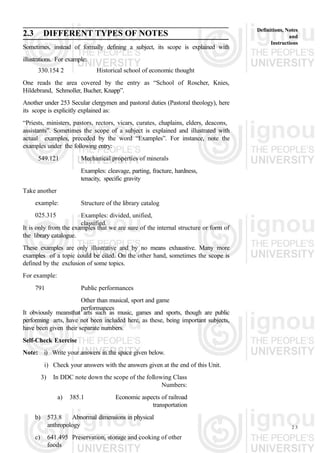
2.3 DIFFERENT TYPES OF NOTES
Sometimes, instead of formally defining a subject, its scope is explained with
illustrations. For example:
330.154 2 Historical school of economic thought
One reads the area covered by the entry as “School of Roscher, Knies,
Hildebrand, Schmoller, Bucher, Knapp”.
Another under 253 Secular clergymen and pastoral duties (Pastoral theology), here
its scope is explicitly explained as:
“Priests, ministers, pastors, rectors, vicars, curates, chaplains, elders, deacons,
assistants”. Sometimes the scope of a subject is explained and illustrated with
actual examples, preceded by the word “Examples”. For instance, note the
examples under the following entry:
549.121 Mechanical properties of minerals
Examples: cleavage, parting, fracture, hardness,
tenacity, specific gravity
Take another
example:
025.315
Structure of the library catalog
Examples: divided, unified,
classified.
It is only from the examples that we are sure of the internal structure or form of
the library catalogue.
These examples are only illustrative and by no means exhaustive. Many more
examples of a topic could be cited. On the other hand, sometimes the scope is
defined by the exclusion of some topics.
For example:
791 Public performances
Other than musical, sport and game
performances
It obviously meansthat arts such as music, games and sports, though are public
performing arts, have not been included here, as these, being important subjects,
have been given their separate numbers.
Self-Check Exercise
Note: i) Write your answers in the space given below.
i) Check your answers with the answers given at the end of this Unit.
3) In DDC note down the scope of the following Class
Numbers:
a) 385.1 Economic aspects of railroad
transportation
b) 573.8 Abnormal dimensions in physical
anthropology
c) 641.495 Preservation, storage and cooking of other
foods
Definitions, Notes
and
Instructions
Classification-
DDC: 19th
Edition
2 4
.....................................................................................................................
.....................................................................................................................
.....................................................................................................................
.....................................................................................................................
2.3.1 Inclusion Notes
Some topics that are not part of a class are given a standing place with a class.
Actually such topics are not fully developed and their literary warrant does not
demand a full and separate number for them. Hence, these topics are given a
standing room (on an ad- hoc basis) in a class with which it may have affinity.
Later, when sufficient literature is produced on the subject, then, as per policy of
DDC editors, these topics may be given a separate number.
For example, see the Inclusion Note in the following entry:
398.47 Ghosts
Including haunted
places
It means that logically speaking folklore with “haunted places” as its theme is not a
part of the entry “398.47 Ghosts as subject of folklore” is not a fully developed
subject. Therefore, for the time being (till giving a full number is justified), it is to
be classed at 398.47.
Take another example:
371.104 Relation of teachers to society
Including relation to immediate community, academic
freedom; rights, obligations, public status of teachers
The “including note” in this entry contains many important topics such as relation
to immediate community, academic freedom, right obligations and public status of
teachers. To explain again, the topic of academic freedom has not yet gathered
enough literature to justify a separate class for it. Therefore, for the time being, it
has been clubbed with other topics under the class number 371.104.
Self-Check Exercise
Note: i) Write your answers in the space given below.
i) Check your answers with the answers given at the end of this Unit.
4) What else do the following class numbers include?
a) 296.385 Moral theology in Judaism
b) 345.075 Trial procedure in criminal law
c) 519.4 Applied numerical analysis
d) 530.41 Solid-state physics
e) 535.846 Raman spectroscopy
f) 561.52 Paleobotany of Coniferales
g) 791.435 3 Education and documentary
motion films
h) 792.16 Staging of religious and morality
plays
2 5
.....................................................................................................................
.....................................................................................................................
.....................................................................................................................
2.3.2 ‘Class here’ Notes
Some topics apparently do not seem to be part of a given subject. These are
broader or narrower than a topic to which they are attached with the note: “Class
here ...”. It means that the place given to them is not very logical, yet it provides a
class number to an otherwise unaccommodated topic. For example, note the entry:
576 Microbes
Class here microbiology
It simply means that microbiology, though simply not microbes, is placed with
576 Microbes. Similarly, under:
574.295 Immune reactions
Class here serology
Now, consider the following
examples:
370.19
Social aspects of education
Class
here educational
sociology
370.152
Cognitive processes
Class
here intelligence
Principally there is much difference between the topics listed as
scope notes and examples, on the one hand, and Inclusion and Class here notes
on the other. Yet their practical effect is the same.
Examples of such notes can be enormously multiplied. These topics
given under notes are also indexed in the Relative Index (Vol. 3). It makes their
location easy in the schedules.
Self-Check Exercise
Note: i) Write your answers in the space given below.
i) Check your answers with the answers given at the end
of this Unit.
5) What else is to be classified under each of the
following class numbers?
a) 266
b) 337
c) 519.5
d) 535.52
e) 615.1
Christian missions
International
economics Statistical
mathematics
Polarization of light
Drugs (Materia
medica)
.....................................................................................................................
.....................................................................................................................
Definitions, Notes
and
Instructions
Classification-
DDC: 19th
Edition
2 6
.....................................................................................................................
.....................................................................................................................
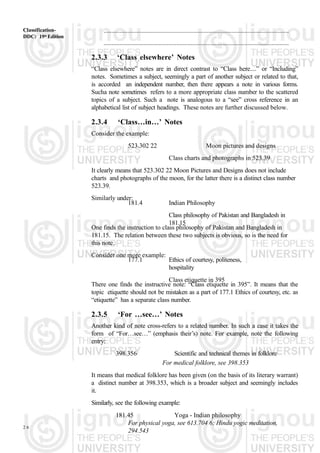
2.3.3 ‘Class elsewhere’ Notes
“Class elsewhere” notes are in direct contrast to “Class here....” or “Including”
notes. Sometimes a subject, seemingly a part of another subject or related to that,
is accorded an independent number, then there appears a note in various forms.
Sucha note sometimes refers to a more appropriate class number to the scattered
topics of a subject. Such a note is analogous to a “see” cross reference in an
alphabetical list of subject headings. These notes are further discussed below.
2.3.4 ‘Class…in…’ Notes
Consider the example:
523.302 22 Moon pictures and designs
Class charts and photographs in 523.39
It clearly means that 523.302 22 Moon Pictures and Designs does not include
charts and photographs of the moon, for the latter there is a distinct class number
523.39.
Similarly under:
181.4 Indian Philosophy
Class philosophy of Pakistan and Bangladesh in
181.15
One finds the instruction to class philosophy of Pakistan and Bangladesh in
181.15. The relation between these two subjects is obvious, so is the need for
this note.
Consider one more example:
177.1 Ethics of courtesy, politeness,
hospitality
Class etiquette in 395
There one finds the instructive note: “Class etiquette in 395”. It means that the
topic etiquette should not be mistaken as a part of 177.1 Ethics of courtesy, etc. as
“etiquette” has a separate class number.
2.3.5 ‘For …see…’ Notes
Another kind of note cross-refers to a related number. In such a case it takes the
form of “For…see…” (emphasis their’s) note. For example, note the following
entry:
398.356 Scientific and technical themes in folklore
For medical folklore, see 398.353
It means that medical folklore has been given (on the basis of its literary warrant)
a distinct number at 398.353, which is a broader subject and seemingly includes
it.
Similarly, see the following example:
181.45 Yoga - Indian philosophy
For physical yoga, see 613.704 6; Hindu yogic meditation,
294.543
2 7
The instruction given under the class number for yoga means that related to yoga
philosophy are the subjects of yogic (physical) exercise and yogic meditation, both
of them have their separate class numbers as given in the instruction.
2.3.6 ‘Class comprehensive works in ...’ Notes
This type of note is appended to a centred entry (explained, in the next section
(2.4) of this Unit), which is covered by a continuous span of numbers. To assign a
single class number to a work covering all the topics, a note gives one number for
such a work.
For example:
181.41-181.48 Hindu-Brahmanical Philosophy
Class comprehensive works in
181.4
Similarly, look at
297.12-297.14 Sources of Islam
Class comprehensive works in
297.1
It means that various sources of Islam are denoted by a span of continuous
numbers, viz., 297.12-297.14, but for a book, comprehensive of all sources of
Islam, the number is 297.1.
2.3.7 Notes Appearing under Discontinued (Bracketed)
Entries
When a number is discontinued in the present edition then there appears a note
indicating its new class number. These notes again are of two types:
a) Having the Form “Do not use; Class ...”
b) Having the Form “Class in...”
Here are some examples of “Do not use; Class...” type note
[221.03] Dictionaries, encyclopedias, concordances of Old Testament
Do not use; class dictionaries and encyclopedias in 221.3,
concordances in 221.4-221.5
It means that in the 19th edition the previous number 221.03 for dictionaries and
encyclopaedias of Old Testament has been discontinued and relocated to 221.3 in
the present edition.
Here is another example:
[250.68] Management of Local Christian Church
Do not use; class management of local Christian church in 254, of
religious congregations and orders in 255
Having the form “Class in ...” type note
Under some discontinued, hence bracketed, numbers appear the instructions as
to where this subject is to be classed now. For example, see the entry:
[301.56] Educational sociology
Class in 370.19
Definitions, Notes
and
Instructions
Classification-
DDC: 19th
Edition
2 8
It simply means that the new number for this topic now is 370.19. This type of
note is more simple and straightforward than the previous form, though their
meanings and effects are the same.
Self-Check Exercise
Note: i) Write your answers in the space given below.
i) Check your answers with the answers given at the end of this Unit.
6) Where to class in…the following subjects? Find out from the schedules.
a) 001.6
b) 070.48
c) 305.4
d) 336
e) 910.4
Data processing
Class business applications in…
Journalism directed to special
groups Class school journalism
in…
Women
Class women suffrage
in… Public finance
Class financial administration of governments
in… Accounts of travel
Class scientific travels in…
.....................................................................................................................
.....................................................................................................................
.....................................................................................................................
.....................................................................................................................
2.3.8 Importance of Various Notes
An entry maysimultaneously have more than one note; in such cases, no note
contradicts the other. The DDC schedules abound with numerous such
definitional, scope and illustrative or “class here or there” notes. These notes
immensely help to correctly classify a document and to arrive at the correct number.
Also, these notes contribute to uniformity in the interpretation of entries and
consequently achieve much desired consistency in the application of DDC in all
libraries in all countries. Moreover, there seems no consensus on the structure of
knowledge and the place of various subjects in the tree of knowledge. The
structure of knowledge as outlined and delineated in DDC may not be correct or
logical, but these notes help to understand the position, boundaries and scope of
these subjects as its editors have devised it and wish it to be understood by the
classifiers.
2.4 CENTERED HEADING/CENTERED ENTRY
In the schedules you will often come across some headings denoted not by one but
by a continuous span of numbers.
For example:
381-382 General internal and international commerce (Trade)
2 9
Here, one topic by virtue of its having many subdivisions has been denoted by a
span of numbers 381-382 and their subdivisions. Hierarchy, here, isdeliberately
broken down. It helps to denote the subdivisions of a centered heading by brief
class numbers.
Take one more example
220
221
Bible
Old
Testament
222-224 Specific parts of Old Testament
Here, instead of denoting the various parts (books) of Old Testament by
hierarchically subdividing 221, these have been denoted by a series of separate
sections, viz., 222- 224, thus providing ample space (and consequently briefer
class numbers) for further subdivisions of Old Testament.
Such entries occur at all the levels of hierarchy. These are called centered entries
or centered headings as these entries are always printed in the centre of the
page and are invariably marked by an equilateral triangle ( ) on the left hand
margin pointing towards the entry. Some other examples of centered headings
are:
251-254 Local church
281.1-281.4 Early church
368.06-368.08 Insurance of specific forms of risks
574.873-574.875 Specific components of cell anatomy and
physiology
Hundreds of more such examples can be found in the DDC schedules. As already
said (in the section on class elsewhere notes) every centred heading contains a
note as to where the comprehensive works on the topic are to be classed as, in
practice, a book is denoted by one class number not by a span of numbers. For
example, under 251- 254 Local church, one finds the instruction: “Class
comprehensive works in 250, special parochial activities in 259.
To repeat, a centred heading is typographically printed in the centre of the
schedule
page, denoted by a continuous span of numbers, signalled by a pointing triangle
( )
and contains a note giving the class number for comprehensive works on that
subject.
It may be noted that every entry denoted by a span of numbers is not a centered
entry. For example, 324.274-.279 or 367.91-.99 are not centered headings but
merely a group of continuous numbers, which can be further individualised as per
instructions.
Self-Check Exercise
Note: i) Write your answers in the space given below.
i) Check your answers with the answers given at the end of this Unit.
7) What are the typographical devices to denote a centered heading?
8) Find the class numbers for comprehensive works on the subjects denoted by
each of the following centered entries.
a) 017-019
b) 017.1-017.4
c) 384.1-384.7
General catalogs
Classified subject
catalogs
Telecommunication
Definitions, Notes
and
Instructions
Classification-
DDC: 19th
Edition
3 0
9) Is the following a centered entry’?
373.3-.9 Secondary education and schools by specific continents, countries,
localities.
.....................................................................................................................
.....................................................................................................................
.....................................................................................................................
.....................................................................................................................
2.5 NUMBER BUILDING NOTES
Any number in the schedules (Vol.2) (and in some cases in Tables 1-7 also) can
be further extended by:
1) Any of the seven tables 1-7 (in Vol. 1).
2) Any number or part of it in the schedules (Vol.2).
The extension (called synthesis or number building) can be with or without
instructions.
Without Instructions by the Editor
Any Standard Subdivision in Table 1 can be added to any original or extended
number in the schedules, Vol.2. By extending this provision any number in Table
2 Areas, in Table 5 Racial, Ethnic National Groups and Table 7 Persons can be
added through the Standard Subdivisions 09,088 and 089.
On Instructions Only
Direct use of numbers from Tables 2-7 (Vol. 1) can be made only on instructions
given in an entry.
Similarly, a number in the schedules can be extended by another whole or part
number in the schedules only on instructions given in the form of: “Add to the
base number… The number following…”. Such kind of instruction is invariably
followed by an example given as an illustration.
a) Individual “add to” Instructions
Such notes are appended to a specific entry. For example under:
333.31 Land reform
Add “Areas” notation 4-9 from Table 2 to the base number 333.31
One reads an instruction: Add “Areas” notation 4-9 from Table 2 to the base
number
333.31. Here, this particular number 333.31 is to be further added to by some
appropriate notation from Table 2.
b) Collective Instruction
Sometimes an “add to” instruction applies to a series of numbers all occurring on
a single page of the schedules. In, such a case, all those numbers which have to be
further synthesised are marked with an asterisk (*), and at the foot of the particular
page there is another asterisk and a note giving add-to instructions. This footnote
applies to all the asterisk marked numbers. This is done only to avoid repetition of
the same instructions time and again. For example, on page 616 of the schedules
a series of numbers from
3 1
494.811 to 495.8 have been marked with an asterisk. Then at the foot of this page
with another asterisk there is an instruction reading-, “Add to base number as
instructed under 420-490”. It simply means that all these numbers, if desired, can
be further extended, as per instruction given under the class numbers 420-490 (at
page 600 of the schedules). These “add-to notes” are the backbone of the number
building equipment of DDC. And these “add-to notes” are a major operational
asset in the correct use of the DDC. Hence, the majority of the other Units of
this Block will be devoted to various forms of “add-notes”. Detailed number
building techniques have been explained in Units 5, 6 and 7 of this Block.
2.6 SUMMARY
In this Unit we have discussed the definitions, notes and instructions provided in
the schedules and their role in the construction of Class Numbers. The main
points are:
1) An entry in the schedules of DDC, more often than not, is appended with
various notes and instructions helping to interpret the scope of a class
number.
2) Definitional notes illustrate or explain the scope of an entry.
3) Inclusion of “class here” notes direct us to a better or more specific class
number for a related topic or part of that topic under which that topic
appears.
4) “Class elsewhere” notes direct us to a better or more specific class number
for a related topic or part of that topic under which that topic appears.
5) A centred heading/entry signalled by a triangular pointer represents a concept
by a span of numbers as there is no specific number in the hierarchy to
denote that concept.
6) The number building notes “Add to the base number…The number following
…” have enormously increased the synthetic or number building capacity of
DDC.
2.7 ANSWERS TO SELF CHECK EXERCISES
7) a) 020 = “
The science and art utilized in identification, collection, organization,
dissemination, use of books, other printed and written records, audiovisual
materials, information”.
b) 351-354 = “
Public administration: the art and science of conducting
government agencies, projects, activities”.
c) 361 = “Social welfare: social assistance, either free or paid for in part or
in full by recipients, to enable individuals to cope with situations beyond
their individual capacities”.
d) 530.15 = “Mathematical description of physical phenomena”.
2) Webster’s Third New International Dictionary of the English
Language. 3)
a) “Market, supplyand demand, costs, finance, income, efficiency,
competition”.
b) “Dwarfs, midgets, giants”.
c) “Frogs, turtles, snails, insects”.
Definitions, Notes
and
Instructions
Classification-
DDC: 19th
Edition
3 2
4) a) Conscience, sins, vices, virtues, duties
Including Biblical precepts
b) Including juries and jury selection; opening statements, examination of
witnesses, summations by prosecution and defense; instructions to ,
jury,
verdicts.
c) Including computer mathematics, coding theory.
d) Including thin films, electron theory of metals.
e) Including Raman effect,
f) Including Araucariaceae, Cephalotaxaceae, Cupressaceae, Pinaceae,
Podocarpaceae, Taxaceae, Taxodiaceae.
g) Including newsreels.
h) Including passion miracle, mystery plays.
5) a) Missionary Societies
b) International Economic Planning
c) Numerical Data, Parametric and Nonparametric Methods
d) Polarimeters
e) Pharmacology
6) a) 651.8 b) 371.897 c) 324.623 d) 350.72 e) 508.3
7) A centred heading is printed at the centre of the schedule page, the terminal
numbers are hyphenated, and on the left hand margin this entry is marked
by a triangle pointing towards the entry.
8) a) 010
b) 017
c) 384
9) No.
2.8 KEYWORDS
Add Note
Centred
Entry/Centred
Beading
‘Class elsewhere’ Note
: An instruction appended to an entry to extend
the class number by a part of the number
taken either from the schedules (Volume 2) or
from any of the Tables 2 to 7 (Volume 1).
: A heading denoted by a span of numbers, as
there is no specific number for that heading.
Under every centred entry, a number for
comprehensive works is always given.
: An instruction given under a heading directing
to a distinct number for a related subject, or
for a part of that subject.
3 3
‘Class here’ Note
Classifier
‘Inclusion’
Note
Number Building
Note
: Instruction under a heading giving explicit
instructions to class a topic under that class
number where apparently it does not seem a
part of that heading, Usually the subject to be
classed there is broader than the heading
under which this note appears.
: A person who assigns class numbers from a
classification system to books and other
reading material in a library.
: A note instructing the classing of some topics
(listed after the term “including”) under a
given number on an ad-hoc basis.
: It is an “add-to” note.
2.9 REFERENCES AND FURTHER READING
Comaromi, John P. ,et al. Manual for Use of Dewey Decimal Classification, 19th
ed. Albany, New York: Forest Press,1982. Print.
Dewey, Melvil. Dewey Decimal Classification and Relative Index. 19th ed.3vols.
Albany, New York: Forest Press, 1979. Print.
Osborn, Jean. Dewey Decimal Classification, 19th Edition: A Study Manual.
Littleton: Libraries Unlimited, 1982. Print.
Satija, M.P., and John P. Comaromi. Introduction to the Practice of Decimal.
Classification. New Delhi: Sterling Publishers, 1987. Print.
Definitions, Notes
and
Instructions

Class defination and its scope in library

  • 1.
    2 1 UNIT 2 DEFINITIONS, NOTES ANDINSTRUCTIONS Structure 1. Objectives 2. Introduction 3. Definitions, Explanation and Scope 4. Different Types of Notes 1. Inclusion Notes 2. ‘Class here’ Notes 3. ‘Class elsewhere’ Notes 4. ‘Class ... in...’ Notes 5. ‘For... see...’ Notes 6. ‘Class comprehensive works in…’ Notes 7. Notes Appearing under Discontinued (Bracketed) Entries 8. Importance of Various Notes 5. Centred Heading/Centred Entry 6. Number Building Notes 7. Summary 8. Answers to Self Check Exercises 9. Keywords 10. References and Further Reading 2.0 OBJECTIVES In this Unit, we will introduce to you the definitions, notes and instructions found under an entry in the schedules of DDC. These notes help in interpreting an entry. After reading this Unit, you will be able to:  explain the meaning of various types of notes and instructions appended to an entry;  apply the instructions while constructing a class number for a subject; and  describe the concept and utility of centered headings in the schedule. 2.1 INTRODUCTION In the seven tables (Vol.1) and more so in the schedules (Vol.2), you will find definitions, notes and instructions under each entry. An entry is a self-contained unit in the schedules and tables consisting of a number or span of numbers, a heading and often one or more notes and number building instruction, if needed. These notes are of various kinds and have different functions to perform. They help us to understand and interpret the definitions, scope and limitations of a subject covered by an entry. Some notes refer us to a more apt number and sometimes to a comparable
  • 2.
    Classification- DDC: 19th Edition 2 2 andrelated number. But of greater importance are the notes to extend further a number called “number building” notes. All these types of instructions have been explained to you in the following sections of this Unit. Understanding these notes and instructions is very essential for classification of documents. Therefore, you have to be familiar with these notes and instructions so as to become a good classifier. 2. DEFINITIONS, EXPLANATION AND SCOPE The scope, connotations and boundaries of a class differ from scheme to scheme. Therefore, invariably all library classification schemes define the boundaries of a class by listing all its subtopics. In other words, every library classification follows the principle: “A class is the sum total of all its enumerated subdivisions” (Ranganathan calls it the Canon of Enumeration). However, in addition to enumeration, some notes and devices are employed for more explicitness. Definition of a Class In the DDC the definitions of some of the classes or their subdivisions are explicitly stated in verbal terms. The definition given is appended immediately below the heading in the entry. For example, there is a very apt definition of “330 Economics” under the entry, which reads: “The science of human behavior as it relates to utilization of scarce means for the satisfaction of needs and desires through production, distribution, consumption.” Sometimes the scope of a subject is elaborated by a definition-like note. For example: 370.158 Psychological effects of education. Its scope is explained as: “Effects on students of school situation, teaching methods, other factors”. With this note the meaning of the entry and the kind of documents to be placed here become more clear. Though this is a highlyvaluable feature of the DDC, yet definition is not the rule. However, where no definition appears, it is to be taken from the any standard English language dictionarysuchas Webster’s Third New International Dictionaryof the English Language. Self-Check Exercise Note: i) Write your answers in the space given below. i) Check your answers with the answers given at the end of this Unit. 1) Note down the definitions of the following classes as given in DDC 19th Edition. a) 020 b) 351-354 c) 361 d) 530.15 Library and information sciences Public administration Social problems and social welfare Mathematical physics 2) If a formal definition of a class is not given in the entry, what is the other source from which to get its formal definition? ..................................................................................................................... ..................................................................................................................... ..................................................................................................................... .....................................................................................................................
  • 3.
    2 3 2.3 DIFFERENTTYPES OF NOTES Sometimes, instead of formally defining a subject, its scope is explained with illustrations. For example: 330.154 2 Historical school of economic thought One reads the area covered by the entry as “School of Roscher, Knies, Hildebrand, Schmoller, Bucher, Knapp”. Another under 253 Secular clergymen and pastoral duties (Pastoral theology), here its scope is explicitly explained as: “Priests, ministers, pastors, rectors, vicars, curates, chaplains, elders, deacons, assistants”. Sometimes the scope of a subject is explained and illustrated with actual examples, preceded by the word “Examples”. For instance, note the examples under the following entry: 549.121 Mechanical properties of minerals Examples: cleavage, parting, fracture, hardness, tenacity, specific gravity Take another example: 025.315 Structure of the library catalog Examples: divided, unified, classified. It is only from the examples that we are sure of the internal structure or form of the library catalogue. These examples are only illustrative and by no means exhaustive. Many more examples of a topic could be cited. On the other hand, sometimes the scope is defined by the exclusion of some topics. For example: 791 Public performances Other than musical, sport and game performances It obviously meansthat arts such as music, games and sports, though are public performing arts, have not been included here, as these, being important subjects, have been given their separate numbers. Self-Check Exercise Note: i) Write your answers in the space given below. i) Check your answers with the answers given at the end of this Unit. 3) In DDC note down the scope of the following Class Numbers: a) 385.1 Economic aspects of railroad transportation b) 573.8 Abnormal dimensions in physical anthropology c) 641.495 Preservation, storage and cooking of other foods Definitions, Notes and Instructions
  • 4.
    Classification- DDC: 19th Edition 2 4 ..................................................................................................................... ..................................................................................................................... ..................................................................................................................... ..................................................................................................................... 2.3.1Inclusion Notes Some topics that are not part of a class are given a standing place with a class. Actually such topics are not fully developed and their literary warrant does not demand a full and separate number for them. Hence, these topics are given a standing room (on an ad- hoc basis) in a class with which it may have affinity. Later, when sufficient literature is produced on the subject, then, as per policy of DDC editors, these topics may be given a separate number. For example, see the Inclusion Note in the following entry: 398.47 Ghosts Including haunted places It means that logically speaking folklore with “haunted places” as its theme is not a part of the entry “398.47 Ghosts as subject of folklore” is not a fully developed subject. Therefore, for the time being (till giving a full number is justified), it is to be classed at 398.47. Take another example: 371.104 Relation of teachers to society Including relation to immediate community, academic freedom; rights, obligations, public status of teachers The “including note” in this entry contains many important topics such as relation to immediate community, academic freedom, right obligations and public status of teachers. To explain again, the topic of academic freedom has not yet gathered enough literature to justify a separate class for it. Therefore, for the time being, it has been clubbed with other topics under the class number 371.104. Self-Check Exercise Note: i) Write your answers in the space given below. i) Check your answers with the answers given at the end of this Unit. 4) What else do the following class numbers include? a) 296.385 Moral theology in Judaism b) 345.075 Trial procedure in criminal law c) 519.4 Applied numerical analysis d) 530.41 Solid-state physics e) 535.846 Raman spectroscopy f) 561.52 Paleobotany of Coniferales g) 791.435 3 Education and documentary motion films h) 792.16 Staging of religious and morality plays
  • 5.
    2 5 ..................................................................................................................... ..................................................................................................................... ..................................................................................................................... 2.3.2 ‘Classhere’ Notes Some topics apparently do not seem to be part of a given subject. These are broader or narrower than a topic to which they are attached with the note: “Class here ...”. It means that the place given to them is not very logical, yet it provides a class number to an otherwise unaccommodated topic. For example, note the entry: 576 Microbes Class here microbiology It simply means that microbiology, though simply not microbes, is placed with 576 Microbes. Similarly, under: 574.295 Immune reactions Class here serology Now, consider the following examples: 370.19 Social aspects of education Class here educational sociology 370.152 Cognitive processes Class here intelligence Principally there is much difference between the topics listed as scope notes and examples, on the one hand, and Inclusion and Class here notes on the other. Yet their practical effect is the same. Examples of such notes can be enormously multiplied. These topics given under notes are also indexed in the Relative Index (Vol. 3). It makes their location easy in the schedules. Self-Check Exercise Note: i) Write your answers in the space given below. i) Check your answers with the answers given at the end of this Unit. 5) What else is to be classified under each of the following class numbers? a) 266 b) 337 c) 519.5 d) 535.52 e) 615.1 Christian missions International economics Statistical mathematics Polarization of light Drugs (Materia medica) ..................................................................................................................... ..................................................................................................................... Definitions, Notes and Instructions
  • 6.
    Classification- DDC: 19th Edition 2 6 ..................................................................................................................... ..................................................................................................................... 2.3.3‘Class elsewhere’ Notes “Class elsewhere” notes are in direct contrast to “Class here....” or “Including” notes. Sometimes a subject, seemingly a part of another subject or related to that, is accorded an independent number, then there appears a note in various forms. Sucha note sometimes refers to a more appropriate class number to the scattered topics of a subject. Such a note is analogous to a “see” cross reference in an alphabetical list of subject headings. These notes are further discussed below. 2.3.4 ‘Class…in…’ Notes Consider the example: 523.302 22 Moon pictures and designs Class charts and photographs in 523.39 It clearly means that 523.302 22 Moon Pictures and Designs does not include charts and photographs of the moon, for the latter there is a distinct class number 523.39. Similarly under: 181.4 Indian Philosophy Class philosophy of Pakistan and Bangladesh in 181.15 One finds the instruction to class philosophy of Pakistan and Bangladesh in 181.15. The relation between these two subjects is obvious, so is the need for this note. Consider one more example: 177.1 Ethics of courtesy, politeness, hospitality Class etiquette in 395 There one finds the instructive note: “Class etiquette in 395”. It means that the topic etiquette should not be mistaken as a part of 177.1 Ethics of courtesy, etc. as “etiquette” has a separate class number. 2.3.5 ‘For …see…’ Notes Another kind of note cross-refers to a related number. In such a case it takes the form of “For…see…” (emphasis their’s) note. For example, note the following entry: 398.356 Scientific and technical themes in folklore For medical folklore, see 398.353 It means that medical folklore has been given (on the basis of its literary warrant) a distinct number at 398.353, which is a broader subject and seemingly includes it. Similarly, see the following example: 181.45 Yoga - Indian philosophy For physical yoga, see 613.704 6; Hindu yogic meditation, 294.543
  • 7.
    2 7 The instructiongiven under the class number for yoga means that related to yoga philosophy are the subjects of yogic (physical) exercise and yogic meditation, both of them have their separate class numbers as given in the instruction. 2.3.6 ‘Class comprehensive works in ...’ Notes This type of note is appended to a centred entry (explained, in the next section (2.4) of this Unit), which is covered by a continuous span of numbers. To assign a single class number to a work covering all the topics, a note gives one number for such a work. For example: 181.41-181.48 Hindu-Brahmanical Philosophy Class comprehensive works in 181.4 Similarly, look at 297.12-297.14 Sources of Islam Class comprehensive works in 297.1 It means that various sources of Islam are denoted by a span of continuous numbers, viz., 297.12-297.14, but for a book, comprehensive of all sources of Islam, the number is 297.1. 2.3.7 Notes Appearing under Discontinued (Bracketed) Entries When a number is discontinued in the present edition then there appears a note indicating its new class number. These notes again are of two types: a) Having the Form “Do not use; Class ...” b) Having the Form “Class in...” Here are some examples of “Do not use; Class...” type note [221.03] Dictionaries, encyclopedias, concordances of Old Testament Do not use; class dictionaries and encyclopedias in 221.3, concordances in 221.4-221.5 It means that in the 19th edition the previous number 221.03 for dictionaries and encyclopaedias of Old Testament has been discontinued and relocated to 221.3 in the present edition. Here is another example: [250.68] Management of Local Christian Church Do not use; class management of local Christian church in 254, of religious congregations and orders in 255 Having the form “Class in ...” type note Under some discontinued, hence bracketed, numbers appear the instructions as to where this subject is to be classed now. For example, see the entry: [301.56] Educational sociology Class in 370.19 Definitions, Notes and Instructions
  • 8.
    Classification- DDC: 19th Edition 2 8 Itsimply means that the new number for this topic now is 370.19. This type of note is more simple and straightforward than the previous form, though their meanings and effects are the same. Self-Check Exercise Note: i) Write your answers in the space given below. i) Check your answers with the answers given at the end of this Unit. 6) Where to class in…the following subjects? Find out from the schedules. a) 001.6 b) 070.48 c) 305.4 d) 336 e) 910.4 Data processing Class business applications in… Journalism directed to special groups Class school journalism in… Women Class women suffrage in… Public finance Class financial administration of governments in… Accounts of travel Class scientific travels in… ..................................................................................................................... ..................................................................................................................... ..................................................................................................................... ..................................................................................................................... 2.3.8 Importance of Various Notes An entry maysimultaneously have more than one note; in such cases, no note contradicts the other. The DDC schedules abound with numerous such definitional, scope and illustrative or “class here or there” notes. These notes immensely help to correctly classify a document and to arrive at the correct number. Also, these notes contribute to uniformity in the interpretation of entries and consequently achieve much desired consistency in the application of DDC in all libraries in all countries. Moreover, there seems no consensus on the structure of knowledge and the place of various subjects in the tree of knowledge. The structure of knowledge as outlined and delineated in DDC may not be correct or logical, but these notes help to understand the position, boundaries and scope of these subjects as its editors have devised it and wish it to be understood by the classifiers. 2.4 CENTERED HEADING/CENTERED ENTRY In the schedules you will often come across some headings denoted not by one but by a continuous span of numbers. For example: 381-382 General internal and international commerce (Trade)
  • 9.
    2 9 Here, onetopic by virtue of its having many subdivisions has been denoted by a span of numbers 381-382 and their subdivisions. Hierarchy, here, isdeliberately broken down. It helps to denote the subdivisions of a centered heading by brief class numbers. Take one more example 220 221 Bible Old Testament 222-224 Specific parts of Old Testament Here, instead of denoting the various parts (books) of Old Testament by hierarchically subdividing 221, these have been denoted by a series of separate sections, viz., 222- 224, thus providing ample space (and consequently briefer class numbers) for further subdivisions of Old Testament. Such entries occur at all the levels of hierarchy. These are called centered entries or centered headings as these entries are always printed in the centre of the page and are invariably marked by an equilateral triangle ( ) on the left hand margin pointing towards the entry. Some other examples of centered headings are: 251-254 Local church 281.1-281.4 Early church 368.06-368.08 Insurance of specific forms of risks 574.873-574.875 Specific components of cell anatomy and physiology Hundreds of more such examples can be found in the DDC schedules. As already said (in the section on class elsewhere notes) every centred heading contains a note as to where the comprehensive works on the topic are to be classed as, in practice, a book is denoted by one class number not by a span of numbers. For example, under 251- 254 Local church, one finds the instruction: “Class comprehensive works in 250, special parochial activities in 259. To repeat, a centred heading is typographically printed in the centre of the schedule page, denoted by a continuous span of numbers, signalled by a pointing triangle ( ) and contains a note giving the class number for comprehensive works on that subject. It may be noted that every entry denoted by a span of numbers is not a centered entry. For example, 324.274-.279 or 367.91-.99 are not centered headings but merely a group of continuous numbers, which can be further individualised as per instructions. Self-Check Exercise Note: i) Write your answers in the space given below. i) Check your answers with the answers given at the end of this Unit. 7) What are the typographical devices to denote a centered heading? 8) Find the class numbers for comprehensive works on the subjects denoted by each of the following centered entries. a) 017-019 b) 017.1-017.4 c) 384.1-384.7 General catalogs Classified subject catalogs Telecommunication Definitions, Notes and Instructions
  • 10.
    Classification- DDC: 19th Edition 3 0 9)Is the following a centered entry’? 373.3-.9 Secondary education and schools by specific continents, countries, localities. ..................................................................................................................... ..................................................................................................................... ..................................................................................................................... ..................................................................................................................... 2.5 NUMBER BUILDING NOTES Any number in the schedules (Vol.2) (and in some cases in Tables 1-7 also) can be further extended by: 1) Any of the seven tables 1-7 (in Vol. 1). 2) Any number or part of it in the schedules (Vol.2). The extension (called synthesis or number building) can be with or without instructions. Without Instructions by the Editor Any Standard Subdivision in Table 1 can be added to any original or extended number in the schedules, Vol.2. By extending this provision any number in Table 2 Areas, in Table 5 Racial, Ethnic National Groups and Table 7 Persons can be added through the Standard Subdivisions 09,088 and 089. On Instructions Only Direct use of numbers from Tables 2-7 (Vol. 1) can be made only on instructions given in an entry. Similarly, a number in the schedules can be extended by another whole or part number in the schedules only on instructions given in the form of: “Add to the base number… The number following…”. Such kind of instruction is invariably followed by an example given as an illustration. a) Individual “add to” Instructions Such notes are appended to a specific entry. For example under: 333.31 Land reform Add “Areas” notation 4-9 from Table 2 to the base number 333.31 One reads an instruction: Add “Areas” notation 4-9 from Table 2 to the base number 333.31. Here, this particular number 333.31 is to be further added to by some appropriate notation from Table 2. b) Collective Instruction Sometimes an “add to” instruction applies to a series of numbers all occurring on a single page of the schedules. In, such a case, all those numbers which have to be further synthesised are marked with an asterisk (*), and at the foot of the particular page there is another asterisk and a note giving add-to instructions. This footnote applies to all the asterisk marked numbers. This is done only to avoid repetition of the same instructions time and again. For example, on page 616 of the schedules a series of numbers from
  • 11.
    3 1 494.811 to495.8 have been marked with an asterisk. Then at the foot of this page with another asterisk there is an instruction reading-, “Add to base number as instructed under 420-490”. It simply means that all these numbers, if desired, can be further extended, as per instruction given under the class numbers 420-490 (at page 600 of the schedules). These “add-to notes” are the backbone of the number building equipment of DDC. And these “add-to notes” are a major operational asset in the correct use of the DDC. Hence, the majority of the other Units of this Block will be devoted to various forms of “add-notes”. Detailed number building techniques have been explained in Units 5, 6 and 7 of this Block. 2.6 SUMMARY In this Unit we have discussed the definitions, notes and instructions provided in the schedules and their role in the construction of Class Numbers. The main points are: 1) An entry in the schedules of DDC, more often than not, is appended with various notes and instructions helping to interpret the scope of a class number. 2) Definitional notes illustrate or explain the scope of an entry. 3) Inclusion of “class here” notes direct us to a better or more specific class number for a related topic or part of that topic under which that topic appears. 4) “Class elsewhere” notes direct us to a better or more specific class number for a related topic or part of that topic under which that topic appears. 5) A centred heading/entry signalled by a triangular pointer represents a concept by a span of numbers as there is no specific number in the hierarchy to denote that concept. 6) The number building notes “Add to the base number…The number following …” have enormously increased the synthetic or number building capacity of DDC. 2.7 ANSWERS TO SELF CHECK EXERCISES 7) a) 020 = “ The science and art utilized in identification, collection, organization, dissemination, use of books, other printed and written records, audiovisual materials, information”. b) 351-354 = “ Public administration: the art and science of conducting government agencies, projects, activities”. c) 361 = “Social welfare: social assistance, either free or paid for in part or in full by recipients, to enable individuals to cope with situations beyond their individual capacities”. d) 530.15 = “Mathematical description of physical phenomena”. 2) Webster’s Third New International Dictionary of the English Language. 3) a) “Market, supplyand demand, costs, finance, income, efficiency, competition”. b) “Dwarfs, midgets, giants”. c) “Frogs, turtles, snails, insects”. Definitions, Notes and Instructions
  • 12.
    Classification- DDC: 19th Edition 3 2 4)a) Conscience, sins, vices, virtues, duties Including Biblical precepts b) Including juries and jury selection; opening statements, examination of witnesses, summations by prosecution and defense; instructions to , jury, verdicts. c) Including computer mathematics, coding theory. d) Including thin films, electron theory of metals. e) Including Raman effect, f) Including Araucariaceae, Cephalotaxaceae, Cupressaceae, Pinaceae, Podocarpaceae, Taxaceae, Taxodiaceae. g) Including newsreels. h) Including passion miracle, mystery plays. 5) a) Missionary Societies b) International Economic Planning c) Numerical Data, Parametric and Nonparametric Methods d) Polarimeters e) Pharmacology 6) a) 651.8 b) 371.897 c) 324.623 d) 350.72 e) 508.3 7) A centred heading is printed at the centre of the schedule page, the terminal numbers are hyphenated, and on the left hand margin this entry is marked by a triangle pointing towards the entry. 8) a) 010 b) 017 c) 384 9) No. 2.8 KEYWORDS Add Note Centred Entry/Centred Beading ‘Class elsewhere’ Note : An instruction appended to an entry to extend the class number by a part of the number taken either from the schedules (Volume 2) or from any of the Tables 2 to 7 (Volume 1). : A heading denoted by a span of numbers, as there is no specific number for that heading. Under every centred entry, a number for comprehensive works is always given. : An instruction given under a heading directing to a distinct number for a related subject, or for a part of that subject.
  • 13.
    3 3 ‘Class here’Note Classifier ‘Inclusion’ Note Number Building Note : Instruction under a heading giving explicit instructions to class a topic under that class number where apparently it does not seem a part of that heading, Usually the subject to be classed there is broader than the heading under which this note appears. : A person who assigns class numbers from a classification system to books and other reading material in a library. : A note instructing the classing of some topics (listed after the term “including”) under a given number on an ad-hoc basis. : It is an “add-to” note. 2.9 REFERENCES AND FURTHER READING Comaromi, John P. ,et al. Manual for Use of Dewey Decimal Classification, 19th ed. Albany, New York: Forest Press,1982. Print. Dewey, Melvil. Dewey Decimal Classification and Relative Index. 19th ed.3vols. Albany, New York: Forest Press, 1979. Print. Osborn, Jean. Dewey Decimal Classification, 19th Edition: A Study Manual. Littleton: Libraries Unlimited, 1982. Print. Satija, M.P., and John P. Comaromi. Introduction to the Practice of Decimal. Classification. New Delhi: Sterling Publishers, 1987. Print. Definitions, Notes and Instructions