1
Presented by
Shreyas Tamboli
Naveen
Jyothsna
LIBERALISATION PRIVATISATION GLOBALISATION
CONTENTS:
Introduction
Reasons for implementing LPG
Liberalization
Privatization
Globalization
Conclusion
Challenges
2
3
Introduction:
July 1991,India has taken a series of measures to restructure its
economy .
The policy have salient feature which are:
1.Liberlisation (internal and external)
2.Extending Privatization
3.Globalisation of the economy
Which are known as “LPG”.
3
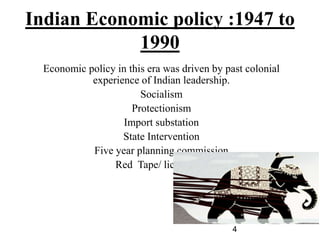
Indian Economic policy :1947 to
1990
Economic policy in this era was driven by past colonial
experience of Indian leadership.
Socialism
Protectionism
Import substation
State Intervention
Five year planning commission
Red Tape/ license raj
4
Reasons for implementing LPG
Excess of consumption and expenditure over revenue resulting in heavy govt.
borrowings.
Growing inefficiency on the use of resources.
Over protection to industries.
Growing trade deficit.
Increase in losses for public sector enterprises.
Various distortion like shortage of foreign exchange and borrowing from
abroad.
Low foreign exchange reserves.
Inflation
5
Factors that forced India for
Economic Reforms
A Balance of Payments crisis in 1991 which pushed the country
to near bankruptcy.
 The Rupee devalued and economic reforms were forced upon
India.
 India central banks foreign exchange reserves had reduced to
the point that India could barely finance three weeks’ worth of
imports.
6
Liberalization:
7
• Liberalization is a very broad term that usually refers to fewer
government regulations in the economy.
•Abolition of industrial licensing and registration.
•Freedom for expansion and production.
• Increase in the investment limit of the small industries.
• Freedom to import capital goods.
• Freedom to import technology.
• Free determination of interest rates.
Impact of these reforms:
• Average annual growth of services shifted to 8.1% during 1991-
2001 from 6.9% during 1981-1991.
• A rate of growth that will double average income in a decade.
• Rapid Growth in communication services, financial services.
• Exports of information technology enabled services particularly
strong.
8
Privatization:
Privatization means transfer of ownership and/or management of an
enterprise from the public sector to the private sector .
Privatization is opening up of an industry that has been reserved for
public sector to the private sector. to encourage efficiency, quality
and innovation in the delivery of goods and services.
9
Need for Privatization:
A sizable number of PSUs have been incurring losses
Multiplicity of authorities to whom the PSUs are accountable
Delay in projects leading to cost escalation
Inefficiency of management.
Many PSUs are over-staffed resulting in lower productivity.
10
Examples of privatization in
India:
Lagan Jute Machinery Company Limited (LJMC)
Videsh Sanchar Nigam Limited (VSNL)
Hindustan Zinc Limited (HZL)
Hotel Corporation Limited of India (HCL)
Bharat Aluminum Company limited (BALCO)
11
12
Globalization:
Globalization implies integration of the economy of the country
with the rest of the world economy and opening up of the
economy for foreign direct investment by liberalizing the rules
and regulations and by creating favorable socio-economic and
political climate for global business.
12
Features of Globalization:
Opening and planning to expand business throughout the world.
Erasing the difference between domestic market and foreign market.
Buying and selling goods and services from/to any countries in the
world.
Global orientation of organizational structure and management
culture
13
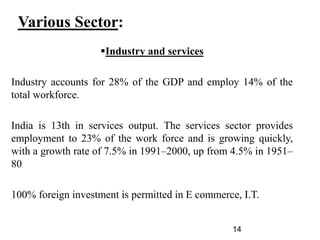
Various Sector:
Industry and services
Industry accounts for 28% of the GDP and employ 14% of the
total workforce.
India is 13th in services output. The services sector provides
employment to 23% of the work force and is growing quickly,
with a growth rate of 7.5% in 1991–2000, up from 4.5% in 1951–
80
100% foreign investment is permitted in E commerce, I.T.
14
Banking and Finance:
15
• EX-Prime Minister Indira Gandhi nationalized 14 banks in 1969,
followed by six others in 1980, and made it mandatory for banks to
provide 40% of their net credit to priority sectors like agriculture,
small-scale industry, retail trade, small businesses, etc.
• Opening up of banking & financial sector to private & foreign
banking institutions led to growth & increased compilation to
public sector banks which lead to better banking services.
•(eg. First ATM machine was introduced by HSBC in 1987 which forced public
sector banks to do same in early 2ooo s )
What India achieved from LPG?
One of the fastest growing & stable economy amongst developing
countries in the world.
India's foreign exchange reserves have steadily risen from $5.8
billion in 1991 to $319 billion in 2015
Nations GDP have grown from 3.5% in 1991 to 6.4% in 2015 as per
projected by IMF.
India stands at 134th rank among 189 Nations in world as per 2015
data, significant improvement from previous 142 position in Ease of
doing business.
16
Conclusion
Economic liberalization has increased the responsibility and role of
the private sector. At the same time, it has reduced the control of
the government in economic activities.
Future of Indian economy depends on the resolution of current
challenges like Land bill, GST (Goods & services tax), Labor law
amendment, Environment clearance bill etc with will decide the
faith Indian economy.
17
18
Challenges
Mr. Jeffrey Sachs, director of Harvard University’s center for
international development and economist, says
“Reform process in India have a long way to go. He feels that
without a focus on the “twin pillars” of social and economic
strategies, the future would be bleak for India, especially in the context
of competition all around”.
18
References
https://www.statista.com
https://www.moneycontrol.co.in
https://www.economictimes.indiatimes.com
https://www.Bloomberg.in
https://www.financialexpress.com
19
Thank you
20

Liberalisation privatisation globalisation

  • 1.
  • 2.
    CONTENTS: Introduction Reasons for implementingLPG Liberalization Privatization Globalization Conclusion Challenges 2
  • 3.
    3 Introduction: July 1991,India hastaken a series of measures to restructure its economy . The policy have salient feature which are: 1.Liberlisation (internal and external) 2.Extending Privatization 3.Globalisation of the economy Which are known as “LPG”. 3
  • 4.
    Indian Economic policy:1947 to 1990 Economic policy in this era was driven by past colonial experience of Indian leadership. Socialism Protectionism Import substation State Intervention Five year planning commission Red Tape/ license raj 4
  • 5.
    Reasons for implementingLPG Excess of consumption and expenditure over revenue resulting in heavy govt. borrowings. Growing inefficiency on the use of resources. Over protection to industries. Growing trade deficit. Increase in losses for public sector enterprises. Various distortion like shortage of foreign exchange and borrowing from abroad. Low foreign exchange reserves. Inflation 5
  • 6.
    Factors that forcedIndia for Economic Reforms A Balance of Payments crisis in 1991 which pushed the country to near bankruptcy.  The Rupee devalued and economic reforms were forced upon India.  India central banks foreign exchange reserves had reduced to the point that India could barely finance three weeks’ worth of imports. 6
  • 7.
    Liberalization: 7 • Liberalization isa very broad term that usually refers to fewer government regulations in the economy. •Abolition of industrial licensing and registration. •Freedom for expansion and production. • Increase in the investment limit of the small industries. • Freedom to import capital goods. • Freedom to import technology. • Free determination of interest rates.
  • 8.
    Impact of thesereforms: • Average annual growth of services shifted to 8.1% during 1991- 2001 from 6.9% during 1981-1991. • A rate of growth that will double average income in a decade. • Rapid Growth in communication services, financial services. • Exports of information technology enabled services particularly strong. 8
  • 9.
    Privatization: Privatization means transferof ownership and/or management of an enterprise from the public sector to the private sector . Privatization is opening up of an industry that has been reserved for public sector to the private sector. to encourage efficiency, quality and innovation in the delivery of goods and services. 9
  • 10.
    Need for Privatization: Asizable number of PSUs have been incurring losses Multiplicity of authorities to whom the PSUs are accountable Delay in projects leading to cost escalation Inefficiency of management. Many PSUs are over-staffed resulting in lower productivity. 10
  • 11.
    Examples of privatizationin India: Lagan Jute Machinery Company Limited (LJMC) Videsh Sanchar Nigam Limited (VSNL) Hindustan Zinc Limited (HZL) Hotel Corporation Limited of India (HCL) Bharat Aluminum Company limited (BALCO) 11
  • 12.
    12 Globalization: Globalization implies integrationof the economy of the country with the rest of the world economy and opening up of the economy for foreign direct investment by liberalizing the rules and regulations and by creating favorable socio-economic and political climate for global business. 12
  • 13.
    Features of Globalization: Openingand planning to expand business throughout the world. Erasing the difference between domestic market and foreign market. Buying and selling goods and services from/to any countries in the world. Global orientation of organizational structure and management culture 13
  • 14.
    Various Sector: Industry andservices Industry accounts for 28% of the GDP and employ 14% of the total workforce. India is 13th in services output. The services sector provides employment to 23% of the work force and is growing quickly, with a growth rate of 7.5% in 1991–2000, up from 4.5% in 1951– 80 100% foreign investment is permitted in E commerce, I.T. 14
  • 15.
    Banking and Finance: 15 •EX-Prime Minister Indira Gandhi nationalized 14 banks in 1969, followed by six others in 1980, and made it mandatory for banks to provide 40% of their net credit to priority sectors like agriculture, small-scale industry, retail trade, small businesses, etc. • Opening up of banking & financial sector to private & foreign banking institutions led to growth & increased compilation to public sector banks which lead to better banking services. •(eg. First ATM machine was introduced by HSBC in 1987 which forced public sector banks to do same in early 2ooo s )
  • 16.
    What India achievedfrom LPG? One of the fastest growing & stable economy amongst developing countries in the world. India's foreign exchange reserves have steadily risen from $5.8 billion in 1991 to $319 billion in 2015 Nations GDP have grown from 3.5% in 1991 to 6.4% in 2015 as per projected by IMF. India stands at 134th rank among 189 Nations in world as per 2015 data, significant improvement from previous 142 position in Ease of doing business. 16
  • 17.
    Conclusion Economic liberalization hasincreased the responsibility and role of the private sector. At the same time, it has reduced the control of the government in economic activities. Future of Indian economy depends on the resolution of current challenges like Land bill, GST (Goods & services tax), Labor law amendment, Environment clearance bill etc with will decide the faith Indian economy. 17
  • 18.
    18 Challenges Mr. Jeffrey Sachs,director of Harvard University’s center for international development and economist, says “Reform process in India have a long way to go. He feels that without a focus on the “twin pillars” of social and economic strategies, the future would be bleak for India, especially in the context of competition all around”. 18
  • 19.
  • 20.