Indian Economic policy :1947 to 1990
Economic policy in this era was driven by past
colonial experience of Indian leadership.
 Socialism
 Protectionism
 Import substitution
 State Intervention
 Five year planning commission
 Red Tape/ license raj
2
Reasons for implementing LPG
 Excess of consumption and expenditure over revenue resulting in heavy
govt. borrowings.
 Growing inefficiency on the use of resources.
 Over protection to industries.
 Growing trade deficit.
 Increase in losses for public sector enterprises.
 Various distortion like shortage of foreign exchange and borrowing from
abroad.
 Low foreign exchange reserves.
 Inflation
3
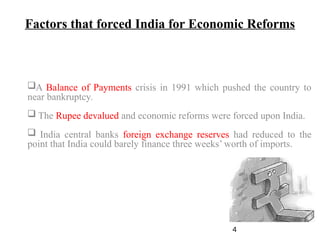
Factors that forced India for Economic Reforms
A Balance of Payments crisis in 1991 which pushed the country to
near bankruptcy.
 The Rupee devalued and economic reforms were forced upon India.
 India central banks foreign exchange reserves had reduced to the
point that India could barely finance three weeks’ worth of imports.
4
For Availing loan , IMF and World Bank
expected India to:
• Liberalise and open up the economy by removing
restrictions on the private sector,
• Reduce the role of the government in many areas
• Remove trade restrictions.
India agreed to the conditionalities of World Bank
and IMF.
Economic Reforms Since
1991- New Economic Policy
• ECONOMIC REFORMS:
Economic reforms or structural adjustment is a long-
term multi-dimensional package of various policies
and programmes for further economic development.
NEP1991:
In July 1991, Prime Minister Narasimha Rao along with
his Finance Minister Manmohan Sigh initiated the
economic liberalisation of 1991, to remove the
inefficiencies in the economic system.
OBJECTIVES OF NEP1991:
• To reduce fiscal deficit and to have relative price
stability.
• To reduce the area of operation of the public sector
and to open up more areas for the private sector.
• To liberalise industrial policy and abolish industrial
licensing for most of the private sector industries.
• To encourage inflow of foreign capital by granting
more concessions to foreign direct investment.
• To liberalise foreign trade by reducing tariff duties
and abolishing quota restrictions in case of many
imports.
Components of NEP 1991
1. MACROECONOMIC STABILISATION- demand side
management:
This is a short-run measures to return to low and stable
inflation and a sustainable fiscal and balance of payments
position.
o Control of inflation
o Fiscal correction
o Improvement in a balance of payment s situation
2.Structural adjustment –supply side
management
This is a long run measures to remove the
bottlenecks and obstacles in the growth path of an
economy. These policies includes :
Trade and capital flow reforms
Industrial deregulation
Public sector reforms and disinvestment
Financial sector reforms
The goals is to abolish controls, eliminate bureaucratic
hurdles and redtapism and make the decision
making process efficient and transparent.
NEP –Policy of Liberalisation,
Privatisation And Globalisation(LPG)
Structural reforms can be seen with
respect to:
Liberalisation
Privatisation
globalisation
LIBERALISATION
Liberalisation means removing all unnecessary
controls and restrictions like permits, licenses,
protectionist duties, quotas, etc. imposed by the
government.
In 1991, government was enforcing regulation in many
ways.
o Industrial licensing
o Private sector was not allowed in many industries.
o Some goods only produced in small scale industries.
o Price controls and control on distribution of selected
industrial products.
• Import licence.
• Foreign exchange control
• Restrictions on investment by big business house etc.
These controls resulted in:
a) Consumption delays
b) Inefficiency
c) Losses
d) High cost economy
Objectives of liberalisation
• To raise internal competitiveness of industrial
production.
• To raise foreign investment and technology.
• To reduce debt burden of the country.
• To get an opportunity to export to developed
countries and to import capital goods and
machinery from them.
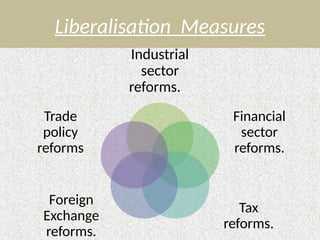
Liberalisation Measures
Industrial
sector
reforms.
Financial
sector
reforms.
Tax
reforms.
Foreign
Exchange
reforms.
Trade
policy
reforms
Industrial sector reforms
• Except for 6 industries related
to security and strategic
concerns:
a) Liquor
b) Cigarettes
c) Industrial explosives
d) Defence equipments
e) Drugs and pharmaceuticals
f) Dangerous chemicals
Abolition of
Industrial Licensing.
Contraction of public
sector.
Reforms in small
scale sector
Concessions in the
MRTP Act.
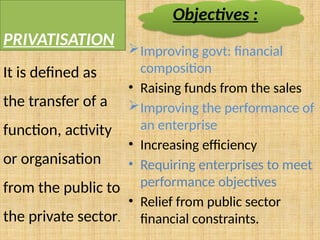
PRIVATISATION
PRIVATISATION Improving govt: financial
composition
• Raising funds from the sales
Improving the performance of
an enterprise
• Increasing efficiency
• Requiring enterprises to meet
performance objectives
• Relief from public sector
financial constraints.
It is defined as
the transfer of a
function, activity
or organisation
from the public to
the private sector.
Objectives :
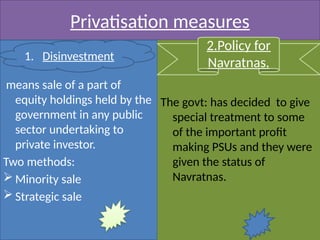
Privatisation measures
means sale of a part of
equity holdings held by the
government in any public
sector undertaking to
private investor.
Two methods:
 Minority sale
 Strategic sale
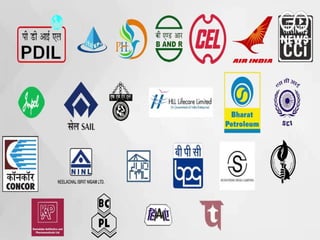
The govt: has decided to give
special treatment to some
of the important profit
making PSUs and they were
given the status of
Navratnas.
1. Disinvestment
2.Policy for
Navratnas.
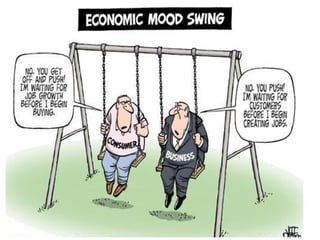
ECONOMICS
HUMOR……………
GLOBALISATION
• It refers to growing economic
interdependence among countries in the
world with regard to technology, capital,
information, goods and services etc:
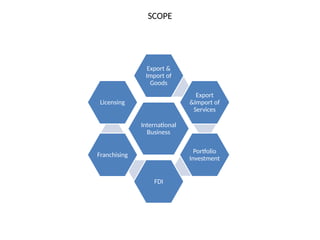
SCOPE
International
Business
Export &
Import of
Goods
Export
&Import of
Services
Portfolio
Investment
FDI
Franchising
Licensing
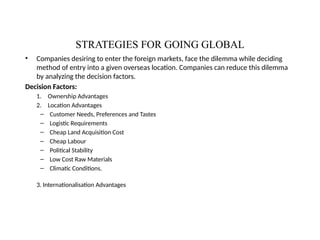
STRATEGIES FOR GOING GLOBAL
• Companies desiring to enter the foreign markets, face the dilemma while deciding
method of entry into a given overseas location. Companies can reduce this dilemma
by analyzing the decision factors.
Decision Factors:
1. Ownership Advantages
2. Location Advantages
– Customer Needs, Preferences and Tastes
– Logistic Requirements
– Cheap Land Acquisition Cost
– Cheap Labour
– Political Stability
– Low Cost Raw Materials
– Climatic Conditions.
3. Internationalisation Advantages
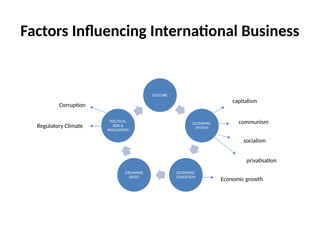
Factors Influencing International Business
CULTURE
ECONOMIC
SYSTEM
ECONOMIC
CONDITION
EXCHANGE
RATES
POLITICAL
RISK &
REGULATION
capitalism
communism
socialism
privatisation
Economic growth
Corruption
Regulatory Climate
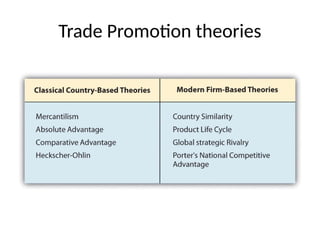
Trade Promotion theories
Case Study
https://youtu.be/32_fm92-EF8
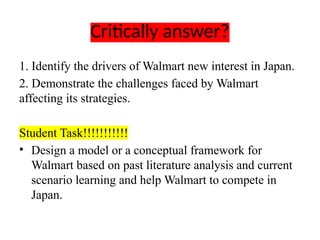
Critically answer?
1. Identify the drivers of Walmart new interest in Japan.
2. Demonstrate the challenges faced by Walmart
affecting its strategies.
Student Task!!!!!!!!!!!
• Design a model or a conceptual framework for
Walmart based on past literature analysis and current
scenario learning and help Walmart to compete in
Japan.
Case : https://youtu.be/BXXdcgchAVw
Learning Objective
• LO-1 Understand what is meant by
Globalization
• LO-2 Recognize the main drivers of
Globalization
• LO-3 Understand how the process of
Globalization is creating opportunities and
challenges for business managers.
Main Organisations for Facilitating
Globalisation
• IMF
• WORLD BANK
• WTO
Impact of LPG
• 1. Economic Growth
• 2.FDI & FII
• 3.Trade
• 4.Check on Fiscal Deficit
• 5.Check on Inflation
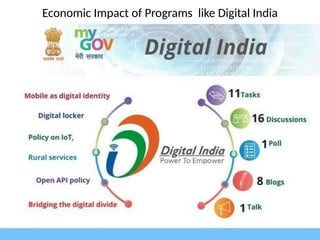
Economic Impact of Programs like Digital India
Student Activity(Case Study)
In 1991, India faced a severe balance of payments crisis, which necessitated a shift in economic
policy. The government introduced the Liberalization, Privatization, and Globalization (LPG)
policy to address the crisis and stimulate economic growth. The LPG policy marked a significant
departure from the earlier import substitution strategy and aimed to open up the Indian
economy to global markets.
Liberalization involved reducing government control over the economy, easing restrictions on
foreign trade, and allowing greater freedom for private sector enterprises. Privatization focused
on reducing state ownership in public enterprises and encouraging private sector participation.
Globalization aimed at integrating the Indian economy with the global economy by promoting
exports, attracting foreign direct investment (FDI), and participating in international trade.The
LPG policy had a transformative impact on various sectors of the Indian economy, including
manufacturing, services, and agriculture. It spurred economic growth, improved industrial
productivity, and enhanced India's global competitiveness. However, the policy also led to
challenges such as increased inequality and regional disparities.
Questions
1. Evaluate the impact of the LPG policy on India's manufacturing sector. How did
liberalization and privatization contribute to the sector's growth and global
competitiveness?
2. Discuss the social implications of the LPG policy in India. How did the policy affect income
distribution and employment opportunities, particularly in rural versus urban areas?
Test your Knowledge
• 1. How has the LPG policy affected the global
competitiveness of businesses in emerging
markets? Discuss the role of globalization in
enhancing or inhibiting competitive advantage.
• 2. What are the potential future challenges
and opportunities for economies that have
embraced the LPG policy? Predict the long-
term effects on economic stability and growth.

PPT 1 on liberalization and privati.pptx

  • 2.
    Indian Economic policy:1947 to 1990 Economic policy in this era was driven by past colonial experience of Indian leadership.  Socialism  Protectionism  Import substitution  State Intervention  Five year planning commission  Red Tape/ license raj 2
  • 3.
    Reasons for implementingLPG  Excess of consumption and expenditure over revenue resulting in heavy govt. borrowings.  Growing inefficiency on the use of resources.  Over protection to industries.  Growing trade deficit.  Increase in losses for public sector enterprises.  Various distortion like shortage of foreign exchange and borrowing from abroad.  Low foreign exchange reserves.  Inflation 3
  • 4.
    Factors that forcedIndia for Economic Reforms A Balance of Payments crisis in 1991 which pushed the country to near bankruptcy.  The Rupee devalued and economic reforms were forced upon India.  India central banks foreign exchange reserves had reduced to the point that India could barely finance three weeks’ worth of imports. 4
  • 5.
    For Availing loan, IMF and World Bank expected India to: • Liberalise and open up the economy by removing restrictions on the private sector, • Reduce the role of the government in many areas • Remove trade restrictions. India agreed to the conditionalities of World Bank and IMF.
  • 6.
    Economic Reforms Since 1991-New Economic Policy
  • 7.
    • ECONOMIC REFORMS: Economicreforms or structural adjustment is a long- term multi-dimensional package of various policies and programmes for further economic development. NEP1991: In July 1991, Prime Minister Narasimha Rao along with his Finance Minister Manmohan Sigh initiated the economic liberalisation of 1991, to remove the inefficiencies in the economic system.
  • 8.
    OBJECTIVES OF NEP1991: •To reduce fiscal deficit and to have relative price stability. • To reduce the area of operation of the public sector and to open up more areas for the private sector. • To liberalise industrial policy and abolish industrial licensing for most of the private sector industries. • To encourage inflow of foreign capital by granting more concessions to foreign direct investment. • To liberalise foreign trade by reducing tariff duties and abolishing quota restrictions in case of many imports.
  • 9.
    Components of NEP1991 1. MACROECONOMIC STABILISATION- demand side management: This is a short-run measures to return to low and stable inflation and a sustainable fiscal and balance of payments position. o Control of inflation o Fiscal correction o Improvement in a balance of payment s situation
  • 10.
    2.Structural adjustment –supplyside management This is a long run measures to remove the bottlenecks and obstacles in the growth path of an economy. These policies includes : Trade and capital flow reforms Industrial deregulation Public sector reforms and disinvestment Financial sector reforms The goals is to abolish controls, eliminate bureaucratic hurdles and redtapism and make the decision making process efficient and transparent.
  • 11.
    NEP –Policy ofLiberalisation, Privatisation And Globalisation(LPG) Structural reforms can be seen with respect to: Liberalisation Privatisation globalisation
  • 12.
    LIBERALISATION Liberalisation means removingall unnecessary controls and restrictions like permits, licenses, protectionist duties, quotas, etc. imposed by the government. In 1991, government was enforcing regulation in many ways. o Industrial licensing o Private sector was not allowed in many industries. o Some goods only produced in small scale industries. o Price controls and control on distribution of selected industrial products.
  • 13.
    • Import licence. •Foreign exchange control • Restrictions on investment by big business house etc. These controls resulted in: a) Consumption delays b) Inefficiency c) Losses d) High cost economy
  • 14.
    Objectives of liberalisation •To raise internal competitiveness of industrial production. • To raise foreign investment and technology. • To reduce debt burden of the country. • To get an opportunity to export to developed countries and to import capital goods and machinery from them.
  • 15.
  • 16.
    Industrial sector reforms •Except for 6 industries related to security and strategic concerns: a) Liquor b) Cigarettes c) Industrial explosives d) Defence equipments e) Drugs and pharmaceuticals f) Dangerous chemicals Abolition of Industrial Licensing. Contraction of public sector. Reforms in small scale sector Concessions in the MRTP Act.
  • 17.
  • 18.
    PRIVATISATION Improving govt:financial composition • Raising funds from the sales Improving the performance of an enterprise • Increasing efficiency • Requiring enterprises to meet performance objectives • Relief from public sector financial constraints. It is defined as the transfer of a function, activity or organisation from the public to the private sector. Objectives :
  • 19.
    Privatisation measures means saleof a part of equity holdings held by the government in any public sector undertaking to private investor. Two methods:  Minority sale  Strategic sale The govt: has decided to give special treatment to some of the important profit making PSUs and they were given the status of Navratnas. 1. Disinvestment 2.Policy for Navratnas.
  • 22.
  • 23.
    GLOBALISATION • It refersto growing economic interdependence among countries in the world with regard to technology, capital, information, goods and services etc:
  • 24.
    SCOPE International Business Export & Import of Goods Export &Importof Services Portfolio Investment FDI Franchising Licensing
  • 27.
    STRATEGIES FOR GOINGGLOBAL • Companies desiring to enter the foreign markets, face the dilemma while deciding method of entry into a given overseas location. Companies can reduce this dilemma by analyzing the decision factors. Decision Factors: 1. Ownership Advantages 2. Location Advantages – Customer Needs, Preferences and Tastes – Logistic Requirements – Cheap Land Acquisition Cost – Cheap Labour – Political Stability – Low Cost Raw Materials – Climatic Conditions. 3. Internationalisation Advantages
  • 28.
    Factors Influencing InternationalBusiness CULTURE ECONOMIC SYSTEM ECONOMIC CONDITION EXCHANGE RATES POLITICAL RISK & REGULATION capitalism communism socialism privatisation Economic growth Corruption Regulatory Climate
  • 29.
  • 30.
  • 31.
    Critically answer? 1. Identifythe drivers of Walmart new interest in Japan. 2. Demonstrate the challenges faced by Walmart affecting its strategies. Student Task!!!!!!!!!!! • Design a model or a conceptual framework for Walmart based on past literature analysis and current scenario learning and help Walmart to compete in Japan.
  • 32.
  • 33.
    Learning Objective • LO-1Understand what is meant by Globalization • LO-2 Recognize the main drivers of Globalization • LO-3 Understand how the process of Globalization is creating opportunities and challenges for business managers.
  • 34.
    Main Organisations forFacilitating Globalisation • IMF • WORLD BANK • WTO
  • 35.
    Impact of LPG •1. Economic Growth • 2.FDI & FII • 3.Trade • 4.Check on Fiscal Deficit • 5.Check on Inflation
  • 36.
    Economic Impact ofPrograms like Digital India
  • 37.
    Student Activity(Case Study) In1991, India faced a severe balance of payments crisis, which necessitated a shift in economic policy. The government introduced the Liberalization, Privatization, and Globalization (LPG) policy to address the crisis and stimulate economic growth. The LPG policy marked a significant departure from the earlier import substitution strategy and aimed to open up the Indian economy to global markets. Liberalization involved reducing government control over the economy, easing restrictions on foreign trade, and allowing greater freedom for private sector enterprises. Privatization focused on reducing state ownership in public enterprises and encouraging private sector participation. Globalization aimed at integrating the Indian economy with the global economy by promoting exports, attracting foreign direct investment (FDI), and participating in international trade.The LPG policy had a transformative impact on various sectors of the Indian economy, including manufacturing, services, and agriculture. It spurred economic growth, improved industrial productivity, and enhanced India's global competitiveness. However, the policy also led to challenges such as increased inequality and regional disparities. Questions 1. Evaluate the impact of the LPG policy on India's manufacturing sector. How did liberalization and privatization contribute to the sector's growth and global competitiveness? 2. Discuss the social implications of the LPG policy in India. How did the policy affect income distribution and employment opportunities, particularly in rural versus urban areas?
  • 38.
    Test your Knowledge •1. How has the LPG policy affected the global competitiveness of businesses in emerging markets? Discuss the role of globalization in enhancing or inhibiting competitive advantage. • 2. What are the potential future challenges and opportunities for economies that have embraced the LPG policy? Predict the long- term effects on economic stability and growth.