Globalization
• According to IMF globalization stands for ‘the
growing economic interdependence of
countries worldwide through increasing
volume and variety of cross-border
transactions in goods and services and of
international capital flows, and also through
the more rapid and widespread diffusion of
technology’.
Drivers Of Globalization
• 1.International trade (lower trade barriers and
more competition)
• 2.Financial flows (FDI ,Management, Debt)
• 3.Communication.
• 4.Technological advances in transportation
,electronics, bioengineering and related fields.
• 5.Population.
Pre-reform
• The role of public sector sharply by reserving
as many as 18 areas exclusively for the public
sector.
• Thus, most critical and important areas of oil,
power, heavy equipments, telecom, etc., were
exclusively in the domain of public sector.
Pre-reform
• Private companies were highly regulated
through the MRTP act and similarly foreign
companies were regulated through the for
FERA.
• The Pre-1991 policies had price regulation for
industrial goods with prices of steel, cement
and other basic goods controlled by the
government.
Reasons For Economic Reform
• After Independence in 1947 Indian
government faced a problem to develop
economy and to solve the issues.
• Five Years Plan
• The low annual growth rate of the economy
of India before 1980, which stagnated around
3.5% from 1950s to 1980s, while per capita
income averaged 1.3%.
Reasons For Economic Reform
• The industrial sector was highly regulated,
bureaucratic controls and subject to strict
licensing system by the government with need for
a license for any industrial activity, besides the
need for compulsory registration before
commencing the business.
• Rupee was depreciated.
• India’s oil import bill was growing, exports
slumped , credit dried up and investors took their
money out because of this economic crisis.
Globalization In India
• “No power on earth can stop an idea whose
time has come.” said then financial minister
Manmohan Singh quoting Victor Hugo while
presenting the Union Budget on 24 July 1991.
What Is LPG?
• The LPG in India initiated in 1991,of the
country’s economic policies, with the goal of
making the economy more market and
service-oriented and expanding the role of
private and foreign investment.
1. LIBERRALISATION – Flexible policies like
dilution of MRTP Act, Reduction in rate of
import duties, in control on foreign exchange,
Financial and banking sector reforms etc.
What Is LPG?
2. PRIVATISATION – Privatization is defined as
when the control of economic is sifted from
public to a private hand.
3. GLOBALIZATION – The processs by which
regional economices,societies,and cultures
have become integrated through a global
network of communication.
EFFECTS OF LPG
• Dr. Manmohan Singh, former finance minister
and P.V Narshimha Rao opened the way of
free economy in the country which lead to the
great development of country.
• Various private companies entered into the
market.
EFFECTS OF LPG
• The model by passes agro based industries which
are a major source of generation of employment
for the masses.
• By permitting free entry of the multinational
corporations in the consumer goods sector.
• Greater freedom for doing business outside the
govt control, reduced the role for public sector.
• De-reserving areas and larger role for private
sector.
GDP
• India’s GDP stood at $266,502 million in 1991.
India’s GDP crossed the $2.65 trillion mark in
2017. Currently, the country is ranked sixth in
the world in terms of nominal GDP.
Foreign Direct Investment
• Before 1991, foreign investment was
negligible. The first year of reform saw a total
foreign investment of only $74 million.
However, investment have steadily risen since
then, As of 31 March 2016,the country has
received total FDI of $ 371 billion, since 1991.
USD 60.1 billion in 2016-17, which was an all-
time high.
Foreign Reserve
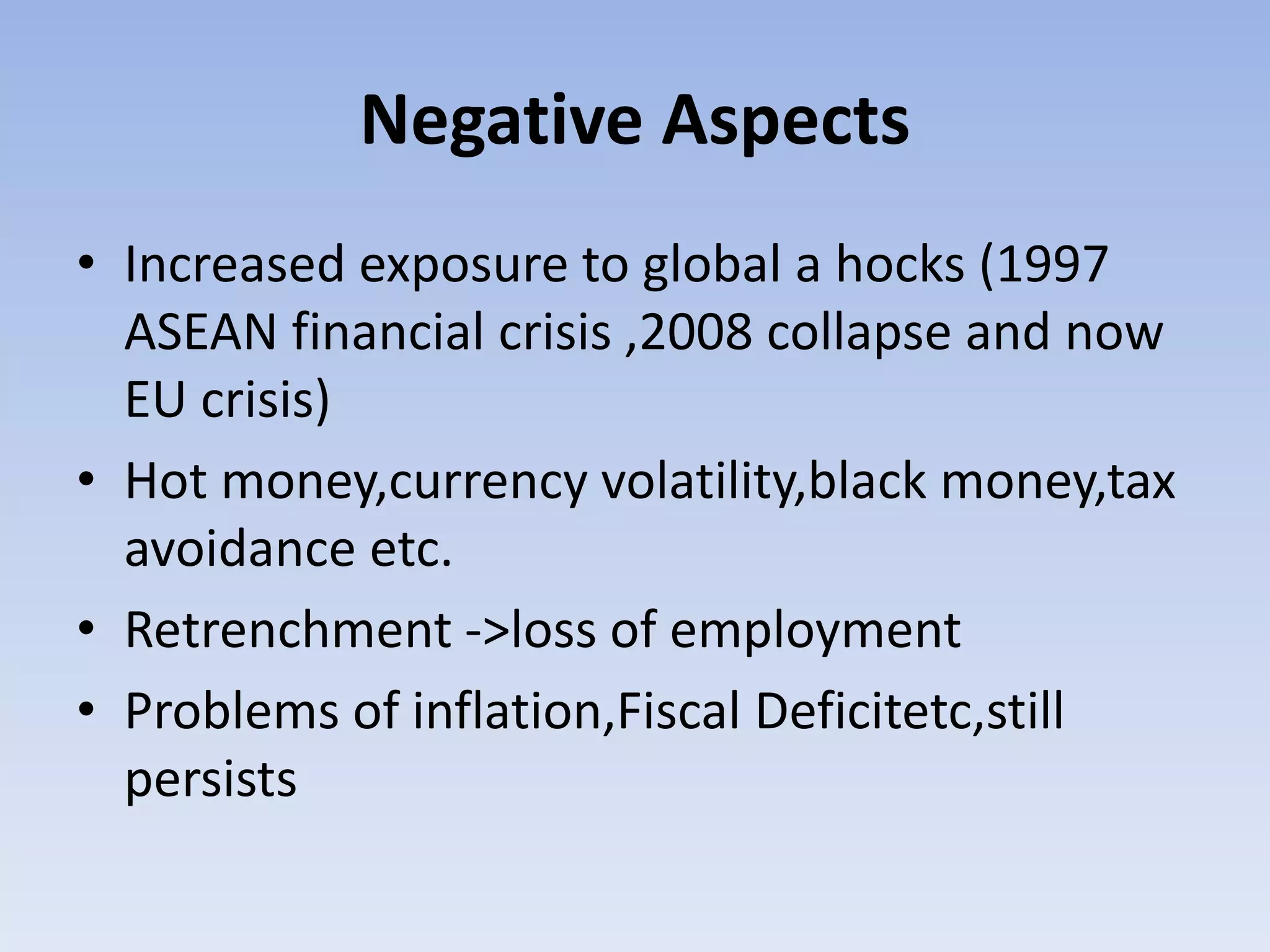
• Foreign Exchange Reserves USD 1.2 billion in
1991. After 26 years later averaged reaching
an all time high of 422.533 USD billion in
March of 2018 and a record low of 29.048
USD Million in September of 1998.
Stock Market
• The 30-share index was lingering around the
1000-level in 1991 before crossing the 4,000
mark the next year. Since then, the Sensex has
risen steadily to reach 29,310 points by the
end of Fiscal Year 2017.
Purchasing Power Parity
• In 1991, per capita PPP was
$1,173. After 26 years late is
$6,570.6 in 2017.
Labor Force And Employment
• India's Population reached 1,316.0 million
people in Mar 2018.In 1991, it stood at 337
million. More or less two-fifth of population is
part of the labor force. The most important
fact is that the decline in unemployment rate
over the last 25 years is only marginal – from
4.3% in 1991 to 3.6% in 2017.
Negative Aspects
• Increased exposure to global a hocks (1997
ASEAN financial crisis ,2008 collapse and now
EU crisis)
• Hot money,currency volatility,black money,tax
avoidance etc.
• Retrenchment ->loss of employment
• Problems of inflation,Fiscal Deficitetc,still
persists
Negative Aspects
• It was expected that the new industrial policy, unveiled in 1991,
would bring boom in manufacturing sector in India and India would
soon take its place among the manufacturing powers of east asia.it
didn’t happen.
• Economic Liberalization has failed
to provide secure and secant jobs to
the mass of the population.
• Jobless growth
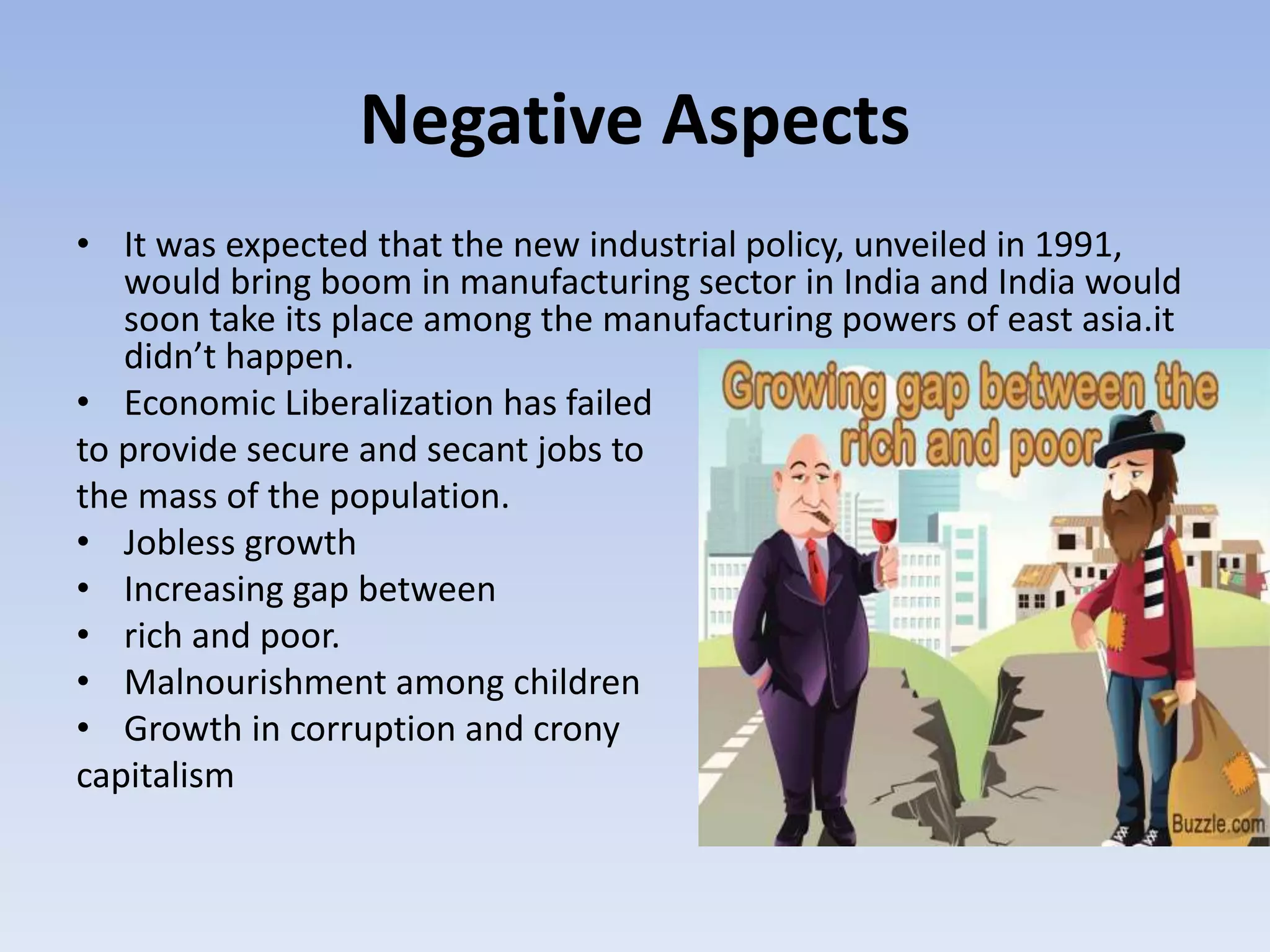
• Increasing gap between
• rich and poor.
• Malnourishment among children
• Growth in corruption and crony
capitalism
Future
• By 2025 the India’s economy is projected to be
about 60 per cent the size of the US economy.
• The transformation into a tri-polar economy
will be complete by 2035, with the Indian
economy only a little smaller than the US
economy but larger than that of western
Europe.
Future
• By 2035, India is likely to be a larger growth
driver than the six largest countries in the
EU,though its impact will be a little over half
that of the US.
• India, which is now the fourth largest
economy in terms of purchasing power parity,
will overtake Japan and become third major
economic power within 10 years.
• One belt one road.
• We have everything by globalization, we have
nothing by globalization. - ANONYMOUS

Globalization India

  • 2.
    Globalization • According toIMF globalization stands for ‘the growing economic interdependence of countries worldwide through increasing volume and variety of cross-border transactions in goods and services and of international capital flows, and also through the more rapid and widespread diffusion of technology’.
  • 3.
    Drivers Of Globalization •1.International trade (lower trade barriers and more competition) • 2.Financial flows (FDI ,Management, Debt) • 3.Communication. • 4.Technological advances in transportation ,electronics, bioengineering and related fields. • 5.Population.
  • 4.
    Pre-reform • The roleof public sector sharply by reserving as many as 18 areas exclusively for the public sector. • Thus, most critical and important areas of oil, power, heavy equipments, telecom, etc., were exclusively in the domain of public sector.
  • 5.
    Pre-reform • Private companieswere highly regulated through the MRTP act and similarly foreign companies were regulated through the for FERA. • The Pre-1991 policies had price regulation for industrial goods with prices of steel, cement and other basic goods controlled by the government.
  • 6.
    Reasons For EconomicReform • After Independence in 1947 Indian government faced a problem to develop economy and to solve the issues. • Five Years Plan • The low annual growth rate of the economy of India before 1980, which stagnated around 3.5% from 1950s to 1980s, while per capita income averaged 1.3%.
  • 7.
    Reasons For EconomicReform • The industrial sector was highly regulated, bureaucratic controls and subject to strict licensing system by the government with need for a license for any industrial activity, besides the need for compulsory registration before commencing the business. • Rupee was depreciated. • India’s oil import bill was growing, exports slumped , credit dried up and investors took their money out because of this economic crisis.
  • 8.
    Globalization In India •“No power on earth can stop an idea whose time has come.” said then financial minister Manmohan Singh quoting Victor Hugo while presenting the Union Budget on 24 July 1991.
  • 9.
    What Is LPG? •The LPG in India initiated in 1991,of the country’s economic policies, with the goal of making the economy more market and service-oriented and expanding the role of private and foreign investment. 1. LIBERRALISATION – Flexible policies like dilution of MRTP Act, Reduction in rate of import duties, in control on foreign exchange, Financial and banking sector reforms etc.
  • 10.
    What Is LPG? 2.PRIVATISATION – Privatization is defined as when the control of economic is sifted from public to a private hand. 3. GLOBALIZATION – The processs by which regional economices,societies,and cultures have become integrated through a global network of communication.
  • 11.
    EFFECTS OF LPG •Dr. Manmohan Singh, former finance minister and P.V Narshimha Rao opened the way of free economy in the country which lead to the great development of country. • Various private companies entered into the market.
  • 12.
    EFFECTS OF LPG •The model by passes agro based industries which are a major source of generation of employment for the masses. • By permitting free entry of the multinational corporations in the consumer goods sector. • Greater freedom for doing business outside the govt control, reduced the role for public sector. • De-reserving areas and larger role for private sector.
  • 13.
    GDP • India’s GDPstood at $266,502 million in 1991. India’s GDP crossed the $2.65 trillion mark in 2017. Currently, the country is ranked sixth in the world in terms of nominal GDP.
  • 14.
    Foreign Direct Investment •Before 1991, foreign investment was negligible. The first year of reform saw a total foreign investment of only $74 million. However, investment have steadily risen since then, As of 31 March 2016,the country has received total FDI of $ 371 billion, since 1991. USD 60.1 billion in 2016-17, which was an all- time high.
  • 15.
    Foreign Reserve • ForeignExchange Reserves USD 1.2 billion in 1991. After 26 years later averaged reaching an all time high of 422.533 USD billion in March of 2018 and a record low of 29.048 USD Million in September of 1998.
  • 16.
    Stock Market • The30-share index was lingering around the 1000-level in 1991 before crossing the 4,000 mark the next year. Since then, the Sensex has risen steadily to reach 29,310 points by the end of Fiscal Year 2017.
  • 17.
    Purchasing Power Parity •In 1991, per capita PPP was $1,173. After 26 years late is $6,570.6 in 2017.
  • 18.
    Labor Force AndEmployment • India's Population reached 1,316.0 million people in Mar 2018.In 1991, it stood at 337 million. More or less two-fifth of population is part of the labor force. The most important fact is that the decline in unemployment rate over the last 25 years is only marginal – from 4.3% in 1991 to 3.6% in 2017.
  • 19.
    Negative Aspects • Increasedexposure to global a hocks (1997 ASEAN financial crisis ,2008 collapse and now EU crisis) • Hot money,currency volatility,black money,tax avoidance etc. • Retrenchment ->loss of employment • Problems of inflation,Fiscal Deficitetc,still persists
  • 20.
    Negative Aspects • Itwas expected that the new industrial policy, unveiled in 1991, would bring boom in manufacturing sector in India and India would soon take its place among the manufacturing powers of east asia.it didn’t happen. • Economic Liberalization has failed to provide secure and secant jobs to the mass of the population. • Jobless growth • Increasing gap between • rich and poor. • Malnourishment among children • Growth in corruption and crony capitalism
  • 21.
    Future • By 2025the India’s economy is projected to be about 60 per cent the size of the US economy. • The transformation into a tri-polar economy will be complete by 2035, with the Indian economy only a little smaller than the US economy but larger than that of western Europe.
  • 22.
    Future • By 2035,India is likely to be a larger growth driver than the six largest countries in the EU,though its impact will be a little over half that of the US. • India, which is now the fourth largest economy in terms of purchasing power parity, will overtake Japan and become third major economic power within 10 years.
  • 23.
    • One beltone road.
  • 24.
    • We haveeverything by globalization, we have nothing by globalization. - ANONYMOUS