A
 PRESENTATION
      ON
LIBERALISATION               LIBERALISATION

             Institute

Shri. Patel Kelavni Mandal College
    Of Tech. & B.ed Junagadh
             2010 - 2011
Kelvin Bhalodiya
Jaydeep Bhalani
Nehal Godhasara
Divyesh Chauhan
Prashant Jivani
INTRODUCTION
The industrial policy was announced on July 24, 1991 by
the government, headed by prime minister P.V Narasimha
Rao. The New Industrial Policy (NIP) was a big departure
from the erstwhile industrial policy.

The important objectives are:

(a) The key objective of industrial policy was rapid
    industrialisation of the country.
(b) to maintain sustained growth in the productivity and
    gainful employment, and
(c) to attain international competitiveness. Therefore, the
    basic philosophy of the New IP, 1991 has been the
    continuity with change.
These changes pertain broadly to five areas viz.,
(a) Industrial licensing.
(b) Public sector policy.
(c) MRTP Act, 1969.
(d) Foreign investment.
(e) Foreign technology agreements.

The new government assumed office in June 1991. it
made a decision to organize sale of gold.

The exchange rate of the rupee was adjusted, and massive
devaluation of the rupee was carried against major
currencies to improve the trade and payment situation. In
this situation, India needed major economic overhauling.
DEFINATION OF L.P.G.
Liberalisation

 Liberalisation refers to relaxation of previous
government restrictions usually in areas of social and
economic policies.

Thus, when government liberalizes trade it means it has
removed the tariff, subsidies and other restrictions on the
flow of goods and services between countries.
Privatisation

 It refers to the transfer of assets or service functions
  from public to private ownership or control and the
  opening of the hitherto closed areas to private sector
  entry.

  Privatisation can be achieved on many ways-
  franchising, leasing, contracting and divesture.
Globalisation


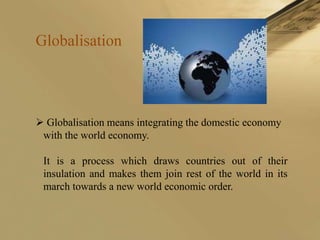
 Globalisation means integrating the domestic economy
 with the world economy.

 It is a process which draws countries out of their
 insulation and makes them join rest of the world in its
 march towards a new world economic order.
Reason for implementing LPG
 Various distortions like poor technological development
  shortage of foreign exchanges; and imprudent borrowings
  from abroad and mismanagement of foreign exchange
  reserves.

 Low foreign exchange reserves.

 Burden of national debt.

 Inflation.
Introduction of Liberalisation
 The economic liberalisation in India refers to
 ongoing economic reforms in India that started on 24
 July 1991. After Independence in 1947, India adhered
 to socialist policies. In the 1980s, Prime Minister Rajiv
 Gandhi initiated some reforms.

  In 1991, after India faced a balance of payments crisis,
  it had to sell 67 tons of gold to the International
  Monetary Fund (IMF) as part of a bailout deal, and
  promise economic restructuring.

  The government of P. V. Narasimha Rao and his finance
  minister Manmohan Singh (the present Prime Minister)
  started breakthrough reforms.
The new neo-liberal policies included opening for
international trade and investment, deregulation, initiation
of privatization, tax reforms, and inflation-controlling
measures.

The main objective of the government was to transform
the economic system from socialism to capitalism so as to
achieve high economic growth and industrialize the nation
for the well-being of Indian citizens. Today India is
mainly characterized as a market economy.
Meaning
 Liberalisation of the economy means to free it from
 direct or physical controls imposed by the government.

  Economic reforms were based on the assumption that
  market forces could guide the economy in a more
  effective manner than government control.

  Examples of one of other undeveloped countries like
  Korea, Thailand, Singapore, etc.

  That had achieved rapid economic development as a
  result of liberalization were kept in consideration.
What made India to liberalize

 A Balance of Payments crisis in 1991 which pushed the
country to near bankruptcy.

 The Rupee devalued and economic reforms were
forced upon India.

 India central bank had refused new credit and foreign
exchange reserves had reduced to the point that India
could barely finance three weeks’ worth of imports
Reforms taken during Liberalisation

 Abolition of industrial licensing and registration

 Liberalizing the MRTP act

 Freedom for expansion and production

 Increase in the investment limit of the small industries

 Freedom to import capital goods

 Freedom to import technology

 Free determination of interest rates
Impact of these reforms

 Average annual growth of services shifted to 8.1%
  during 1991-2001 from 6.9% during 1981-1991.

 A rate of growth that will double average income in a
  decade.

 Rapid Growth in communication services, financial
  services, business service & community services.

 Exports of information technology enabled services
  particularly strong.
Industrial licensing
     Industrial licensing is governed by industries
(Development and Regulation) act 1951. it is a very
effective tool used by the government to regulate the
private sector.

It abolished all industrial licensing, irrespective of the
level of investment, except for 18 industries related to
security and strategic concern, social reasons, concerns
related to safety and overriding environment issues,
manufacture of products of hazardous nature and articles
of elitist consumption.
Later, this list was trimmed, and as of now license is
required only for 6 items listed in Annexure II. These are
as follows.


1. Distillation and brewing of alcoholic drinks.
2. Cigars and cigarettes of tobacco and manufactured
   tobacco substitutes.
3. Electronic Aerospace and defense equipment.
4. Industrial explosives including detonating fuses,
   safety fuses, gun powder, nitrocellulose and matches.
5. Hazardous chemicals.
6. Drugs and pharmaceuticals.
Public Sector
The statement of industry policy 1991 reduce the list of
industries reserved for the public sector to eight from 70
and further for more area where de resaved which
trimmed the list of four.

Public sector monopoly was limited only for 8 industries
of security and strategic relevance. This was also later
trimmed and only railways, arms and ammunition and
allied items of defence equipments, defence aircraft and
warships, atomic energy, minerals specified in the
schedule to the atomic energy, remained. Presently, only 2
sector are under public sector monopoly: Atomic energy
& Railway transport.
Various Sector
A. Industry and services

Industry accounts for 28% of the GDP and employ 14%
of the total workforce.

The Indian industrial sector underwent significant
changes as a result of the economic reforms of
1991, which removed import restrictions, brought in
foreign competition, led to privatisation of certain public
sector industries.
India is 13th in services output. The services sector
provides employment to 23% of the work force and is
growing quickly, with a growth rate of 7.5% in 1991–
2000, up from 4.5% in 1951–80.

Even sectors like Insurance which were earlier reserved
for public sector were not only opened for private sector,
when foreign investment was allowed up to 26%.

Under the 1997, WTO financial servicers agreement,
India is committed to permit 12 foreign bank branches
annually.
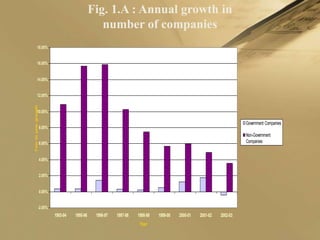
Fig. 1.A : Annual growth in
                                                     number of companies
             18.00%


             16.00%


             14.00%


             12.00%
Year to year growth


             10.00%

                                                                                                                         Government Companies
                      8.00%
                                                                                                                         Non-Government
                      6.00%                                                                                              Companies


                      4.00%


                      2.00%


                      0.00%


                 -2.00%
                              1993-94   1995-96    1996-97   1997-98   1998-99   1999-00   2000-01   2001-02   2002-03
                                                                        Year
100% foreign investment is permitted in information
technology Unit setup exclusively for exports.

100% of FDI is allowed in E commerce. Automatic
approval is allowed for Foreign equity in software &
almost all area of Electronics.
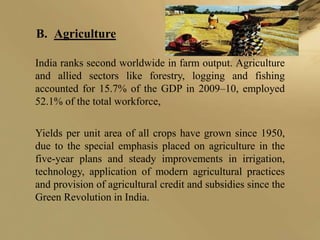
B. Agriculture

India ranks second worldwide in farm output. Agriculture
and allied sectors like forestry, logging and fishing
accounted for 15.7% of the GDP in 2009–10, employed
52.1% of the total workforce,

Yields per unit area of all crops have grown since 1950,
due to the special emphasis placed on agriculture in the
five-year plans and steady improvements in irrigation,
technology, application of modern agricultural practices
and provision of agricultural credit and subsidies since the
Green Revolution in India.
India is the largest producer in the world of milk, jute and
pulses, and also has the world's second largest cattle
population with 175 million animals in 2008.

It is the second largest producer of rice, wheat, sugarcane,
cotton and groundnuts, as well as the second largest fruit
and vegetable producer, accounting for 10.9% and 8.6%
of the world fruit and vegetable production respectively.
C. Banking and finance


Prime Minister Indira Gandhi nationalized 14 banks in
1969, followed by six others in 1980, and made it
mandatory for banks to provide 40% of their net credit to
priority sectors like agriculture, small-scale industry, retail
trade, small businesses, etc.

To ensure that the banks fulfill their social and
developmental goals. Since then, the number of bank
branches has increased from 8,260 in 1969 to 72,170 in
2007 and the population covered by a branch decreased
from 63,800 to 15,000 during the same period.
India's gross domestic saving in 2006–07 as a percentage
of GDP stood at a high 32.7%. More than half of personal
savings are invested in physical assets such as land,
houses, cattle, and gold.

The public sector banks hold over 75% of total assets of
the banking industry, with the private and foreign banks
holding 18.2% and 6.5% respectively.

Since liberalisation, the government has approved
significant banking reforms.
MRTP Act, 1969
MRTP Act, 1969 The New Industrial Policy, 1991
proposes to amend suitably the Monopolies and
Restrictive Trade Practices Act, 1969.
MRTP can be divine into four part :
1. Monopolistic practices
2. Restrictive trade practices
3. Unfair tread practices
4. Controlling the concentration of economic power.
Principle objective of MRTP act are as under:
1. Prevention of concentration of economic power &
    control of monopolies
2. Prohibition of monopolistic, restrictive and unfair
    trade practices.
This restricted the growth of Indian industry and units like
TISCO,TELCO,HINDALCO and Ranbaxy, which
through having the capacity to become global players,
remained confined to India, producing substandard goods.

In 1991, the MRTP Act was restructured and pre-entry
restrictions removed with respect to new undertaking,
expansion ,amalgamation, merger, takeover, registration,
etc.
Foreign investment

The 1956 Industrial policy accepted the role of foreign
equity, since independence we have always looked at
foreign equity as some sort of economic slavery.

But in last 50 years, the enormous underutilization of
resources, unemployment, poor infrastructure and
pervasive poverty compelled the government to open the
doors for foreign equity.
Today, India welcomes foreign equity in almost every
sector. In 1991, it allowed:

1) Automatic approval for foreign equity participation up
   to 51% granted to high priority industries listed every
   in Annexure IV.
2) Foreign trading companies are allowed to invest up to
   51% in Indian trading house engaged in export
   activity.
3) In hotel and tourism related industry, up to 51%
   foreign equity is allowed.
4) Even in the mining sector foreign investment up to
   50% was allowed.
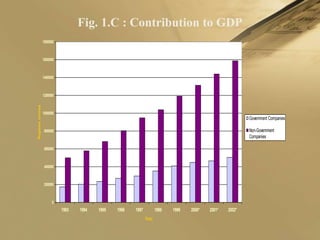
Fig. 1.C : Contribution to GDP
                1800000


                1600000


                1400000


                1200000
Rupees crores


                1000000
                                                                                                          Government Companies

                800000                                                                                    Non-Government
                                                                                                          Companies

                600000


                400000


                200000


                     0
                          1993   1994   1995   1996   1997          1998   1999   2000*   2001*   2002*
                                                             Year
Foreign Technology Agreements
Foreign Technology Agreements The New Industrial
Policy proposes to give automatic permission for foreign
technology agreements in identified high priority
industries. Further, it also proposes to allow other
industries to import foreign technology subject to the
fulfillment of certain conditions.
•The RBI grants automatic approval by the means of the
regional offices to Indian industries for foreign
technology collaboration
•The royalty period should not exceed 7 years from the
date of starting of the business or 10 years from the date
mentioned in the agreement
Balance of payments
Since independence, India's balance of payments on its
current account has been negative. Since economic
liberalisation in the 1990s, precipitated by a balance of
payment crisis.

India's exports rose consistently, covering 80.3% of its
imports in 2002–03, up from 66.2% in 1990–91.However,
the global economic slump followed by a general
deceleration in world trade saw the exports as a
percentage of imports drop to 61.4% in 2008–09.
India's growing oil import bill is seen as the main driver
behind the large current account deficit, which rose to
$118.7 billion, or 9.7% of GDP, in 2008–09. Between
January and October 2010, India imported $82.1 billion
worth of crude oil.

India's reliance on external assistance and concessional
debt has decreased since liberalisation of the economy,
and the debt service ratio decreased from 35.3% in 1990–
91 to 4.4% in 2008–09.

In India, External Commercial Borrowings (ECBs), or
commercial loans from non-resident lenders, are being
permitted by the Government for providing an additional
source of funds to Indian corporate. India's foreign
exchange reserves have steadily risen from $5.8 billion in
March 1991 to $283.5 billion in December 2009.
Challenges Ahead
1) Governance
    Need for elimination of large number of Rules &
      Regulations in the books
    Sharply reducing the number of implementing
      agencies
    Moving towards single window clearance
2) Infrastructure: A Challenge and an opportunity
CONCLUSION

The New Industrial Policy, 1991 certainly differs
significantly from the earlier philosophies, approaches,
etc. of the government. For instance, prior to 1991, scope
of public sector was expanded by reserving more number
of industries for the public sector.

But now, its scope has been reduced drastically by
reducing the number of industries reserved for the public
sector. Like this, a large number of changes can be noticed
in the new policy.
This process has been continuing even in post
liberalization era. Adding to this, the government has
taken a number of steps to give effect to its policy
decisions included in the New Industrial Policy, 1991.

Though the economy has been benefited significantly
from these measures, the economy has not been able to
reap the full benefits of the Economic Reform Package
owing to the political instability, etc.
Arguments in the favor of
          Liberalization

 Increase in rate of economic growth
 Increase in competitiveness of industrial sector
 Reduction in poverty and inequality
 Fall in fiscal deficit
 Control on prices
 Decline in deficit of BOP
 Increase in Efficiency
Arguments in the Against of
        Liberalization
 Less importance to agriculture.
 Pressure by IMF and World Bank.
 More depending on Foreign Debt.
 Dependence on Foreign technology.
 Problem of Unemployment.
Liaberalisation ppt

Liaberalisation ppt

  • 1.
    A PRESENTATION ON LIBERALISATION LIBERALISATION Institute Shri. Patel Kelavni Mandal College Of Tech. & B.ed Junagadh 2010 - 2011
  • 2.
    Kelvin Bhalodiya Jaydeep Bhalani NehalGodhasara Divyesh Chauhan Prashant Jivani
  • 4.
    INTRODUCTION The industrial policywas announced on July 24, 1991 by the government, headed by prime minister P.V Narasimha Rao. The New Industrial Policy (NIP) was a big departure from the erstwhile industrial policy. The important objectives are: (a) The key objective of industrial policy was rapid industrialisation of the country. (b) to maintain sustained growth in the productivity and gainful employment, and (c) to attain international competitiveness. Therefore, the basic philosophy of the New IP, 1991 has been the continuity with change.
  • 5.
    These changes pertainbroadly to five areas viz., (a) Industrial licensing. (b) Public sector policy. (c) MRTP Act, 1969. (d) Foreign investment. (e) Foreign technology agreements. The new government assumed office in June 1991. it made a decision to organize sale of gold. The exchange rate of the rupee was adjusted, and massive devaluation of the rupee was carried against major currencies to improve the trade and payment situation. In this situation, India needed major economic overhauling.
  • 6.
    DEFINATION OF L.P.G. Liberalisation Liberalisation refers to relaxation of previous government restrictions usually in areas of social and economic policies. Thus, when government liberalizes trade it means it has removed the tariff, subsidies and other restrictions on the flow of goods and services between countries.
  • 7.
    Privatisation  It refersto the transfer of assets or service functions from public to private ownership or control and the opening of the hitherto closed areas to private sector entry. Privatisation can be achieved on many ways- franchising, leasing, contracting and divesture.
  • 8.
    Globalisation  Globalisation meansintegrating the domestic economy with the world economy. It is a process which draws countries out of their insulation and makes them join rest of the world in its march towards a new world economic order.
  • 9.
    Reason for implementingLPG  Various distortions like poor technological development shortage of foreign exchanges; and imprudent borrowings from abroad and mismanagement of foreign exchange reserves.  Low foreign exchange reserves.  Burden of national debt.  Inflation.
  • 11.
    Introduction of Liberalisation The economic liberalisation in India refers to ongoing economic reforms in India that started on 24 July 1991. After Independence in 1947, India adhered to socialist policies. In the 1980s, Prime Minister Rajiv Gandhi initiated some reforms. In 1991, after India faced a balance of payments crisis, it had to sell 67 tons of gold to the International Monetary Fund (IMF) as part of a bailout deal, and promise economic restructuring. The government of P. V. Narasimha Rao and his finance minister Manmohan Singh (the present Prime Minister) started breakthrough reforms.
  • 12.
    The new neo-liberalpolicies included opening for international trade and investment, deregulation, initiation of privatization, tax reforms, and inflation-controlling measures. The main objective of the government was to transform the economic system from socialism to capitalism so as to achieve high economic growth and industrialize the nation for the well-being of Indian citizens. Today India is mainly characterized as a market economy.
  • 13.
    Meaning  Liberalisation ofthe economy means to free it from direct or physical controls imposed by the government. Economic reforms were based on the assumption that market forces could guide the economy in a more effective manner than government control. Examples of one of other undeveloped countries like Korea, Thailand, Singapore, etc. That had achieved rapid economic development as a result of liberalization were kept in consideration.
  • 14.
    What made Indiato liberalize  A Balance of Payments crisis in 1991 which pushed the country to near bankruptcy.  The Rupee devalued and economic reforms were forced upon India.  India central bank had refused new credit and foreign exchange reserves had reduced to the point that India could barely finance three weeks’ worth of imports
  • 15.
    Reforms taken duringLiberalisation  Abolition of industrial licensing and registration  Liberalizing the MRTP act  Freedom for expansion and production  Increase in the investment limit of the small industries  Freedom to import capital goods  Freedom to import technology  Free determination of interest rates
  • 16.
    Impact of thesereforms  Average annual growth of services shifted to 8.1% during 1991-2001 from 6.9% during 1981-1991.  A rate of growth that will double average income in a decade.  Rapid Growth in communication services, financial services, business service & community services.  Exports of information technology enabled services particularly strong.
  • 18.
    Industrial licensing Industrial licensing is governed by industries (Development and Regulation) act 1951. it is a very effective tool used by the government to regulate the private sector. It abolished all industrial licensing, irrespective of the level of investment, except for 18 industries related to security and strategic concern, social reasons, concerns related to safety and overriding environment issues, manufacture of products of hazardous nature and articles of elitist consumption.
  • 19.
    Later, this listwas trimmed, and as of now license is required only for 6 items listed in Annexure II. These are as follows. 1. Distillation and brewing of alcoholic drinks. 2. Cigars and cigarettes of tobacco and manufactured tobacco substitutes. 3. Electronic Aerospace and defense equipment. 4. Industrial explosives including detonating fuses, safety fuses, gun powder, nitrocellulose and matches. 5. Hazardous chemicals. 6. Drugs and pharmaceuticals.
  • 20.
    Public Sector The statementof industry policy 1991 reduce the list of industries reserved for the public sector to eight from 70 and further for more area where de resaved which trimmed the list of four. Public sector monopoly was limited only for 8 industries of security and strategic relevance. This was also later trimmed and only railways, arms and ammunition and allied items of defence equipments, defence aircraft and warships, atomic energy, minerals specified in the schedule to the atomic energy, remained. Presently, only 2 sector are under public sector monopoly: Atomic energy & Railway transport.
  • 21.
    Various Sector A. Industryand services Industry accounts for 28% of the GDP and employ 14% of the total workforce. The Indian industrial sector underwent significant changes as a result of the economic reforms of 1991, which removed import restrictions, brought in foreign competition, led to privatisation of certain public sector industries.
  • 22.
    India is 13thin services output. The services sector provides employment to 23% of the work force and is growing quickly, with a growth rate of 7.5% in 1991– 2000, up from 4.5% in 1951–80. Even sectors like Insurance which were earlier reserved for public sector were not only opened for private sector, when foreign investment was allowed up to 26%. Under the 1997, WTO financial servicers agreement, India is committed to permit 12 foreign bank branches annually.
  • 23.
    Fig. 1.A :Annual growth in number of companies 18.00% 16.00% 14.00% 12.00% Year to year growth 10.00% Government Companies 8.00% Non-Government 6.00% Companies 4.00% 2.00% 0.00% -2.00% 1993-94 1995-96 1996-97 1997-98 1998-99 1999-00 2000-01 2001-02 2002-03 Year
  • 24.
    100% foreign investmentis permitted in information technology Unit setup exclusively for exports. 100% of FDI is allowed in E commerce. Automatic approval is allowed for Foreign equity in software & almost all area of Electronics.
  • 25.
    B. Agriculture India rankssecond worldwide in farm output. Agriculture and allied sectors like forestry, logging and fishing accounted for 15.7% of the GDP in 2009–10, employed 52.1% of the total workforce, Yields per unit area of all crops have grown since 1950, due to the special emphasis placed on agriculture in the five-year plans and steady improvements in irrigation, technology, application of modern agricultural practices and provision of agricultural credit and subsidies since the Green Revolution in India.
  • 26.
    India is thelargest producer in the world of milk, jute and pulses, and also has the world's second largest cattle population with 175 million animals in 2008. It is the second largest producer of rice, wheat, sugarcane, cotton and groundnuts, as well as the second largest fruit and vegetable producer, accounting for 10.9% and 8.6% of the world fruit and vegetable production respectively.
  • 27.
    C. Banking andfinance Prime Minister Indira Gandhi nationalized 14 banks in 1969, followed by six others in 1980, and made it mandatory for banks to provide 40% of their net credit to priority sectors like agriculture, small-scale industry, retail trade, small businesses, etc. To ensure that the banks fulfill their social and developmental goals. Since then, the number of bank branches has increased from 8,260 in 1969 to 72,170 in 2007 and the population covered by a branch decreased from 63,800 to 15,000 during the same period.
  • 28.
    India's gross domesticsaving in 2006–07 as a percentage of GDP stood at a high 32.7%. More than half of personal savings are invested in physical assets such as land, houses, cattle, and gold. The public sector banks hold over 75% of total assets of the banking industry, with the private and foreign banks holding 18.2% and 6.5% respectively. Since liberalisation, the government has approved significant banking reforms.
  • 29.
    MRTP Act, 1969 MRTPAct, 1969 The New Industrial Policy, 1991 proposes to amend suitably the Monopolies and Restrictive Trade Practices Act, 1969. MRTP can be divine into four part : 1. Monopolistic practices 2. Restrictive trade practices 3. Unfair tread practices 4. Controlling the concentration of economic power. Principle objective of MRTP act are as under: 1. Prevention of concentration of economic power & control of monopolies 2. Prohibition of monopolistic, restrictive and unfair trade practices.
  • 30.
    This restricted thegrowth of Indian industry and units like TISCO,TELCO,HINDALCO and Ranbaxy, which through having the capacity to become global players, remained confined to India, producing substandard goods. In 1991, the MRTP Act was restructured and pre-entry restrictions removed with respect to new undertaking, expansion ,amalgamation, merger, takeover, registration, etc.
  • 31.
    Foreign investment The 1956Industrial policy accepted the role of foreign equity, since independence we have always looked at foreign equity as some sort of economic slavery. But in last 50 years, the enormous underutilization of resources, unemployment, poor infrastructure and pervasive poverty compelled the government to open the doors for foreign equity.
  • 32.
    Today, India welcomesforeign equity in almost every sector. In 1991, it allowed: 1) Automatic approval for foreign equity participation up to 51% granted to high priority industries listed every in Annexure IV. 2) Foreign trading companies are allowed to invest up to 51% in Indian trading house engaged in export activity. 3) In hotel and tourism related industry, up to 51% foreign equity is allowed. 4) Even in the mining sector foreign investment up to 50% was allowed.
  • 33.
    Fig. 1.C :Contribution to GDP 1800000 1600000 1400000 1200000 Rupees crores 1000000 Government Companies 800000 Non-Government Companies 600000 400000 200000 0 1993 1994 1995 1996 1997 1998 1999 2000* 2001* 2002* Year
  • 34.
    Foreign Technology Agreements ForeignTechnology Agreements The New Industrial Policy proposes to give automatic permission for foreign technology agreements in identified high priority industries. Further, it also proposes to allow other industries to import foreign technology subject to the fulfillment of certain conditions. •The RBI grants automatic approval by the means of the regional offices to Indian industries for foreign technology collaboration •The royalty period should not exceed 7 years from the date of starting of the business or 10 years from the date mentioned in the agreement
  • 35.
    Balance of payments Sinceindependence, India's balance of payments on its current account has been negative. Since economic liberalisation in the 1990s, precipitated by a balance of payment crisis. India's exports rose consistently, covering 80.3% of its imports in 2002–03, up from 66.2% in 1990–91.However, the global economic slump followed by a general deceleration in world trade saw the exports as a percentage of imports drop to 61.4% in 2008–09.
  • 36.
    India's growing oilimport bill is seen as the main driver behind the large current account deficit, which rose to $118.7 billion, or 9.7% of GDP, in 2008–09. Between January and October 2010, India imported $82.1 billion worth of crude oil. India's reliance on external assistance and concessional debt has decreased since liberalisation of the economy, and the debt service ratio decreased from 35.3% in 1990– 91 to 4.4% in 2008–09. In India, External Commercial Borrowings (ECBs), or commercial loans from non-resident lenders, are being permitted by the Government for providing an additional source of funds to Indian corporate. India's foreign exchange reserves have steadily risen from $5.8 billion in March 1991 to $283.5 billion in December 2009.
  • 37.
    Challenges Ahead 1) Governance Need for elimination of large number of Rules & Regulations in the books Sharply reducing the number of implementing agencies Moving towards single window clearance 2) Infrastructure: A Challenge and an opportunity
  • 38.
    CONCLUSION The New IndustrialPolicy, 1991 certainly differs significantly from the earlier philosophies, approaches, etc. of the government. For instance, prior to 1991, scope of public sector was expanded by reserving more number of industries for the public sector. But now, its scope has been reduced drastically by reducing the number of industries reserved for the public sector. Like this, a large number of changes can be noticed in the new policy.
  • 39.
    This process hasbeen continuing even in post liberalization era. Adding to this, the government has taken a number of steps to give effect to its policy decisions included in the New Industrial Policy, 1991. Though the economy has been benefited significantly from these measures, the economy has not been able to reap the full benefits of the Economic Reform Package owing to the political instability, etc.
  • 40.
    Arguments in thefavor of Liberalization  Increase in rate of economic growth  Increase in competitiveness of industrial sector  Reduction in poverty and inequality  Fall in fiscal deficit  Control on prices  Decline in deficit of BOP  Increase in Efficiency
  • 41.
    Arguments in theAgainst of Liberalization  Less importance to agriculture.  Pressure by IMF and World Bank.  More depending on Foreign Debt.  Dependence on Foreign technology.  Problem of Unemployment.