CORPORATE STORY ON      “Levi’s”
       Presented By

      MANENDRA & TEAM
Introduction
 Levi Strauss & Co. (LS&CO.), one of the world's largest apparel
  manufacturer brand

 Sold in over 110 countries, in more than 55,000 retail
  locations worldwide

 Manufactures jeans in approximately 108 sizes and
   20 finish fabrics

 3 Brand Portfolio - Levi’s ®,Dockers ® & Levi’s Strauss
Mission statement

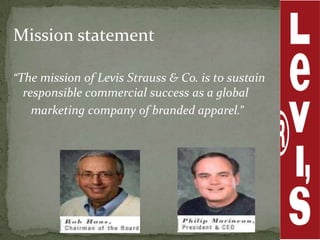
“The mission of Levis Strauss & Co. is to sustain
 responsible commercial success as a global
   marketing company of branded apparel.”
 Vision Statement

  “When LS & Co. describe the future of Levi
  they are talking about a building on the
  foundation they have inherited: affirming best of
 their Company’s tradition, closing gaps that may
 exist between principles and practices and
  updating some of their values to reflect
 contemporary circumstances.”
History
 The company was founded by Levi Strauss in 1853 primarily
   selling wholesale dry goods. The company was founded in San
  Francisco, California.

 A tailor named Jacob Davis thought of an idea to use copper
  rivets to reinforce the points of strain on pants.

 Davis and Strauss purchased the patent of the idea of using
  copper rivets in clothing on May 20, 1873.
History Cont…….
 The innovation of the rivets in the jeans differentiated
     Levi’s jeans from others because of its increased durability.

   Over the years, Levi Over Levi’s jeans have become more
    popular, initially due to its durability. Jean products expanded,
     targeting different consumers.

 Levi Strauss & Co. eventually captures most of the denim jean
    market, becomes the largest manufacturer of jeans, and profits
    reach $1 billion by 1974.
TimeLine
 1853: Levi Strauss begins selling dry goods in San Francisco
 1873: Levi Strauss & Co. patent riveted jeans and begin
           selling them.
   1912: Koveralls, denim play suit for children, is first
            nationally sold product for the company.
   1935: Company sells first blue jeans for women.
   1940s: U.S. government issues denim work clothes for

                    employees in the defense industry.
   1974: Company sales reach $1 billion1974: billion.
   1986: Company introduces Dockers as a new casual line of
           clothes new clothes.
LOGO
    In 1886 the Two Horse ® brand leather patch, a symbol of the
     pants Showing Strength in jeans.

 The Levi's® brand eye-catching Red Tab Device was
    added to the jeans in 1936. Placed onto the right back pocket
    with the word "Levi’s®" White capital letters, it differentiates
    Levi's® jeans from competitors.

    Levi’s® jeans famous arched back pocket stitching is
     called the “accurate.”
 Why choose Levi’s for the Corporate story?
HUMAN RESOURSE MANAGEMENT
HR Policy

 Recruitment & Selection
 Training
 Rewards & Recognition
 Red Tap Foundation
 Other benefits and facilities
Product Portfolio
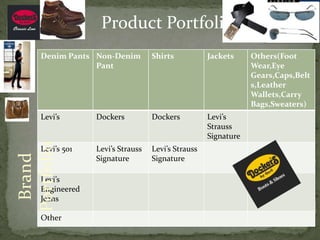
     Denim Pants Non-Denim         Shirts           Jackets     Others(Foot
                 Pant                                           Wear,Eye
                                                                Gears,Caps,Belt
                                                                s,Leather
                                                                Wallets,Carry
                                                                Bags,Sweaters)
     Levi’s       Dockers          Dockers          Levi’s
                                                    Strauss
                                                    Signature
Portfolio


     Levi’s 501   Levi’s Strauss   Levi’s Strauss
 Brand


                  Signature        Signature

     Levi’s
     Engineered
     Jeans

     Other
Market and Competition
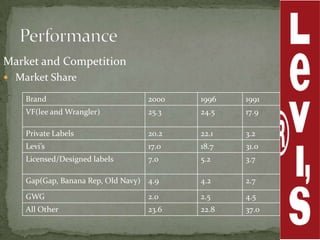
 Market Share

    Brand                          2000   1996   1991
    VF(lee and Wrangler)           25.3   24.5   17.9

    Private Labels                 20.2   22.1   3.2
    Levi’s                         17.0   18.7   31.0
    Licensed/Designed labels       7.0    5.2    3.7

    Gap(Gap, Banana Rep, Old Navy) 4.9    4.2    2.7
    GWG                            2.0    2.5    4.5
    All Other                      23.6   22.8   37.0
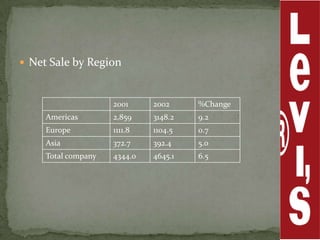
 Net Sale by Region


                     2001     2002     %Change
     Americas        2,859    3148.2   9.2
     Europe          1111.8   1104.5   0.7
     Asia            372.7    392.4    5.0
     Total company   4344.0   4645.1   6.5
OPERATIONS
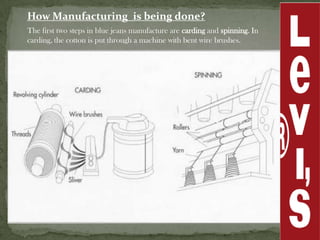
How Manufacturing is being done?
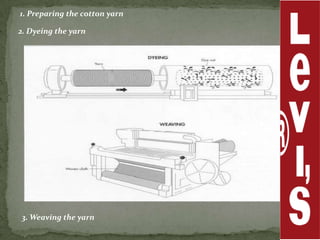
The first two steps in blue jeans manufacture are carding and spinning. In
carding, the cotton is put through a machine with bent wire brushes.
Steps in manufacturing: -
1. Preparing the cotton yarn

2. Dyeing the yarn


3. Weaving the yarn
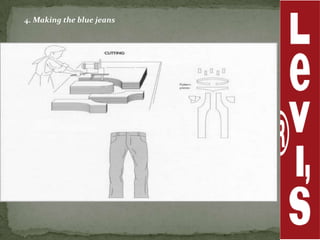
4. Making the blue jeans
Supply Chain
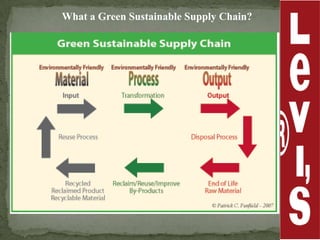
What a Green Sustainable Supply Chain?
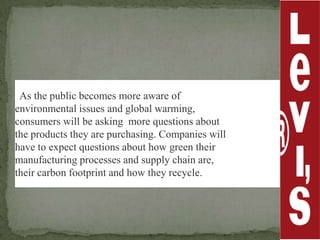
As the public becomes more aware of
environmental issues and global warming,
consumers will be asking more questions about
the products they are purchasing. Companies will
have to expect questions about how green their
manufacturing processes and supply chain are,
their carbon footprint and how they recycle.
Marketing
 Levi’s has maintained its equity worldwide. A
   mix of standardization & localization in Levi’s
  products has enabled the company to become a
  renowned brand worldwide.
 Levis use Differentiated marketing because
   it has multiple marketing mixes i.e. it involve
   multiple products, targeted towards multiple
  segments.
Marketing Objectives
 To improve leadership market positions and
  superior product and services.
 To maintain and protect the global brand.
 Increase the market share in products by annual
  average of 2.8% in the next 5 years.
 Also, to maintain the global market share of
   denim product in the same period.
POSITIONING
 Levi Strauss & Co. maintains it’’s image as an American Icon and the originator
  of
    American jeans.

 In 1930s, the company survived the Great Depression due to increased interest
  in
    Western culture.––Jeans were positioned as being worn by “cowboys..”

 Levi’’s jeans were issued to employees in the defense industry (including
    veterans) during World War II

 WWII veterans were regarded as heroes.––


 During the Baby Boom era, Levi’’s targets younger consumers and positions
  product as cool.
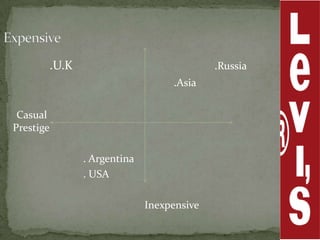
.U.K                               .Russia
                                     .Asia

 Casual
Prestige

                  . Argentina
                  . USA

                                Inexpensive
Product Features

 Comfort
 Durability
 Style
DISTRIBUTION CHANNEL
 LEVIS distributes JEANS by the Channel Members that is
  through retailer and wholesalers.
 Levi’s is using selective but intensive
   distribution level for the distribution of its
   products

Levis opened around 500 outlets at prime
 locations in India.
PRICING
 Levi’s all products are sold at listed price.
 There is no discount to offer.

 Product’s price is influenced by the following
  factors:-
1. Cost of the product
2. Affordable for the target market
3. Demand of the product
4. Uniqueness and innovative features of the
    products
PRICING STRATEGY : LEVI’S STRAUSS:

 As Levi’s has different Products ranges for different
 segments the pricing strategy of LEVI’S can be Called
 as both penetrative as well as market growth pricing.
Pricing Strategy Cont…..

 Levi's came to India in 1995.


 The brand was trying to skim the market but at the cost of
    market share and volume.

 LS & CO. has tried to build its image as an innovator by coming in INDIA with
    their Jeans having new and latest style and look

   Levi’s India plans to vacate the middle price segment and
    plans to concentrate on the lower and the higher end.
Cont…….
 In order to maintain revenues, the company
  releases the Levi’s Signature Jeans
 To differentiate Levi’s Strauss Signature ,the
   company developed new labeling and styles.
 Levi’s launched new mid market brand-Denizen
   in India September 10,2010.
 Providing EMI in Jeans
PROMOTION & ADVERTISING

 The advertisement given by the LEVIS
  stresses on the demand of the product and enhancement
  of its features.

 Levis uses institutional advertising to promote company’s
  image by saying Many Copy the
  Red Tab No One can copy the Original.
Cont……
 Advertisements of Levi Strauss & Co. are very
  innovative and eye-catching. Buyers are attracted
  towards the product.

 Television advertisements are more innovative and
   target younger crowds.

 Levi's launched "Friend's Store,"using a new Facebook tool.

  150,000 fans on Facebook in India alone.
 Cont…………
 In the US we have the Levi’s Guy and the Levi’s Girl on
  Twitter.

 On YouTube Levis released many of their TV commercials
  and also do specific small cameo ads.

 Levi's CURVE ID fit
 To mark its 15th anniversary in the India, apparel
  brand Levi's has announced
  several initiatives titled 'Change Your World’'.
 Chevrolet has joined Levi Strauss for celebrating the
  latter's 15th year
   anniversary in India
BRAND AMBASDORS
 international denim brand Levis has signed Priyanka
  Chopra as their brand ambassador fImran Khan Replaces Shahid
  Kapoor As Levis’ Brand Ambassador

 The company frequently promoted music & theatrical
  productions.

 Sponsored artists incl. Christina Aguilera, Mariah Carey, Ben Folds
  Five, The White Stripes etc.
 LEVI’S competitors                        include Bugle Boy, Calvin Klein,
  and Fruit of the Loom, Guess, J.C Penny, Nike, J.Crew,
  Osh Kosh B’Gosh, Oxford Industries, Polo, GAP, Tommy Hilfiger,
  VF, & Warnaco Group.
 Some of Levi’s competitors include:
 High end consumers
       Calvin Klein
        Tommy Hilfiger
 Low end consumers
        Miss sixty, Guess
 Competitive advantage

 Economies of scale,Levi is capable of implementing a
  cost leadership strategy within the company and the environment,
  therefore, resulting in a competitive advantage

 the company has accumulated knowledge and
   productive inputs.

 This legacy allows Levi’s to promote the image of
  quality and value to their brand
 The brand image Levi’s encompasses results in them
  having a higher price tags compared to other brand Levi’s
  differentiates itself from all other competitors through the
 ability to brand products through strong brand image
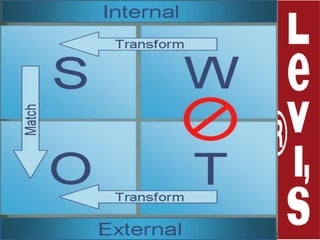
Strength

 History
 Brand Name
 Finance and Access to International Capital
 Management
 Expertise in Jeans Industries-R&D
 Distribution Channels and Global Sourcing
Weakness
 High Costs of brand protection
 Lack of control over quality(licensing)
 Lack of control over distribution decisions(Retailers
  pressure to stop selling on the Web)
 Distribution Conflicts(Large food retailers i.e. Tesco
  have been selling Levi products at lower price then standard,
  damaging other channels such as Levis Strauss stores)
Opportunities
 Arising of New Market such as Europe and
    Russia(to supply local demand)
    Technological development lower production and
     coordination activities
    Low Manufacturing and production costs in
     various international markets(i.e. Bangladesh)
    Development in other industries such as electronic
    (MP3 player) could pass new opportunities for complementing new Levi’s
     products.
    Total Market for casual wear is growing
Threats
 Saturation of Jeans Market.
 Economic Downturns in some countries.
 Fast changes in Consumer tastes.
 Local regulations on advertisement.
  Lack protection of property rights in some
  countries such as China.
 Increasing Competition from Gap,Guess,J.C.
  Penny,Nike,Mochino,D&G,Osh Kosh,Oxford,
  Polo.
“LIFE BLOOD AND NERVE CENTRE OF BUSINESS”
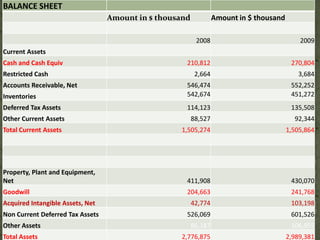
BALANCE SHEET
                                  Amount in $ thousand            Amount in $ thousand

                                                          2008                               2009
Current Assets
Cash and Cash Equiv                                  210,812                              270,804
Restricted Cash                                           2,664                             3,684
Accounts Receivable, Net                             546,474                              552,252
Inventories                                          542,674                              451,272
Deferred Tax Assets                                  114,123                              135,508
Other Current Assets                                     88,527                            92,344
Total Current Assets                               1,505,274                             1,505,864


Property, Plant and Equipment,
Net                                                  411,908                              430,070
Goodwill                                             204,663                              241,768
Acquired Intangible Assets, Net                          42,774                           103,198
Non Current Deferred Tax Assets                      526,069                              601,526
Other Assets                                             86,187                           106,955
Total Assets                                       2,776,875                             2,989,381
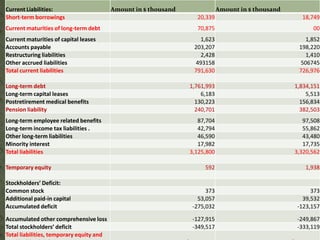
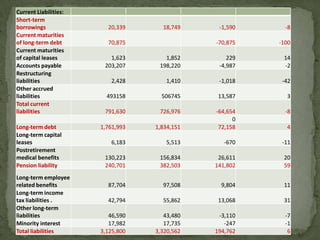
Current Liabilities:                      Amount in $ thousand               Amount in $ thousand
Short-term borrowings                                              20,339                             18,749
Current maturities of long-term debt                               70,875                                 00
Current maturities of capital leases                                1,623                              1,852
Accounts payable                                                  203,207                            198,220
Restructuring liabilities                                           2,428                              1,410
Other accrued liabilities                                         493158                             506745
Total current liabilities                                         791,630                            726,976

Long-term debt                                                   1,761,993                          1,834,151
Long-term capital leases                                             6,183                              5,513
Postretirement medical benefits                                    130,223                            156,834
Pension liability                                                  240,701                            382,503
Long-term employee related benefits                                 87,704                             97,508
Long-term income tax liabilities .                                  42,794                             55,862
Other long-term liabilities                                         46,590                             43,480
Minority interest                                                   17,982                             17,735
Total liabilities                                                3,125,800                          3,320,562

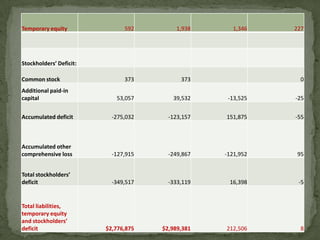
Temporary equity                                                      592                              1,938

Stockholders’ Deficit:
Common stock                                                          373                                373
Additional paid-in capital                                         53,057                             39,532
Accumulated deficit                                              -275,032                           -123,157

Accumulated other comprehensive loss                             -127,915                           -249,867
Total stockholders’ deficit                                      -349,517                           -333,119
Total liabilities, temporary equity and
Comparative Balance Sheet
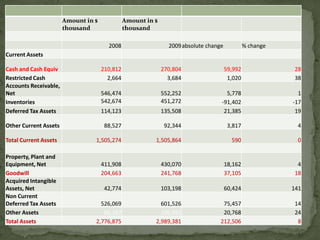
Amount in $             Amount in $
                       thousand                thousand

                                       2008                    2009 absolute change            % change
Current Assets

Cash and Cash Equiv                  210,812                 270,804                  59,992              28
Restricted Cash                        2,664                   3,684                   1,020              38
Accounts Receivable,
Net                                  546,474                 552,252                5,778                   1
Inventories                          542,674                 451,272              -91,402                 -17
Deferred Tax Assets                  114,123                 135,508               21,385                  19

Other Current Assets                  88,527                  92,344                   3,817               4

Total Current Assets             1,505,274               1,505,864                      590                0

Property, Plant and
Equipment, Net                       411,908                 430,070                  18,162               4
Goodwill                             204,663                 241,768                  37,105              18
Acquired Intangible
Assets, Net                           42,774                 103,198                  60,424              141
Non Current
Deferred Tax Assets                526,069                 601,526                 75,457                 14
Other Assets                        86,187                 106,955                 20,768                 24
Total Assets                     2,776,875               2,989,381                212,506                  8
Current Liabilities:
Short-term
borrowings               20,339      18,749     -1,590     -8
Current maturities
of long-term debt        70,875                -70,875   -100
Current maturities
of capital leases         1,623       1,852        229    14
Accounts payable        203,207     198,220     -4,987    -2
Restructuring
liabilities               2,428       1,410     -1,018    -42
Other accrued
liabilities              493158      506745     13,587     3
Total current
liabilities             791,630     726,976    -64,654     -8
                                                     0
Long-term debt         1,761,993   1,834,151    72,158     4
Long-term capital
leases                    6,183       5,513       -670    -11
Postretirement
medical benefits        130,223     156,834     26,611    20
Pension liability       240,701     382,503    141,802    59
Long-term employee
related benefits         87,704      97,508      9,804    11
Long-term income
tax liabilities .        42,794      55,862     13,068    31
Other long-term
liabilities               46,590      43,480    -3,110     -7
Minority interest         17,982      17,735      -247     -1
Total liabilities      3,125,800   3,320,562   194,762      6
Temporary equity               592         1,938     1,346    227


Stockholders’ Deficit:

Common stock                   373          373                0
Additional paid-in
capital                     53,057       39,532     -13,525   -25


Accumulated deficit        -275,032     -123,157   151,875    -55


Accumulated other
comprehensive loss         -127,915     -249,867   -121,952   95


Total stockholders’
deficit                    -349,517     -333,119    16,398     -5


Total liabilities,
temporary equity
and stockholders’
deficit                  $2,776,875   $2,989,381   212,506     8
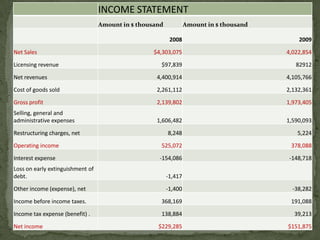
INCOME STATEMENT
                                  Amount in $ thousand            Amount in $ thousand

                                                          2008                               2009

Net Sales                                          $4,303,075                            4,022,854

Licensing revenue                                    $97,839                                82912

Net revenues                                        4,400,914                            4,105,766

Cost of goods sold                                  2,261,112                            2,132,361

Gross profit                                        2,139,802                            1,973,405
Selling, general and
administrative expenses                             1,606,482                            1,590,093

Restructuring charges, net                               8,248                              5,224

Operating income                                     525,072                              378,088

Interest expense                                     -154,086                            -148,718
Loss on early extinguishment of
debt.                                                    -1,417

Other income (expense), net                              -1,400                            -38,282

Income before income taxes.                          368,169                              191,088

Income tax expense (benefit) .                       138,884                               39,213

Net income                                          $229,285                             $151,875
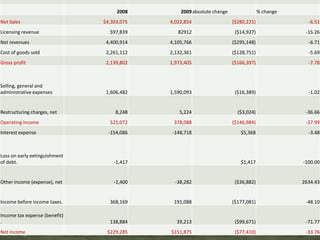
Comparative Income Statement
2008        2009 absolute change                % change
Net Sales                      $4,303,075   4,022,854                  ($280,221)                -6.51
Licensing revenue                $97,839       82912                    ($14,927)               -15.26
Net revenues                    4,400,914   4,105,766                  ($295,148)                -6.71
Cost of goods sold              2,261,112   2,132,361                  ($128,751)                -5.69
Gross profit                    2,139,802   1,973,405                  ($166,397)                -7.78


Selling, general and
administrative expenses         1,606,482   1,590,093                   ($16,389)                -1.02


Restructuring charges, net          8,248      5,224                     ($3,024)               -36.66
Operating income                 525,072     378,088                   ($146,984)               -27.99
Interest expense                 -154,086   -148,718                      $5,368                 -3.48


Loss on early extinguishment
of debt.                           -1,417                                 $1,417               -100.00


Other income (expense), net        -1,400     -38,282                   ($36,882)              2634.43


Income before income taxes.      368,169     191,088                   ($177,081)               -48.10

Income tax expense (benefit)
.                                138,884      39,213                    ($99,671)               -71.77
Net income                      $229,285    $151,875                    ($77,410)               -33.76
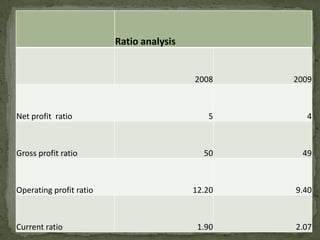
Ratio analysis


                                          2008    2009


Net profit ratio                             5       4


Gross profit ratio                          50      49


Operating profit ratio                    12.20   9.40


Current ratio                              1.90   2.07
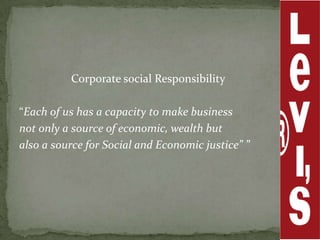
Corporate social Responsibility

“Each of us has a capacity to make business
not only a source of economic, wealth but
also a source for Social and Economic justice” ”
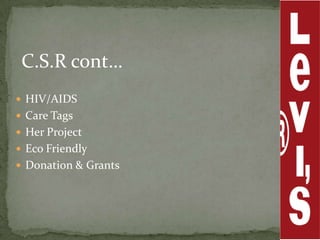
C.S.R cont…
 HIV/AIDS
 Care Tags
 Her Project
 Eco Friendly
 Donation & Grants
Think about the next Choice

Levi's co. manendra

  • 1.
    CORPORATE STORY ON “Levi’s” Presented By MANENDRA & TEAM
  • 2.
    Introduction  Levi Strauss& Co. (LS&CO.), one of the world's largest apparel manufacturer brand  Sold in over 110 countries, in more than 55,000 retail locations worldwide  Manufactures jeans in approximately 108 sizes and 20 finish fabrics  3 Brand Portfolio - Levi’s ®,Dockers ® & Levi’s Strauss
  • 3.
    Mission statement “The missionof Levis Strauss & Co. is to sustain responsible commercial success as a global marketing company of branded apparel.”
  • 4.
     Vision Statement “When LS & Co. describe the future of Levi they are talking about a building on the foundation they have inherited: affirming best of their Company’s tradition, closing gaps that may exist between principles and practices and updating some of their values to reflect contemporary circumstances.”
  • 5.
    History  The companywas founded by Levi Strauss in 1853 primarily selling wholesale dry goods. The company was founded in San Francisco, California.  A tailor named Jacob Davis thought of an idea to use copper rivets to reinforce the points of strain on pants.  Davis and Strauss purchased the patent of the idea of using copper rivets in clothing on May 20, 1873.
  • 6.
    History Cont…….  Theinnovation of the rivets in the jeans differentiated Levi’s jeans from others because of its increased durability.  Over the years, Levi Over Levi’s jeans have become more popular, initially due to its durability. Jean products expanded, targeting different consumers.  Levi Strauss & Co. eventually captures most of the denim jean market, becomes the largest manufacturer of jeans, and profits reach $1 billion by 1974.
  • 7.
    TimeLine  1853: LeviStrauss begins selling dry goods in San Francisco  1873: Levi Strauss & Co. patent riveted jeans and begin selling them.  1912: Koveralls, denim play suit for children, is first nationally sold product for the company.  1935: Company sells first blue jeans for women.  1940s: U.S. government issues denim work clothes for employees in the defense industry.  1974: Company sales reach $1 billion1974: billion.  1986: Company introduces Dockers as a new casual line of clothes new clothes.
  • 8.
    LOGO  In 1886 the Two Horse ® brand leather patch, a symbol of the pants Showing Strength in jeans.  The Levi's® brand eye-catching Red Tab Device was added to the jeans in 1936. Placed onto the right back pocket with the word "Levi’s®" White capital letters, it differentiates Levi's® jeans from competitors.  Levi’s® jeans famous arched back pocket stitching is called the “accurate.”
  • 9.
     Why chooseLevi’s for the Corporate story?
  • 10.
  • 11.
    HR Policy  Recruitment& Selection  Training  Rewards & Recognition  Red Tap Foundation  Other benefits and facilities
  • 12.
    Product Portfolio Denim Pants Non-Denim Shirts Jackets Others(Foot Pant Wear,Eye Gears,Caps,Belt s,Leather Wallets,Carry Bags,Sweaters) Levi’s Dockers Dockers Levi’s Strauss Signature Portfolio Levi’s 501 Levi’s Strauss Levi’s Strauss Brand Signature Signature Levi’s Engineered Jeans Other
  • 13.
    Market and Competition Market Share Brand 2000 1996 1991 VF(lee and Wrangler) 25.3 24.5 17.9 Private Labels 20.2 22.1 3.2 Levi’s 17.0 18.7 31.0 Licensed/Designed labels 7.0 5.2 3.7 Gap(Gap, Banana Rep, Old Navy) 4.9 4.2 2.7 GWG 2.0 2.5 4.5 All Other 23.6 22.8 37.0
  • 14.
     Net Saleby Region 2001 2002 %Change Americas 2,859 3148.2 9.2 Europe 1111.8 1104.5 0.7 Asia 372.7 392.4 5.0 Total company 4344.0 4645.1 6.5
  • 15.
  • 16.
    How Manufacturing isbeing done? The first two steps in blue jeans manufacture are carding and spinning. In carding, the cotton is put through a machine with bent wire brushes.
  • 17.
  • 18.
    1. Preparing thecotton yarn 2. Dyeing the yarn 3. Weaving the yarn
  • 19.
    4. Making theblue jeans
  • 20.
  • 21.
    What a GreenSustainable Supply Chain?
  • 22.
    As the publicbecomes more aware of environmental issues and global warming, consumers will be asking more questions about the products they are purchasing. Companies will have to expect questions about how green their manufacturing processes and supply chain are, their carbon footprint and how they recycle.
  • 23.
  • 24.
     Levi’s hasmaintained its equity worldwide. A mix of standardization & localization in Levi’s products has enabled the company to become a renowned brand worldwide.  Levis use Differentiated marketing because it has multiple marketing mixes i.e. it involve multiple products, targeted towards multiple segments.
  • 25.
    Marketing Objectives  Toimprove leadership market positions and superior product and services.  To maintain and protect the global brand.  Increase the market share in products by annual average of 2.8% in the next 5 years.  Also, to maintain the global market share of denim product in the same period.
  • 26.
    POSITIONING  Levi Strauss& Co. maintains it’’s image as an American Icon and the originator of American jeans.  In 1930s, the company survived the Great Depression due to increased interest in Western culture.––Jeans were positioned as being worn by “cowboys..”  Levi’’s jeans were issued to employees in the defense industry (including veterans) during World War II  WWII veterans were regarded as heroes.––  During the Baby Boom era, Levi’’s targets younger consumers and positions product as cool.
  • 27.
    .U.K .Russia .Asia Casual Prestige . Argentina . USA Inexpensive
  • 28.
  • 29.
    DISTRIBUTION CHANNEL  LEVISdistributes JEANS by the Channel Members that is through retailer and wholesalers.  Levi’s is using selective but intensive distribution level for the distribution of its products Levis opened around 500 outlets at prime locations in India.
  • 30.
    PRICING  Levi’s allproducts are sold at listed price.  There is no discount to offer.  Product’s price is influenced by the following factors:- 1. Cost of the product 2. Affordable for the target market 3. Demand of the product 4. Uniqueness and innovative features of the products
  • 31.
    PRICING STRATEGY :LEVI’S STRAUSS: As Levi’s has different Products ranges for different segments the pricing strategy of LEVI’S can be Called as both penetrative as well as market growth pricing.
  • 32.
    Pricing Strategy Cont….. Levi's came to India in 1995.  The brand was trying to skim the market but at the cost of market share and volume.  LS & CO. has tried to build its image as an innovator by coming in INDIA with their Jeans having new and latest style and look  Levi’s India plans to vacate the middle price segment and plans to concentrate on the lower and the higher end.
  • 33.
    Cont…….  In orderto maintain revenues, the company releases the Levi’s Signature Jeans  To differentiate Levi’s Strauss Signature ,the company developed new labeling and styles.  Levi’s launched new mid market brand-Denizen in India September 10,2010.  Providing EMI in Jeans
  • 34.
    PROMOTION & ADVERTISING The advertisement given by the LEVIS stresses on the demand of the product and enhancement of its features.  Levis uses institutional advertising to promote company’s image by saying Many Copy the Red Tab No One can copy the Original.
  • 35.
    Cont……  Advertisements ofLevi Strauss & Co. are very innovative and eye-catching. Buyers are attracted towards the product.  Television advertisements are more innovative and target younger crowds.  Levi's launched "Friend's Store,"using a new Facebook tool. 150,000 fans on Facebook in India alone.
  • 36.
     Cont…………  Inthe US we have the Levi’s Guy and the Levi’s Girl on Twitter.  On YouTube Levis released many of their TV commercials and also do specific small cameo ads.  Levi's CURVE ID fit
  • 37.
     To markits 15th anniversary in the India, apparel brand Levi's has announced several initiatives titled 'Change Your World’'.  Chevrolet has joined Levi Strauss for celebrating the latter's 15th year anniversary in India
  • 38.
    BRAND AMBASDORS  internationaldenim brand Levis has signed Priyanka Chopra as their brand ambassador fImran Khan Replaces Shahid Kapoor As Levis’ Brand Ambassador  The company frequently promoted music & theatrical productions.  Sponsored artists incl. Christina Aguilera, Mariah Carey, Ben Folds Five, The White Stripes etc.
  • 39.
     LEVI’S competitors include Bugle Boy, Calvin Klein, and Fruit of the Loom, Guess, J.C Penny, Nike, J.Crew, Osh Kosh B’Gosh, Oxford Industries, Polo, GAP, Tommy Hilfiger, VF, & Warnaco Group.  Some of Levi’s competitors include:  High end consumers Calvin Klein Tommy Hilfiger  Low end consumers Miss sixty, Guess
  • 40.
     Competitive advantage Economies of scale,Levi is capable of implementing a cost leadership strategy within the company and the environment, therefore, resulting in a competitive advantage  the company has accumulated knowledge and productive inputs.  This legacy allows Levi’s to promote the image of quality and value to their brand
  • 41.
     The brandimage Levi’s encompasses results in them having a higher price tags compared to other brand Levi’s differentiates itself from all other competitors through the ability to brand products through strong brand image
  • 43.
    Strength  History  BrandName  Finance and Access to International Capital  Management  Expertise in Jeans Industries-R&D  Distribution Channels and Global Sourcing
  • 44.
    Weakness  High Costsof brand protection  Lack of control over quality(licensing)  Lack of control over distribution decisions(Retailers pressure to stop selling on the Web)  Distribution Conflicts(Large food retailers i.e. Tesco have been selling Levi products at lower price then standard, damaging other channels such as Levis Strauss stores)
  • 45.
    Opportunities  Arising ofNew Market such as Europe and Russia(to supply local demand)  Technological development lower production and coordination activities  Low Manufacturing and production costs in various international markets(i.e. Bangladesh)  Development in other industries such as electronic (MP3 player) could pass new opportunities for complementing new Levi’s products.  Total Market for casual wear is growing
  • 46.
    Threats  Saturation ofJeans Market.  Economic Downturns in some countries.  Fast changes in Consumer tastes.  Local regulations on advertisement.  Lack protection of property rights in some countries such as China.  Increasing Competition from Gap,Guess,J.C. Penny,Nike,Mochino,D&G,Osh Kosh,Oxford, Polo.
  • 47.
    “LIFE BLOOD ANDNERVE CENTRE OF BUSINESS”
  • 48.
    BALANCE SHEET Amount in $ thousand Amount in $ thousand 2008 2009 Current Assets Cash and Cash Equiv 210,812 270,804 Restricted Cash 2,664 3,684 Accounts Receivable, Net 546,474 552,252 Inventories 542,674 451,272 Deferred Tax Assets 114,123 135,508 Other Current Assets 88,527 92,344 Total Current Assets 1,505,274 1,505,864 Property, Plant and Equipment, Net 411,908 430,070 Goodwill 204,663 241,768 Acquired Intangible Assets, Net 42,774 103,198 Non Current Deferred Tax Assets 526,069 601,526 Other Assets 86,187 106,955 Total Assets 2,776,875 2,989,381
  • 49.
    Current Liabilities: Amount in $ thousand Amount in $ thousand Short-term borrowings 20,339 18,749 Current maturities of long-term debt 70,875 00 Current maturities of capital leases 1,623 1,852 Accounts payable 203,207 198,220 Restructuring liabilities 2,428 1,410 Other accrued liabilities 493158 506745 Total current liabilities 791,630 726,976 Long-term debt 1,761,993 1,834,151 Long-term capital leases 6,183 5,513 Postretirement medical benefits 130,223 156,834 Pension liability 240,701 382,503 Long-term employee related benefits 87,704 97,508 Long-term income tax liabilities . 42,794 55,862 Other long-term liabilities 46,590 43,480 Minority interest 17,982 17,735 Total liabilities 3,125,800 3,320,562 Temporary equity 592 1,938 Stockholders’ Deficit: Common stock 373 373 Additional paid-in capital 53,057 39,532 Accumulated deficit -275,032 -123,157 Accumulated other comprehensive loss -127,915 -249,867 Total stockholders’ deficit -349,517 -333,119 Total liabilities, temporary equity and
  • 50.
  • 51.
    Amount in $ Amount in $ thousand thousand 2008 2009 absolute change % change Current Assets Cash and Cash Equiv 210,812 270,804 59,992 28 Restricted Cash 2,664 3,684 1,020 38 Accounts Receivable, Net 546,474 552,252 5,778 1 Inventories 542,674 451,272 -91,402 -17 Deferred Tax Assets 114,123 135,508 21,385 19 Other Current Assets 88,527 92,344 3,817 4 Total Current Assets 1,505,274 1,505,864 590 0 Property, Plant and Equipment, Net 411,908 430,070 18,162 4 Goodwill 204,663 241,768 37,105 18 Acquired Intangible Assets, Net 42,774 103,198 60,424 141 Non Current Deferred Tax Assets 526,069 601,526 75,457 14 Other Assets 86,187 106,955 20,768 24 Total Assets 2,776,875 2,989,381 212,506 8
  • 52.
    Current Liabilities: Short-term borrowings 20,339 18,749 -1,590 -8 Current maturities of long-term debt 70,875 -70,875 -100 Current maturities of capital leases 1,623 1,852 229 14 Accounts payable 203,207 198,220 -4,987 -2 Restructuring liabilities 2,428 1,410 -1,018 -42 Other accrued liabilities 493158 506745 13,587 3 Total current liabilities 791,630 726,976 -64,654 -8 0 Long-term debt 1,761,993 1,834,151 72,158 4 Long-term capital leases 6,183 5,513 -670 -11 Postretirement medical benefits 130,223 156,834 26,611 20 Pension liability 240,701 382,503 141,802 59 Long-term employee related benefits 87,704 97,508 9,804 11 Long-term income tax liabilities . 42,794 55,862 13,068 31 Other long-term liabilities 46,590 43,480 -3,110 -7 Minority interest 17,982 17,735 -247 -1 Total liabilities 3,125,800 3,320,562 194,762 6
  • 53.
    Temporary equity 592 1,938 1,346 227 Stockholders’ Deficit: Common stock 373 373 0 Additional paid-in capital 53,057 39,532 -13,525 -25 Accumulated deficit -275,032 -123,157 151,875 -55 Accumulated other comprehensive loss -127,915 -249,867 -121,952 95 Total stockholders’ deficit -349,517 -333,119 16,398 -5 Total liabilities, temporary equity and stockholders’ deficit $2,776,875 $2,989,381 212,506 8
  • 54.
    INCOME STATEMENT Amount in $ thousand Amount in $ thousand 2008 2009 Net Sales $4,303,075 4,022,854 Licensing revenue $97,839 82912 Net revenues 4,400,914 4,105,766 Cost of goods sold 2,261,112 2,132,361 Gross profit 2,139,802 1,973,405 Selling, general and administrative expenses 1,606,482 1,590,093 Restructuring charges, net 8,248 5,224 Operating income 525,072 378,088 Interest expense -154,086 -148,718 Loss on early extinguishment of debt. -1,417 Other income (expense), net -1,400 -38,282 Income before income taxes. 368,169 191,088 Income tax expense (benefit) . 138,884 39,213 Net income $229,285 $151,875
  • 55.
  • 56.
    2008 2009 absolute change % change Net Sales $4,303,075 4,022,854 ($280,221) -6.51 Licensing revenue $97,839 82912 ($14,927) -15.26 Net revenues 4,400,914 4,105,766 ($295,148) -6.71 Cost of goods sold 2,261,112 2,132,361 ($128,751) -5.69 Gross profit 2,139,802 1,973,405 ($166,397) -7.78 Selling, general and administrative expenses 1,606,482 1,590,093 ($16,389) -1.02 Restructuring charges, net 8,248 5,224 ($3,024) -36.66 Operating income 525,072 378,088 ($146,984) -27.99 Interest expense -154,086 -148,718 $5,368 -3.48 Loss on early extinguishment of debt. -1,417 $1,417 -100.00 Other income (expense), net -1,400 -38,282 ($36,882) 2634.43 Income before income taxes. 368,169 191,088 ($177,081) -48.10 Income tax expense (benefit) . 138,884 39,213 ($99,671) -71.77 Net income $229,285 $151,875 ($77,410) -33.76
  • 57.
    Ratio analysis 2008 2009 Net profit ratio 5 4 Gross profit ratio 50 49 Operating profit ratio 12.20 9.40 Current ratio 1.90 2.07
  • 58.
    Corporate social Responsibility “Eachof us has a capacity to make business not only a source of economic, wealth but also a source for Social and Economic justice” ”
  • 59.
    C.S.R cont…  HIV/AIDS Care Tags  Her Project  Eco Friendly  Donation & Grants
  • 60.
    Think about thenext Choice