Global
Leader
of
Jeans
Country of origin
SanFrancisco, California, USA.
BACKGROUND OF LEVI’S
• DURING THE GOLD RUSH IN SAN FRANCISCO, LEVI STRAUSS MOVED THERE FROM
GERMANY AND STARTED A WHOLESALE BUSINESS OF SHOVELS, PICKS, LANTERNS, POTS
AND PANS, SHOES, LONG JOHNS, SHIRTS AND DUNGAREES. A TRAILER JACOB DAVIS WAS
HIS CUSTOMER .DEVIS INVENTED BLUE JEANS TO SOLVE THE PROBLEM OF GOLD MINERS
AS DENIM IS TOO STRONG, DURABLE, AND DOES NOT GET DIRTY EASILY. BUT HE ALONE
COULD NOT AFFORD TO PATENT JEANS. SO DEVIS ALONG WITH STRAUSS PATENTED BLUE
JEANS ON 20 MAY 1873 AND STARTED THE DENIM COMPANY NAMED LEVI’S.
• IN 1890 THE FIRST JEANS OF LEVI’S COMPANY NAMED LEVI’S 501 WERE PRODUCED. INITIALLY LEVI'S
JEANS WERE ONLY PRODUCED FOR GOLD MINERS AND OTHER WORKERS LIKE COWBOYS, LUMBERJACKS,
AND RAILROAD WORKERS. DURING WORLD WAR 2, LEVI’S JEANS WERE ALSO WORN BY THE PEOPLE WHO
WERE CONNECTED TO DEFENSE. FINALLY AFTER 1950, LEVIS JEANS WERE TREMENDOUSLY POPULAR
AMONG GENERAL PEOPLE. IN 1962 THERE WERE 6 PLANTS OF LEVI’S JEANS. IN 1974 NUMBER OF PLANTS
BECAME 63.BUT AFTER 1980 THE COMPANY POPULARITY WAS DESCENDING BECAUSE OF COMPETITORS
AND LACK OF PLANNING. IN 1985, AS LEVI STRAUSS & CO. CONTINUED TO RESTRUCTURE AND CUT
BACK, THE COMPANY WAS TAKEN PRIVATE IN A LEVERAGED BUYOUT FOR $1.45 BILLION . THE COMPANY
THEN STARTED PRODUCING JACKETS, T-SHIRTS, WALLET, BELT, SHOES, HOODY, BAGS, DUNGAREES ETC.
STILL NOW LEVI’S JEANS ARE DOMINATING THE MARKET.
Brief Description on Levi’s
• When Levi's discusses their future, they speak of a foundation building they have inherited:
acknowledging the best of the heritage of their business, closing discrepancies between
ideals and procedures, and adjusting some of their beliefs to match contemporary
circumstances.The Organization claims that common goals are as important to the growth
of the Company as being a pioneer in the clothing industry and delivering premium
merchandise and service.
• The Company's mission is to ensure responsible strategic sustainability as a branded casual
clothing multinational marketing company.They need to balance higher profitability and
return on investment targets, leading market positions, and superior goods and service.
They will pursue their business ethically and show leadership in upholding our
commitments to the societies and community.
PRODUCT RANGE
 Crewneck tee shirt
 Reusable face mask
 men’s Jeans
 Sherpa trucker jacket
 Shrink to fit men’s jacket
 Hoodie
 Fit stretch men’s jeans
 Taper fit men’s jeans
 Skinny ankle utility pants
 Ribcage straight ankle utility jeans
 Wide leg women’s jeans
 Crop women's jeans
 Bandana
 High waist denim skirts
 Women’s shorts
 Bodysuits
 Scarves
 Jumpsuit
 Romper
 Carpet
 Short Tail
 Vests
 Mountain Coat
 Drop shoulder mackintosh
 Bags
 Backpacks
 Tank tops
 Shoes
 Barstow western shirt
 Carrier cargo men’s shorts
 Athletic taper men’s shorts
 Icon belt
 Sunset one pocket button-up shirt
 Socks
 Hats
 Classic t-shirts
 Tie-dye shorts
 Boxer briefs
 Worn trucker jacket
 Long-sleeve t-shirts
 Crewneck sweatshirt
 Bomber jacket
 Classic western standard shirts
 Woodside utility parka
ABOUT ITS EMPLOYEES
 Levis has around 15100 employees (2018). The uniform
of the employees is Levi's jeans and a long sleeve or t-
shirt. No crop tops or dresses. The employees can wear
safety shoes, safety glasses, and hard hats as required.
To apply for Levis, the application process at Levi's must
be begun by visiting the website of their professions.
From there, they can learn about working at Levi's,
discover the types of open vacancies, find opportunities
in the field that attracts people, and complete the
application.
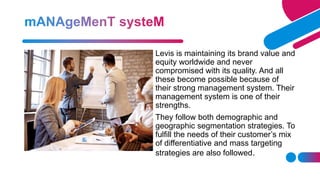
Levis is maintaining its brand value and
equity worldwide and never
compromised with its quality. And all
these become possible because of
their strong management system. Their
management system is one of their
strengths.
They follow both demographic and
geographic segmentation strategies. To
fulfill the needs of their customer’s mix
of differentiative and mass targeting
strategies are also followed.
SUPPLIERS
• Cotton web Ltd., Pakistan
• Sinha Industries Ltd. Bangladesh
• Ayesha Clothing Co. Ltd. Bangladesh
• Yida Manufacturer Co. Ltd. Cambodia
• Chia Li Screw Ltd. Taiwan
• Crystal Apparel Ltd. Hong Kong
• Your Choice Fasteners and tools co.
Taiwan
• Gng Sourcing Co. Ltd. South Korea
• Saab Co. Ltd. Japan
• C and Y Garments Co. Ltd. Lesotho
z
Economy
 Levi Strauss & Co. is one of the
biggest clothing firms in the world
and a leader in denim
internationally. Worldwide, we have
some 500 outlets, and our goods
are available in over 100 countries.
Among them Germany, Mexico, UK,
France, Norway, Sweden, Poland,
and many more. Their turnover is
around $5.8 billion, and their
revenue growth is 10% ( men’s
wear), 14% (women's wear). Their
adjusted free cash flow is 116
million dollars. 50000+ retail
locations and 3000+ brand
dedicated stores. Among them,
53% is in the U.S. 31% in Europe.
16% Asia, Middle East, and Africa.
z
Compliance issues
Levi’s doing its business in an ethical, honest, and transparent manner. They have some
compliance programs. Elements of these compliance programs:
 Compliance Program Oversight & Leadership
 Compliance Operations & Strategic Planning
 Policies, Procedures & Guidelines
 Investigation & Disciplinary Action
 Third-Party Compliance, Risk & Due Diligence
 Anti-bribery & Anti-corruption
 Auditing & Remediation
 Compliance Training & Communication
SUSTAINABLE INITIATIVE:
• Sustainable cotton farming: by this method more
cotton can be grown by using less water and less
harmful chemicals which is more profitable and
better paid for farmers.
• Use of lyocell : 60% of products of levis are made
from waterless technology which saves 3.5 billion
liters of water as far.
• Recycle of jeans
• Stopped using PFCS and PFAS: PFCS and
PFAS have severe human and
environmental health impacts including
cancer. So they are banned in Levis.
• Environmental Impact
Levi's has made strong contributions to sustainable manufacturing of denim,
including dramatically reducing the use of water. Since then, Levi's has vowed to
decrease the dangerous chemicals used to color and process its apparel and plans to
remove hazardous chemicals by 2020.
Its environment rating is 'good'. It utilizes certain environmentally friendly materials,
including recycled materials. It has set a science-based goal for the elimination of
greenhouse gas emissions from its supply chain and activities and is on track to reach
its target.
conclusion
Levis has an impact on price in the form of a jeans brand on the customer’s choice of brands. Also, there
is a strong correlation between the price of the jeans and customers' satisfaction with the brand of
jeans. Though it offers a variety of products to its customers, its main turnover is mainly depending on
jeans and it’s 80% of their total turnover. Levi Strauss' brand value can be established through successful
and wisely coordinated marketing activities and make it stand out from the competition. Levi Strauss
must stop making misleading commitments regarding product functionality that the manufacturing
department does not satisfy.

All about Levi's

  • 1.
  • 2.
  • 3.
    BACKGROUND OF LEVI’S •DURING THE GOLD RUSH IN SAN FRANCISCO, LEVI STRAUSS MOVED THERE FROM GERMANY AND STARTED A WHOLESALE BUSINESS OF SHOVELS, PICKS, LANTERNS, POTS AND PANS, SHOES, LONG JOHNS, SHIRTS AND DUNGAREES. A TRAILER JACOB DAVIS WAS HIS CUSTOMER .DEVIS INVENTED BLUE JEANS TO SOLVE THE PROBLEM OF GOLD MINERS AS DENIM IS TOO STRONG, DURABLE, AND DOES NOT GET DIRTY EASILY. BUT HE ALONE COULD NOT AFFORD TO PATENT JEANS. SO DEVIS ALONG WITH STRAUSS PATENTED BLUE JEANS ON 20 MAY 1873 AND STARTED THE DENIM COMPANY NAMED LEVI’S.
  • 5.
    • IN 1890THE FIRST JEANS OF LEVI’S COMPANY NAMED LEVI’S 501 WERE PRODUCED. INITIALLY LEVI'S JEANS WERE ONLY PRODUCED FOR GOLD MINERS AND OTHER WORKERS LIKE COWBOYS, LUMBERJACKS, AND RAILROAD WORKERS. DURING WORLD WAR 2, LEVI’S JEANS WERE ALSO WORN BY THE PEOPLE WHO WERE CONNECTED TO DEFENSE. FINALLY AFTER 1950, LEVIS JEANS WERE TREMENDOUSLY POPULAR AMONG GENERAL PEOPLE. IN 1962 THERE WERE 6 PLANTS OF LEVI’S JEANS. IN 1974 NUMBER OF PLANTS BECAME 63.BUT AFTER 1980 THE COMPANY POPULARITY WAS DESCENDING BECAUSE OF COMPETITORS AND LACK OF PLANNING. IN 1985, AS LEVI STRAUSS & CO. CONTINUED TO RESTRUCTURE AND CUT BACK, THE COMPANY WAS TAKEN PRIVATE IN A LEVERAGED BUYOUT FOR $1.45 BILLION . THE COMPANY THEN STARTED PRODUCING JACKETS, T-SHIRTS, WALLET, BELT, SHOES, HOODY, BAGS, DUNGAREES ETC. STILL NOW LEVI’S JEANS ARE DOMINATING THE MARKET.
  • 6.
    Brief Description onLevi’s • When Levi's discusses their future, they speak of a foundation building they have inherited: acknowledging the best of the heritage of their business, closing discrepancies between ideals and procedures, and adjusting some of their beliefs to match contemporary circumstances.The Organization claims that common goals are as important to the growth of the Company as being a pioneer in the clothing industry and delivering premium merchandise and service. • The Company's mission is to ensure responsible strategic sustainability as a branded casual clothing multinational marketing company.They need to balance higher profitability and return on investment targets, leading market positions, and superior goods and service. They will pursue their business ethically and show leadership in upholding our commitments to the societies and community.
  • 7.
    PRODUCT RANGE  Crewnecktee shirt  Reusable face mask  men’s Jeans  Sherpa trucker jacket  Shrink to fit men’s jacket  Hoodie  Fit stretch men’s jeans  Taper fit men’s jeans  Skinny ankle utility pants  Ribcage straight ankle utility jeans  Wide leg women’s jeans  Crop women's jeans  Bandana  High waist denim skirts  Women’s shorts  Bodysuits  Scarves  Jumpsuit  Romper  Carpet  Short Tail  Vests
  • 8.
     Mountain Coat Drop shoulder mackintosh  Bags  Backpacks  Tank tops  Shoes  Barstow western shirt  Carrier cargo men’s shorts  Athletic taper men’s shorts  Icon belt  Sunset one pocket button-up shirt  Socks  Hats  Classic t-shirts  Tie-dye shorts  Boxer briefs  Worn trucker jacket  Long-sleeve t-shirts  Crewneck sweatshirt  Bomber jacket  Classic western standard shirts  Woodside utility parka
  • 9.
    ABOUT ITS EMPLOYEES Levis has around 15100 employees (2018). The uniform of the employees is Levi's jeans and a long sleeve or t- shirt. No crop tops or dresses. The employees can wear safety shoes, safety glasses, and hard hats as required. To apply for Levis, the application process at Levi's must be begun by visiting the website of their professions. From there, they can learn about working at Levi's, discover the types of open vacancies, find opportunities in the field that attracts people, and complete the application.
  • 10.
    Levis is maintainingits brand value and equity worldwide and never compromised with its quality. And all these become possible because of their strong management system. Their management system is one of their strengths. They follow both demographic and geographic segmentation strategies. To fulfill the needs of their customer’s mix of differentiative and mass targeting strategies are also followed.
  • 11.
    SUPPLIERS • Cotton webLtd., Pakistan • Sinha Industries Ltd. Bangladesh • Ayesha Clothing Co. Ltd. Bangladesh • Yida Manufacturer Co. Ltd. Cambodia • Chia Li Screw Ltd. Taiwan • Crystal Apparel Ltd. Hong Kong • Your Choice Fasteners and tools co. Taiwan • Gng Sourcing Co. Ltd. South Korea • Saab Co. Ltd. Japan • C and Y Garments Co. Ltd. Lesotho
  • 12.
    z Economy  Levi Strauss& Co. is one of the biggest clothing firms in the world and a leader in denim internationally. Worldwide, we have some 500 outlets, and our goods are available in over 100 countries. Among them Germany, Mexico, UK, France, Norway, Sweden, Poland, and many more. Their turnover is around $5.8 billion, and their revenue growth is 10% ( men’s wear), 14% (women's wear). Their adjusted free cash flow is 116 million dollars. 50000+ retail locations and 3000+ brand dedicated stores. Among them, 53% is in the U.S. 31% in Europe. 16% Asia, Middle East, and Africa.
  • 13.
    z Compliance issues Levi’s doingits business in an ethical, honest, and transparent manner. They have some compliance programs. Elements of these compliance programs:  Compliance Program Oversight & Leadership  Compliance Operations & Strategic Planning  Policies, Procedures & Guidelines  Investigation & Disciplinary Action  Third-Party Compliance, Risk & Due Diligence  Anti-bribery & Anti-corruption  Auditing & Remediation  Compliance Training & Communication
  • 14.
    SUSTAINABLE INITIATIVE: • Sustainablecotton farming: by this method more cotton can be grown by using less water and less harmful chemicals which is more profitable and better paid for farmers. • Use of lyocell : 60% of products of levis are made from waterless technology which saves 3.5 billion liters of water as far.
  • 15.
    • Recycle ofjeans • Stopped using PFCS and PFAS: PFCS and PFAS have severe human and environmental health impacts including cancer. So they are banned in Levis.
  • 16.
    • Environmental Impact Levi'shas made strong contributions to sustainable manufacturing of denim, including dramatically reducing the use of water. Since then, Levi's has vowed to decrease the dangerous chemicals used to color and process its apparel and plans to remove hazardous chemicals by 2020. Its environment rating is 'good'. It utilizes certain environmentally friendly materials, including recycled materials. It has set a science-based goal for the elimination of greenhouse gas emissions from its supply chain and activities and is on track to reach its target.
  • 17.
    conclusion Levis has animpact on price in the form of a jeans brand on the customer’s choice of brands. Also, there is a strong correlation between the price of the jeans and customers' satisfaction with the brand of jeans. Though it offers a variety of products to its customers, its main turnover is mainly depending on jeans and it’s 80% of their total turnover. Levi Strauss' brand value can be established through successful and wisely coordinated marketing activities and make it stand out from the competition. Levi Strauss must stop making misleading commitments regarding product functionality that the manufacturing department does not satisfy.