Levi Strauss& Co.
          A Market Analysis


                        By:-
                               Md. Akram
                                 Sec-A
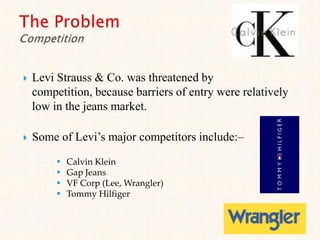
   Levi Strauss & Co. was threatened by
    competition, because barriers of entry were relatively
    low in the jeans market.

   Some of Levi’s major competitors include:–
            Calvin Klein
            Gap Jeans
            VF Corp (Lee, Wrangler)
            Tommy Hilfiger
   The entrance of new competitors had many
    effects on Levi’s.

     -Levi’s no longer had monopoly power

     -more competitive prices       lower profits

     –Availability of substitutes

     –Levi’s Consumers started buying from
    competitors which lowered Levi’s market share.
Also…


   Competitors successfully started grabbing
    Levi’s market due to heavy advertisement and
    branding.

   Branding was especially effective for
    companies like “Calvin Klein” that targeted
    high-end consumers.
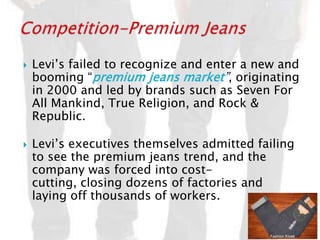
   Levi’s failed to recognize and enter a new and
    booming “premium jeans market”, originating
    in 2000 and led by brands such as Seven For
    All Mankind, True Religion, and Rock &
    Republic.

   Levi’s executives themselves admitted failing
    to see the premium jeans trend, and the
    company was forced into cost-
    cutting, closing dozens of factories and
    laying off thousands of workers.
   With the rise of competitors and decrease in brand
    image, Levi Strauss & Co. made use of edgy
    advertisements.
        Brand Loyalty & Brand Image
              -Many of Levi’s ads stress brand loyalty to
        maintain existing customers.
               -Some TV ads were set in the late 1800s,
        stressing the historic value of the company.
               –At the same time, Levi’s ads stressed the
        “youthfulness“ of their brand jeans.
               TV advertisements were more innovative and
        targeted younger crowds.

These marketing strategies however did not help with the
worldwide decrease demand for jeans. This implies that
Demand
                      Price


   In order to maintain revenues, the company
    released the Levi’s signature jeans. This
    product line appealed to the low-end
    consumers.
   In 2002, Levi Strauss & Co. made an agreement with the
    largest retailer Wal-Mart as a supply-chain strategy to
    mass-market consumers.
        “Levi’s Signature brand to be sold in Wal-Mart stores
    exclusively”

   This was an excellent strategic move because Wal-Mart
    was making large sales while Levi’s could not keep up in
    sales. This had potential to benefit both the parties.

   By 2002, Wal-Mart was #1 in the Fortune 500 list & Levi
    Strauss & Co. was ranked #383.


               This partnership was a great success.
Thank You

Levi's market analysis

  • 1.
    Levi Strauss& Co. A Market Analysis By:- Md. Akram Sec-A
  • 2.
    Levi Strauss & Co. was threatened by competition, because barriers of entry were relatively low in the jeans market.  Some of Levi’s major competitors include:–  Calvin Klein  Gap Jeans  VF Corp (Lee, Wrangler)  Tommy Hilfiger
  • 3.
    The entrance of new competitors had many effects on Levi’s. -Levi’s no longer had monopoly power -more competitive prices lower profits –Availability of substitutes –Levi’s Consumers started buying from competitors which lowered Levi’s market share.
  • 4.
    Also…  Competitors successfully started grabbing Levi’s market due to heavy advertisement and branding.  Branding was especially effective for companies like “Calvin Klein” that targeted high-end consumers.
  • 5.
    Levi’s failed to recognize and enter a new and booming “premium jeans market”, originating in 2000 and led by brands such as Seven For All Mankind, True Religion, and Rock & Republic.  Levi’s executives themselves admitted failing to see the premium jeans trend, and the company was forced into cost- cutting, closing dozens of factories and laying off thousands of workers.
  • 6.
    With the rise of competitors and decrease in brand image, Levi Strauss & Co. made use of edgy advertisements. Brand Loyalty & Brand Image -Many of Levi’s ads stress brand loyalty to maintain existing customers. -Some TV ads were set in the late 1800s, stressing the historic value of the company. –At the same time, Levi’s ads stressed the “youthfulness“ of their brand jeans. TV advertisements were more innovative and targeted younger crowds. These marketing strategies however did not help with the worldwide decrease demand for jeans. This implies that
  • 7.
    Demand Price  In order to maintain revenues, the company released the Levi’s signature jeans. This product line appealed to the low-end consumers.
  • 8.
    In 2002, Levi Strauss & Co. made an agreement with the largest retailer Wal-Mart as a supply-chain strategy to mass-market consumers. “Levi’s Signature brand to be sold in Wal-Mart stores exclusively”  This was an excellent strategic move because Wal-Mart was making large sales while Levi’s could not keep up in sales. This had potential to benefit both the parties.  By 2002, Wal-Mart was #1 in the Fortune 500 list & Levi Strauss & Co. was ranked #383. This partnership was a great success.
  • 9.