
Marketing Management
Project
Group Members
Aman Kumar (4A)
Bharat Lanzara (10A)
Manas Singh (22A)
Sumegha Setia (42A)
Index
• STP (Segmentation-Target-Positioning)

• Identification of Channel Strategy

• Product Strategy

• Brand Strategy

• Branch Promotion Activities
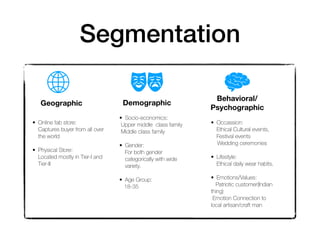
Segmentation
Geographic Demographic
Behavioral/
Psychographic
• Online fab store:
Captures buyer from all over
the world
• Physical Store:
Located mostly in Tier-I and
Tier-II
• Socio-economics:
Upper middle class family
Middle class family
• Gender:
For both gender
categorically with wide
variety.
• Age Group:
18-35
• Occassion:
Ethical Cultural events,
Festival events
Wedding ceremonies
• Lifestyle:
Ethical daily wear habits.
• Emotions/Values:
Patriotic customer(Indian
thing)
Emotion Connection to
local artisan/craft man
Targeting
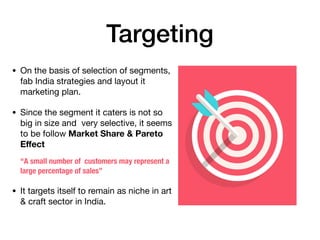
• On the basis of selection of segments,
fab India strategies and layout it
marketing plan.

• Since the segment it caters is not so
big in size and very selective, it seems
to be follow Market Share & Pareto
Effect
“A small number of  customers may represent a
large percentage of sales”
• It targets itself to remain as niche in art
& craft sector in India.
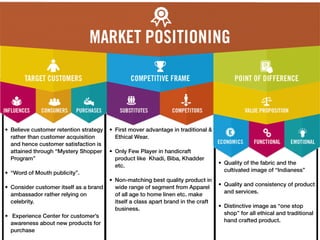
• Believe customer retention strategy
rather than customer acquisition
and hence customer satisfaction is
attained through “Mystery Shopper
Program”
• “Word of Mouth publicity”.
• Consider customer itself as a brand
ambassador rather relying on
celebrity.
• Experience Center for customer’s
awareness about new products for
purchase
• Quality of the fabric and the
cultivated image of “Indianess”
• Quality and consistency of product
and services.
• Distinctive image as “one stop
shop” for all ethical and traditional
hand crafted product.
• First mover advantage in traditional &
Ethical Wear.
• Only Few Player in handicraft
product like Khadi, Biba, Khadder
etc.
• Non-matching best quality product in
wide range of segment from Apparel
of all age to home linen etc. make
itself a class apart brand in the craft
business.
Identification of Channel
Strategy
Physical Distribution Strategy
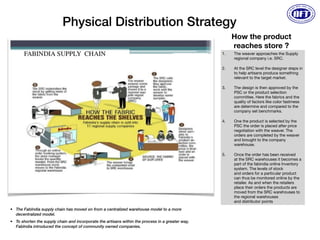
• The FabIndia supply chain has moved on from a centralized warehouse model to a more
decentralized model. 
• To shorten the supply chain and incorporate the artisans within the process in a greater way,
FabIndia introduced the concept of community owned companies.
1. The weaver approaches the Supply
regional company i.e. SRC. 

2. At the SRC level the designer steps in
to help artisans produce something
relevant to the target market. 

3. The design is then approved by the
PSC or the product selection
committee. Here the fabrics and the
quality of factors like color fastmess
are determine and compared to the
company set benchmarks. 

4. One the product is selected by the
PSC the order is placed after price
negotiation with the weaver. The
orders are completed by the weaver
and brought to the company
warehouse.

5. Once the order has been received
at the SRC warehouses it becomes a
part of the fabindia online Inventory
system. The levels of stock
and orders for a particular product
can thus be monitored online by the
retailer. As and when the retailers
place their orders the products are
moved from the SRC warehouses to
the regional warehouses
and distributor points
How the product
reaches store ?
Customer Service Strategy
• Fab India enhances customer experience with launch
of “fabfamily”- a locality program.

•  Benefits of “fabfamily” customer focused program
include shopping from home exclusive previews,
shopping by appointment, an extended exchange
period, and a dedicated relationship manager.

• Gift Voucher for loyal and regular costumers.

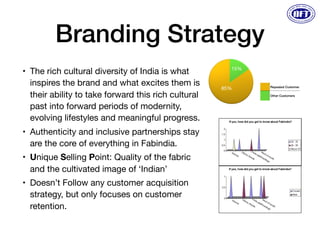
• Special discounts and attractive offers (85% repeat
customers).

• Mystery Shopper Program: To understand customer
and check the satisfaction level.

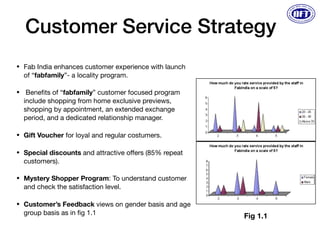
• Customer’s Feedback views on gender basis and age
group basis as in fig 1.1
Fig 1.1
Product Strategy
Product-Brand Correlation
Existing Products New Products
Existing
Brand
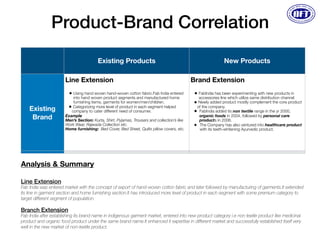
Line Extension
• Using hand woven hand-woven cotton fabric.Fab India entered
into hand woven product segments and manufactured home
furnishing items, garments for women/men/children.
• Categorizing more level of product in each segment helped
company to cater different need of consumer.
Example
Men’s Section: Kurta, Shirt, Pyjamas, Trousers and collection’s like
Work Wear, Rajwada Collection etc.
Home furnishing: Bed Cover, Bed Sheet, Quilts pillow covers, etc.
Brand Extension
• FabIndia has been experimenting with new products in
accessories line which utilize same distribution channel
• Newly added product mostly complement the core product
of the company.
• FabIndia added its non textile range in the yr 2000,
organic foods in 2004, followed by personal care
products in 2006.
• The Company has also ventured into healthcare product
with its teeth-whitening Ayurvedic product.
New Brand Multi Brand New Brand
Analysis & Summary
Line Extension
Fab India was entered market with the concept of export of hand-woven cotton fabric and later followed by manufacturing of garments.It extended
its line in garment section and home furnishing section.It has introduced more level of product in each segment with some premium category to
target different segment of population.
Branch Extension
Fab India after establishing its brand name in indigenous garment market, entered into new product category i.e non textile product like medicinal
product and organic food product under the same brand name.It enhanced it expertise in different market and successfully established itself very
well in the new market of non-textile product.
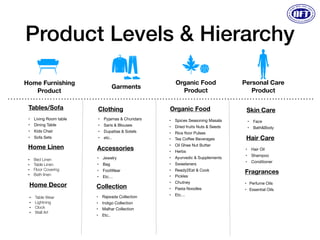
Product Levels & Hierarchy
Home Furnishing
Product
Organic Food
Product
Garments
Personal Care
Product
Tables/Sofa
• Living Room table

• Dining Table

• Kids Chair

• Sofa Sets
Home Linen
• Bed Linen
• Table Linen
• Floor Covering
• Bath linen
Clothing
• Pyjamas & Churidars

• Saris & Blouses

• Dupattas & Sotels

• etc..
Accessories
• Jewelry 

• Bag

• FootWear

• Etc…
Collection
• Rajwada Collection

• Indigo Collection

• Malhar Collection

• Etc..
Home Decor
• Table Wear
• Lightning
• Clock
• Wall Art
Organic Food
• Spices Seasoning Masala

• Dried fruits Nuts & Seeds

• Rice floor Pulses

• Tea Coffee Beverages

• Oil Ghee Nut Butter

• Herbs

• Ayurvedic & Supplements

• Sweeteners

• Ready2Eat & Cook

• Pickles

• Chutney

• Pasta Noodles

• Etc…
Skin Care
• Face

• Bath&Body
Hair Care
• Hair Oil 

• Shampoo

• Conditioner
Fragrances
• Perfume Oils

• Essential Oils
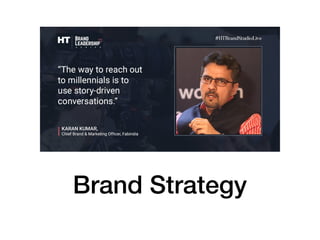
Brand Strategy
Branding Strategy
• The rich cultural diversity of India is what
inspires the brand and what excites them is
their ability to take forward this rich cultural
past into forward periods of modernity,
evolving lifestyles and meaningful progress. 

• Authenticity and inclusive partnerships stay
are the core of everything in Fabindia.

• Unique Selling Point: Quality of the fabric
and the cultivated image of ‘Indian’

• Doesn’t Follow any customer acquisition
strategy, but only focuses on customer
retention.
Repeated Customer
Other Customers
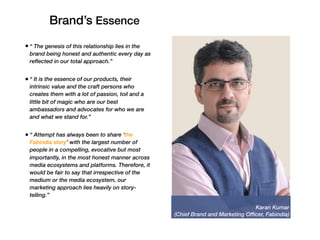
Karan Kumar
(Chief Brand and Marketing Officer, Fabindia)
• “ The genesis of this relationship lies in the
brand being honest and authentic every day as
reflected in our total approach.”
• “ It is the essence of our products, their
intrinsic value and the craft persons who
creates them with a lot of passion, toil and a
little bit of magic who are our best
ambassadors and advocates for who we are
and what we stand for.”
• “ Attempt has always been to share ‘the
Fabindia story’ with the largest number of
people in a compelling, evocative but most
importantly, in the most honest manner across
media ecosystems and platforms. Therefore, it
would be fair to say that irrespective of the
medium or the media ecosystem, our
marketing approach lies heavily on story-
telling.”
Brand’s Essence
Brand Promotions
Activities
Promotional Events &
Campaigns
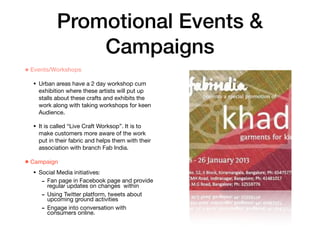
• Events/Workshops
• Urban areas have a 2 day workshop cum
exhibition where these artists will put up
stalls about these crafts and exhibits the
work along with taking workshops for keen
Audience.

• It is called “Live Craft Worksop”. It is to
make customers more aware of the work
put in their fabric and helps them with their
association with branch Fab India.

• Campaign
• Social Media initiatives:

- Fan page in Facebook page and provide
regular updates on changes within

- Using Twitter platform, tweets about
upcoming ground activities

- Engage into conversation with
consumers online.

Fab India Marketing & Strategy

  • 1.
    Marketing Management Project Group Members AmanKumar (4A) Bharat Lanzara (10A) Manas Singh (22A) Sumegha Setia (42A)
  • 2.
    Index • STP (Segmentation-Target-Positioning) •Identification of Channel Strategy • Product Strategy • Brand Strategy • Branch Promotion Activities
  • 4.
    Segmentation Geographic Demographic Behavioral/ Psychographic • Onlinefab store: Captures buyer from all over the world • Physical Store: Located mostly in Tier-I and Tier-II • Socio-economics: Upper middle class family Middle class family • Gender: For both gender categorically with wide variety. • Age Group: 18-35 • Occassion: Ethical Cultural events, Festival events Wedding ceremonies • Lifestyle: Ethical daily wear habits. • Emotions/Values: Patriotic customer(Indian thing) Emotion Connection to local artisan/craft man
  • 5.
    Targeting • On thebasis of selection of segments, fab India strategies and layout it marketing plan. • Since the segment it caters is not so big in size and very selective, it seems to be follow Market Share & Pareto Effect “A small number of  customers may represent a large percentage of sales” • It targets itself to remain as niche in art & craft sector in India.
  • 6.
    • Believe customerretention strategy rather than customer acquisition and hence customer satisfaction is attained through “Mystery Shopper Program” • “Word of Mouth publicity”. • Consider customer itself as a brand ambassador rather relying on celebrity. • Experience Center for customer’s awareness about new products for purchase • Quality of the fabric and the cultivated image of “Indianess” • Quality and consistency of product and services. • Distinctive image as “one stop shop” for all ethical and traditional hand crafted product. • First mover advantage in traditional & Ethical Wear. • Only Few Player in handicraft product like Khadi, Biba, Khadder etc. • Non-matching best quality product in wide range of segment from Apparel of all age to home linen etc. make itself a class apart brand in the craft business.
  • 7.
  • 8.
    Physical Distribution Strategy •The FabIndia supply chain has moved on from a centralized warehouse model to a more decentralized model.  • To shorten the supply chain and incorporate the artisans within the process in a greater way, FabIndia introduced the concept of community owned companies. 1. The weaver approaches the Supply regional company i.e. SRC.  2. At the SRC level the designer steps in to help artisans produce something relevant to the target market.  3. The design is then approved by the PSC or the product selection committee. Here the fabrics and the quality of factors like color fastmess are determine and compared to the company set benchmarks.  4. One the product is selected by the PSC the order is placed after price negotiation with the weaver. The orders are completed by the weaver and brought to the company warehouse. 5. Once the order has been received at the SRC warehouses it becomes a part of the fabindia online Inventory system. The levels of stock and orders for a particular product can thus be monitored online by the retailer. As and when the retailers place their orders the products are moved from the SRC warehouses to the regional warehouses and distributor points How the product reaches store ?
  • 9.
    Customer Service Strategy •Fab India enhances customer experience with launch of “fabfamily”- a locality program. •  Benefits of “fabfamily” customer focused program include shopping from home exclusive previews, shopping by appointment, an extended exchange period, and a dedicated relationship manager. • Gift Voucher for loyal and regular costumers. • Special discounts and attractive offers (85% repeat customers). • Mystery Shopper Program: To understand customer and check the satisfaction level. • Customer’s Feedback views on gender basis and age group basis as in fig 1.1 Fig 1.1
  • 10.
  • 11.
    Product-Brand Correlation Existing ProductsNew Products Existing Brand Line Extension • Using hand woven hand-woven cotton fabric.Fab India entered into hand woven product segments and manufactured home furnishing items, garments for women/men/children. • Categorizing more level of product in each segment helped company to cater different need of consumer. Example Men’s Section: Kurta, Shirt, Pyjamas, Trousers and collection’s like Work Wear, Rajwada Collection etc. Home furnishing: Bed Cover, Bed Sheet, Quilts pillow covers, etc. Brand Extension • FabIndia has been experimenting with new products in accessories line which utilize same distribution channel • Newly added product mostly complement the core product of the company. • FabIndia added its non textile range in the yr 2000, organic foods in 2004, followed by personal care products in 2006. • The Company has also ventured into healthcare product with its teeth-whitening Ayurvedic product. New Brand Multi Brand New Brand Analysis & Summary Line Extension Fab India was entered market with the concept of export of hand-woven cotton fabric and later followed by manufacturing of garments.It extended its line in garment section and home furnishing section.It has introduced more level of product in each segment with some premium category to target different segment of population. Branch Extension Fab India after establishing its brand name in indigenous garment market, entered into new product category i.e non textile product like medicinal product and organic food product under the same brand name.It enhanced it expertise in different market and successfully established itself very well in the new market of non-textile product.
  • 12.
    Product Levels &Hierarchy Home Furnishing Product Organic Food Product Garments Personal Care Product Tables/Sofa • Living Room table • Dining Table • Kids Chair • Sofa Sets Home Linen • Bed Linen • Table Linen • Floor Covering • Bath linen Clothing • Pyjamas & Churidars • Saris & Blouses • Dupattas & Sotels • etc.. Accessories • Jewelry • Bag • FootWear • Etc… Collection • Rajwada Collection • Indigo Collection • Malhar Collection • Etc.. Home Decor • Table Wear • Lightning • Clock • Wall Art Organic Food • Spices Seasoning Masala • Dried fruits Nuts & Seeds • Rice floor Pulses • Tea Coffee Beverages • Oil Ghee Nut Butter • Herbs • Ayurvedic & Supplements • Sweeteners • Ready2Eat & Cook • Pickles • Chutney • Pasta Noodles • Etc… Skin Care • Face • Bath&Body Hair Care • Hair Oil • Shampoo • Conditioner Fragrances • Perfume Oils • Essential Oils
  • 13.
  • 14.
    Branding Strategy • Therich cultural diversity of India is what inspires the brand and what excites them is their ability to take forward this rich cultural past into forward periods of modernity, evolving lifestyles and meaningful progress. • Authenticity and inclusive partnerships stay are the core of everything in Fabindia. • Unique Selling Point: Quality of the fabric and the cultivated image of ‘Indian’ • Doesn’t Follow any customer acquisition strategy, but only focuses on customer retention. Repeated Customer Other Customers
  • 15.
    Karan Kumar (Chief Brandand Marketing Officer, Fabindia) • “ The genesis of this relationship lies in the brand being honest and authentic every day as reflected in our total approach.” • “ It is the essence of our products, their intrinsic value and the craft persons who creates them with a lot of passion, toil and a little bit of magic who are our best ambassadors and advocates for who we are and what we stand for.” • “ Attempt has always been to share ‘the Fabindia story’ with the largest number of people in a compelling, evocative but most importantly, in the most honest manner across media ecosystems and platforms. Therefore, it would be fair to say that irrespective of the medium or the media ecosystem, our marketing approach lies heavily on story- telling.” Brand’s Essence
  • 16.
  • 17.
    Promotional Events & Campaigns •Events/Workshops • Urban areas have a 2 day workshop cum exhibition where these artists will put up stalls about these crafts and exhibits the work along with taking workshops for keen Audience. • It is called “Live Craft Worksop”. It is to make customers more aware of the work put in their fabric and helps them with their association with branch Fab India. • Campaign • Social Media initiatives: - Fan page in Facebook page and provide regular updates on changes within - Using Twitter platform, tweets about upcoming ground activities - Engage into conversation with consumers online.