Performance
of smartphone
EXPERIENCE

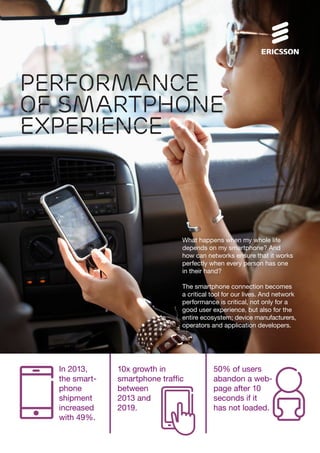
What happens when my whole life
depends on my smartphone? And
how can networks ensure that it works
perfectly when every person has one
in their hand?
The smartphone connection becomes
a critical tool for our lives. And network
performance is critical, not only for a
good user experience, but also for the
entire ecosystem; device manufacturers,
operators and application developers.

In 2013,
the smartphone
shipment
increased
with 49%.

10x growth in
smartphone traffic
between
2013 and
2019.

50% of users
abandon a webpage after 10
seconds if it
has not loaded.
Executive summary
What happens when my whole organized life depends on my smartphone? And how can networks
ensure that it works perfectly when every person has one in their hand? The advent and rapid adoption
of smartphones – they are now outselling feature phones – revolutionized the way we connect.
But the way we use smartphones is changing, from surfing the internet to using connected services
powered by mobile apps. We use them to do things: play a game, get directions, make a payment,
get fit, do our jobs. The smartphone connection becomes a critical tool for our lives. And network
performance is critical for the entire mobile ecosystem: device manufacturers, operators and application
developers.

CHANGED CONSUMER BEHAVIOUR

EXPECTATIONS PUSH NETWORK EVOLUTION

54% of the consumers say smartphones make them
more efficient, but the experience often doesn’t live up to
expectations. Problems with coverage and waiting times
harm consumer loyalty. Around 30 percent of users have
problems every day, 60 percent every week. Slow browsing
and slow downloads are the most common issues, while
15-20 percent regularly lose internet or service access.

The smartphone becomes more and more central in
people’s lives and constantly brings new expectations
from the consumers.

And as more people get higher-end devices, the demands
on networks in terms of coverage, capacity and speed will
just keep on growing.

Already in 2011, time spent on apps surpassed the time
we spend on web browsing.
In parallel, service providers expect to reach the consumers
seamlessly via the smartphone.
These expectations push network evolution. 60% of the
traffic is already web browsing, social media and streaming.
Networks need to be prepared to not only handle the huge
growth in data but also the growth of diversifying needs.
So, in the end, it all boils down to how well your network
supports these trends and business models. At Ericsson,
this is at our core, to develop networks that responds the
new challenges and gives operators the ability to prosper.

CORE PRINCIPLES FOR ACHIEVING BETTER
SMARTPHONE EXPERIENCE
We are using our smartphones anywhere and anytime.
Even on public transport, where service is often less than
perfect, nearly half of our fellow travelers are connecting
to their social networks and reading the news. New usage
patterns are changing the requirements for networks:
people sitting and waiting watch more video, for example,
which demands more capacity.

NEW BUSINESS MODELS
Successful operators who shifted to the smartphone paradigm – with the right network performance and service
bundles – have seen profitable growth.
There are two approaches to smart packaging: to package
data or to package services, collaborating with third-party
service providers. Bucket data deals provide varying
quantities of data at different price points. The alternative
bundles data and connectivity with services, an operator’s
own (storage, navigation) or third-party services (such as
Spotify). Another business model is co-bundling, even
closer integration together with a third-party provider.
Now most operators are maintaining mobile broadband
tiered pricing and shared data plans are adopted in many
markets.

At Ericsson, we believe there are 3 core principles that
will support operators in developing and improving the
network performance for better smartphone experience.
Think App coverage. Think Everywhere. Think Ecosystem.

Think App coverage
In essence, the processes used by operators to manage
network quality for voice can be employed for mobile
data – with one major difference. Voice services involve
well-known and static KPIs. Delivering data services with
wide spectrum of apps, many apps requires decisions
about service levels that must be continually revisited as
the apps evolve and present new requirements. Operators

Successful operators who shifted
to the smartphone paradigm – with
the right network performance and
service bundles – have seen profitable
growth and outperform competition.
will need to adapt continually as mobile devices, apps and
network capabilities all develop in parallel. The advantage
of an App coverage focus is that this approach enables the
integration of coverage, capacity and quality into a holistic
view of network performance, allowing the operator to
deliver network quality that meets the user experience.

Network evolution
To evolve the network, operators need different solutions
to meet the varying requirements of capacity. Radio and
transport need to evolve together and they should evolve
in a way to always be ahead of the growth in traffic.
There are different needs in rural areas than in suburban
areas. In rural areas there is mainly a need to improve
coverage and capacity, while in urban areas it is about
improving, densifying and add capacity and coverage.
We call this approach heterogeneous networks and the
performance of a heterogeneous network depends greatly
on the degree of radio coordination between cells.

Think everywhere
We use smartphones differently than feature phones. We
use them all the time and everywhere, adoption of new
behaviors and expectations. Operators need to ensure
that they understand the different requirements that different
contexts put on the network.

Think Ecosystem
The smartphone experience is critically dependent on the
three factors - network, device and app. Devices and apps
must be included in the equation and synchronized when
developing and improving the network.
To realize the core principles and deliver what our customer’s
need, Ericsson uses an iterative method based on assessment, optimization, evolution and collaboration.

For the best network experience, advanced traffic
management is needed to assign devices to the best
radio access, cell type and frequency band(s) at all times.
Only relying on standardized protocol support, would be
highly inefficient and bring a poorer user experience. By
using coordinated small cells, the macro spectrum can
be fully reused in the small cells, which means the same
services can be delivered using less spectrum; simply
because the achievable user bit-rate is proportional to
spectrum bandwidth. Expanding capacity on existing sites
is probably the way to serve the “next billion data users”.

Collaboration
Assess
First of all, the network should be reviewed from a smartphone perspective providing information of current
issues and a reference of wanted performance levels. For
instance, how many 3G capable Smartphone users camp
on 2G when they should camp on 3G that provides a better
experience? If this is the case, it will impact severely the
performance perceived by the user and limits the app usage.
Different smartphones behave differently. When knowing
which device is related to which problem, it is possible to
plan actions to replace those devices, or introduce specific
setting in the network to reduce the impact.

Tune and optimize
Tuning and optimization is one of the most important
actions to maximize the usage of existing assets in the
network. Example: Signaling is one of the major challenges
that Smartphone brings. The constant communication of
the Apps requires a lot of resources of the network, and
even more during handovers. By reducing handovers
through network tuning and optimization the network is
being off-loaded.

To support our customers with the best performing networks, Ericsson collaborates with the leading players in
the eco system to gain knowledge and understand the
network requirements and the new business models.
We gain experience by providing networks in the most
demanding smartphone markets in the world and through
Ericsson labs we gain deep understanding of how the
device interacts with the network.

SUMMARY
To ensure a great smartphone experience, Ericsson
recommends:

>> Secure user experience by building superior app coverage
>> Create market differentiation by innovative business
models

>> Align network strategy for current and future device and
app evolution
Contact your Ericsson representative for more details.
www.ericsson.com
Ericsson is a world-leading provider of telecommunications equipment and services to
mobile and fixed network operators. Over 1,000 networks in more than 180 countries use our
network equipment, and more than 40 percent of the world’s mobile traffic passes through
Ericsson networks.
We are one of the few companies worldwide that can offer end-to-end solutions for all major
mobile communication standards. Our networks, telecom services and multimedia solutions
make it easier for people, across the world, to communicate.
And as communication changes the way we live and work, Ericsson is playing a key role in
this evolution. Using innovation to empower people, business and society, we are working
towards the Networked Society, in which everything that can benefit from a connection will
have one.
Our vision is to be the prime driver in an all-communicating world

Telefonaktiebolaget LM Ericsson
SE-126 25 Stockholm, Sweden
Telephone +46 8 719 0000
Fax +46 8 18 40 85
www.ericsson.com

The content of this document is subject to revision without
notice due to continued progress in methodology, design and
manufacturing. Ericsson shall have no liability for any error or
damage of any kind resulting from the use of this document

287 01-FGB, rev A
© Ericsson AB 2013

The Performance of Smartphone Experience

  • 1.
    Performance of smartphone EXPERIENCE What happenswhen my whole life depends on my smartphone? And how can networks ensure that it works perfectly when every person has one in their hand? The smartphone connection becomes a critical tool for our lives. And network performance is critical, not only for a good user experience, but also for the entire ecosystem; device manufacturers, operators and application developers. In 2013, the smartphone shipment increased with 49%. 10x growth in smartphone traffic between 2013 and 2019. 50% of users abandon a webpage after 10 seconds if it has not loaded.
  • 2.
    Executive summary What happenswhen my whole organized life depends on my smartphone? And how can networks ensure that it works perfectly when every person has one in their hand? The advent and rapid adoption of smartphones – they are now outselling feature phones – revolutionized the way we connect. But the way we use smartphones is changing, from surfing the internet to using connected services powered by mobile apps. We use them to do things: play a game, get directions, make a payment, get fit, do our jobs. The smartphone connection becomes a critical tool for our lives. And network performance is critical for the entire mobile ecosystem: device manufacturers, operators and application developers. CHANGED CONSUMER BEHAVIOUR EXPECTATIONS PUSH NETWORK EVOLUTION 54% of the consumers say smartphones make them more efficient, but the experience often doesn’t live up to expectations. Problems with coverage and waiting times harm consumer loyalty. Around 30 percent of users have problems every day, 60 percent every week. Slow browsing and slow downloads are the most common issues, while 15-20 percent regularly lose internet or service access. The smartphone becomes more and more central in people’s lives and constantly brings new expectations from the consumers. And as more people get higher-end devices, the demands on networks in terms of coverage, capacity and speed will just keep on growing. Already in 2011, time spent on apps surpassed the time we spend on web browsing. In parallel, service providers expect to reach the consumers seamlessly via the smartphone. These expectations push network evolution. 60% of the traffic is already web browsing, social media and streaming. Networks need to be prepared to not only handle the huge growth in data but also the growth of diversifying needs. So, in the end, it all boils down to how well your network supports these trends and business models. At Ericsson, this is at our core, to develop networks that responds the new challenges and gives operators the ability to prosper. CORE PRINCIPLES FOR ACHIEVING BETTER SMARTPHONE EXPERIENCE We are using our smartphones anywhere and anytime. Even on public transport, where service is often less than perfect, nearly half of our fellow travelers are connecting to their social networks and reading the news. New usage patterns are changing the requirements for networks: people sitting and waiting watch more video, for example, which demands more capacity. NEW BUSINESS MODELS Successful operators who shifted to the smartphone paradigm – with the right network performance and service bundles – have seen profitable growth. There are two approaches to smart packaging: to package data or to package services, collaborating with third-party service providers. Bucket data deals provide varying quantities of data at different price points. The alternative bundles data and connectivity with services, an operator’s own (storage, navigation) or third-party services (such as Spotify). Another business model is co-bundling, even closer integration together with a third-party provider. Now most operators are maintaining mobile broadband tiered pricing and shared data plans are adopted in many markets. At Ericsson, we believe there are 3 core principles that will support operators in developing and improving the network performance for better smartphone experience. Think App coverage. Think Everywhere. Think Ecosystem. Think App coverage In essence, the processes used by operators to manage network quality for voice can be employed for mobile data – with one major difference. Voice services involve well-known and static KPIs. Delivering data services with wide spectrum of apps, many apps requires decisions about service levels that must be continually revisited as the apps evolve and present new requirements. Operators Successful operators who shifted to the smartphone paradigm – with the right network performance and service bundles – have seen profitable growth and outperform competition.
  • 3.
    will need toadapt continually as mobile devices, apps and network capabilities all develop in parallel. The advantage of an App coverage focus is that this approach enables the integration of coverage, capacity and quality into a holistic view of network performance, allowing the operator to deliver network quality that meets the user experience. Network evolution To evolve the network, operators need different solutions to meet the varying requirements of capacity. Radio and transport need to evolve together and they should evolve in a way to always be ahead of the growth in traffic. There are different needs in rural areas than in suburban areas. In rural areas there is mainly a need to improve coverage and capacity, while in urban areas it is about improving, densifying and add capacity and coverage. We call this approach heterogeneous networks and the performance of a heterogeneous network depends greatly on the degree of radio coordination between cells. Think everywhere We use smartphones differently than feature phones. We use them all the time and everywhere, adoption of new behaviors and expectations. Operators need to ensure that they understand the different requirements that different contexts put on the network. Think Ecosystem The smartphone experience is critically dependent on the three factors - network, device and app. Devices and apps must be included in the equation and synchronized when developing and improving the network. To realize the core principles and deliver what our customer’s need, Ericsson uses an iterative method based on assessment, optimization, evolution and collaboration. For the best network experience, advanced traffic management is needed to assign devices to the best radio access, cell type and frequency band(s) at all times. Only relying on standardized protocol support, would be highly inefficient and bring a poorer user experience. By using coordinated small cells, the macro spectrum can be fully reused in the small cells, which means the same services can be delivered using less spectrum; simply because the achievable user bit-rate is proportional to spectrum bandwidth. Expanding capacity on existing sites is probably the way to serve the “next billion data users”. Collaboration Assess First of all, the network should be reviewed from a smartphone perspective providing information of current issues and a reference of wanted performance levels. For instance, how many 3G capable Smartphone users camp on 2G when they should camp on 3G that provides a better experience? If this is the case, it will impact severely the performance perceived by the user and limits the app usage. Different smartphones behave differently. When knowing which device is related to which problem, it is possible to plan actions to replace those devices, or introduce specific setting in the network to reduce the impact. Tune and optimize Tuning and optimization is one of the most important actions to maximize the usage of existing assets in the network. Example: Signaling is one of the major challenges that Smartphone brings. The constant communication of the Apps requires a lot of resources of the network, and even more during handovers. By reducing handovers through network tuning and optimization the network is being off-loaded. To support our customers with the best performing networks, Ericsson collaborates with the leading players in the eco system to gain knowledge and understand the network requirements and the new business models. We gain experience by providing networks in the most demanding smartphone markets in the world and through Ericsson labs we gain deep understanding of how the device interacts with the network. SUMMARY To ensure a great smartphone experience, Ericsson recommends: >> Secure user experience by building superior app coverage >> Create market differentiation by innovative business models >> Align network strategy for current and future device and app evolution Contact your Ericsson representative for more details. www.ericsson.com
  • 4.
    Ericsson is aworld-leading provider of telecommunications equipment and services to mobile and fixed network operators. Over 1,000 networks in more than 180 countries use our network equipment, and more than 40 percent of the world’s mobile traffic passes through Ericsson networks. We are one of the few companies worldwide that can offer end-to-end solutions for all major mobile communication standards. Our networks, telecom services and multimedia solutions make it easier for people, across the world, to communicate. And as communication changes the way we live and work, Ericsson is playing a key role in this evolution. Using innovation to empower people, business and society, we are working towards the Networked Society, in which everything that can benefit from a connection will have one. Our vision is to be the prime driver in an all-communicating world Telefonaktiebolaget LM Ericsson SE-126 25 Stockholm, Sweden Telephone +46 8 719 0000 Fax +46 8 18 40 85 www.ericsson.com The content of this document is subject to revision without notice due to continued progress in methodology, design and manufacturing. Ericsson shall have no liability for any error or damage of any kind resulting from the use of this document 287 01-FGB, rev A © Ericsson AB 2013