Mobile Democracy: A Disruptive Innovation for Democracy-hungry Groups Abdelnasser Abdelaal and Hesham Ali Department of Computer Science College of Information Science and Technology University of Nebraska at Omaha Omaha, NE 68182 {aabdelaal| [email_address]
Agenda Introduction  IT and Social Applications Emerging M-Democracy Technology Previous work Proposed Model for M-Democracy Case studies Conclusions and Future Directions
Information Technology (IT) IT is a super scientific discipline that includes the disciplines that address issues related to collecting, storing, managing, processing information, and employing information and algorithmic techniques to solve problems in various application domains.
State of the IT Discipline Tremendous growth and development of Information Technology (IT) in recent years The progress in core IT areas is happening fast -  almost on a daily basis  The impact of this progress is not transferring with the same speed to other disciplines or to real-world applications Some may argue that IT may have lost some of its exciting flare
Signs of the lack of “true integration” The use of IT is not seamlessly integrated in our daily activities IT-related interdisciplinary disciplines are struggling to achieve their goals and achieve them quickly Major flaws in developing IT products for several critical applications  The digital divide issue
The New Role of IT Integrate with various disciplines and create new exciting areas such as Bioinformatics and Media Technology Provide the tools and innovations to other disciplines and help them achieve their goals  Take advantage of the growth of the new IT hybrid areas to further develop the core areas of IT
The Challenges for Integrating IT in Other areas Clash of cultures in different disciplines It is against the mighty silo structure Potential overemphasis of the IT component Lack of proper resources Overestimation of needed resources More than one cook in the kitchen, which recipe to use?
IT and Social Applications  Information and Communication Technology in general and mobile communication in particular have a number of societal applications: Civic engagement Electronic democracy Social inclusion for marginalized individuals Increasing social capital in the society  Definition: The term  Mobile democracy  refers to the usage of mobile interfaces by citizens, activists, politicians to generate, disseminate, and receive political content for the purpose of improving civic engagement and policy outcomes.
M-Democracy M-Democracy tools are particularly important for Democracy-Hungry Groups. These are Groups that lack the necessary civic engagement and political participation capabilities due to:  The lack of affordable and reliable communications tools Time and distance restrictions to participate in the political events;  Government regulations that restrict political participation Disabilities and special needs   These Groups include rural residents, quasi-nomadic individuals, mobile workforce, youth, and developing societies.
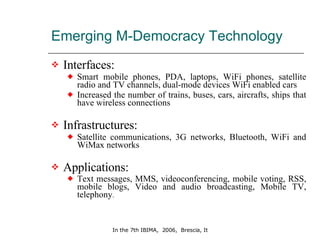
Emerging M-Democracy Technology  Interfaces:   Smart mobile phones, PDA, laptops, WiFi phones, satellite radio and TV channels, dual-mode devices WiFi enabled cars Increased the number of trains, buses, cars, aircrafts, ships that have wireless connections Infrastructures: Satellite communications, 3G networks, Bluetooth, WiFi and WiMax networks Applications: Text messages, MMS, videoconferencing, mobile voting, RSS, mobile blogs, Video and audio broadcasting, Mobile TV, telephony .
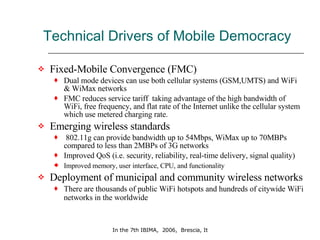
Technical Drivers of Mobile Democracy Fixed-Mobile Convergence (FMC) Dual mode devices can use both cellular systems (GSM,UMTS) and WiFi & WiMax networks FMC reduces service tariff  taking advantage of the high bandwidth of WiFi, free frequency, and flat rate of the Internet unlike the cellular system which use metered charging rate.  Emerging wireless standards 802.11g can provide bandwidth up to 54Mbps, WiMax up to 70MBPs compared to less than 2MBPs of 3G networks Improved QoS (i.e. security, reliability, real-time delivery, signal quality) Improved memory, user interface, CPU, and functionality   Deployment of municipal and community wireless networks There are thousands of public WiFi hotspots and hundreds of citywide WiFi networks in the worldwide
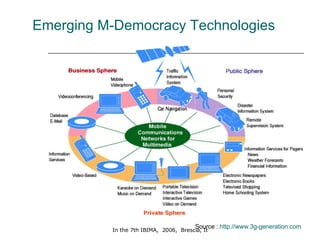
Emerging M-Democracy Technologies Source :  http://www.3g-generation.com
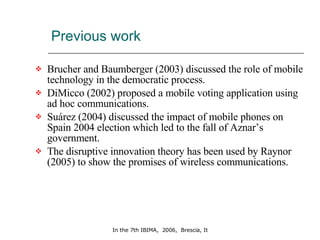
Previous work  Brucher and Baumberger (2003) discussed the role of mobile technology in the democratic process.  DiMicco (2002) proposed a mobile voting application using ad hoc communications.  Suárez (2004) discussed the impact of mobile phones on Spain 2004 election which led to the fall of Aznar’s government. The disruptive innovation theory has been used by Raynor (2005) to show the promises of wireless communications.
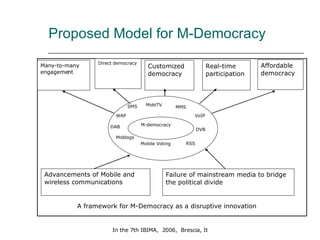
Proposed Model for M-Democracy  We propose a framework for M-Democracy that takes into account the emerging mobile and wireless technologies and the drowbaks of currnet civic engagmnet tools.  This model uses the disruptive innovation theory to show the increasing impact of mobile communications on political participation and civic engagement.  It shows that M-Democracy technologies are growing to supplement conventional information dissemination and civic engagement facilities particularly for DHGs.  According to the disruptive innovation theory, the inferior technology, in terms of performance, will eventually substitute or complement current technologies particularly for specific segments of users or applications.
Drawbacks of Mainstream Media  Failure of mainstream civic engagement tools Traditional mainstream media (TV, radio, newspapers) Failed to achieve political inclusion of the society at large.  These media are asymmetric when it comes to political participation.  Audiences can passively receive political content but cannot generate  E-Democracy tools and capabilities are not available to about 85% of the world’s population due to the lack of Internet access.
Proposed Model for M-Democracy Many-to-many engagement M-democracy Direct democracy Customized democracy Real-time participation Advancements of Mobile and wireless communications Failure of mainstream media to bridge the political divide SMS MobiTV Moblogs WAP RSS MMS DAB DVB VoIP Affordable democracy  Mobile Voting A framework for M-Democracy as a disruptive innovation
Key Properties of M-Democracy  Affordable political participation  In terms of time, effort, flexibility and portability Many-to-many civic engagement citizens can communicate with each other and their representatives via emails, videoconferencing, online forums, etc Direct democracy Constituents can contact their representatives directly using mobile phones  Customized democracy Citizens can create their own infrastructure or application of interest  Real-time participation  Mobile communications provide anywhere, anytime, and real-time participation  Low-regulated democracy  Unlike traditional media, authorities have less control of the content of text messages, emails, online forums, Moblogs, etc
Case Study 1: Egypt  Egyptian bloggers: They have grown to be the main political reform force. Where they use mobile phones to document and disseminate the violations of security forces and post them on open sites Organize demonstrations, and promote freedom of speech in Egypt   Egyptian oppositions used laptops to provide voters with their voting number in front of the voting stations  during elections of 2005
Case Study 2: Nepal Recently in Nepal:  Cell phones used to mobilize demonstrations asking the monarchy government to return democracy in 2005 The government cut of mobile services to prevent oppositions form using it to coordinate demonstrations After International pressure, the government returned the elected government and the mobile service as well
Case Study 3: Wireless Omaha  Free or Affordable Wireless Infrastructure with a focus on addressing the digital divide issue The University has been collaborating with city official to provide wireless coverage in public libraries, civic centers, and city parks  The impact of connectivity Omaha Public Library informal survey The impact on the growing Hispanic population
Other Case Studies  Mobile text messages have been used to arrange for demontrations againest the President in the Philippines and eventuually led to his removal Short Message Service (SMS) has been used to engage young people in Canada, register voters in South Africa, increase vote turnout in UK, and complete tax forms in Norway  WiFi networks have been used to politically engage native americans in public affairs through a community wireless network funded by HP
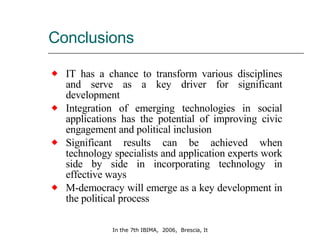
Conclusions IT has a chance to transform various disciplines and serve as a key driver for significant development Integration of emerging technologies in social applications has the potential of improving civic engagement and political inclusion Significant results can be achieved when technology specialists and application experts work side by side in incorporating technology in effective ways M-democracy will emerge as a key development in the political process
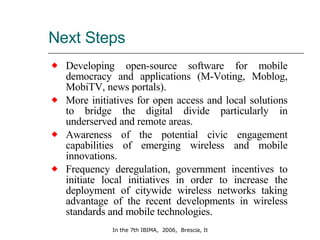
Next Steps Developing open-source software for mobile democracy and applications (M-Voting, Moblog, MobiTV, news portals). More initiatives for open access and local solutions to bridge the digital divide particularly in underserved and remote areas.  Awareness of the potential civic engagement capabilities of emerging wireless and mobile innovations.  Frequency deregulation, government incentives to initiate local initiatives in order to increase the deployment of citywide wireless networks taking advantage of the recent developments in wireless standards and mobile technologies.
Acknowledgment Nebraska Research Initiative NSF EPSCoR

Mobile Democracy

  • 1.
    Mobile Democracy: ADisruptive Innovation for Democracy-hungry Groups Abdelnasser Abdelaal and Hesham Ali Department of Computer Science College of Information Science and Technology University of Nebraska at Omaha Omaha, NE 68182 {aabdelaal| [email_address]
  • 2.
    Agenda Introduction IT and Social Applications Emerging M-Democracy Technology Previous work Proposed Model for M-Democracy Case studies Conclusions and Future Directions
  • 3.
    Information Technology (IT)IT is a super scientific discipline that includes the disciplines that address issues related to collecting, storing, managing, processing information, and employing information and algorithmic techniques to solve problems in various application domains.
  • 4.
    State of theIT Discipline Tremendous growth and development of Information Technology (IT) in recent years The progress in core IT areas is happening fast - almost on a daily basis The impact of this progress is not transferring with the same speed to other disciplines or to real-world applications Some may argue that IT may have lost some of its exciting flare
  • 5.
    Signs of thelack of “true integration” The use of IT is not seamlessly integrated in our daily activities IT-related interdisciplinary disciplines are struggling to achieve their goals and achieve them quickly Major flaws in developing IT products for several critical applications The digital divide issue
  • 6.
    The New Roleof IT Integrate with various disciplines and create new exciting areas such as Bioinformatics and Media Technology Provide the tools and innovations to other disciplines and help them achieve their goals Take advantage of the growth of the new IT hybrid areas to further develop the core areas of IT
  • 7.
    The Challenges forIntegrating IT in Other areas Clash of cultures in different disciplines It is against the mighty silo structure Potential overemphasis of the IT component Lack of proper resources Overestimation of needed resources More than one cook in the kitchen, which recipe to use?
  • 8.
    IT and SocialApplications Information and Communication Technology in general and mobile communication in particular have a number of societal applications: Civic engagement Electronic democracy Social inclusion for marginalized individuals Increasing social capital in the society Definition: The term Mobile democracy refers to the usage of mobile interfaces by citizens, activists, politicians to generate, disseminate, and receive political content for the purpose of improving civic engagement and policy outcomes.
  • 9.
    M-Democracy M-Democracy toolsare particularly important for Democracy-Hungry Groups. These are Groups that lack the necessary civic engagement and political participation capabilities due to: The lack of affordable and reliable communications tools Time and distance restrictions to participate in the political events; Government regulations that restrict political participation Disabilities and special needs These Groups include rural residents, quasi-nomadic individuals, mobile workforce, youth, and developing societies.
  • 10.
    Emerging M-Democracy Technology Interfaces: Smart mobile phones, PDA, laptops, WiFi phones, satellite radio and TV channels, dual-mode devices WiFi enabled cars Increased the number of trains, buses, cars, aircrafts, ships that have wireless connections Infrastructures: Satellite communications, 3G networks, Bluetooth, WiFi and WiMax networks Applications: Text messages, MMS, videoconferencing, mobile voting, RSS, mobile blogs, Video and audio broadcasting, Mobile TV, telephony .
  • 11.
    Technical Drivers ofMobile Democracy Fixed-Mobile Convergence (FMC) Dual mode devices can use both cellular systems (GSM,UMTS) and WiFi & WiMax networks FMC reduces service tariff taking advantage of the high bandwidth of WiFi, free frequency, and flat rate of the Internet unlike the cellular system which use metered charging rate. Emerging wireless standards 802.11g can provide bandwidth up to 54Mbps, WiMax up to 70MBPs compared to less than 2MBPs of 3G networks Improved QoS (i.e. security, reliability, real-time delivery, signal quality) Improved memory, user interface, CPU, and functionality Deployment of municipal and community wireless networks There are thousands of public WiFi hotspots and hundreds of citywide WiFi networks in the worldwide
  • 12.
    Emerging M-Democracy TechnologiesSource : http://www.3g-generation.com
  • 13.
    Previous work Brucher and Baumberger (2003) discussed the role of mobile technology in the democratic process. DiMicco (2002) proposed a mobile voting application using ad hoc communications. Suárez (2004) discussed the impact of mobile phones on Spain 2004 election which led to the fall of Aznar’s government. The disruptive innovation theory has been used by Raynor (2005) to show the promises of wireless communications.
  • 14.
    Proposed Model forM-Democracy We propose a framework for M-Democracy that takes into account the emerging mobile and wireless technologies and the drowbaks of currnet civic engagmnet tools. This model uses the disruptive innovation theory to show the increasing impact of mobile communications on political participation and civic engagement. It shows that M-Democracy technologies are growing to supplement conventional information dissemination and civic engagement facilities particularly for DHGs. According to the disruptive innovation theory, the inferior technology, in terms of performance, will eventually substitute or complement current technologies particularly for specific segments of users or applications.
  • 15.
    Drawbacks of MainstreamMedia Failure of mainstream civic engagement tools Traditional mainstream media (TV, radio, newspapers) Failed to achieve political inclusion of the society at large. These media are asymmetric when it comes to political participation. Audiences can passively receive political content but cannot generate E-Democracy tools and capabilities are not available to about 85% of the world’s population due to the lack of Internet access.
  • 16.
    Proposed Model forM-Democracy Many-to-many engagement M-democracy Direct democracy Customized democracy Real-time participation Advancements of Mobile and wireless communications Failure of mainstream media to bridge the political divide SMS MobiTV Moblogs WAP RSS MMS DAB DVB VoIP Affordable democracy Mobile Voting A framework for M-Democracy as a disruptive innovation
  • 17.
    Key Properties ofM-Democracy Affordable political participation In terms of time, effort, flexibility and portability Many-to-many civic engagement citizens can communicate with each other and their representatives via emails, videoconferencing, online forums, etc Direct democracy Constituents can contact their representatives directly using mobile phones Customized democracy Citizens can create their own infrastructure or application of interest Real-time participation Mobile communications provide anywhere, anytime, and real-time participation Low-regulated democracy Unlike traditional media, authorities have less control of the content of text messages, emails, online forums, Moblogs, etc
  • 18.
    Case Study 1:Egypt Egyptian bloggers: They have grown to be the main political reform force. Where they use mobile phones to document and disseminate the violations of security forces and post them on open sites Organize demonstrations, and promote freedom of speech in Egypt Egyptian oppositions used laptops to provide voters with their voting number in front of the voting stations during elections of 2005
  • 19.
    Case Study 2:Nepal Recently in Nepal: Cell phones used to mobilize demonstrations asking the monarchy government to return democracy in 2005 The government cut of mobile services to prevent oppositions form using it to coordinate demonstrations After International pressure, the government returned the elected government and the mobile service as well
  • 20.
    Case Study 3:Wireless Omaha Free or Affordable Wireless Infrastructure with a focus on addressing the digital divide issue The University has been collaborating with city official to provide wireless coverage in public libraries, civic centers, and city parks The impact of connectivity Omaha Public Library informal survey The impact on the growing Hispanic population
  • 21.
    Other Case Studies Mobile text messages have been used to arrange for demontrations againest the President in the Philippines and eventuually led to his removal Short Message Service (SMS) has been used to engage young people in Canada, register voters in South Africa, increase vote turnout in UK, and complete tax forms in Norway WiFi networks have been used to politically engage native americans in public affairs through a community wireless network funded by HP
  • 22.
    Conclusions IT hasa chance to transform various disciplines and serve as a key driver for significant development Integration of emerging technologies in social applications has the potential of improving civic engagement and political inclusion Significant results can be achieved when technology specialists and application experts work side by side in incorporating technology in effective ways M-democracy will emerge as a key development in the political process
  • 23.
    Next Steps Developingopen-source software for mobile democracy and applications (M-Voting, Moblog, MobiTV, news portals). More initiatives for open access and local solutions to bridge the digital divide particularly in underserved and remote areas. Awareness of the potential civic engagement capabilities of emerging wireless and mobile innovations. Frequency deregulation, government incentives to initiate local initiatives in order to increase the deployment of citywide wireless networks taking advantage of the recent developments in wireless standards and mobile technologies.
  • 24.
    Acknowledgment Nebraska ResearchInitiative NSF EPSCoR