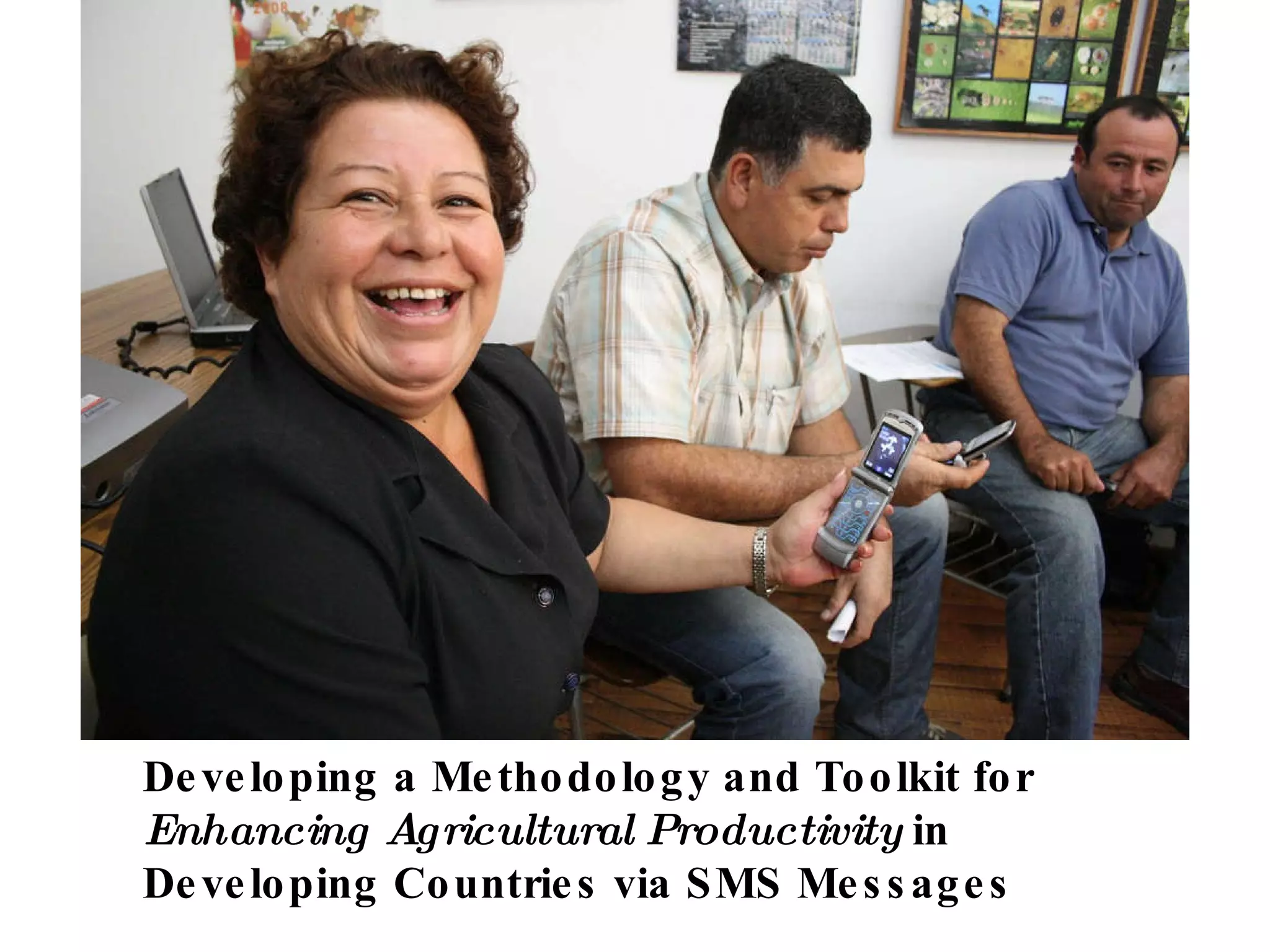
Developing a Methodology and Toolkit for  Enhancing Agricultural Productivity  in  Developing Countries via SMS Messages
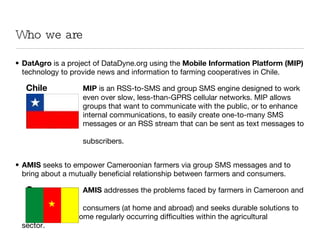
Who we are DatAgro  is a project of DataDyne.org using the  Mobile Information Platform   (MIP)  technology to provide news and information to farming cooperatives in Chile.   Chile MIP  is an RSS-to-SMS and group SMS engine designed to work even over slow, less-than-GPRS cellular networks. MIP allows  groups that want to communicate with the public, or to enhance  internal communications, to easily create one-to-many SMS  messages or an RSS stream that can be sent as text messages to  subscribers. AMIS  seeks to empower Cameroonian farmers via group SMS messages and to bring about a mutually beneficial relationship between farmers and consumers.    Cameroon AMIS  addresses the problems faced by farmers in Cameroon and  consumers (at home and abroad) and seeks durable solutions to  overcome regularly occurring difficulties within the agricultural  sector.
In the developed world, we rely on the  internet to reduce information inequalities by eliminating barriers  to accessing and sharing information. In the developing world, people are extremely unlikely to have that access and are unlikely to get it any time soon. This is especially true of  rural farmers, who tend to have significantly lower levels of internet connectivity than their urban peers . During the past decade, however, developing countries have made tremendous strides in connecting their rural populations to cellular networks.  SMS messages are today ´s  only existing digital technology able to reach a majority of the rural poor in many developing countries. SMS Messages Key to Overcoming Information Inequality
Cameroon´s  AMIS  project and Chile´s  DatAgro  are on the leading edge of programs attempting to leverage the power of information and communication technologies (ICTs) to increase the viability of small farms and agricultural cooperatives. The projects take different tactics to reach similar goals and have started informally  sharing their practices as well as their difficulties .  Rural farming communities around the world would benefit from a rigorous  documentation of the lessons learned  by these projects and  access to the processes and tools they have developed .  Applying ICTs to Agricultural Production
Though small holdings farmers have been slow to incorporate information technology into their work,  projects around the world are beginning to experiment with the use of cellular-based ICTs to improve productivity . Our goal is to  document and package the work we are doing  and make it available for free to other communities using a  Creative Commons  license in order to  help other projects avoid mistakes and maximize the impact of the time and resources they invest . In order to obtain best results, we will  recruit one more similar project in the southern hemisphere  to expand our breadth of experience.  Promoting Cooperation to Maximize Impact
What we propose... Using our diverse experiences, we propose to make it easy for others to use handheld technologies and SMS messages to reach their local farmers and improve the agricultural productivity of small farms in the  developing world
Project Components South-South Cooperation  to Enhance Agricultural Productivity in Developing Countries via the use of Handheld Technology and SMS Messages Desk Study  on the Use of SMS Technology to Enhance  Agricultural Productivity in Developing Countries Online Toolkit  for Using SMS Technology to Enhance  Agricultural Productivity in Developing Countries Workshop  for Integrating SMS Technology into Agricultural Projects eAgriculture  Virtual Community
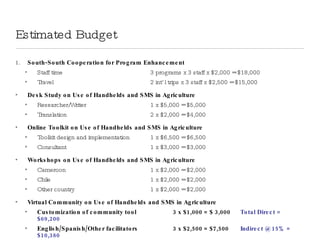
Estimated Budget South-South Cooperation for Program Enhancement Staff time 3 programs x 3 staff x $2,000 = $18,000 Travel 2 int’l trips x 3 staff x $2,500 = $15,000 Desk Study on Use of Handhelds and SMS in Agriculture Researcher/Writer 1 x $5,000 = $5,000 Translation 2 x $2,000 = $4,000 Online Toolkit on Use of Handhelds and SMS in Agriculture Toolkit design and implementation  1 x $6,500 = $6,500  Consultant 1 x $3,000 = $3,000  Workshops on Use of Handhelds and SMS in Agriculture Cameroon 1 x $2,000 = $2,000  Chile 1 x $2,000 = $2,000  Other country 1 x $2,000 = $2,000  Virtual Community on Use of Handhelds and SMS in Agriculture Customization of community tool 3 x $1,000 = $ 3,000 Total Direct = $69,200 English/Spanish/Other facilitators 3 x $2,500 = $7,500 Indirect @ 15% = $10,380 Hosting 12 x $100 = $1,200 TOTAL = $79,580
Questions?

Dat Agro and AMIS Collaborative Project to Increase Agricultural Productivity in Developing Countries

  • 1.
    Developing a Methodologyand Toolkit for Enhancing Agricultural Productivity in Developing Countries via SMS Messages
  • 2.
    Who we areDatAgro is a project of DataDyne.org using the Mobile Information Platform (MIP) technology to provide news and information to farming cooperatives in Chile. Chile MIP is an RSS-to-SMS and group SMS engine designed to work even over slow, less-than-GPRS cellular networks. MIP allows groups that want to communicate with the public, or to enhance internal communications, to easily create one-to-many SMS messages or an RSS stream that can be sent as text messages to subscribers. AMIS seeks to empower Cameroonian farmers via group SMS messages and to bring about a mutually beneficial relationship between farmers and consumers. Cameroon AMIS addresses the problems faced by farmers in Cameroon and consumers (at home and abroad) and seeks durable solutions to overcome regularly occurring difficulties within the agricultural sector.
  • 3.
    In the developedworld, we rely on the internet to reduce information inequalities by eliminating barriers to accessing and sharing information. In the developing world, people are extremely unlikely to have that access and are unlikely to get it any time soon. This is especially true of rural farmers, who tend to have significantly lower levels of internet connectivity than their urban peers . During the past decade, however, developing countries have made tremendous strides in connecting their rural populations to cellular networks. SMS messages are today ´s only existing digital technology able to reach a majority of the rural poor in many developing countries. SMS Messages Key to Overcoming Information Inequality
  • 4.
    Cameroon´s AMIS project and Chile´s DatAgro are on the leading edge of programs attempting to leverage the power of information and communication technologies (ICTs) to increase the viability of small farms and agricultural cooperatives. The projects take different tactics to reach similar goals and have started informally sharing their practices as well as their difficulties . Rural farming communities around the world would benefit from a rigorous documentation of the lessons learned by these projects and access to the processes and tools they have developed . Applying ICTs to Agricultural Production
  • 5.
    Though small holdingsfarmers have been slow to incorporate information technology into their work, projects around the world are beginning to experiment with the use of cellular-based ICTs to improve productivity . Our goal is to document and package the work we are doing and make it available for free to other communities using a Creative Commons license in order to help other projects avoid mistakes and maximize the impact of the time and resources they invest . In order to obtain best results, we will recruit one more similar project in the southern hemisphere to expand our breadth of experience. Promoting Cooperation to Maximize Impact
  • 6.
    What we propose...Using our diverse experiences, we propose to make it easy for others to use handheld technologies and SMS messages to reach their local farmers and improve the agricultural productivity of small farms in the developing world
  • 7.
    Project Components South-SouthCooperation to Enhance Agricultural Productivity in Developing Countries via the use of Handheld Technology and SMS Messages Desk Study on the Use of SMS Technology to Enhance Agricultural Productivity in Developing Countries Online Toolkit for Using SMS Technology to Enhance Agricultural Productivity in Developing Countries Workshop for Integrating SMS Technology into Agricultural Projects eAgriculture Virtual Community
  • 8.
    Estimated Budget South-SouthCooperation for Program Enhancement Staff time 3 programs x 3 staff x $2,000 = $18,000 Travel 2 int’l trips x 3 staff x $2,500 = $15,000 Desk Study on Use of Handhelds and SMS in Agriculture Researcher/Writer 1 x $5,000 = $5,000 Translation 2 x $2,000 = $4,000 Online Toolkit on Use of Handhelds and SMS in Agriculture Toolkit design and implementation 1 x $6,500 = $6,500 Consultant 1 x $3,000 = $3,000 Workshops on Use of Handhelds and SMS in Agriculture Cameroon 1 x $2,000 = $2,000 Chile 1 x $2,000 = $2,000 Other country 1 x $2,000 = $2,000 Virtual Community on Use of Handhelds and SMS in Agriculture Customization of community tool 3 x $1,000 = $ 3,000 Total Direct = $69,200 English/Spanish/Other facilitators 3 x $2,500 = $7,500 Indirect @ 15% = $10,380 Hosting 12 x $100 = $1,200 TOTAL = $79,580
  • 9.