Public Safety and
the Interoperability
Challenge
by Brenna Smith
and Tom Tolman
Public Safety and
the Interoperability
Challenge
by Brenna Smith
and Tom Tolman
Can We Talk?Can We Talk?
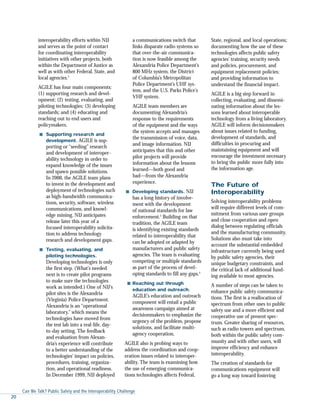
Photosource:PhotoDisc
National Institute of Justice Journal s April 2000
17
I
n their routine day-to-day
operations, many public safety
agencies can transmit mug
shots, fingerprints, and videos of
crime scenes to their communica-
tions centers. But when agencies
from multiple jurisdictions need
to mount a coordinated response
(for example, during a high-speed
pursuit across geographic bound-
aries), they may not be able to talk
to each other via their radios in
real time because their separate
radio equipment is incompatible.
When disaster strikes—a bombing,
plane crash, or natural disaster—
they even may be forced to use hand
signals or runners to relay messages.
In an era when news, data, and
pictures can be sent instantaneously
to the farthest reaches of the earth, it
is hard to believe that police officers,
firefighters, and emergency medical
service personnel may not be able to
talk to each other by radio.
Both the fairly common incident as
well as the rare headline-grabbing
event (such as the Oklahoma City
bombing or Columbine shootings)
test the ability of public safety agen-
cies to coordinate and respond
immediately. But in many cases,
precious seconds can be lost while
dispatchers translate and relay
emergency communications.
The ability to share information
in real time between agencies is
called interoperability. The basic
idea is this: Persons who need
to exchange information should
be able to do so, even when they
are using different technologies
from different manufacturers, with-
out the need for custom hardware
or software to integrate them all.
It’s a little like the incompatibilities
between various computer operat-
ing systems (e.g., Windows, Macin-
tosh, Unix)—but a lot more compli-
cated. Broadly defined, interoper-
ability refers to the ability to trans-
mit all types of communications
electronically, including voice,
data, and images. This article
focuses on one aspect: The ability
of public safety agencies to talk to
each other via radios.
Why Do We Have
This Problem?
Many factors contribute to lack
of interoperability. Public safety
agencies report that incompatible
radio frequency bands and limited
funding to update equipment are
their biggest problems,1
but John
Clark, former Deputy Chief of
Public Safety for the Federal
Communications Commission,
sees the issue in larger terms. Clark
says, “The problem with public
safety interoperability is a problem
of management, leadership, institu-
tional control, and institutional
culture.”
Limited Radio “Spectrum.” In
the early years of radio communica-
tion, public safety agencies used
radio spectrum only for voice
transmissions. Today, public safety
agencies are using radio spectrum
for much more than voice transmis-
sions. Just as consumers can now
use their wireless telephones to
download their e-mail, so too
can police officers use systems
originally dedicated to voice trans-
missions to send crime scene data,
videos, fingerprints, and mug shots.
The trend toward wireless commu-
nications and the convergence
of different telecommunication
processes is causing more and more
“traffic congestion” over the air
waves.
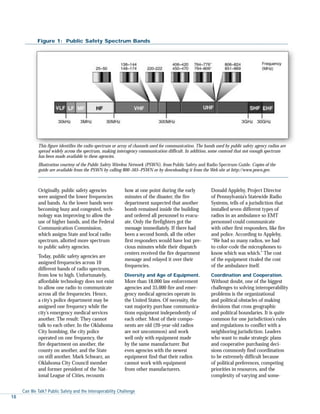
Electronic transmissions are sent
over a finite natural resource called
radio spectrum. John Clark calls
radio spectrum the “electromagnetic
real estate in the sky.” Spectrum is
divided into bands, such as VHF
and UHF. These in turn are divided
into frequencies or megahertz
(MHz). For example, 25–50 MHz
resides at the lower end of the VHF
band while 764–776 MHz resides
at the upper end of the UHF band.
(See figure 1, next page.)
Interoperability is the ability of two or
more organizations to communicate and
share information (voice, data, images, and
video) in real or near real time.
about the authors
Brenna Smith manages the AGILE team for the Research and Technology Division of
NIJ’s Office of Science and Technology. Tom Tolman is the Communications Technology
Manager at NIJ’s National Law Enforcement and Corrections Technology Center–Rocky
Mountain Region.
Originally, public safety agencies
were assigned the lower frequencies
and bands. As the lower bands were
becoming busy and congested, tech-
nology was improving to allow the
use of higher bands, and the Federal
Communication Commission,
which assigns State and local radio
spectrum, allotted more spectrum
to public safety agencies.
Today, public safety agencies are
assigned frequencies across 10
different bands of radio spectrum,
from low to high. Unfortunately,
affordable technology does not exist
to allow one radio to communicate
across all the frequencies. Hence,
a city’s police department may be
assigned one frequency while the
city’s emergency medical services
another. The result: They cannot
talk to each other. In the Oklahoma
City bombing, the city police
operated on one frequency, the
fire department on another, the
county on another, and the State
on still another. Mark Schwarz, an
Oklahoma City Council member
and former president of the Nat-
ional League of Cities, recounts
how at one point during the early
minutes of the disaster, the fire
department suspected that another
bomb remained inside the building
and ordered all personnel to evacu-
ate. Only the firefighters got the
message immediately. If there had
been a second bomb, all the other
first responders would have lost pre-
cious minutes while their dispatch
centers received the fire department
message and relayed it over their
frequencies.
Diversity and Age of Equipment.
More than 18,000 law enforcement
agencies and 35,000 fire and emer-
gency medical agencies operate in
the United States. Of necessity, the
vast majority purchase communica-
tions equipment independently of
each other. Most of their compo-
nents are old (20-year-old radios
are not uncommon) and work
well only with equipment made
by the same manufacturer. But
even agencies with the newest
equipment find that their radios
cannot work with equipment
from other manufacturers.
Donald Appleby, Project Director
of Pennsylvania’s Statewide Radio
Systems, tells of a jurisdiction that
installed seven different types of
radios in an ambulance so EMT
personnel could communicate
with other first responders, like fire
and police. According to Appleby,
“We had so many radios, we had
to color-code the microphones to
know which was which.” The cost
of the equipment rivaled the cost
of the ambulance itself.
Coordination and Cooperation.
Without doubt, one of the biggest
challenges to solving interoperability
problems is the organizational
and political obstacles of making
decisions that cross geographic
and political boundaries. It is quite
common for one jurisdiction’s rules
and regulations to conflict with a
neighboring jurisdiction. Leaders
who want to make strategic plans
and cooperative purchasing deci-
sions commonly find coordination
to be extremely difficult because
of political preferences, competing
priorities in resources, and the
complexity of varying and some-
Figure 1: Public Safety Spectrum Bands
Can We Talk? Public Safety and the Interoperability Challenge
18
This figure identifies the radio spectrum or array of channels used for communication. The bands used by public safety agency radios are
spread widely across the spectrum, making interagency communication difficult. In addition, some contend that not enough spectrum
has been made available to these agencies.
Illustration courtesy of the Public Safety Wireless Network (PSWN), from Public Safety and Radio Spectrum Guide. Copies of the
guide are available from the PSWN by calling 800–565–PSWN or by downloading it from the Web site at http://www.pswn.gov.
National Institute of Justice Journal s April 2000
19
times incompatible laws across
jurisdictions.
Technical solutions can be attained,
but without coordination, coopera-
tion, and planning among agencies,
the technologies cannot be imple-
mented to their greatest potential.
Potential Solutions
Although there is no silver bullet
or single solution to achieving inter-
operability, several approaches can
foster enhanced communication
among agencies. One such approach
is the use of digital radio systems.
Digital systems improve interoper-
ability indirectly because they gener-
ally operate more efficiently with
radio spectrum. Digital systems also
offer more options or functionality,
such as the ability to use “talk
groups” that relay information to
multiple users at once and improved
encryption capability so that infor-
mation transmitted over digital
systems can be made secure. In addi-
tion, signals transmitted over digital
systems are clearer over longer dis-
tances. Michigan is implementing a
statewide effort to streamline com-
munication by moving all of its pub-
lic safety agencies to an 800 MHz
statewide digital system. But digital
systems only help if they are “trunk-
ed” so that users are automatically
routed to an open channel and need
not wait for an open channel.
Some public safety agencies are
trying another approach: Using
products and services that tradition-
ally have been sold only to con-
sumers, such as satellite paging
systems, cellular phones, and per-
sonal communication systems
(PCS’s) that transmit both voice
and data. These alternatives are
helping to alleviate existing public
safety spectrum congestion and to
expand the geographic boundaries
of signal areas.
Sharing radio towers is another
approach. The city leaders of Upper
St. Clair, Pennsylvania, a suburb of
Pittsburgh, have partnered with a
commercial radio enterprise to
improve interoperability for their
public safety services. The city has
allowed a commercial enterprise
to build a radio tower on a site that
would not otherwise be available to
them. In exchange for permission
to build the tower, the commercial
enterprise has agreed to let the
city use the tower for police trans-
missions.
Although there are many issues to
be ironed out regarding the use of
commercially available services for
public safety, some agencies are
already putting the benefits into
practice. The Alexandria (Virginia)
Police Department, for example,
is using a commercially available
product (called “Cellular Digital
Packet Data,” or CDPD) to wire-
lessly transmit information to and
from laptop computers in patrol
vehicles.
NIJ’s Effort to
Support Solutions
The National Institute of Justice,
with its history of developing
standards for law enforcement
products and its close working
relationships with State and local
public safety agencies, has taken
steps to assist in solving interoper-
ability problems.
San Diego County Integrates
12 Agencies. One of the earliest
interoperability projects (opera-
tional since 1996) connected the
dispatch centers (radio communica-
tion systems) of 12 agencies operat-
ing in San Diego County, including
the Border Patrol, Immigration and
Naturalization Service, California
Highway Patrol, and San Diego
Police Department. The Border
Tactical Communication System,
or BORTAC as the project is called,
was undertaken jointly with the
Office of National Drug Control
Policy and the U.S. Navy’s Public
Safety Center in San Diego.
Leaders of the participating agencies
engaged in considerable early plan-
ning, significant negotiation,
and substantial discussion of the
tradeoffs before the project could
become a reality. Territorial issues,
personality differences, and legal
and liability concerns all hampered
the project. Eventually, off-the-shelf
communications circuits and radio
system software were used to link
the agencies’ various radio systems.
Now, with BORTAC in place, offi-
cers are able to speak directly to
one another, eliminating the need
for dispatchers to relay information.
Officers in two or more agencies can
talk together, and multiple, indepen-
dent conversations can occur simul-
taneously. For example, the Border
Patrol can talk to the San Diego
Sheriff’s Department about one
matter while the Immigration and
Naturalization Service, San Diego
Fire Department, and Emergency
Medical Service personnel are talk-
ing about something else.
Public safety agencies use BORTAC
several times each month for an
array of activities, including regional
auto-theft task force operations,
counterdrug sweeps, police pursuits,
special cross-border events, and
gang suppression. In one case, a
felon who had threatened officers
with a weapon tried to escape on
a motorcycle. Three neighboring
agencies were patched through
BORTAC and apprehended the
suspect without injury to the
officers.
The BORTAC model is now being
enhanced and replicated in Imperial
County and Los Angeles County,
California, and in Brownsville,
Texas.
AGILE: A Comprehensive Effort.
Created in 1998, AGILE (Advanced
Generation of Interoperability for
Law Enforcement) pulls together all
interoperability efforts within NIJ
and serves as the point of contact
for coordinating interoperability
initiatives with other projects, both
within the Department of Justice as
well as with other Federal, State, and
local agencies.2
AGILE has four main components:
(1) supporting research and devel-
opment; (2) testing, evaluating, and
piloting technologies; (3) developing
standards; and (4) educating and
reaching out to end users and
policymakers.
s Supporting research and
development. AGILE is sup-
porting or “seeding” research
and development of interoper-
ability technology in order to
expand knowledge of the issues
and spawn possible solutions.
In 2000, the AGILE team plans
to invest in the development and
deployment of technologies such
as high-bandwidth communica-
tions, security, software, wireless
communications, and knowl-
edge mining. NIJ anticipates
release later this year of a
focused interoperability solicita-
tion to address technology
research and development gaps.
s Testing, evaluating, and
piloting technologies.
Developing technologies is only
the first step. (What’s needed
next is to create pilot programs
to make sure the technologies
work as intended.) One of NIJ’s
pilot sites is the Alexandria
(Virginia) Police Department.
Alexandria is an “operational
laboratory,” which means the
technologies have moved from
the test lab into a real-life, day-
to-day setting. The feedback
and evaluation from Alexan-
dria’s experience will contribute
to a better understanding of the
technologies’ impact on policies,
procedures, training, organiza-
tion, and operational readiness.
In December 1999, NIJ deployed
a communications switch that
links disparate radio systems so
that over-the-air communica-
tion is now feasible among the
Alexandria Police Department’s
800 MHz system, the District
of Columbia’s Metropolitan
Police Department’s UHF sys-
tem, and the U.S. Parks Police’s
VHF system.
AGILE team members are
documenting Alexandria’s
response to the requirements
of the equipment and the ways
the system accepts and manages
the transmission of voice, data,
and image information. NIJ
anticipates that this and other
pilot projects will provide
information about the lessons
learned—both good and
bad—from the Alexandria
experience.
s Developing standards. NIJ
has a long history of involve-
ment with the development
of national standards for law
enforcement.3
Building on that
tradition, the AGILE team
is identifying existing standards
related to interoperability that
can be adopted or adapted by
manufacturers and public safety
agencies. The team is evaluating
competing or multiple standards
as part of the process of devel-
oping standards to fill any gaps.4
s Reaching out through
education and outreach.
AGILE’s education and outreach
component will entail a public
awareness campaign aimed at
decisionmakers to emphasize the
urgency of the problem, propose
solutions, and facilitate multi-
agency cooperation.
AGILE also is probing ways to
address the coordination and coop-
eration issues related to interoper-
ability. The team is examining how
the use of emerging communica-
tions technologies affects Federal,
State, regional, and local operations;
documenting how the use of these
technologies affects public safety
agencies’ training, security needs
and policies, procurement, and
equipment replacement policies;
and providing information to
understand the financial impact.
AGILE is a big step forward in
collecting, evaluating, and dissemi-
nating information about the les-
sons learned about interoperable
technology from a living laboratory.
AGILE will inform decisionmakers
about issues related to funding,
development of standards, and
difficulties in procuring and
maintaining equipment and will
encourage the investment necessary
to bring the public more fully into
the information age.
The Future of
Interoperability
Solving interoperability problems
will require different levels of com-
mitment from various user groups
and close cooperation and open
dialog between regulating officials
and the manufacturing community.
Solutions also must take into
account the substantial embedded
infrastructure currently being used
by public safety agencies, their
unique budgetary constraints, and
the critical lack of additional fund-
ing available to most agencies.
A number of steps can be taken to
enhance public safety communica-
tions. The first is a reallocation of
spectrum from other uses to public
safety use and a more efficient and
cooperative use of present spec-
trum. Greater sharing of resources,
such as radio towers and spectrum,
both within the public safety com-
munity and with other users, will
improve efficiency and enhance
interoperability.
The creation of standards for
communications equipment will
go a long way toward fostering
Can We Talk? Public Safety and the Interoperability Challenge
20
National Institute of Justice Journal s April 2000
21
interoperability. But the develop-
ment of standards is a slow, time-
consuming process that must be
considered a long-term solution.
These critical areas will require
further attention at all levels of
government and by all public safety
agencies and, as noted earlier by
John Clark, a concerted effort to
overcome institutional control and
culture.
NCJ 181729
Notes
1. Taylor, Mary J., Robert C. Epper,
and Thomas K. Tolman, Wireless
Communications and Interoper-
ability Among State and Local
Law Enforcement Agencies,
Research in Brief, Washington,
D.C.: U.S. Department of Justice,
National Institute of Justice,
January 1998 (NCJ 168945).
2. In addition to AGILE, the other
primary Department of Justice
interoperability projects include
the Global Criminal Justice
Information Network, a
technology-based approach to
helping the justice community
share information globally, and
the Public Safety Wireless Net-
work, a joint Justice-Treasury
Department undertaking to
develop a nationwide, wireless
telecommunications network for
use by public safety agencies at
all levels of government.
3. NIJ, for example, was responsible
for the development of national
standards for body armor and
has now issued standards for
products ranging from hand-
cuffs to police cars.
4. NIJ is working with organiza-
tions dedicated to establishing
standards in these arenas, includ-
ing the Telecommunications
Industry Association, the
Institute of Electrical and
Electronics Engineers, and the
Internet Engineering Task Force.
For More Information
s For information about AGILE, contact NIJ staff Brenna Smith (202–305–3305) or
Tom Coty (202–524–7683).
s For information about BORTAC, contact Bob Waldron, Director, NLECTC–
Western Region at 310–336–2124.
s Taylor, Mary J., Robert C. Epper, and Thomas K. Tolman, Wireless Communications
and Interoperability Among State and Local Law Enforcement Agencies, Research in
Brief, Washington, D.C., U.S. Department of Justice, National Institute of Justice,
January 1998 (NCJ 168945). This study surveyed thousands of law enforcement
agencies; the data and analysis provide a valuable glimpse into the problems State
and local agencies face.
s “Why Can’t We Talk?” videotape. This 13-minute tape for high- to midlevel State and
local public officials explores the issue and emphasizes the need for changing the
way jurisdictions plan and coordinate the design of their communications systems.
Emergency services personnel, police officials, firefighters, and public policymakers
relate their experiences with interoperability problems—and their proposed solutions.
Free copies are available from the National Law Enforcement and Corrections
Technology Center by calling 1–800–248–2742.
s National Law Enforcement and Corrections Technology Center–Rocky Mountain,
Understanding Wireless Communications in Public Safety, Guidebook to Technology,
Issues, Planning and Management. Obtain a copy by visiting http://www.nlectc.
org/nlectcrm or calling 1–800–248–2742.
s A discussion of costs and funding issues can be found in “Report on Funding
Mechanisms for Public Safety Radio Communications” (December 1997) and
“Report on Funding Strategy for Public Safety Radio Communications” (October
1998). Both reports were prepared by Booz-Allen & Hamilton for the Public Safety
Wireless Network and are available at the Network’s Web site, http://www.pswn.gov.
The Bureau of Justice Assistance (BJA) (http://www.ojp.usdoj.gov/bja) offers several
programs to assist State and local municipalities interested in interoperability:
s The Edward Byrne Memorial State and Local Law Enforcement Assistance Program
provides funds through two types of grant programs: Discretionary and formula.
Discretionary funds are awarded directly to public and private agencies and private
nonprofit organizations. Formula funds, which are awarded to the States, in turn
make awards to State and local units of governments.
s The Local Law Enforcement Block Grants Program provides funds to units of local
government to underwrite projects to reduce crime and improve public safety.
Public safety agencies have used these funds to upgrade radio systems and
improve information sharing.
Web-Based Sources
s Visit the Justice Technology Information Network (JUSTNET) at http://www.nlectc.org,
or call the National Law Enforcement and Corrections Technology Center at
1–800–248–2742.
s Visit the Public Safety Wireless Network (PSWN) program, a joint initiative of the
Departments of Justice and Treasury at http://www.pswn.gov, or call PSWN at
1–800–565–PSWN.
s Visit the Federal Communications Commission’s Wireless Telecommunications
Bureau at http://www.fcc.gov/wtb/publicsafety, or call the Bureau at 202–418–0680.

Can We Talk? Author\'s Tolman & Smith

  • 1.
    Public Safety and theInteroperability Challenge by Brenna Smith and Tom Tolman Public Safety and the Interoperability Challenge by Brenna Smith and Tom Tolman Can We Talk?Can We Talk? Photosource:PhotoDisc
  • 2.
    National Institute ofJustice Journal s April 2000 17 I n their routine day-to-day operations, many public safety agencies can transmit mug shots, fingerprints, and videos of crime scenes to their communica- tions centers. But when agencies from multiple jurisdictions need to mount a coordinated response (for example, during a high-speed pursuit across geographic bound- aries), they may not be able to talk to each other via their radios in real time because their separate radio equipment is incompatible. When disaster strikes—a bombing, plane crash, or natural disaster— they even may be forced to use hand signals or runners to relay messages. In an era when news, data, and pictures can be sent instantaneously to the farthest reaches of the earth, it is hard to believe that police officers, firefighters, and emergency medical service personnel may not be able to talk to each other by radio. Both the fairly common incident as well as the rare headline-grabbing event (such as the Oklahoma City bombing or Columbine shootings) test the ability of public safety agen- cies to coordinate and respond immediately. But in many cases, precious seconds can be lost while dispatchers translate and relay emergency communications. The ability to share information in real time between agencies is called interoperability. The basic idea is this: Persons who need to exchange information should be able to do so, even when they are using different technologies from different manufacturers, with- out the need for custom hardware or software to integrate them all. It’s a little like the incompatibilities between various computer operat- ing systems (e.g., Windows, Macin- tosh, Unix)—but a lot more compli- cated. Broadly defined, interoper- ability refers to the ability to trans- mit all types of communications electronically, including voice, data, and images. This article focuses on one aspect: The ability of public safety agencies to talk to each other via radios. Why Do We Have This Problem? Many factors contribute to lack of interoperability. Public safety agencies report that incompatible radio frequency bands and limited funding to update equipment are their biggest problems,1 but John Clark, former Deputy Chief of Public Safety for the Federal Communications Commission, sees the issue in larger terms. Clark says, “The problem with public safety interoperability is a problem of management, leadership, institu- tional control, and institutional culture.” Limited Radio “Spectrum.” In the early years of radio communica- tion, public safety agencies used radio spectrum only for voice transmissions. Today, public safety agencies are using radio spectrum for much more than voice transmis- sions. Just as consumers can now use their wireless telephones to download their e-mail, so too can police officers use systems originally dedicated to voice trans- missions to send crime scene data, videos, fingerprints, and mug shots. The trend toward wireless commu- nications and the convergence of different telecommunication processes is causing more and more “traffic congestion” over the air waves. Electronic transmissions are sent over a finite natural resource called radio spectrum. John Clark calls radio spectrum the “electromagnetic real estate in the sky.” Spectrum is divided into bands, such as VHF and UHF. These in turn are divided into frequencies or megahertz (MHz). For example, 25–50 MHz resides at the lower end of the VHF band while 764–776 MHz resides at the upper end of the UHF band. (See figure 1, next page.) Interoperability is the ability of two or more organizations to communicate and share information (voice, data, images, and video) in real or near real time. about the authors Brenna Smith manages the AGILE team for the Research and Technology Division of NIJ’s Office of Science and Technology. Tom Tolman is the Communications Technology Manager at NIJ’s National Law Enforcement and Corrections Technology Center–Rocky Mountain Region.
  • 3.
    Originally, public safetyagencies were assigned the lower frequencies and bands. As the lower bands were becoming busy and congested, tech- nology was improving to allow the use of higher bands, and the Federal Communication Commission, which assigns State and local radio spectrum, allotted more spectrum to public safety agencies. Today, public safety agencies are assigned frequencies across 10 different bands of radio spectrum, from low to high. Unfortunately, affordable technology does not exist to allow one radio to communicate across all the frequencies. Hence, a city’s police department may be assigned one frequency while the city’s emergency medical services another. The result: They cannot talk to each other. In the Oklahoma City bombing, the city police operated on one frequency, the fire department on another, the county on another, and the State on still another. Mark Schwarz, an Oklahoma City Council member and former president of the Nat- ional League of Cities, recounts how at one point during the early minutes of the disaster, the fire department suspected that another bomb remained inside the building and ordered all personnel to evacu- ate. Only the firefighters got the message immediately. If there had been a second bomb, all the other first responders would have lost pre- cious minutes while their dispatch centers received the fire department message and relayed it over their frequencies. Diversity and Age of Equipment. More than 18,000 law enforcement agencies and 35,000 fire and emer- gency medical agencies operate in the United States. Of necessity, the vast majority purchase communica- tions equipment independently of each other. Most of their compo- nents are old (20-year-old radios are not uncommon) and work well only with equipment made by the same manufacturer. But even agencies with the newest equipment find that their radios cannot work with equipment from other manufacturers. Donald Appleby, Project Director of Pennsylvania’s Statewide Radio Systems, tells of a jurisdiction that installed seven different types of radios in an ambulance so EMT personnel could communicate with other first responders, like fire and police. According to Appleby, “We had so many radios, we had to color-code the microphones to know which was which.” The cost of the equipment rivaled the cost of the ambulance itself. Coordination and Cooperation. Without doubt, one of the biggest challenges to solving interoperability problems is the organizational and political obstacles of making decisions that cross geographic and political boundaries. It is quite common for one jurisdiction’s rules and regulations to conflict with a neighboring jurisdiction. Leaders who want to make strategic plans and cooperative purchasing deci- sions commonly find coordination to be extremely difficult because of political preferences, competing priorities in resources, and the complexity of varying and some- Figure 1: Public Safety Spectrum Bands Can We Talk? Public Safety and the Interoperability Challenge 18 This figure identifies the radio spectrum or array of channels used for communication. The bands used by public safety agency radios are spread widely across the spectrum, making interagency communication difficult. In addition, some contend that not enough spectrum has been made available to these agencies. Illustration courtesy of the Public Safety Wireless Network (PSWN), from Public Safety and Radio Spectrum Guide. Copies of the guide are available from the PSWN by calling 800–565–PSWN or by downloading it from the Web site at http://www.pswn.gov.
  • 4.
    National Institute ofJustice Journal s April 2000 19 times incompatible laws across jurisdictions. Technical solutions can be attained, but without coordination, coopera- tion, and planning among agencies, the technologies cannot be imple- mented to their greatest potential. Potential Solutions Although there is no silver bullet or single solution to achieving inter- operability, several approaches can foster enhanced communication among agencies. One such approach is the use of digital radio systems. Digital systems improve interoper- ability indirectly because they gener- ally operate more efficiently with radio spectrum. Digital systems also offer more options or functionality, such as the ability to use “talk groups” that relay information to multiple users at once and improved encryption capability so that infor- mation transmitted over digital systems can be made secure. In addi- tion, signals transmitted over digital systems are clearer over longer dis- tances. Michigan is implementing a statewide effort to streamline com- munication by moving all of its pub- lic safety agencies to an 800 MHz statewide digital system. But digital systems only help if they are “trunk- ed” so that users are automatically routed to an open channel and need not wait for an open channel. Some public safety agencies are trying another approach: Using products and services that tradition- ally have been sold only to con- sumers, such as satellite paging systems, cellular phones, and per- sonal communication systems (PCS’s) that transmit both voice and data. These alternatives are helping to alleviate existing public safety spectrum congestion and to expand the geographic boundaries of signal areas. Sharing radio towers is another approach. The city leaders of Upper St. Clair, Pennsylvania, a suburb of Pittsburgh, have partnered with a commercial radio enterprise to improve interoperability for their public safety services. The city has allowed a commercial enterprise to build a radio tower on a site that would not otherwise be available to them. In exchange for permission to build the tower, the commercial enterprise has agreed to let the city use the tower for police trans- missions. Although there are many issues to be ironed out regarding the use of commercially available services for public safety, some agencies are already putting the benefits into practice. The Alexandria (Virginia) Police Department, for example, is using a commercially available product (called “Cellular Digital Packet Data,” or CDPD) to wire- lessly transmit information to and from laptop computers in patrol vehicles. NIJ’s Effort to Support Solutions The National Institute of Justice, with its history of developing standards for law enforcement products and its close working relationships with State and local public safety agencies, has taken steps to assist in solving interoper- ability problems. San Diego County Integrates 12 Agencies. One of the earliest interoperability projects (opera- tional since 1996) connected the dispatch centers (radio communica- tion systems) of 12 agencies operat- ing in San Diego County, including the Border Patrol, Immigration and Naturalization Service, California Highway Patrol, and San Diego Police Department. The Border Tactical Communication System, or BORTAC as the project is called, was undertaken jointly with the Office of National Drug Control Policy and the U.S. Navy’s Public Safety Center in San Diego. Leaders of the participating agencies engaged in considerable early plan- ning, significant negotiation, and substantial discussion of the tradeoffs before the project could become a reality. Territorial issues, personality differences, and legal and liability concerns all hampered the project. Eventually, off-the-shelf communications circuits and radio system software were used to link the agencies’ various radio systems. Now, with BORTAC in place, offi- cers are able to speak directly to one another, eliminating the need for dispatchers to relay information. Officers in two or more agencies can talk together, and multiple, indepen- dent conversations can occur simul- taneously. For example, the Border Patrol can talk to the San Diego Sheriff’s Department about one matter while the Immigration and Naturalization Service, San Diego Fire Department, and Emergency Medical Service personnel are talk- ing about something else. Public safety agencies use BORTAC several times each month for an array of activities, including regional auto-theft task force operations, counterdrug sweeps, police pursuits, special cross-border events, and gang suppression. In one case, a felon who had threatened officers with a weapon tried to escape on a motorcycle. Three neighboring agencies were patched through BORTAC and apprehended the suspect without injury to the officers. The BORTAC model is now being enhanced and replicated in Imperial County and Los Angeles County, California, and in Brownsville, Texas. AGILE: A Comprehensive Effort. Created in 1998, AGILE (Advanced Generation of Interoperability for Law Enforcement) pulls together all
  • 5.
    interoperability efforts withinNIJ and serves as the point of contact for coordinating interoperability initiatives with other projects, both within the Department of Justice as well as with other Federal, State, and local agencies.2 AGILE has four main components: (1) supporting research and devel- opment; (2) testing, evaluating, and piloting technologies; (3) developing standards; and (4) educating and reaching out to end users and policymakers. s Supporting research and development. AGILE is sup- porting or “seeding” research and development of interoper- ability technology in order to expand knowledge of the issues and spawn possible solutions. In 2000, the AGILE team plans to invest in the development and deployment of technologies such as high-bandwidth communica- tions, security, software, wireless communications, and knowl- edge mining. NIJ anticipates release later this year of a focused interoperability solicita- tion to address technology research and development gaps. s Testing, evaluating, and piloting technologies. Developing technologies is only the first step. (What’s needed next is to create pilot programs to make sure the technologies work as intended.) One of NIJ’s pilot sites is the Alexandria (Virginia) Police Department. Alexandria is an “operational laboratory,” which means the technologies have moved from the test lab into a real-life, day- to-day setting. The feedback and evaluation from Alexan- dria’s experience will contribute to a better understanding of the technologies’ impact on policies, procedures, training, organiza- tion, and operational readiness. In December 1999, NIJ deployed a communications switch that links disparate radio systems so that over-the-air communica- tion is now feasible among the Alexandria Police Department’s 800 MHz system, the District of Columbia’s Metropolitan Police Department’s UHF sys- tem, and the U.S. Parks Police’s VHF system. AGILE team members are documenting Alexandria’s response to the requirements of the equipment and the ways the system accepts and manages the transmission of voice, data, and image information. NIJ anticipates that this and other pilot projects will provide information about the lessons learned—both good and bad—from the Alexandria experience. s Developing standards. NIJ has a long history of involve- ment with the development of national standards for law enforcement.3 Building on that tradition, the AGILE team is identifying existing standards related to interoperability that can be adopted or adapted by manufacturers and public safety agencies. The team is evaluating competing or multiple standards as part of the process of devel- oping standards to fill any gaps.4 s Reaching out through education and outreach. AGILE’s education and outreach component will entail a public awareness campaign aimed at decisionmakers to emphasize the urgency of the problem, propose solutions, and facilitate multi- agency cooperation. AGILE also is probing ways to address the coordination and coop- eration issues related to interoper- ability. The team is examining how the use of emerging communica- tions technologies affects Federal, State, regional, and local operations; documenting how the use of these technologies affects public safety agencies’ training, security needs and policies, procurement, and equipment replacement policies; and providing information to understand the financial impact. AGILE is a big step forward in collecting, evaluating, and dissemi- nating information about the les- sons learned about interoperable technology from a living laboratory. AGILE will inform decisionmakers about issues related to funding, development of standards, and difficulties in procuring and maintaining equipment and will encourage the investment necessary to bring the public more fully into the information age. The Future of Interoperability Solving interoperability problems will require different levels of com- mitment from various user groups and close cooperation and open dialog between regulating officials and the manufacturing community. Solutions also must take into account the substantial embedded infrastructure currently being used by public safety agencies, their unique budgetary constraints, and the critical lack of additional fund- ing available to most agencies. A number of steps can be taken to enhance public safety communica- tions. The first is a reallocation of spectrum from other uses to public safety use and a more efficient and cooperative use of present spec- trum. Greater sharing of resources, such as radio towers and spectrum, both within the public safety com- munity and with other users, will improve efficiency and enhance interoperability. The creation of standards for communications equipment will go a long way toward fostering Can We Talk? Public Safety and the Interoperability Challenge 20
  • 6.
    National Institute ofJustice Journal s April 2000 21 interoperability. But the develop- ment of standards is a slow, time- consuming process that must be considered a long-term solution. These critical areas will require further attention at all levels of government and by all public safety agencies and, as noted earlier by John Clark, a concerted effort to overcome institutional control and culture. NCJ 181729 Notes 1. Taylor, Mary J., Robert C. Epper, and Thomas K. Tolman, Wireless Communications and Interoper- ability Among State and Local Law Enforcement Agencies, Research in Brief, Washington, D.C.: U.S. Department of Justice, National Institute of Justice, January 1998 (NCJ 168945). 2. In addition to AGILE, the other primary Department of Justice interoperability projects include the Global Criminal Justice Information Network, a technology-based approach to helping the justice community share information globally, and the Public Safety Wireless Net- work, a joint Justice-Treasury Department undertaking to develop a nationwide, wireless telecommunications network for use by public safety agencies at all levels of government. 3. NIJ, for example, was responsible for the development of national standards for body armor and has now issued standards for products ranging from hand- cuffs to police cars. 4. NIJ is working with organiza- tions dedicated to establishing standards in these arenas, includ- ing the Telecommunications Industry Association, the Institute of Electrical and Electronics Engineers, and the Internet Engineering Task Force. For More Information s For information about AGILE, contact NIJ staff Brenna Smith (202–305–3305) or Tom Coty (202–524–7683). s For information about BORTAC, contact Bob Waldron, Director, NLECTC– Western Region at 310–336–2124. s Taylor, Mary J., Robert C. Epper, and Thomas K. Tolman, Wireless Communications and Interoperability Among State and Local Law Enforcement Agencies, Research in Brief, Washington, D.C., U.S. Department of Justice, National Institute of Justice, January 1998 (NCJ 168945). This study surveyed thousands of law enforcement agencies; the data and analysis provide a valuable glimpse into the problems State and local agencies face. s “Why Can’t We Talk?” videotape. This 13-minute tape for high- to midlevel State and local public officials explores the issue and emphasizes the need for changing the way jurisdictions plan and coordinate the design of their communications systems. Emergency services personnel, police officials, firefighters, and public policymakers relate their experiences with interoperability problems—and their proposed solutions. Free copies are available from the National Law Enforcement and Corrections Technology Center by calling 1–800–248–2742. s National Law Enforcement and Corrections Technology Center–Rocky Mountain, Understanding Wireless Communications in Public Safety, Guidebook to Technology, Issues, Planning and Management. Obtain a copy by visiting http://www.nlectc. org/nlectcrm or calling 1–800–248–2742. s A discussion of costs and funding issues can be found in “Report on Funding Mechanisms for Public Safety Radio Communications” (December 1997) and “Report on Funding Strategy for Public Safety Radio Communications” (October 1998). Both reports were prepared by Booz-Allen & Hamilton for the Public Safety Wireless Network and are available at the Network’s Web site, http://www.pswn.gov. The Bureau of Justice Assistance (BJA) (http://www.ojp.usdoj.gov/bja) offers several programs to assist State and local municipalities interested in interoperability: s The Edward Byrne Memorial State and Local Law Enforcement Assistance Program provides funds through two types of grant programs: Discretionary and formula. Discretionary funds are awarded directly to public and private agencies and private nonprofit organizations. Formula funds, which are awarded to the States, in turn make awards to State and local units of governments. s The Local Law Enforcement Block Grants Program provides funds to units of local government to underwrite projects to reduce crime and improve public safety. Public safety agencies have used these funds to upgrade radio systems and improve information sharing. Web-Based Sources s Visit the Justice Technology Information Network (JUSTNET) at http://www.nlectc.org, or call the National Law Enforcement and Corrections Technology Center at 1–800–248–2742. s Visit the Public Safety Wireless Network (PSWN) program, a joint initiative of the Departments of Justice and Treasury at http://www.pswn.gov, or call PSWN at 1–800–565–PSWN. s Visit the Federal Communications Commission’s Wireless Telecommunications Bureau at http://www.fcc.gov/wtb/publicsafety, or call the Bureau at 202–418–0680.