BT11
Concurrent Session 
11/8/2012 3:45 PM 


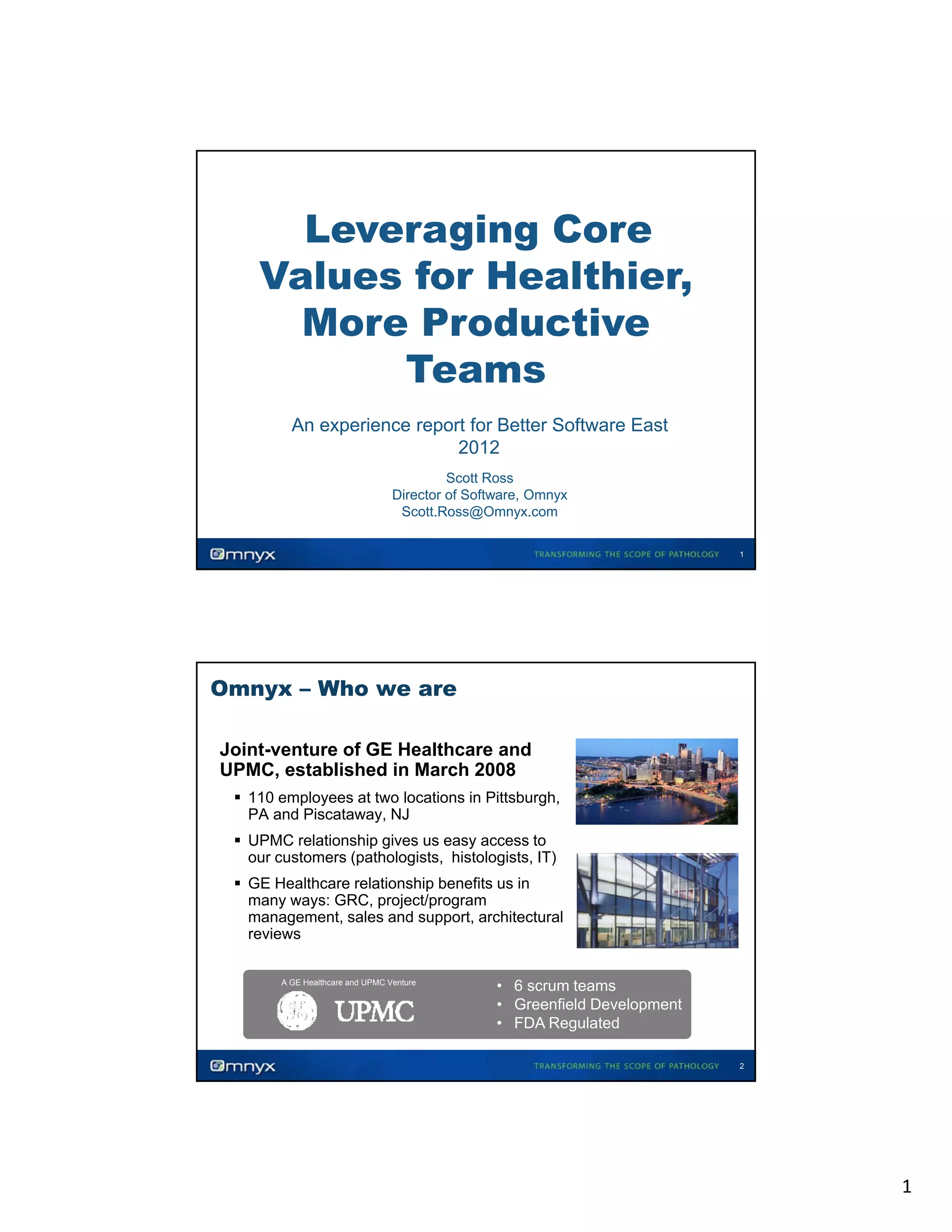
"Leveraging Core Values for
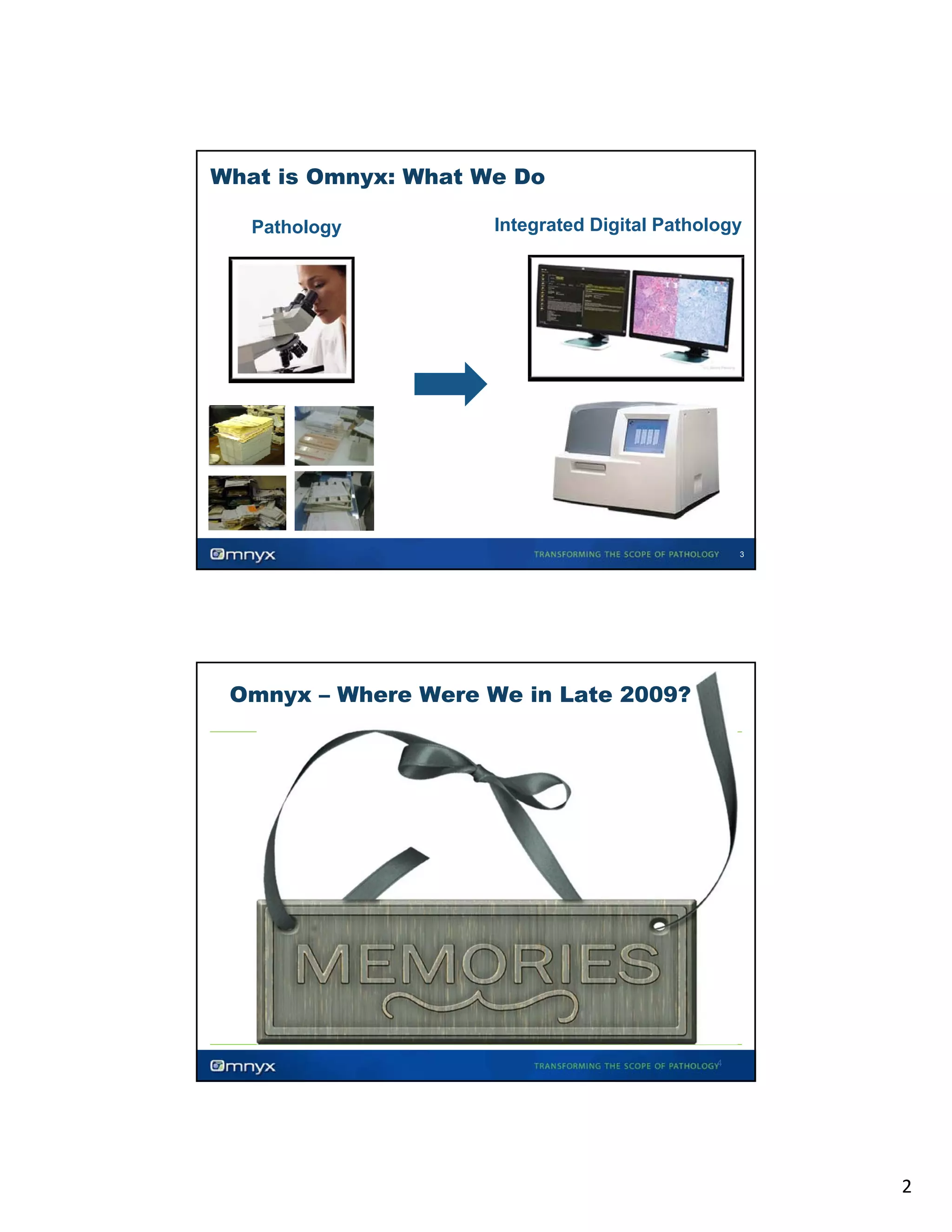
Healthier, More Productive Teams"


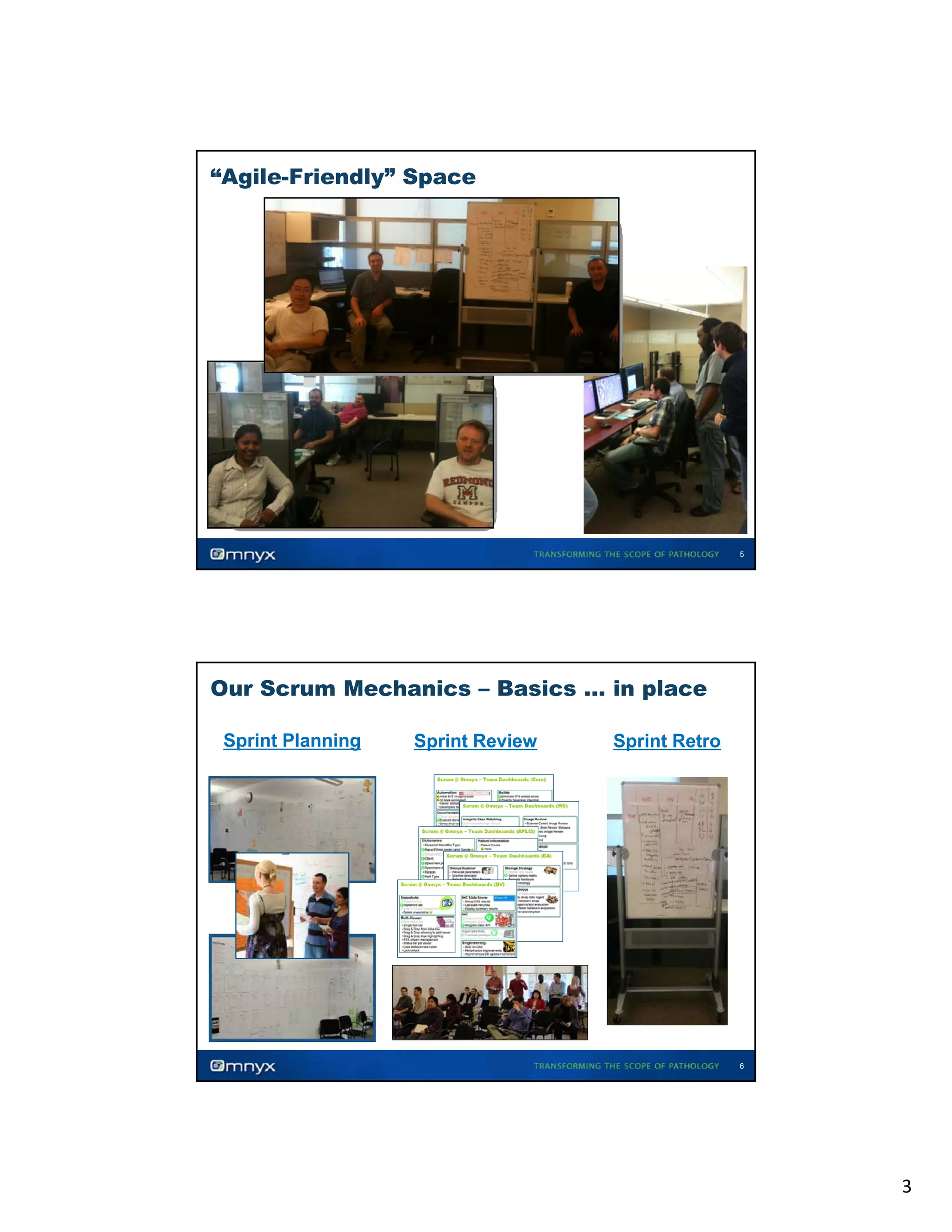
Presented by:
Scott Ross
Omnyx


Brought to you by: 


340 Corporate Way, Suite 300, Orange Park, FL 32073 
888‐268‐8770 ∙ 904‐278‐0524 ∙ sqeinfo@sqe.com ∙ www.sqe.com
Scott Ross
Omnyx
In the software industry for more than twenty years, Scott Ross is currently director of software
at Omnyx, a joint venture of GE Healthcare and the University of Pittsburgh Medical Center. He
has worked with scanners, handheld controllers, videoconferencing systems, pharmacy
applications, digital radiology, and now digital pathology in a variety of management positions.
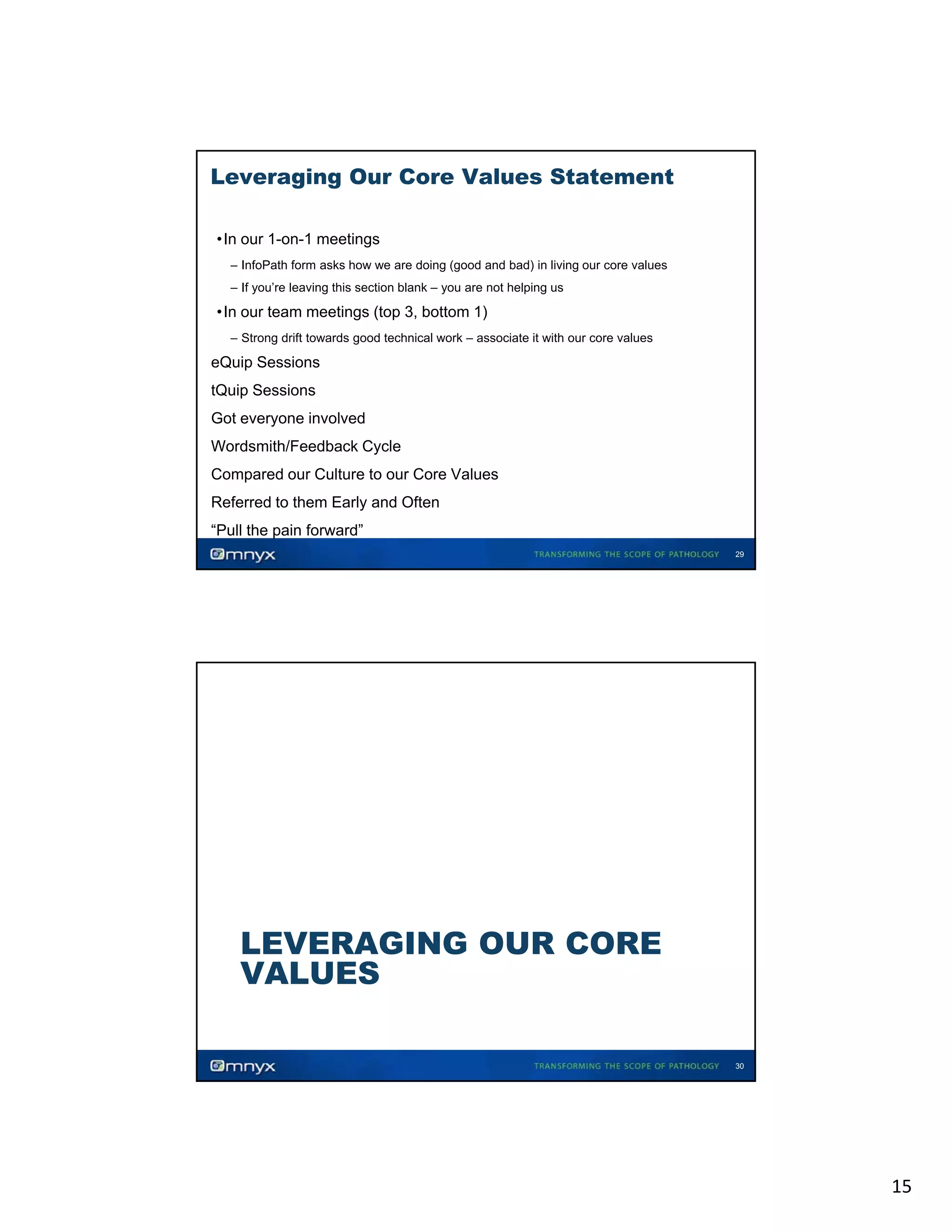
Scott has been practicing Scrum for three years—after spending two years practicing Scrumbut. Passionate about vision and core values, Scott has helped transform churches and teams
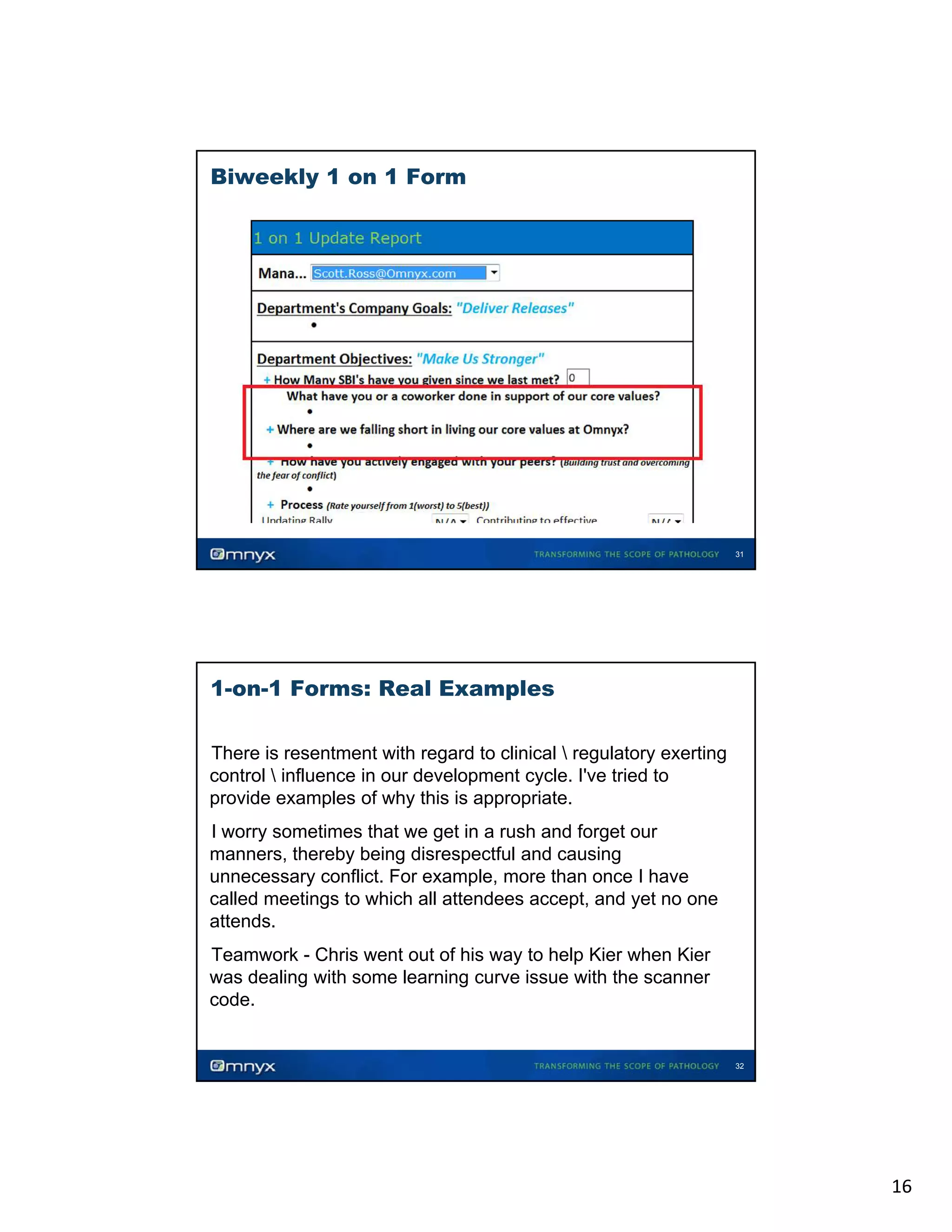
using these tools. When well-written, vision statements can be challenging and energizing—and
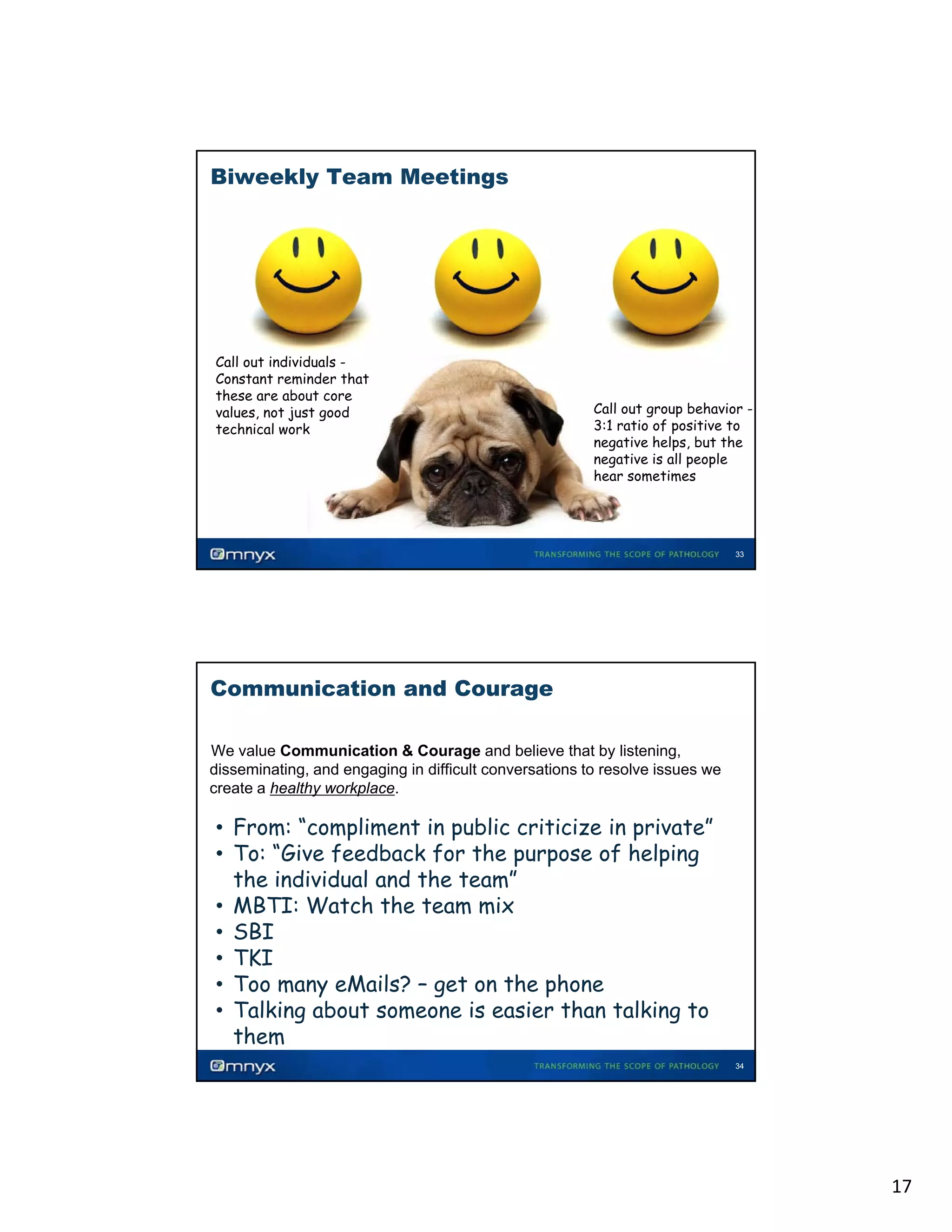
can help bring out the best in people. Scott enjoys woodworking, golf, reading, and hiking.
Leveraging Core
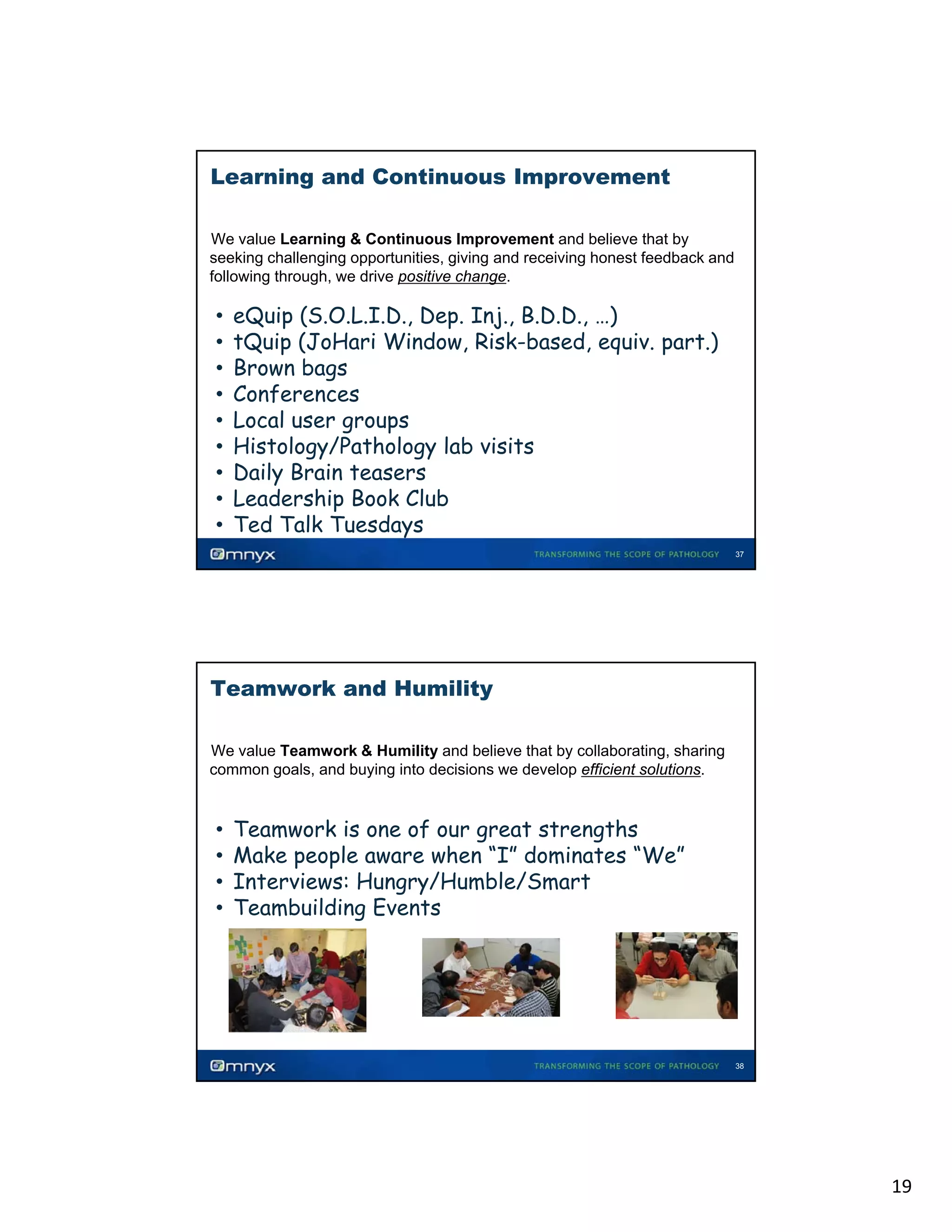
Values for Healthier,
,
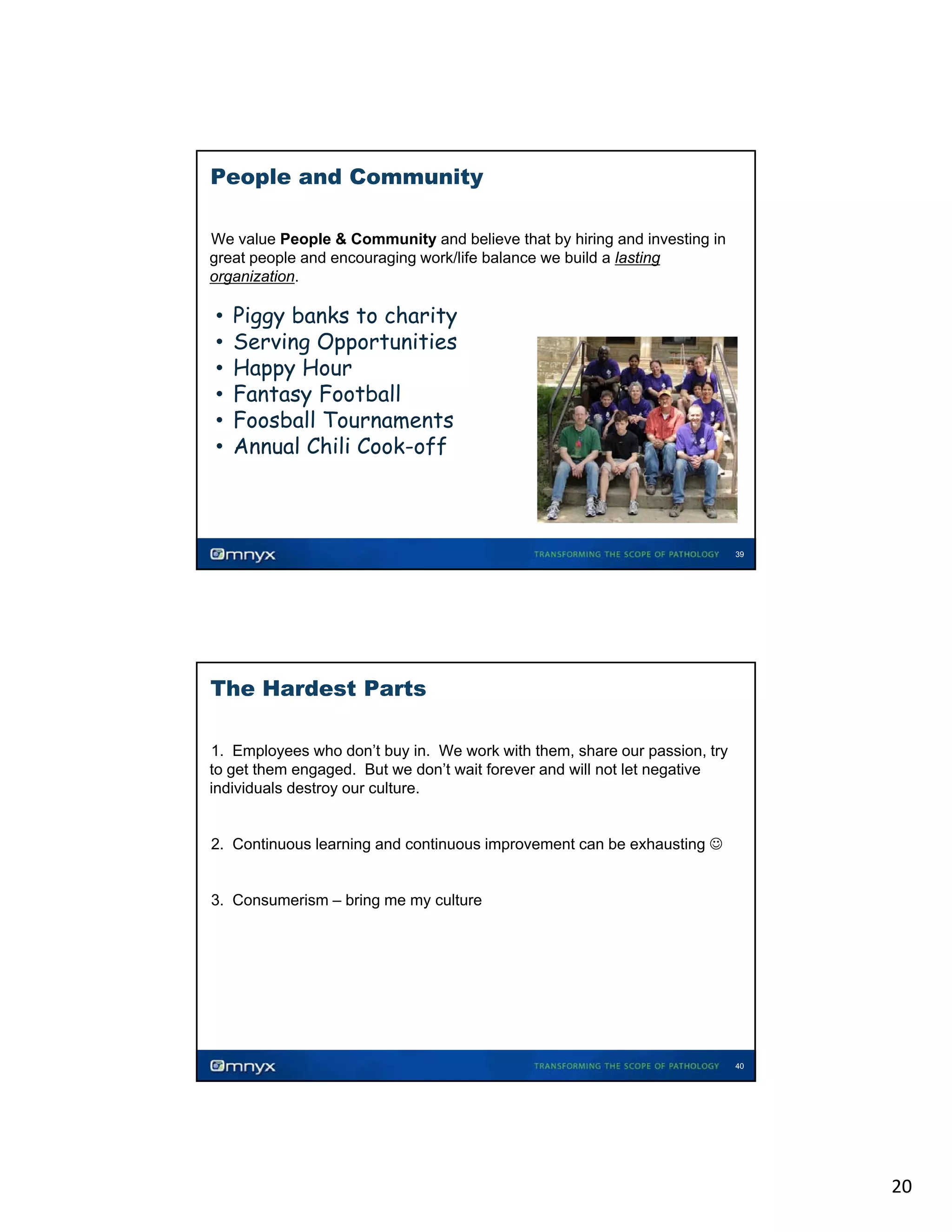
More Productive
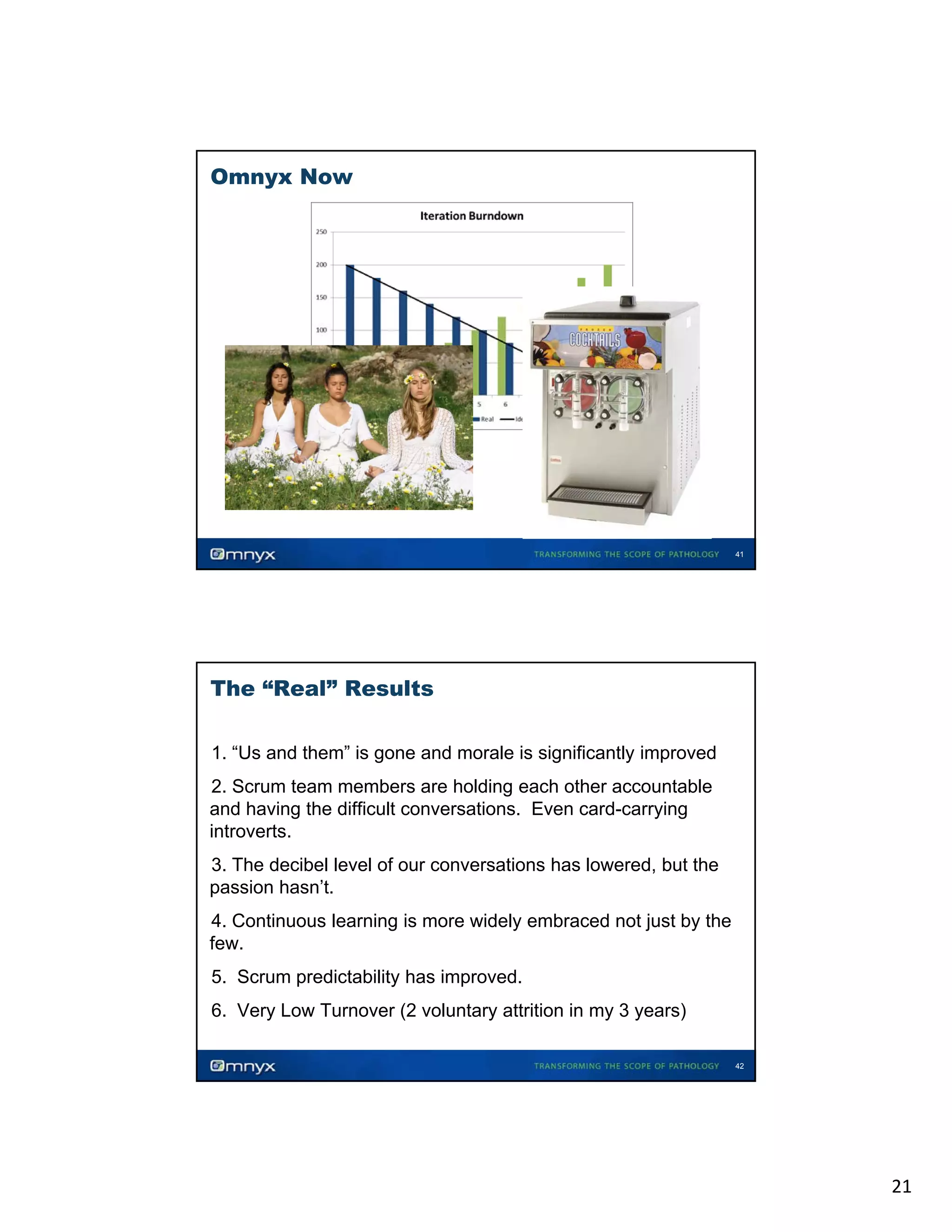
Teams
•

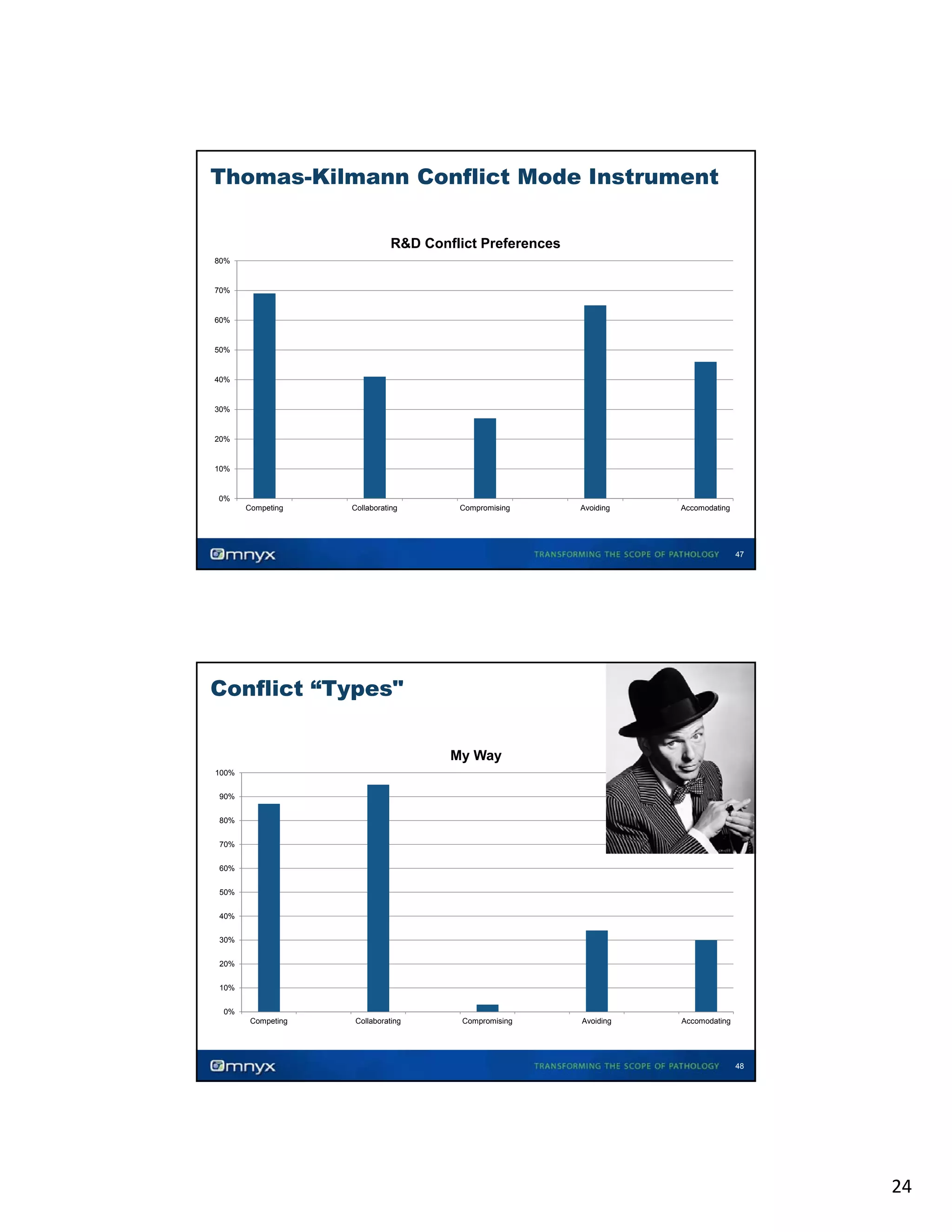
•

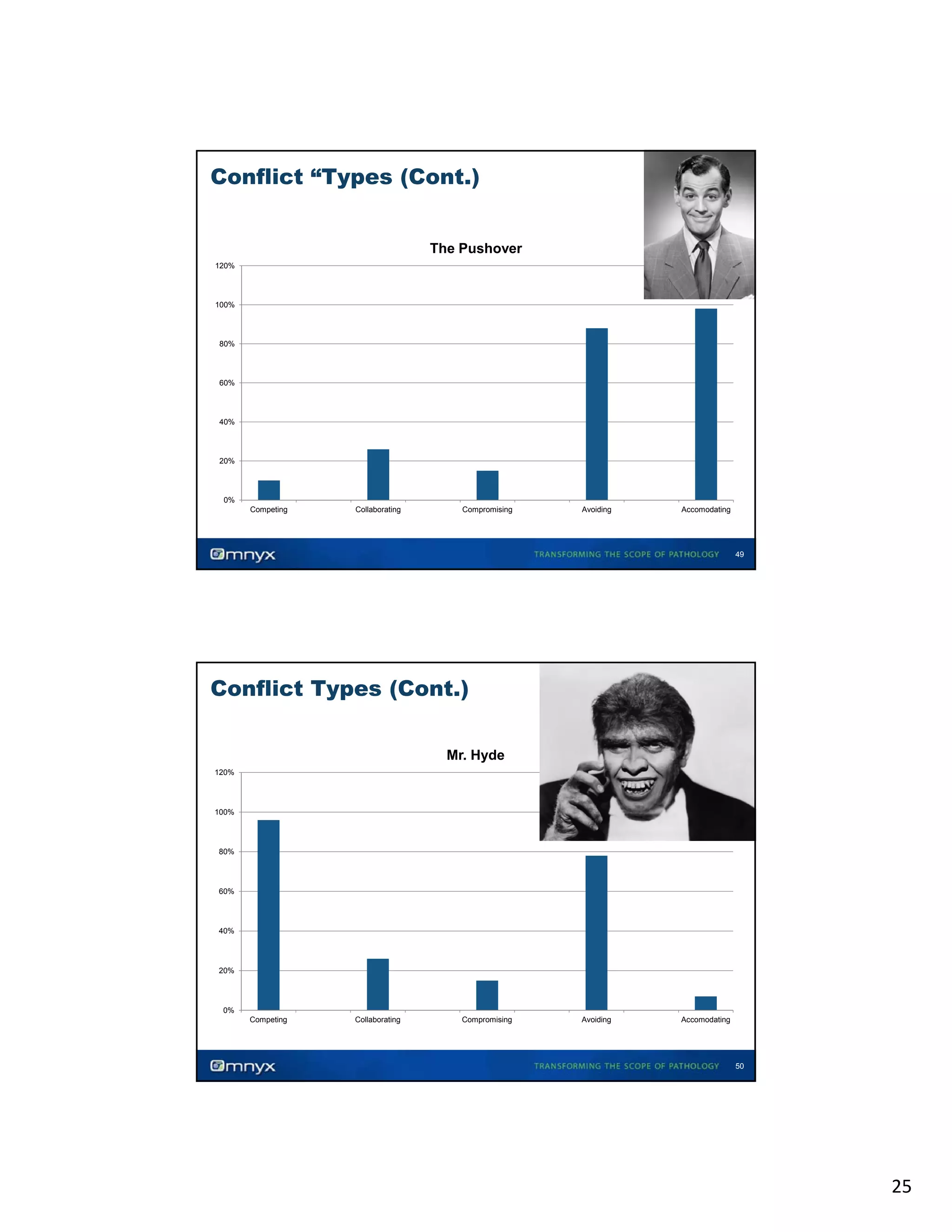
An experience report for Better Software East
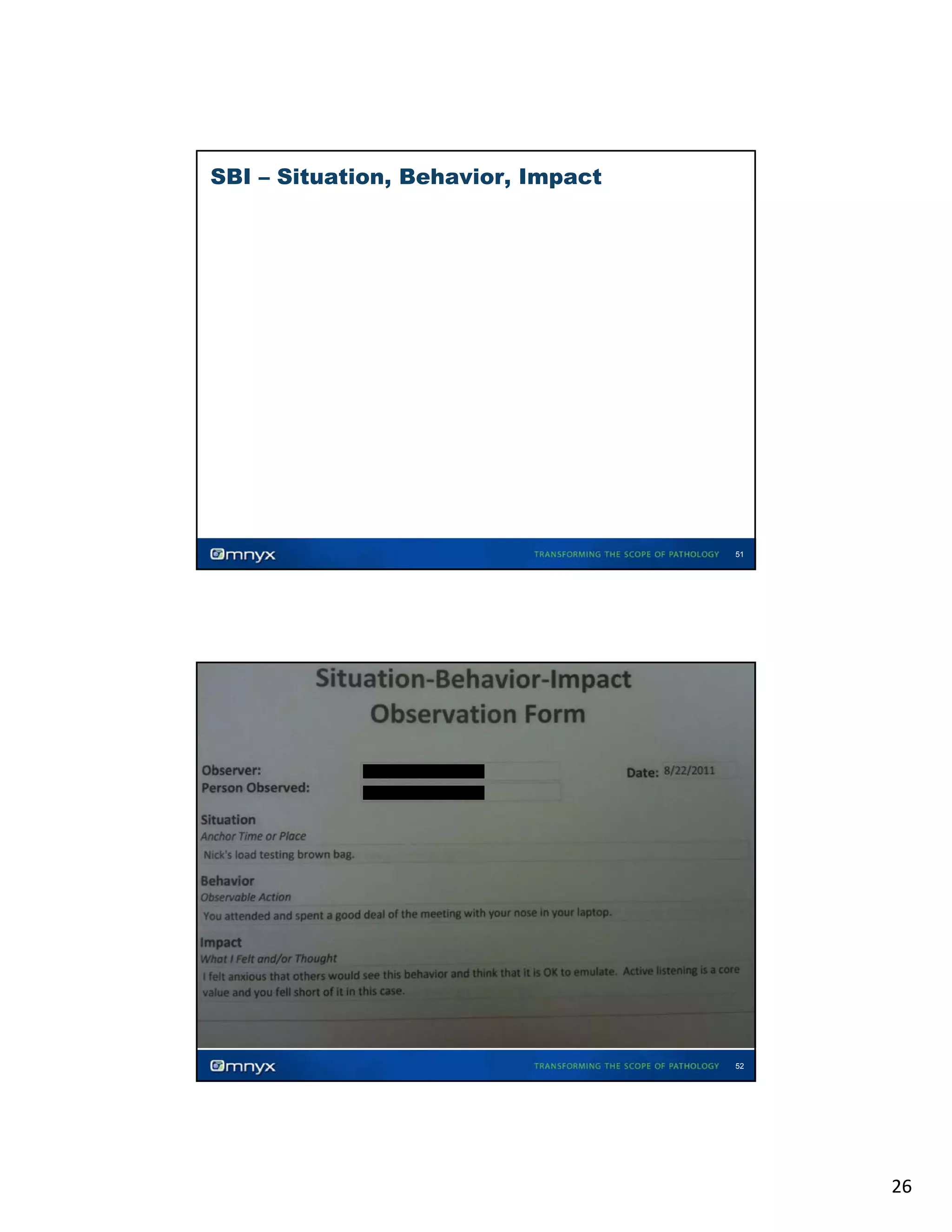
2012
Scott Ross
Director of Software, Omnyx
Scott.Ross@Omnyx.com
•

•

•

1

Omnyx – Who we are
Joint-venture of GE Healthcare and
UPMC, established in March 2008
110 employees at two locations in Pittsburgh,
PA and Piscataway, NJ
UPMC relationship gives us easy access to
our customers (pathologists, histologists, IT)
GE Healthcare relationship benefits us in
many ways: GRC, project/program
management, sales and support, architectural
reviews
A GE Healthcare and UPMC Venture

• 6 scrum teams
• Greenfield Development
• FDA Regulated
2

1
What is Omnyx: What We Do
•

Pathology

•

Integrated Digital Pathology

3

Omnyx – Where Were We in Late 2009?

4

2
“Agile-Friendly” Space

5

Our Scrum Mechanics – Basics … in place
Sprint Planning

Sprint Review

Sprint Retro

6

3
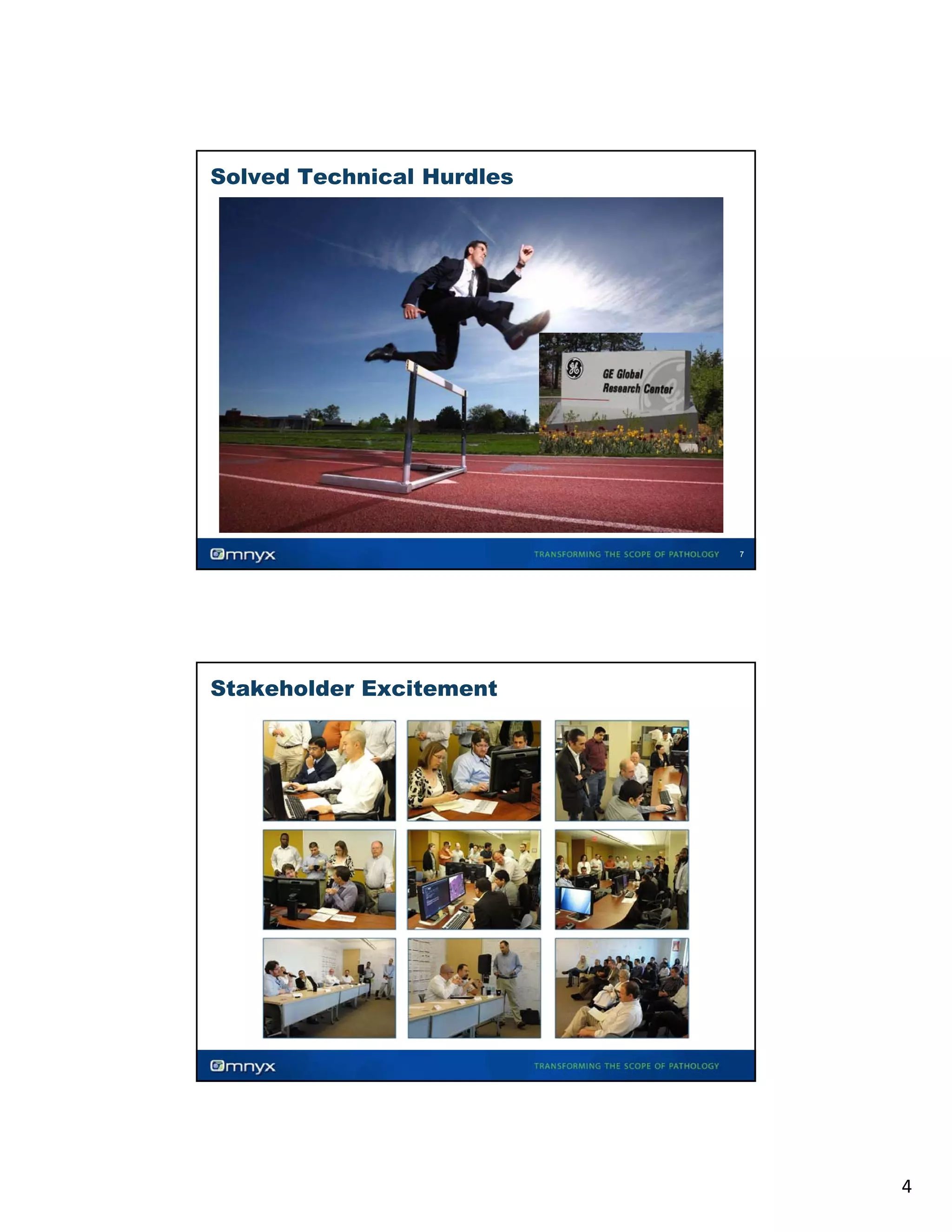
Solved Technical Hurdles

7

Stakeholder Excitement

4
Playing Together

9

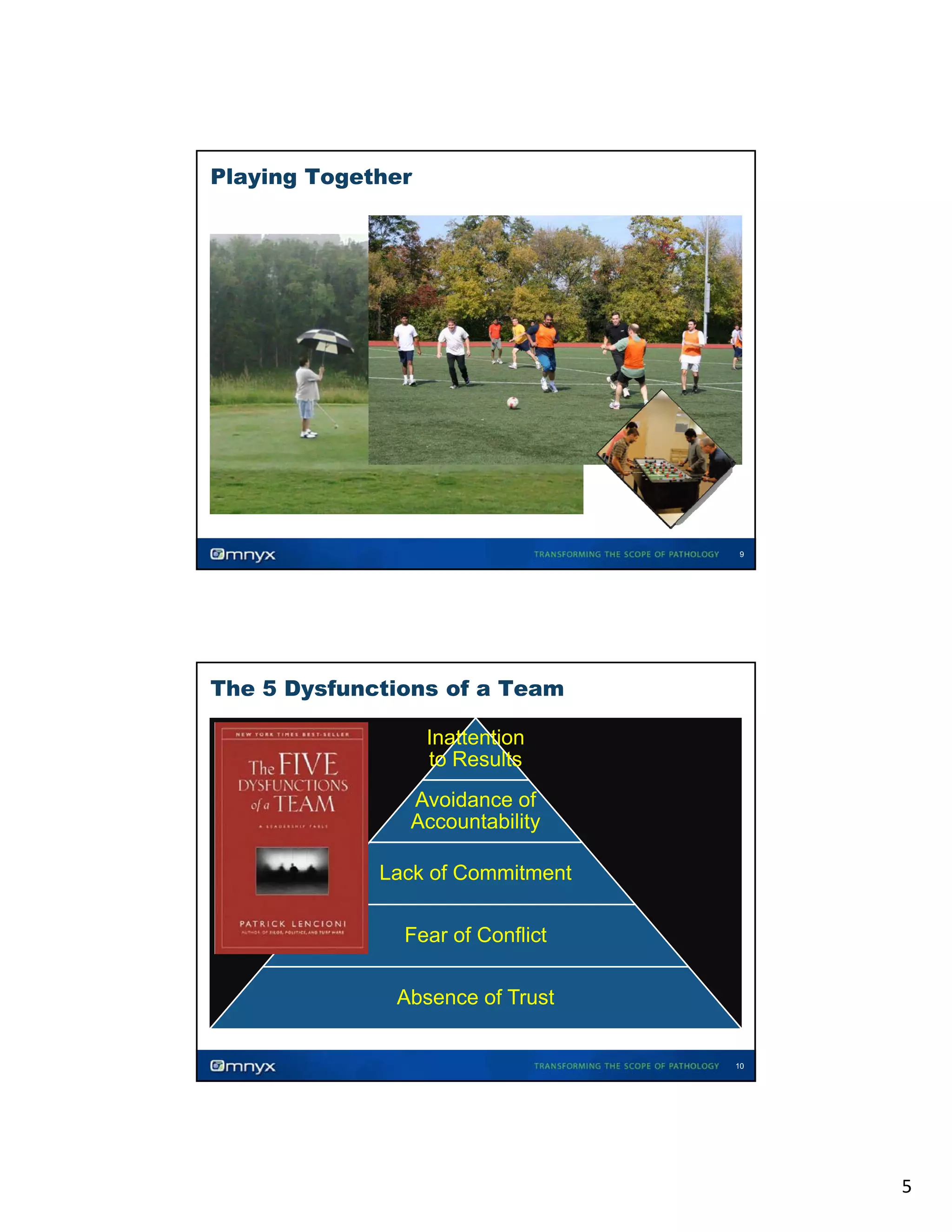
The 5 Dysfunctions of a Team
Inattention
to Results
Avoidance of
Accountability
Lack of Commitment
Fear of Conflict
Absence of Trust

10

5
So, What Motivated us to Write Our Core
Values?

11

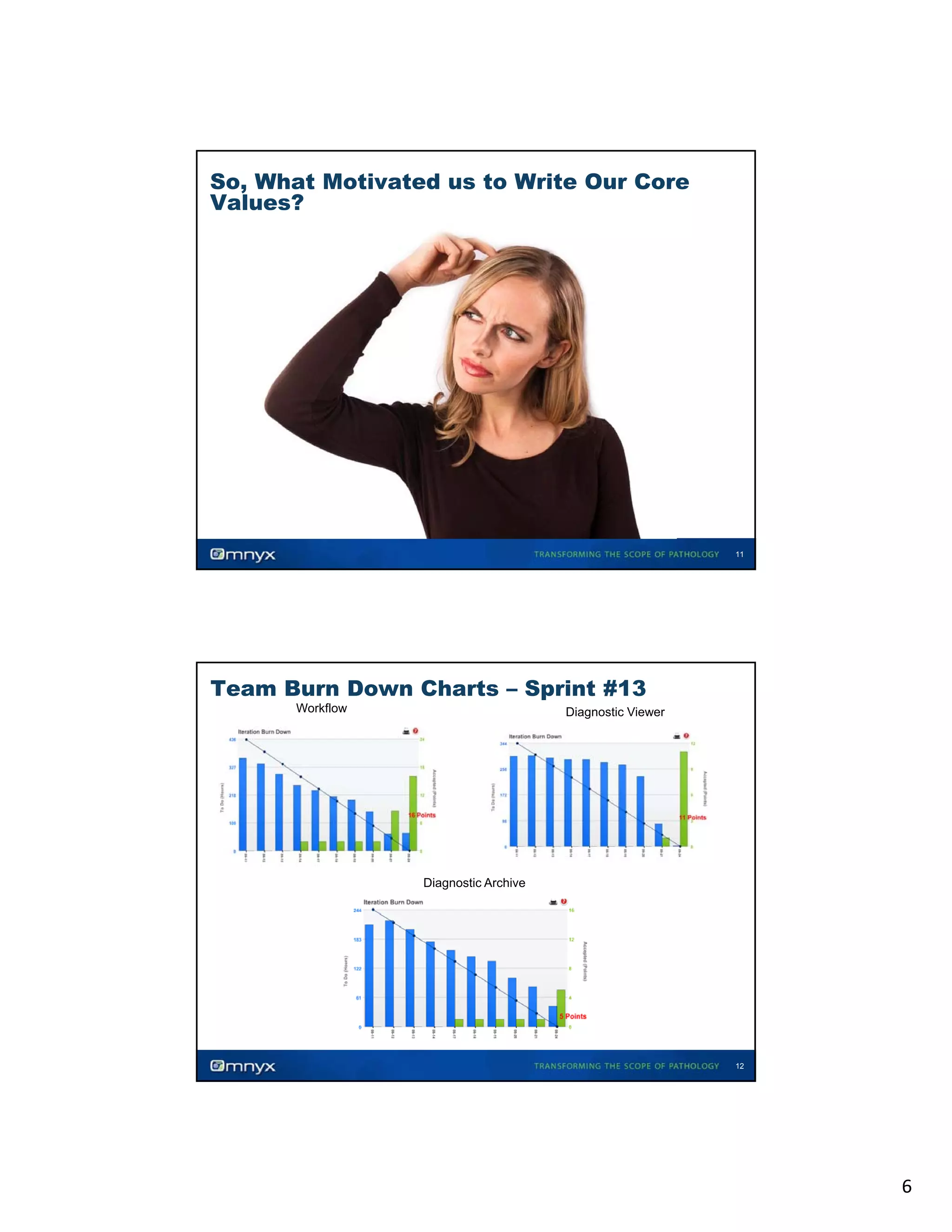
Team Burn Down Charts – Sprint #13
Workflow

Diagnostic Viewer

Diagnostic Archive

12

6
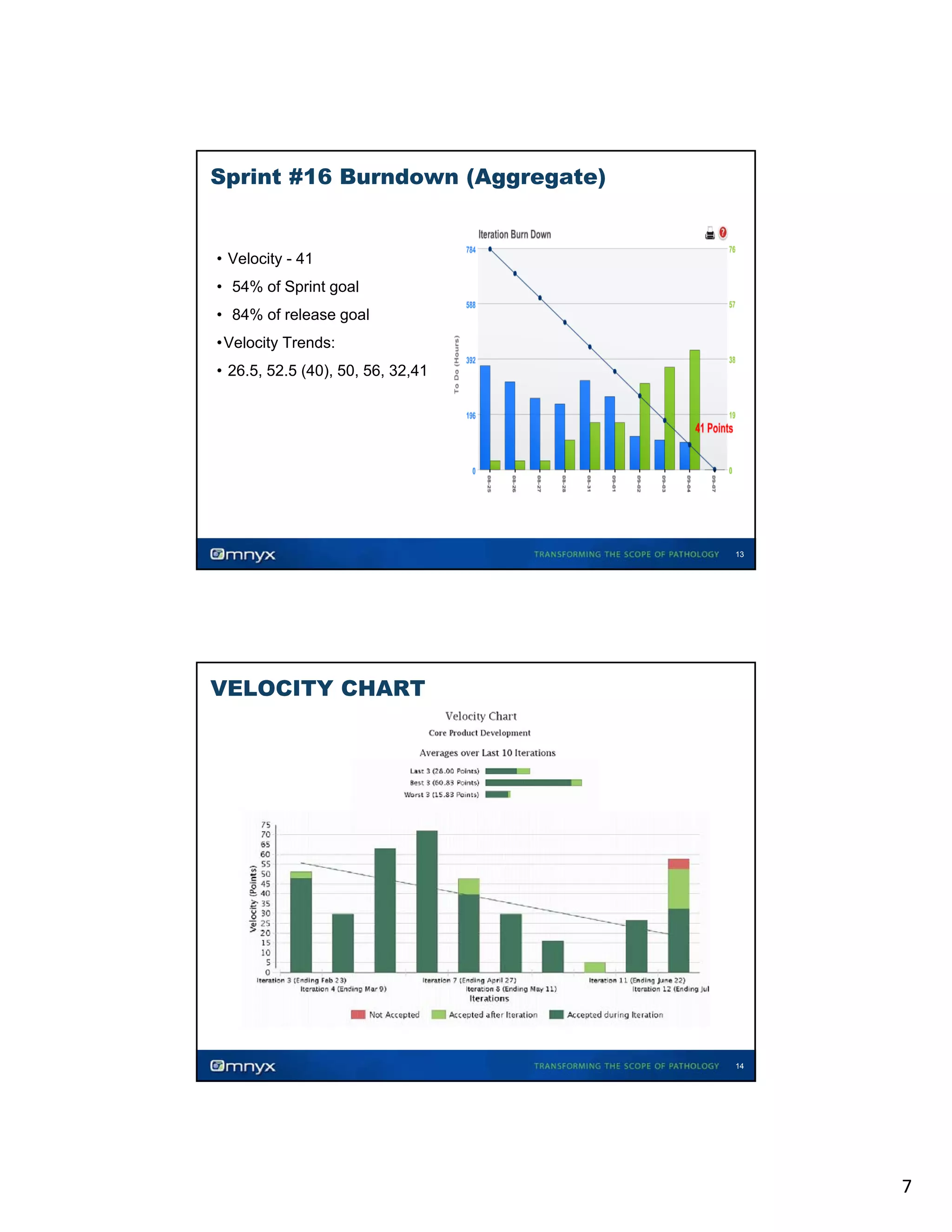
Sprint #16 Burndown (Aggregate)

• Velocity - 41
• 54% of Sprint goal
• 84% of release goal
•Velocity Trends:
• 26.5, 52.5 (40), 50, 56, 32,41

13

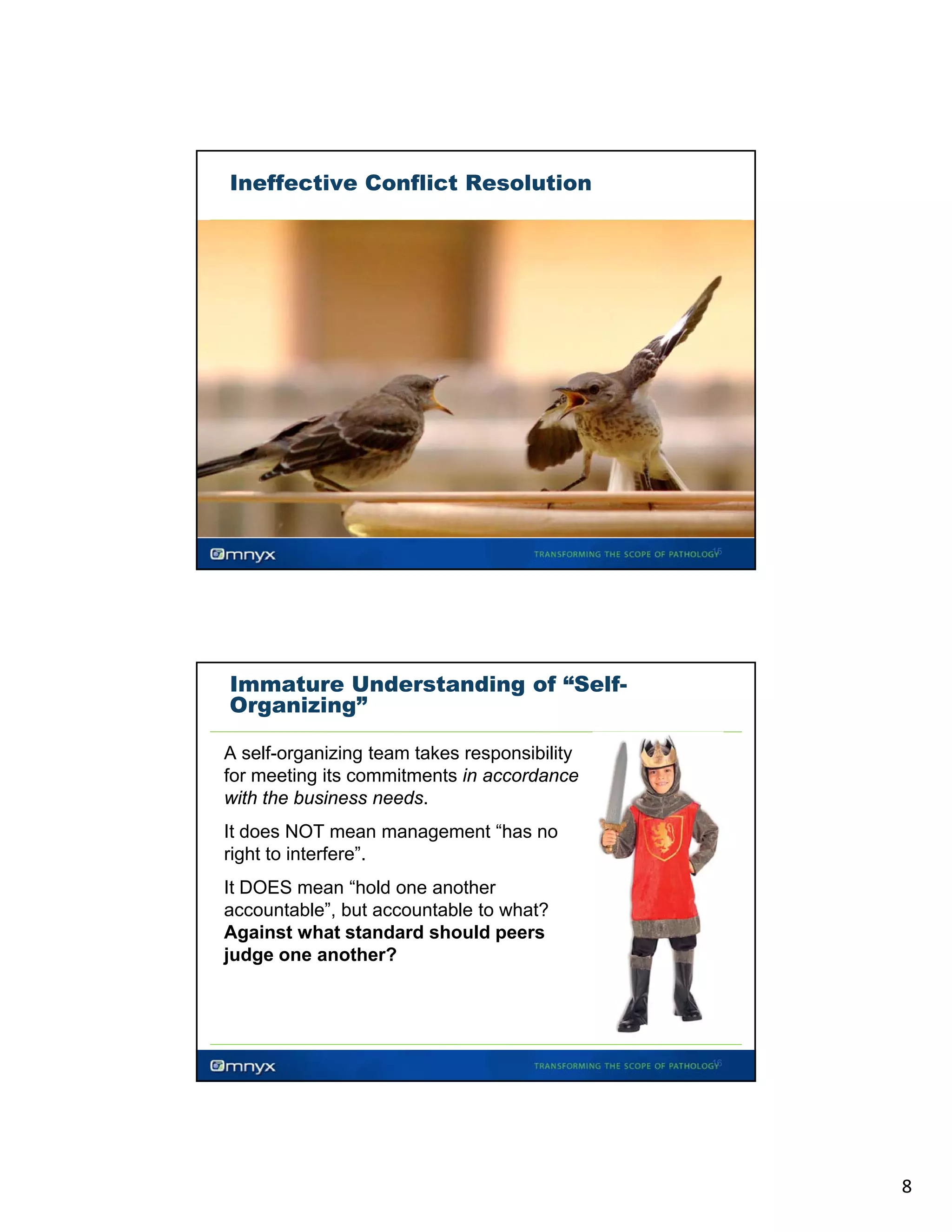
VELOCITY CHART

14

7
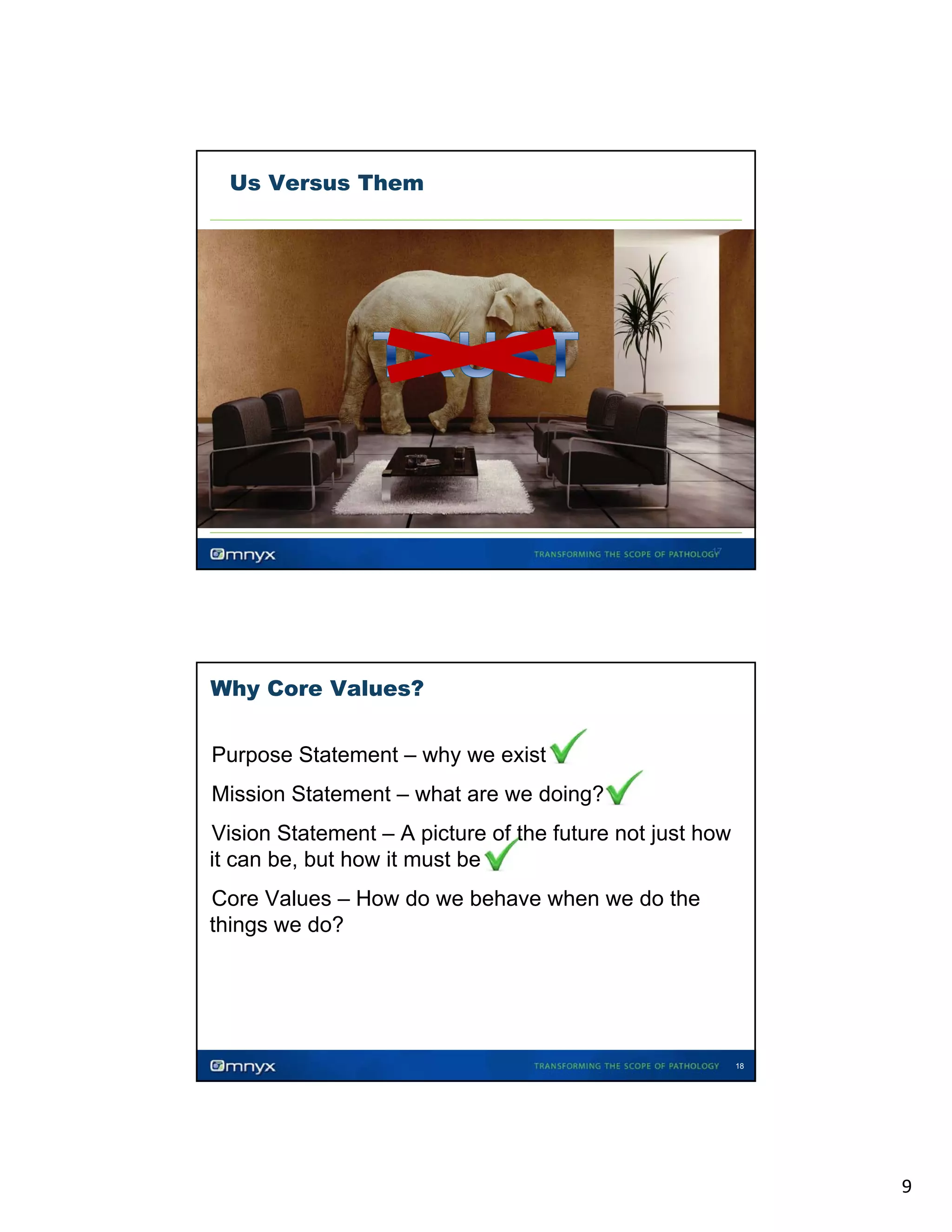
Ineffective Conflict Resolution

15

Immature Understanding of “SelfOrganizing”
A self-organizing team takes responsibility
for meeting its commitments in accordance
with the business needs
needs.
It does NOT mean management “has no
right to interfere”.
It DOES mean “hold one another
accountable”, but accountable to what?
g
p
Against what standard should peers
judge one another?

16

8
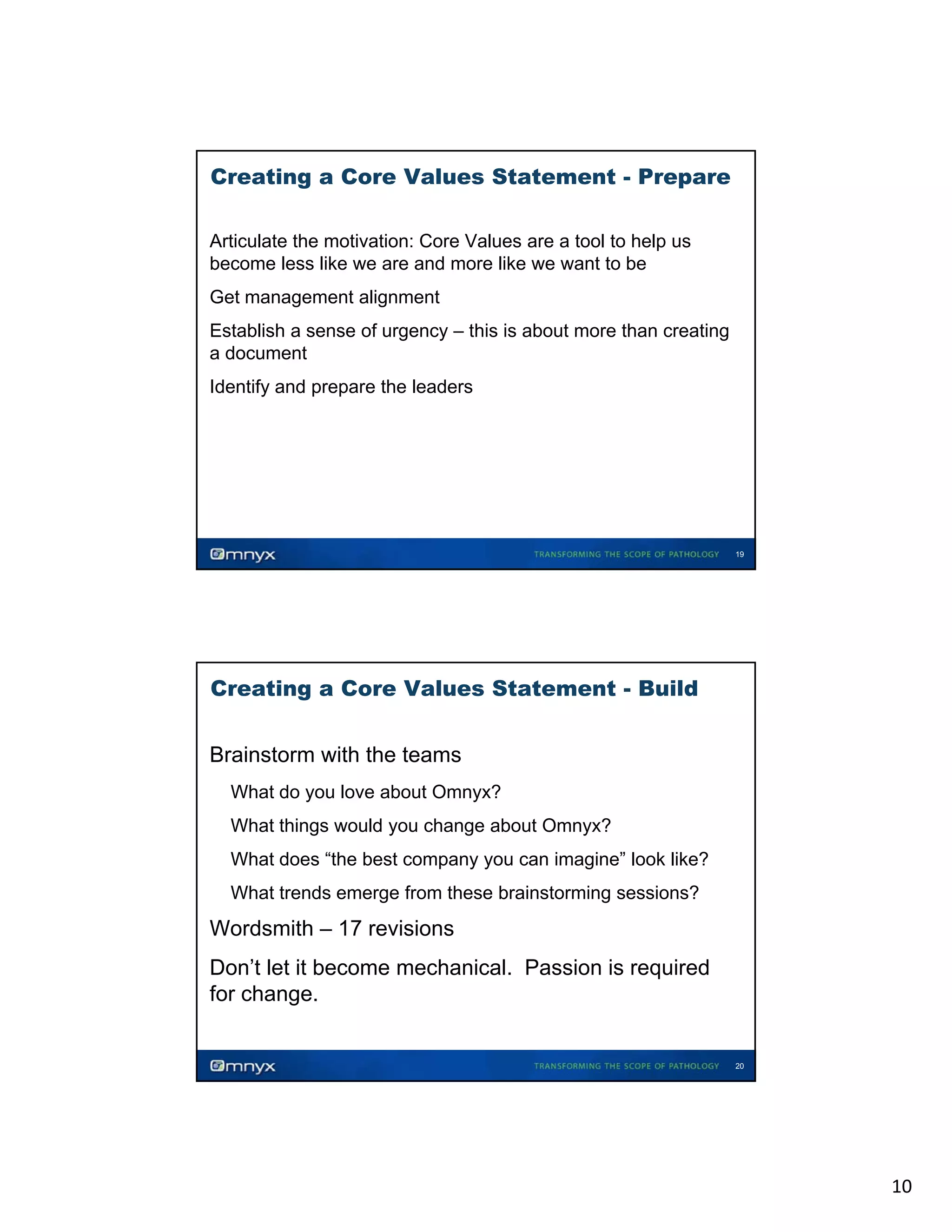
Us Versus Them

17

Why Core Values?

•

•

Purpose Statement – why we exist
Mission Statement – what are we doing?
g

Vision Statement – A picture of the future not just how
it can be, but how it must be

•

Core Values – How do we behave when we do the
things we do?

•

18

9
Creating a Core Values Statement - Prepare
Articulate the motivation: Core Values are a tool to help us
become less like we are and more like we want to be
Get
G management alignment
li
Establish a sense of urgency – this is about more than creating
a document
Identify and prepare the leaders

19

Creating a Core Values Statement - Build
Brainstorm with the teams
What do you love about Omnyx?
y
y
What things would you change about Omnyx?
What does “the best company you can imagine” look like?
What trends emerge from these brainstorming sessions?

Wordsmith – 17 revisions
Don’t let it become mechanical. Passion is required
for change.

20

10
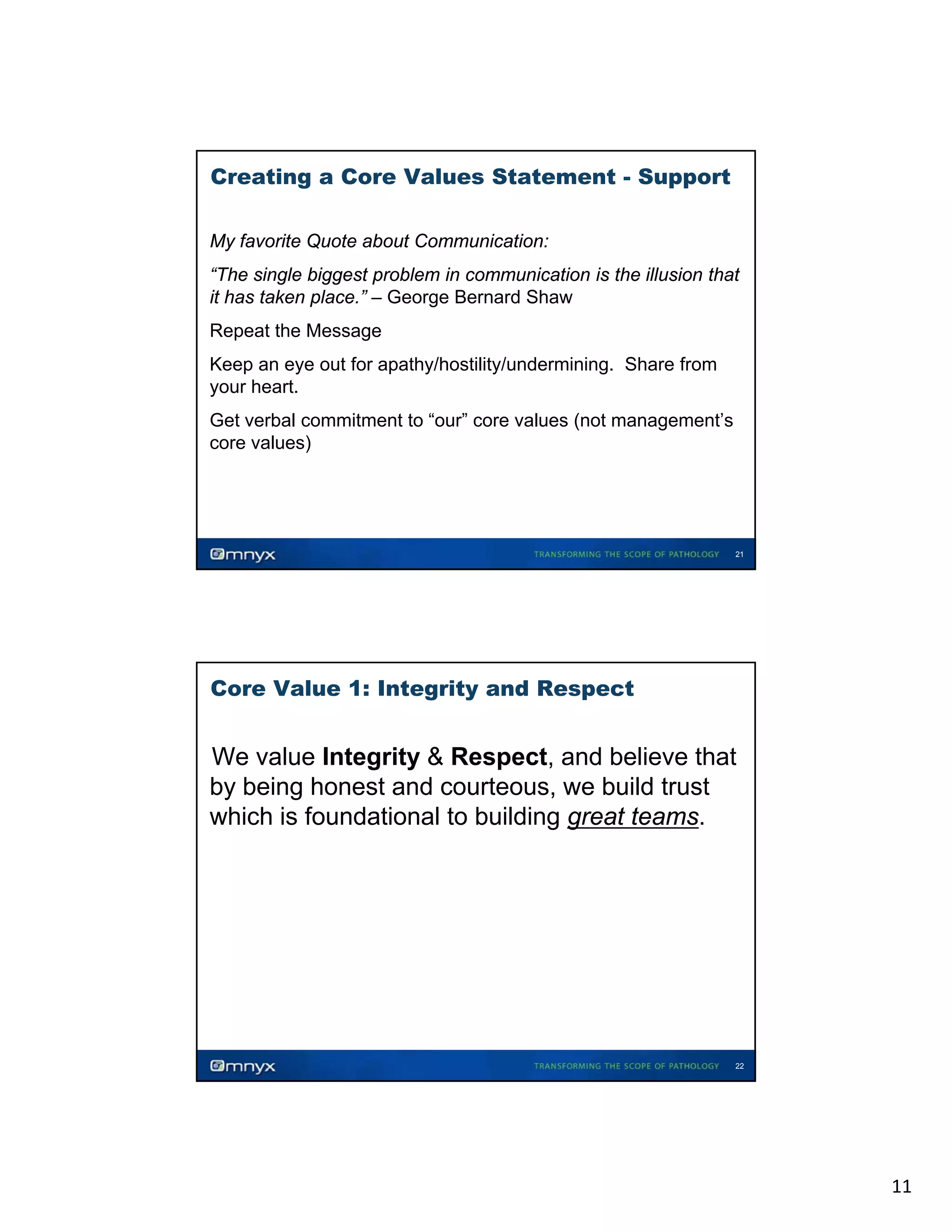
Creating a Core Values Statement - Support
My favorite Quote about Communication:
“The single biggest problem in communication is the illusion that
it has k
i h taken place.” – G
l
” George Bernard Sh
B
d Shaw
Repeat the Message
Keep an eye out for apathy/hostility/undermining. Share from
your heart.
Get verbal commitment to “our” core values (not management’s
(
g
core values)

21

Core Value 1: Integrity and Respect

We value Integrity & Respect, and believe that
by being honest and courteous, we build trust
which is foundational to building great teams.
•

22

11
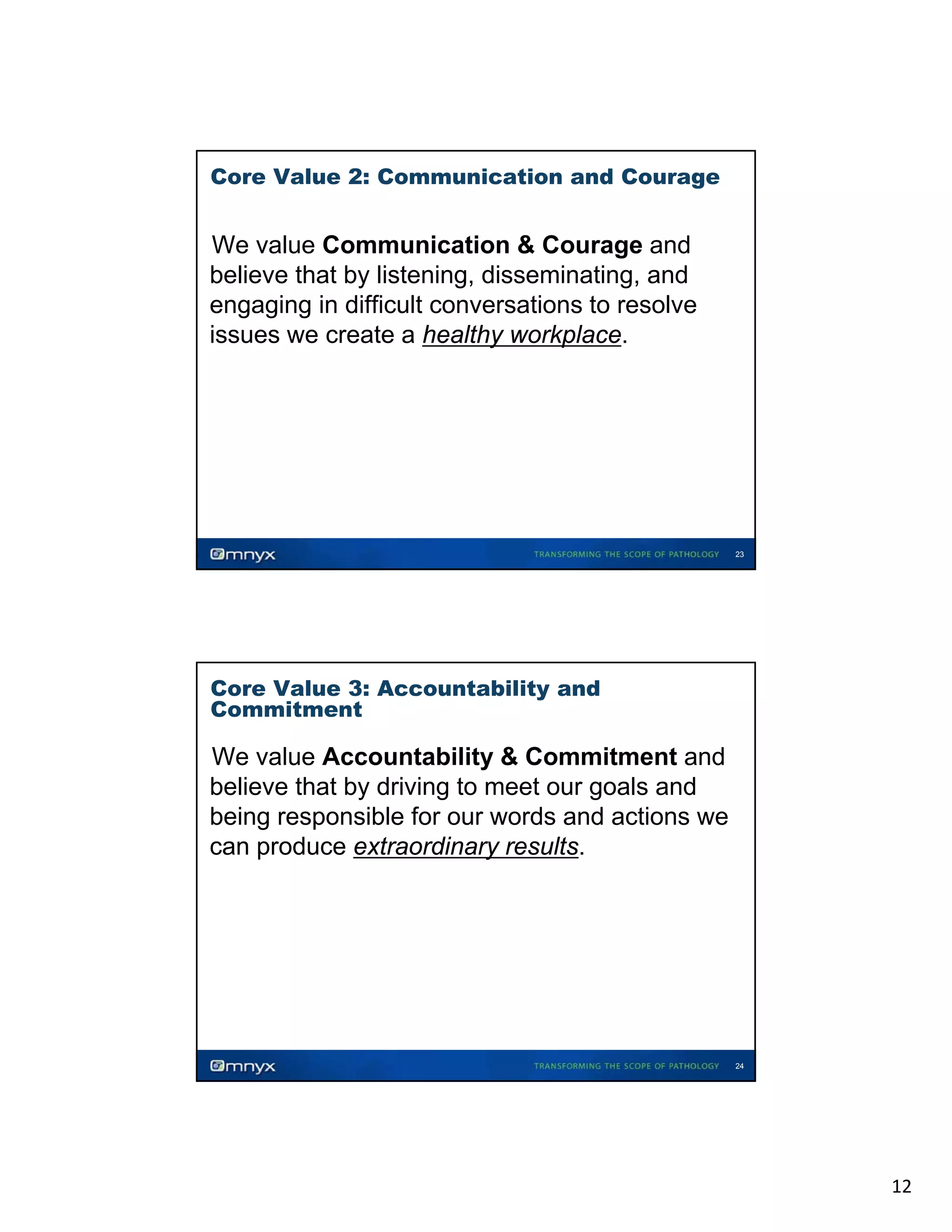
Core Value 2: Communication and Courage

We value Communication & Courage and
believe that by listening, disseminating, and
engaging in difficult conversations to resolve
issues we create a healthy workplace.
•

23

Core Value 3: Accountability and
Commitment

We value Accountability & Commitment and
believe that by driving to meet our goals and
being responsible for our words and actions we
can produce extraordinary results.
•

24

12
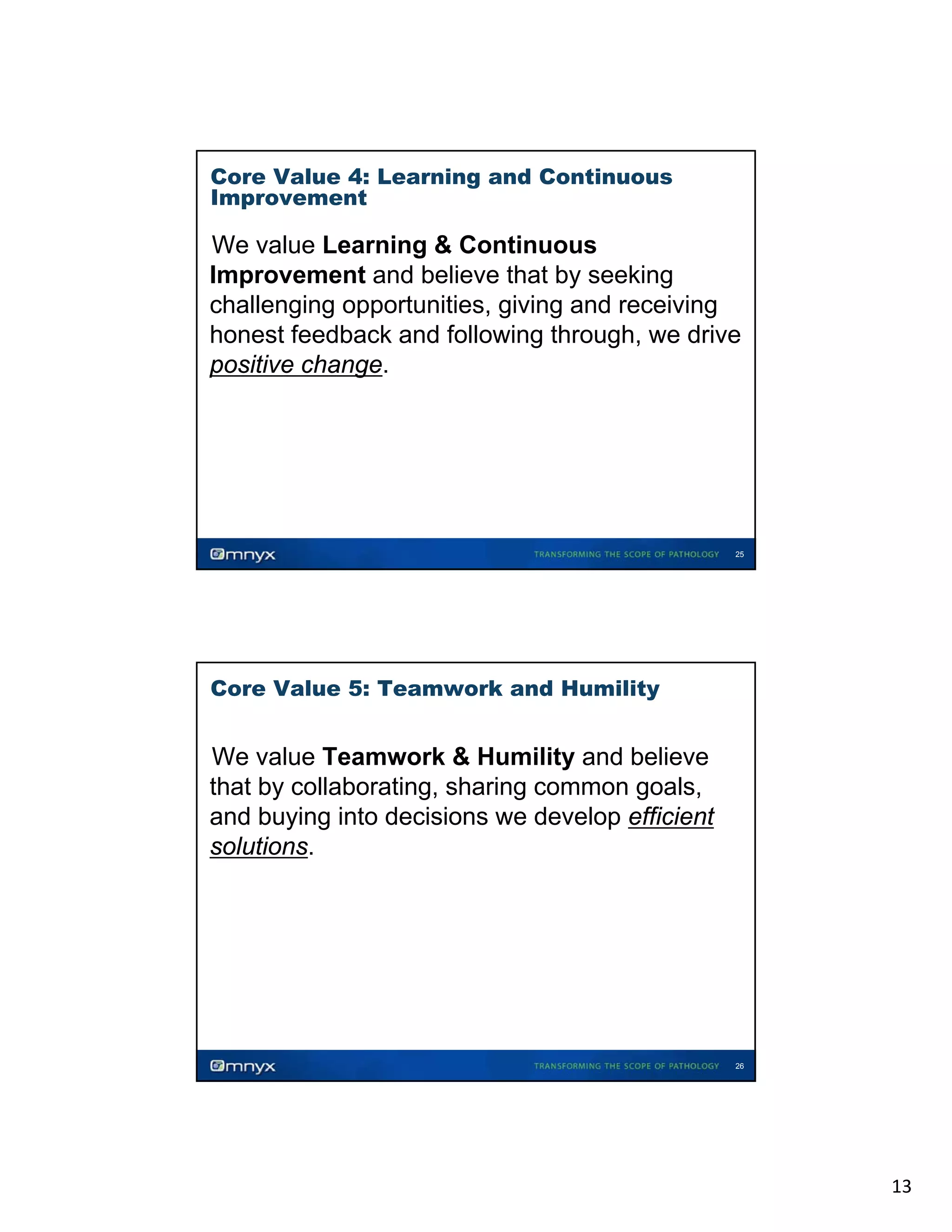
Core Value 4: Learning and Continuous
Improvement

We value Learning & Continuous
Improvement and believe that by seeking
challenging opportunities, giving and receiving
honest feedback and following through, we drive
positive change.
•

25

Core Value 5: Teamwork and Humility

We value Teamwork & Humility and believe
that by collaborating, sharing common goals,
and buying into decisions we develop efficient
solutions.
•

26

13
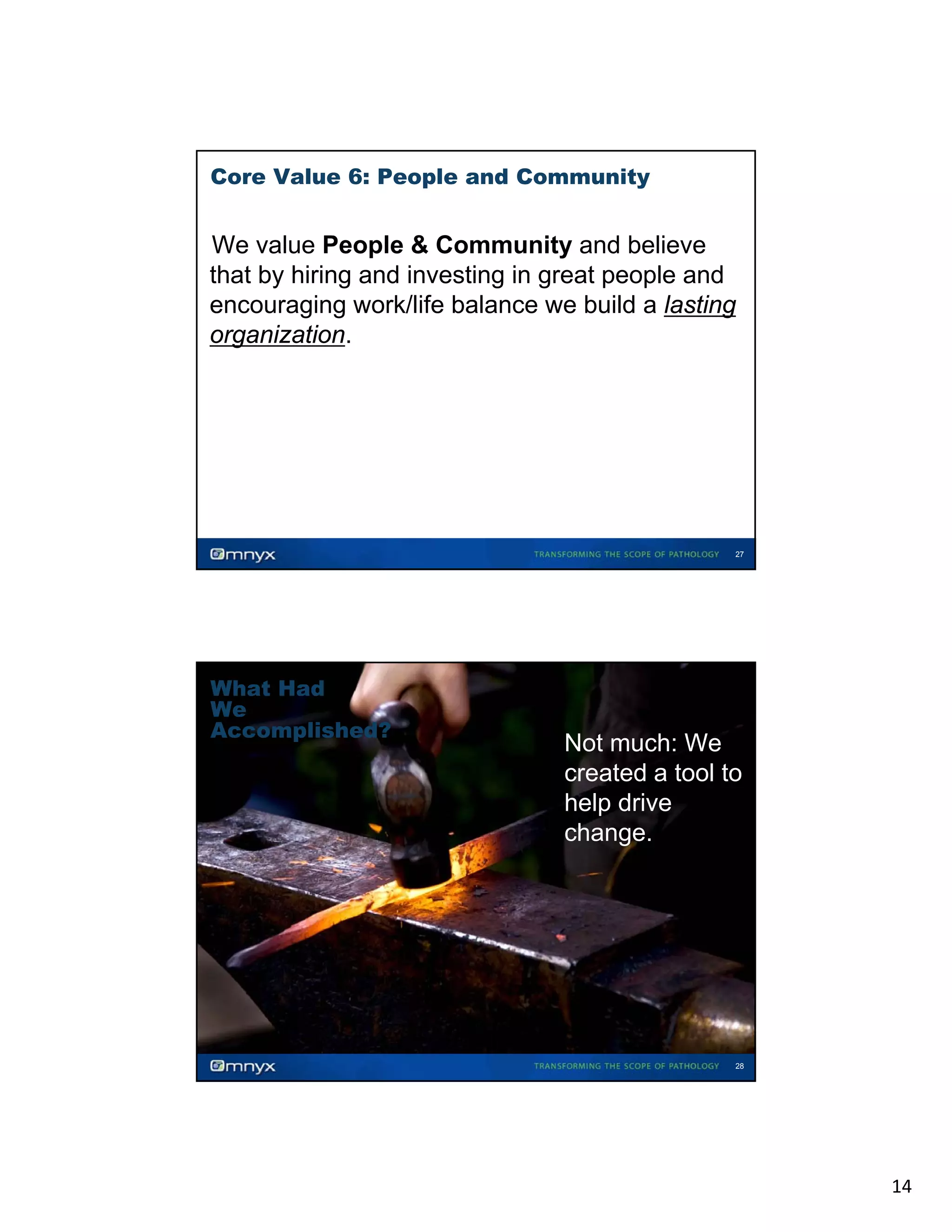
Core Value 6: People and Community

We value People & Community and believe
that by hiring and investing in great people and
encouraging work/life balance we build a lasting
organization.
•

27

What Had
We
Accomplished?

Not much: We
created a tool to
help drive
change.

28

14
Leveraging Our Core Values Statement
•In our 1-on-1 meetings
– InfoPath form asks how we are doing (good and bad) in living our core values
– If you re leaving this section blank – you are not helping us
you’re

•In our team meetings (top 3, bottom 1)
– Strong drift towards good technical work – associate it with our core values
•

•

•

•

•

•

•

eQuip Sessions
tQuip Sessions
Got everyone involved
Wordsmith/Feedback Cycle
Compared our Culture to our Core Values
Referred to them Early and Often
“Pull the pain forward”
29

LEVERAGING OUR CORE
VALUES
30

15
Biweekly 1 on 1 Form

31

1-on-1 Forms: Real Examples
There is resentment with regard to clinical  regulatory exerting
control  influence in our development cycle. I've tried to
provide examples of why this is appropriate.
appropriate
•

I worry sometimes that we get in a rush and forget our
manners, thereby being disrespectful and causing
unnecessary conflict. For example, more than once I have
called meetings to which all attendees accept, and yet no one
attends.
•

Teamwork - Chris went out of his way to help Kier when Kier
was dealing with some learning curve issue with the scanner
code.
•

•

32

16
Biweekly Team Meetings

Call out individuals Constant reminder that
these are about core
values, not just good
technical work

Call out group behavior 31
3:1 ratio of positive to
negative helps, but the
negative is all people
hear sometimes

33

Communication and Courage
We value Communication & Courage and believe that by listening,
disseminating, and engaging in difficult conversations to resolve issues we
create a healthy workplace.
•

• From: “compliment in public criticize in private”
• To: “Give feedback for the purpose of helping
the individual and the team”
• MBTI: Watch the team mix
• SBI
• TKI
• Too many eMails? – get on the phone
• Talking about someone is easier than talking to
them
34

17
Integrity and Respect
We value Integrity & Respect, and believe that by being honest and
courteous, we build trust which is foundational to building great teams.
•

• Mentor, set examples which kill gossip
• Celebrate diversity of skills – getting things
done
• Intentional focus when hiring
• Integrity is Pass/Fail

35

Accountability and Commitment
We value Accountability & Commitment and believe that by driving to
meet our goals and being responsible for our words and actions we can
produce extraordinary results.

•

• Releases and sprints – force the commitment
(don’t force what we are committing to)
• When we fall short, it’s OK, but it’s not
acceptable
• Big thumbs up or thumbs down on sprint reviews
g
p
p

36

18
Learning and Continuous Improvement
We value Learning & Continuous Improvement and believe that by
seeking challenging opportunities, giving and receiving honest feedback and
following through, we drive positive change.
•

•
•
•
•
•
•
•
•
•

eQuip (S.O.L.I.D., Dep. Inj., B.D.D., …)
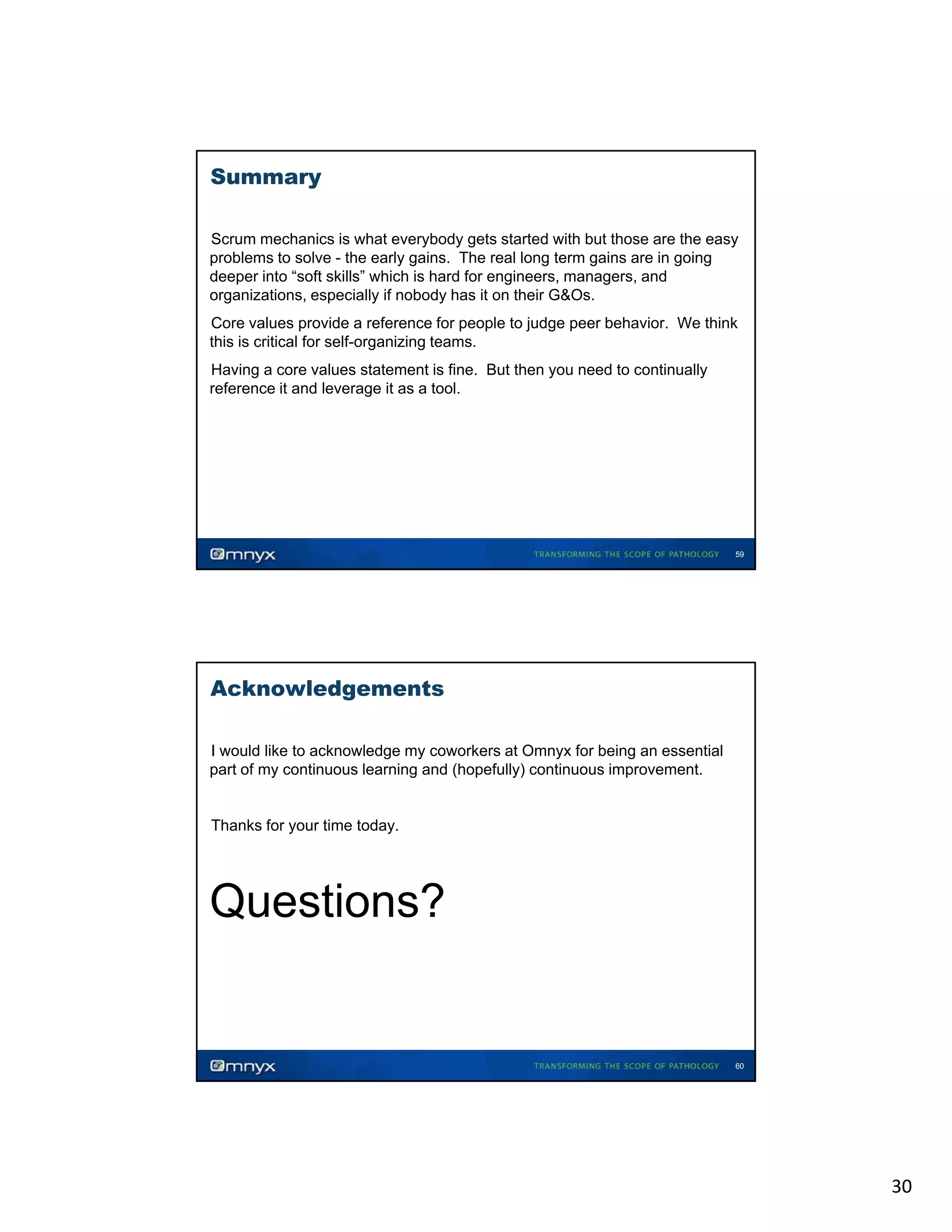
tQuip (JoHari Window, Risk-based, equiv. part.)
Brown bags
Conferences
Local user groups
g
p
Histology/Pathology lab visits
Daily Brain teasers
Leadership Book Club
Ted Talk Tuesdays
37

Teamwork and Humility
We value Teamwork & Humility and believe that by collaborating, sharing
common goals, and buying into decisions we develop efficient solutions.

•

•
•
•
•

Teamwork is one of our great strengths
Make people aware when “I” dominates “We”
Interviews: Hungry/Humble/Smart
Teambuilding Events

38

19
People and Community
We value People & Community and believe that by hiring and investing in
great people and encouraging work/life balance we build a lasting
organization.
•

•
•
•
•
•
•

Piggy banks to charity
Serving Opportunities
Happy Hour
Fantasy Football
Foosball Tournaments
Annual Chili Cook-off

39

The Hardest Parts
1. Employees who don’t buy in. We work with them, share our passion, try
to get them engaged. But we don’t wait forever and will not let negative
individuals destroy our culture.
•

•

•

2. Continuous learning and continuous improvement can be exhausting ☺

3. Consumerism – bring me my culture

40

20
Omnyx Now

41

The “Real” Results
•

1. “Us and them” is gone and morale is significantly improved

2. Scrum team members are holding each other accountable
and h i the diffi l conversations. Even card-carrying
d having h difficult
i
E
d
i
introverts.
•

3. The decibel level of our conversations has lowered, but the
passion hasn’t.
•

4. Continuous learning is more widely embraced not just by the
few.
few
•

•

•

5. Scrum predictability has improved.
6. Very Low Turnover (2 voluntary attrition in my 3 years)
42

21
One of the Best Places to Work in Pittsburgh

43

We Have More Drama in our Meetings

44

22
Where are the Metrics?
•

I am suspicious of metrics which measure “soft skills” or culture

As a small company, we don’t conduct surveys on morale. So
we d ’ h
don’t have numbers to show the morale b f
b
h
h
l before and after.
d f
•

Our scrum performance is better, but there are a lot of
differences and it would be misleading to imply we know
precisely what role core values played in doing scrum better.
•

•

The key metric over time will be the success of our company.

45

RESOURCES

46

23
Thomas-Kilmann Conflict Mode Instrument
R&D Conflict Preferences
80%

70%

60%

50%

40%

30%

20%

10%

0%
Competing

Collaborating

Compromising

Avoiding

Accomodating

47

Conflict “Types"
My Way
100%
90%
80%
70%
60%
50%
40%
30%
20%
10%
0%
Competing

Collaborating

Compromising

Avoiding

Accomodating

48

24
Conflict “Types (Cont.)
The Pushover
120%

100%

80%

60%

40%

20%

0%
Competing

Collaborating

Compromising

Avoiding

Accomodating

49

Conflict Types (Cont.)
Mr. Hyde
120%

100%

80%

60%

40%

20%

0%
Competing

Collaborating

Compromising

Avoiding

Accomodating

50

25
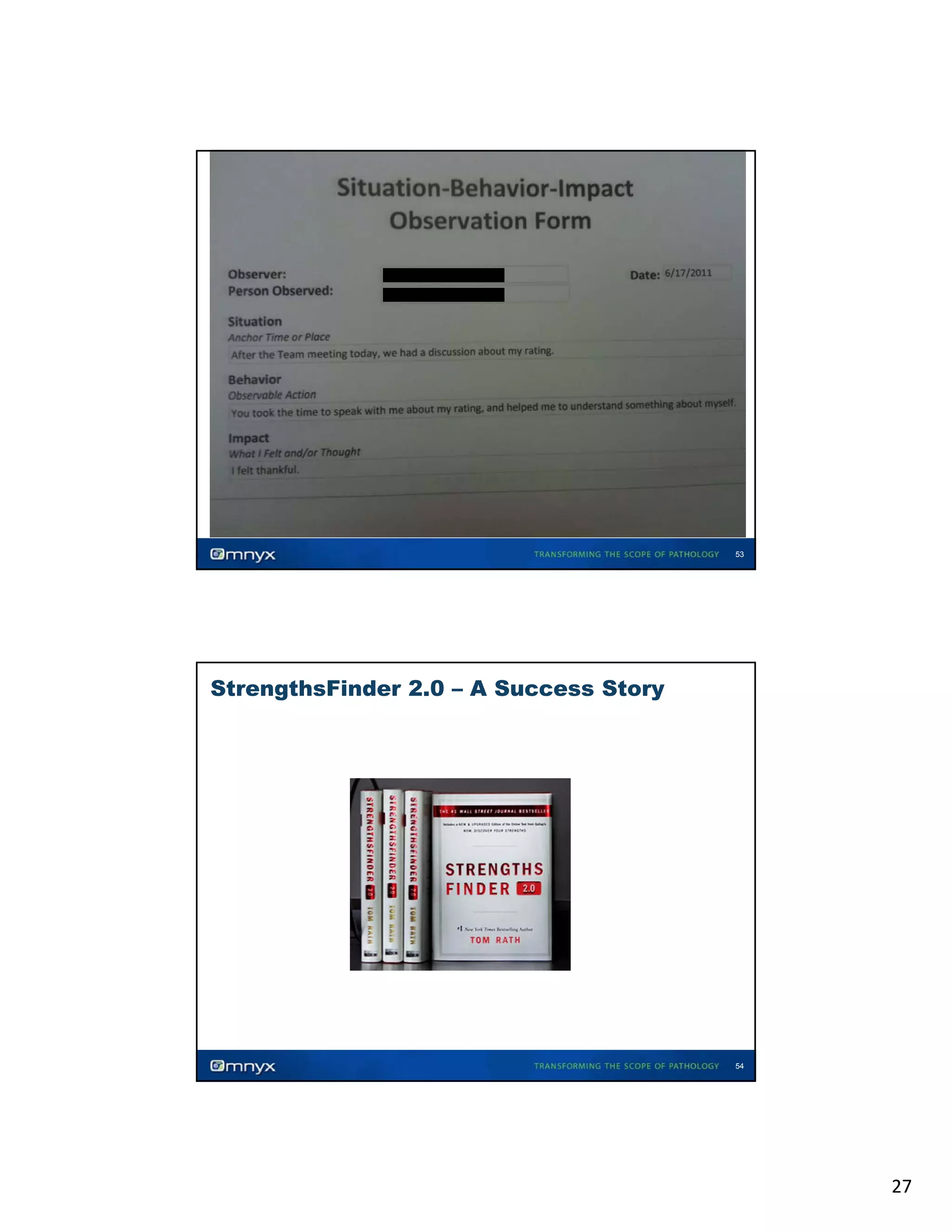
SBI – Situation, Behavior, Impact

51

52

26
53

StrengthsFinder 2.0 – A Success Story

54

27
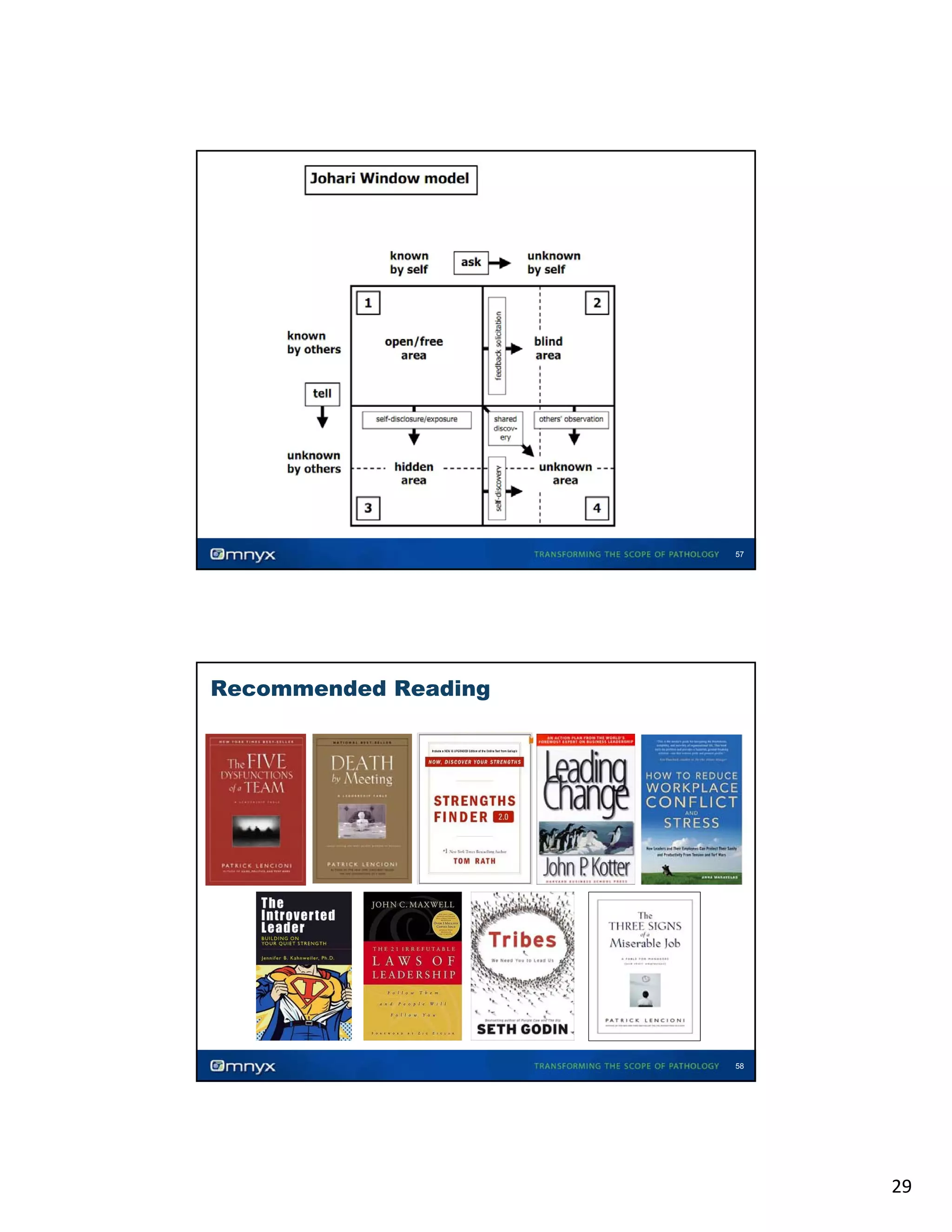
BIBS

55

Johari Window

56

28
57

Recommended Reading

58

29
Summary
Scrum mechanics is what everybody gets started with but those are the easy
problems to solve - the early gains. The real long term gains are in going
deeper into “soft skills” which is hard for engineers, managers, and
organizations, especially if nobody h it on th i G&O
i ti
i ll
b d has
their G&Os.
•

Core values provide a reference for people to judge peer behavior. We think
this is critical for self-organizing teams.

•

Having a core values statement is fine. But then you need to continually
reference it and leverage it as a tool.
•

59

Acknowledgements
I would like to acknowledge my coworkers at Omnyx for being an essential
part of my continuous learning and (hopefully) continuous improvement.

•

•

Thanks for your time today.

Questions?

60

30

Leveraging Core Values for Healthier, More Productive Teams

  • 1.
              BT11 Concurrent Session  11/8/2012 3:45 PM                "Leveraging Core Valuesfor Healthier, More Productive Teams"       Presented by: Scott Ross Omnyx                 Brought to you by:        340 Corporate Way, Suite 300, Orange Park, FL 32073  888‐268‐8770 ∙ 904‐278‐0524 ∙ sqeinfo@sqe.com ∙ www.sqe.com
  • 2.
    Scott Ross Omnyx In thesoftware industry for more than twenty years, Scott Ross is currently director of software at Omnyx, a joint venture of GE Healthcare and the University of Pittsburgh Medical Center. He has worked with scanners, handheld controllers, videoconferencing systems, pharmacy applications, digital radiology, and now digital pathology in a variety of management positions. Scott has been practicing Scrum for three years—after spending two years practicing Scrumbut. Passionate about vision and core values, Scott has helped transform churches and teams using these tools. When well-written, vision statements can be challenging and energizing—and can help bring out the best in people. Scott enjoys woodworking, golf, reading, and hiking.
  • 3.
    Leveraging Core Values forHealthier, , More Productive Teams • • An experience report for Better Software East 2012 Scott Ross Director of Software, Omnyx Scott.Ross@Omnyx.com • • • 1 Omnyx – Who we are Joint-venture of GE Healthcare and UPMC, established in March 2008 110 employees at two locations in Pittsburgh, PA and Piscataway, NJ UPMC relationship gives us easy access to our customers (pathologists, histologists, IT) GE Healthcare relationship benefits us in many ways: GRC, project/program management, sales and support, architectural reviews A GE Healthcare and UPMC Venture • 6 scrum teams • Greenfield Development • FDA Regulated 2 1
  • 4.
    What is Omnyx:What We Do • Pathology • Integrated Digital Pathology 3 Omnyx – Where Were We in Late 2009? 4 2
  • 5.
    “Agile-Friendly” Space 5 Our ScrumMechanics – Basics … in place Sprint Planning Sprint Review Sprint Retro 6 3
  • 6.
  • 7.
    Playing Together 9 The 5Dysfunctions of a Team Inattention to Results Avoidance of Accountability Lack of Commitment Fear of Conflict Absence of Trust 10 5
  • 8.
    So, What Motivatedus to Write Our Core Values? 11 Team Burn Down Charts – Sprint #13 Workflow Diagnostic Viewer Diagnostic Archive 12 6
  • 9.
    Sprint #16 Burndown(Aggregate) • Velocity - 41 • 54% of Sprint goal • 84% of release goal •Velocity Trends: • 26.5, 52.5 (40), 50, 56, 32,41 13 VELOCITY CHART 14 7
  • 10.
    Ineffective Conflict Resolution 15 ImmatureUnderstanding of “SelfOrganizing” A self-organizing team takes responsibility for meeting its commitments in accordance with the business needs needs. It does NOT mean management “has no right to interfere”. It DOES mean “hold one another accountable”, but accountable to what? g p Against what standard should peers judge one another? 16 8
  • 11.
    Us Versus Them 17 WhyCore Values? • • Purpose Statement – why we exist Mission Statement – what are we doing? g Vision Statement – A picture of the future not just how it can be, but how it must be • Core Values – How do we behave when we do the things we do? • 18 9
  • 12.
    Creating a CoreValues Statement - Prepare Articulate the motivation: Core Values are a tool to help us become less like we are and more like we want to be Get G management alignment li Establish a sense of urgency – this is about more than creating a document Identify and prepare the leaders 19 Creating a Core Values Statement - Build Brainstorm with the teams What do you love about Omnyx? y y What things would you change about Omnyx? What does “the best company you can imagine” look like? What trends emerge from these brainstorming sessions? Wordsmith – 17 revisions Don’t let it become mechanical. Passion is required for change. 20 10
  • 13.
    Creating a CoreValues Statement - Support My favorite Quote about Communication: “The single biggest problem in communication is the illusion that it has k i h taken place.” – G l ” George Bernard Sh B d Shaw Repeat the Message Keep an eye out for apathy/hostility/undermining. Share from your heart. Get verbal commitment to “our” core values (not management’s ( g core values) 21 Core Value 1: Integrity and Respect We value Integrity & Respect, and believe that by being honest and courteous, we build trust which is foundational to building great teams. • 22 11
  • 14.
    Core Value 2:Communication and Courage We value Communication & Courage and believe that by listening, disseminating, and engaging in difficult conversations to resolve issues we create a healthy workplace. • 23 Core Value 3: Accountability and Commitment We value Accountability & Commitment and believe that by driving to meet our goals and being responsible for our words and actions we can produce extraordinary results. • 24 12
  • 15.
    Core Value 4:Learning and Continuous Improvement We value Learning & Continuous Improvement and believe that by seeking challenging opportunities, giving and receiving honest feedback and following through, we drive positive change. • 25 Core Value 5: Teamwork and Humility We value Teamwork & Humility and believe that by collaborating, sharing common goals, and buying into decisions we develop efficient solutions. • 26 13
  • 16.
    Core Value 6:People and Community We value People & Community and believe that by hiring and investing in great people and encouraging work/life balance we build a lasting organization. • 27 What Had We Accomplished? Not much: We created a tool to help drive change. 28 14
  • 17.
    Leveraging Our CoreValues Statement •In our 1-on-1 meetings – InfoPath form asks how we are doing (good and bad) in living our core values – If you re leaving this section blank – you are not helping us you’re •In our team meetings (top 3, bottom 1) – Strong drift towards good technical work – associate it with our core values • • • • • • • eQuip Sessions tQuip Sessions Got everyone involved Wordsmith/Feedback Cycle Compared our Culture to our Core Values Referred to them Early and Often “Pull the pain forward” 29 LEVERAGING OUR CORE VALUES 30 15
  • 18.
    Biweekly 1 on1 Form 31 1-on-1 Forms: Real Examples There is resentment with regard to clinical regulatory exerting control influence in our development cycle. I've tried to provide examples of why this is appropriate. appropriate • I worry sometimes that we get in a rush and forget our manners, thereby being disrespectful and causing unnecessary conflict. For example, more than once I have called meetings to which all attendees accept, and yet no one attends. • Teamwork - Chris went out of his way to help Kier when Kier was dealing with some learning curve issue with the scanner code. • • 32 16
  • 19.
    Biweekly Team Meetings Callout individuals Constant reminder that these are about core values, not just good technical work Call out group behavior 31 3:1 ratio of positive to negative helps, but the negative is all people hear sometimes 33 Communication and Courage We value Communication & Courage and believe that by listening, disseminating, and engaging in difficult conversations to resolve issues we create a healthy workplace. • • From: “compliment in public criticize in private” • To: “Give feedback for the purpose of helping the individual and the team” • MBTI: Watch the team mix • SBI • TKI • Too many eMails? – get on the phone • Talking about someone is easier than talking to them 34 17
  • 20.
    Integrity and Respect Wevalue Integrity & Respect, and believe that by being honest and courteous, we build trust which is foundational to building great teams. • • Mentor, set examples which kill gossip • Celebrate diversity of skills – getting things done • Intentional focus when hiring • Integrity is Pass/Fail 35 Accountability and Commitment We value Accountability & Commitment and believe that by driving to meet our goals and being responsible for our words and actions we can produce extraordinary results. • • Releases and sprints – force the commitment (don’t force what we are committing to) • When we fall short, it’s OK, but it’s not acceptable • Big thumbs up or thumbs down on sprint reviews g p p 36 18
  • 21.
    Learning and ContinuousImprovement We value Learning & Continuous Improvement and believe that by seeking challenging opportunities, giving and receiving honest feedback and following through, we drive positive change. • • • • • • • • • • eQuip (S.O.L.I.D., Dep. Inj., B.D.D., …) tQuip (JoHari Window, Risk-based, equiv. part.) Brown bags Conferences Local user groups g p Histology/Pathology lab visits Daily Brain teasers Leadership Book Club Ted Talk Tuesdays 37 Teamwork and Humility We value Teamwork & Humility and believe that by collaborating, sharing common goals, and buying into decisions we develop efficient solutions. • • • • • Teamwork is one of our great strengths Make people aware when “I” dominates “We” Interviews: Hungry/Humble/Smart Teambuilding Events 38 19
  • 22.
    People and Community Wevalue People & Community and believe that by hiring and investing in great people and encouraging work/life balance we build a lasting organization. • • • • • • • Piggy banks to charity Serving Opportunities Happy Hour Fantasy Football Foosball Tournaments Annual Chili Cook-off 39 The Hardest Parts 1. Employees who don’t buy in. We work with them, share our passion, try to get them engaged. But we don’t wait forever and will not let negative individuals destroy our culture. • • • 2. Continuous learning and continuous improvement can be exhausting ☺ 3. Consumerism – bring me my culture 40 20
  • 23.
    Omnyx Now 41 The “Real”Results • 1. “Us and them” is gone and morale is significantly improved 2. Scrum team members are holding each other accountable and h i the diffi l conversations. Even card-carrying d having h difficult i E d i introverts. • 3. The decibel level of our conversations has lowered, but the passion hasn’t. • 4. Continuous learning is more widely embraced not just by the few. few • • • 5. Scrum predictability has improved. 6. Very Low Turnover (2 voluntary attrition in my 3 years) 42 21
  • 24.
    One of theBest Places to Work in Pittsburgh 43 We Have More Drama in our Meetings 44 22
  • 25.
    Where are theMetrics? • I am suspicious of metrics which measure “soft skills” or culture As a small company, we don’t conduct surveys on morale. So we d ’ h don’t have numbers to show the morale b f b h h l before and after. d f • Our scrum performance is better, but there are a lot of differences and it would be misleading to imply we know precisely what role core values played in doing scrum better. • • The key metric over time will be the success of our company. 45 RESOURCES 46 23
  • 26.
    Thomas-Kilmann Conflict ModeInstrument R&D Conflict Preferences 80% 70% 60% 50% 40% 30% 20% 10% 0% Competing Collaborating Compromising Avoiding Accomodating 47 Conflict “Types" My Way 100% 90% 80% 70% 60% 50% 40% 30% 20% 10% 0% Competing Collaborating Compromising Avoiding Accomodating 48 24
  • 27.
    Conflict “Types (Cont.) ThePushover 120% 100% 80% 60% 40% 20% 0% Competing Collaborating Compromising Avoiding Accomodating 49 Conflict Types (Cont.) Mr. Hyde 120% 100% 80% 60% 40% 20% 0% Competing Collaborating Compromising Avoiding Accomodating 50 25
  • 28.
    SBI – Situation,Behavior, Impact 51 52 26
  • 29.
    53 StrengthsFinder 2.0 –A Success Story 54 27
  • 30.
  • 31.
  • 32.
    Summary Scrum mechanics iswhat everybody gets started with but those are the easy problems to solve - the early gains. The real long term gains are in going deeper into “soft skills” which is hard for engineers, managers, and organizations, especially if nobody h it on th i G&O i ti i ll b d has their G&Os. • Core values provide a reference for people to judge peer behavior. We think this is critical for self-organizing teams. • Having a core values statement is fine. But then you need to continually reference it and leverage it as a tool. • 59 Acknowledgements I would like to acknowledge my coworkers at Omnyx for being an essential part of my continuous learning and (hopefully) continuous improvement. • • Thanks for your time today. Questions? 60 30