Lean Leadership
Ken Flaherty
| San Diego, CA | February 24, 2014
Anchoring Organizational
Values to Lean Principles
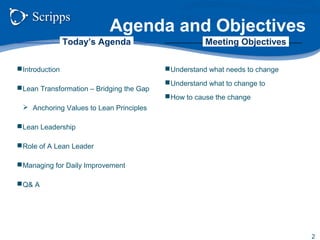
Agenda and Objectives
2
Introduction
Lean Transformation – Bridging the Gap
 Anchoring Values to Lean Principles
Lean Leadership
Role of A Lean Leader
Managing for Daily Improvement
Q& A
Meeting ObjectivesToday’s Agenda
Understand what needs to change
Understand what to change to
How to cause the change
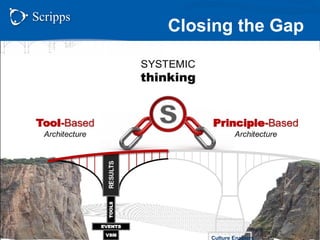
Closing the Gap
Culture Enablers
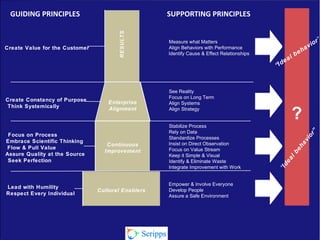
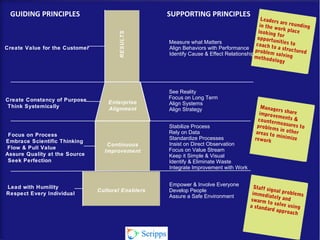
GUIDING PRINCIPLES SUPPORTING PRINCIPLES
Measure what Matters
Align Behaviors with PerformanceCreate Value for the Customer
Identify Cause & Effect Relationships
See Reality
Focus on Long Term
Create Constancy of Purpose Enterprise Align Systems
Think Systemically Alignment Align Strategy
?RESULTS
Stabilize Process
Rely on Data
Focus on Process
Standardize Processes
Embrace Scientific Thinking Insist on Direct ObservationContinuous
Flow & Pull Value Focus on Value StreamImprovement
Assure Quality at the Source Keep it Simple & Visual
Seek Perfection Identify & Eliminate Waste
Integrate Improvement with Work
Empower & Involve Everyone
Lead with Humility
Cultural Enablers Develop People
Respect Every Individual Assure a Safe Environment
“Ideal behavior”
“Idealbehavior”
GUIDING PRINCIPLES SUPPORTING PRINCIPLES
Measure what Matters
Align Behaviors with PerformanceCreate Value for the Customer
Identify Cause & Effect Relationships
See Reality
Focus on Long TermCreate Constancy of Purpose Enterprise Align Systems
Think Systemically Alignment Align Strategy
RESULTS
Stabilize Process
Rely on DataFocus on Process
Standardize Processes
Embrace Scientific Thinking
Insist on Direct ObservationContinuous
Flow & Pull Value Focus on Value StreamImprovement
Assure Quality at the Source Keep it Simple & Visual
Seek Perfection Identify & Eliminate Waste
Integrate Improvement with Work
Empower & Involve EveryoneLead with Humility
Cultural Enablers Develop People
Respect Every Individual
Assure a Safe Environment
Leaders are roundingin the work placelooking foropportunities tocoach to a structuredproblem solvingmethodology
Managers shareimprovements &countermeasures toproblems in otherareas to minimizerework
Staff signal problemsimmediately andswarm to solve usinga standard approach
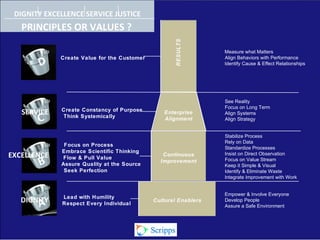
DIGNITY EXCELLENCE SERVICE JUSTICE
PRINCIPLES OR VALUES ?
Measure what Matters
Create Value for the Customer Align Behaviors with Performance
Identify Cause & Effect Relationships
See Reality
Focus on Long Term
Create Constancy of Purpose
SERVICE Enterprise Align Systems
Think Systemically Alignment Align Strategy
Stabilize Process
Rely on Data
Focus on Process
Standardize Processes
Embrace Scientific Thinking Insist on Direct ObservationContinuousEXCELLENCE Flow & Pull Value Focus on Value StreamImprovement
Assure Quality at the Source Keep it Simple & Visual
Seek Perfection Identify & Eliminate Waste
Integrate Improvement with WorkRESULTS
Empower & Involve Everyone
Lead with Humility
Develop PeopleDIGNITY Cultural Enablers
Respect Every Individual Assure a Safe Environment
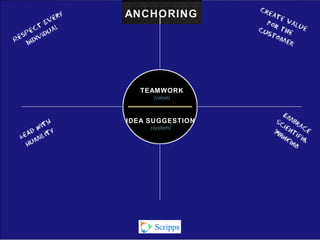
ANCHORING
TEAMWORK
(value)
IDEA SUGGESTION
(system)
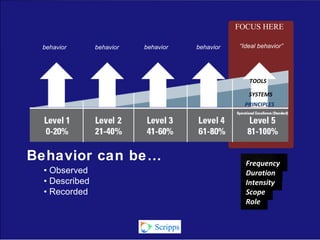
FOCUS HERE
behavior behavior “Ideal behavior”behavior behavior
TOOLS
SYSTEMS
PRINCIPLES
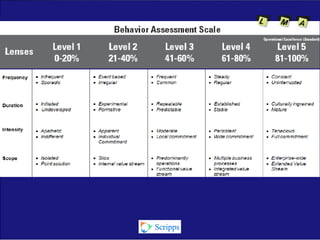
Behavior can be… Frequency
• Observed Duration
• Described Intensity
Scope• Recorded
Role
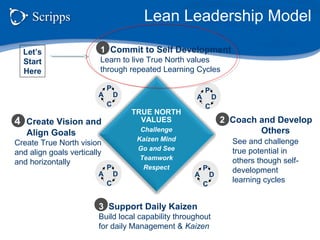
Lean Leadership Model
3 Support Daily Kaizen
Build local capability throughout
for daily Management & Kaizen
2 Coach and Develop
Others
4 Create Vision and
Align Goals
Create True North vision
and align goals vertically
and horizontally
1 Commit to Self Development
Learn to live True North values
through repeated Learning Cycles
TRUE NORTH
VALUES
Challenge
Kaizen Mind
Go and See
Teamwork
Respect
P
D
C
A
P
D
C
A
P
D
C
A
P
D
C
A
See and challenge
true potential in
others though self-
development
learning cycles
Let’s
Start
Here
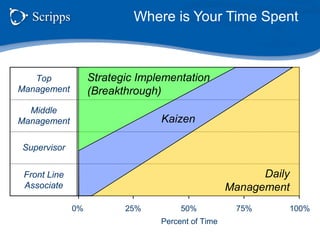
Where is Your Time Spent
Top
Management
Middle
Management
Supervisor
Front Line
Associate
Strategic Implementation
(Breakthrough)
Daily
Management
Kaizen
0% 25% 50% 75% 100%
Percent of Time
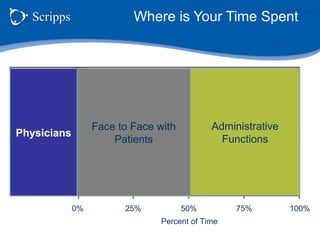
Where is Your Time Spent
0% 25% 50% 75% 100%
Percent of Time
Physicians
Face to Face with
Patients
Administrative
Functions
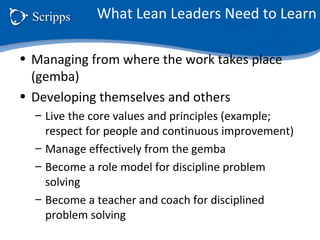
What Lean Leaders Need to Learn
• Managing from where the work takes place
(gemba)
• Developing themselves and others
– Live the core values and principles (example;
respect for people and continuous improvement)
– Manage effectively from the gemba
– Become a role model for discipline problem
solving
– Become a teacher and coach for disciplined
problem solving
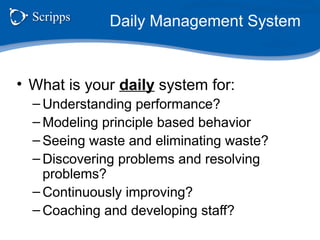
Daily Management System
• What is your daily system for:
– Understanding performance?
– Modeling principle based behavior
– Seeing waste and eliminating waste?
– Discovering problems and resolving
problems?
– Continuously improving?
– Coaching and developing staff?
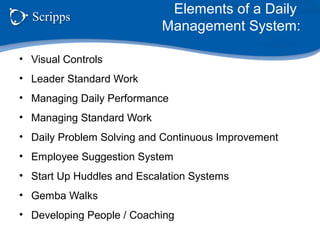
Elements of a Daily
Management System:
• Visual Controls
• Leader Standard Work
• Managing Daily Performance
• Managing Standard Work
• Daily Problem Solving and Continuous Improvement
• Employee Suggestion System
• Start Up Huddles and Escalation Systems
• Gemba Walks
• Developing People / Coaching
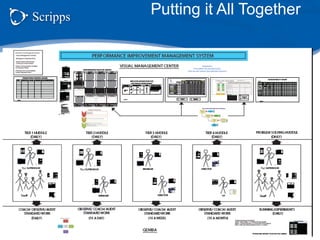
Putting it All Together
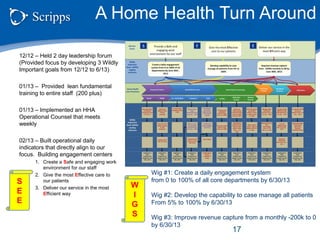
12/12 – Held 2 day leadership forum
(Provided focus by developing 3 Wildly
Important goals from 12/12 to 6/13)
01/13 – Provided lean fundamental
training to entire staff (200 plus)
01/13 – Implemented an HHA
Operational Counsel that meets
weekly
02/13 – Built operational daily
indicators that directly align to our
focus. Building engagement centers
1. Create a Safe and engaging work
environment for our staff
2. Give the most Effective care to
our patients
3. Deliver our service in the most
Efficient way
17
S
E
E
W
I
G
S
Wig #1: Create a daily engagement system
from 0 to 100% of all core departments by 6/30/13
Wig #2: Develop the capability to case manage all patients
From 5% to 100% by 6/30/13
Wig #3: Improve revenue capture from a monthly -200k to 0
by 6/30/13
A Home Health Turn Around
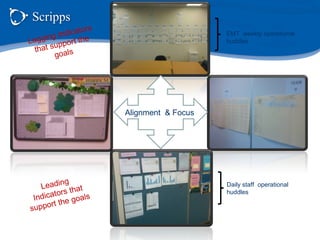
Alignment & Focus
EMT weekly operational
huddles
Daily staff operational
huddles
Lagging Indicators
that support the
goals
Leading
Indicators that
support the goals
Questions?
Ken Flaherty
kenf@emsstrategies.com

Scripps Health Lean Presentation 2-24-14

  • 1.
    Lean Leadership Ken Flaherty |San Diego, CA | February 24, 2014 Anchoring Organizational Values to Lean Principles
  • 2.
    Agenda and Objectives 2 Introduction LeanTransformation – Bridging the Gap  Anchoring Values to Lean Principles Lean Leadership Role of A Lean Leader Managing for Daily Improvement Q& A Meeting ObjectivesToday’s Agenda Understand what needs to change Understand what to change to How to cause the change
  • 3.
  • 4.
    GUIDING PRINCIPLES SUPPORTINGPRINCIPLES Measure what Matters Align Behaviors with PerformanceCreate Value for the Customer Identify Cause & Effect Relationships See Reality Focus on Long Term Create Constancy of Purpose Enterprise Align Systems Think Systemically Alignment Align Strategy ?RESULTS Stabilize Process Rely on Data Focus on Process Standardize Processes Embrace Scientific Thinking Insist on Direct ObservationContinuous Flow & Pull Value Focus on Value StreamImprovement Assure Quality at the Source Keep it Simple & Visual Seek Perfection Identify & Eliminate Waste Integrate Improvement with Work Empower & Involve Everyone Lead with Humility Cultural Enablers Develop People Respect Every Individual Assure a Safe Environment “Ideal behavior” “Idealbehavior”
  • 5.
    GUIDING PRINCIPLES SUPPORTINGPRINCIPLES Measure what Matters Align Behaviors with PerformanceCreate Value for the Customer Identify Cause & Effect Relationships See Reality Focus on Long TermCreate Constancy of Purpose Enterprise Align Systems Think Systemically Alignment Align Strategy RESULTS Stabilize Process Rely on DataFocus on Process Standardize Processes Embrace Scientific Thinking Insist on Direct ObservationContinuous Flow & Pull Value Focus on Value StreamImprovement Assure Quality at the Source Keep it Simple & Visual Seek Perfection Identify & Eliminate Waste Integrate Improvement with Work Empower & Involve EveryoneLead with Humility Cultural Enablers Develop People Respect Every Individual Assure a Safe Environment Leaders are roundingin the work placelooking foropportunities tocoach to a structuredproblem solvingmethodology Managers shareimprovements &countermeasures toproblems in otherareas to minimizerework Staff signal problemsimmediately andswarm to solve usinga standard approach
  • 6.
    DIGNITY EXCELLENCE SERVICEJUSTICE PRINCIPLES OR VALUES ? Measure what Matters Create Value for the Customer Align Behaviors with Performance Identify Cause & Effect Relationships See Reality Focus on Long Term Create Constancy of Purpose SERVICE Enterprise Align Systems Think Systemically Alignment Align Strategy Stabilize Process Rely on Data Focus on Process Standardize Processes Embrace Scientific Thinking Insist on Direct ObservationContinuousEXCELLENCE Flow & Pull Value Focus on Value StreamImprovement Assure Quality at the Source Keep it Simple & Visual Seek Perfection Identify & Eliminate Waste Integrate Improvement with WorkRESULTS Empower & Involve Everyone Lead with Humility Develop PeopleDIGNITY Cultural Enablers Respect Every Individual Assure a Safe Environment
  • 7.
  • 8.
    FOCUS HERE behavior behavior“Ideal behavior”behavior behavior TOOLS SYSTEMS PRINCIPLES Behavior can be… Frequency • Observed Duration • Described Intensity Scope• Recorded Role
  • 10.
    Lean Leadership Model 3Support Daily Kaizen Build local capability throughout for daily Management & Kaizen 2 Coach and Develop Others 4 Create Vision and Align Goals Create True North vision and align goals vertically and horizontally 1 Commit to Self Development Learn to live True North values through repeated Learning Cycles TRUE NORTH VALUES Challenge Kaizen Mind Go and See Teamwork Respect P D C A P D C A P D C A P D C A See and challenge true potential in others though self- development learning cycles Let’s Start Here
  • 11.
    Where is YourTime Spent Top Management Middle Management Supervisor Front Line Associate Strategic Implementation (Breakthrough) Daily Management Kaizen 0% 25% 50% 75% 100% Percent of Time
  • 12.
    Where is YourTime Spent 0% 25% 50% 75% 100% Percent of Time Physicians Face to Face with Patients Administrative Functions
  • 13.
    What Lean LeadersNeed to Learn • Managing from where the work takes place (gemba) • Developing themselves and others – Live the core values and principles (example; respect for people and continuous improvement) – Manage effectively from the gemba – Become a role model for discipline problem solving – Become a teacher and coach for disciplined problem solving
  • 14.
    Daily Management System •What is your daily system for: – Understanding performance? – Modeling principle based behavior – Seeing waste and eliminating waste? – Discovering problems and resolving problems? – Continuously improving? – Coaching and developing staff?
  • 15.
    Elements of aDaily Management System: • Visual Controls • Leader Standard Work • Managing Daily Performance • Managing Standard Work • Daily Problem Solving and Continuous Improvement • Employee Suggestion System • Start Up Huddles and Escalation Systems • Gemba Walks • Developing People / Coaching
  • 16.
  • 17.
    12/12 – Held2 day leadership forum (Provided focus by developing 3 Wildly Important goals from 12/12 to 6/13) 01/13 – Provided lean fundamental training to entire staff (200 plus) 01/13 – Implemented an HHA Operational Counsel that meets weekly 02/13 – Built operational daily indicators that directly align to our focus. Building engagement centers 1. Create a Safe and engaging work environment for our staff 2. Give the most Effective care to our patients 3. Deliver our service in the most Efficient way 17 S E E W I G S Wig #1: Create a daily engagement system from 0 to 100% of all core departments by 6/30/13 Wig #2: Develop the capability to case manage all patients From 5% to 100% by 6/30/13 Wig #3: Improve revenue capture from a monthly -200k to 0 by 6/30/13 A Home Health Turn Around
  • 18.
    Alignment & Focus EMTweekly operational huddles Daily staff operational huddles Lagging Indicators that support the goals Leading Indicators that support the goals
  • 19.

Editor's Notes

  • #12 If you went back and totaled up all of your time, think about how much time was spent firefighting, daily management, kaizen, versus how much was on breakthrough. “We all have our planners” “Who uses Microsoft office, Palm, Franklin planner?” “How does the company expect you to use your time?” The company expects top management to be spending their time on breakthrough. This tool will help us do that. With Strategic Implementation, the top management should be spending more than 60% of their time on breakthroughs. Daily Management is the task required each day to get the product or service to the customer. Sometimes daily management takes on a large amount of firefighting due to out of control processes. By spending time on Kaizen, the firefighting can be reduced, which create more time for doing improvement activities. When we hear “I don’t have time for Kaizen” this is a tip that too much time is spent on firefighting and that the dail management process are out of control. Some Kaizen may need to be focused on getting these processes under control before significant time can be spent on improving to world class levels.   The diagram represents what will take the most time with each of the management levels when Strategic Implementation is in place.
  • #13 If you went back and totaled up all of your time, think about how much time was spent firefighting, daily management, kaizen, versus how much was on breakthrough. “We all have our planners” “Who uses Microsoft office, Palm, Franklin planner?” “How does the company expect you to use your time?” The company expects top management to be spending their time on breakthrough. This tool will help us do that. With Strategic Implementation, the top management should be spending more than 60% of their time on breakthroughs. Daily Management is the task required each day to get the product or service to the customer. Sometimes daily management takes on a large amount of firefighting due to out of control processes. By spending time on Kaizen, the firefighting can be reduced, which create more time for doing improvement activities. When we hear “I don’t have time for Kaizen” this is a tip that too much time is spent on firefighting and that the dail management process are out of control. Some Kaizen may need to be focused on getting these processes under control before significant time can be spent on improving to world class levels.   The diagram represents what will take the most time with each of the management levels when Strategic Implementation is in place.