CHECK THE ASSIGNMENT
CONTEXT, PLEASE?
DIRECTIONS:
•Look at the illustrations.
•Imagine that you are the one
talking.
•Write the line/s you are going to
say about the given situation in
your Creative Writing notebook.
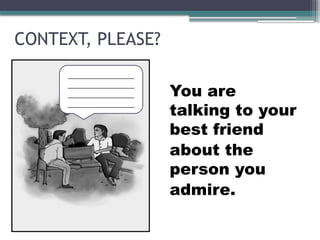
CONTEXT, PLEASE?
You are
talking to your
best friend
about the
person you
admire.
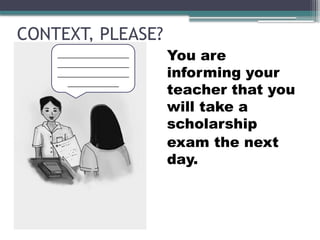
CONTEXT, PLEASE?
You are
informing your
teacher that you
will take a
scholarship
exam the next
day.
______________
______________
______________
__________
PROCESS
•1. What kind of
words did you use in
each situation?
PROCESS
2. What did you
consider in responding
in the situations?
PROCESS
3. Which of the
situations uses formal
or less formal
language? Explain.
•Think of
words as
superheroes
What is Diction?
•The choice of words or
the style used by an
individual when
speaking or writing.
DICTION
•What makes a text a good one or a
bad one is the choice of words used
by the author.
•Thus, diction separates a good
writing from a bad writing.
There are several factors to consider when
choosing words:
•Words need to be right and
accurate.
•Words need to be appropriate
for the context.
•Words need to be understood
by the readers .
TYPES OF
DICTION
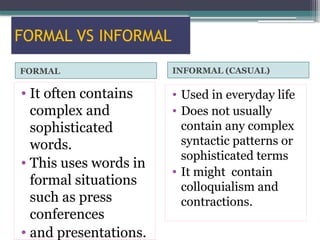
FORMAL VS INFORMAL
FORMAL INFORMAL (CASUAL)
• It often contains
complex and
sophisticated
words.
• This uses words in
formal situations
such as press
conferences
• and presentations.
• Used in everyday life
• Does not usually
contain any complex
syntactic patterns or
sophisticated terms
• It might contain
colloquialism and
contractions.
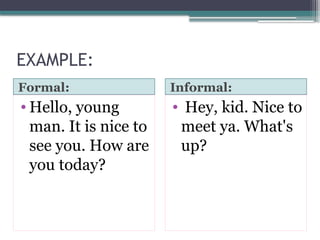
EXAMPLE:
Formal: Informal:
• Hello, young
man. It is nice to
see you. How are
you today?
• Hey, kid. Nice to
meet ya. What's
up?
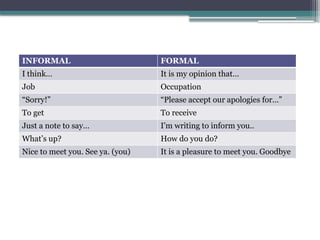
INFORMAL FORMAL
I think… It is my opinion that…
Job Occupation
“Sorry!” “Please accept our apologies for…”
To get To receive
Just a note to say… I’m writing to inform you..
What’s up? How do you do?
Nice to meet you. See ya. (you) It is a pleasure to meet you. Goodbye
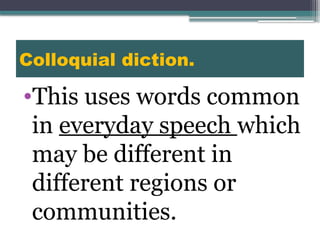
Colloquial diction.
•This uses words common
in everyday speech which
may be different in
different regions or
communities.
COLLOQUIALISM
A. WORDS
One famous colloquial difference in the
United States is the way a someone refers to
a carbonated beverage.
There are regional borders that separate the
usage of the words ―soda,―pop, ―soft
drink, and ―Coke(used as a generic term
and not just to refer to the brand).
COLLOQUIALISM
A.1 Contractions:
Words such as ―ain’t and
―gonna are examples of
colloquialism.
These are not widely used in
English speaking countries.
COLLOQUIALISM
A.2. Profanity:
Some words are considered profane in some
dialects of English where they are not at all
bad in other dialects.
A good example is the word ―bloody which
is a common adjective in American English;
but in British English it means curse.
B. Phrases:
•Old as the hills
•Eat my dust
C. Aphorisms:
•concise statement of a
principle
•Examples:
•I was not born yesterday.
•To see is to believe.
3. SLANG DICTION
•This is the use of words that
are newly coined, or even
impolite.
• Rapidly changing
words/phrases
SLANG
•Words like fam(family),
bae (boy/girlfriend),
bromance (friendship
between two males) and
frenemy (two friends with
constant disputes)
CONNOTATION
VS
DENOTATION
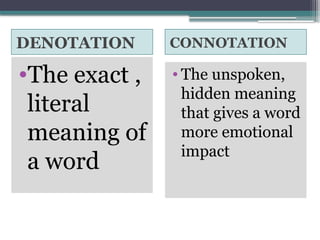
DENOTATION CONNOTATION
•The exact ,
literal
meaning of
a word
• The unspoken,
hidden meaning
that gives a word
more emotional
impact
Denotation vs Connotation
•“The family sat
together in front of a
warm fire.”
CONNOTATION
•Mrs. Darcy knows the
answers to questions no
one else can answer.
•She might be called informed.
•She might be called confident.
•She might be called conceited.
•Which of these words has a
neutral connotation, and
merely states a fact, without
opinion or judgement.
•Which of theses words has a
positive connotation and
could be considered a
compliment?
•Which of these words has a
negative connotation and
could be taken as criticism?
JARGON
•Are specific words or phrases
in different contexts, professions
and trade.
•The people out that context
may not be able to identify
these words and phrases.
JARGON
•For example, FTP is a police
jargon for failure to pay the
fine; BP is a medical jargon
for blood pressure.
SIGNIFICANCE OF JARGON IN CW
•to show that a character is truly
part of the profession that he or she
is supposed to have
•Can lend an air of credibility, and
help readers suspend their
disbelief
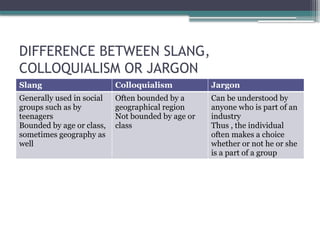
DIFFERENCE BETWEEN SLANG,
COLLOQUIALISM OR JARGON
Slang Colloquialism Jargon
Generally used in social
groups such as by
teenagers
Bounded by age or class,
sometimes geography as
well
Often bounded by a
geographical region
Not bounded by age or
class
Can be understood by
anyone who is part of an
industry
Thus , the individual
often makes a choice
whether or not he or she
is a part of a group
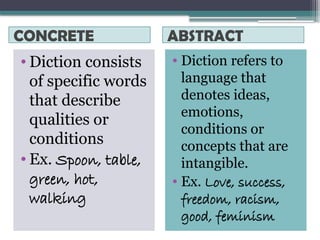
CONCRETE ABSTRACT
• Diction consists
of specific words
that describe
qualities or
conditions
• Ex. Spoon, table,
green, hot,
walking
• Diction refers to
language that
denotes ideas,
emotions,
conditions or
concepts that are
intangible.
• Ex. Love, success,
freedom, racism,
good, feminism
CONCLUDING QUESTION:
•How does proper diction
able to evoke meaningful
responses of your
readers?
Based on our lesson about diction, answer this question.
• In children’s books Dr. Seuss’ Green Eggs and
Ham, he wrote:
“Do you like green eggs and ham?
I do not like them Sam-I-am. I do
not like green eggs and ham.”
•Does the author consider the
target audience in this
couplet? Why or why not?
SHORT QUIZ
1) Which of the following observes
proper diction?
A. She already sang, dances, and acts.
B. She advised us to prepare for the
exam.
C. I come, I saw, I conquered - Julius
Caesar
D. Being positive in times of crisis
could effect one’s decision.
2) What level of language uses words
that are suited in formal setting such
as business meeting and conferences?
A. Colloquial
B. formal
C. informal diction
D. slang
3) A type of jargon used for specific
professions or trades.
A. jargon
B. formal
C. abstract
D. slang
4) “His latest movie was epic!” What
type of diction is used in this
sentence?
A. jargon
B. Colloquial diction
C. abstract
D. slang
5) “Would you care to explain the
reason behind your decision to leave
the gathering early?”
What type of diction is used in this
sentence?
A. informal
B. Colloquial diction
C. formal
D. jargon

diction: its types, definitions and examples.pptx

  • 1.
  • 2.
    CONTEXT, PLEASE? DIRECTIONS: •Look atthe illustrations. •Imagine that you are the one talking. •Write the line/s you are going to say about the given situation in your Creative Writing notebook.
  • 3.
    CONTEXT, PLEASE? You are talkingto your best friend about the person you admire.
  • 4.
    CONTEXT, PLEASE? You are informingyour teacher that you will take a scholarship exam the next day. ______________ ______________ ______________ __________
  • 5.
    PROCESS •1. What kindof words did you use in each situation?
  • 6.
    PROCESS 2. What didyou consider in responding in the situations?
  • 7.
    PROCESS 3. Which ofthe situations uses formal or less formal language? Explain.
  • 8.
  • 9.
    What is Diction? •Thechoice of words or the style used by an individual when speaking or writing.
  • 10.
    DICTION •What makes atext a good one or a bad one is the choice of words used by the author. •Thus, diction separates a good writing from a bad writing.
  • 11.
    There are severalfactors to consider when choosing words: •Words need to be right and accurate. •Words need to be appropriate for the context. •Words need to be understood by the readers .
  • 12.
  • 14.
    FORMAL VS INFORMAL FORMALINFORMAL (CASUAL) • It often contains complex and sophisticated words. • This uses words in formal situations such as press conferences • and presentations. • Used in everyday life • Does not usually contain any complex syntactic patterns or sophisticated terms • It might contain colloquialism and contractions.
  • 15.
    EXAMPLE: Formal: Informal: • Hello,young man. It is nice to see you. How are you today? • Hey, kid. Nice to meet ya. What's up?
  • 16.
    INFORMAL FORMAL I think…It is my opinion that… Job Occupation “Sorry!” “Please accept our apologies for…” To get To receive Just a note to say… I’m writing to inform you.. What’s up? How do you do? Nice to meet you. See ya. (you) It is a pleasure to meet you. Goodbye
  • 17.
    Colloquial diction. •This useswords common in everyday speech which may be different in different regions or communities.
  • 18.
    COLLOQUIALISM A. WORDS One famouscolloquial difference in the United States is the way a someone refers to a carbonated beverage. There are regional borders that separate the usage of the words ―soda,―pop, ―soft drink, and ―Coke(used as a generic term and not just to refer to the brand).
  • 19.
    COLLOQUIALISM A.1 Contractions: Words suchas ―ain’t and ―gonna are examples of colloquialism. These are not widely used in English speaking countries.
  • 20.
    COLLOQUIALISM A.2. Profanity: Some wordsare considered profane in some dialects of English where they are not at all bad in other dialects. A good example is the word ―bloody which is a common adjective in American English; but in British English it means curse.
  • 21.
    B. Phrases: •Old asthe hills •Eat my dust
  • 22.
    C. Aphorisms: •concise statementof a principle •Examples: •I was not born yesterday. •To see is to believe.
  • 23.
    3. SLANG DICTION •Thisis the use of words that are newly coined, or even impolite. • Rapidly changing words/phrases
  • 24.
    SLANG •Words like fam(family), bae(boy/girlfriend), bromance (friendship between two males) and frenemy (two friends with constant disputes)
  • 25.
  • 26.
    DENOTATION CONNOTATION •The exact, literal meaning of a word • The unspoken, hidden meaning that gives a word more emotional impact
  • 27.
    Denotation vs Connotation •“Thefamily sat together in front of a warm fire.”
  • 28.
    CONNOTATION •Mrs. Darcy knowsthe answers to questions no one else can answer.
  • 29.
    •She might becalled informed. •She might be called confident. •She might be called conceited.
  • 30.
    •Which of thesewords has a neutral connotation, and merely states a fact, without opinion or judgement.
  • 31.
    •Which of theseswords has a positive connotation and could be considered a compliment?
  • 32.
    •Which of thesewords has a negative connotation and could be taken as criticism?
  • 33.
    JARGON •Are specific wordsor phrases in different contexts, professions and trade. •The people out that context may not be able to identify these words and phrases.
  • 34.
    JARGON •For example, FTPis a police jargon for failure to pay the fine; BP is a medical jargon for blood pressure.
  • 35.
    SIGNIFICANCE OF JARGONIN CW •to show that a character is truly part of the profession that he or she is supposed to have •Can lend an air of credibility, and help readers suspend their disbelief
  • 36.
    DIFFERENCE BETWEEN SLANG, COLLOQUIALISMOR JARGON Slang Colloquialism Jargon Generally used in social groups such as by teenagers Bounded by age or class, sometimes geography as well Often bounded by a geographical region Not bounded by age or class Can be understood by anyone who is part of an industry Thus , the individual often makes a choice whether or not he or she is a part of a group
  • 37.
    CONCRETE ABSTRACT • Dictionconsists of specific words that describe qualities or conditions • Ex. Spoon, table, green, hot, walking • Diction refers to language that denotes ideas, emotions, conditions or concepts that are intangible. • Ex. Love, success, freedom, racism, good, feminism
  • 38.
    CONCLUDING QUESTION: •How doesproper diction able to evoke meaningful responses of your readers?
  • 39.
    Based on ourlesson about diction, answer this question. • In children’s books Dr. Seuss’ Green Eggs and Ham, he wrote: “Do you like green eggs and ham? I do not like them Sam-I-am. I do not like green eggs and ham.”
  • 40.
    •Does the authorconsider the target audience in this couplet? Why or why not?
  • 41.
  • 42.
    1) Which ofthe following observes proper diction? A. She already sang, dances, and acts. B. She advised us to prepare for the exam. C. I come, I saw, I conquered - Julius Caesar D. Being positive in times of crisis could effect one’s decision.
  • 43.
    2) What levelof language uses words that are suited in formal setting such as business meeting and conferences? A. Colloquial B. formal C. informal diction D. slang
  • 44.
    3) A typeof jargon used for specific professions or trades. A. jargon B. formal C. abstract D. slang
  • 45.
    4) “His latestmovie was epic!” What type of diction is used in this sentence? A. jargon B. Colloquial diction C. abstract D. slang
  • 46.
    5) “Would youcare to explain the reason behind your decision to leave the gathering early?” What type of diction is used in this sentence? A. informal B. Colloquial diction C. formal D. jargon