Effective Paragraph Beginnings 
and Endings 
Jo I. Bartolata 
College of Arts and Letters
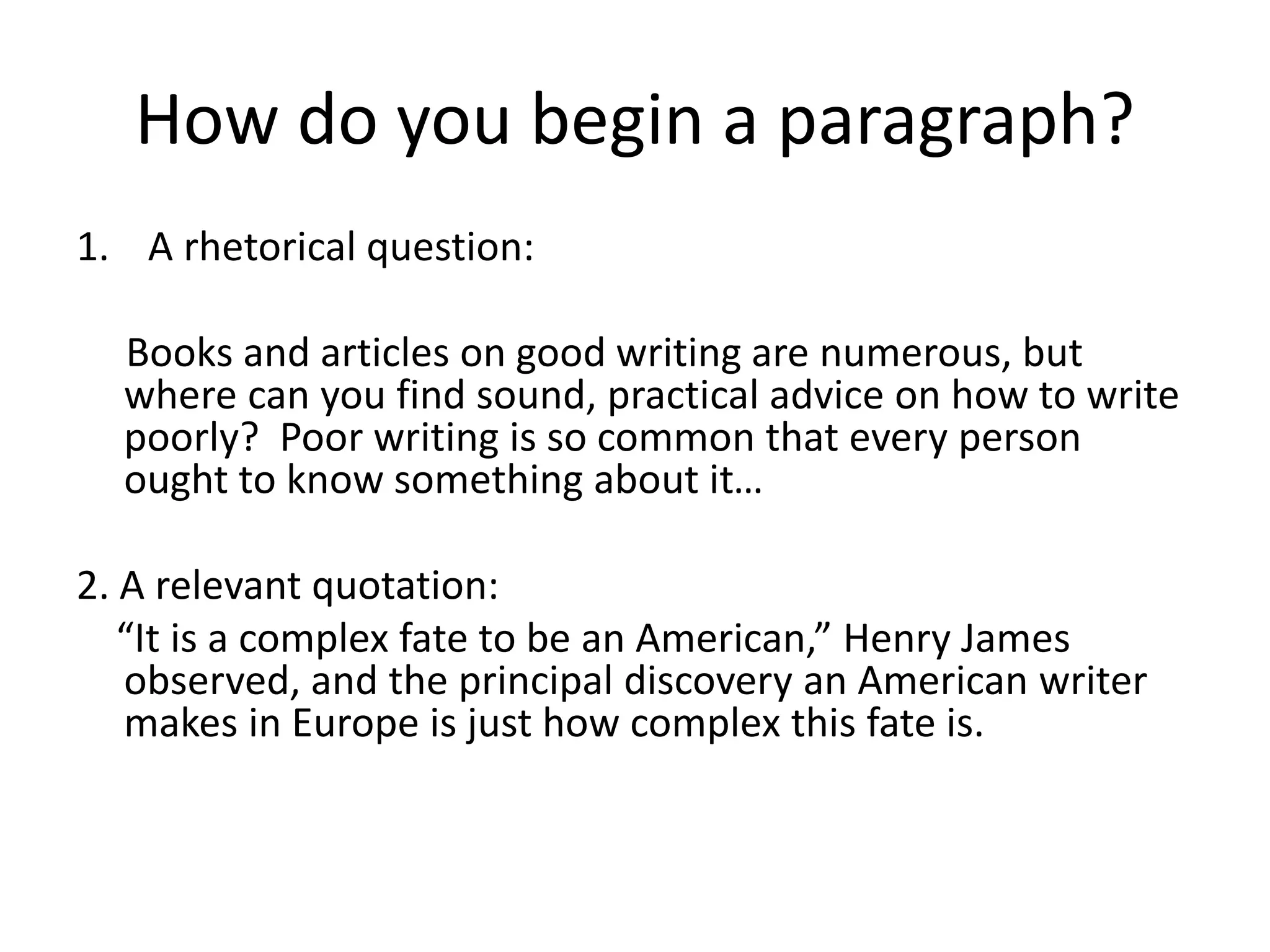
How do you begin a paragraph? 
1. A rhetorical question: 
Books and articles on good writing are numerous, but 
where can you find sound, practical advice on how to write 
poorly? Poor writing is so common that every person 
ought to know something about it… 
2. A relevant quotation: 
“It is a complex fate to be an American,” Henry James 
observed, and the principal discovery an American writer 
makes in Europe is just how complex this fate is.
3. A dramatic statement: 
It is clear that America as it now exists must be 
destroyed. There is no other way. It is impossible to 
live within this country and not become a thief or a 
murderer. 
4. Play on familiar words or rhythms: 
Television is something by our times, out of our times, 
for our times. It reflects the virtues and faults of our 
times.
5. A proverb—not a cliché 
“All work and no play makes Jack a dull boy.” 
Although this is a half-truth, people certainly 
need to have a work ethic. 
6. A straightforward statement of opinion: 
Ian Fleming’s James Bond is the most famous spy 
since Mata Hari. The indomitable secret agent 
reaches every level of literacy.
7. An illustration 
The philosopher Diogenes lived in a tub in the 
market place. He owned the clothes on his back 
and a wooden cup; one morning, when he saw a 
man drinking out of hands, he threw away the 
cup. Alexander the Great came to Athens, and 
went down to the market place to see Diogenes; 
as he was about to leave he asked, “Is there 
anything I can do for you? Yes,” said Diogenes, 
“you can get out of my light.”
What not to do 
1. Apologize 
Although I don’t know much about graduate teaching assistants, I thought that I’d 
write a paper about them. 
2. Complain 
I started thinking about this paper after dinner and couldn’t come up with an 
interesting subject because we were told that we could write about anything… 
3. Be dull 
Some graduate teaching assistants are good, and some graduate teaching 
assistants are bad. 
4. Refer to the title/announce 
The title of this paper, “Graduate Teaching Assistants,” indicates that it is 
concerned with graduate students who are teaching in college while also pursuing 
their own graduate work. OR This paper will discus…
How do you end a paragraph? 
1. Echoing the introduction: Echoing your introduction can be a good 
strategy if it is meant to bring the reader full-circle. If you begin by 
describing a scenario, you can end with the same scenario as proof 
that your essay was helpful in creating a new understanding. 
Example: 
Introduction 
From the parking lot, I could see the towers of the castle of the 
Magic Kingdom standing stately against the blue sky. To the right, 
the tall peak of The Matterhorn rose even higher. From the left, I 
could hear the jungle sounds of Adventureland. As I entered the 
gate, Main Street stretched before me with its quaint shops evoking 
an old-fashioned small town so charming it could never have 
existed. I was entranced. Disneyland may have been built for 
children, but it brings out the child in adults.
Conclusion 
I thought I would spend a few hours at Disneyland, but 
here I was at 1:00 A.M., closing time, leaving the front 
gates with the now dark towers of the Magic Kingdom 
behind me. I could see tired children, toddling along 
and struggling to keep their eyes open as best they 
could. Others slept in their parents' arms as we waited 
for the parking lot tram that would take us to our cars. 
My forty-year-old feet ached, and I felt a bit sad to 
think that in a couple of days I would be leaving 
California, my vacation over, to go back to my desk. But 
then I smiled to think that for at least a day I felt ten 
years old again.
2. Challenging the reader: By issuing a challenge to your 
readers, you are helping them to redirect the 
information in the paper, and they may apply it to their 
own lives. 
Example 
Though serving on a jury is not only a civic 
responsibility but also an interesting experience, many 
people still view jury duty as a chore that interrupts 
their jobs and the routine of their daily lives. However, 
juries are part of America's attempt to be a free and 
just society. Thus, jury duty challenges us to be 
interested and responsible citizens.
3. Looking to the future: Looking to the future can emphasize 
the importance of your paper or redirect the readers' 
thought process. It may help them apply the new 
information to their lives or see things more globally. 
Example 
Without well-qualified teachers, schools are little more than 
buildings and equipment. If higher-paying careers continue 
to attract the best and the brightest students, there will not 
only be a shortage of teachers, but the teachers available 
may not have the best qualifications. Our youth will suffer. 
And when youth suffers, the future suffers.
4. Posing questions: Posing questions, either to your readers or in 
general, may help your readers gain a new perspective on the topic, 
which they may not have held before reading your conclusion. It 
may also bring your main ideas together to create a new meaning. 
Example 
Campaign advertisements should help us understand the 
candidate's qualifications and positions on the issues. Instead, most 
tell us what a boob or knave the opposing candidate is, or they 
present general images of the candidate as a family person or God-fearing 
American. Do such advertisements contribute to creating an 
informed electorate or a people who choose political leaders the 
same way they choose soft drinks and soap?
5. An answer to a question the essay or its title 
poses 
Example: 
Title: Are Teachers Fair to Boys? 
Unhappily, in too many of the nation’s female-oriented 
schools, we are still planting the seeds 
which may be making millions of Johnnies low-achievers, 
dropouts, truants, delinquents, and 
maladjusted members of society.
Reminders in writing the conclusion 
• Restate thesis, although in different words to avoid monotony. 
• Interpret the significance of the material presented in the body of 
the paper. 
• Make predictions based on the material in the body of the paper. 
• An anecdote sometimes effectively concludes a paper. 
• Quotations and questions can serve to conclude papers. 
• They are much easier to write if your introduction is well-written!
Additional Resources for Study 
http://wiki.answers.com/Q/How_do_you_write 
_good_beginnings_and_endings_for_paragrap 
hs_and_essays 
http://www2.le.ac.uk/offices/ld/resources/writi 
ng/grammar/grammar-guides/paras

Paragraph Beginnings and Endings

  • 1.
    Effective Paragraph Beginnings and Endings Jo I. Bartolata College of Arts and Letters
  • 2.
    How do youbegin a paragraph? 1. A rhetorical question: Books and articles on good writing are numerous, but where can you find sound, practical advice on how to write poorly? Poor writing is so common that every person ought to know something about it… 2. A relevant quotation: “It is a complex fate to be an American,” Henry James observed, and the principal discovery an American writer makes in Europe is just how complex this fate is.
  • 3.
    3. A dramaticstatement: It is clear that America as it now exists must be destroyed. There is no other way. It is impossible to live within this country and not become a thief or a murderer. 4. Play on familiar words or rhythms: Television is something by our times, out of our times, for our times. It reflects the virtues and faults of our times.
  • 4.
    5. A proverb—nota cliché “All work and no play makes Jack a dull boy.” Although this is a half-truth, people certainly need to have a work ethic. 6. A straightforward statement of opinion: Ian Fleming’s James Bond is the most famous spy since Mata Hari. The indomitable secret agent reaches every level of literacy.
  • 5.
    7. An illustration The philosopher Diogenes lived in a tub in the market place. He owned the clothes on his back and a wooden cup; one morning, when he saw a man drinking out of hands, he threw away the cup. Alexander the Great came to Athens, and went down to the market place to see Diogenes; as he was about to leave he asked, “Is there anything I can do for you? Yes,” said Diogenes, “you can get out of my light.”
  • 6.
    What not todo 1. Apologize Although I don’t know much about graduate teaching assistants, I thought that I’d write a paper about them. 2. Complain I started thinking about this paper after dinner and couldn’t come up with an interesting subject because we were told that we could write about anything… 3. Be dull Some graduate teaching assistants are good, and some graduate teaching assistants are bad. 4. Refer to the title/announce The title of this paper, “Graduate Teaching Assistants,” indicates that it is concerned with graduate students who are teaching in college while also pursuing their own graduate work. OR This paper will discus…
  • 7.
    How do youend a paragraph? 1. Echoing the introduction: Echoing your introduction can be a good strategy if it is meant to bring the reader full-circle. If you begin by describing a scenario, you can end with the same scenario as proof that your essay was helpful in creating a new understanding. Example: Introduction From the parking lot, I could see the towers of the castle of the Magic Kingdom standing stately against the blue sky. To the right, the tall peak of The Matterhorn rose even higher. From the left, I could hear the jungle sounds of Adventureland. As I entered the gate, Main Street stretched before me with its quaint shops evoking an old-fashioned small town so charming it could never have existed. I was entranced. Disneyland may have been built for children, but it brings out the child in adults.
  • 8.
    Conclusion I thoughtI would spend a few hours at Disneyland, but here I was at 1:00 A.M., closing time, leaving the front gates with the now dark towers of the Magic Kingdom behind me. I could see tired children, toddling along and struggling to keep their eyes open as best they could. Others slept in their parents' arms as we waited for the parking lot tram that would take us to our cars. My forty-year-old feet ached, and I felt a bit sad to think that in a couple of days I would be leaving California, my vacation over, to go back to my desk. But then I smiled to think that for at least a day I felt ten years old again.
  • 9.
    2. Challenging thereader: By issuing a challenge to your readers, you are helping them to redirect the information in the paper, and they may apply it to their own lives. Example Though serving on a jury is not only a civic responsibility but also an interesting experience, many people still view jury duty as a chore that interrupts their jobs and the routine of their daily lives. However, juries are part of America's attempt to be a free and just society. Thus, jury duty challenges us to be interested and responsible citizens.
  • 10.
    3. Looking tothe future: Looking to the future can emphasize the importance of your paper or redirect the readers' thought process. It may help them apply the new information to their lives or see things more globally. Example Without well-qualified teachers, schools are little more than buildings and equipment. If higher-paying careers continue to attract the best and the brightest students, there will not only be a shortage of teachers, but the teachers available may not have the best qualifications. Our youth will suffer. And when youth suffers, the future suffers.
  • 11.
    4. Posing questions:Posing questions, either to your readers or in general, may help your readers gain a new perspective on the topic, which they may not have held before reading your conclusion. It may also bring your main ideas together to create a new meaning. Example Campaign advertisements should help us understand the candidate's qualifications and positions on the issues. Instead, most tell us what a boob or knave the opposing candidate is, or they present general images of the candidate as a family person or God-fearing American. Do such advertisements contribute to creating an informed electorate or a people who choose political leaders the same way they choose soft drinks and soap?
  • 12.
    5. An answerto a question the essay or its title poses Example: Title: Are Teachers Fair to Boys? Unhappily, in too many of the nation’s female-oriented schools, we are still planting the seeds which may be making millions of Johnnies low-achievers, dropouts, truants, delinquents, and maladjusted members of society.
  • 13.
    Reminders in writingthe conclusion • Restate thesis, although in different words to avoid monotony. • Interpret the significance of the material presented in the body of the paper. • Make predictions based on the material in the body of the paper. • An anecdote sometimes effectively concludes a paper. • Quotations and questions can serve to conclude papers. • They are much easier to write if your introduction is well-written!
  • 14.
    Additional Resources forStudy http://wiki.answers.com/Q/How_do_you_write _good_beginnings_and_endings_for_paragrap hs_and_essays http://www2.le.ac.uk/offices/ld/resources/writi ng/grammar/grammar-guides/paras