DICTION
Prepared by:
Ann Marielle N. Fuentes
WilliT. Florete
Hannah Grace Morales
WHO SAID THIS?
•A FORMAL PERSON
•A CASUAL PERSON
•A POETIC PERSON
•What helped you determine the
speaker of each line?
•Why do you think learning about
diction is important?
DICTION
THE CHOICE OF WORDS
TYPES OF
DICTION
FORMAL DICTION
Formal diction uses the proper definitions of words in a
mostly serious tone.This is the style of workplaces, schools,
and other formal environments.
EXAMPLE:
Respectfully, I must disagree.
INFORMAL DICTION
Informal diction is the opposite of formal diction; it involves the
playful use of words, including jokes and wordplay. Informal
diction is the way you talk to the people closest to you.
EXAMPLE:
No way, that’s not true at all.
PEDANTIC DICTION
Pedantic diction uses an excessive amount of academic or “big” words, as if
the speaker is trying to prove how smart they are. Pedantic diction comes
across as arrogant in real life, but it’s nonetheless useful as a writing tool.
EXAMPLE:
In examination of your stance, I have identified some critical errors that I will now
expound on.
PEDESTRIAN DICTION
Pedestrian diction is considered the opposite of pedantic; instead of trying to
sound smart, it’s trying to sound normal or common. Pedestrian diction, which
doesn’t use fancy words or slang, is thought to be how regular people talk.
EXAMPLE:
I understand what you’re saying, but there’s something very important that you’re
missing.
SLANG DICTION
Diction with slang, an extension of informal diction, encompasses
words and phrases that only a particular type of person understands.
Slang is often divided by generation, such as “sussy,” used by Gen Z,
and “nifty,” used by baby boomers.
EXAMPLE:
You’re so full of it.
COLLOQUIAL DICTION
Similar to slang, colloquial diction refers to specific words or
phrases used in particular geographical locations.
EXAMPLE:
Instead of using the word “coke”, people who live on theWest Coast of
US use the word “soda”.
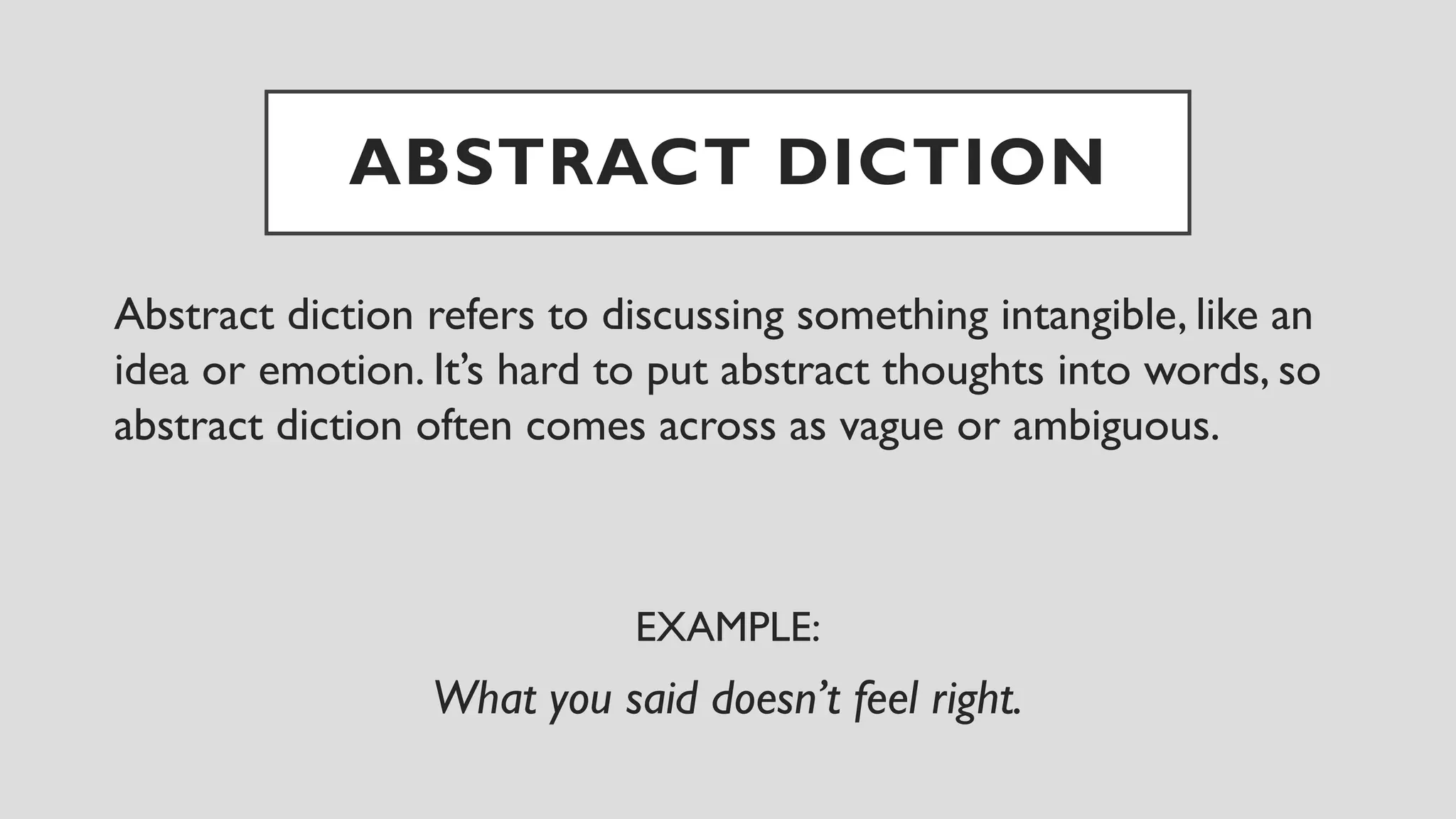
ABSTRACT DICTION
Abstract diction refers to discussing something intangible, like an
idea or emotion. It’s hard to put abstract thoughts into words, so
abstract diction often comes across as vague or ambiguous.
EXAMPLE:
What you said doesn’t feel right.
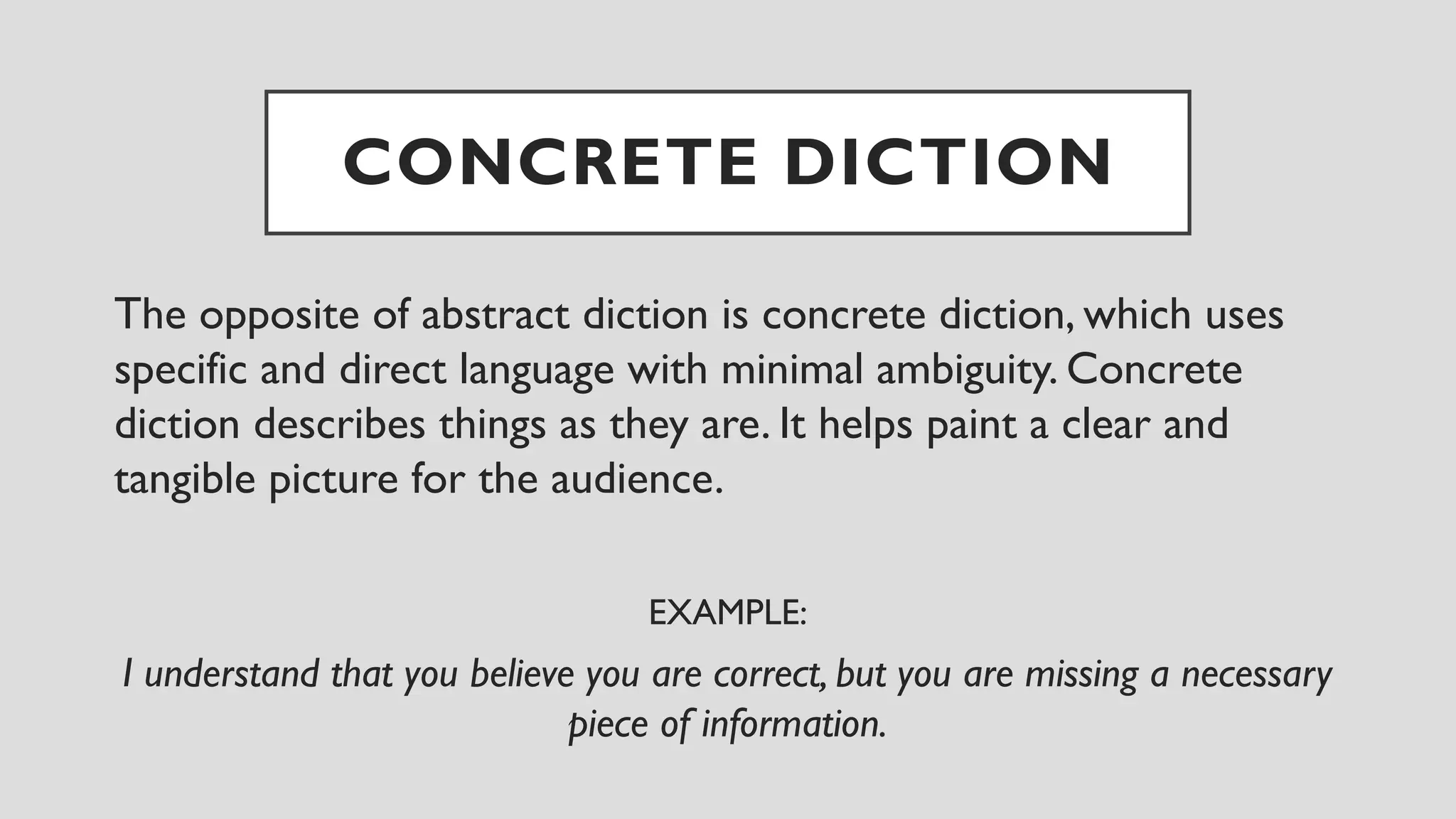
CONCRETE DICTION
The opposite of abstract diction is concrete diction, which uses
specific and direct language with minimal ambiguity. Concrete
diction describes things as they are. It helps paint a clear and
tangible picture for the audience.
EXAMPLE:
I understand that you believe you are correct, but you are missing a necessary
piece of information.
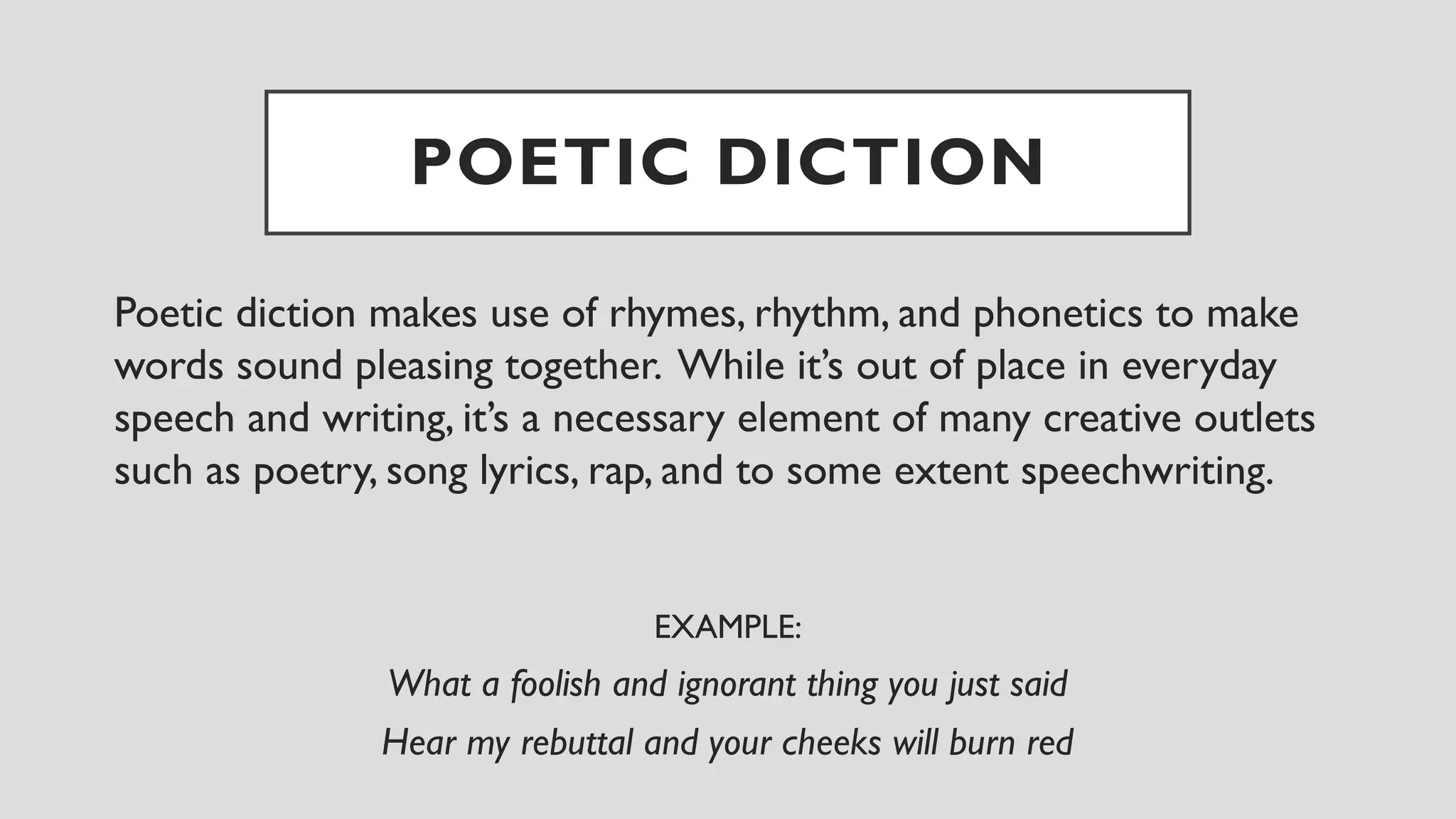
POETIC DICTION
Poetic diction makes use of rhymes, rhythm, and phonetics to make
words sound pleasing together. While it’s out of place in everyday
speech and writing, it’s a necessary element of many creative outlets
such as poetry, song lyrics, rap, and to some extent speechwriting.
EXAMPLE:
What a foolish and ignorant thing you just said
Hear my rebuttal and your cheeks will burn red
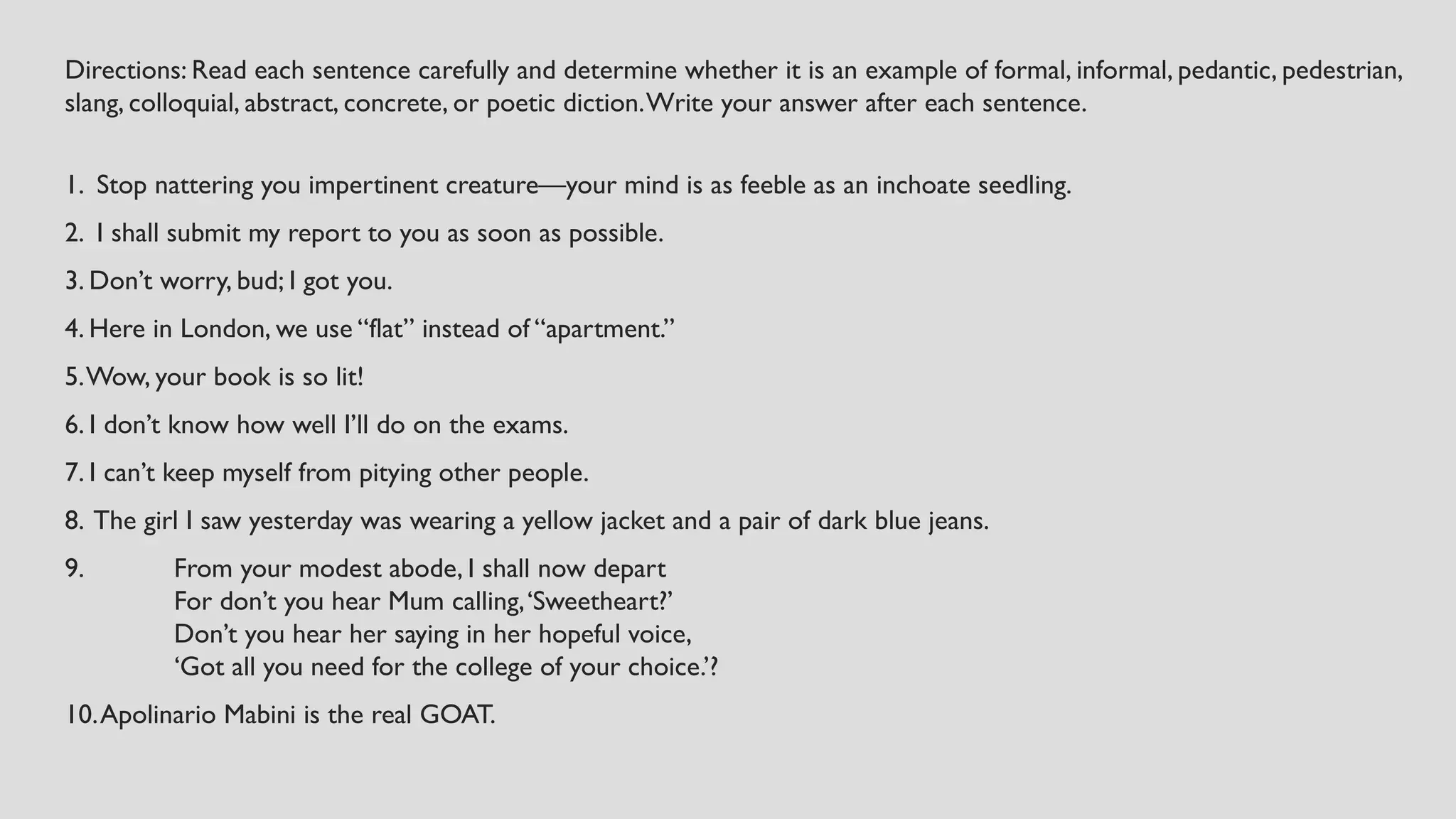
Directions: Read each sentence carefully and determine whether it is an example of formal, informal, pedantic, pedestrian,
slang, colloquial, abstract, concrete, or poetic diction.Write your answer after each sentence.
1. Stop nattering you impertinent creature—your mind is as feeble as an inchoate seedling.
2. I shall submit my report to you as soon as possible.
3. Don’t worry, bud; I got you.
4. Here in London, we use “flat” instead of “apartment.”
5.Wow, your book is so lit!
6. I don’t know how well I’ll do on the exams.
7. I can’t keep myself from pitying other people.
8. The girl I saw yesterday was wearing a yellow jacket and a pair of dark blue jeans.
9. From your modest abode, I shall now depart
For don’t you hear Mum calling,‘Sweetheart?’
Don’t you hear her saying in her hopeful voice,
‘Got all you need for the college of your choice.’?
10.Apolinario Mabini is the real GOAT.

4.1-DICTION.pptx For (Grade 12 students)

  • 1.
    DICTION Prepared by: Ann MarielleN. Fuentes WilliT. Florete Hannah Grace Morales
  • 2.
    WHO SAID THIS? •AFORMAL PERSON •A CASUAL PERSON •A POETIC PERSON
  • 3.
    •What helped youdetermine the speaker of each line? •Why do you think learning about diction is important?
  • 4.
  • 5.
  • 6.
    FORMAL DICTION Formal dictionuses the proper definitions of words in a mostly serious tone.This is the style of workplaces, schools, and other formal environments. EXAMPLE: Respectfully, I must disagree.
  • 7.
    INFORMAL DICTION Informal dictionis the opposite of formal diction; it involves the playful use of words, including jokes and wordplay. Informal diction is the way you talk to the people closest to you. EXAMPLE: No way, that’s not true at all.
  • 8.
    PEDANTIC DICTION Pedantic dictionuses an excessive amount of academic or “big” words, as if the speaker is trying to prove how smart they are. Pedantic diction comes across as arrogant in real life, but it’s nonetheless useful as a writing tool. EXAMPLE: In examination of your stance, I have identified some critical errors that I will now expound on.
  • 9.
    PEDESTRIAN DICTION Pedestrian dictionis considered the opposite of pedantic; instead of trying to sound smart, it’s trying to sound normal or common. Pedestrian diction, which doesn’t use fancy words or slang, is thought to be how regular people talk. EXAMPLE: I understand what you’re saying, but there’s something very important that you’re missing.
  • 10.
    SLANG DICTION Diction withslang, an extension of informal diction, encompasses words and phrases that only a particular type of person understands. Slang is often divided by generation, such as “sussy,” used by Gen Z, and “nifty,” used by baby boomers. EXAMPLE: You’re so full of it.
  • 11.
    COLLOQUIAL DICTION Similar toslang, colloquial diction refers to specific words or phrases used in particular geographical locations. EXAMPLE: Instead of using the word “coke”, people who live on theWest Coast of US use the word “soda”.
  • 12.
    ABSTRACT DICTION Abstract dictionrefers to discussing something intangible, like an idea or emotion. It’s hard to put abstract thoughts into words, so abstract diction often comes across as vague or ambiguous. EXAMPLE: What you said doesn’t feel right.
  • 13.
    CONCRETE DICTION The oppositeof abstract diction is concrete diction, which uses specific and direct language with minimal ambiguity. Concrete diction describes things as they are. It helps paint a clear and tangible picture for the audience. EXAMPLE: I understand that you believe you are correct, but you are missing a necessary piece of information.
  • 14.
    POETIC DICTION Poetic dictionmakes use of rhymes, rhythm, and phonetics to make words sound pleasing together. While it’s out of place in everyday speech and writing, it’s a necessary element of many creative outlets such as poetry, song lyrics, rap, and to some extent speechwriting. EXAMPLE: What a foolish and ignorant thing you just said Hear my rebuttal and your cheeks will burn red
  • 15.
    Directions: Read eachsentence carefully and determine whether it is an example of formal, informal, pedantic, pedestrian, slang, colloquial, abstract, concrete, or poetic diction.Write your answer after each sentence. 1. Stop nattering you impertinent creature—your mind is as feeble as an inchoate seedling. 2. I shall submit my report to you as soon as possible. 3. Don’t worry, bud; I got you. 4. Here in London, we use “flat” instead of “apartment.” 5.Wow, your book is so lit! 6. I don’t know how well I’ll do on the exams. 7. I can’t keep myself from pitying other people. 8. The girl I saw yesterday was wearing a yellow jacket and a pair of dark blue jeans. 9. From your modest abode, I shall now depart For don’t you hear Mum calling,‘Sweetheart?’ Don’t you hear her saying in her hopeful voice, ‘Got all you need for the college of your choice.’? 10.Apolinario Mabini is the real GOAT.

Editor's Notes

  • #2 1. “I will address that issue right away.” 2. “I’m gonna work out so that I’ll get ripped.” 3. “How do you like to go up in a swing, up in the air so blue? Oh, I do think it the pleasantest thing, ever a child can do! - Next Slide -
  • #3 - One thing that truly helped us determine the speaker of each line was the words that were used. This goes to say that the words we say reveal our tone, attitude, and purpose for speaking - Learning about diction is important because it will help us determine which choice of words is appropriate for a certain situation or setting
  • #4 Diction in creative writing means picking the right words. It's like choosing colors to paint a picture. When you pick the right words, it helps create the right feeling, make characters interesting, and tell stories in a way that's easy to understand and fun to read. So, it's like using your words to make a beautiful and exciting story for people to enjoy.
  • #6 *Ask the students to give examples
  • #7 *Ask the students to give examples
  • #8 *Ask the students to give examples
  • #9 Pedestrian - a person who lacks vitality, imagination, or distinction. *Ask the students to give examples
  • #10 Example: Her eyebrows are on fleek *Ask the students to give examples
  • #11 Philippines – Salvage (to kill) The rest of the world (lol) – Salvage (to save) *Ask the students to give examples
  • #12 Example: Love is a powerful force that can overcome any obstacle. *Ask the students to give examples
  • #13 The roaring waves crashed against the rocky shoreline, sending salty spray into the air. – “roaring waves” provide specific and sensory details, making the descriptions more vivid and easier for readers to picture in their minds. *Ask the students to give examples
  • #14 Beneath the moon's soft, silver shroud, In whispers of the night, My heart's refrain, unspoken loud, A yearning, pure and bright. - this means missing someone *Ask the students to give examples