JO I. BARTOLATA
BUCAL
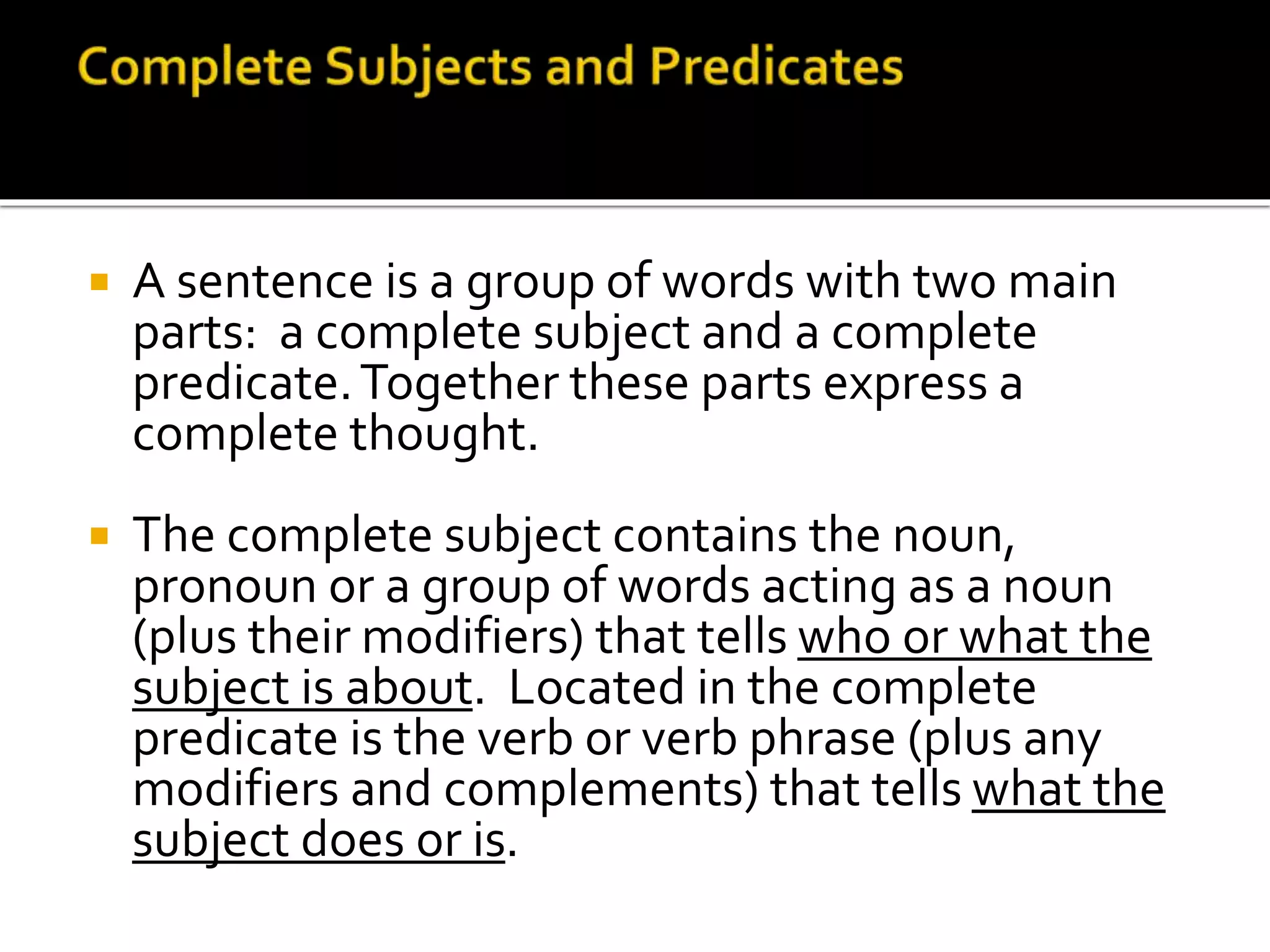
 A sentence is a group of words with two main
parts: a complete subject and a complete
predicate.Together these parts express a
complete thought.
 The complete subject contains the noun,
pronoun or a group of words acting as a noun
(plus their modifiers) that tells who or what the
subject is about. Located in the complete
predicate is the verb or verb phrase (plus any
modifiers and complements) that tells what the
subject does or is.
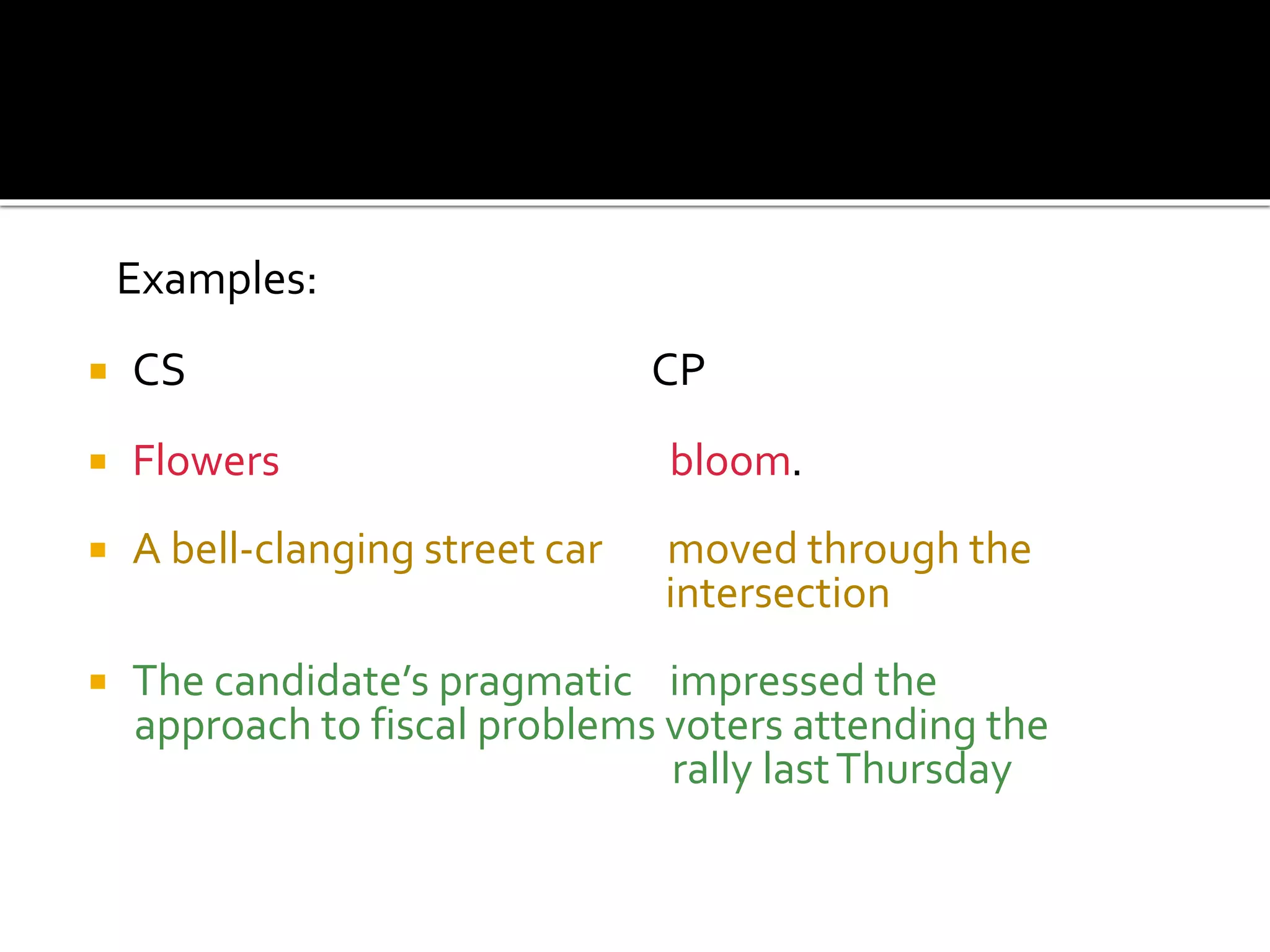
Examples:
 CS CP
 Flowers bloom.
 A bell-clanging street car moved through the
intersection
 The candidate’s pragmatic impressed the
approach to fiscal problems voters attending the
rally lastThursday
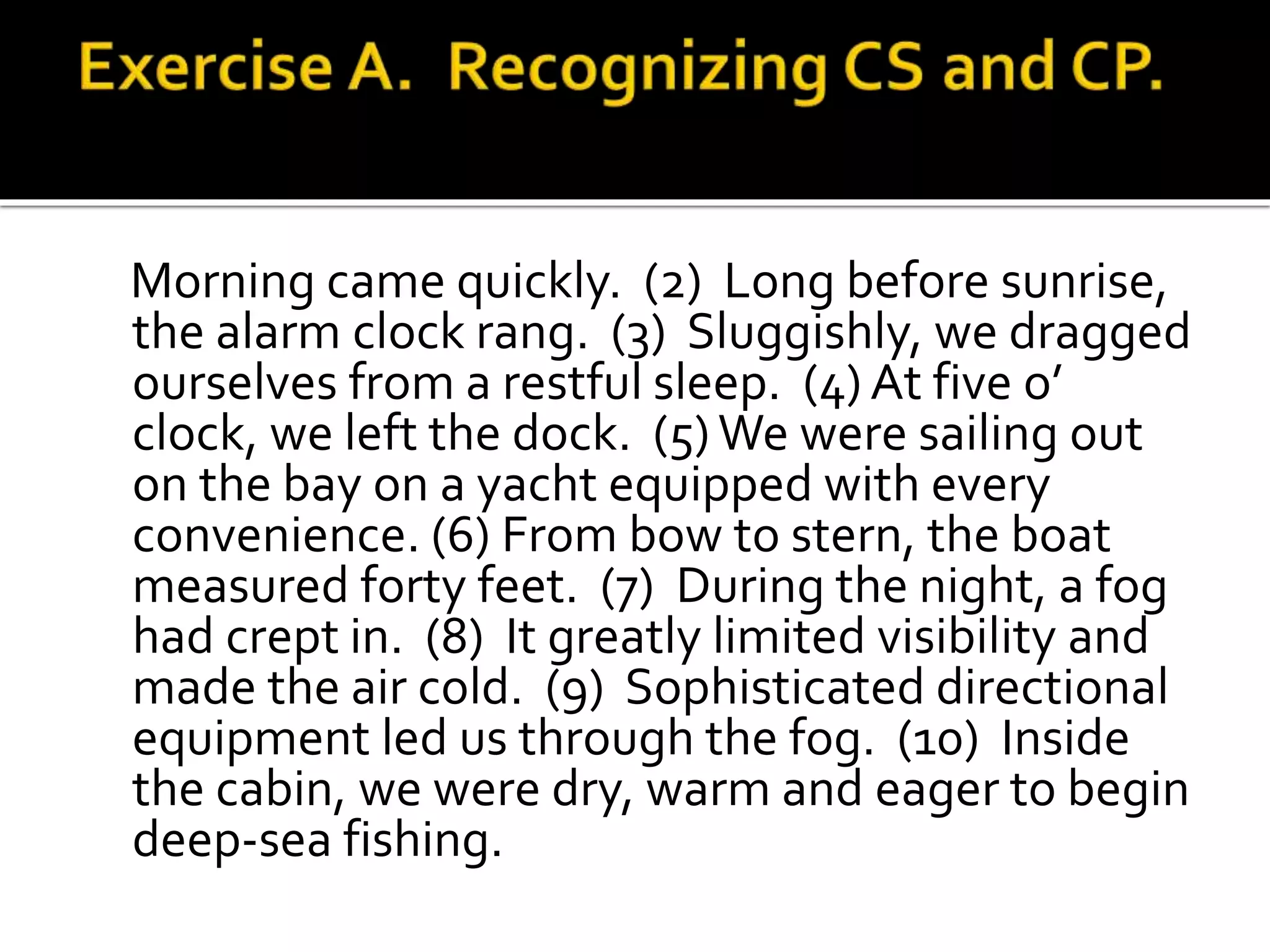
Morning came quickly. (2) Long before sunrise,
the alarm clock rang. (3) Sluggishly, we dragged
ourselves from a restful sleep. (4) At five o’
clock, we left the dock. (5) We were sailing out
on the bay on a yacht equipped with every
convenience. (6) From bow to stern, the boat
measured forty feet. (7) During the night, a fog
had crept in. (8) It greatly limited visibility and
made the air cold. (9) Sophisticated directional
equipment led us through the fog. (10) Inside
the cabin, we were dry, warm and eager to begin
deep-sea fishing.
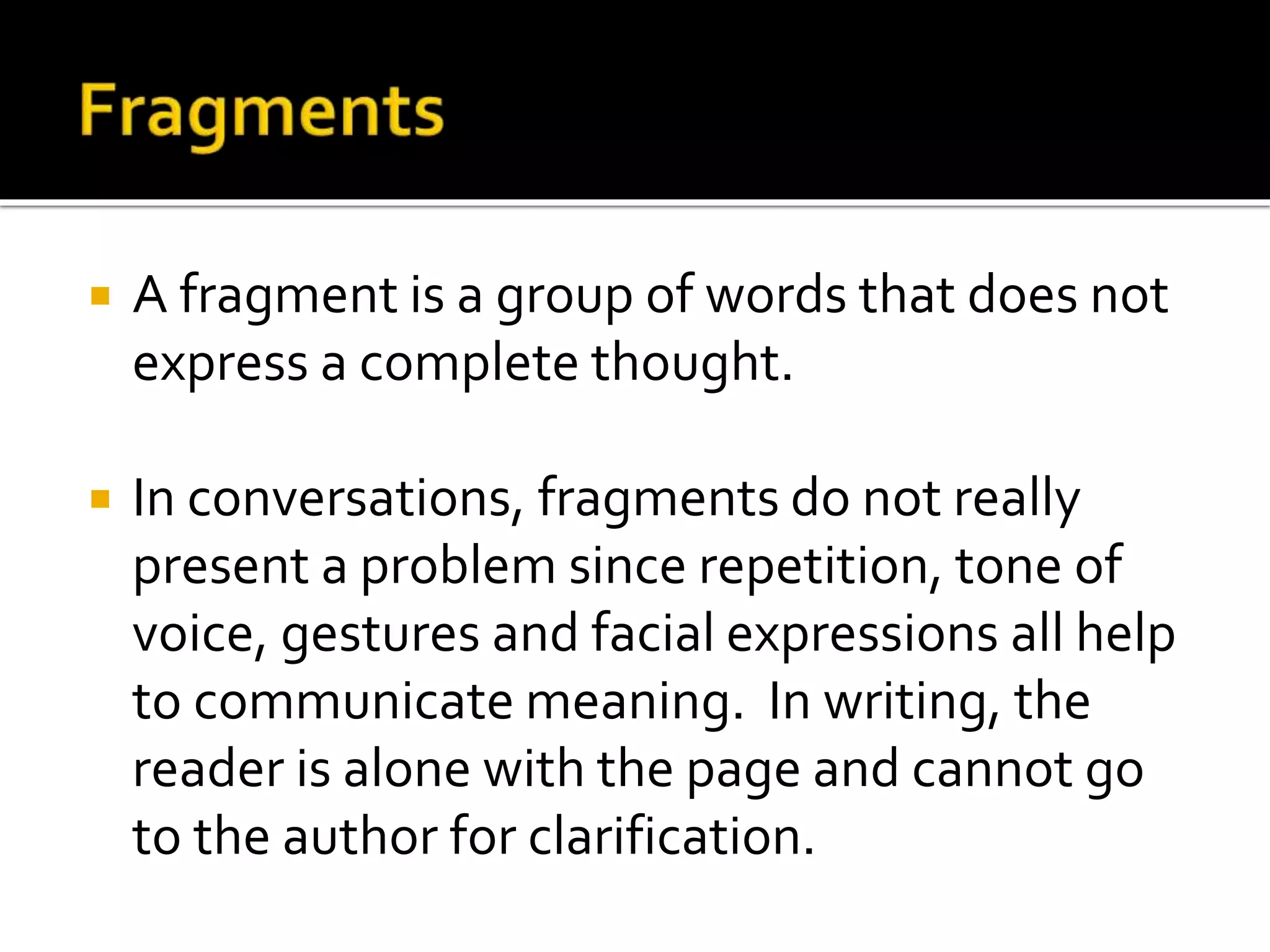
 A fragment is a group of words that does not
express a complete thought.
 In conversations, fragments do not really
present a problem since repetition, tone of
voice, gestures and facial expressions all help
to communicate meaning. In writing, the
reader is alone with the page and cannot go
to the author for clarification.
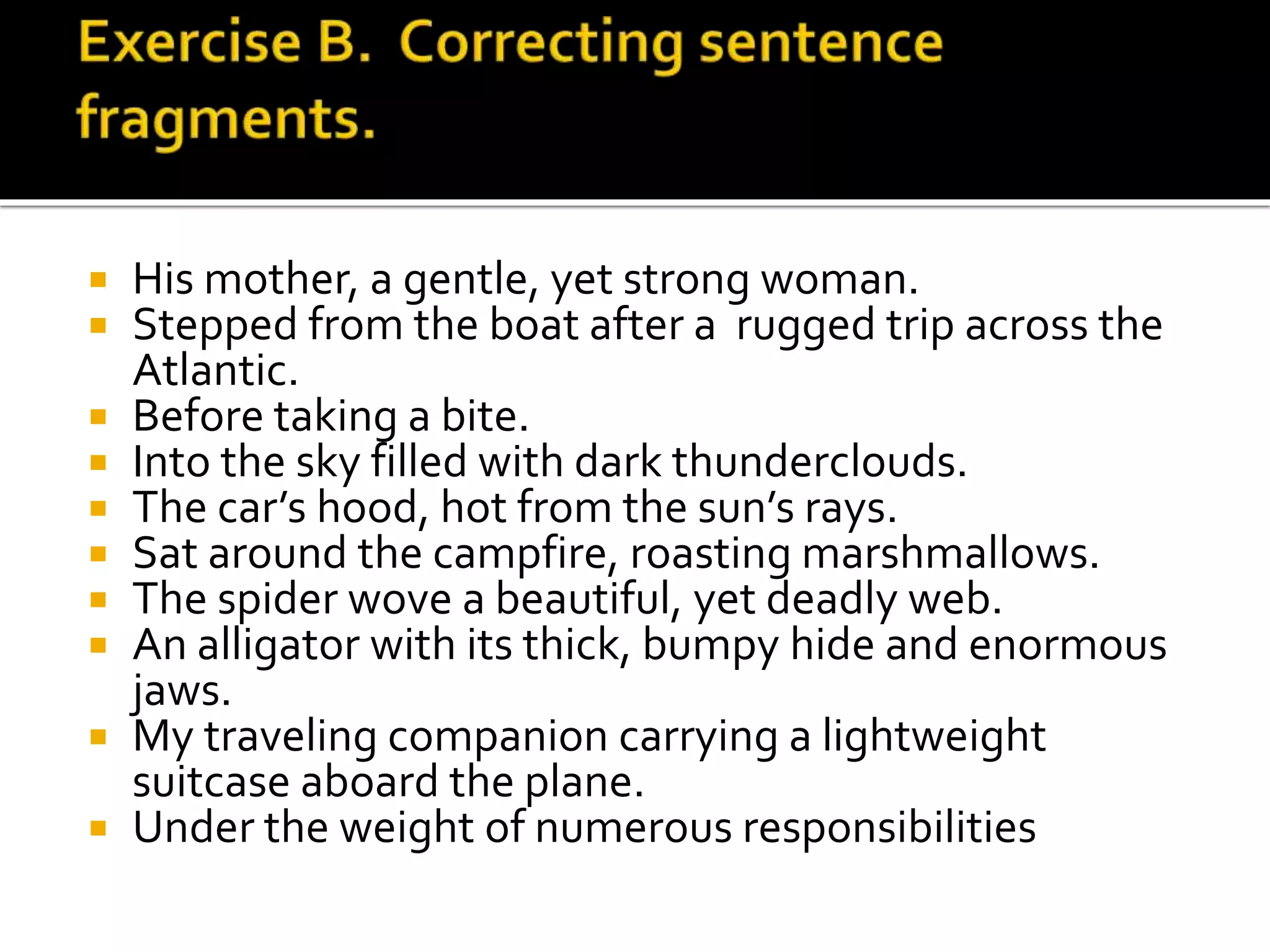
 His mother, a gentle, yet strong woman.
 Stepped from the boat after a rugged trip across the
Atlantic.
 Before taking a bite.
 Into the sky filled with dark thunderclouds.
 The car’s hood, hot from the sun’s rays.
 Sat around the campfire, roasting marshmallows.
 The spider wove a beautiful, yet deadly web.
 An alligator with its thick, bumpy hide and enormous
jaws.
 My traveling companion carrying a lightweight
suitcase aboard the plane.
 Under the weight of numerous responsibilities
 The simple subject is the essential noun,
pronoun or group of words acting as a noun
that cannot be left out of the complete
subject. The simple predicate is the essential
verb or verb phrase that cannot be left out of
the complete predicate
 What is the action verb or linking verb (SP)?
Then ask who or what before it (SS).
 Some sentences are complete with just a
subject and a verb. The meaning of many
sentences however depends on additional
words to finish the idea. To complete the
meaning, a writer must add complements.
 A complement is a word or group of words
that completes the meaning of the predicate
of a sentence.
1. Direct Object (DO) – a noun or pronoun or a
group of words acting as a noun that
receives the action of a transitive verb. (Ask
whom or what after the action verb)
The student verbalized his thoughts.
The manager reprimanded his subordinate.
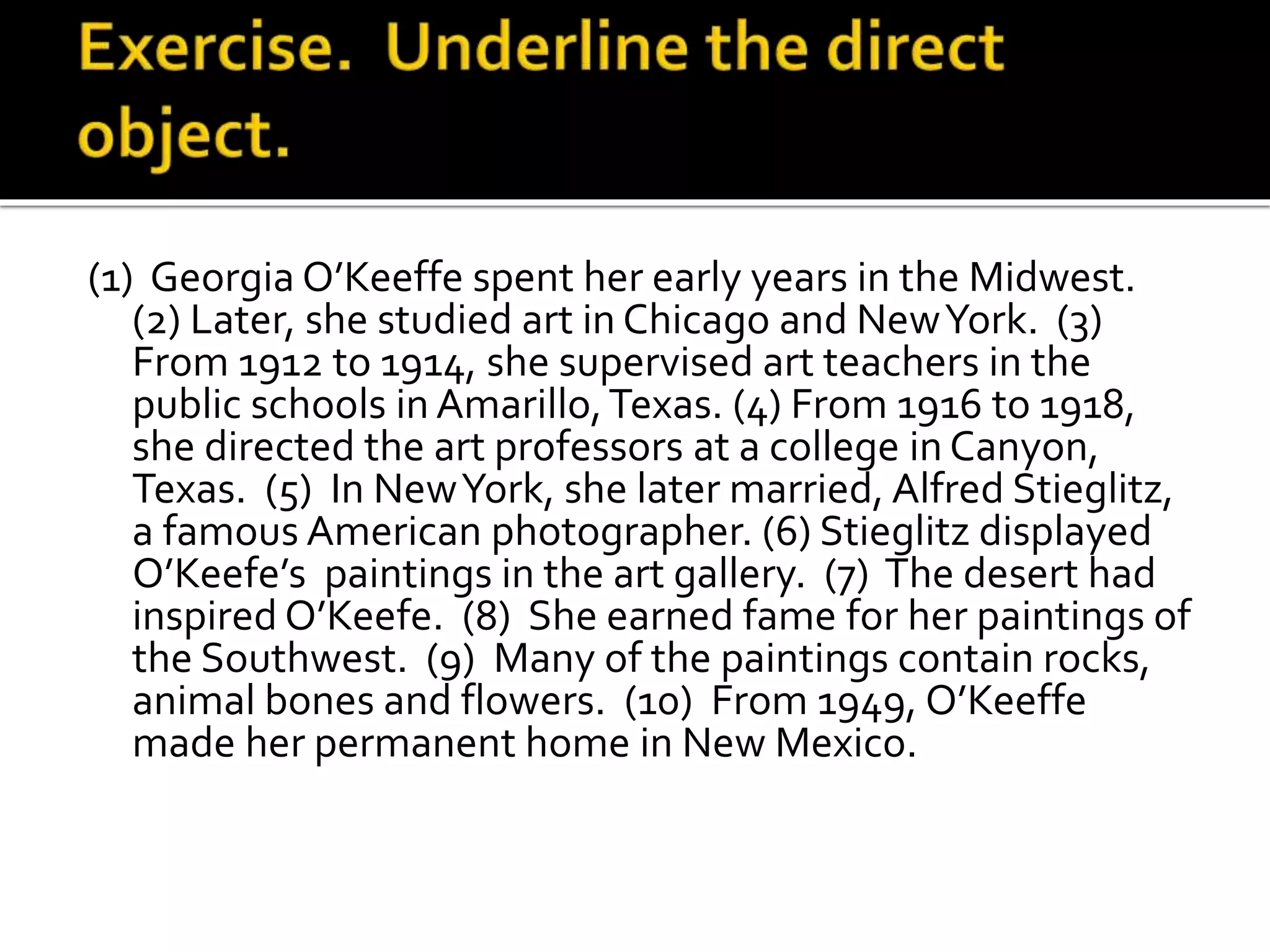
(1) Georgia O’Keeffe spent her early years in the Midwest.
(2) Later, she studied art in Chicago and NewYork. (3)
From 1912 to 1914, she supervised art teachers in the
public schools in Amarillo,Texas. (4) From 1916 to 1918,
she directed the art professors at a college in Canyon,
Texas. (5) In NewYork, she later married, Alfred Stieglitz,
a famous American photographer. (6) Stieglitz displayed
O’Keefe’s paintings in the art gallery. (7) The desert had
inspired O’Keefe. (8) She earned fame for her paintings of
the Southwest. (9) Many of the paintings contain rocks,
animal bones and flowers. (10) From 1949, O’Keeffe
made her permanent home in New Mexico.
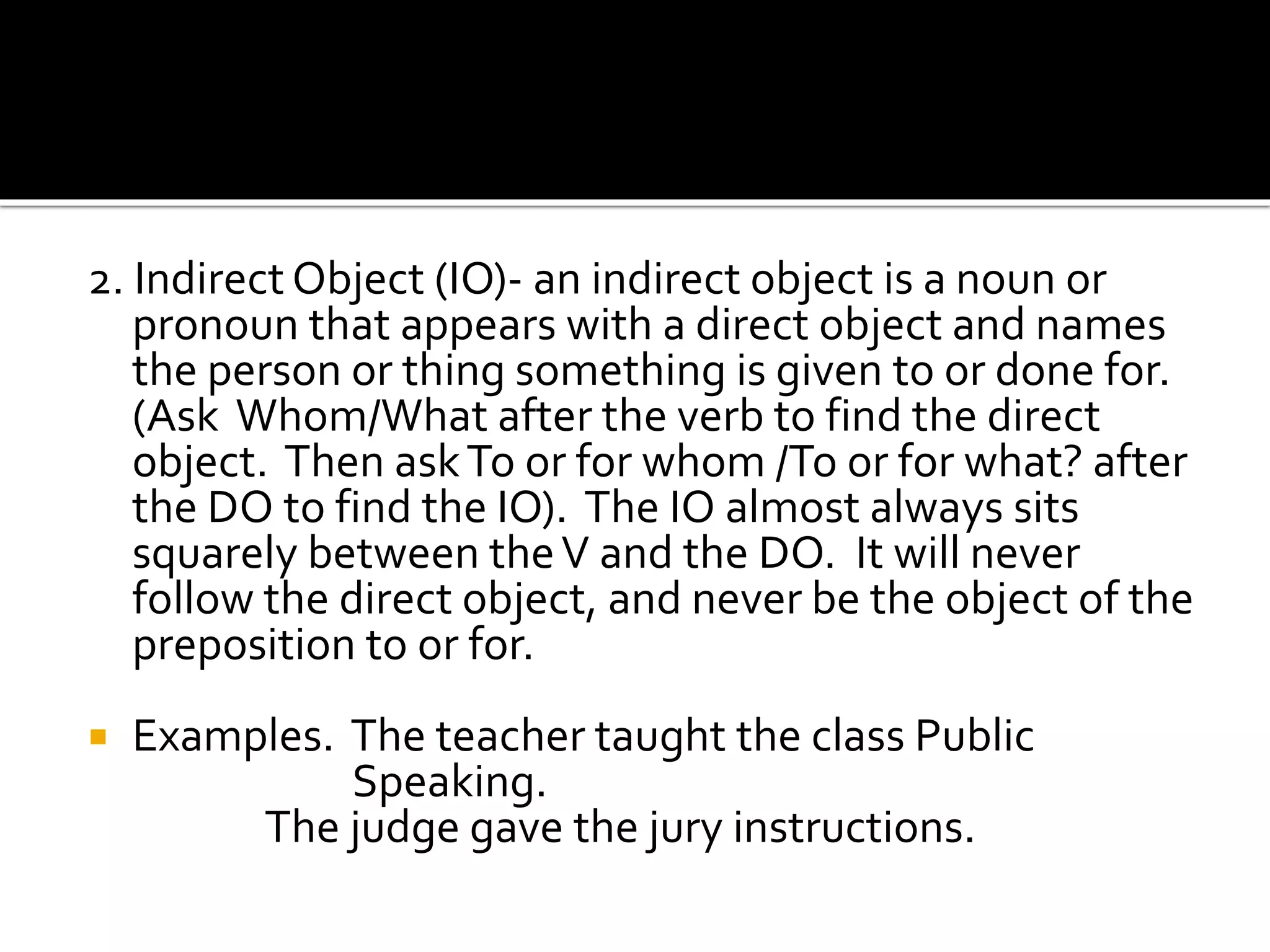
2. Indirect Object (IO)- an indirect object is a noun or
pronoun that appears with a direct object and names
the person or thing something is given to or done for.
(Ask Whom/What after the verb to find the direct
object. Then askTo or for whom /To or for what? after
the DO to find the IO). The IO almost always sits
squarely between theV and the DO. It will never
follow the direct object, and never be the object of the
preposition to or for.
 Examples. The teacher taught the class Public
Speaking.
The judge gave the jury instructions.
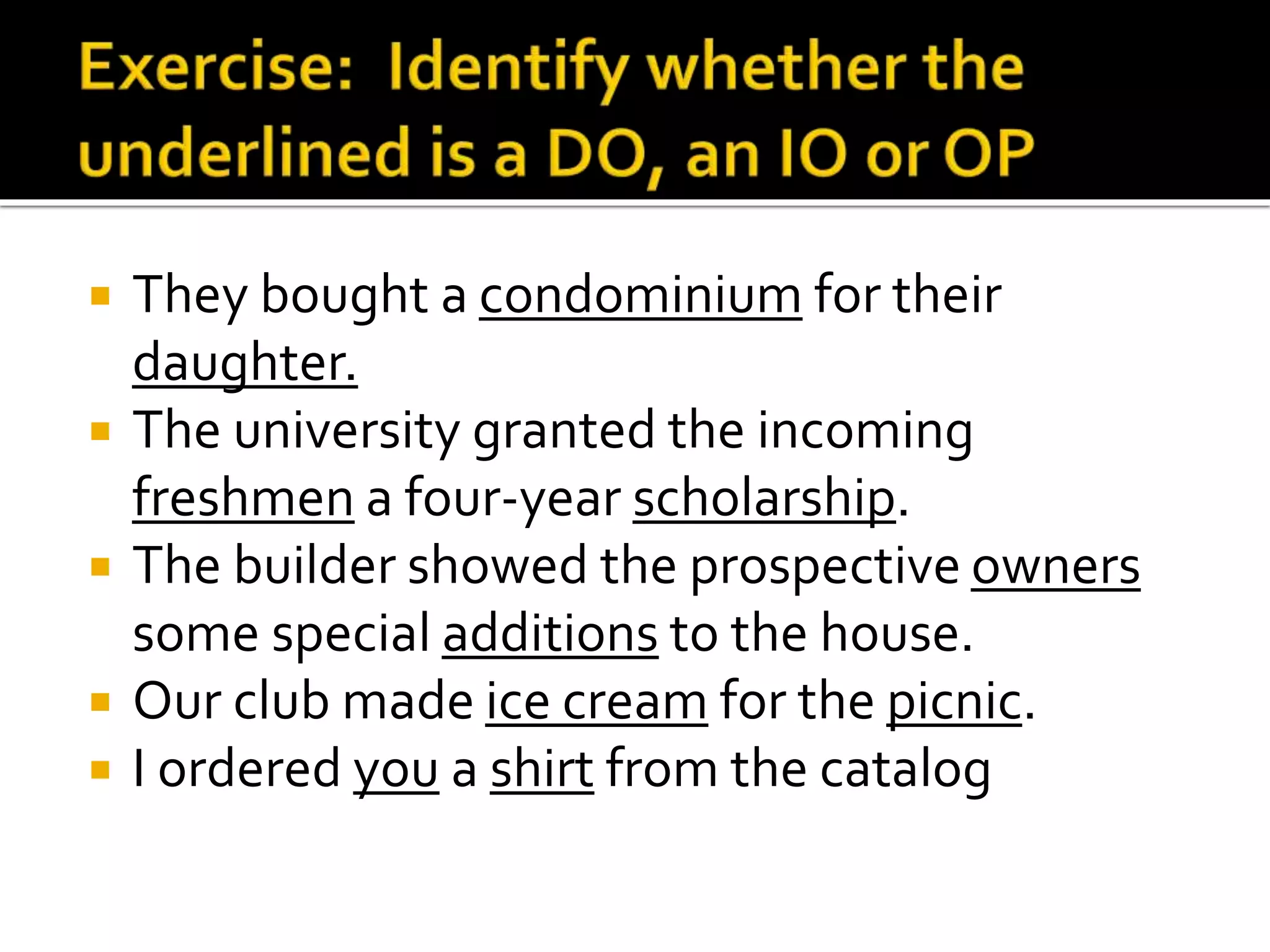
 They bought a condominium for their
daughter.
 The university granted the incoming
freshmen a four-year scholarship.
 The builder showed the prospective owners
some special additions to the house.
 Our club made ice cream for the picnic.
 I ordered you a shirt from the catalog
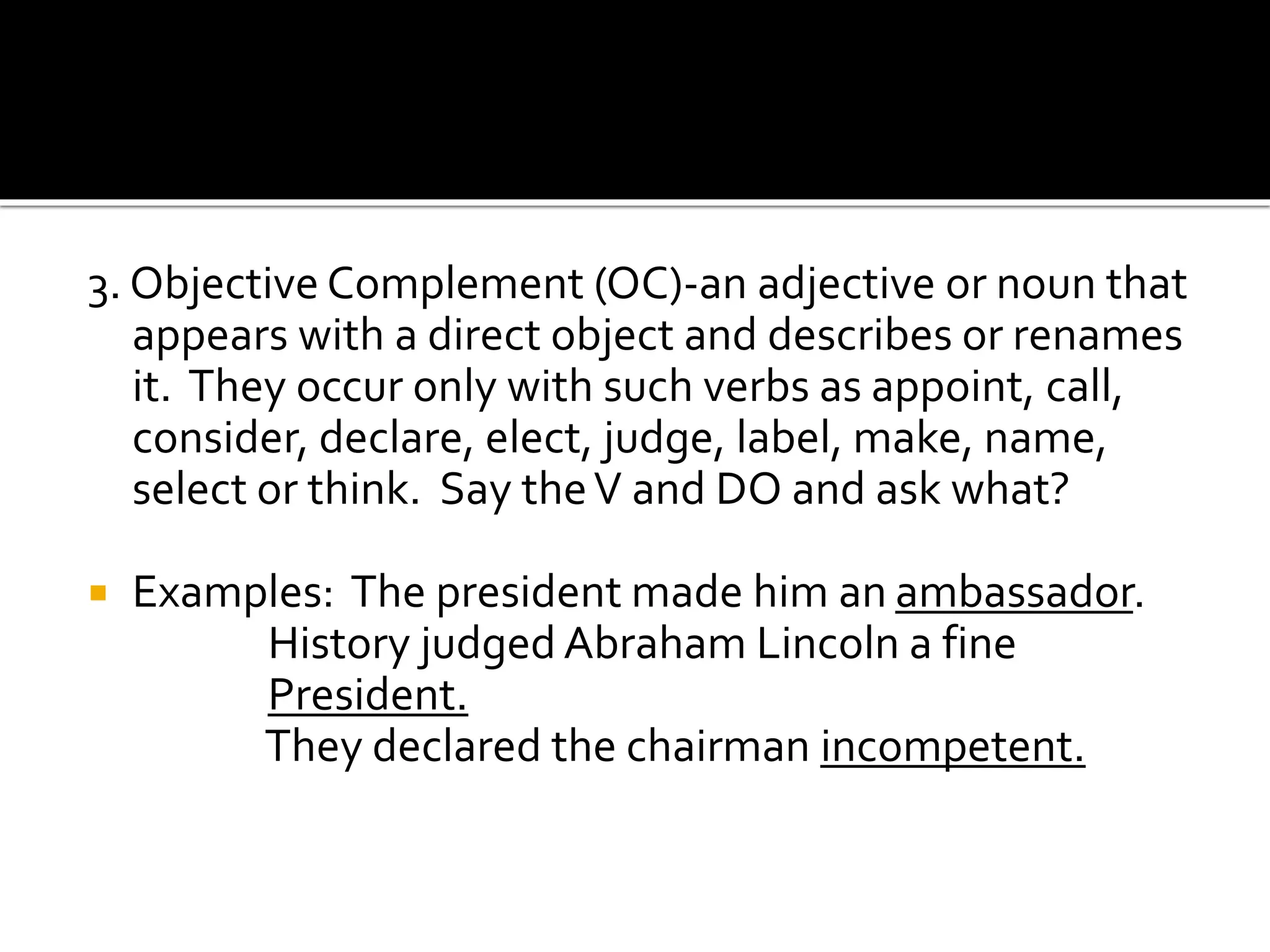
3. Objective Complement (OC)-an adjective or noun that
appears with a direct object and describes or renames
it. They occur only with such verbs as appoint, call,
consider, declare, elect, judge, label, make, name,
select or think. Say theV and DO and ask what?
 Examples: The president made him an ambassador.
History judged Abraham Lincoln a fine
President.
They declared the chairman incompetent.
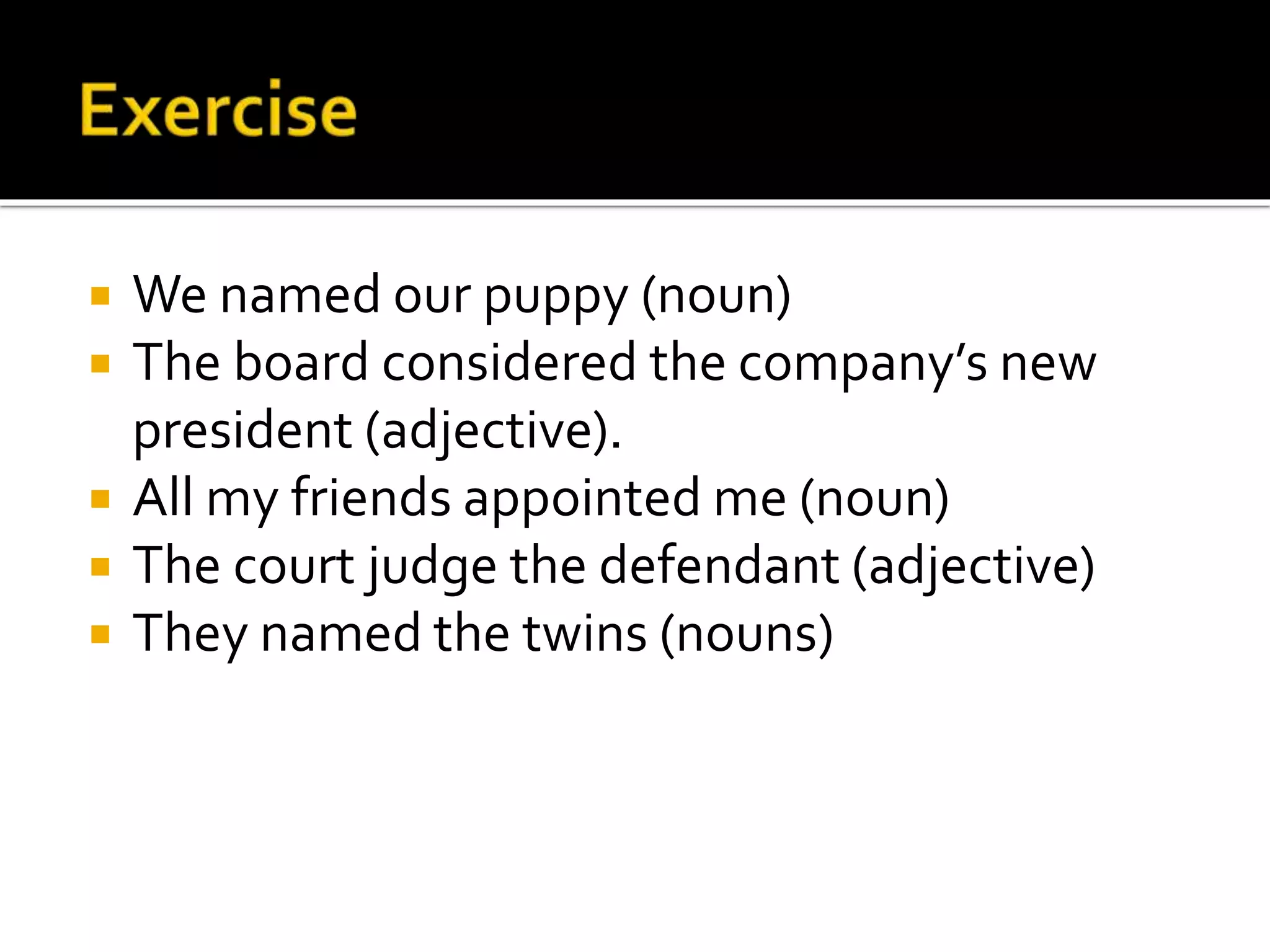
 We named our puppy (noun)
 The board considered the company’s new
president (adjective).
 All my friends appointed me (noun)
 The court judge the defendant (adjective)
 They named the twins (nouns)
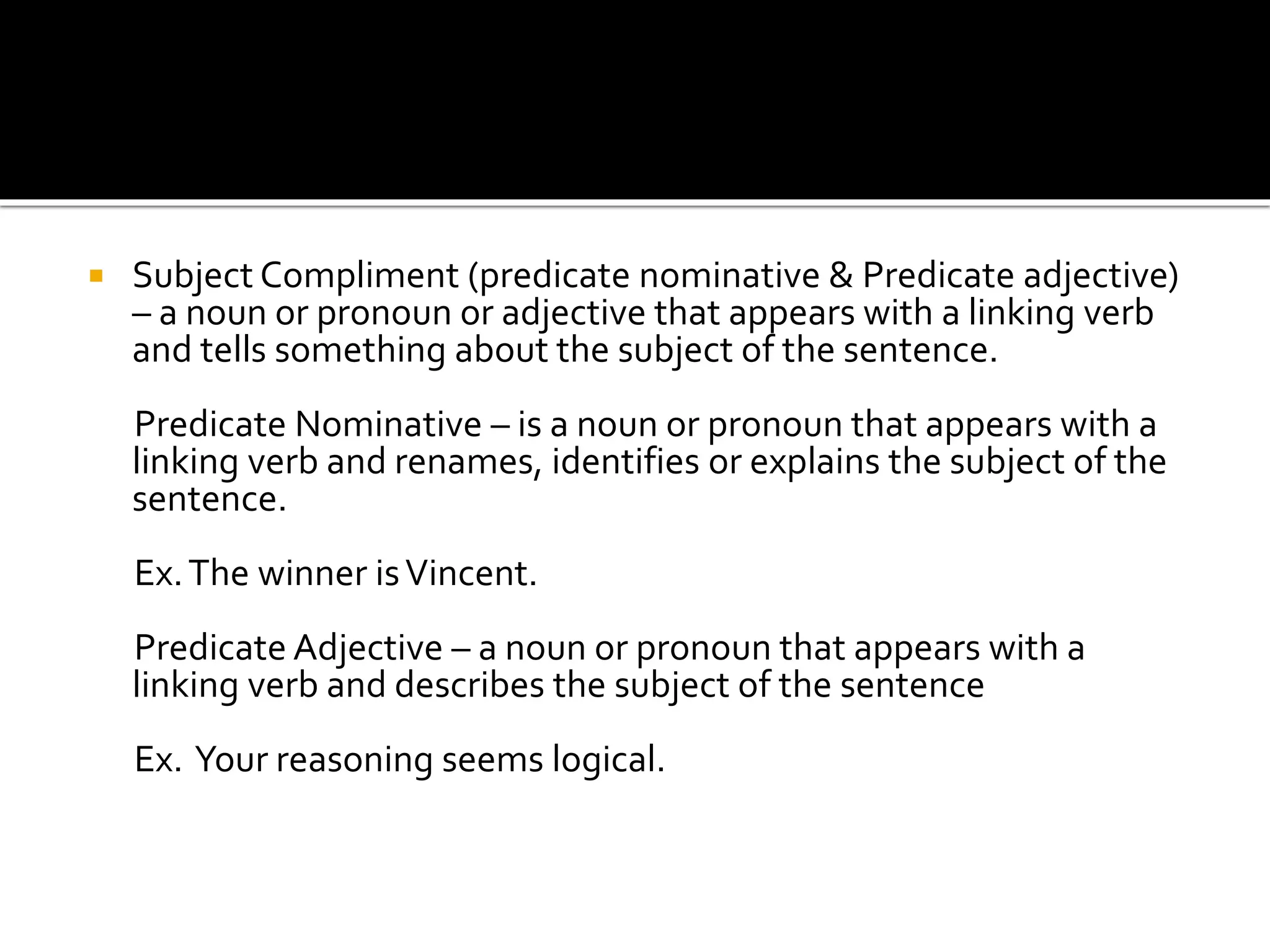
 Subject Compliment (predicate nominative & Predicate adjective)
– a noun or pronoun or adjective that appears with a linking verb
and tells something about the subject of the sentence.
Predicate Nominative – is a noun or pronoun that appears with a
linking verb and renames, identifies or explains the subject of the
sentence.
Ex.The winner isVincent.
Predicate Adjective – a noun or pronoun that appears with a
linking verb and describes the subject of the sentence
Ex. Your reasoning seems logical.
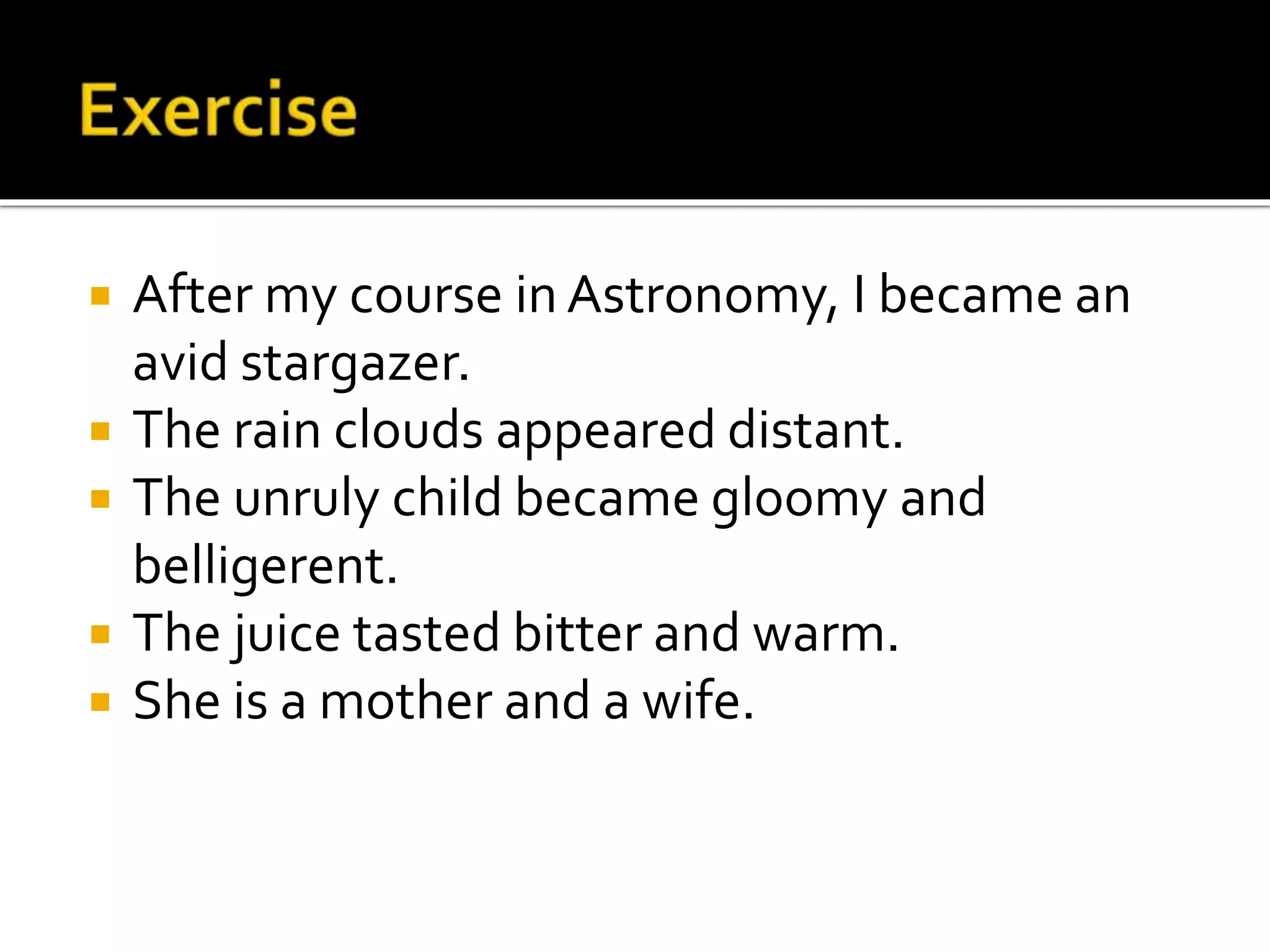
 After my course in Astronomy, I became an
avid stargazer.
 The rain clouds appeared distant.
 The unruly child became gloomy and
belligerent.
 The juice tasted bitter and warm.
 She is a mother and a wife.

Basic Sentence Parts

  • 1.
  • 2.
     A sentenceis a group of words with two main parts: a complete subject and a complete predicate.Together these parts express a complete thought.  The complete subject contains the noun, pronoun or a group of words acting as a noun (plus their modifiers) that tells who or what the subject is about. Located in the complete predicate is the verb or verb phrase (plus any modifiers and complements) that tells what the subject does or is.
  • 3.
    Examples:  CS CP Flowers bloom.  A bell-clanging street car moved through the intersection  The candidate’s pragmatic impressed the approach to fiscal problems voters attending the rally lastThursday
  • 4.
    Morning came quickly.(2) Long before sunrise, the alarm clock rang. (3) Sluggishly, we dragged ourselves from a restful sleep. (4) At five o’ clock, we left the dock. (5) We were sailing out on the bay on a yacht equipped with every convenience. (6) From bow to stern, the boat measured forty feet. (7) During the night, a fog had crept in. (8) It greatly limited visibility and made the air cold. (9) Sophisticated directional equipment led us through the fog. (10) Inside the cabin, we were dry, warm and eager to begin deep-sea fishing.
  • 5.
     A fragmentis a group of words that does not express a complete thought.  In conversations, fragments do not really present a problem since repetition, tone of voice, gestures and facial expressions all help to communicate meaning. In writing, the reader is alone with the page and cannot go to the author for clarification.
  • 6.
     His mother,a gentle, yet strong woman.  Stepped from the boat after a rugged trip across the Atlantic.  Before taking a bite.  Into the sky filled with dark thunderclouds.  The car’s hood, hot from the sun’s rays.  Sat around the campfire, roasting marshmallows.  The spider wove a beautiful, yet deadly web.  An alligator with its thick, bumpy hide and enormous jaws.  My traveling companion carrying a lightweight suitcase aboard the plane.  Under the weight of numerous responsibilities
  • 7.
     The simplesubject is the essential noun, pronoun or group of words acting as a noun that cannot be left out of the complete subject. The simple predicate is the essential verb or verb phrase that cannot be left out of the complete predicate  What is the action verb or linking verb (SP)? Then ask who or what before it (SS).
  • 8.
     Some sentencesare complete with just a subject and a verb. The meaning of many sentences however depends on additional words to finish the idea. To complete the meaning, a writer must add complements.  A complement is a word or group of words that completes the meaning of the predicate of a sentence.
  • 9.
    1. Direct Object(DO) – a noun or pronoun or a group of words acting as a noun that receives the action of a transitive verb. (Ask whom or what after the action verb) The student verbalized his thoughts. The manager reprimanded his subordinate.
  • 10.
    (1) Georgia O’Keeffespent her early years in the Midwest. (2) Later, she studied art in Chicago and NewYork. (3) From 1912 to 1914, she supervised art teachers in the public schools in Amarillo,Texas. (4) From 1916 to 1918, she directed the art professors at a college in Canyon, Texas. (5) In NewYork, she later married, Alfred Stieglitz, a famous American photographer. (6) Stieglitz displayed O’Keefe’s paintings in the art gallery. (7) The desert had inspired O’Keefe. (8) She earned fame for her paintings of the Southwest. (9) Many of the paintings contain rocks, animal bones and flowers. (10) From 1949, O’Keeffe made her permanent home in New Mexico.
  • 11.
    2. Indirect Object(IO)- an indirect object is a noun or pronoun that appears with a direct object and names the person or thing something is given to or done for. (Ask Whom/What after the verb to find the direct object. Then askTo or for whom /To or for what? after the DO to find the IO). The IO almost always sits squarely between theV and the DO. It will never follow the direct object, and never be the object of the preposition to or for.  Examples. The teacher taught the class Public Speaking. The judge gave the jury instructions.
  • 12.
     They boughta condominium for their daughter.  The university granted the incoming freshmen a four-year scholarship.  The builder showed the prospective owners some special additions to the house.  Our club made ice cream for the picnic.  I ordered you a shirt from the catalog
  • 13.
    3. Objective Complement(OC)-an adjective or noun that appears with a direct object and describes or renames it. They occur only with such verbs as appoint, call, consider, declare, elect, judge, label, make, name, select or think. Say theV and DO and ask what?  Examples: The president made him an ambassador. History judged Abraham Lincoln a fine President. They declared the chairman incompetent.
  • 14.
     We namedour puppy (noun)  The board considered the company’s new president (adjective).  All my friends appointed me (noun)  The court judge the defendant (adjective)  They named the twins (nouns)
  • 15.
     Subject Compliment(predicate nominative & Predicate adjective) – a noun or pronoun or adjective that appears with a linking verb and tells something about the subject of the sentence. Predicate Nominative – is a noun or pronoun that appears with a linking verb and renames, identifies or explains the subject of the sentence. Ex.The winner isVincent. Predicate Adjective – a noun or pronoun that appears with a linking verb and describes the subject of the sentence Ex. Your reasoning seems logical.
  • 16.
     After mycourse in Astronomy, I became an avid stargazer.  The rain clouds appeared distant.  The unruly child became gloomy and belligerent.  The juice tasted bitter and warm.  She is a mother and a wife.