Principles of Information Security,
Fifth Edition
Chapter 6
Security Technology: Firewalls and
VPNs
If you think technology can solve your security problems,
then you don’t understand the problems and you don’t
understand the technology.
BRUCE SCHNEIER, AMERICAN CRYPTOGRAPHER,
COMPUTER SECURITY SPECIALIST, AND WRITER
Lesson 1 – Technical
Controls
Learning Objectives
• Upon completion of this material, you should be
able to:
– Discuss the important role of access control in
computer-based information systems, and identify
and discuss widely used authentication factors
– Describe firewall technology and the various
approaches to firewall implementation
– Identify the various approaches to control remote
and dial-up access by authenticating and authorizing
users
Principles of Information Security, Fifth Edition 2
Learning Objectives (cont’d)
– Discuss content filtering technology
– Describe virtual private networks and discuss the
technology that enables them
Principles of Information Security, Fifth Edition 3
Introduction
• Technical controls are essential in enforcing policy
for many IT functions not under direct human
control.
• When properly implemented, technical control
solutions improve an organization’s ability to
balance the objectives of making information
readily available and preserving information’s
confidentiality and integrity.
Principles of Information Security, Fifth Edition 4
Access Control
• Access control: method by which systems
determine whether and how to admit a user into a
trusted area of the organization
• Mandatory access controls (MACs): use data
classification schemes
• Discretionary access controls (DACs): allow users
to control and possibly provide access to
information/resources at their disposal
• Nondiscretionary controls: strictly enforced version
of MACs that are managed by a central authority
Principles of Information Security, Fifth Edition 5
Principles of Information Security, Fifth Edition 6
Identification
• Identification: mechanism whereby unverified
entities seeking access to a resource (supplicants)
provide a label by which they are known to the
system
• Identifiers can be composite identifiers,
concatenating elements—department codes,
random numbers, or special characters—to make
them unique.
• Some organizations generate random numbers.
Principles of Information Security, Fifth Edition 7
Authentication
• Authentication: the process of validating a
supplicant’s purported identity
• Authentication factors
– Something a supplicant knows
• Password: a private word or a combination of
characters that only the user should know
• Passphrase: a series of characters, typically longer
than a password, from which a virtual password is
derived
Principles of Information Security, Fifth Edition 8
Authentication (cont’d)
• Authentication factors (cont’d)
– Something a supplicant has
• Dumb card: ID or ATM card with magnetic stripe
• Smart card: contains a computer chip that can verify
and validate information
• Synchronous tokens
• Asynchronous tokens
– Something a supplicant is
• Relies upon individual characteristics
• Strong authentication
Principles of Information Security, Fifth Edition 9
Authorization
• Authorization: the matching of an authenticated
entity to a list of information assets and
corresponding access levels
• Authorization can be handled in one of three ways:
– Authorization for each authenticated user
– Authorization for members of a group
– Authorization across multiple systems
• Authorization tickets
Principles of Information Security, Fifth Edition 10
Accountability
• Accountability (auditability): ensures that all actions
on a system—authorized or unauthorized—can be
attributed to an authenticated identity
• Most often accomplished by means of system logs
and database journals, and the auditing of these
records
• Systems logs record specific information.
• Logs have many uses.
Principles of Information Security, Fifth Edition 11
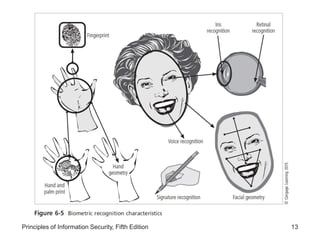
Biometrics
• Approach based on the use of measurable human
characteristics/traits to authenticate identity
• Only fingerprints, retina of eye, and iris of eye are
considered truly unique.
• Evaluated on false reject rate, false accept rate,
and crossover error rate
• Highly reliable/effective biometric systems are often
considered intrusive by users.
Principles of Information Security, Fifth Edition 12
Principles of Information Security, Fifth Edition 13
Principles of Information Security, Fifth Edition 14
Access Control Architecture Models
• Illustrate access control implementations and can
help organizations quickly make improvements
through adaptation
• Trusted computing base (TCB)
– Part of TCSEC Rainbow Series
– Used to enforce security policy (rules of system
configuration)
– Biggest challenges include covert channels
• Storage channels
• Timing channels
Principles of Information Security, Fifth Edition 15
Access Control Architecture Models
(cont’d)
• ITSEC: an international set of criteria for evaluating
computer systems
– Compares Targets of Evaluation (ToE) to detailed security
function specifications
• The Common Criteria
– Considered successor to both TCSEC and ITSEC
• Bell-LaPadula Confidentiality Model
– Model of an automated system able to manipulate its state or
status over time
• Biba Integrity Model
– Based on “no write up, no read down” principle
Principles of Information Security, Fifth Edition 16
Access Control Architecture Models
(cont’d)
• Clark-Wilson Integrity Model
– No changes by unauthorized subjects
– No unauthorized changes by authorized subjects
– Maintenance of internal and external consistency
• Graham-Denning Access Control Model
– Composed of set of objects, set of subjects, and set of rights
• Harrison-Ruzzo-Ullman Model
– Defines method to allow changes to access rights and
addition/removal of subjects/objects
• Brewer-Nash Model (Chinese Wall)
– Designed to prevent conflict of interest between two
parties
Principles of Information Security, Fifth Edition 17
Firewalls
• Prevent specific types of information from moving
between an untrusted network (the Internet) and a
trusted network (organization’s internal network)
• May be:
– Separate computer system
– Software service running on existing router or server
– Separate network containing supporting devices
Principles of Information Security, Fifth Edition 18
Firewalls Processing Modes
• Five processing modes by which firewalls can be
categorized:
– Packet filtering
– Application gateways
– Circuit gateways
– MAC layer firewalls
– Hybrids
19
Principles of Information Security, Fifth Edition
Packet-Filtering Firewalls
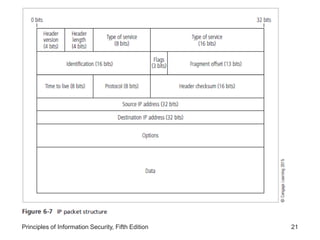
• Packet-filtering firewalls examine the header
information of data packets.
• Most often based on the combination of:
– IP source and destination address
– Direction (inbound or outbound)
– Transmission Control Protocol (TCP) or User
Datagram Protocol (UDP) source and destination
port requests
• Simple firewall models enforce rules designed to
prohibit packets with certain addresses or partial
addresses from passing through device.
20
Principles of Information Security, Fifth Edition
21
Principles of Information Security, Fifth Edition
22
Principles of Information Security, Fifth Edition
23
Principles of Information Security, Fifth Edition
24
Principles of Information Security, Fifth Edition
Packet-Filtering Firewalls (cont’d)
• Three subsets of packet-filtering firewalls:
– Static filtering: requires that filtering rules be
developed and installed within the firewall
– Dynamic filtering: allows firewall to react to emergent
event and update or create rules to deal with event
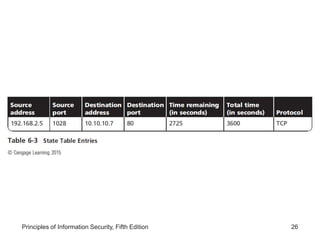
– Stateful inspection: firewalls that keep track of each
network connection between internal and external
systems using a state table
25
Principles of Information Security, Fifth Edition
Principles of Information Security, Fifth Edition 26

Lessson 1

  • 1.
    Principles of InformationSecurity, Fifth Edition Chapter 6 Security Technology: Firewalls and VPNs If you think technology can solve your security problems, then you don’t understand the problems and you don’t understand the technology. BRUCE SCHNEIER, AMERICAN CRYPTOGRAPHER, COMPUTER SECURITY SPECIALIST, AND WRITER Lesson 1 – Technical Controls
  • 2.
    Learning Objectives • Uponcompletion of this material, you should be able to: – Discuss the important role of access control in computer-based information systems, and identify and discuss widely used authentication factors – Describe firewall technology and the various approaches to firewall implementation – Identify the various approaches to control remote and dial-up access by authenticating and authorizing users Principles of Information Security, Fifth Edition 2
  • 3.
    Learning Objectives (cont’d) –Discuss content filtering technology – Describe virtual private networks and discuss the technology that enables them Principles of Information Security, Fifth Edition 3
  • 4.
    Introduction • Technical controlsare essential in enforcing policy for many IT functions not under direct human control. • When properly implemented, technical control solutions improve an organization’s ability to balance the objectives of making information readily available and preserving information’s confidentiality and integrity. Principles of Information Security, Fifth Edition 4
  • 5.
    Access Control • Accesscontrol: method by which systems determine whether and how to admit a user into a trusted area of the organization • Mandatory access controls (MACs): use data classification schemes • Discretionary access controls (DACs): allow users to control and possibly provide access to information/resources at their disposal • Nondiscretionary controls: strictly enforced version of MACs that are managed by a central authority Principles of Information Security, Fifth Edition 5
  • 6.
    Principles of InformationSecurity, Fifth Edition 6
  • 7.
    Identification • Identification: mechanismwhereby unverified entities seeking access to a resource (supplicants) provide a label by which they are known to the system • Identifiers can be composite identifiers, concatenating elements—department codes, random numbers, or special characters—to make them unique. • Some organizations generate random numbers. Principles of Information Security, Fifth Edition 7
  • 8.
    Authentication • Authentication: theprocess of validating a supplicant’s purported identity • Authentication factors – Something a supplicant knows • Password: a private word or a combination of characters that only the user should know • Passphrase: a series of characters, typically longer than a password, from which a virtual password is derived Principles of Information Security, Fifth Edition 8
  • 9.
    Authentication (cont’d) • Authenticationfactors (cont’d) – Something a supplicant has • Dumb card: ID or ATM card with magnetic stripe • Smart card: contains a computer chip that can verify and validate information • Synchronous tokens • Asynchronous tokens – Something a supplicant is • Relies upon individual characteristics • Strong authentication Principles of Information Security, Fifth Edition 9
  • 10.
    Authorization • Authorization: thematching of an authenticated entity to a list of information assets and corresponding access levels • Authorization can be handled in one of three ways: – Authorization for each authenticated user – Authorization for members of a group – Authorization across multiple systems • Authorization tickets Principles of Information Security, Fifth Edition 10
  • 11.
    Accountability • Accountability (auditability):ensures that all actions on a system—authorized or unauthorized—can be attributed to an authenticated identity • Most often accomplished by means of system logs and database journals, and the auditing of these records • Systems logs record specific information. • Logs have many uses. Principles of Information Security, Fifth Edition 11
  • 12.
    Biometrics • Approach basedon the use of measurable human characteristics/traits to authenticate identity • Only fingerprints, retina of eye, and iris of eye are considered truly unique. • Evaluated on false reject rate, false accept rate, and crossover error rate • Highly reliable/effective biometric systems are often considered intrusive by users. Principles of Information Security, Fifth Edition 12
  • 13.
    Principles of InformationSecurity, Fifth Edition 13
  • 14.
    Principles of InformationSecurity, Fifth Edition 14
  • 15.
    Access Control ArchitectureModels • Illustrate access control implementations and can help organizations quickly make improvements through adaptation • Trusted computing base (TCB) – Part of TCSEC Rainbow Series – Used to enforce security policy (rules of system configuration) – Biggest challenges include covert channels • Storage channels • Timing channels Principles of Information Security, Fifth Edition 15
  • 16.
    Access Control ArchitectureModels (cont’d) • ITSEC: an international set of criteria for evaluating computer systems – Compares Targets of Evaluation (ToE) to detailed security function specifications • The Common Criteria – Considered successor to both TCSEC and ITSEC • Bell-LaPadula Confidentiality Model – Model of an automated system able to manipulate its state or status over time • Biba Integrity Model – Based on “no write up, no read down” principle Principles of Information Security, Fifth Edition 16
  • 17.
    Access Control ArchitectureModels (cont’d) • Clark-Wilson Integrity Model – No changes by unauthorized subjects – No unauthorized changes by authorized subjects – Maintenance of internal and external consistency • Graham-Denning Access Control Model – Composed of set of objects, set of subjects, and set of rights • Harrison-Ruzzo-Ullman Model – Defines method to allow changes to access rights and addition/removal of subjects/objects • Brewer-Nash Model (Chinese Wall) – Designed to prevent conflict of interest between two parties Principles of Information Security, Fifth Edition 17
  • 18.
    Firewalls • Prevent specifictypes of information from moving between an untrusted network (the Internet) and a trusted network (organization’s internal network) • May be: – Separate computer system – Software service running on existing router or server – Separate network containing supporting devices Principles of Information Security, Fifth Edition 18
  • 19.
    Firewalls Processing Modes •Five processing modes by which firewalls can be categorized: – Packet filtering – Application gateways – Circuit gateways – MAC layer firewalls – Hybrids 19 Principles of Information Security, Fifth Edition
  • 20.
    Packet-Filtering Firewalls • Packet-filteringfirewalls examine the header information of data packets. • Most often based on the combination of: – IP source and destination address – Direction (inbound or outbound) – Transmission Control Protocol (TCP) or User Datagram Protocol (UDP) source and destination port requests • Simple firewall models enforce rules designed to prohibit packets with certain addresses or partial addresses from passing through device. 20 Principles of Information Security, Fifth Edition
  • 21.
    21 Principles of InformationSecurity, Fifth Edition
  • 22.
    22 Principles of InformationSecurity, Fifth Edition
  • 23.
    23 Principles of InformationSecurity, Fifth Edition
  • 24.
    24 Principles of InformationSecurity, Fifth Edition
  • 25.
    Packet-Filtering Firewalls (cont’d) •Three subsets of packet-filtering firewalls: – Static filtering: requires that filtering rules be developed and installed within the firewall – Dynamic filtering: allows firewall to react to emergent event and update or create rules to deal with event – Stateful inspection: firewalls that keep track of each network connection between internal and external systems using a state table 25 Principles of Information Security, Fifth Edition
  • 26.
    Principles of InformationSecurity, Fifth Edition 26