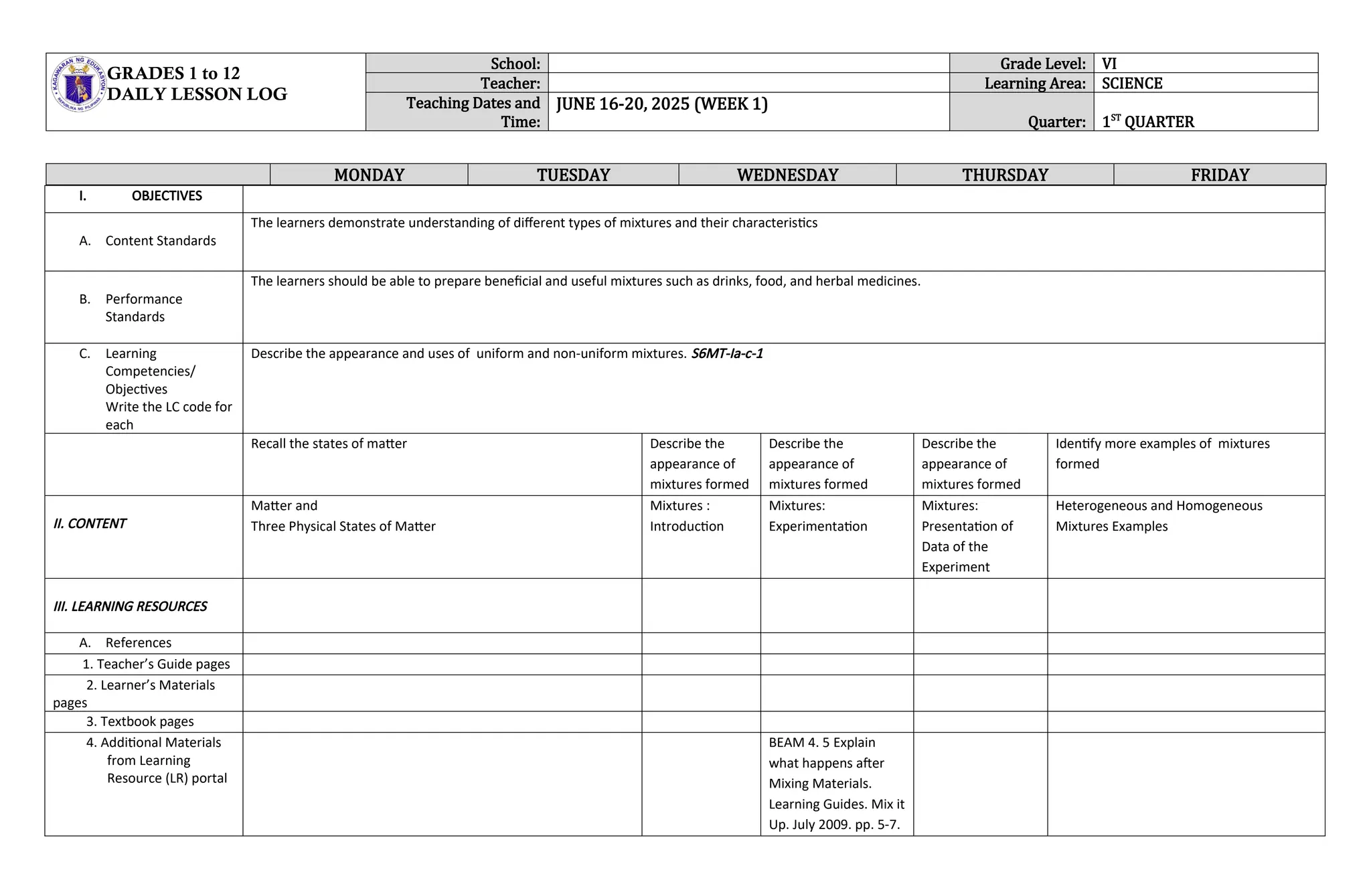
GRADES 1 to12
DAILY LESSON LOG
School: Grade Level: VI
Teacher: Learning Area: SCIENCE
Teaching Dates and
Time:
JUNE 16-20, 2025 (WEEK 1)
Quarter: 1ST
QUARTER
MONDAY TUESDAY WEDNESDAY THURSDAY FRIDAY
I. OBJECTIVES
A. Content Standards
The learners demonstrate understanding of different types of mixtures and their characteristics
B. Performance
Standards
The learners should be able to prepare beneficial and useful mixtures such as drinks, food, and herbal medicines.
C. Learning
Competencies/
Objectives
Write the LC code for
each
Describe the appearance and uses of uniform and non-uniform mixtures. S6MT-Ia-c-1
Recall the states of matter Describe the
appearance of
mixtures formed
Describe the
appearance of
mixtures formed
Describe the
appearance of
mixtures formed
Identify more examples of mixtures
formed
II. CONTENT
Matter and
Three Physical States of Matter
Mixtures :
Introduction
Mixtures:
Experimentation
Mixtures:
Presentation of
Data of the
Experiment
Heterogeneous and Homogeneous
Mixtures Examples
III. LEARNING RESOURCES
A. References
1. Teacher’s Guide pages
2. Learner’s Materials
pages
3. Textbook pages
4. Additional Materials
from Learning
Resource (LR) portal
BEAM 4. 5 Explain
what happens after
Mixing Materials.
Learning Guides. Mix it
Up. July 2009. pp. 5-7.
2.
B. Other Learning
Resources
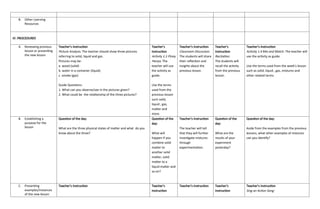
IV.PROCEDURES
A. Reviewing previous
lesson or presenting
the new lesson
Teacher’s Instruction
Picture Analysis. The teacher should show three pictures
referring to solid, liquid and gas.
Pictures may be:
a. wood (solid)
b. water in a container (liquid)
c. smoke (gas)
Guide Questions:
1. What can you observe/see in the pictures given?
2. What could be the relationship of the three pictures?
Teacher’s
Instruction
Activity 1.1 Pinoy
Henyo. The
teacher will use
the activity as
guide.
Use the terms
used from the
previous lesson
such solid,
liquid , gas,
matter and
more.
Teacher’s Instruction
Classroom Discussion.
The students will share
their reflection and
insights about the
previous lesson.
Teacher’s
Instruction
Recitation.
The students will
recall the activity
from the previous
lesson.
Teacher’s Instruction
Activity 1.4 Mix and Match. The teacher will
use the activity as guide.
Use the terms used from the week’s lesson
such as solid, liquid , gas, mixtures and
other related terms.
B. Establishing a
purpose for the
lesson
Question of the day:
What are the three physical states of matter and what do you
know about the three?
Question of the
day:
What will
happen if you
combine solid
matter to
another solid
matter, solid
matter to a
liquid matter and
so on?
Teacher’s Instruction
The teacher will tell
that they will further
investigate mixtures
through
experimentation.
Question of the
day:
What are the
results of your
experiment
yesterday?
Question of the day:
Aside from the examples from the previous
lessons, what other examples of mixtures
can you identify?
C. Presenting
examples/instances
of the new lesson
Teacher’s Instruction Teacher’s
Instruction
Teacher’s Instruction Teacher’s
Instruction
Teacher’s Instruction
Sing an Action Song:
3.
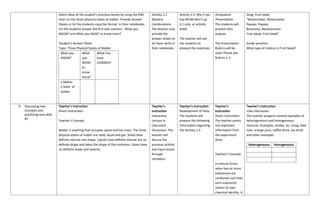
Solicit ideas ofthe student’s previous lesson by using the KWL
chart on the three physical states of matter. Provide Answer
Sheets or let the students copy the format in their notebooks.
Let the students answer the first two columns : What you
KNOW? and What you WANT to know more?
Student’s Answer Sheet
Topic: Three Physical States of Matter
What you
KNOW?
What
you
WANT
to
know
more?
What You
have
LEARNED?
1.Matter
2.State of
matter
Activity 1.2
Mystery
Combinations.
The teacher may
provide the
answer sheets or
let them write in
their notebooks.
Activity 1.3: Mix It Up!
Use BEAM Mix it up
3.1 only or activity
sheet.
The teacher will ask
the students to
prepare the materials.
Groupwork
Presentation.
The students will
present their
outputs.
The Presentation
Rubrics will be
used. Please see
Rubrics 1.1.
Song: Fruit Salad
“Watermelon, Watermelon
Papaya, Papaya,
Bananana, Bananananan
Fruit Salad, Fruit Salad”
Guide question:
What type of mixture is Fruit Salad?
D. Discussing new
concepts and
practicing new skills
#1
Teacher’s Instruction
Direct Instruction.
Teacher’s Concept:
Matter is anything that occupies space and has mass. The three
physical states of matter are solid, liquid and gas. Solids have
definite volume and shape. Liquids have definite volume but no
definite shape and takes the shape of the container. Gases have
no definite shape and volume.
Teacher’s
Instruction
Interactive
Lecture in
Classroom
Discussion. The
teacher will
discuss the
previous activity
and input lesson
through
recitation.
Teacher’s Instruction
Development of Data.
The students will
prepare the following
information regarding
the Activity 1.3.
Teacher’s
Instruction
Direct Instruction.
The teacher points
out important
information from
the experiment
done.
Teacher’s Concept:
A mixture forms
when two or more
substances are
combined such that
each substance
retains its own
chemical identity. A
Teacher’s Instruction
Class Discussion.
The teacher prepares several examples of
heterogeneous and homogeneous
mixtures. Examples, smoke, air, smog, halo-
halo, orange juice, coffee drink, tea drink
and other examples
Heterogeneous Homogeneous
4.
homogeneous
mixture has asingle
phase and a
heterogeneous
mixture has two or
more phases.
E. Discussing new
concepts and
practicing new skills
#2
F. Developing mastery
(leads to Formative
Assessment 3)
G. Finding practical
applications of
concepts and skills in
daily living
H. Making
generalizations and
abstractions about
the lesson
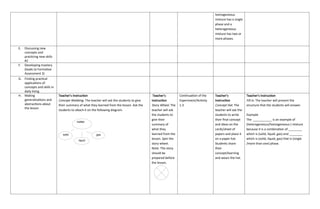
Teacher’s Instruction
Concept Webbing. The teacher will ask the students to give
their summary of what they learned from the lesson. Ask the
students to attach it on the following diagram.
Teacher’s
Instruction
Story Wheel. The
teacher will ask
the students to
give their
summary of
what they
learned from the
lesson. Spin the
story wheel.
Note: The story
should be
prepared before
the lesson.
Continuation of the
Experiment/Activity
1.3
Teacher’s
Instruction
Concept Hat. The
teacher will ask the
students to write
their final concept
and ideas on the
cards/sheet of
papers and place it
on a paper hat.
Students share
their
concept/learning
and wears the hat.
Teacher’s Instruction
Fill in. The teacher will present the
structure that the students will answer.
Example
The ___________ is an example of
(heterogeneous/homogeneous ) mixture
because it is a combination of ________
which is (solid, liquid ,gas) and ________
which is (solid, liquid, gas) that is (single
/more than one) phase.
matter
gas
liquid
solid
5.
The story wheel
shouldcontain
important terms.
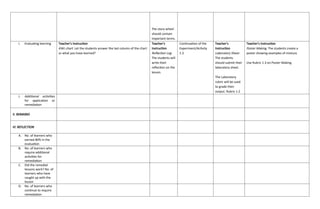
I. Evaluating learning Teacher’s Instruction
KWL chart. Let the students answer the last column of the chart
or what you have learned?
Teacher’s
Instruction
Reflection Log.
The students will
write their
reflection on the
lesson.
Continuation of the
Experiment/Activity
1.3
Teacher’s
Instruction
Laboratory Sheet.
The students
should submit their
laboratory sheet.
The Laboratory
rubric will be used
to grade their
output. Rubric 1.2
Teacher’s Instruction
Poster Making. The students create a
poster showing examples of mixture.
Use Rubric 1.3 on Poster Making
J. Additional activities
for application or
remediation
V. REMARKS
VI. REFLECTION
A. No. of learners who
earned 80% in the
evaluation
B. No. of learners who
require additional
activities for
remediation
C. Did the remedial
lessons work? No. of
learners who have
caught up with the
lesson
D. No. of learners who
continue to require
remediation
6.
E. Which ofmy teaching
strategies worked
well? Why did these
work?
F. What difficulties did I
encounter which my
principal or
supervisor can help
me solve?
G. What innovation or
localized materials
did I use/discover
which I wish to share
with other teachers?