a TEXT textis
neither written nor read
in a vacuum; its meaning
and interpretation are
affected by a given set of
circumstances.
4.
a CONTEXT
is definedas the social, cultural,
political, historical, and other
related circumstances that
surround the text and form the
terms from which it can be
better understood and
evaluated.
5.
When was thework written?
01.
What were the circumstances that produced
it?
What issues does it deal with?
02.
03.
Knowledge of the text’s context helps in
appreciating the text’s message more deeply. In
discovering a reading’s context, you may ask the
questions like:
HYPER
TEXT
Hypertext is anonlinear way to
present information and is
usually accomplished using
“links”. Such links help the
readers navigate further
information about the topic
being discussed and may also
lead to other links that can direct
the readers to various options.
8.
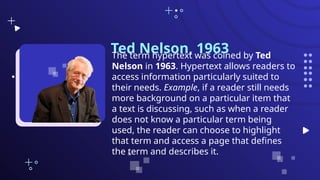
Ted Nelson, 1963
Theterm hypertext was coined by Ted
Nelson in 1963. Hypertext allows readers to
access information particularly suited to
their needs. Example, if a reader still needs
more background on a particular item that
a text is discussing, such as when a reader
does not know a particular term being
used, the reader can choose to highlight
that term and access a page that defines
the term and describes it.
9.
Hypertext
also allows thereaders to create their
own meaning out of the material
given to them and learn better
associatively. Hypertext is text
displayed on a computer display or
other electronic devices with
references to other text that the
reader can immediately access.
10.
Hypertext
documents are interconnected
byhyperlinks, which are typically
activated by a mouse click,
keypress set, or by touching
the screen. Rather than
remaining static like traditional
text, hypertext makes a dynamic
organization of information
possible through links and
connections (called hyperlink).
11.
In a hypertextsystem, the reader is free to
navigate information by exploring the
connections provided.
12.
INTERTEXT
process of textdevelopment that merges two
more processes such as imitation and
creation in doing a text.
13.
INTER
TEXT
● Intertext orintertextuality is technically
defined as a process of text development
that merges two more processes such as
imitation and creation in doing a text. It
involves imitation because the author as
highly influenced by another author
comes up with his own version of the text
consciously or unconsciously incorporating
the style and other characteristics of the
text done by that author.
14.
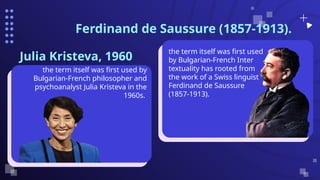
Ferdinand de Saussure(1857-1913).
Julia Kristeva, 1960
the term itself was first used by
Bulgarian-French philosopher and
psychoanalyst Julia Kristeva in the
1960s.
the term itself was first used
by Bulgarian-French Inter
textuality has rooted from
the work of a Swiss linguist
Ferdinand de Saussure
(1857-1913).
15.
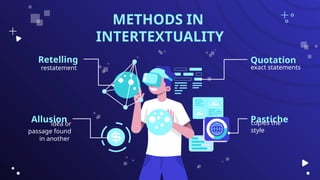
01. Retelling -is the restatement of a story or re-
expression of a narrative.
METHODS IN
INTERTEXTUALITY
02. Quotation - is the method of directly lifting the
exact statements or set of words from a text
another author has made.
16.
03. Allusion -In this method, a writer or speaker
explicitly or implicitly pertains to an idea or
passage found in another text without the use of
quotation.
METHODS IN
INTERTEXTUALITY
04. Pastiche - is a text developed in a way that it
copies the style or other properties of another text
without making fun of it unlike in a parody.
Lesson Summary
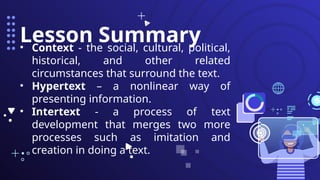
• Context- the social, cultural, political,
historical, and other related
circumstances that surround the text.
• Hypertext – a nonlinear way of
presenting information.
• Intertext - a process of text
development that merges two more
processes such as imitation and
creation in doing a text.
19.
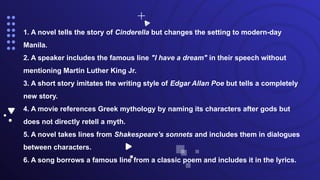
1. A noveltells the story of Cinderella but changes the setting to modern-day
Manila.
2. A speaker includes the famous line "I have a dream" in their speech without
mentioning Martin Luther King Jr.
3. A short story imitates the writing style of Edgar Allan Poe but tells a completely
new story.
4. A movie references Greek mythology by naming its characters after gods but
does not directly retell a myth.
5. A novel takes lines from Shakespeare's sonnets and includes them in dialogues
between characters.
6. A song borrows a famous line from a classic poem and includes it in the lyrics.
20.
•.
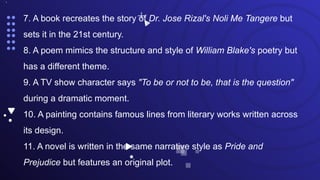
7. A bookrecreates the story of Dr. Jose Rizal's Noli Me Tangere but
sets it in the 21st century.
8. A poem mimics the structure and style of William Blake's poetry but
has a different theme.
9. A TV show character says "To be or not to be, that is the question"
during a dramatic moment.
10. A painting contains famous lines from literary works written across
its design.
11. A novel is written in the same narrative style as Pride and
Prejudice but features an original plot.
21.
•.
12. A famousmovie is rewritten and adapted to fit a
new cultural setting while keeping the main story
the same.
13. A political cartoon references Julius Caesar by
showing a leader being betrayed by his allies.
14. A new book borrows key phrases from The
Bible and incorporates them into its dialogue.
15. A short film copies the visual style and
storytelling techniques of classic silent films but
presents a modern story.







![MARCH 12 [Autosaved].pptxfffffffffffffffffffffffffff](https://cdn.slidesharecdn.com/ss_thumbnails/march12autosaved-240903033419-781c9000-thumbnail.jpg?width=640&height=640&fit=bounds)


