

PRESENTED BY
PAROMITA MITRA BHAUMIK
Psychologist/Learning and development trainer/Teacher
Educator
1)WHAT IS CLASSROOM MANAGEMENT
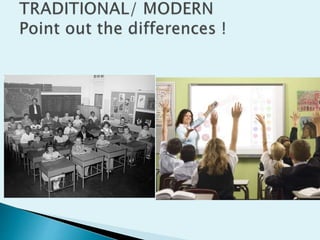
2)DIFFERENCE BETWEEN TRADITIONAL AND
MODERN CLASROOMS
3)TIME MANAGEMENT
4) TEACHING STRATEGIES-
5) MIND MAPPING AND CLASSROOM
APPLICATIONS
6) DISCIPLINE RULES AND PROCEDURE
7) CASE DISCUSSIONS
# From Teacher –Centric to Child- centric
# From teaching lessons to capacity building
# From books to multimedia
#From importance of” marks” to” grades” from
the highest marks to class averages
# From IQ being the predictor of future success
to emphasis on EQ
# From Uniform instructions to differential
instructions
# From barring certain students from class to
inclusive classrooms
 “THE ACTIONS TAKEN BY
THE TEACHERS TO CREATE
AND MAINTAIN A LEARNING
ENVIRONMENT CONDUCIVE
FOR SUCCESSFUL
INSTRUCTION”---EVERTSON AND
WEINSTEIN 2006
 TO GAIN CONTROL OVER THE CLASS
ENVIRONMENT
 HIGHER STUDENT ENGAGEMENT TIME FOR
THE MIXED ABILITY CLASSROOM
.SOCIAL/ PERSONALITY DEVELOPMENT
FOSTERING THINKING EMOTIONAL AND
SOCIAL SKILLS TRAINING
 EFFECTIVE INSTRUCTIONAL STRATEGIES
PLANNING
 *TEACHER DIRECTED REVIEW(5 MINS)-ask
question, quizzes, match the following on the
last lesson
 *INTRODUCTION OF NEW CONCEPTS (5MINS)-use
models real objects, audiovisuals
 *GUIDED PRACTICE ON ASSIGNMENT-(10MINS)-
include reading, writing, speaking and listening
skills
 *INDEPENDENT/CO-OPERATIVE
(RECIPROCAL)WORK(15 MINS)
 *CONCLUSION-(5MINS) –Summarizing the lecture
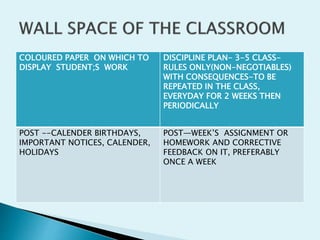
COLOURED PAPER ON WHICH TO
DISPLAY STUDENT;S WORK
DISCIPLINE PLAN- 3-5 CLASS-
RULES ONLY(NON-NEGOTIABLES)
WITH CONSEQUENCES-TO BE
REPEATED IN THE CLASS,
EVERYDAY FOR 2 WEEKS THEN
PERIODICALLY
POST --CALENDER BIRTHDAYS,
IMPORTANT NOTICES, CALENDER,
HOLIDAYS
POST—WEEK’S ASSIGNMENT OR
HOMEWORK AND CORRECTIVE
FEEDBACK ON IT, PREFERABLY
ONCE A WEEK
LEARNING
STRATEGIES
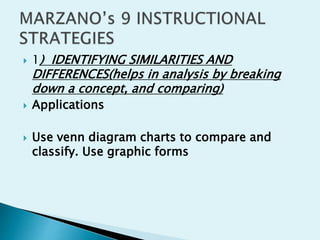
 1) IDENTIFYING SIMILARITIES AND
DIFFERENCES(helps in analysis by breaking
down a concept, and comparing)
 Applications
 Use venn diagram charts to compare and
classify. Use graphic forms
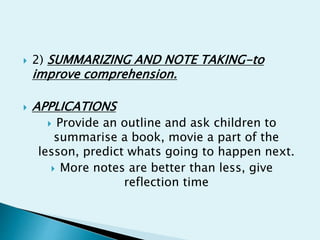
 2) SUMMARIZING AND NOTE TAKING-to
improve comprehension.
 APPLICATIONS
 Provide an outline and ask children to
summarise a book, movie a part of the
lesson, predict whats going to happen next.
 More notes are better than less, give
reflection time
 3 ) Reinforcing efforts and providing
recognition-capacity building without
comparing.Recognition works better than
tangible rewards
 APPLICATIONS
 Share stories about successful people,
students to keep a log about their efforts and
achievements, to reflect and analyze.
Personalise recognition,’pause prompt and
praise with the struggling one
 4) Home work and Practice- fixed schedule of
work, minimal interference from parents,give
feedback
 APPLICATIONS
 Explain the H.W rules,choose the difficult
concepts .be consistent.
 5) Non Linguistic Representation-more brain
stimulation when a concept is represented
verbally and visually
 APPLICATIONS
Use physical models, movements , symbols etc
 6) Co-Operative Learning-children learn
better through brain storming in groups and
teaching one another
 APPLICATIONS
 Groups of varying size abilities and interest,
who can choose their pace and goals
 7) Setting objective and providing feedback
 Set a goal and provide corrective feedback
 APPLICATIONS-feedback should be specific
and timely
 8) Generalizing and testing hypothesis
 Deductive reasoning using a general rule to
make a prediction works best
 Applications( what if...predictions and guided
imaginations)
 What will happen if humans could fly?
 What would be the scenario without the world
wars?
 9) CUES QUESTIONS ADVANCED
ORGANISATION
 Use leading questions so that the students
can apply already acquired knowledge
 APPLICATIONS-introduce a new topic, tie it to
already acquired knowledge, arouse curiosity,
(10 sec reading)match the following quizzes
MIND
MAPPING
STRATEGY
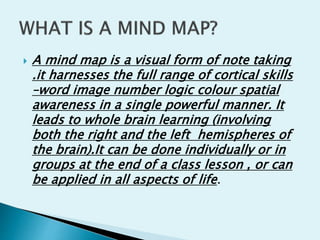
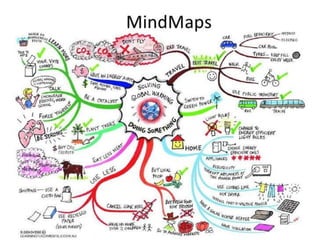
 A mind map is a visual form of note taking
.it harnesses the full range of cortical skills
–word image number logic colour spatial
awareness in a single powerful manner. It
leads to whole brain learning (involving
both the right and the left hemispheres of
the brain).It can be done individually or in
groups at the end of a class lesson , or can
be applied in all aspects of life.
CLASSROOM
DISCIPLINE
AND PROBLEM
ISSUES
 THE MAIN PROBLEM ISSUE IN THE
CLASSROOM, LEADING TO LESSON
DISRUPTIONS, DOES NOT STEM
FROM THE LACK OF DISCIPLINE
OR TEACHERS,’PERSONALITY BUT
FROM
 LACK OF PROCEDURE AND
REGULAR ROUTINE WHICH NEEDS
DRILLS
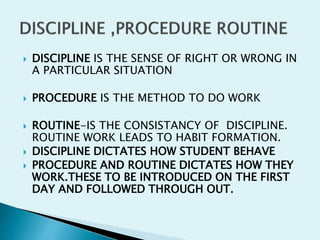
 DISCIPLINE IS THE SENSE OF RIGHT OR WRONG IN
A PARTICULAR SITUATION
 PROCEDURE IS THE METHOD TO DO WORK
 ROUTINE-IS THE CONSISTANCY OF DISCIPLINE.
ROUTINE WORK LEADS TO HABIT FORMATION.
 DISCIPLINE DICTATES HOW STUDENT BEHAVE
 PROCEDURE AND ROUTINE DICTATES HOW THEY
WORK.THESE TO BE INTRODUCED ON THE FIRST
DAY AND FOLLOWED THROUGH OUT.
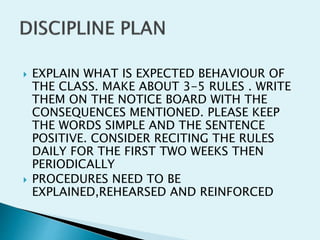
 EXPLAIN WHAT IS EXPECTED BEHAVIOUR OF
THE CLASS. MAKE ABOUT 3-5 RULES . WRITE
THEM ON THE NOTICE BOARD WITH THE
CONSEQUENCES MENTIONED. PLEASE KEEP
THE WORDS SIMPLE AND THE SENTENCE
POSITIVE. CONSIDER RECITING THE RULES
DAILY FOR THE FIRST TWO WEEKS THEN
PERIODICALLY
 PROCEDURES NEED TO BE
EXPLAINED,REHEARSED AND REINFORCED
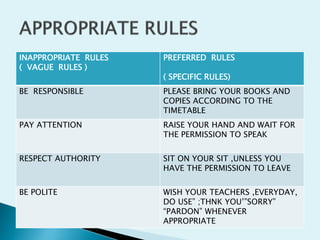
INAPPROPRIATE RULES
( VAGUE RULES )
PREFERRED RULES
( SPECIFIC RULES)
BE RESPONSIBLE PLEASE BRING YOUR BOOKS AND
COPIES ACCORDING TO THE
TIMETABLE
PAY ATTENTION RAISE YOUR HAND AND WAIT FOR
THE PERMISSION TO SPEAK
RESPECT AUTHORITY SIT ON YOUR SIT ,UNLESS YOU
HAVE THE PERMISSION TO LEAVE
BE POLITE WISH YOUR TEACHERS ,EVERYDAY,
DO USE” ;THNK YOU’”SORRY”
“PARDON” WHENEVER
APPROPRIATE
PROBLEM
BEHAVIOUR
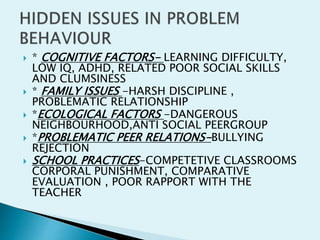
 * COGNITIVE FACTORS- LEARNING DIFFICULTY,
LOW IQ, ADHD, RELATED POOR SOCIAL SKILLS
AND CLUMSINESS
 * FAMILY ISSUES -HARSH DISCIPLINE ,
PROBLEMATIC RELATIONSHIP
 *ECOLOGICAL FACTORS -DANGEROUS
NEIGHBOURHOOD,ANTI SOCIAL PEERGROUP
 *PROBLEMATIC PEER RELATIONS-BULLYING
REJECTION
 SCHOOL PRACTICES-COMPETETIVE CLASSROOMS
CORPORAL PUNISHMENT, COMPARATIVE
EVALUATION , POOR RAPPORT WITH THE
TEACHER
IF YOU WANT IT ,.....TEACH
IT. IF YOUEXPEXT TO
MAINTAIN
IT......ENCOURAGE IT,
ACKNOWLEDGE IT,
REINFORCE IT !
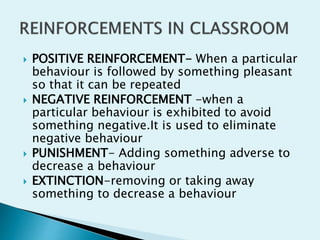
 POSITIVE REINFORCEMENT- When a particular
behaviour is followed by something pleasant
so that it can be repeated
 NEGATIVE REINFORCEMENT -when a
particular behaviour is exhibited to avoid
something negative.It is used to eliminate
negative behaviour
 PUNISHMENT- Adding something adverse to
decrease a behaviour
 EXTINCTION-removing or taking away
something to decrease a behaviour
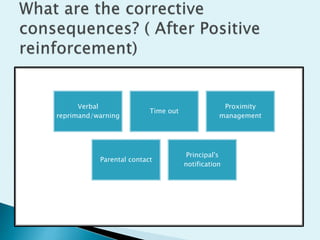
Verbal
reprimand/warning
Time out
Proximity
management
Parental contact
Principal's
notification
 FIND THE PERSON DOING RIGHT BEHAVIOUR
AND EMPHASISE IT BY THE FOLLOWING
PROCESS
 1)Be specific and praise the behavior
consistently
 “you are doing well because you revise your
paper”
 2)Be timely -express s soon as it occurs
 3)reinforce the effects of the behaviour
 “this sets an example to others to follow”
 Redirecting focus when a negative behaviour
occurs-consistently for about 3 months
changes it into a positive one
 `1 when it occurs redirect focus by
suggesting that the specific behaviour is not
consistent with their better character--”I am
so surprised ,it is unlike you to do this’
 2 Reinforce the consequence in a positive and
fun tone. “we cannot have other people not
like a boy like you, that would be tragic”
 1) Identify the student, categorise him
 2) see the context try to find the cause and
pay off
 3) Specify expected behaviour in class
 4) use reinforcements
 5) conduct behavioural rehearsals
 6) Prompt expected behaviour
 7)Catch them being good,
 8) monitor a plan 9)Keep a log 10) Involve
parents ,for serious /chronic issues
 PAROMITA MITRA BHAUMIK
 www.paromitamitrabhaumik.com
 paromitaforyou@gmail.com
 9051670642/9830021567

EFFECTIVE CLASSROOMS BYPAROMITA MITRA BHAUMIK

  • 1.
    PRESENTED BY PAROMITA MITRABHAUMIK Psychologist/Learning and development trainer/Teacher Educator
  • 2.
    1)WHAT IS CLASSROOMMANAGEMENT 2)DIFFERENCE BETWEEN TRADITIONAL AND MODERN CLASROOMS 3)TIME MANAGEMENT 4) TEACHING STRATEGIES- 5) MIND MAPPING AND CLASSROOM APPLICATIONS 6) DISCIPLINE RULES AND PROCEDURE 7) CASE DISCUSSIONS
  • 4.
    # From Teacher–Centric to Child- centric # From teaching lessons to capacity building # From books to multimedia #From importance of” marks” to” grades” from the highest marks to class averages # From IQ being the predictor of future success to emphasis on EQ # From Uniform instructions to differential instructions # From barring certain students from class to inclusive classrooms
  • 5.
     “THE ACTIONSTAKEN BY THE TEACHERS TO CREATE AND MAINTAIN A LEARNING ENVIRONMENT CONDUCIVE FOR SUCCESSFUL INSTRUCTION”---EVERTSON AND WEINSTEIN 2006
  • 6.
     TO GAINCONTROL OVER THE CLASS ENVIRONMENT  HIGHER STUDENT ENGAGEMENT TIME FOR THE MIXED ABILITY CLASSROOM .SOCIAL/ PERSONALITY DEVELOPMENT FOSTERING THINKING EMOTIONAL AND SOCIAL SKILLS TRAINING  EFFECTIVE INSTRUCTIONAL STRATEGIES
  • 7.
  • 8.
     *TEACHER DIRECTEDREVIEW(5 MINS)-ask question, quizzes, match the following on the last lesson  *INTRODUCTION OF NEW CONCEPTS (5MINS)-use models real objects, audiovisuals  *GUIDED PRACTICE ON ASSIGNMENT-(10MINS)- include reading, writing, speaking and listening skills  *INDEPENDENT/CO-OPERATIVE (RECIPROCAL)WORK(15 MINS)  *CONCLUSION-(5MINS) –Summarizing the lecture
  • 9.
    COLOURED PAPER ONWHICH TO DISPLAY STUDENT;S WORK DISCIPLINE PLAN- 3-5 CLASS- RULES ONLY(NON-NEGOTIABLES) WITH CONSEQUENCES-TO BE REPEATED IN THE CLASS, EVERYDAY FOR 2 WEEKS THEN PERIODICALLY POST --CALENDER BIRTHDAYS, IMPORTANT NOTICES, CALENDER, HOLIDAYS POST—WEEK’S ASSIGNMENT OR HOMEWORK AND CORRECTIVE FEEDBACK ON IT, PREFERABLY ONCE A WEEK
  • 10.
  • 11.
     1) IDENTIFYINGSIMILARITIES AND DIFFERENCES(helps in analysis by breaking down a concept, and comparing)  Applications  Use venn diagram charts to compare and classify. Use graphic forms
  • 12.
     2) SUMMARIZINGAND NOTE TAKING-to improve comprehension.  APPLICATIONS  Provide an outline and ask children to summarise a book, movie a part of the lesson, predict whats going to happen next.  More notes are better than less, give reflection time
  • 13.
     3 )Reinforcing efforts and providing recognition-capacity building without comparing.Recognition works better than tangible rewards  APPLICATIONS  Share stories about successful people, students to keep a log about their efforts and achievements, to reflect and analyze. Personalise recognition,’pause prompt and praise with the struggling one
  • 14.
     4) Homework and Practice- fixed schedule of work, minimal interference from parents,give feedback  APPLICATIONS  Explain the H.W rules,choose the difficult concepts .be consistent.
  • 15.
     5) NonLinguistic Representation-more brain stimulation when a concept is represented verbally and visually  APPLICATIONS Use physical models, movements , symbols etc
  • 16.
     6) Co-OperativeLearning-children learn better through brain storming in groups and teaching one another  APPLICATIONS  Groups of varying size abilities and interest, who can choose their pace and goals
  • 17.
     7) Settingobjective and providing feedback  Set a goal and provide corrective feedback  APPLICATIONS-feedback should be specific and timely
  • 18.
     8) Generalizingand testing hypothesis  Deductive reasoning using a general rule to make a prediction works best  Applications( what if...predictions and guided imaginations)  What will happen if humans could fly?  What would be the scenario without the world wars?
  • 19.
     9) CUESQUESTIONS ADVANCED ORGANISATION  Use leading questions so that the students can apply already acquired knowledge  APPLICATIONS-introduce a new topic, tie it to already acquired knowledge, arouse curiosity, (10 sec reading)match the following quizzes
  • 20.
  • 21.
     A mindmap is a visual form of note taking .it harnesses the full range of cortical skills –word image number logic colour spatial awareness in a single powerful manner. It leads to whole brain learning (involving both the right and the left hemispheres of the brain).It can be done individually or in groups at the end of a class lesson , or can be applied in all aspects of life.
  • 23.
  • 24.
     THE MAINPROBLEM ISSUE IN THE CLASSROOM, LEADING TO LESSON DISRUPTIONS, DOES NOT STEM FROM THE LACK OF DISCIPLINE OR TEACHERS,’PERSONALITY BUT FROM  LACK OF PROCEDURE AND REGULAR ROUTINE WHICH NEEDS DRILLS
  • 25.
     DISCIPLINE ISTHE SENSE OF RIGHT OR WRONG IN A PARTICULAR SITUATION  PROCEDURE IS THE METHOD TO DO WORK  ROUTINE-IS THE CONSISTANCY OF DISCIPLINE. ROUTINE WORK LEADS TO HABIT FORMATION.  DISCIPLINE DICTATES HOW STUDENT BEHAVE  PROCEDURE AND ROUTINE DICTATES HOW THEY WORK.THESE TO BE INTRODUCED ON THE FIRST DAY AND FOLLOWED THROUGH OUT.
  • 26.
     EXPLAIN WHATIS EXPECTED BEHAVIOUR OF THE CLASS. MAKE ABOUT 3-5 RULES . WRITE THEM ON THE NOTICE BOARD WITH THE CONSEQUENCES MENTIONED. PLEASE KEEP THE WORDS SIMPLE AND THE SENTENCE POSITIVE. CONSIDER RECITING THE RULES DAILY FOR THE FIRST TWO WEEKS THEN PERIODICALLY  PROCEDURES NEED TO BE EXPLAINED,REHEARSED AND REINFORCED
  • 27.
    INAPPROPRIATE RULES ( VAGUERULES ) PREFERRED RULES ( SPECIFIC RULES) BE RESPONSIBLE PLEASE BRING YOUR BOOKS AND COPIES ACCORDING TO THE TIMETABLE PAY ATTENTION RAISE YOUR HAND AND WAIT FOR THE PERMISSION TO SPEAK RESPECT AUTHORITY SIT ON YOUR SIT ,UNLESS YOU HAVE THE PERMISSION TO LEAVE BE POLITE WISH YOUR TEACHERS ,EVERYDAY, DO USE” ;THNK YOU’”SORRY” “PARDON” WHENEVER APPROPRIATE
  • 28.
  • 29.
     * COGNITIVEFACTORS- LEARNING DIFFICULTY, LOW IQ, ADHD, RELATED POOR SOCIAL SKILLS AND CLUMSINESS  * FAMILY ISSUES -HARSH DISCIPLINE , PROBLEMATIC RELATIONSHIP  *ECOLOGICAL FACTORS -DANGEROUS NEIGHBOURHOOD,ANTI SOCIAL PEERGROUP  *PROBLEMATIC PEER RELATIONS-BULLYING REJECTION  SCHOOL PRACTICES-COMPETETIVE CLASSROOMS CORPORAL PUNISHMENT, COMPARATIVE EVALUATION , POOR RAPPORT WITH THE TEACHER
  • 30.
    IF YOU WANTIT ,.....TEACH IT. IF YOUEXPEXT TO MAINTAIN IT......ENCOURAGE IT, ACKNOWLEDGE IT, REINFORCE IT !
  • 31.
     POSITIVE REINFORCEMENT-When a particular behaviour is followed by something pleasant so that it can be repeated  NEGATIVE REINFORCEMENT -when a particular behaviour is exhibited to avoid something negative.It is used to eliminate negative behaviour  PUNISHMENT- Adding something adverse to decrease a behaviour  EXTINCTION-removing or taking away something to decrease a behaviour
  • 32.
  • 33.
     FIND THEPERSON DOING RIGHT BEHAVIOUR AND EMPHASISE IT BY THE FOLLOWING PROCESS  1)Be specific and praise the behavior consistently  “you are doing well because you revise your paper”  2)Be timely -express s soon as it occurs  3)reinforce the effects of the behaviour  “this sets an example to others to follow”
  • 34.
     Redirecting focuswhen a negative behaviour occurs-consistently for about 3 months changes it into a positive one  `1 when it occurs redirect focus by suggesting that the specific behaviour is not consistent with their better character--”I am so surprised ,it is unlike you to do this’  2 Reinforce the consequence in a positive and fun tone. “we cannot have other people not like a boy like you, that would be tragic”
  • 35.
     1) Identifythe student, categorise him  2) see the context try to find the cause and pay off  3) Specify expected behaviour in class  4) use reinforcements  5) conduct behavioural rehearsals  6) Prompt expected behaviour  7)Catch them being good,  8) monitor a plan 9)Keep a log 10) Involve parents ,for serious /chronic issues
  • 36.
     PAROMITA MITRABHAUMIK  www.paromitamitrabhaumik.com  paromitaforyou@gmail.com  9051670642/9830021567