Rubric –Appendix pg. 26
Four components
◦ Planning – will look at tomorrow
◦ Classroom management
◦ Instruction
◦ Professional Notebook
3.
Organizes AvailableSpace, Materials, and/or
Equipment to Facilitate Learning
◦ Furniture is arranged to facilitate easy movement for
teacher and students.
◦ Arrangement of the room is functional for activities
observed.
◦ Materials, equipment, and aids were organized and
ready to use.
◦ Pre-organization by the teacher is evident.
◦ Classroom space is organized to accommodate a
variety of activities.
4.
Promotes APositive Learning Climate
◦ Students appear to be comfortable and feel at-ease
with the teacher.
◦ Assistance is provided to ALL students.
◦ Academic standards are high. (Students know what is
expected of them.)
◦ Verbal and nonverbal encouragement is given to
students.
◦ Confidence in ALL students is evident.
◦ All students are treated fairly, equally and
consistently.
5.
Manages Routinesand Transitions in a Timely
Manner
◦ Class began promptly.
◦ Routines for beginning class, ending class,
completing assignments, distribution materials, etc.
are well-established and continuously reinforced.
◦ No time lost when activities change.
◦ Students are actively engaged in learning activities
the entire class period.
6.
Manages and/orAdjusts Time Allotted for
Planned Activities
◦ Activities provided for early finishers.
◦ Manages interruptions with minimum loss of time
◦ Minimizes or redirects student digressions.
◦ Minimizes the time students spend waiting with
nothing to do.
◦ Pace of lesson is appropriate for grade level.
7.
Establishes Expectationsfor Learner Behavior
◦ Has established and maintained high behavioral
expectations.
◦ Procedures and rules are clearly established and
reinforced.
◦ Consequences of unacceptable behavior are well-
established.
◦ Constant attention by the teacher is given to high
standards and expectations
8.
Uses MonitoringTechniques to Facilitate
Learning
◦ Unacceptable behavior is stopped and redirected
◦ Consequences of unacceptable behavior are
reasonable
◦ Monitors students’ adherence to rules
◦ Uses preventive measures to keep problems form
occurring
9.
Uses TechniquesWhich Develops Lesson Objectives
◦ Students are made aware of the
purposes/rationale/objectives of the lesson.
◦ A variety of teaching methods and learning activities is
used.
◦ Attention of all the students is secured before each activity
begins.
◦ Lesson begins with an activity that focuses students’
attention. (motivation)
◦ Teacher & student activities are used to develop the
objectivities.
◦ Purposes of the activities chosen are clearly stated.
10.
Sequences Lessonto Promote Learning
◦ Relates lesson to past and future lessons
◦ Activities focus on learning new concepts or skills
◦ Guided practice is monitored by the teacher for student
understanding
◦ Provides opportunities for independent practice of newly
learned concepts and skills
◦ Lesson includes a review
◦ Lesson includes a formal closure
◦ Monitoring is done continuously throughout the lesson
◦ Feedback is given concerning students’ academic
performance
◦ Lesson is developed in a logical sequence; content is well-
organized.
11.
Uses AvailableTeaching Materials/ Aids to
Achieve Lesson Objectives
◦ A variety of aids and materials is used to maintain
student interest and provide variety in instruction.
◦ Aids and materials are used to develop objectives.
◦ Aids and materials are used to accommodate
individual differences
◦ Aids and materials are used for enrichment,
remediation, and extending concepts.
12.
Adjusts LessonWhen Appropriate
◦ Re-teaching is done, if needed.
◦ Takes advantage of “teachable moments”.
◦ Adjusts time for activities, when needed. (Use NO =
Not Observable, if this attribute is not observed and is
not needed.)
13.
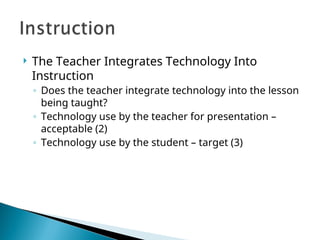
The TeacherIntegrates Technology Into
Instruction
◦ Does the teacher integrate technology into the lesson
being taught?
◦ Technology use by the teacher for presentation –
acceptable (2)
◦ Technology use by the student – target (3)
14.
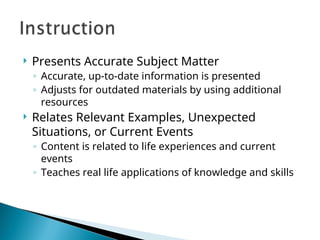
Presents AccurateSubject Matter
◦ Accurate, up-to-date information is presented
◦ Adjusts for outdated materials by using additional
resources
Relates Relevant Examples, Unexpected
Situations, or Current Events
◦ Content is related to life experiences and current
events
◦ Teaches real life applications of knowledge and skills
15.
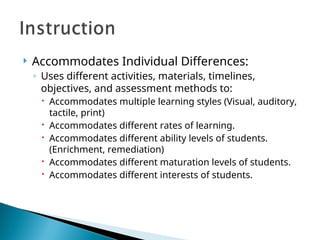
Accommodates IndividualDifferences:
◦ Uses different activities, materials, timelines,
objectives, and assessment methods to:
Accommodates multiple learning styles (Visual, auditory,
tactile, print)
Accommodates different rates of learning.
Accommodates different ability levels of students.
(Enrichment, remediation)
Accommodates different maturation levels of students.
Accommodates different interests of students.
16.
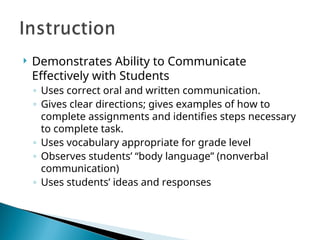
Demonstrates Abilityto Communicate
Effectively with Students
◦ Uses correct oral and written communication.
◦ Gives clear directions; gives examples of how to
complete assignments and identifies steps necessary
to complete task.
◦ Uses vocabulary appropriate for grade level
◦ Observes students’ “body language” (nonverbal
communication)
◦ Uses students’ ideas and responses
17.
Stimulates andEncourages High Order Thinking
at the Appropriate Developmental Levels
◦ Questions require the use of high order thinking skills.
◦ Provides “wait time” for student’s response
◦ Use of single rather than multiple questions
◦ Asks probing questions
◦ Provides activities that encourage high order thinking
(often requires cooperative or collaborative work
among students)
◦ Provides activities that require problem solving or
decision making
18.
Encourages StudentParticipation
◦ Encourages ALL students to participate including
non-volunteers
◦ Uses student ideas and responses to encourage
interaction
19.
Consistently monitorsongoing performance of
the students during the lesson being observed
◦ Asks higher order questions to check for student
comprehension
◦ Moves around the room to check for student
understanding.
◦ Requests student demonstrations of what has been
taught and learned.
◦ Encourages students to ask questions
20.
Uses appropriateand effective assessment
techniques
Provides timely feedback to students
21.
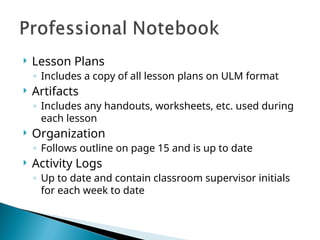
Lesson Plans
◦Includes a copy of all lesson plans on ULM format
Artifacts
◦ Includes any handouts, worksheets, etc. used during
each lesson
Organization
◦ Follows outline on page 15 and is up to date
Activity Logs
◦ Up to date and contain classroom supervisor initials
for each week to date
22.
There shouldbe a daily routine for students
when entering the class.
It helps to have an agenda on the board so
students know what will occur that day, and it
keeps you focused.
Have something for students to be doing as
soon as they enter so that you may silently take
roll.
23.
Now thatyou have their attention, state and/or
point to the objective for the day’s lesson.
Have a physical signal that you use to get
students’ attention.
When you implement activities, tell students
what your expectations are for the activity, e.g.
cooperative learning groups, games.
24.
Do notallow a student who is passive or not
engaged to disappear in the classroom.
◦ Call on that student to do or speak in class in a manner
that he or she will not be embarrassed.
◦ As a teacher it is your responsibility to bring the student
out of the shadows into the marvelous light of learning.
Help less-engaged, shy, passive students, and
slow learners to find success in your class by
baiting them with easy questions or tasks until
you can eventually give them more challenging
questions and tasks.
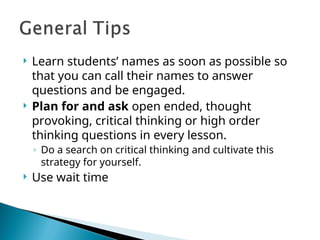
25.
Learn students’names as soon as possible so
that you can call their names to answer
questions and be engaged.
Plan for and ask open ended, thought
provoking, critical thinking or high order
thinking questions in every lesson.
◦ Do a search on critical thinking and cultivate this
strategy for yourself.
Use wait time