Success Criteria/WILF/TIB
        December 2010
Objectives
To understand what success criteria are and how
they can be used effectively to raise standards.


To consider the progression needed in success
criteria to be effective.


To consider how you will use success criteria in
your class.
What are Success Criteria?
They are nothing new- you already do it!
We have always asked children ‘what are
the key things you need to remember?’
Good teachers have always shared the
smaller ‘steps to success’.
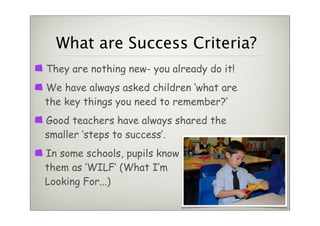
In some schools, pupils know
them as ‘WILF’ (What I’m
Looking For...)
What are Success Criteria?
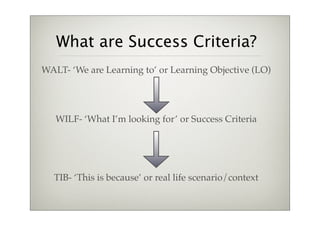
WALT- ‘We are Learning to’ or Learning Objective (LO)


   WILF- ‘What I’m looking for’ or Success Criteria


  TIB- ‘This is because’ or real life scenario/context
What are Success Criteria?
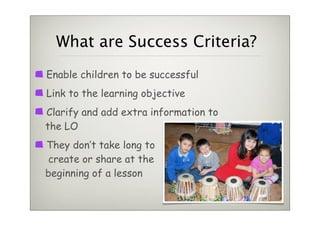
Enable children to be successful
Link to the learning objective
Clarify and add extra information to
the LO
They don’t take long to
 create or share at the
beginning of a lesson
Benefits for teachers
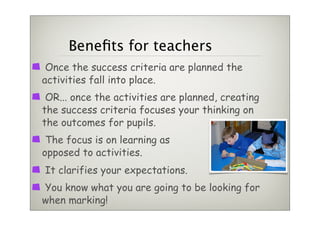
 Once the success criteria are planned the
activities fall into place.
 OR... once the activities are planned, creating
the success criteria focuses your thinking on
the outcomes for pupils.
 The focus is on learning as
opposed to activities.
It clarifies your expectations.
You know what you are going to be looking for
when marking!
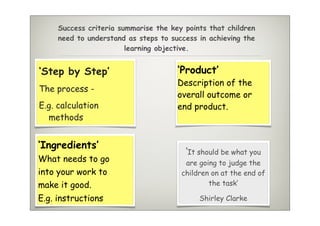
Success criteria summarise the key points that children
     need to understand as steps to success in achieving the
                        learning objective.


‘Step by Step’                        ‘Product’
                                      Description of the
The process -
                                      overall outcome or
E.g. calculation                      end product.
  methods


‘Ingredients’
                                        ‘It should be what you
What needs to go                        are going to judge the
into your work to                      children on at the end of
make it good.                                  the task’

E.g. instructions                           Shirley Clarke
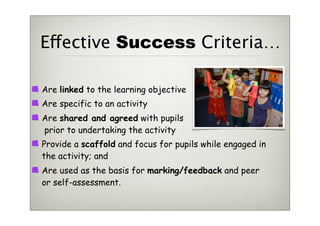
Effective Success Criteria…

Are linked to the learning objective
Are specific to an activity
Are shared and agreed with pupils
prior to undertaking the activity
Provide a scaffold and focus for pupils while engaged in
the activity; and
Are used as the basis for marking/feedback and peer
or self-assessment.
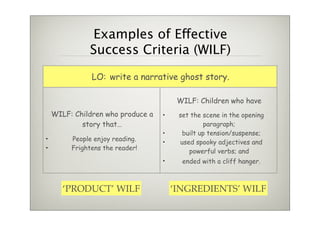
Examples of Effective
              Success Criteria (WILF)
               LO: write a narrative ghost story.

                                        WILF: Children who have
    WILF: Children who produce a   •    set the scene in the opening
            story that…                         paragraph;
                                   •     built up tension/suspense;
•        People enjoy reading.
                                   •    used spooky adjectives and
•        Frightens the reader!
                                           powerful verbs; and
                                   •     ended with a cliff hanger.


       ‘PRODUCT’ WILF                  ‘INGREDIENTS’ WILF
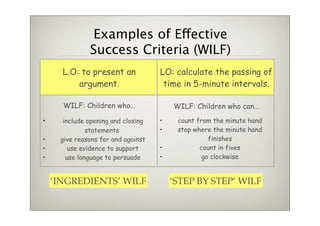
Examples of Effective
              Success Criteria (WILF)
      L.O: to present an            LO: calculate the passing of
          argument.                  time in 5-minute intervals.

      WILF: Children who…               WILF: Children who can…

•     include opening and closing   •    count from the minute hand
              statements            •    stop where the minute hand
•    give reasons for and against                  finishes
•       use evidence to support     •           count in fives
•      use language to persuade     •            go clockwise


    ‘INGREDIENTS’ WILF                  ‘STEP BY STEP’ WILF
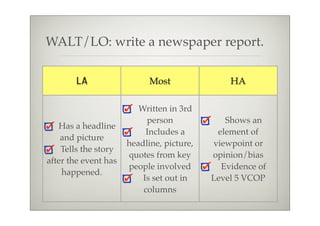
WALT/LO: write a newspaper report.

       LA                   Most               HA

                         Written in 3rd
                           person             Shows an
   Has a headline
                           Includes a       element of
    and picture
                      headline, picture,   viewpoint or
    Tells the story
                      quotes from key      opinion/bias
after the event has
                      people involved        Evidence of
    happened.
                          Is set out in    Level 5 VCOP
                          columns
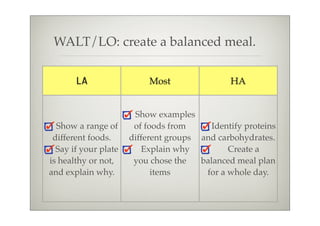
WALT/LO: create a balanced meal.

       LA                  Most                HA


                       Show examples
  Show a range of      of foods from      Identify proteins
 different foods.     different groups and carbohydrates.
  Say if your plate      Explain why          Create a
is healthy or not,     you chose the   balanced meal plan
and explain why.            items       for a whole day.
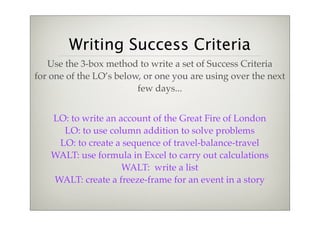
Writing Success Criteria
   Use the 3-box method to write a set of Success Criteria
for one of the LO’s below, or one you are using over the next
                         few days...


    LO: to write an account of the Great Fire of London
      LO: to use column addition to solve problems
     LO: to create a sequence of travel-balance-travel
    WALT: use formula in Excel to carry out calculations
                     WALT: write a list
    WALT: create a freeze-frame for an event in a story
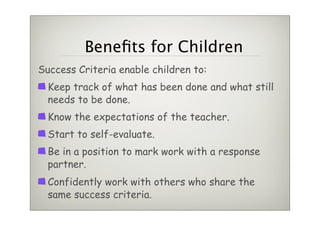
Benefits for Children
Success Criteria enable children to:
  Keep track of what has been done and what still
  needs to be done.
  Know the expectations of the teacher.
  Start to self-evaluate.
  Be in a position to mark work with a response
  partner.
  Confidently work with others who share the
  same success criteria.
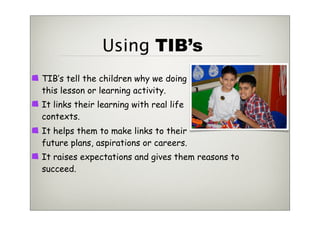
Using TIB’s
TIB’s tell the children why we doing
this lesson or learning activity.
It links their learning with real life
contexts.
It helps them to make links to their
future plans, aspirations or careers.
It raises expectations and gives them reasons to
succeed.
Example TIB’s
 In a maths lesson focusing on mental calculations;
 “This will help you to calculate quickly in your head
 when you’re out shopping or help you in jobs such as
            accountant, carpenter or MP (!)


       In a literacy lesson focusing on writing;
“This will help you to get the best results in your exams
which will help you go to university. You might also use
 these skills when you become an author, journalist or
                         lawyer.
Example TIB’s
          In a PE lesson focusing on balances;
“This will help you ride a bike, skateboard or surf-board
   or become a ballet dancer, footballer or gymnast.


                In a Science investigation;
   “You can use the skills we learn today in lots of jobs
where you need to make predictions and solve problems;
 scientist, archaeologist, detective. Can you think of any
                            more?
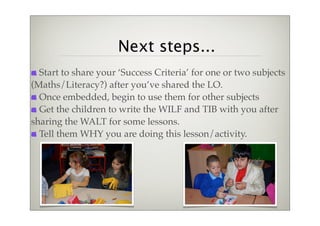
Next steps...
  Start to share your ‘Success Criteria’ for one or two subjects
(Maths/Literacy?) after you’ve shared the LO.
  Once embedded, begin to use them for other subjects
  Get the children to write the WILF and TIB with you after
sharing the WALT for some lessons.
  Tell them WHY you are doing this lesson/activity.

Walmley Wilf Inset

  • 1.
  • 2.
    Objectives To understand whatsuccess criteria are and how they can be used effectively to raise standards. To consider the progression needed in success criteria to be effective. To consider how you will use success criteria in your class.
  • 3.
    What are SuccessCriteria? They are nothing new- you already do it! We have always asked children ‘what are the key things you need to remember?’ Good teachers have always shared the smaller ‘steps to success’. In some schools, pupils know them as ‘WILF’ (What I’m Looking For...)
  • 4.
    What are SuccessCriteria? WALT- ‘We are Learning to’ or Learning Objective (LO) WILF- ‘What I’m looking for’ or Success Criteria TIB- ‘This is because’ or real life scenario/context
  • 5.
    What are SuccessCriteria? Enable children to be successful Link to the learning objective Clarify and add extra information to the LO They don’t take long to create or share at the beginning of a lesson
  • 6.
    Benefits for teachers Once the success criteria are planned the activities fall into place. OR... once the activities are planned, creating the success criteria focuses your thinking on the outcomes for pupils. The focus is on learning as opposed to activities. It clarifies your expectations. You know what you are going to be looking for when marking!
  • 7.
    Success criteria summarisethe key points that children need to understand as steps to success in achieving the learning objective. ‘Step by Step’ ‘Product’ Description of the The process - overall outcome or E.g. calculation end product. methods ‘Ingredients’ ‘It should be what you What needs to go are going to judge the into your work to children on at the end of make it good. the task’ E.g. instructions Shirley Clarke
  • 8.
    Effective Success Criteria… Arelinked to the learning objective Are specific to an activity Are shared and agreed with pupils prior to undertaking the activity Provide a scaffold and focus for pupils while engaged in the activity; and Are used as the basis for marking/feedback and peer or self-assessment.
  • 9.
    Examples of Effective Success Criteria (WILF) LO: write a narrative ghost story. WILF: Children who have WILF: Children who produce a • set the scene in the opening story that… paragraph; • built up tension/suspense; • People enjoy reading. • used spooky adjectives and • Frightens the reader! powerful verbs; and • ended with a cliff hanger. ‘PRODUCT’ WILF ‘INGREDIENTS’ WILF
  • 10.
    Examples of Effective Success Criteria (WILF) L.O: to present an LO: calculate the passing of argument. time in 5-minute intervals. WILF: Children who… WILF: Children who can… • include opening and closing • count from the minute hand statements • stop where the minute hand • give reasons for and against finishes • use evidence to support • count in fives • use language to persuade • go clockwise ‘INGREDIENTS’ WILF ‘STEP BY STEP’ WILF
  • 11.
    WALT/LO: write anewspaper report. LA Most HA Written in 3rd person Shows an Has a headline Includes a element of and picture headline, picture, viewpoint or Tells the story quotes from key opinion/bias after the event has people involved Evidence of happened. Is set out in Level 5 VCOP columns
  • 12.
    WALT/LO: create abalanced meal. LA Most HA Show examples Show a range of of foods from Identify proteins different foods. different groups and carbohydrates. Say if your plate Explain why Create a is healthy or not, you chose the balanced meal plan and explain why. items for a whole day.
  • 13.
    Writing Success Criteria Use the 3-box method to write a set of Success Criteria for one of the LO’s below, or one you are using over the next few days... LO: to write an account of the Great Fire of London LO: to use column addition to solve problems LO: to create a sequence of travel-balance-travel WALT: use formula in Excel to carry out calculations WALT: write a list WALT: create a freeze-frame for an event in a story
  • 14.
    Benefits for Children SuccessCriteria enable children to: Keep track of what has been done and what still needs to be done. Know the expectations of the teacher. Start to self-evaluate. Be in a position to mark work with a response partner. Confidently work with others who share the same success criteria.
  • 15.
    Using TIB’s TIB’s tellthe children why we doing this lesson or learning activity. It links their learning with real life contexts. It helps them to make links to their future plans, aspirations or careers. It raises expectations and gives them reasons to succeed.
  • 16.
    Example TIB’s Ina maths lesson focusing on mental calculations; “This will help you to calculate quickly in your head when you’re out shopping or help you in jobs such as accountant, carpenter or MP (!) In a literacy lesson focusing on writing; “This will help you to get the best results in your exams which will help you go to university. You might also use these skills when you become an author, journalist or lawyer.
  • 17.
    Example TIB’s In a PE lesson focusing on balances; “This will help you ride a bike, skateboard or surf-board or become a ballet dancer, footballer or gymnast. In a Science investigation; “You can use the skills we learn today in lots of jobs where you need to make predictions and solve problems; scientist, archaeologist, detective. Can you think of any more?
  • 18.
    Next steps... Start to share your ‘Success Criteria’ for one or two subjects (Maths/Literacy?) after you’ve shared the LO. Once embedded, begin to use them for other subjects Get the children to write the WILF and TIB with you after sharing the WALT for some lessons. Tell them WHY you are doing this lesson/activity.