DIVISIBILITY RULES
ALAN S. ABERILLA
Divisibility rules or Divisibility tests have been mentioned to
make the division procedure easier and quicker. If students
learn the division rules in Math or the divisibility tests for 1 to
20, they can solve the problems in a better way. For example,
divisibility rules for 13 help us to know which numbers are
completely divided by 13. Some numbers like 2, 3, 4, 5 have
rules which can be understood easily. But rules for 7, 11, 13,
are a little complex and need to be understood in-depth.
Mathematics is not easy for some of us. At times, the need for
tricks and shorthand techniques is felt, to solve Math
problems faster and easily without lengthy calculation. It will
also help students to score better marks in exams. These
rules are a great example of such shorthand techniques. In
this article, let us discuss the division rules in Math with many
Divisibility Test (Division Rules in Math)
As the name suggests, divisibility tests or division rules in
Math help one to check whether a number is divisible by
another number without the actual method of division. If a
number is completely divisible by another number then the
quotient will be a whole number and the remainder will be
zero.
Since every number is not completely divisible by every
other number such numbers leave remainder other than
zero. These rules are certain ones, which help us to
determine the actual divisor of a number just by
considering the digits of the number.
Divisibility Rule of 1
Every number is divisible by 1. Divisibility rule for 1
doesn’t have any condition. Any number divided by 1 will
give the number itself, irrespective of how large the
number is. For example, 3 is divisible by 1 and 3000 is
also divisible by 1 completely.
Divisibility Rule of 2
If a number is even or a number whose last digit is an
even number i.e. 2,4,6,8 including 0, it is always
completely divisible by 2.
Example: 508 is an even number and is divisible by 2 but
509 is not an even number, hence it is not divisible by 2.
Procedure to check whether 508 is divisible by 2 or not is
as follows:
• Consider the number 508
• Just take the last digit 8 and divide it by 2
• If the last digit 8 is divisible by 2 then the number 508 is
also divisible
by 2.
Divisibility Rules for 3
Divisibility rule for 3 states that a number is completely
divisible by 3 if the sum of its digits is divisible by 3.
Consider a number, 308. To check whether 308 is divisible by
3 or not, take sum of the digits (i.e. 3+0+8= 11). Now check
whether the sum is divisible by 3 or not. If the sum is a
multiple of 3, then the original number is also divisible by 3.
Here, since 11 is not divisible by 3, 308 is also not divisible by
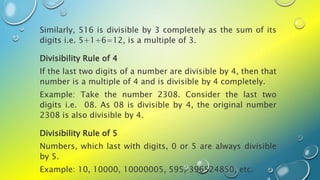
Similarly, 516 is divisible by 3 completely as the sum of its
digits i.e. 5+1+6=12, is a multiple of 3.
Divisibility Rule of 4
If the last two digits of a number are divisible by 4, then that
number is a multiple of 4 and is divisible by 4 completely.
Example: Take the number 2308. Consider the last two
digits i.e. 08. As 08 is divisible by 4, the original number
2308 is also divisible by 4.
Divisibility Rule of 5
Numbers, which last with digits, 0 or 5 are always divisible
by 5.
Example: 10, 10000, 10000005, 595, 396524850, etc.
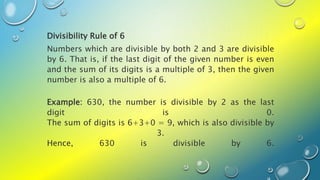
Divisibility Rule of 6
Numbers which are divisible by both 2 and 3 are divisible
by 6. That is, if the last digit of the given number is even
and the sum of its digits is a multiple of 3, then the given
number is also a multiple of 6.
Example: 630, the number is divisible by 2 as the last
digit is 0.
The sum of digits is 6+3+0 = 9, which is also divisible by
3.
Hence, 630 is divisible by 6.
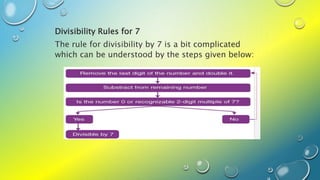
Divisibility Rules for 7
The rule for divisibility by 7 is a bit complicated
which can be understood by the steps given below:
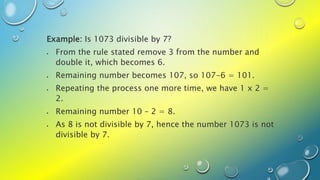
Example: Is 1073 divisible by 7?
 From the rule stated remove 3 from the number and
double it, which becomes 6.
 Remaining number becomes 107, so 107-6 = 101.
 Repeating the process one more time, we have 1 x 2 =
2.
 Remaining number 10 – 2 = 8.
 As 8 is not divisible by 7, hence the number 1073 is not
divisible by 7.
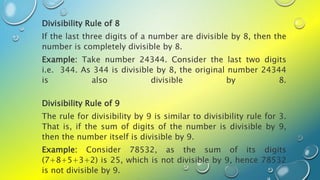
Divisibility Rule of 8
If the last three digits of a number are divisible by 8, then the
number is completely divisible by 8.
Example: Take number 24344. Consider the last two digits
i.e. 344. As 344 is divisible by 8, the original number 24344
is also divisible by 8.
Divisibility Rule of 9
The rule for divisibility by 9 is similar to divisibility rule for 3.
That is, if the sum of digits of the number is divisible by 9,
then the number itself is divisible by 9.
Example: Consider 78532, as the sum of its digits
(7+8+5+3+2) is 25, which is not divisible by 9, hence 78532
is not divisible by 9.
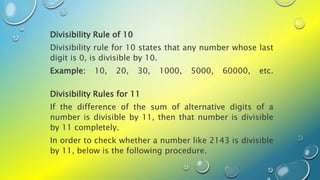
Divisibility Rule of 10
Divisibility rule for 10 states that any number whose last
digit is 0, is divisible by 10.
Example: 10, 20, 30, 1000, 5000, 60000, etc.
Divisibility Rules for 11
If the difference of the sum of alternative digits of a
number is divisible by 11, then that number is divisible
by 11 completely.
In order to check whether a number like 2143 is divisible
by 11, below is the following procedure.
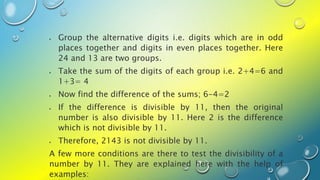
 Group the alternative digits i.e. digits which are in odd
places together and digits in even places together. Here
24 and 13 are two groups.
 Take the sum of the digits of each group i.e. 2+4=6 and
1+3= 4
 Now find the difference of the sums; 6-4=2
 If the difference is divisible by 11, then the original
number is also divisible by 11. Here 2 is the difference
which is not divisible by 11.
 Therefore, 2143 is not divisible by 11.
A few more conditions are there to test the divisibility of a
number by 11. They are explained here with the help of
examples:
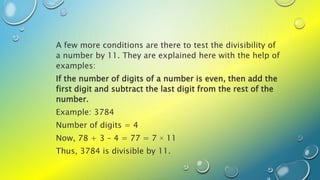
A few more conditions are there to test the divisibility of
a number by 11. They are explained here with the help of
examples:
If the number of digits of a number is even, then add the
first digit and subtract the last digit from the rest of the
number.
Example: 3784
Number of digits = 4
Now, 78 + 3 – 4 = 77 = 7 × 11
Thus, 3784 is divisible by 11.
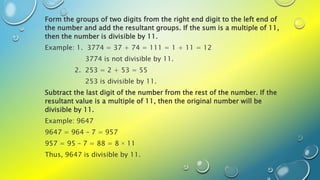
Form the groups of two digits from the right end digit to the left end of
the number and add the resultant groups. If the sum is a multiple of 11,
then the number is divisible by 11.
Example: 1. 3774 = 37 + 74 = 111 = 1 + 11 = 12
3774 is not divisible by 11.
2. 253 = 2 + 53 = 55
253 is divisible by 11.
Subtract the last digit of the number from the rest of the number. If the
resultant value is a multiple of 11, then the original number will be
divisible by 11.
Example: 9647
9647 = 964 – 7 = 957
957 = 95 – 7 = 88 = 8 × 11
Thus, 9647 is divisible by 11.
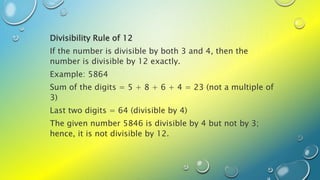
Divisibility Rule of 12
If the number is divisible by both 3 and 4, then the
number is divisible by 12 exactly.
Example: 5864
Sum of the digits = 5 + 8 + 6 + 4 = 23 (not a multiple of
3)
Last two digits = 64 (divisible by 4)
The given number 5846 is divisible by 4 but not by 3;
hence, it is not divisible by 12.
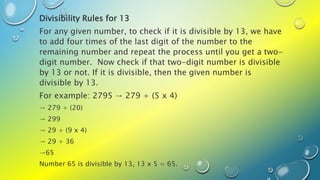
Divisibility Rules for 13
For any given number, to check if it is divisible by 13, we have
to add four times of the last digit of the number to the
remaining number and repeat the process until you get a two-
digit number. Now check if that two-digit number is divisible
by 13 or not. If it is divisible, then the given number is
divisible by 13.
For example: 2795 → 279 + (5 x 4)
→ 279 + (20)
→ 299
→ 29 + (9 x 4)
→ 29 + 36
→65
Number 65 is divisible by 13, 13 x 5 = 65.
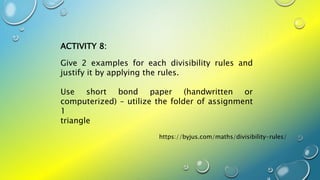
ACTIVITY 8:
Give 2 examples for each divisibility rules and
justify it by applying the rules.
Use short bond paper (handwritten or
computerized) – utilize the folder of assignment
1
triangle
https://byjus.com/maths/divisibility-rules/
Lesson 9   divisibility rules

Lesson 9 divisibility rules

  • 1.
  • 2.
    Divisibility rules orDivisibility tests have been mentioned to make the division procedure easier and quicker. If students learn the division rules in Math or the divisibility tests for 1 to 20, they can solve the problems in a better way. For example, divisibility rules for 13 help us to know which numbers are completely divided by 13. Some numbers like 2, 3, 4, 5 have rules which can be understood easily. But rules for 7, 11, 13, are a little complex and need to be understood in-depth. Mathematics is not easy for some of us. At times, the need for tricks and shorthand techniques is felt, to solve Math problems faster and easily without lengthy calculation. It will also help students to score better marks in exams. These rules are a great example of such shorthand techniques. In this article, let us discuss the division rules in Math with many
  • 3.
    Divisibility Test (DivisionRules in Math) As the name suggests, divisibility tests or division rules in Math help one to check whether a number is divisible by another number without the actual method of division. If a number is completely divisible by another number then the quotient will be a whole number and the remainder will be zero. Since every number is not completely divisible by every other number such numbers leave remainder other than zero. These rules are certain ones, which help us to determine the actual divisor of a number just by considering the digits of the number.
  • 4.
    Divisibility Rule of1 Every number is divisible by 1. Divisibility rule for 1 doesn’t have any condition. Any number divided by 1 will give the number itself, irrespective of how large the number is. For example, 3 is divisible by 1 and 3000 is also divisible by 1 completely. Divisibility Rule of 2 If a number is even or a number whose last digit is an even number i.e. 2,4,6,8 including 0, it is always completely divisible by 2. Example: 508 is an even number and is divisible by 2 but 509 is not an even number, hence it is not divisible by 2. Procedure to check whether 508 is divisible by 2 or not is as follows:
  • 5.
    • Consider thenumber 508 • Just take the last digit 8 and divide it by 2 • If the last digit 8 is divisible by 2 then the number 508 is also divisible by 2. Divisibility Rules for 3 Divisibility rule for 3 states that a number is completely divisible by 3 if the sum of its digits is divisible by 3. Consider a number, 308. To check whether 308 is divisible by 3 or not, take sum of the digits (i.e. 3+0+8= 11). Now check whether the sum is divisible by 3 or not. If the sum is a multiple of 3, then the original number is also divisible by 3. Here, since 11 is not divisible by 3, 308 is also not divisible by
  • 6.
    Similarly, 516 isdivisible by 3 completely as the sum of its digits i.e. 5+1+6=12, is a multiple of 3. Divisibility Rule of 4 If the last two digits of a number are divisible by 4, then that number is a multiple of 4 and is divisible by 4 completely. Example: Take the number 2308. Consider the last two digits i.e. 08. As 08 is divisible by 4, the original number 2308 is also divisible by 4. Divisibility Rule of 5 Numbers, which last with digits, 0 or 5 are always divisible by 5. Example: 10, 10000, 10000005, 595, 396524850, etc.
  • 7.
    Divisibility Rule of6 Numbers which are divisible by both 2 and 3 are divisible by 6. That is, if the last digit of the given number is even and the sum of its digits is a multiple of 3, then the given number is also a multiple of 6. Example: 630, the number is divisible by 2 as the last digit is 0. The sum of digits is 6+3+0 = 9, which is also divisible by 3. Hence, 630 is divisible by 6.
  • 8.
    Divisibility Rules for7 The rule for divisibility by 7 is a bit complicated which can be understood by the steps given below:
  • 9.
    Example: Is 1073divisible by 7?  From the rule stated remove 3 from the number and double it, which becomes 6.  Remaining number becomes 107, so 107-6 = 101.  Repeating the process one more time, we have 1 x 2 = 2.  Remaining number 10 – 2 = 8.  As 8 is not divisible by 7, hence the number 1073 is not divisible by 7.
  • 10.
    Divisibility Rule of8 If the last three digits of a number are divisible by 8, then the number is completely divisible by 8. Example: Take number 24344. Consider the last two digits i.e. 344. As 344 is divisible by 8, the original number 24344 is also divisible by 8. Divisibility Rule of 9 The rule for divisibility by 9 is similar to divisibility rule for 3. That is, if the sum of digits of the number is divisible by 9, then the number itself is divisible by 9. Example: Consider 78532, as the sum of its digits (7+8+5+3+2) is 25, which is not divisible by 9, hence 78532 is not divisible by 9.
  • 11.
    Divisibility Rule of10 Divisibility rule for 10 states that any number whose last digit is 0, is divisible by 10. Example: 10, 20, 30, 1000, 5000, 60000, etc. Divisibility Rules for 11 If the difference of the sum of alternative digits of a number is divisible by 11, then that number is divisible by 11 completely. In order to check whether a number like 2143 is divisible by 11, below is the following procedure.
  • 12.
     Group thealternative digits i.e. digits which are in odd places together and digits in even places together. Here 24 and 13 are two groups.  Take the sum of the digits of each group i.e. 2+4=6 and 1+3= 4  Now find the difference of the sums; 6-4=2  If the difference is divisible by 11, then the original number is also divisible by 11. Here 2 is the difference which is not divisible by 11.  Therefore, 2143 is not divisible by 11. A few more conditions are there to test the divisibility of a number by 11. They are explained here with the help of examples:
  • 13.
    A few moreconditions are there to test the divisibility of a number by 11. They are explained here with the help of examples: If the number of digits of a number is even, then add the first digit and subtract the last digit from the rest of the number. Example: 3784 Number of digits = 4 Now, 78 + 3 – 4 = 77 = 7 × 11 Thus, 3784 is divisible by 11.
  • 14.
    Form the groupsof two digits from the right end digit to the left end of the number and add the resultant groups. If the sum is a multiple of 11, then the number is divisible by 11. Example: 1. 3774 = 37 + 74 = 111 = 1 + 11 = 12 3774 is not divisible by 11. 2. 253 = 2 + 53 = 55 253 is divisible by 11. Subtract the last digit of the number from the rest of the number. If the resultant value is a multiple of 11, then the original number will be divisible by 11. Example: 9647 9647 = 964 – 7 = 957 957 = 95 – 7 = 88 = 8 × 11 Thus, 9647 is divisible by 11.
  • 15.
    Divisibility Rule of12 If the number is divisible by both 3 and 4, then the number is divisible by 12 exactly. Example: 5864 Sum of the digits = 5 + 8 + 6 + 4 = 23 (not a multiple of 3) Last two digits = 64 (divisible by 4) The given number 5846 is divisible by 4 but not by 3; hence, it is not divisible by 12.
  • 16.
    Divisibility Rules for13 For any given number, to check if it is divisible by 13, we have to add four times of the last digit of the number to the remaining number and repeat the process until you get a two- digit number. Now check if that two-digit number is divisible by 13 or not. If it is divisible, then the given number is divisible by 13. For example: 2795 → 279 + (5 x 4) → 279 + (20) → 299 → 29 + (9 x 4) → 29 + 36 →65 Number 65 is divisible by 13, 13 x 5 = 65.
  • 17.
    ACTIVITY 8: Give 2examples for each divisibility rules and justify it by applying the rules. Use short bond paper (handwritten or computerized) – utilize the folder of assignment 1 triangle https://byjus.com/maths/divisibility-rules/