The Body Fluids
Lesson 8
Biochemistry (MC Lecture)
Easter College,
Incorporated
Julius M. Panayo, RMT
Instructor
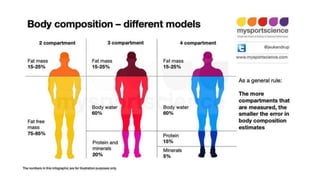
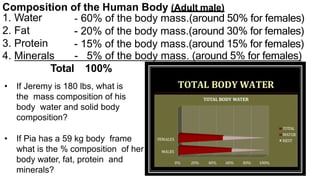
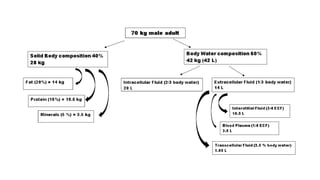
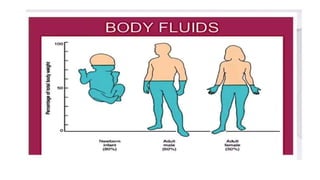
Composition of the Human Body (Adult male)
1. Water
2. Fat
3. Protein
- 60% of the body mass.(around 50% for females)
- 20% of the body mass.(around 30% for females)
- 15% of the body mass.(around 15% for females)
4. Minerals - 5% of the body mass. (around 5% for females)
Total 100%
• If Jeremy is 180 lbs, what is
the mass composition of his
body water and solid body
composition?
• If Pia has a 59 kg body frame
what is the % composition of her
body water, fat, protein and
minerals?
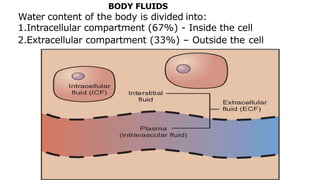
BODY FLUIDS
Water content of the body is divided into:
1.Intracellular compartment (67%) - Inside the cell
2.Extracellular compartment (33%) – Outside the cell
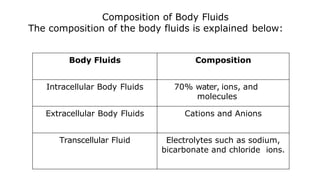
Body Fluids Composition
Intracellular Body Fluids 70% water, ions, and
molecules
Extracellular Body Fluids Cations and Anions
Transcellular Fluid Electrolytes such as sodium,
bicarbonate and chloride ions.
Composition of Body Fluids
The composition of the body fluids is explained below:
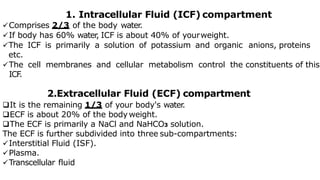
1. Intracellular Fluid (ICF) compartment
Comprises 2/3 of the body water
.
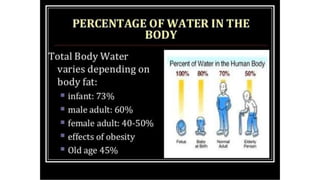
If body has 60% water
, ICF is about 40% of yourweight.
The ICF is primarily a solution of potassium and organic anions, proteins
etc.
The cell membranes and cellular metabolism control the constituents of this
ICF
.
2.Extracellular Fluid (ECF) compartment
It is the remaining 1/3 of your body's water
.
ECF is about 20% of the body weight.
The ECF is primarily a NaCl and NaHCO3 solution.
The ECF is further subdivided into three sub-compartments:
Interstitial Fluid (ISF).
Plasma.
Transcellular fluid
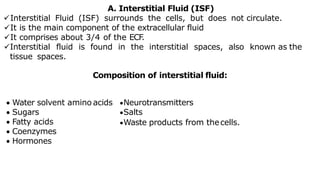
A. Interstitial Fluid (ISF)
Interstitial Fluid (ISF) surrounds the cells, but does not circulate.
It is the main component of the extracellular fluid
It comprises about 3/4 of the ECF
.
Interstitial fluid is found in the interstitial spaces, also known as the
tissue spaces.
Composition of interstitial fluid:
 Water solvent amino acids
 Sugars
 Fatty acids
 Coenzymes
 Hormones
Neurotransmitters
Salts
Waste products from thecells.
Function of interstitial fluid
Intercellular communication.
Interstitial fluid bathes the cells of the tissues.
Removal of metabolic waste.
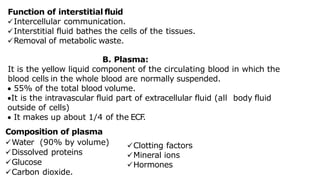
B. Plasma:
It is the yellow liquid component of the circulating blood in which the
blood cells in the whole blood are normally suspended.
 55% of the total blood volume.
It is the intravascular fluid part of extracellular fluid (all body fluid
outside of cells)
 It makes up about 1/4 of the ECF
.
Composition of plasma
Water (90% by volume)
Dissolved proteins
Glucose
Carbon dioxide.
Clotting factors
Mineral ions
Hormones
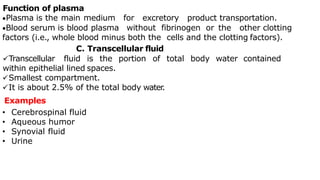
Function of plasma
Plasma is the main medium for excretory product transportation.
Blood serum is blood plasma without fibrinogen or the other clotting
factors (i.e., whole blood minus both the cells and the clotting factors).
C. Transcellular fluid
Transcellular fluid is the portion of total body water contained
within epithelial lined spaces.
Smallest compartment.
It is about 2.5% of the total body water
.
Examples
• Cerebrospinal fluid
• Aqueous humor
• Synovial fluid
• Urine
BODY FLUIDS
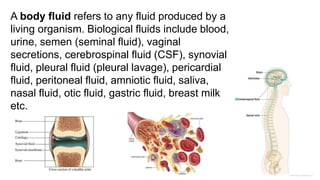
A body fluid refers to any fluid produced by a
living organism. Biological fluids include blood,
urine, semen (seminal fluid), vaginal
secretions, cerebrospinal fluid (CSF), synovial
fluid, pleural fluid (pleural lavage), pericardial
fluid, peritoneal fluid, amniotic fluid, saliva,
nasal fluid, otic fluid, gastric fluid, breast milk
etc.
BODY FLUIDS
Blood and lymph are the two most important body fluids in the human
body. Blood comprises of plasma, white blood cells, red blood cells,
and platelets.
Lymph is a colorless fluid that circulates inside the lymphatic vessels.
FUNCTIONS OF BODY FLUIDS
The important functions of body fluids include:
 The body fluids facilitate the transportation of oxygen and
nutrients throughout the body and remove the waste from the
body.
 They help in regulating the body temperature.
 They maintain an efficient metabolism of the body.
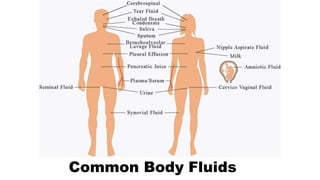
Common Body Fluids
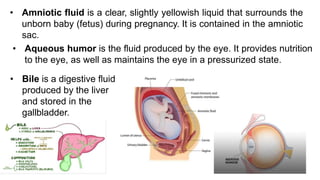
• Amniotic fluid is a clear, slightly yellowish liquid that surrounds the
unborn baby (fetus) during pregnancy. It is contained in the amniotic
sac.
• Aqueous humor is the fluid produced by the eye. It provides nutrition
to the eye, as well as maintains the eye in a pressurized state.
• Bile is a digestive fluid
produced by the liver
and stored in the
gallbladder.
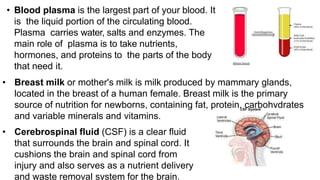
• Blood plasma is the largest part of your blood. It
is the liquid portion of the circulating blood.
Plasma carries water, salts and enzymes. The
main role of plasma is to take nutrients,
hormones, and proteins to the parts of the body
that need it.
• Breast milk or mother's milk is milk produced by mammary glands,
located in the breast of a human female. Breast milk is the primary
source of nutrition for newborns, containing fat, protein, carbohydrates
and variable minerals and vitamins.
• Cerebrospinal fluid (CSF) is a clear fluid
that surrounds the brain and spinal cord. It
cushions the brain and spinal cord from
injury and also serves as a nutrient delivery
and waste removal system for the brain.
• Cerumen is the medical term for
earwax. It is a brown, orange, red,
yellowish or gray waxy substance
secreted in the ear canal of
humans and other mammals.
• Chyle is a milky bodily fluid
consisting of lymph and
emulsified fats, or free fatty
acids. It is formed in the small
intestine during digestion of fatty
foods, and taken up by lymph
vessels specifically known as
lacteals.
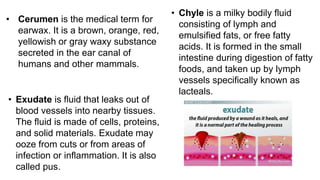
• Exudate is fluid that leaks out of
blood vessels into nearby tissues.
The fluid is made of cells, proteins,
and solid materials. Exudate may
ooze from cuts or from areas of
infection or inflammation. It is also
called pus.
• Gastric juice is a variable mixture of water,
hydrochloric acid, electrolytes (sodium,
potassium, calcium, phosphate, sulfate, and
bicarbonate), and organic substances (mucus,
pepsins, and protein). This juice is highly
acidic because of its hydrochloric acid content,
and it is rich in enzymes.
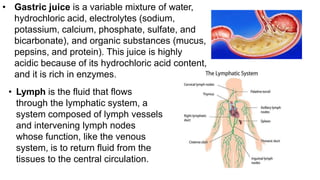
• Lymph is the fluid that flows
through the lymphatic system, a
system composed of lymph vessels
and intervening lymph nodes
whose function, like the venous
system, is to return fluid from the
tissues to the central circulation.
• Mucus is a normal, slippery and stringy
fluid substance produced by many lining
tissues in the body. It is essential for body
function and acts as a protective and
moisturizing layer to keep critical organs
from drying out. Mucus also acts as a trap
for irritants like dust, smoke, or bacteria.
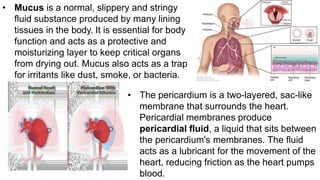
• The pericardium is a two-layered, sac-like
membrane that surrounds the heart.
Pericardial membranes produce
pericardial fluid, a liquid that sits between
the pericardium's membranes. The fluid
acts as a lubricant for the movement of the
heart, reducing friction as the heart pumps
blood.
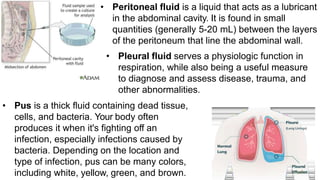
• Peritoneal fluid is a liquid that acts as a lubricant
in the abdominal cavity. It is found in small
quantities (generally 5-20 mL) between the layers
of the peritoneum that line the abdominal wall.
• Pleural fluid serves a physiologic function in
respiration, while also being a useful measure
to diagnose and assess disease, trauma, and
other abnormalities.
• Pus is a thick fluid containing dead tissue,
cells, and bacteria. Your body often
produces it when it's fighting off an
infection, especially infections caused by
bacteria. Depending on the location and
type of infection, pus can be many colors,
including white, yellow, green, and brown.
• Saliva is a thick, colorless, opalescent fluid that is constantly present in
the mouth of humans and other vertebrates. It is composed of water,
mucus, proteins, mineral salts, and amylase. As saliva circulates in the
mouth cavity it picks up food debris, bacterial cells, and white blood cells.
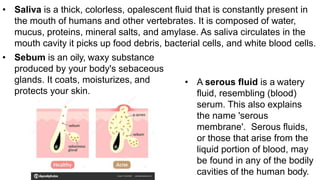
• Sebum is an oily, waxy substance
produced by your body's sebaceous
glands. It coats, moisturizes, and
protects your skin.
• A serous fluid is a watery
fluid, resembling (blood)
serum. This also explains
the name 'serous
membrane'. Serous fluids,
or those that arise from the
liquid portion of blood, may
be found in any of the bodily
cavities of the human body.
• Semen is the thick fluid that
comes from men's penis when
they ejaculate during sexual
activity. It carries sperm out of a
man's body so it can fertilize an
egg and create an embryo (the
first stage of pregnancy).
• Sputum is a type of thick mucus that is
produced by the lungs when they are
diseased or damaged. Sputum is
produced when a person’s lungs are
diseased or damaged. Sputum is not
saliva but the thick mucus – sometimes
called phlegm – which is coughed up
from the lungs.
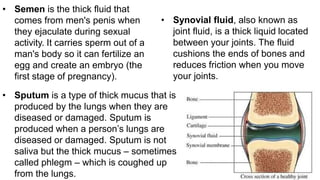
• Synovial fluid, also known as
joint fluid, is a thick liquid located
between your joints. The fluid
cushions the ends of bones and
reduces friction when you move
your joints.
• Sweat is produced by
glands in the deeper layer
of the skin, the dermis.
Sweat glands occur all
over the body, but are
most numerous on the
forehead, the armpits, the
palms and the soles of the
feet. Sweat is mainly
water, but it also contains
some salts. Its main
function is to control body
temperature. As the water
in the sweat evaporates,
the surface of the skin
cools.
• Tears are a clear liquid secreted by the
lacrimal glands (tear gland) found in the
eyes of all land mammals (except for
goats and rabbits). Their functions
include lubricating the eyes (basal
tears), removing irritants (reflex tears),
and aiding the immune system.
• Urine is a liquid by-product of metabolism
in humans and in many other animals.
Urine flows from the kidneys through the
ureters to the urinary bladder.
• Vomit is the ejected matter from the
stomach through the mouth and
sometimes through the nose brought
about by emesis or throwing up.

Lesson 8 BODY FLUIDS.pptx

  • 1.
    The Body Fluids Lesson8 Biochemistry (MC Lecture) Easter College, Incorporated Julius M. Panayo, RMT Instructor
  • 3.
    Composition of theHuman Body (Adult male) 1. Water 2. Fat 3. Protein - 60% of the body mass.(around 50% for females) - 20% of the body mass.(around 30% for females) - 15% of the body mass.(around 15% for females) 4. Minerals - 5% of the body mass. (around 5% for females) Total 100% • If Jeremy is 180 lbs, what is the mass composition of his body water and solid body composition? • If Pia has a 59 kg body frame what is the % composition of her body water, fat, protein and minerals?
  • 6.
    BODY FLUIDS Water contentof the body is divided into: 1.Intracellular compartment (67%) - Inside the cell 2.Extracellular compartment (33%) – Outside the cell
  • 7.
    Body Fluids Composition IntracellularBody Fluids 70% water, ions, and molecules Extracellular Body Fluids Cations and Anions Transcellular Fluid Electrolytes such as sodium, bicarbonate and chloride ions. Composition of Body Fluids The composition of the body fluids is explained below:
  • 8.
    1. Intracellular Fluid(ICF) compartment Comprises 2/3 of the body water . If body has 60% water , ICF is about 40% of yourweight. The ICF is primarily a solution of potassium and organic anions, proteins etc. The cell membranes and cellular metabolism control the constituents of this ICF . 2.Extracellular Fluid (ECF) compartment It is the remaining 1/3 of your body's water . ECF is about 20% of the body weight. The ECF is primarily a NaCl and NaHCO3 solution. The ECF is further subdivided into three sub-compartments: Interstitial Fluid (ISF). Plasma. Transcellular fluid
  • 9.
    A. Interstitial Fluid(ISF) Interstitial Fluid (ISF) surrounds the cells, but does not circulate. It is the main component of the extracellular fluid It comprises about 3/4 of the ECF . Interstitial fluid is found in the interstitial spaces, also known as the tissue spaces. Composition of interstitial fluid:  Water solvent amino acids  Sugars  Fatty acids  Coenzymes  Hormones Neurotransmitters Salts Waste products from thecells.
  • 10.
    Function of interstitialfluid Intercellular communication. Interstitial fluid bathes the cells of the tissues. Removal of metabolic waste. B. Plasma: It is the yellow liquid component of the circulating blood in which the blood cells in the whole blood are normally suspended.  55% of the total blood volume. It is the intravascular fluid part of extracellular fluid (all body fluid outside of cells)  It makes up about 1/4 of the ECF . Composition of plasma Water (90% by volume) Dissolved proteins Glucose Carbon dioxide. Clotting factors Mineral ions Hormones
  • 11.
    Function of plasma Plasmais the main medium for excretory product transportation. Blood serum is blood plasma without fibrinogen or the other clotting factors (i.e., whole blood minus both the cells and the clotting factors). C. Transcellular fluid Transcellular fluid is the portion of total body water contained within epithelial lined spaces. Smallest compartment. It is about 2.5% of the total body water . Examples • Cerebrospinal fluid • Aqueous humor • Synovial fluid • Urine
  • 12.
  • 13.
    A body fluidrefers to any fluid produced by a living organism. Biological fluids include blood, urine, semen (seminal fluid), vaginal secretions, cerebrospinal fluid (CSF), synovial fluid, pleural fluid (pleural lavage), pericardial fluid, peritoneal fluid, amniotic fluid, saliva, nasal fluid, otic fluid, gastric fluid, breast milk etc.
  • 14.
    BODY FLUIDS Blood andlymph are the two most important body fluids in the human body. Blood comprises of plasma, white blood cells, red blood cells, and platelets. Lymph is a colorless fluid that circulates inside the lymphatic vessels. FUNCTIONS OF BODY FLUIDS The important functions of body fluids include:  The body fluids facilitate the transportation of oxygen and nutrients throughout the body and remove the waste from the body.  They help in regulating the body temperature.  They maintain an efficient metabolism of the body.
  • 15.
  • 16.
    • Amniotic fluidis a clear, slightly yellowish liquid that surrounds the unborn baby (fetus) during pregnancy. It is contained in the amniotic sac. • Aqueous humor is the fluid produced by the eye. It provides nutrition to the eye, as well as maintains the eye in a pressurized state. • Bile is a digestive fluid produced by the liver and stored in the gallbladder.
  • 17.
    • Blood plasmais the largest part of your blood. It is the liquid portion of the circulating blood. Plasma carries water, salts and enzymes. The main role of plasma is to take nutrients, hormones, and proteins to the parts of the body that need it. • Breast milk or mother's milk is milk produced by mammary glands, located in the breast of a human female. Breast milk is the primary source of nutrition for newborns, containing fat, protein, carbohydrates and variable minerals and vitamins. • Cerebrospinal fluid (CSF) is a clear fluid that surrounds the brain and spinal cord. It cushions the brain and spinal cord from injury and also serves as a nutrient delivery and waste removal system for the brain.
  • 18.
    • Cerumen isthe medical term for earwax. It is a brown, orange, red, yellowish or gray waxy substance secreted in the ear canal of humans and other mammals. • Chyle is a milky bodily fluid consisting of lymph and emulsified fats, or free fatty acids. It is formed in the small intestine during digestion of fatty foods, and taken up by lymph vessels specifically known as lacteals. • Exudate is fluid that leaks out of blood vessels into nearby tissues. The fluid is made of cells, proteins, and solid materials. Exudate may ooze from cuts or from areas of infection or inflammation. It is also called pus.
  • 19.
    • Gastric juiceis a variable mixture of water, hydrochloric acid, electrolytes (sodium, potassium, calcium, phosphate, sulfate, and bicarbonate), and organic substances (mucus, pepsins, and protein). This juice is highly acidic because of its hydrochloric acid content, and it is rich in enzymes. • Lymph is the fluid that flows through the lymphatic system, a system composed of lymph vessels and intervening lymph nodes whose function, like the venous system, is to return fluid from the tissues to the central circulation.
  • 20.
    • Mucus isa normal, slippery and stringy fluid substance produced by many lining tissues in the body. It is essential for body function and acts as a protective and moisturizing layer to keep critical organs from drying out. Mucus also acts as a trap for irritants like dust, smoke, or bacteria. • The pericardium is a two-layered, sac-like membrane that surrounds the heart. Pericardial membranes produce pericardial fluid, a liquid that sits between the pericardium's membranes. The fluid acts as a lubricant for the movement of the heart, reducing friction as the heart pumps blood.
  • 21.
    • Peritoneal fluidis a liquid that acts as a lubricant in the abdominal cavity. It is found in small quantities (generally 5-20 mL) between the layers of the peritoneum that line the abdominal wall. • Pleural fluid serves a physiologic function in respiration, while also being a useful measure to diagnose and assess disease, trauma, and other abnormalities. • Pus is a thick fluid containing dead tissue, cells, and bacteria. Your body often produces it when it's fighting off an infection, especially infections caused by bacteria. Depending on the location and type of infection, pus can be many colors, including white, yellow, green, and brown.
  • 22.
    • Saliva isa thick, colorless, opalescent fluid that is constantly present in the mouth of humans and other vertebrates. It is composed of water, mucus, proteins, mineral salts, and amylase. As saliva circulates in the mouth cavity it picks up food debris, bacterial cells, and white blood cells. • Sebum is an oily, waxy substance produced by your body's sebaceous glands. It coats, moisturizes, and protects your skin. • A serous fluid is a watery fluid, resembling (blood) serum. This also explains the name 'serous membrane'. Serous fluids, or those that arise from the liquid portion of blood, may be found in any of the bodily cavities of the human body.
  • 23.
    • Semen isthe thick fluid that comes from men's penis when they ejaculate during sexual activity. It carries sperm out of a man's body so it can fertilize an egg and create an embryo (the first stage of pregnancy). • Sputum is a type of thick mucus that is produced by the lungs when they are diseased or damaged. Sputum is produced when a person’s lungs are diseased or damaged. Sputum is not saliva but the thick mucus – sometimes called phlegm – which is coughed up from the lungs. • Synovial fluid, also known as joint fluid, is a thick liquid located between your joints. The fluid cushions the ends of bones and reduces friction when you move your joints.
  • 24.
    • Sweat isproduced by glands in the deeper layer of the skin, the dermis. Sweat glands occur all over the body, but are most numerous on the forehead, the armpits, the palms and the soles of the feet. Sweat is mainly water, but it also contains some salts. Its main function is to control body temperature. As the water in the sweat evaporates, the surface of the skin cools. • Tears are a clear liquid secreted by the lacrimal glands (tear gland) found in the eyes of all land mammals (except for goats and rabbits). Their functions include lubricating the eyes (basal tears), removing irritants (reflex tears), and aiding the immune system. • Urine is a liquid by-product of metabolism in humans and in many other animals. Urine flows from the kidneys through the ureters to the urinary bladder. • Vomit is the ejected matter from the stomach through the mouth and sometimes through the nose brought about by emesis or throwing up.