ERYTHROCYTE 
SEDIMENTATION RATE 
RAJESH MOHESS, CLT.AL.
ERYTHROCYTE SEDIMENTATION RATE (ESR) 
• The erythrocyte sedimentation rate (ESR) is a 
nnoonnssppeecciiffiicc ssccrreeeenniinngg tteesstt indicative of 
inflammation 
• There are two methods of determining ESR: 
Westergren and Wintrobe 
• Studies have shown that the Wintrobe method 
was found to be misleading in some important 
cases 
• As a result, the Westergren method is most widely 
used
ERYTHROCYTE SEDIMENTATION RATE (ESR) 
• Anticoagulated blood is drawn up into a tube of standardized 
dimensions and left in a vertical position for exactly one hour. 
• After that period the point at which the red cells have separated and 
settled from the plasma is recorded by reading from the scale on the 
side of the tube. 
• This test measures the distance that RBCs will fall in a vertical tube 
over a given time period 
• It is used as an initial screening tool and also as a follow-up test to 
monitor therapy and progression or remission of disease. 
• The ESR is directly proportional to red cell mass 
• The ESR is reported in millimeters
ERYTHROCYTE SEDIMENTATION RATE (ESR) 
• Although the test has been used since 1926 the phenomenon 
of red cell sedimentation is still only partly understood. 
• However three definite phases have been identified in the 
process. 
• During the first, or Lag Phase, the red cells form a 
characteristic rouleaux pattern and sedimentation is 
generally slow. 
• The rate accelerates in the second period, the Decantation 
Phase, and slows again in the final Packing Phase as red cell 
aggregates pile up at the base of the tube
ERYTHROCYTE SEDIMENTATION RATE (ESR) 
• The size of the rouleaux aggregates formed in the Lag Phase is the 
critical factor affecting the final result of the ESR. 
• The rouleaux itself appears to be influenced mainly by certain plasma 
proteins including fibrinogen, IgM and alpha2-macroglobulin. 
• From the above it can be seen that the sedimentation 'rate' of the red 
cells is not linear. 
• Further, the time taken for each of the three phases will differ 
between patients. 
• Therefore no attempt should be made to 'estimate' the result at 1 
hour by doubling the value at 30 minutes or multiplying by three after 
20 minutes
ERYTHROCYTE SEDIMENTATION RATE (ESR) 
• Any condition that will increase rouleaux formation will 
usually increase the settling of red cells. 
• Specimens that are not properly anticoagulated will 
also affect red cell settling. 
EDTA is the recommended anticoagulant
ERYTHROCYTE SEDIMENTATION RATE (ESR) 
EQUIPMENT 
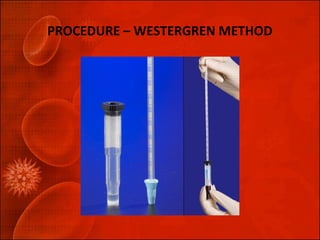
• Westergren ESR system 
• Wintrobe system (tubes) 
• Disposable pipette
PROCEDURE – WESTERGREN METHOD
PROCEDURE – WESTERGREN METHOD 
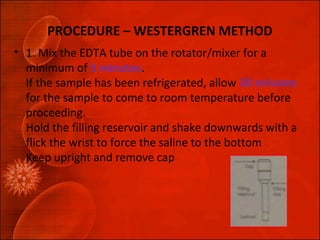
• 1. Mix the EDTA tube on the rotator/mixer for a 
minimum of 5 minutes. 
If the sample has been refrigerated, allow 30 minutes 
for the sample to come to room temperature before 
proceeding. 
Hold the filling reservoir and shake downwards with a 
flick the wrist to force the saline to the bottom 
Keep upright and remove cap
PROCEDURE – WESTERGREN METHOD 
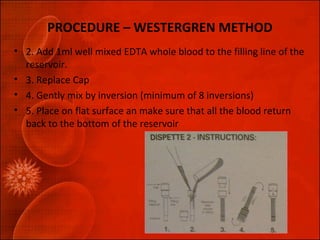
• 2. Add 1ml well mixed EDTA whole blood to the filling line of the 
reservoir. 
• 3. Replace Cap 
• 4. Gently mix by inversion (minimum of 8 inversions) 
• 5. Place on flat surface an make sure that all the blood return 
back to the bottom of the reservoir
PROCEDURE – WESTERGREN METHOD 
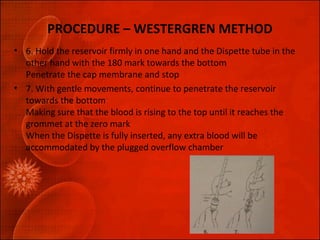
• 6. Hold the reservoir firmly in one hand and the Dispette tube in the 
other hand with the 180 mark towards the bottom 
Penetrate the cap membrane and stop 
• 7. With gentle movements, continue to penetrate the reservoir 
towards the bottom 
Making sure that the blood is rising to the top until it reaches the 
grommet at the zero mark 
When the Dispette is fully inserted, any extra blood will be 
accommodated by the plugged overflow chamber
PROCEDURE – WESTERGREN METHOD 
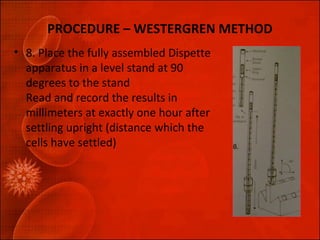
• 8. Place the fully assembled Dispette 
apparatus in a level stand at 90 
degrees to the stand 
Read and record the results in 
millimeters at exactly one hour after 
settling upright (distance which the 
cells have settled)
PROCEDURE – WINTROBE METHOD 
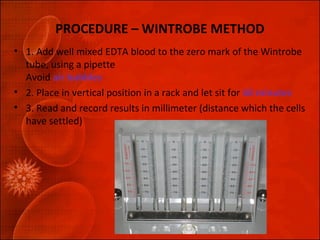
• 1. Add well mixed EDTA blood to the zero mark of the Wintrobe 
tube, using a pipette 
Avoid air bubbles 
• 2. Place in vertical position in a rack and let sit for 60 minutes 
• 3. Read and record results in millimeter (distance which the cells 
have settled)
ERYTHROCYTE SEDIMENTATION RATE 
NORMAL RANGE 
• Men 0 to 20 mm/hr 
• Women 0 to 30 mm/hr
LIMITATIONS 
• 1. Tubes not filled properly will yield erroneous results. 
• 2. Refrigerated specimens must come to room temperature for 30 
minutes prior to testing. 
• 3. The ESR rack must be on a level surface and free of vibration. 
Vibration can cause a falsely increased ESR. 
• 4. Cold agglutinins can cause a falsely elevated ESR. 
An ESR can be performed at 37 degrees C (incubator) for 60 minutes with 
no ill effects. 
• 5. Red cell shape and size: Specimens containing sickle cells, 
acanthocytes, or spherocytes will settle slowly and give a decreased ESR 
• 6. Increased rouleaux formation, excessive globulin, or increased 
fibrinogen will increase the ESR.
LIMITATIONS 
• 7. Specimen must be free of clots and/or fibrin. 
• 8. A tilted ESR tube gives erroneous results. 
• 9. Hemolyzed samples are not acceptable. 
• 10. Specimens older than 24 hours are not acceptable. 
• 11. Do not pick up the stand to read results as this will affect other 
tests in progress. 
Bring the eye to the level of the top of the red cells to read 
accurately from the scale 
• 12. Results must be read at exactly one hour, otherwise the cells 
with continue to sediment resulting in higher results
PATHOLOGICAL CONDITIONS ASSOCIATED WITH ESR 
Increased ESR 
• 1. KKiiddnneeyy ddiisseeaassee 
• 22.. PPrreeggnnaannccyy 
• 33.. RRhheeuummaattiicc ffeevveerr 
• 44.. RRhheeuummaattooiidd aarrtthhrriittiiss 
• 55.. AAnneemmiiaa 
• 66.. SSyypphhiilliiss 
• 77.. SSyysstteemmiicc lluuppuuss eerryytthheemmaattoossuuss 
• 88.. TThhyyrrooiidd ddiisseeaassee 
• 99.. EElleevvaatteedd rroooomm tteemmppeerraattuurree 
• 1100.. IIsscchheemmiicc ssttrrookkee 
• 1111.. TTeemmppoorraall aarrtteerriittiiss
PATHOLOGICAL CONDITIONS ASSOCIATED WITH ESR 
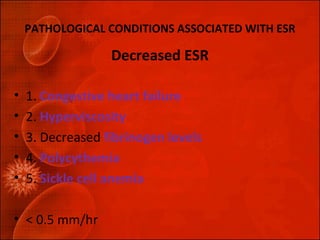
Decreased ESR 
• 1. Congestive heart failure 
• 2. Hyperviscosity 
• 3. Decreased fibrinogen levels 
• 4. Polycythemia 
• 5. Sickle cell anemia 
• < 0.5 mm/hr
ERYTHROCYTE SEDIMENTATION RATE 
THE END

Erythrocyte sedimentation rate (esr)

  • 1.
    ERYTHROCYTE SEDIMENTATION RATE RAJESH MOHESS, CLT.AL.
  • 2.
    ERYTHROCYTE SEDIMENTATION RATE(ESR) • The erythrocyte sedimentation rate (ESR) is a nnoonnssppeecciiffiicc ssccrreeeenniinngg tteesstt indicative of inflammation • There are two methods of determining ESR: Westergren and Wintrobe • Studies have shown that the Wintrobe method was found to be misleading in some important cases • As a result, the Westergren method is most widely used
  • 3.
    ERYTHROCYTE SEDIMENTATION RATE(ESR) • Anticoagulated blood is drawn up into a tube of standardized dimensions and left in a vertical position for exactly one hour. • After that period the point at which the red cells have separated and settled from the plasma is recorded by reading from the scale on the side of the tube. • This test measures the distance that RBCs will fall in a vertical tube over a given time period • It is used as an initial screening tool and also as a follow-up test to monitor therapy and progression or remission of disease. • The ESR is directly proportional to red cell mass • The ESR is reported in millimeters
  • 4.
    ERYTHROCYTE SEDIMENTATION RATE(ESR) • Although the test has been used since 1926 the phenomenon of red cell sedimentation is still only partly understood. • However three definite phases have been identified in the process. • During the first, or Lag Phase, the red cells form a characteristic rouleaux pattern and sedimentation is generally slow. • The rate accelerates in the second period, the Decantation Phase, and slows again in the final Packing Phase as red cell aggregates pile up at the base of the tube
  • 5.
    ERYTHROCYTE SEDIMENTATION RATE(ESR) • The size of the rouleaux aggregates formed in the Lag Phase is the critical factor affecting the final result of the ESR. • The rouleaux itself appears to be influenced mainly by certain plasma proteins including fibrinogen, IgM and alpha2-macroglobulin. • From the above it can be seen that the sedimentation 'rate' of the red cells is not linear. • Further, the time taken for each of the three phases will differ between patients. • Therefore no attempt should be made to 'estimate' the result at 1 hour by doubling the value at 30 minutes or multiplying by three after 20 minutes
  • 6.
    ERYTHROCYTE SEDIMENTATION RATE(ESR) • Any condition that will increase rouleaux formation will usually increase the settling of red cells. • Specimens that are not properly anticoagulated will also affect red cell settling. EDTA is the recommended anticoagulant
  • 7.
    ERYTHROCYTE SEDIMENTATION RATE(ESR) EQUIPMENT • Westergren ESR system • Wintrobe system (tubes) • Disposable pipette
  • 8.
  • 9.
    PROCEDURE – WESTERGRENMETHOD • 1. Mix the EDTA tube on the rotator/mixer for a minimum of 5 minutes. If the sample has been refrigerated, allow 30 minutes for the sample to come to room temperature before proceeding. Hold the filling reservoir and shake downwards with a flick the wrist to force the saline to the bottom Keep upright and remove cap
  • 10.
    PROCEDURE – WESTERGRENMETHOD • 2. Add 1ml well mixed EDTA whole blood to the filling line of the reservoir. • 3. Replace Cap • 4. Gently mix by inversion (minimum of 8 inversions) • 5. Place on flat surface an make sure that all the blood return back to the bottom of the reservoir
  • 11.
    PROCEDURE – WESTERGRENMETHOD • 6. Hold the reservoir firmly in one hand and the Dispette tube in the other hand with the 180 mark towards the bottom Penetrate the cap membrane and stop • 7. With gentle movements, continue to penetrate the reservoir towards the bottom Making sure that the blood is rising to the top until it reaches the grommet at the zero mark When the Dispette is fully inserted, any extra blood will be accommodated by the plugged overflow chamber
  • 12.
    PROCEDURE – WESTERGRENMETHOD • 8. Place the fully assembled Dispette apparatus in a level stand at 90 degrees to the stand Read and record the results in millimeters at exactly one hour after settling upright (distance which the cells have settled)
  • 13.
    PROCEDURE – WINTROBEMETHOD • 1. Add well mixed EDTA blood to the zero mark of the Wintrobe tube, using a pipette Avoid air bubbles • 2. Place in vertical position in a rack and let sit for 60 minutes • 3. Read and record results in millimeter (distance which the cells have settled)
  • 14.
    ERYTHROCYTE SEDIMENTATION RATE NORMAL RANGE • Men 0 to 20 mm/hr • Women 0 to 30 mm/hr
  • 15.
    LIMITATIONS • 1.Tubes not filled properly will yield erroneous results. • 2. Refrigerated specimens must come to room temperature for 30 minutes prior to testing. • 3. The ESR rack must be on a level surface and free of vibration. Vibration can cause a falsely increased ESR. • 4. Cold agglutinins can cause a falsely elevated ESR. An ESR can be performed at 37 degrees C (incubator) for 60 minutes with no ill effects. • 5. Red cell shape and size: Specimens containing sickle cells, acanthocytes, or spherocytes will settle slowly and give a decreased ESR • 6. Increased rouleaux formation, excessive globulin, or increased fibrinogen will increase the ESR.
  • 16.
    LIMITATIONS • 7.Specimen must be free of clots and/or fibrin. • 8. A tilted ESR tube gives erroneous results. • 9. Hemolyzed samples are not acceptable. • 10. Specimens older than 24 hours are not acceptable. • 11. Do not pick up the stand to read results as this will affect other tests in progress. Bring the eye to the level of the top of the red cells to read accurately from the scale • 12. Results must be read at exactly one hour, otherwise the cells with continue to sediment resulting in higher results
  • 17.
    PATHOLOGICAL CONDITIONS ASSOCIATEDWITH ESR Increased ESR • 1. KKiiddnneeyy ddiisseeaassee • 22.. PPrreeggnnaannccyy • 33.. RRhheeuummaattiicc ffeevveerr • 44.. RRhheeuummaattooiidd aarrtthhrriittiiss • 55.. AAnneemmiiaa • 66.. SSyypphhiilliiss • 77.. SSyysstteemmiicc lluuppuuss eerryytthheemmaattoossuuss • 88.. TThhyyrrooiidd ddiisseeaassee • 99.. EElleevvaatteedd rroooomm tteemmppeerraattuurree • 1100.. IIsscchheemmiicc ssttrrookkee • 1111.. TTeemmppoorraall aarrtteerriittiiss
  • 18.
    PATHOLOGICAL CONDITIONS ASSOCIATEDWITH ESR Decreased ESR • 1. Congestive heart failure • 2. Hyperviscosity • 3. Decreased fibrinogen levels • 4. Polycythemia • 5. Sickle cell anemia • < 0.5 mm/hr
  • 19.