Sec on 2.1–2.2
    The Deriva ve
      V63.0121.011: Calculus I
    Professor Ma hew Leingang
           New York University


        February 14, 2011


.                                NYUMathematics
Announcements


   Quiz this week on
   Sec ons 1.1–1.4
   No class Monday,
   February 21
Objectives
The Derivative
   Understand and state the defini on of
   the deriva ve of a func on at a point.
   Given a func on and a point in its
   domain, decide if the func on is
   differen able at the point and find the
   value of the deriva ve at that point.
   Understand and give several examples
   of deriva ves modeling rates of change
   in science.
Objectives
The Derivative as a Function

   Given a func on f, use the defini on of
   the deriva ve to find the deriva ve
   func on f’.
   Given a func on, find its second
   deriva ve.
   Given the graph of a func on, sketch
   the graph of its deriva ve.
Outline
 Rates of Change
    Tangent Lines
    Velocity
    Popula on growth
    Marginal costs
 The deriva ve, defined
    Deriva ves of (some) power func ons
    What does f tell you about f′ ?
 How can a func on fail to be differen able?
 Other nota ons
 The second deriva ve
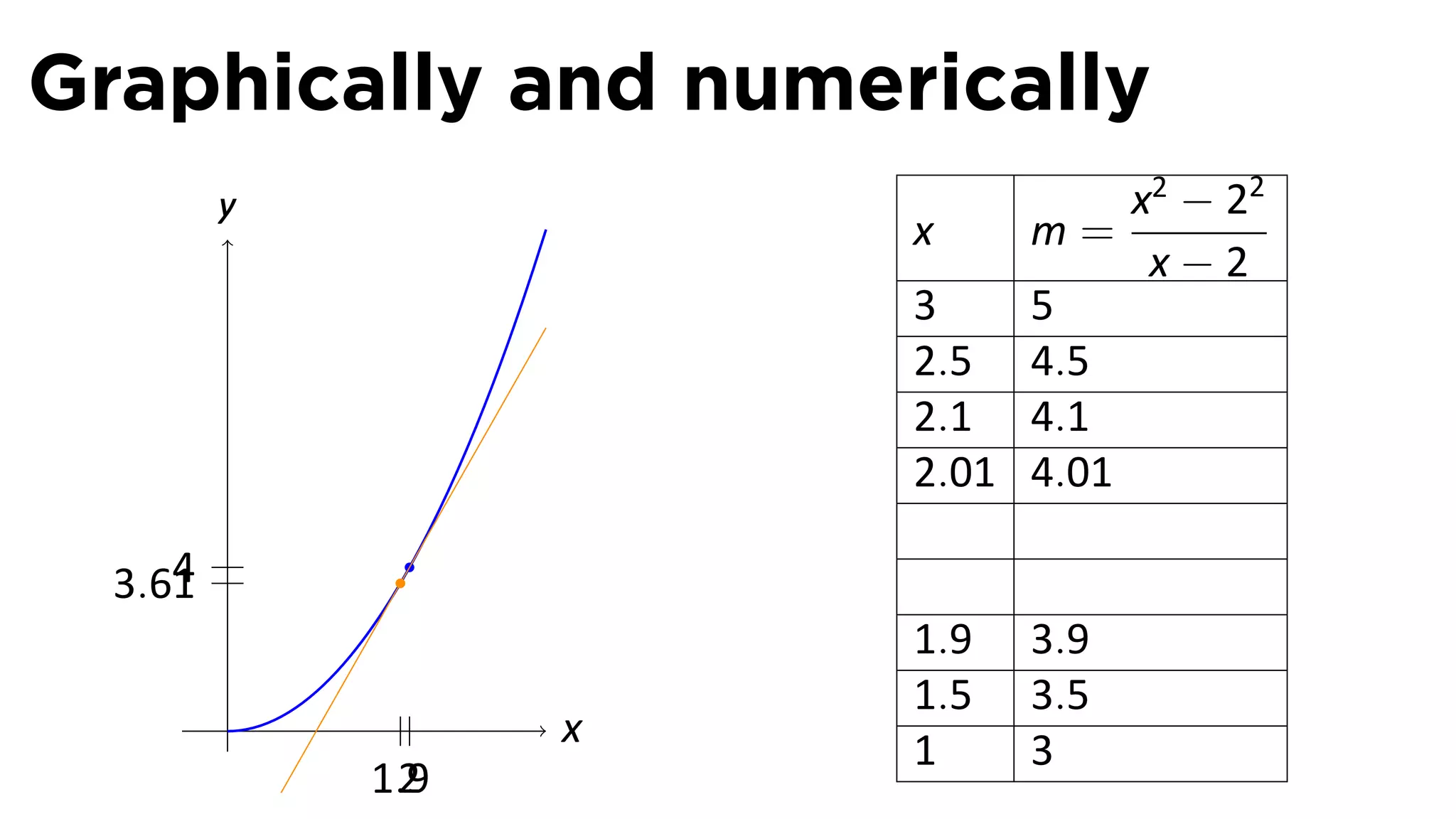
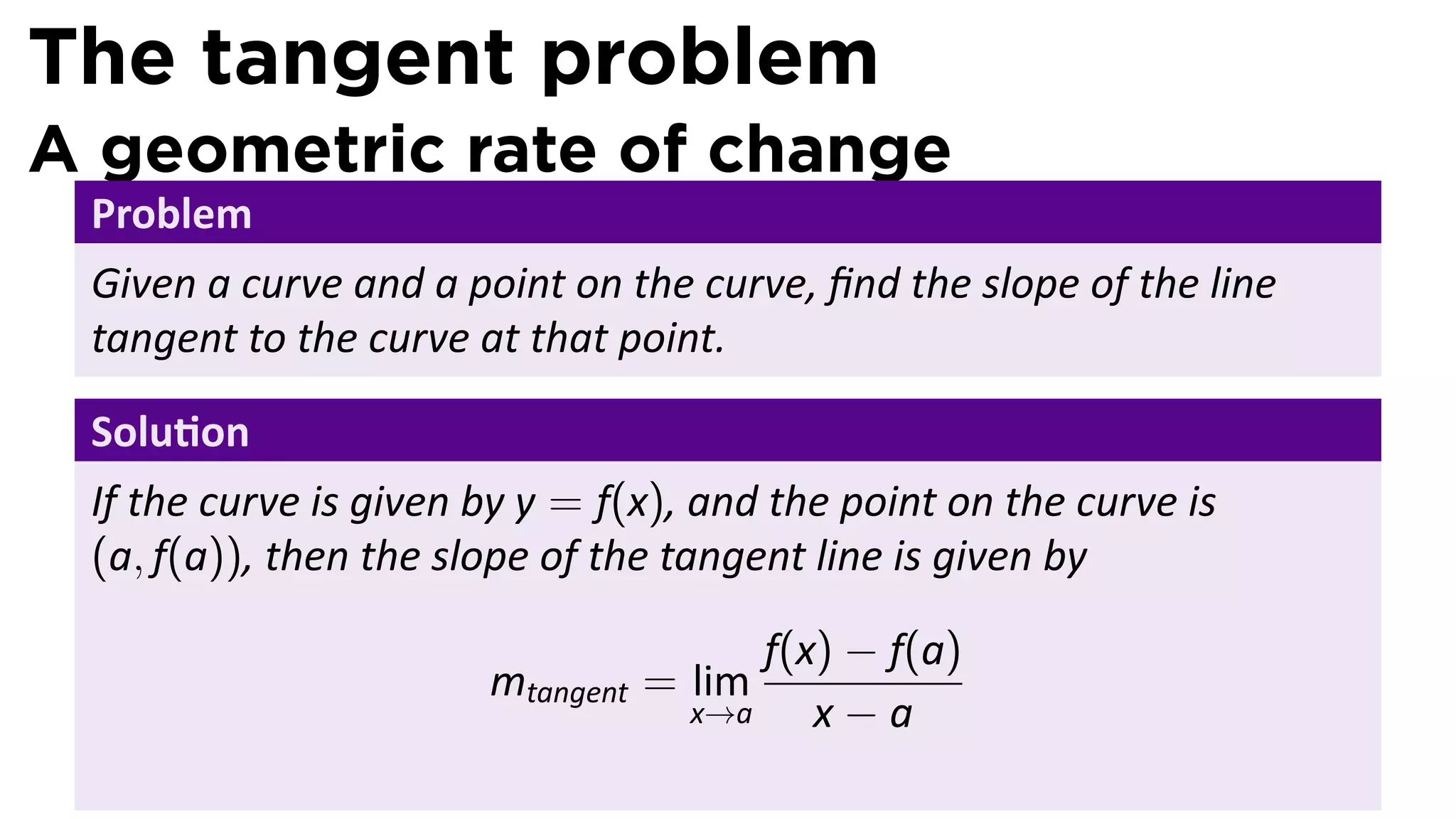
The tangent problem
A geometric rate of change
 Problem
 Given a curve and a point on the curve, find the slope of the line
 tangent to the curve at that point.
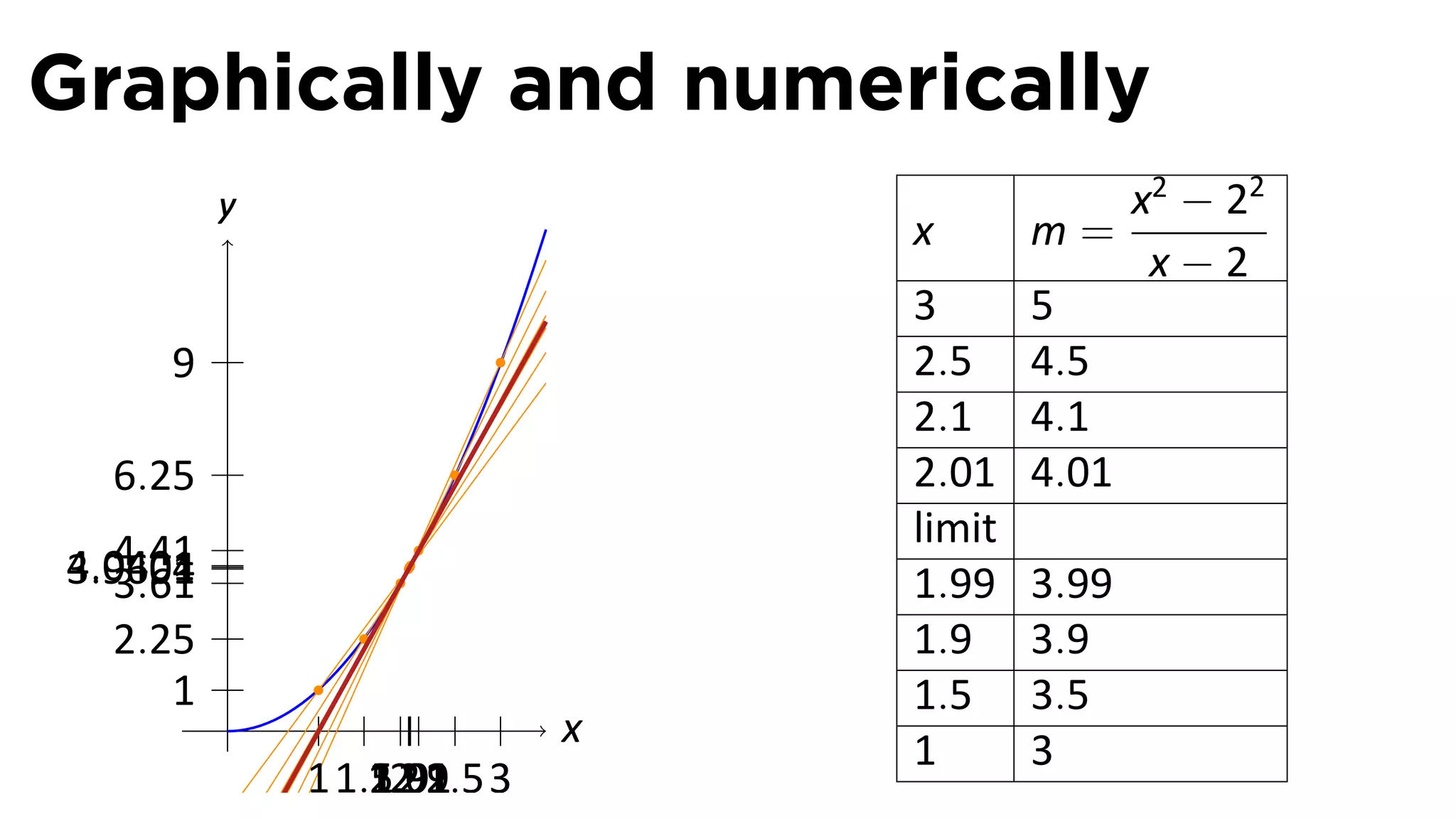
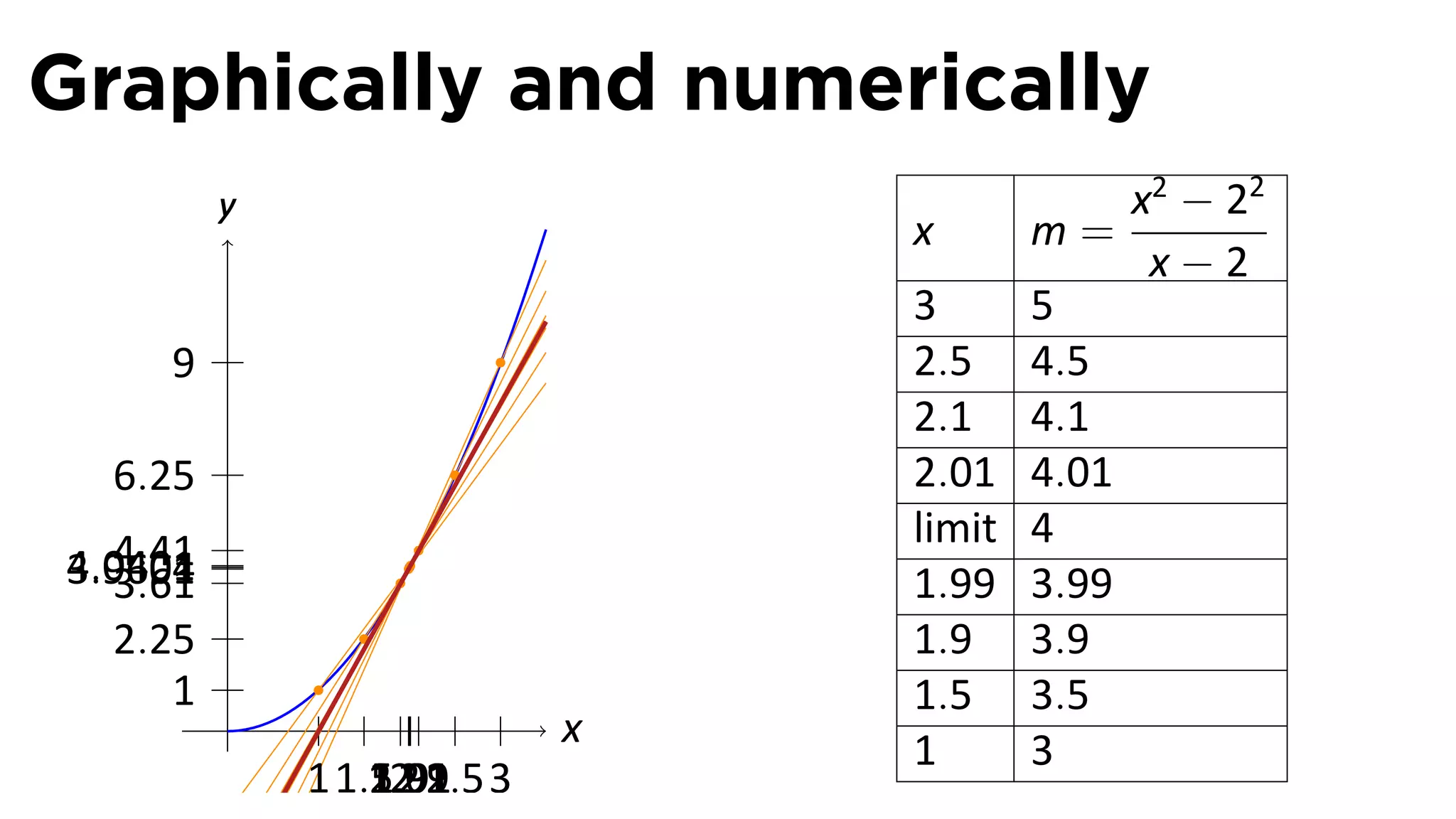
A tangent problem


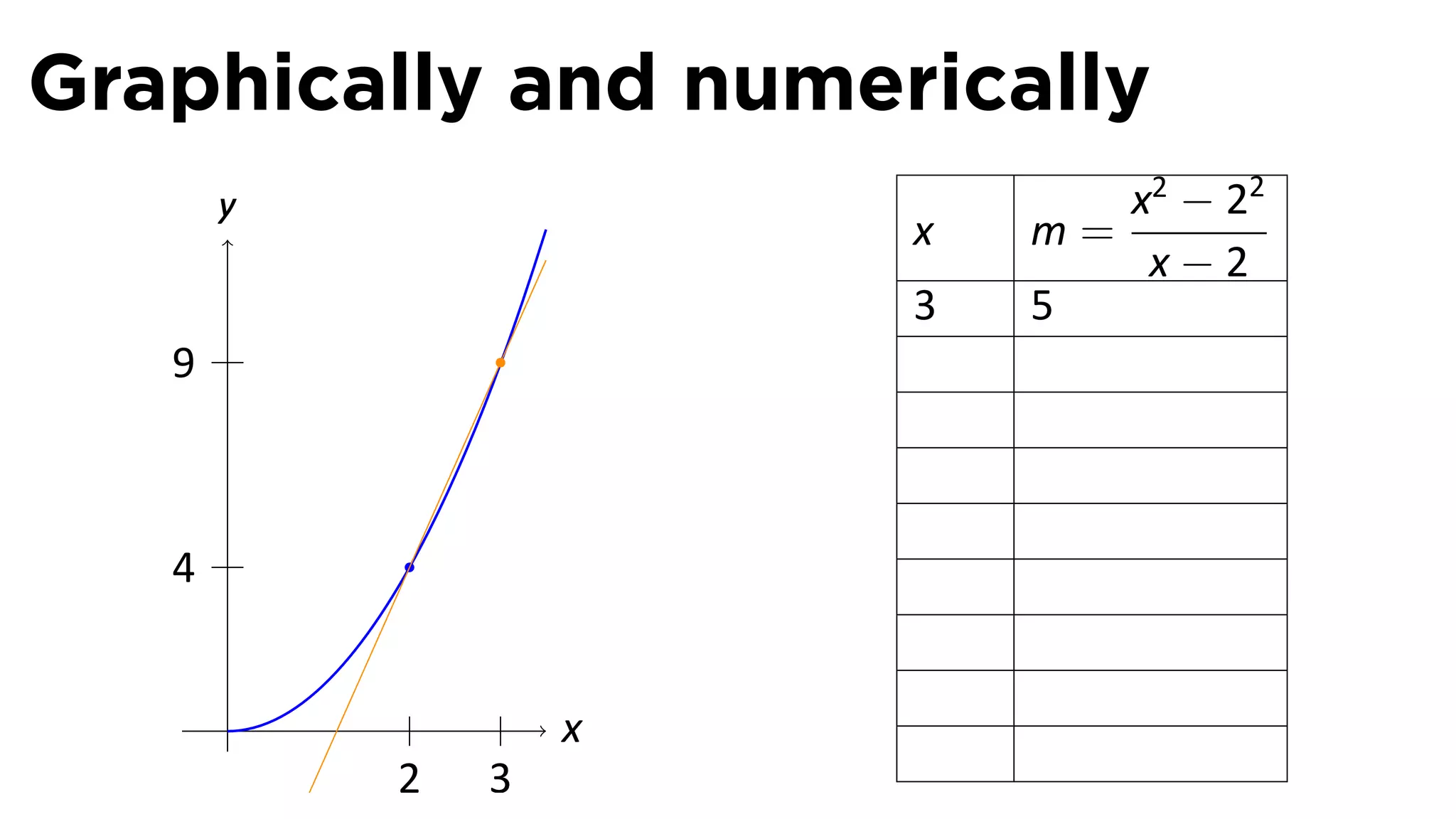
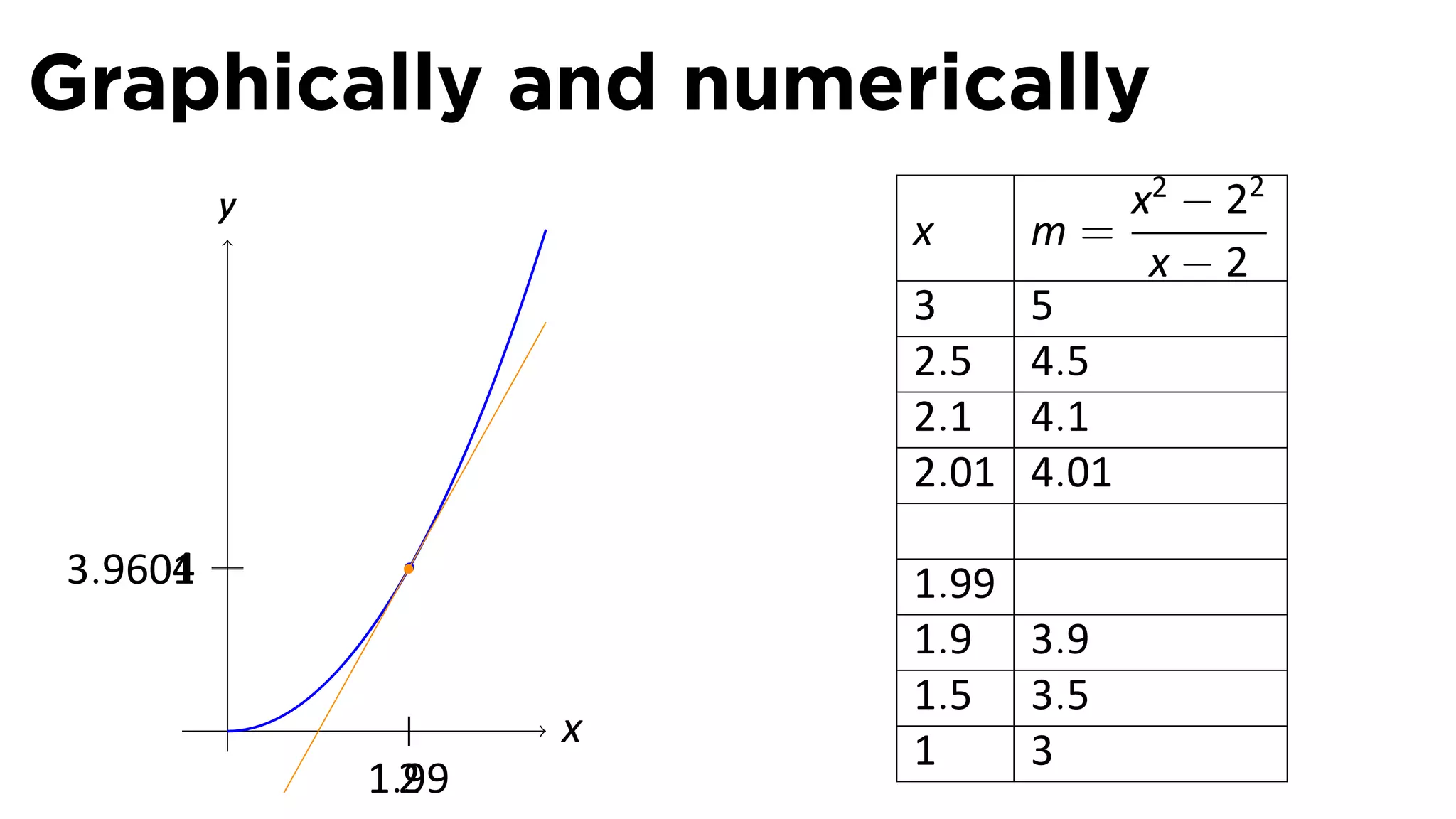
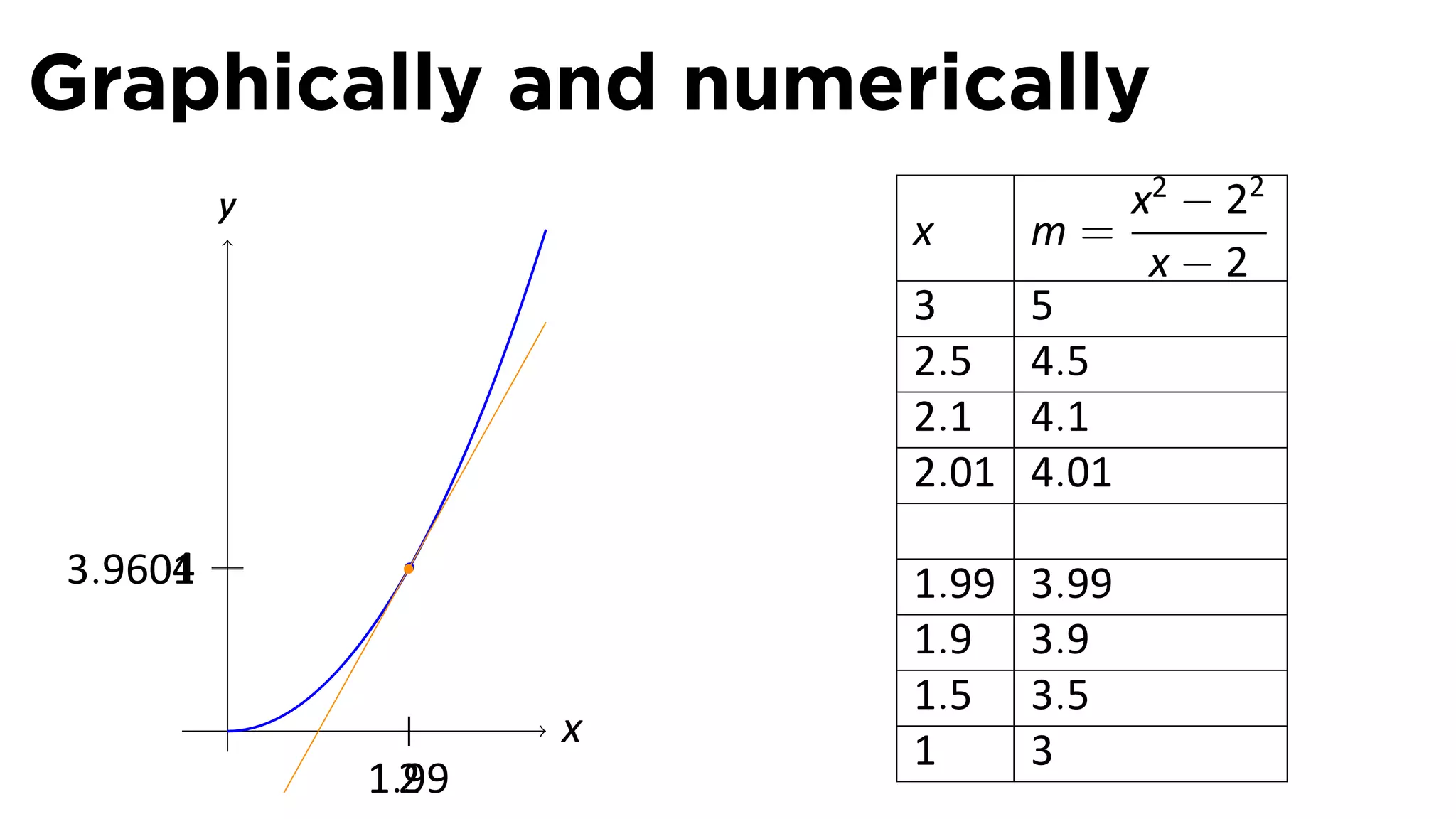
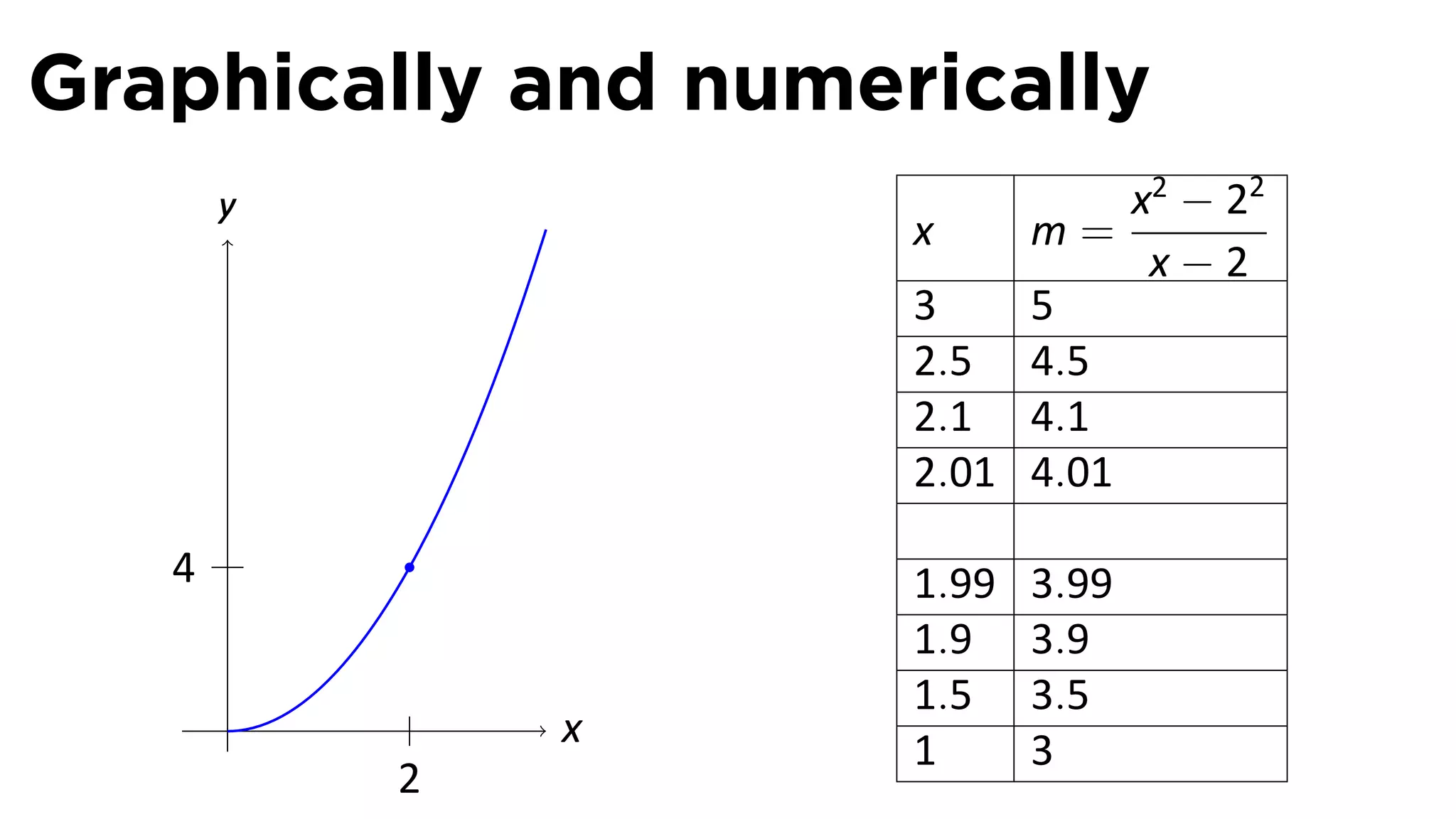
 Example
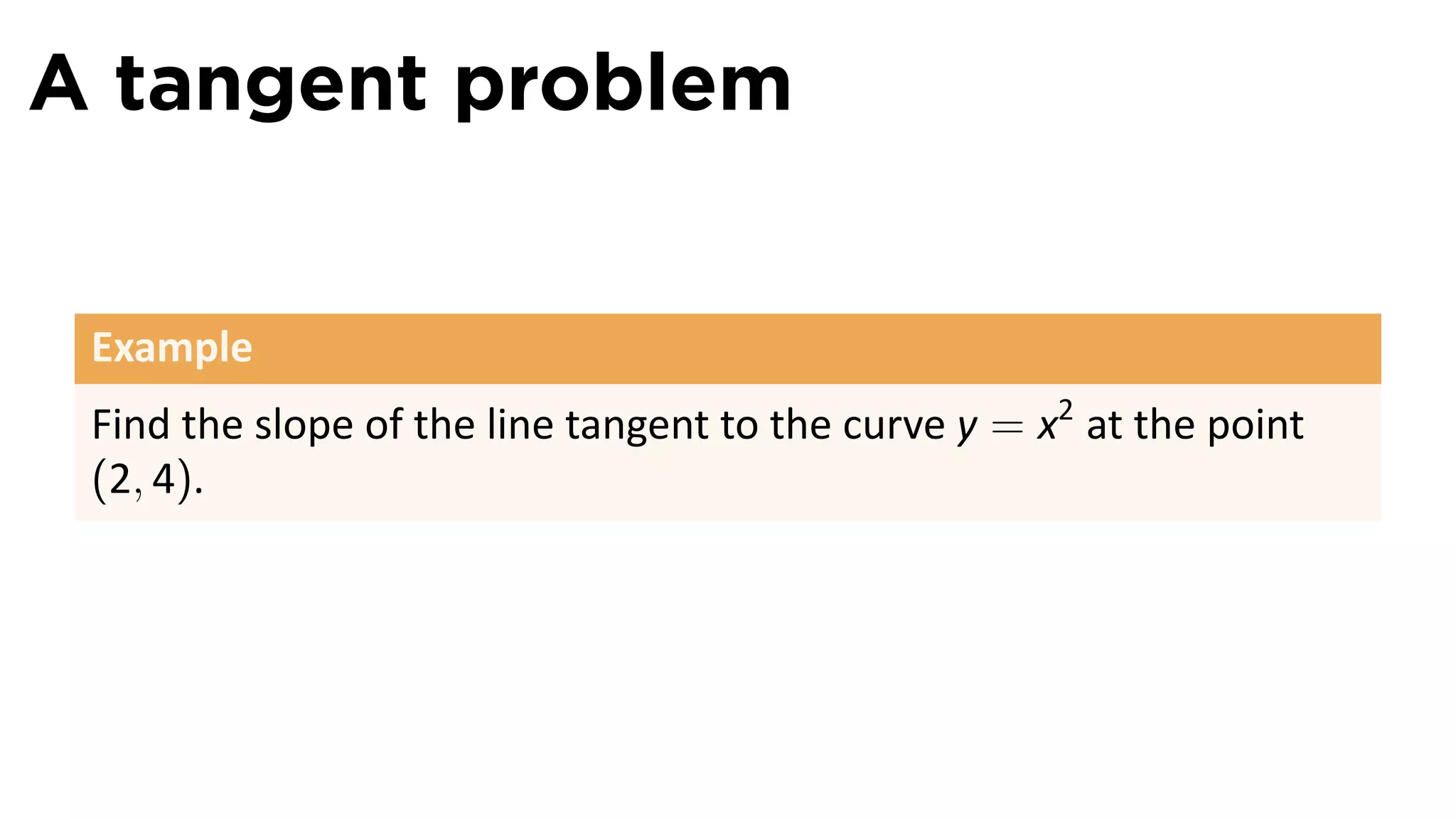
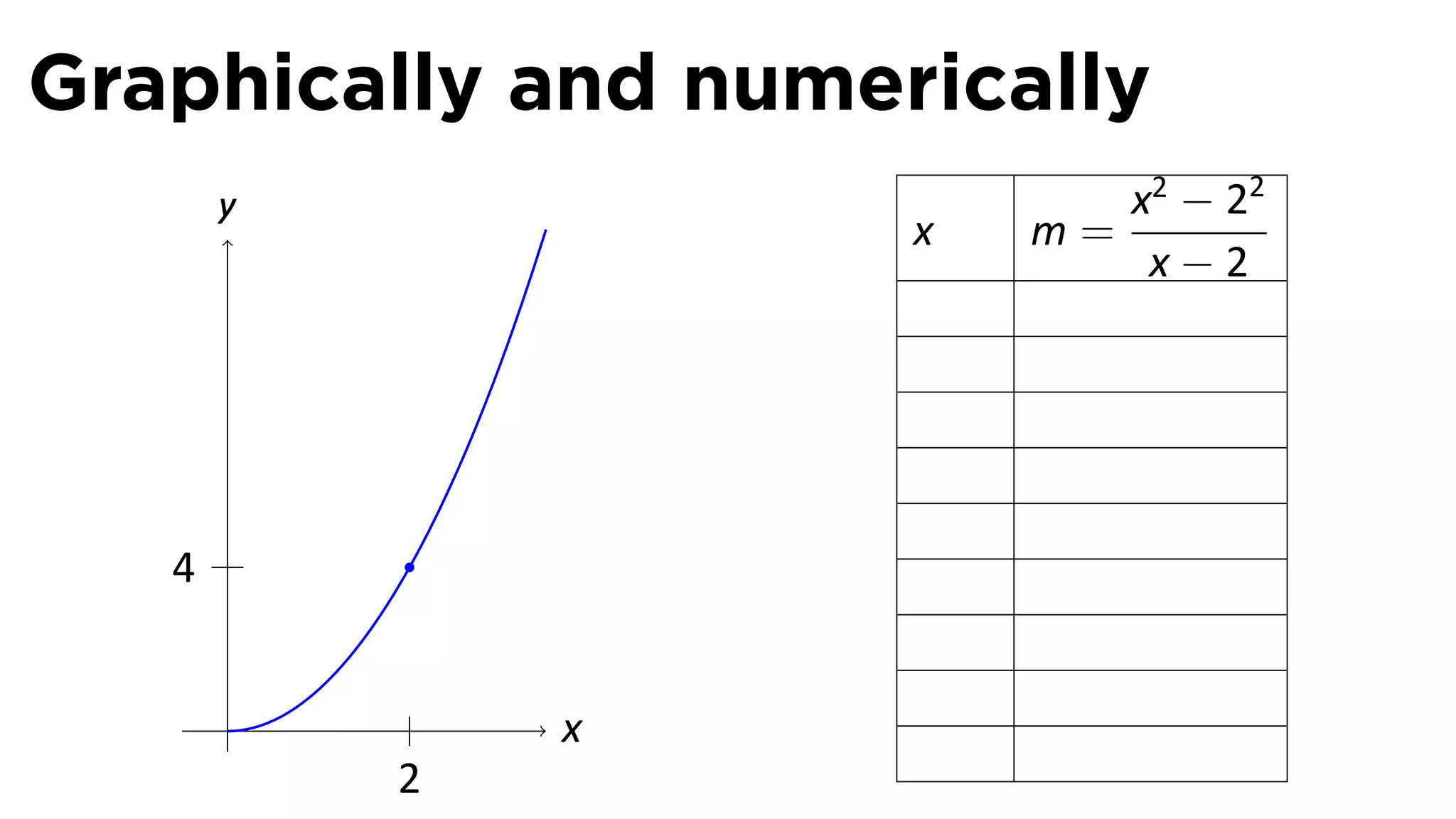
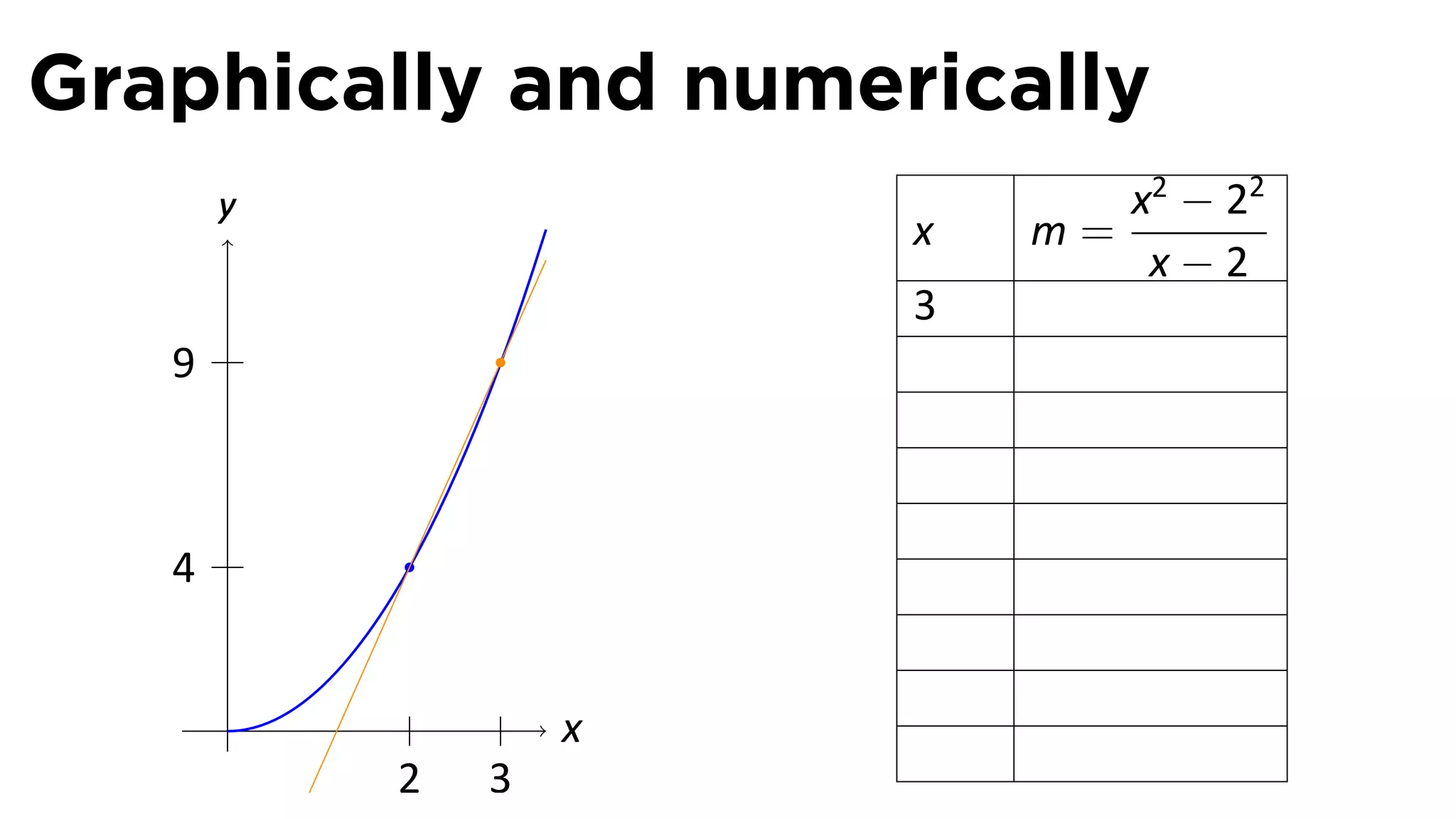
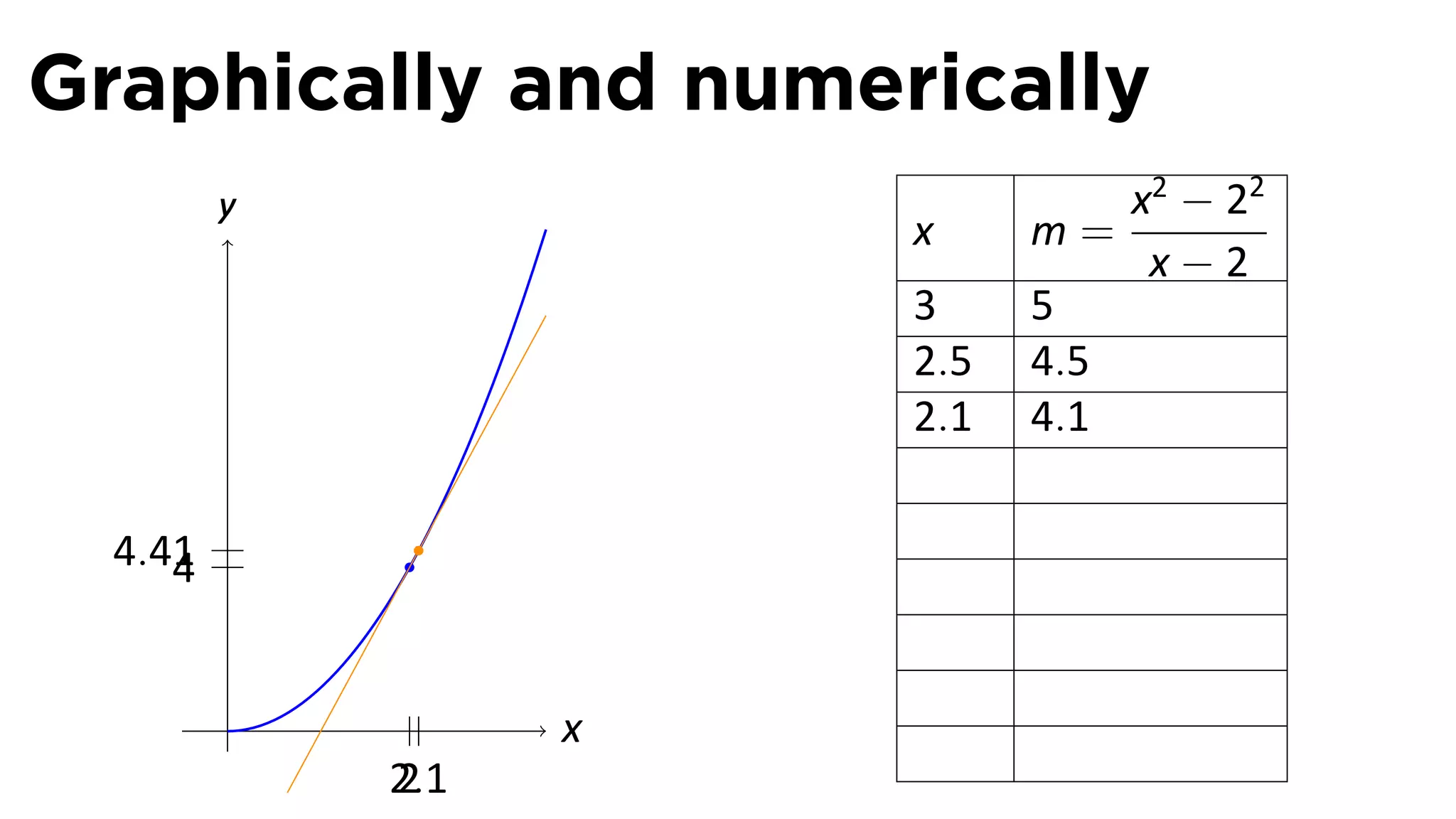
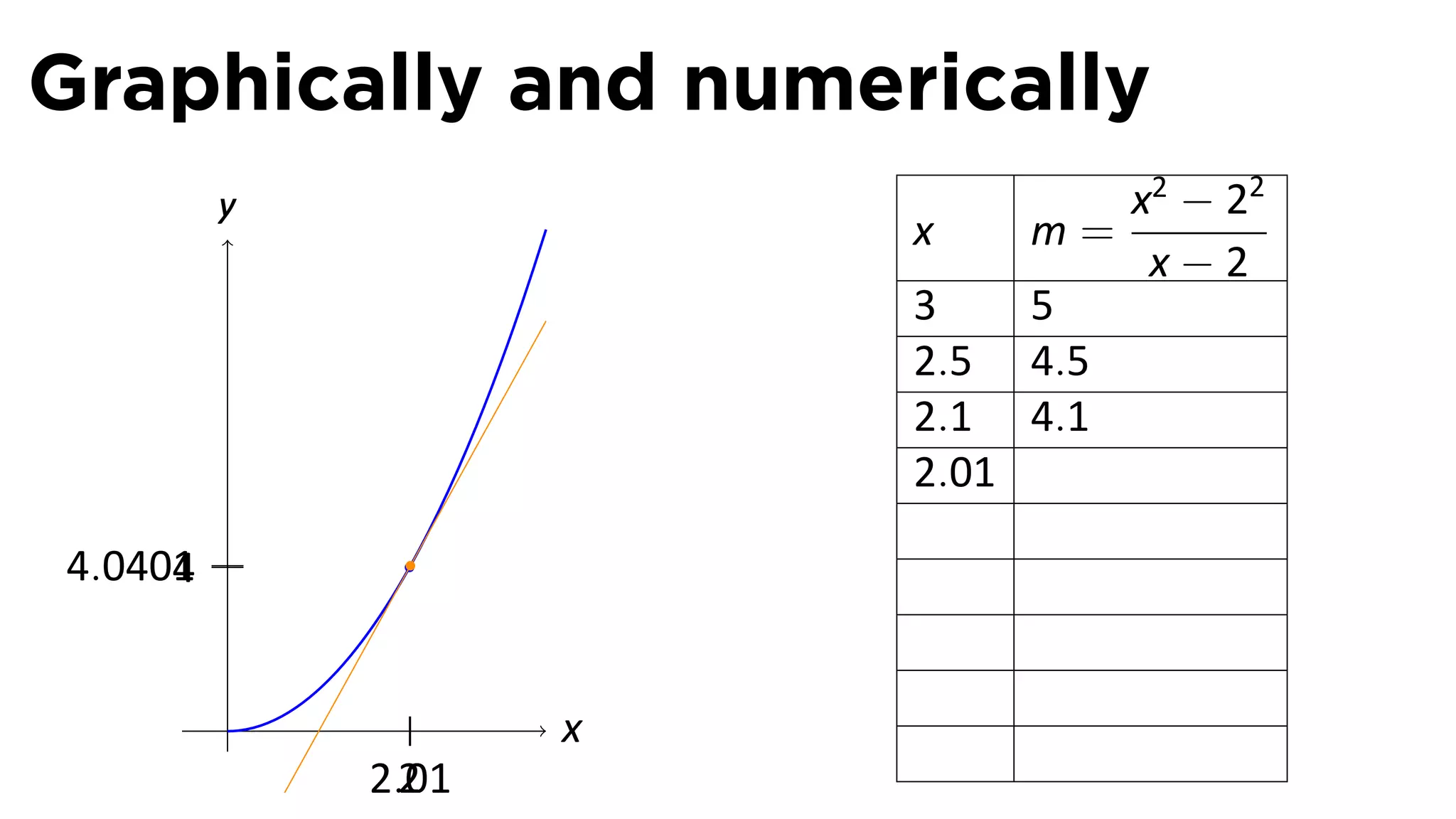
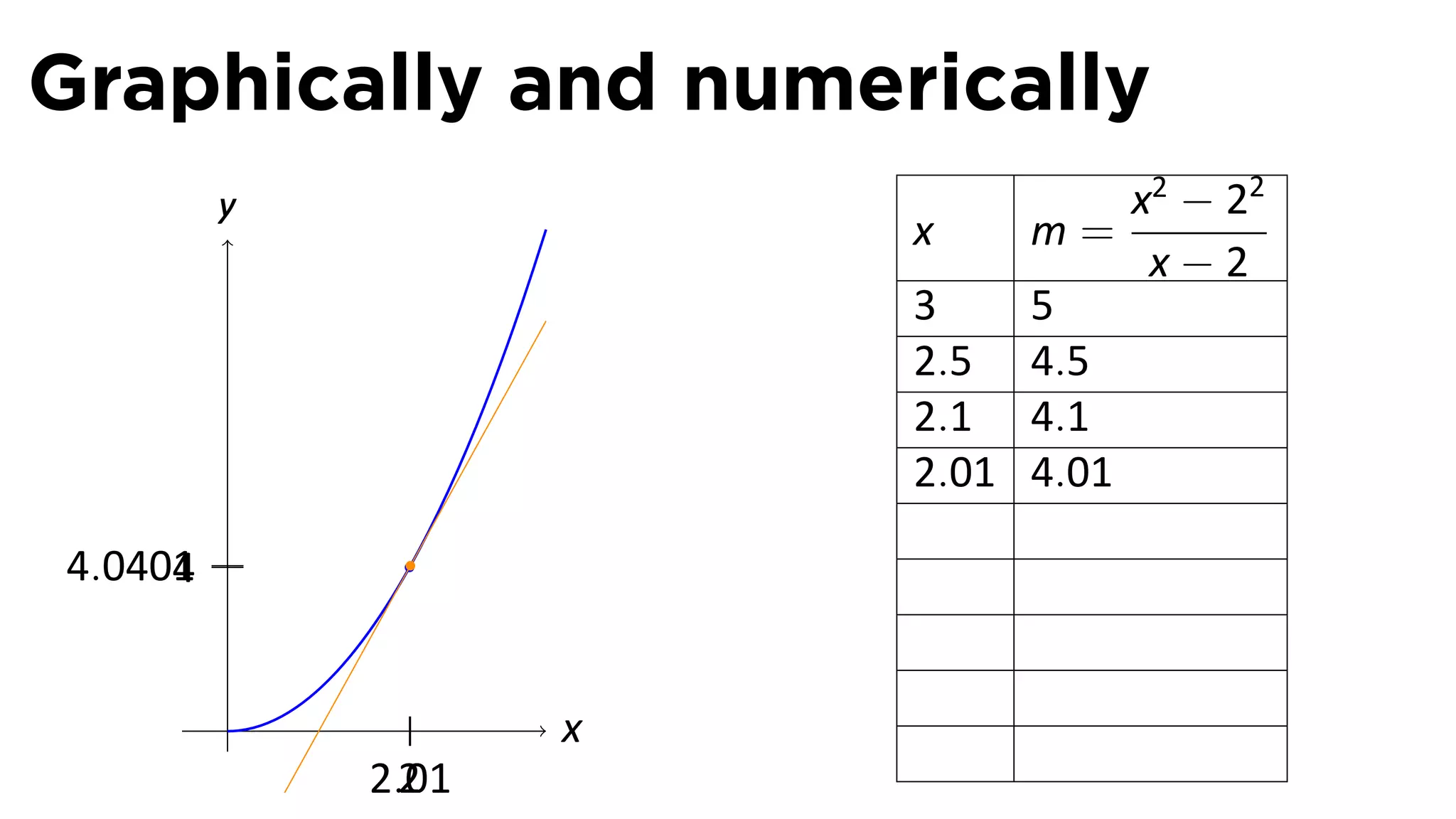
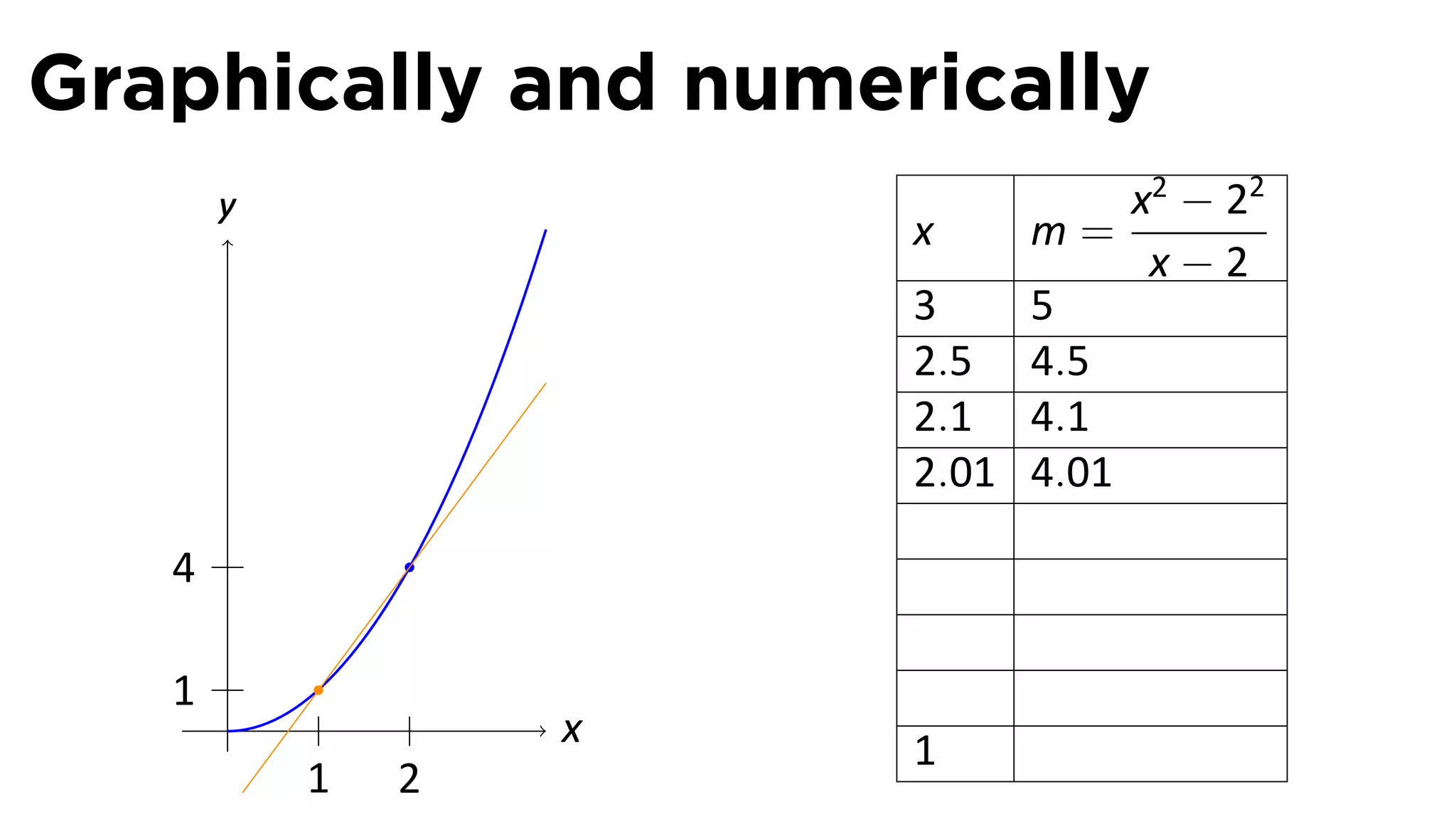
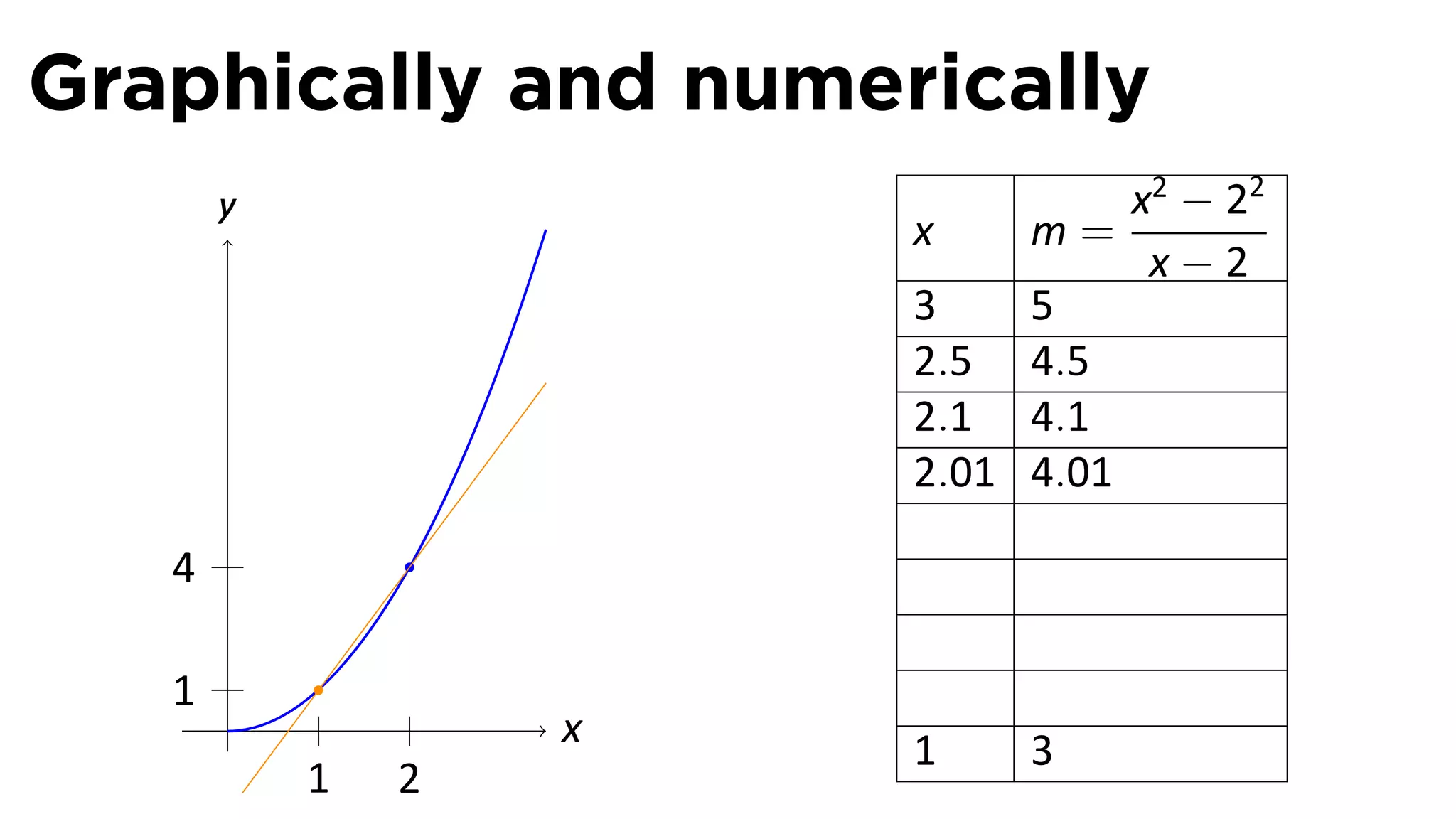
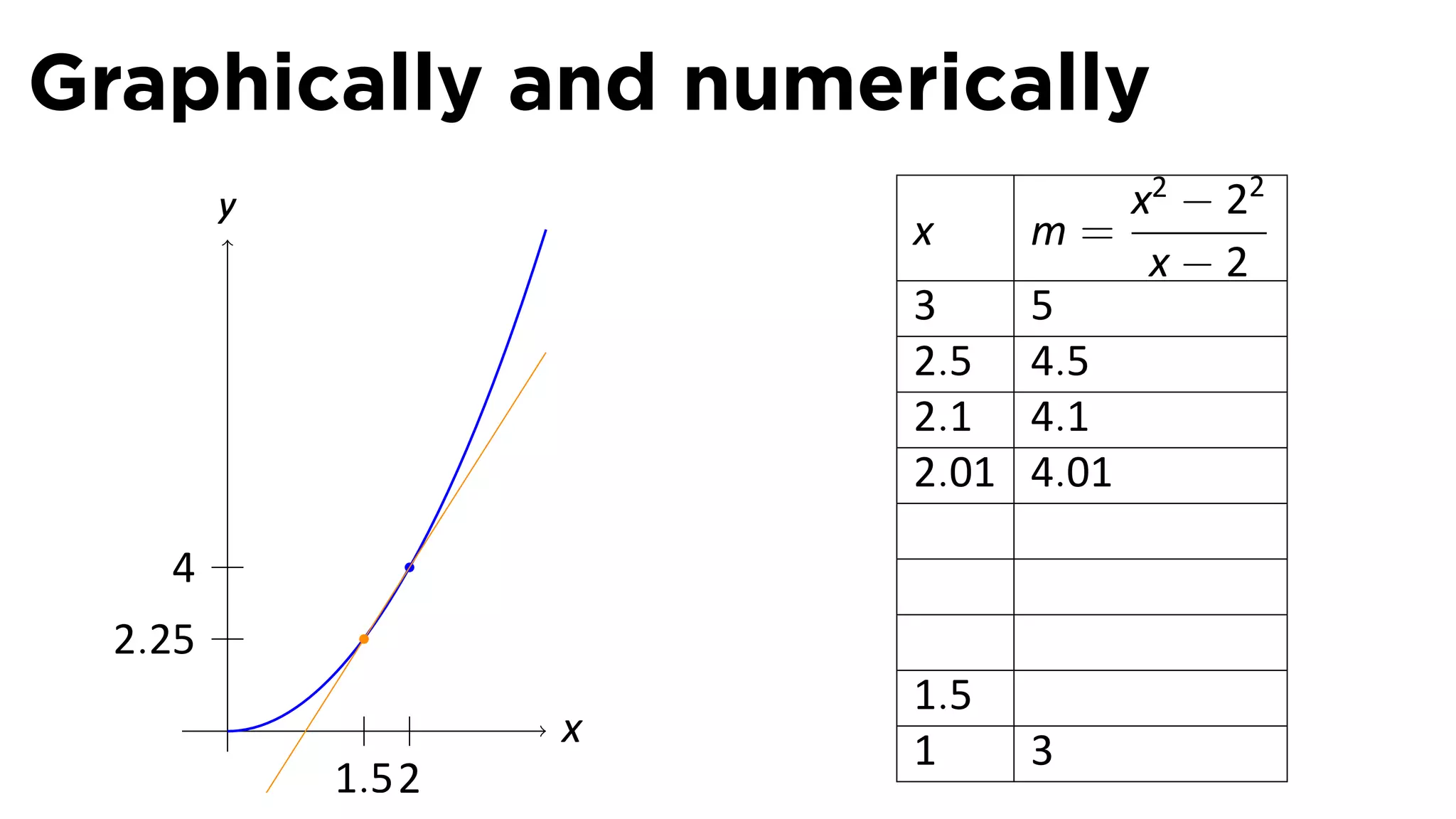
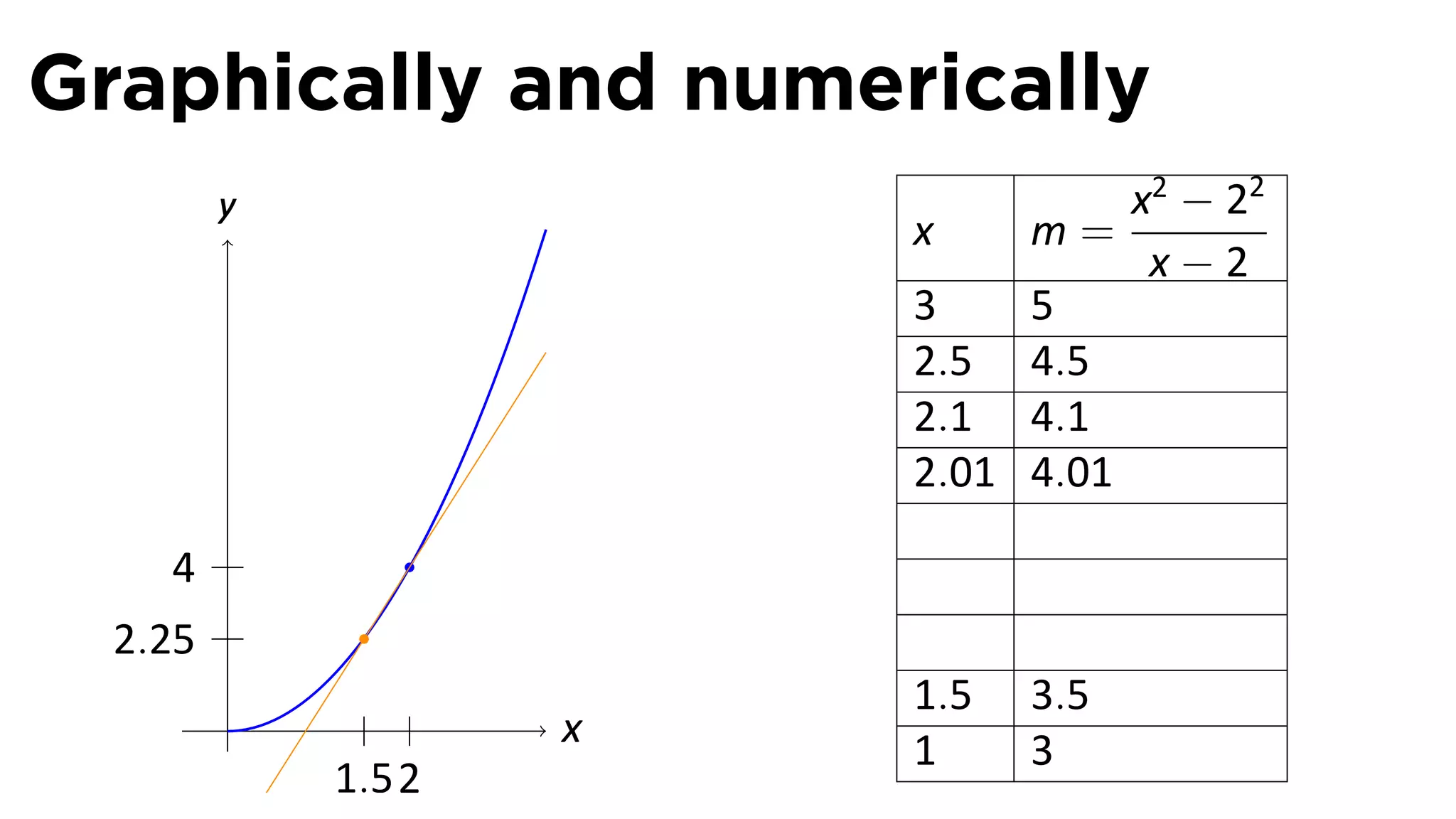
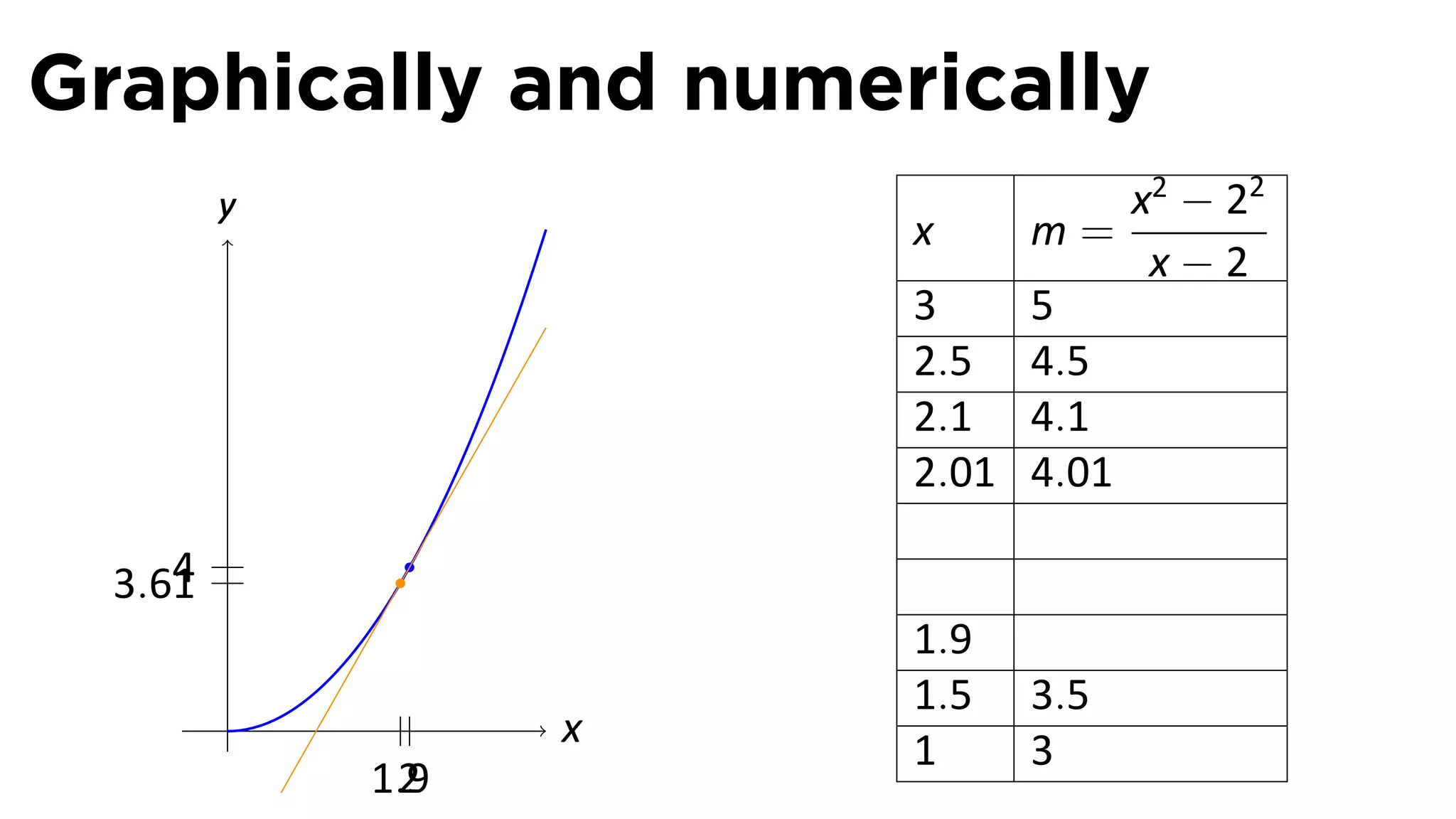
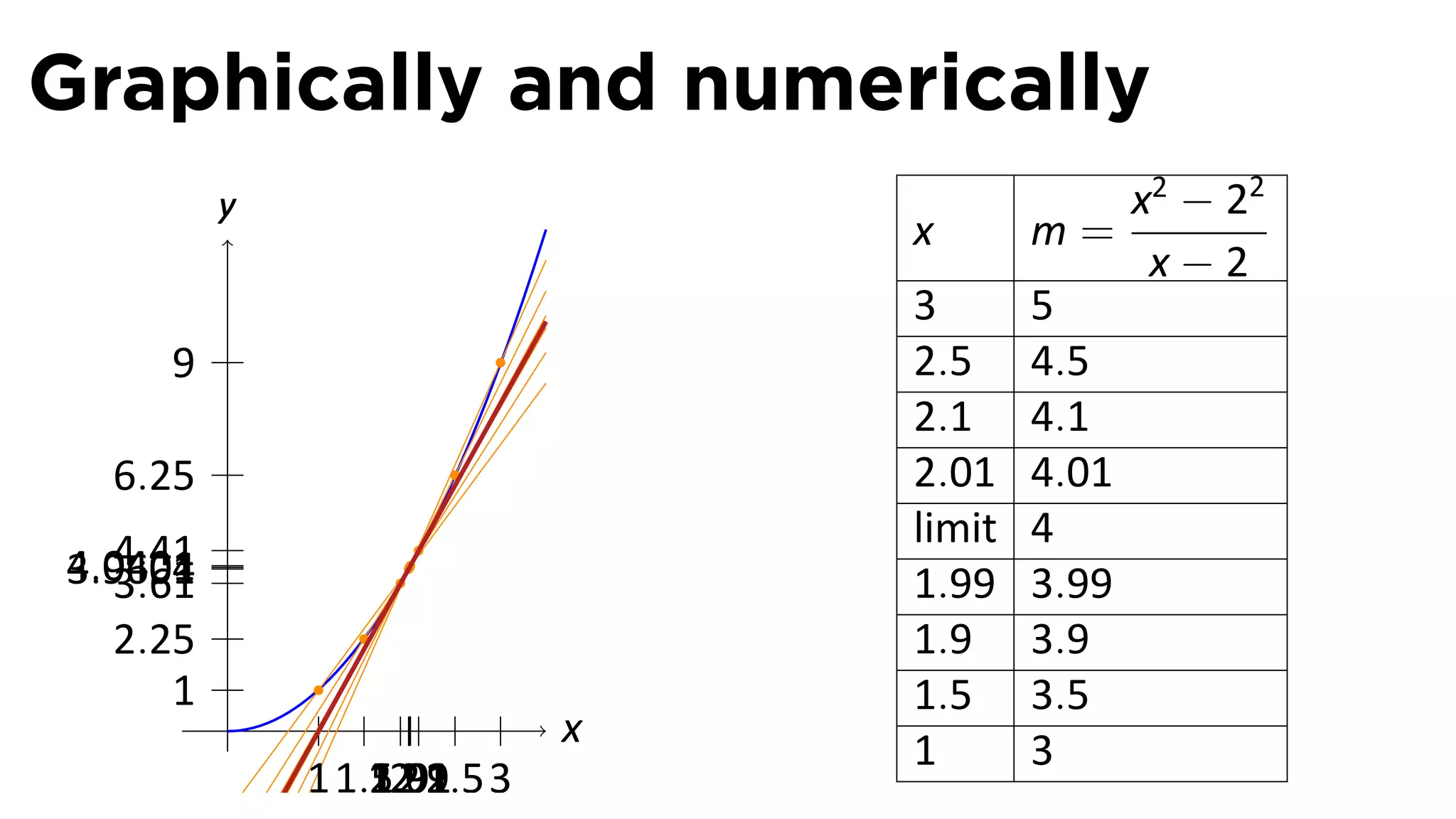
 Find the slope of the line tangent to the curve y = x2 at the point
 (2, 4).
Graphically and numerically
       y                    x2 − 22
                     x   m=
                             x−2


   4


       .       x
           2
Graphically and numerically
       y                      x2 − 22
                       x   m=
                               x−2
                       3
   9


   4


       .           x
           2   3
Graphically and numerically
       y                      x2 − 22
                       x   m=
                               x−2
                       3   5
   9


   4


       .           x
           2   3
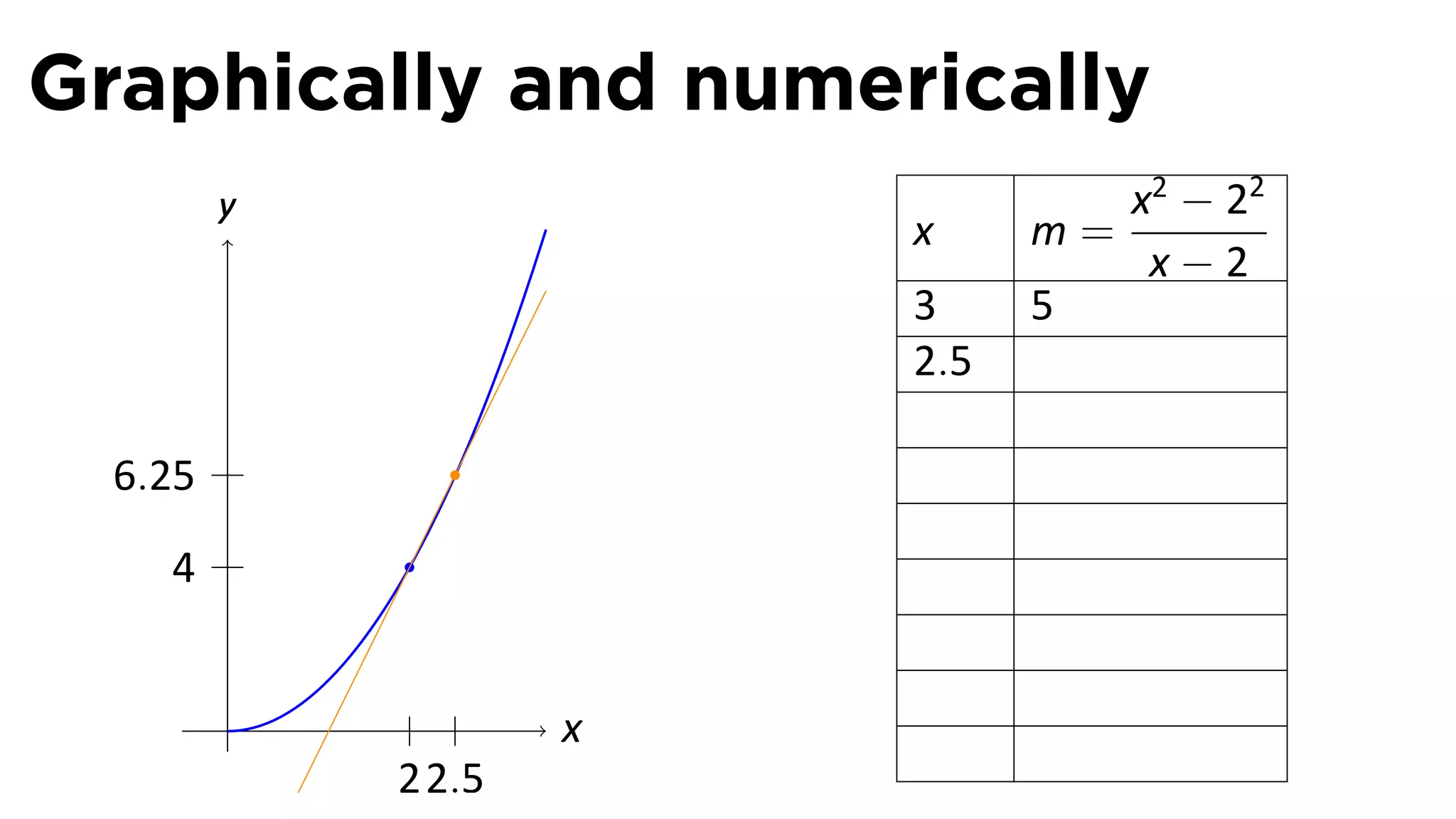
Graphically and numerically
         y                        x2 − 22
                         x     m=
                                   x−2
                         3     5
                         2.5

  6.25

    4


         .           x
             2 2.5
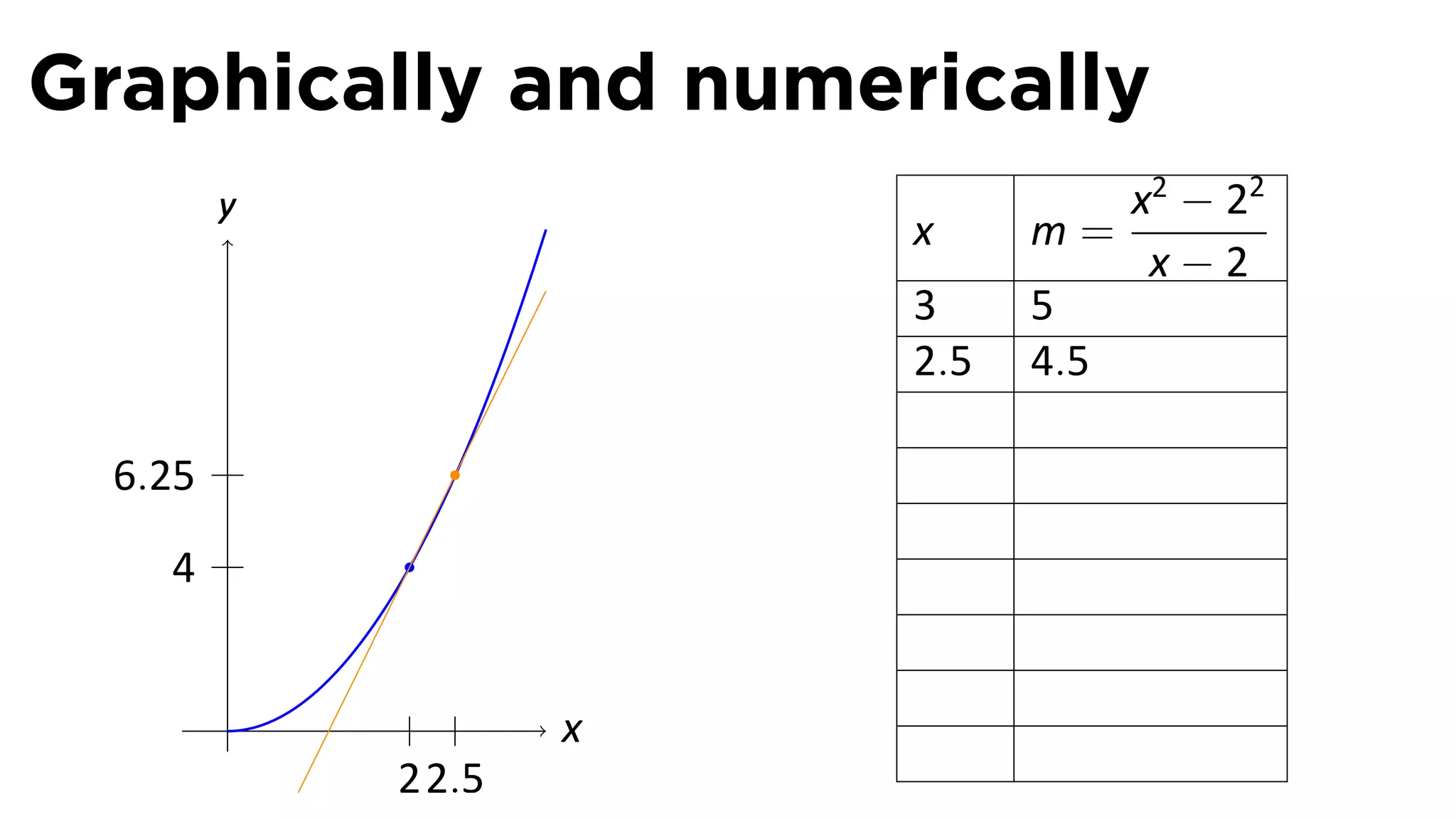
Graphically and numerically
         y                         x2 − 22
                         x     m=
                                    x−2
                         3     5
                         2.5   4.5

  6.25

    4


         .           x
             2 2.5
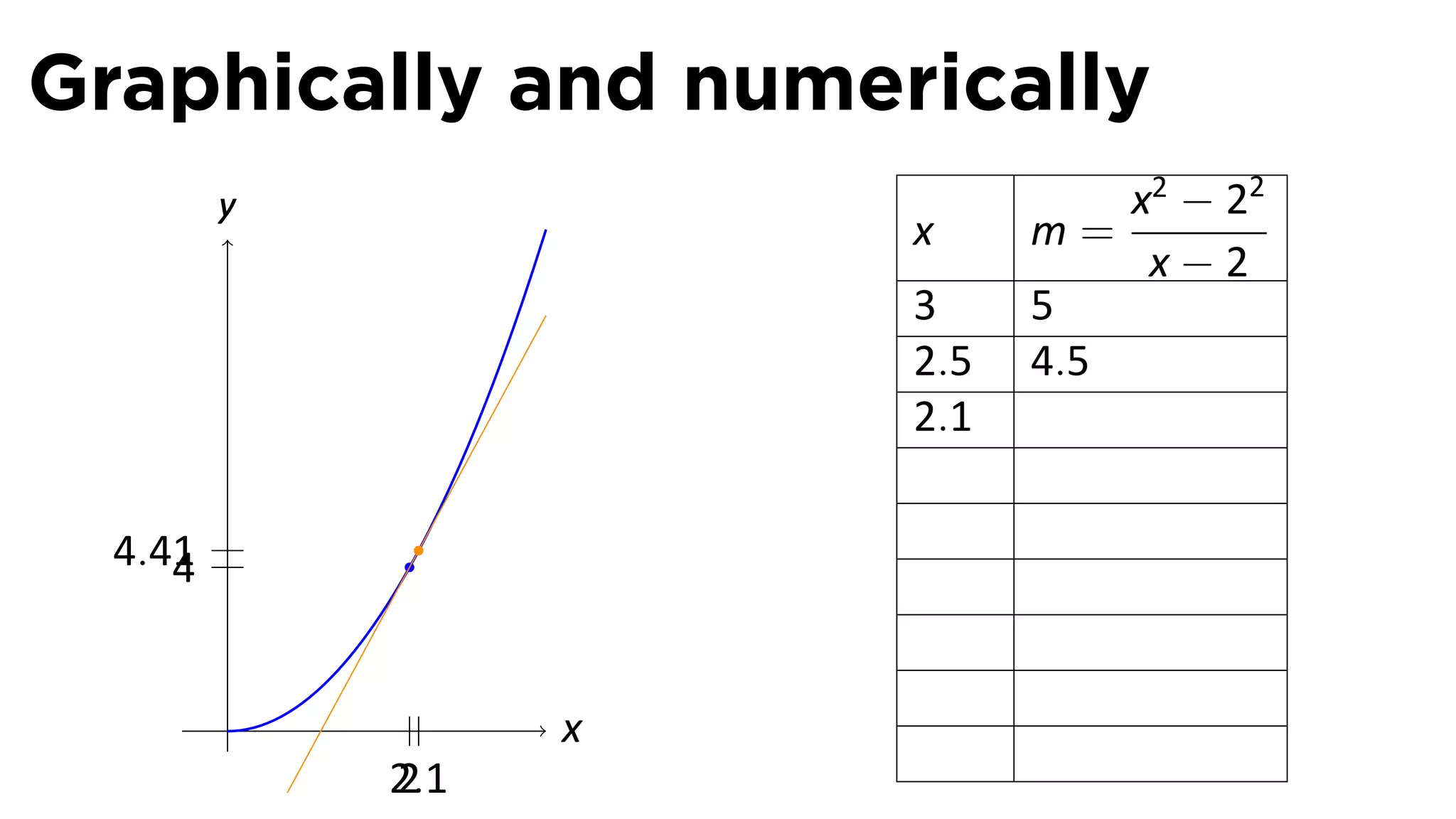
Graphically and numerically
         y                       x2 − 22
                       x     m=
                                  x−2
                       3     5
                       2.5   4.5
                       2.1

  4.41
     4


         .         x
             2.1
             2
Graphically and numerically
         y                       x2 − 22
                       x     m=
                                  x−2
                       3     5
                       2.5   4.5
                       2.1   4.1

  4.41
     4


         .         x
             2.1
             2
Graphically and numerically
         y                         x2 − 22
                        x      m=
                                    x−2
                        3      5
                        2.5    4.5
                        2.1    4.1
                        2.01

4.0401
     4


         .          x
             2.01
              2
Graphically and numerically
         y                        x2 − 22
                        x    m=
                                   x−2
                        3    5
                        2.5 4.5
                        2.1 4.1
                        2.01 4.01

4.0401
     4


         .          x
             2.01
              2
Graphically and numerically
       y                         x2 − 22
                       x    m=
                                  x−2
                       3    5
                       2.5 4.5
                       2.1 4.1
                       2.01 4.01

   4

   1
       .           x   1
           1   2
Graphically and numerically
       y                         x2 − 22
                       x    m=
                                  x−2
                       3    5
                       2.5 4.5
                       2.1 4.1
                       2.01 4.01

   4

   1
       .           x   1    3
           1   2
Graphically and numerically
         y                         x2 − 22
                         x    m=
                                    x−2
                         3    5
                         2.5 4.5
                         2.1 4.1
                         2.01 4.01

    4
  2.25
         .               1.5
                     x   1     3
             1.5 2
Graphically and numerically
         y                         x2 − 22
                         x    m=
                                    x−2
                         3    5
                         2.5 4.5
                         2.1 4.1
                         2.01 4.01

    4
  2.25
         .               1.5   3.5
                     x   1     3
             1.5 2
Graphically and numerically
         y                       x2 − 22
                       x    m=
                                  x−2
                       3    5
                       2.5 4.5
                       2.1 4.1
                       2.01 4.01

     4
  3.61
                       1.9
         .             1.5   3.5
                   x   1     3
             1.9
              2
Graphically and numerically
         y                       x2 − 22
                       x    m=
                                  x−2
                       3    5
                       2.5 4.5
                       2.1 4.1
                       2.01 4.01

     4
  3.61
                       1.9   3.9
         .             1.5   3.5
                   x   1     3
             1.9
              2
Graphically and numerically
         y                        x2 − 22
                        x    m=
                                   x−2
                        3    5
                        2.5 4.5
                        2.1 4.1
                        2.01 4.01

     4
3.9601                  1.99
                        1.9 3.9
         .              1.5 3.5
                    x   1    3
             1.99
               2
Graphically and numerically
         y                        x2 − 22
                        x    m=
                                   x−2
                        3    5
                        2.5 4.5
                        2.1 4.1
                        2.01 4.01

     4
3.9601                  1.99   3.99
                        1.9    3.9
         .              1.5    3.5
                    x   1      3
             1.99
               2
Graphically and numerically
       y                       x2 − 22
                     x    m=
                                x−2
                     3    5
                     2.5 4.5
                     2.1 4.1
                     2.01 4.01

   4                 1.99   3.99
                     1.9    3.9
       .             1.5    3.5
               x     1      3
           2
Graphically and numerically
         y                              x2 − 22
                              x     m=
                                         x−2
                              3     5
    9                         2.5 4.5
                              2.1 4.1
  6.25                        2.01 4.01
                              limit
  4.41
4.0401
     4
3.9601
  3.61                        1.99 3.99
  2.25                        1.9 3.9
     1                        1.5 3.5
         .                x   1     3
             1 1.52.1 3
                 1.99
                 2.01
                 1.92.5
                   2
Graphically and numerically
         y                              x2 − 22
                              x     m=
                                         x−2
                              3     5
    9                         2.5 4.5
                              2.1 4.1
  6.25                        2.01 4.01
                              limit 4
  4.41
4.0401
     4
3.9601
  3.61                        1.99 3.99
  2.25                        1.9 3.9
     1                        1.5 3.5
         .                x   1     3
             1 1.52.1 3
                 1.99
                 2.01
                 1.92.5
                   2
The tangent problem
A geometric rate of change
 Problem
 Given a curve and a point on the curve, find the slope of the line
 tangent to the curve at that point.

 Solu on
 If the curve is given by y = f(x), and the point on the curve is
 (a, f(a)), then the slope of the tangent line is given by

                                       f(x) − f(a)
                       mtangent = lim
                                   x→a    x−a
The velocity problem
Kinematics—Physical rates of change


 Problem
 Given the posi on func on of a moving object, find the velocity of
 the object at a certain instant in me.
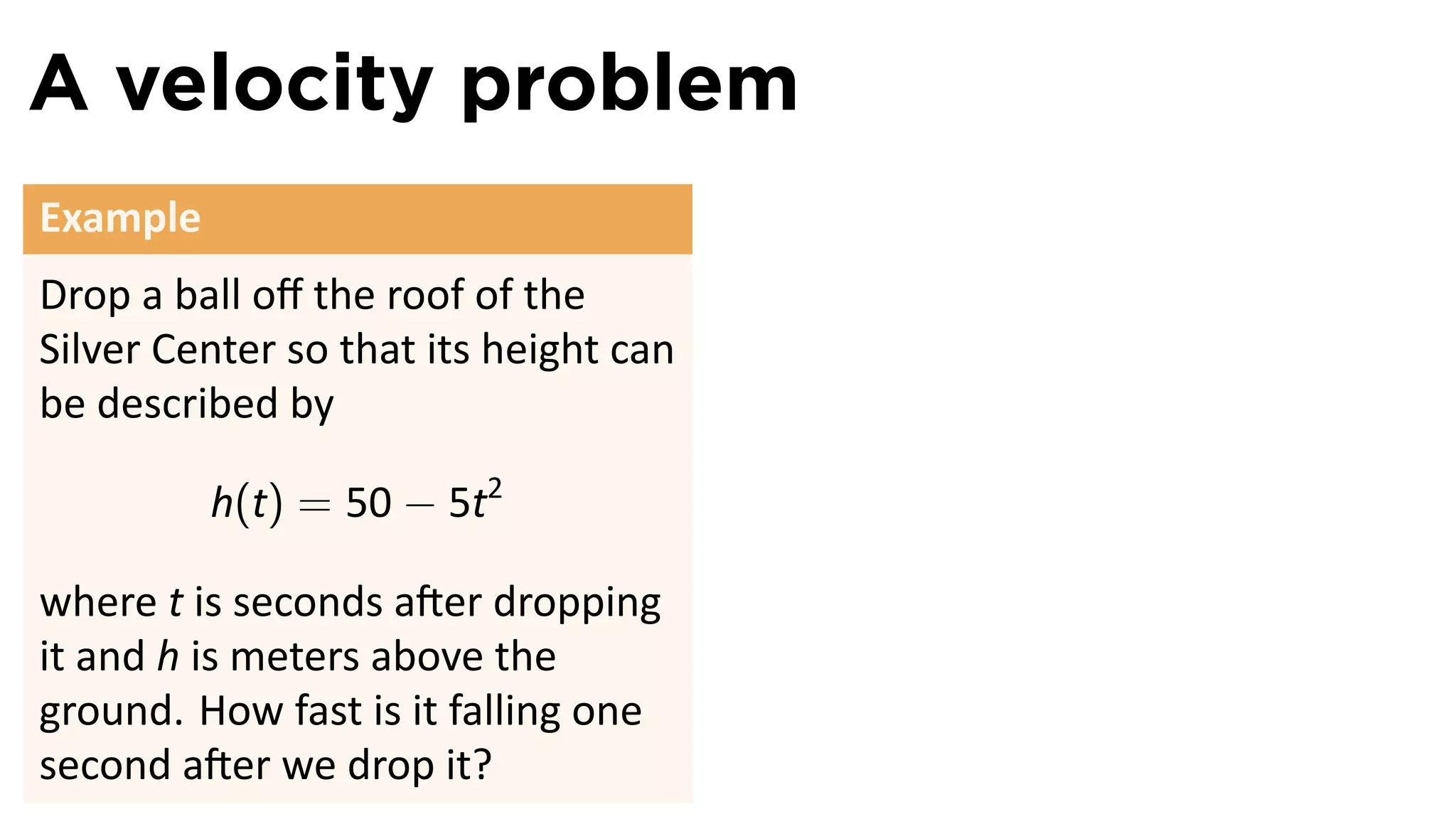
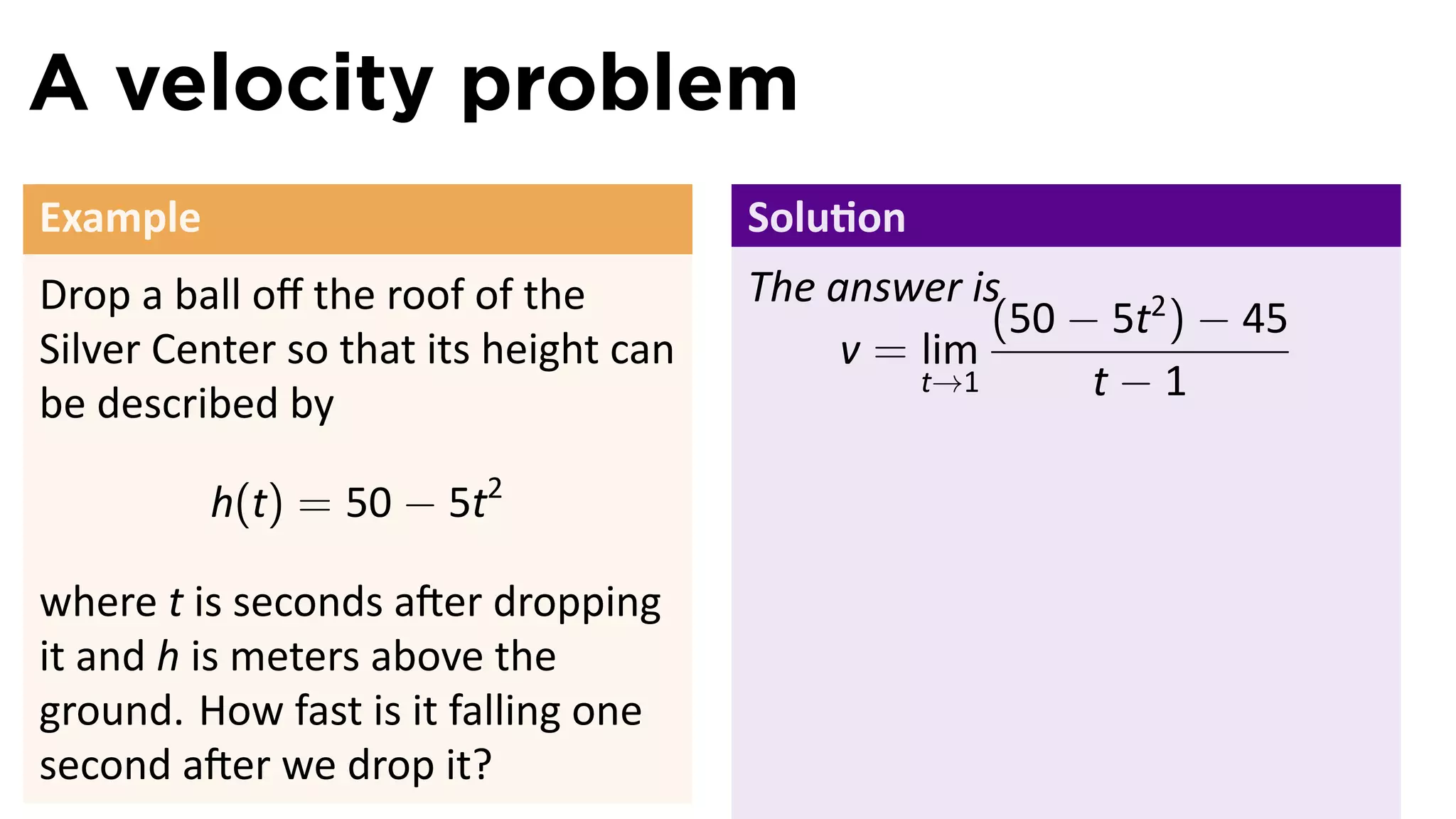
A velocity problem
Example
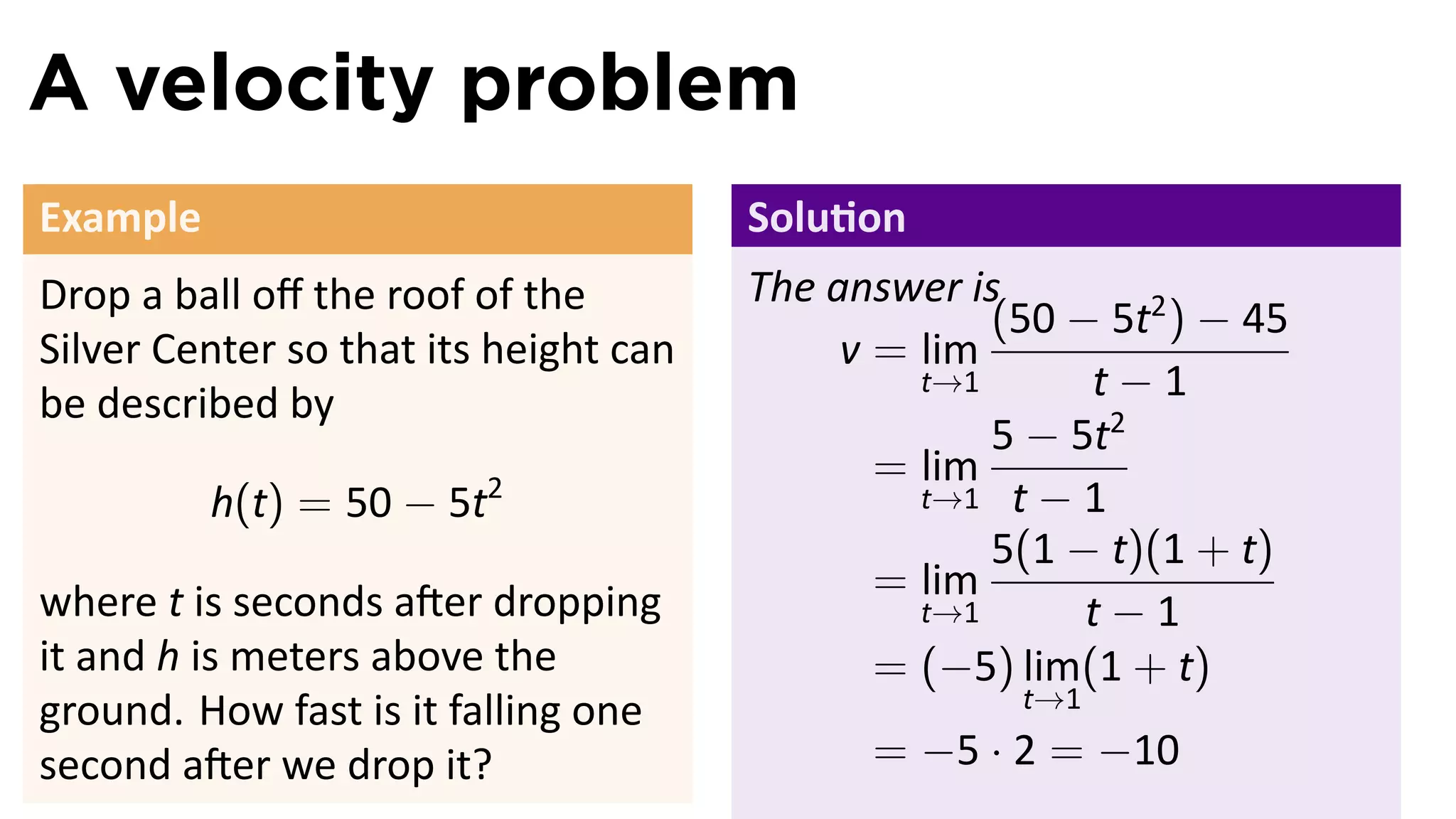
Drop a ball off the roof of the
Silver Center so that its height can
be described by

          h(t) = 50 − 5t2

where t is seconds a er dropping
it and h is meters above the
ground. How fast is it falling one
second a er we drop it?
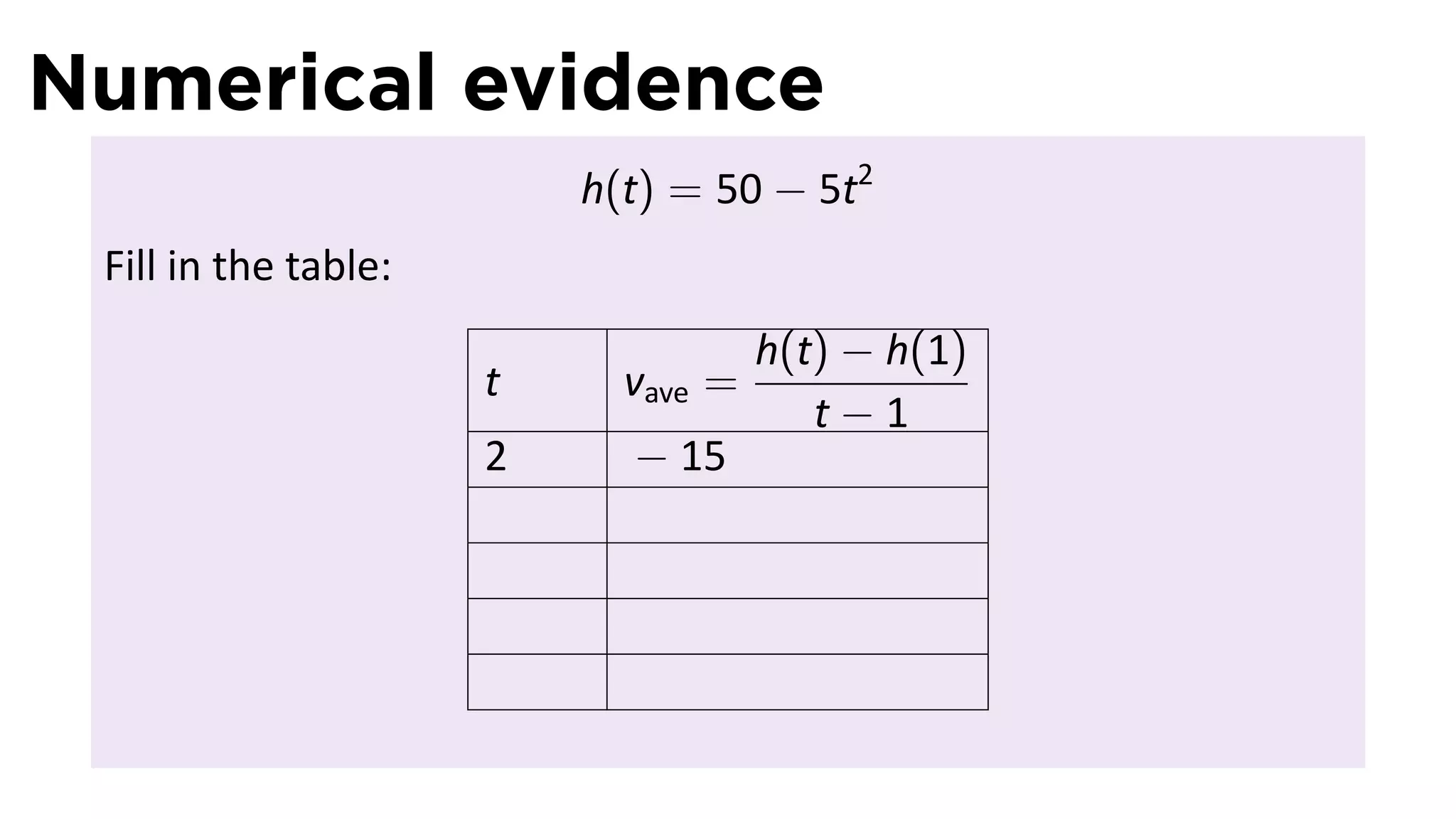
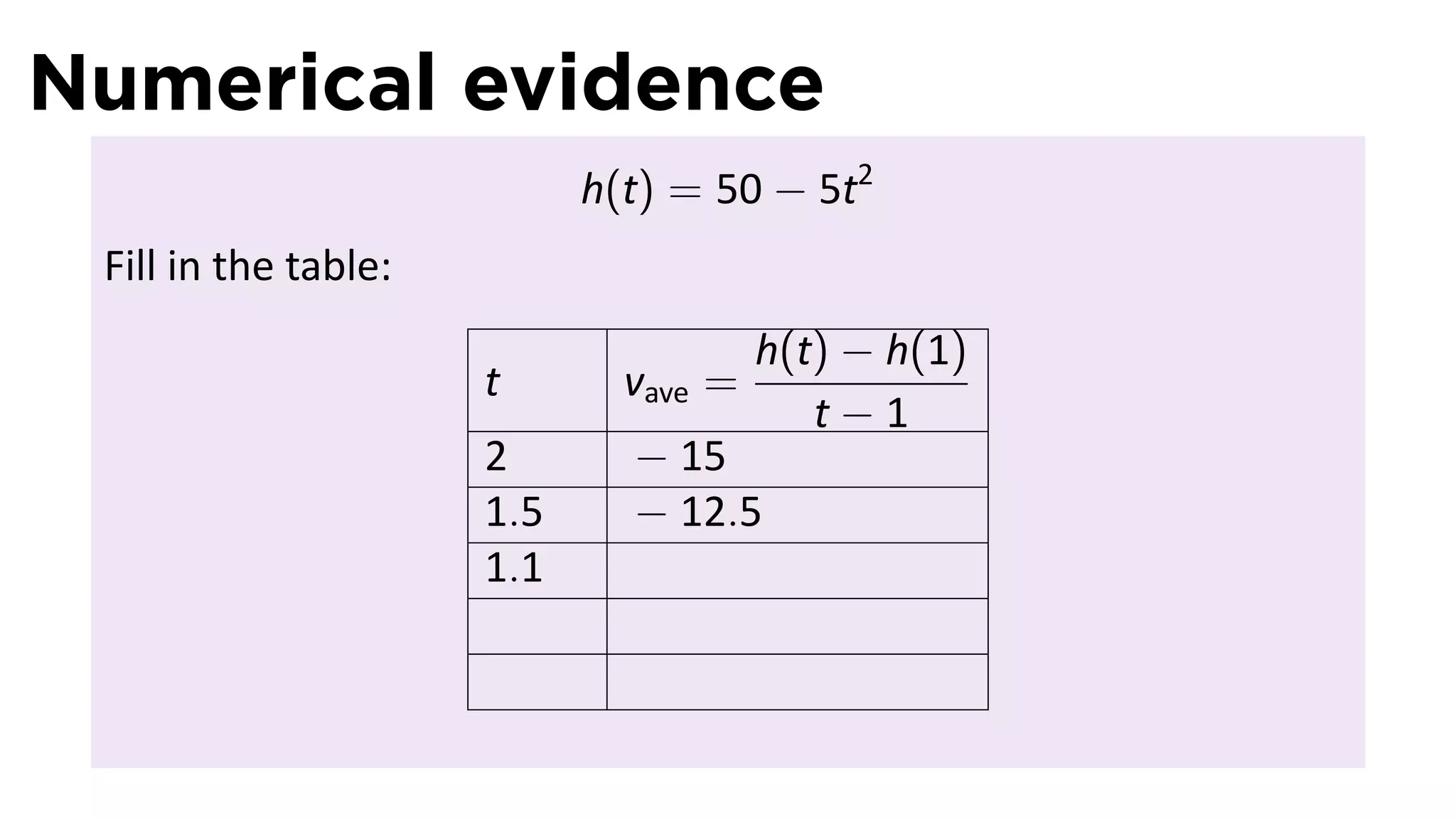
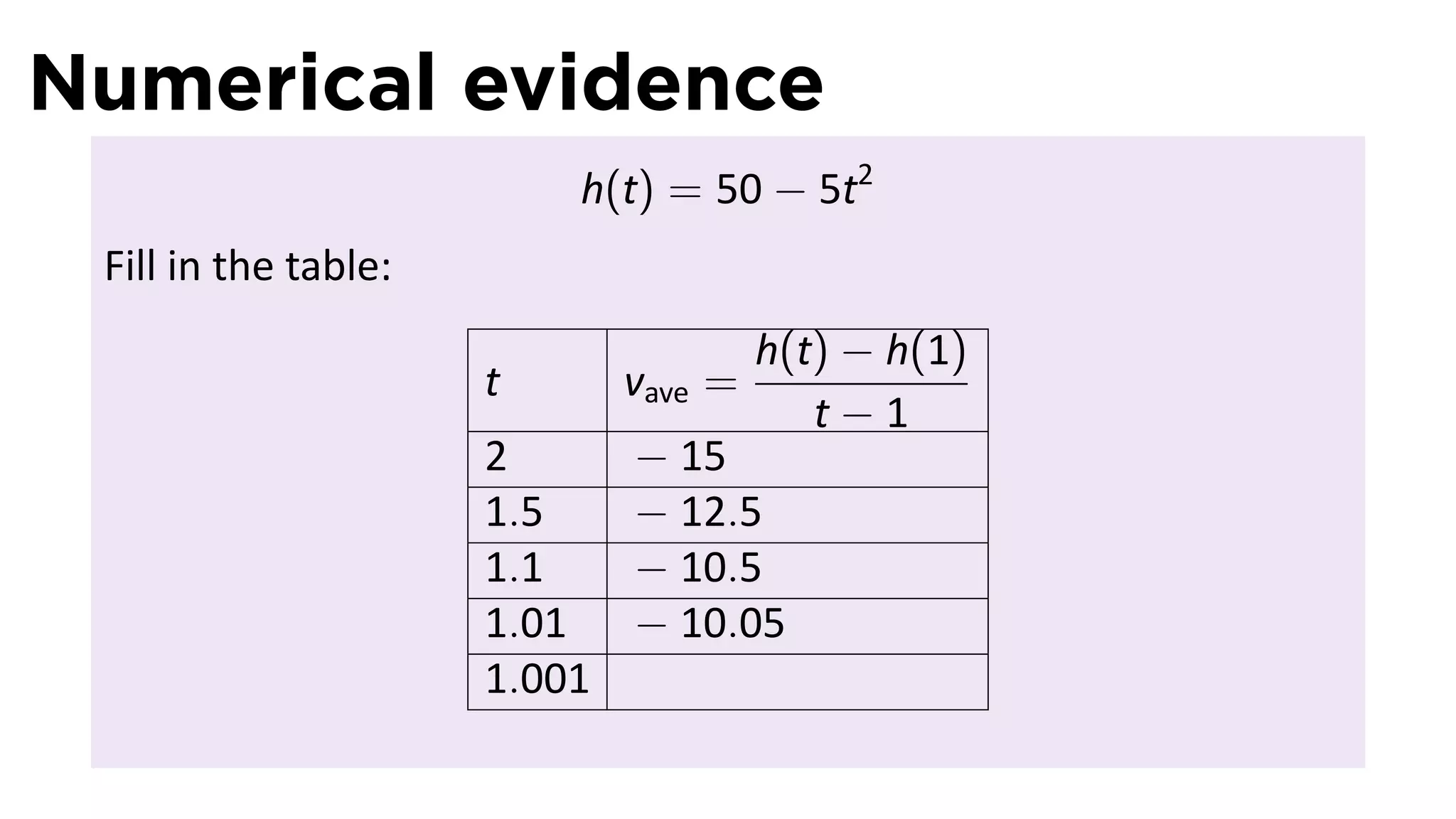
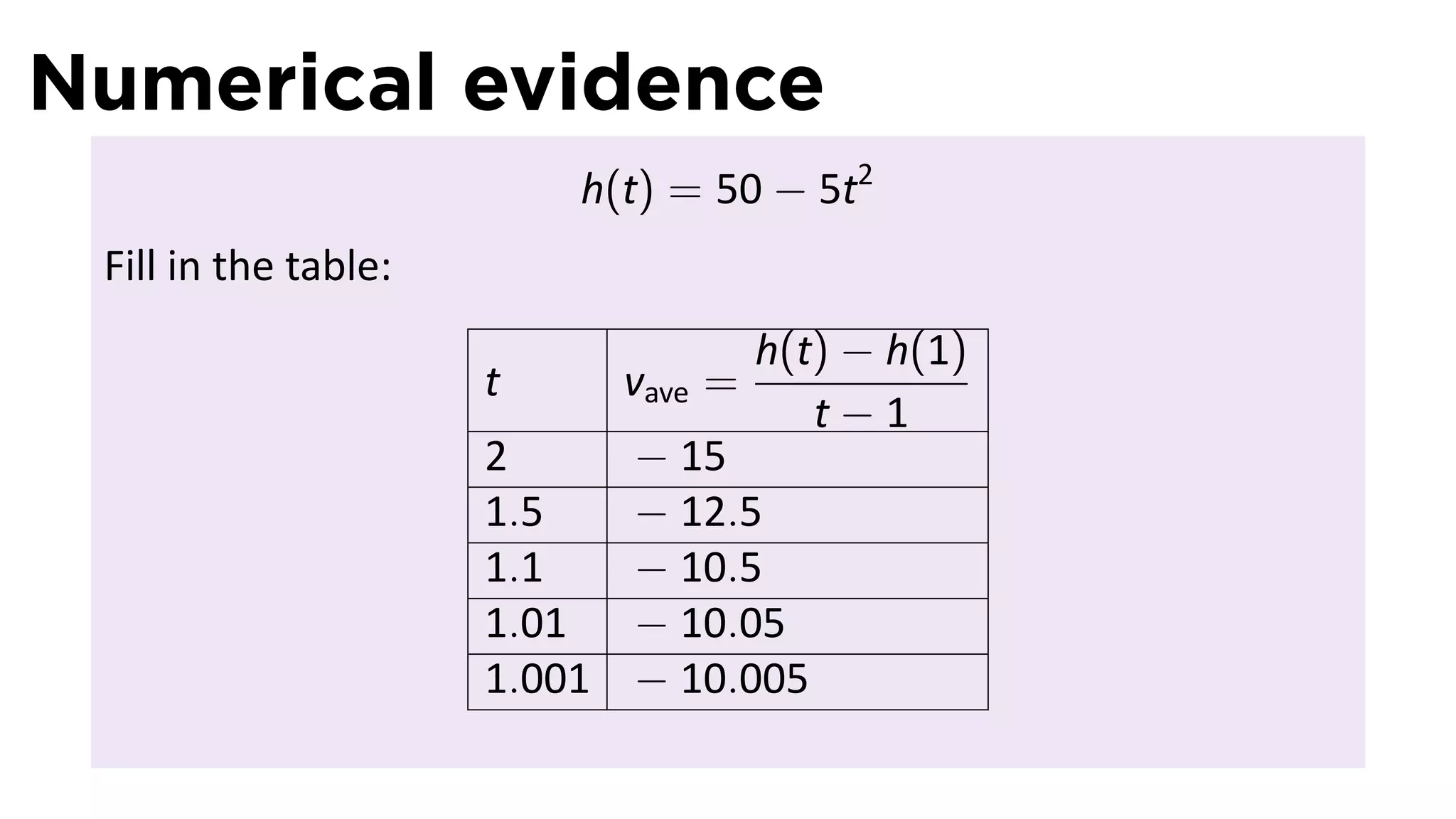
Numerical evidence
                          h(t) = 50 − 5t2
 Fill in the table:
                                     h(t) − h(1)
                      t     vave =
                                        t−1
                      2     − 15
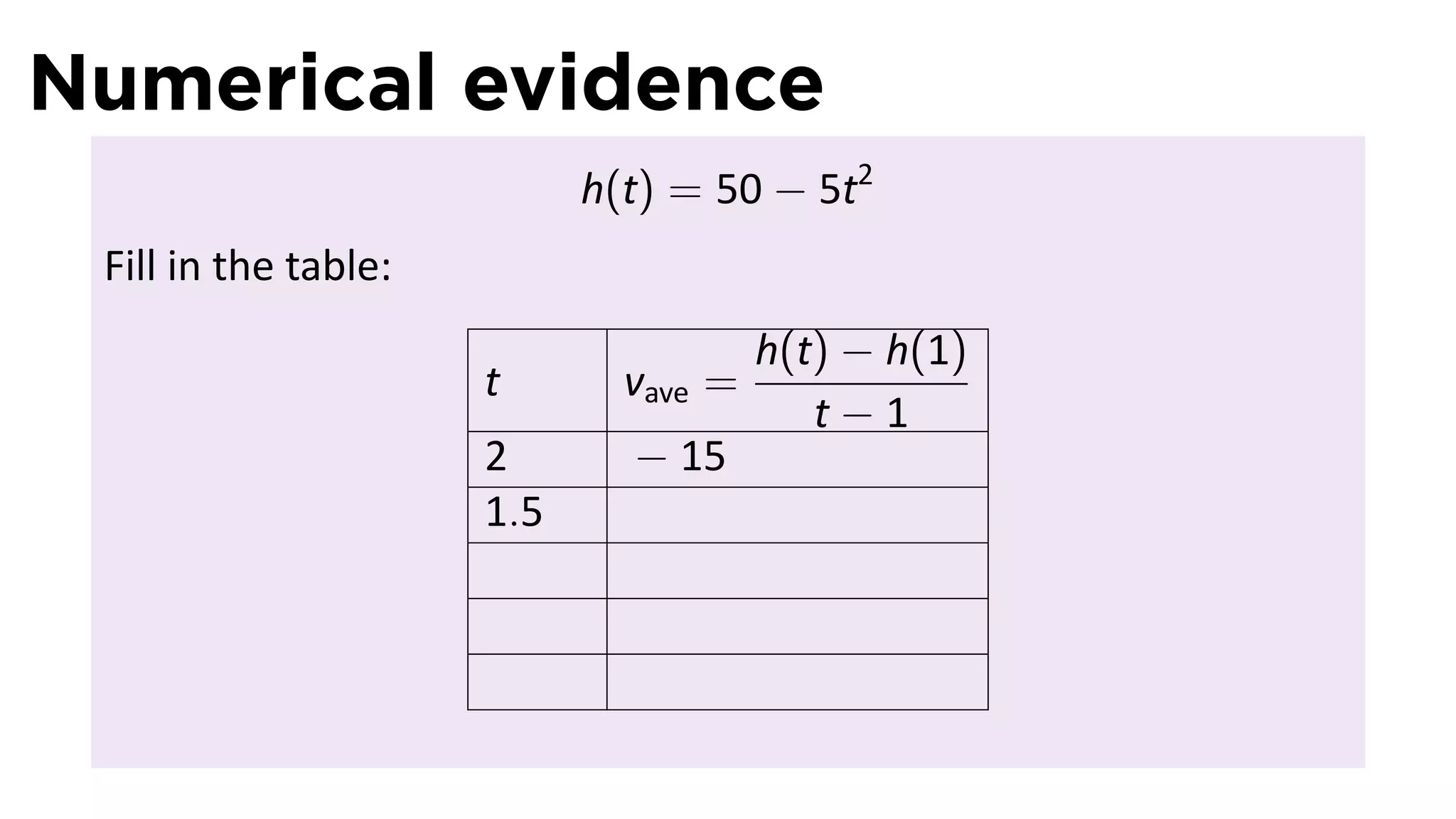
Numerical evidence
                            h(t) = 50 − 5t2
 Fill in the table:
                                       h(t) − h(1)
                      t       vave =
                                          t−1
                      2       − 15
                      1.5
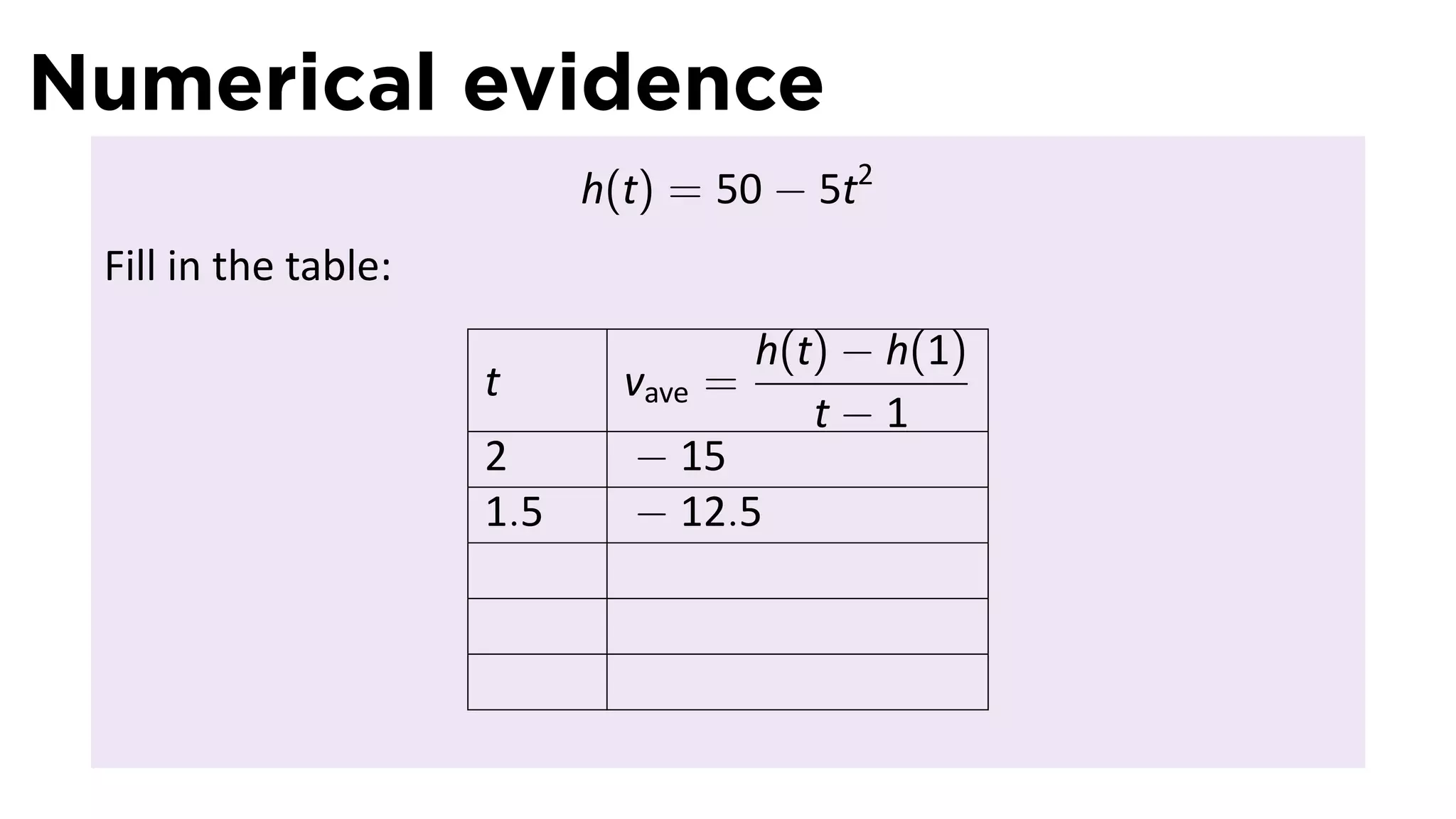
Numerical evidence
                            h(t) = 50 − 5t2
 Fill in the table:
                                       h(t) − h(1)
                      t       vave =
                                          t−1
                      2       − 15
                      1.5     − 12.5
Numerical evidence
                            h(t) = 50 − 5t2
 Fill in the table:
                                       h(t) − h(1)
                      t       vave =
                                          t−1
                      2       − 15
                      1.5     − 12.5
                      1.1
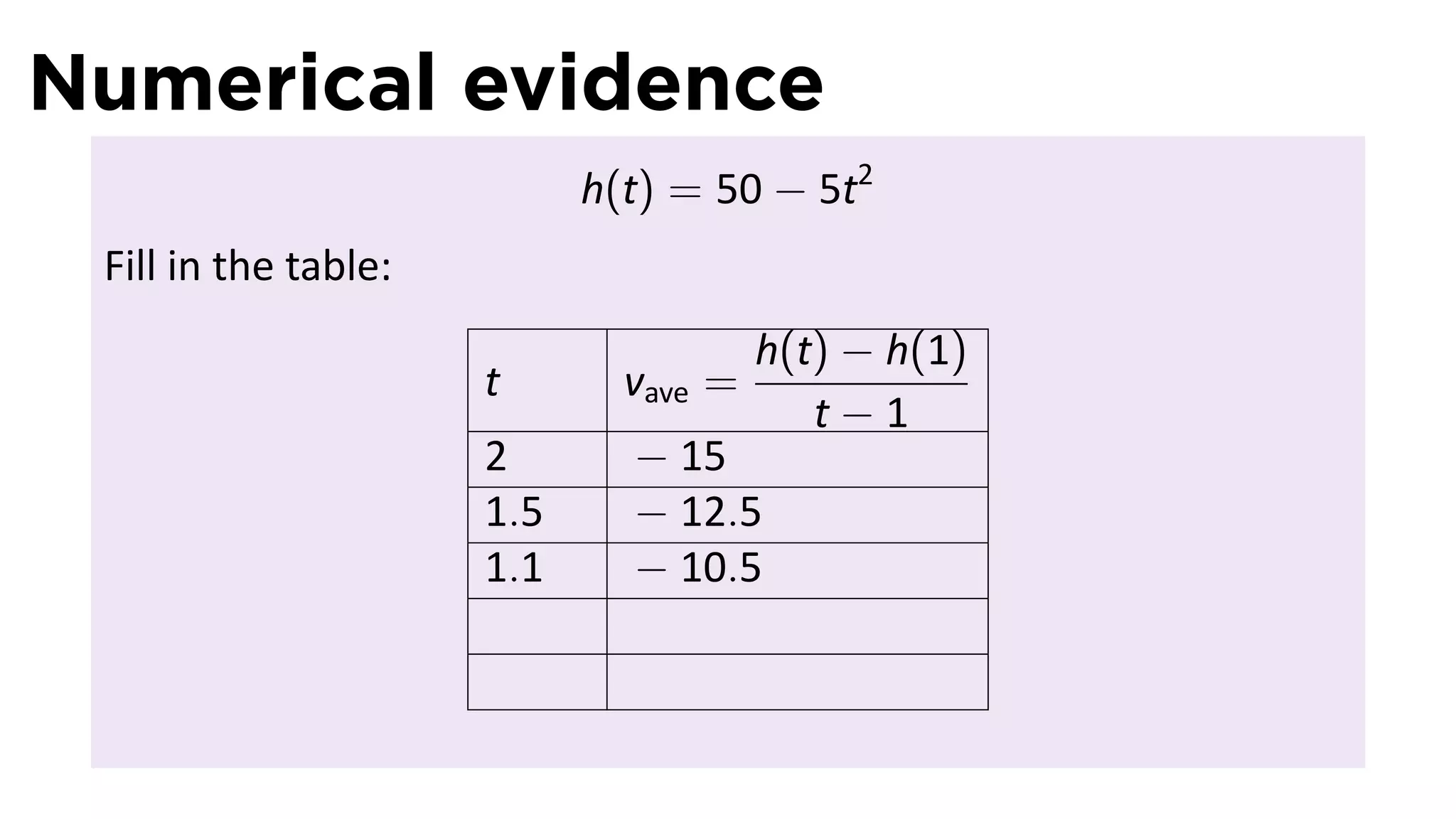
Numerical evidence
                            h(t) = 50 − 5t2
 Fill in the table:
                                       h(t) − h(1)
                      t       vave =
                                          t−1
                      2       − 15
                      1.5     − 12.5
                      1.1     − 10.5
Numerical evidence
                             h(t) = 50 − 5t2
 Fill in the table:
                                        h(t) − h(1)
                      t        vave =
                                           t−1
                      2        − 15
                      1.5      − 12.5
                      1.1      − 10.5
                      1.01
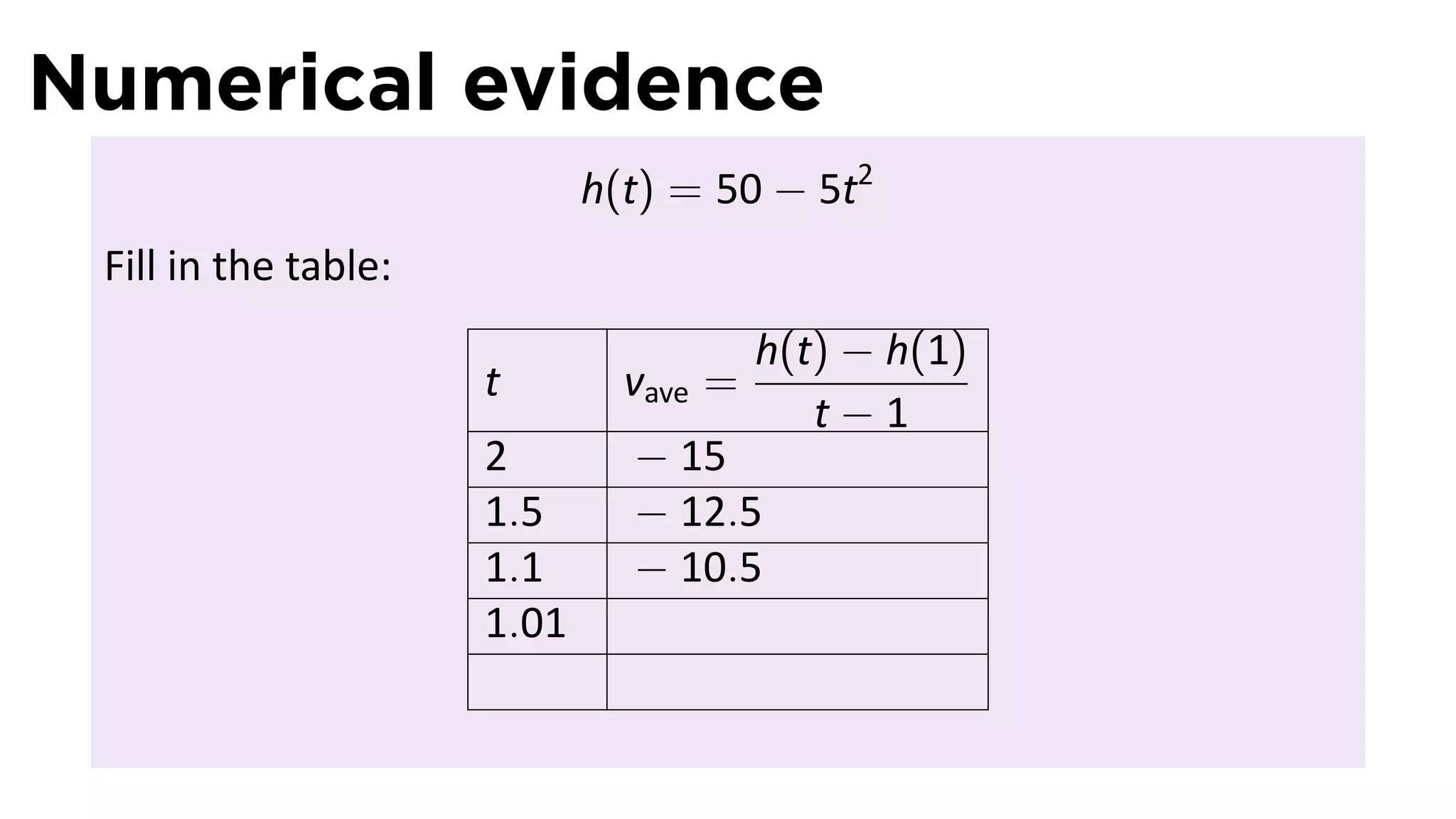
Numerical evidence
                             h(t) = 50 − 5t2
 Fill in the table:
                                        h(t) − h(1)
                      t        vave =
                                           t−1
                      2        − 15
                      1.5      − 12.5
                      1.1      − 10.5
                      1.01     − 10.05
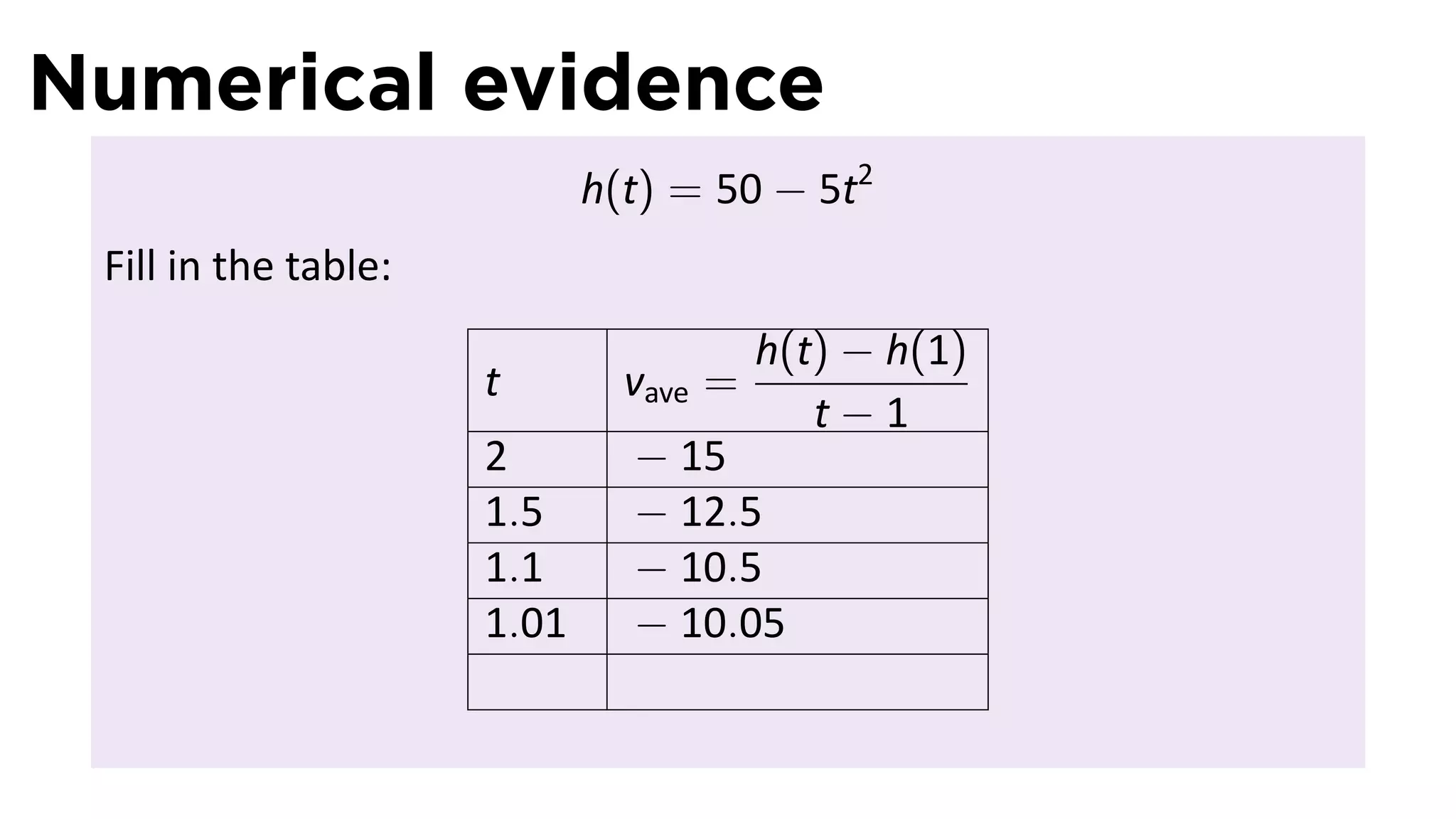
Numerical evidence
                          h(t) = 50 − 5t2
 Fill in the table:
                                       h(t) − h(1)
                      t       vave =
                                          t−1
                      2       − 15
                      1.5     − 12.5
                      1.1     − 10.5
                      1.01    − 10.05
                      1.001
Numerical evidence
                          h(t) = 50 − 5t2
 Fill in the table:
                                       h(t) − h(1)
                      t       vave =
                                          t−1
                      2       − 15
                      1.5     − 12.5
                      1.1     − 10.5
                      1.01    − 10.05
                      1.001   − 10.005
A velocity problem
Example                                Solu on
Drop a ball off the roof of the         The answer is
                                                    (50 − 5t2 ) − 45
Silver Center so that its height can        v = lim
be described by
                                                t→1      t−1

          h(t) = 50 − 5t2

where t is seconds a er dropping
it and h is meters above the
ground. How fast is it falling one
second a er we drop it?
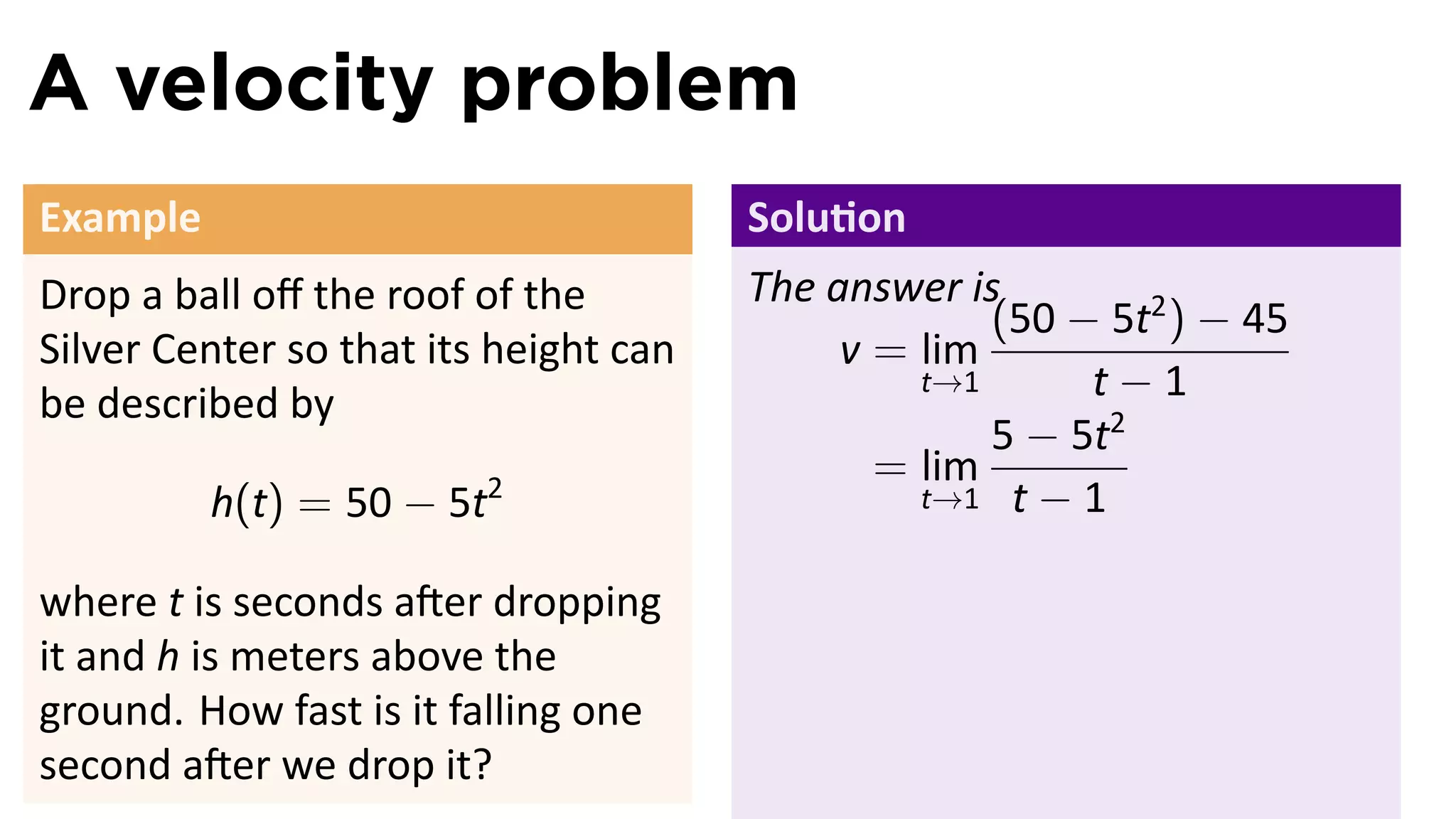
A velocity problem
Example                                Solu on
Drop a ball off the roof of the         The answer is
                                                    (50 − 5t2 ) − 45
Silver Center so that its height can        v = lim
be described by
                                                t→1      t−1
                                                    5 − 5t2
                                              = lim
          h(t) = 50 − 5t2                       t→1 t − 1


where t is seconds a er dropping
it and h is meters above the
ground. How fast is it falling one
second a er we drop it?
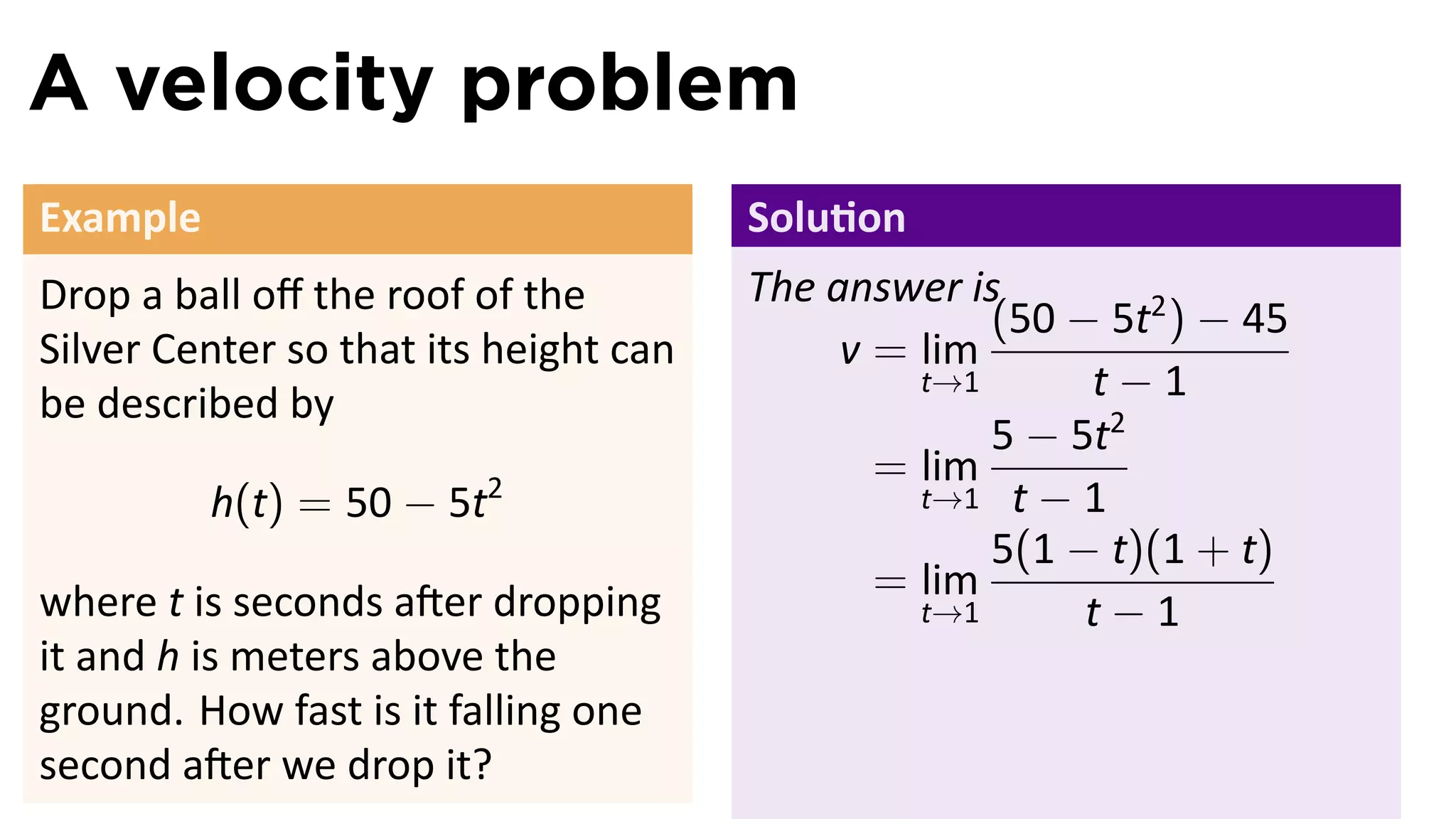
A velocity problem
Example                                Solu on
Drop a ball off the roof of the         The answer is
                                                    (50 − 5t2 ) − 45
Silver Center so that its height can        v = lim
be described by
                                                t→1      t−1
                                                    5 − 5t2
                                              = lim
          h(t) = 50 − 5t2                       t→1 t − 1
                                                    5(1 − t)(1 + t)
where t is seconds a er dropping              = lim
                                                t→1      t−1
it and h is meters above the
ground. How fast is it falling one
second a er we drop it?
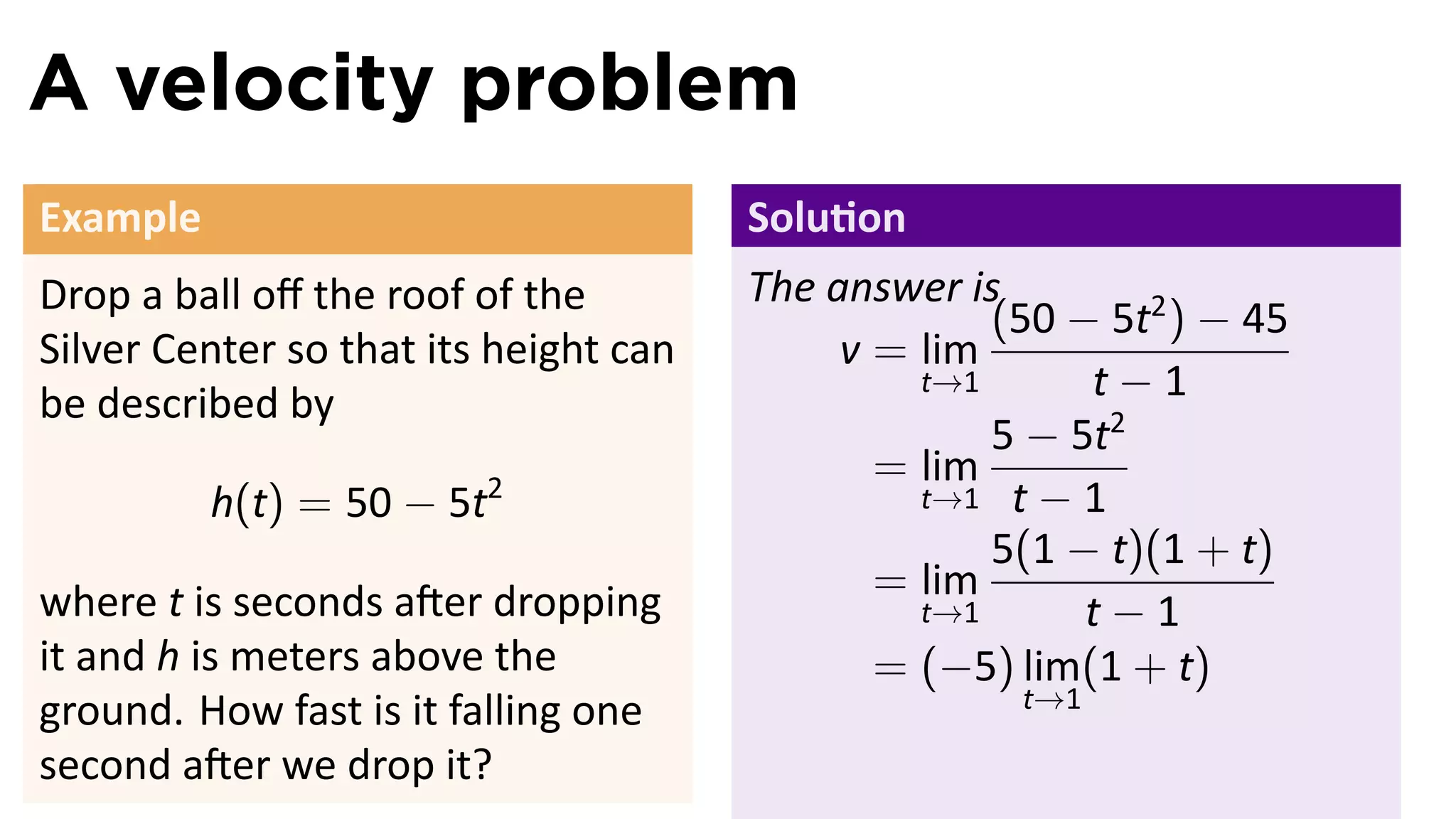
A velocity problem
Example                                Solu on
Drop a ball off the roof of the         The answer is
                                                    (50 − 5t2 ) − 45
Silver Center so that its height can        v = lim
be described by
                                                t→1      t−1
                                                    5 − 5t2
                                              = lim
          h(t) = 50 − 5t2                       t→1 t − 1
                                                    5(1 − t)(1 + t)
where t is seconds a er dropping              = lim
                                                t→1      t−1
it and h is meters above the                  = (−5) lim(1 + t)
                                                     t→1
ground. How fast is it falling one
second a er we drop it?
A velocity problem
Example                                Solu on
Drop a ball off the roof of the         The answer is
                                                    (50 − 5t2 ) − 45
Silver Center so that its height can        v = lim
be described by
                                                t→1      t−1
                                                    5 − 5t2
                                              = lim
          h(t) = 50 − 5t2                       t→1 t − 1
                                                    5(1 − t)(1 + t)
where t is seconds a er dropping              = lim
                                                t→1      t−1
it and h is meters above the                  = (−5) lim(1 + t)
                                                     t→1
ground. How fast is it falling one
second a er we drop it?                      = −5 · 2 = −10
Velocity in general
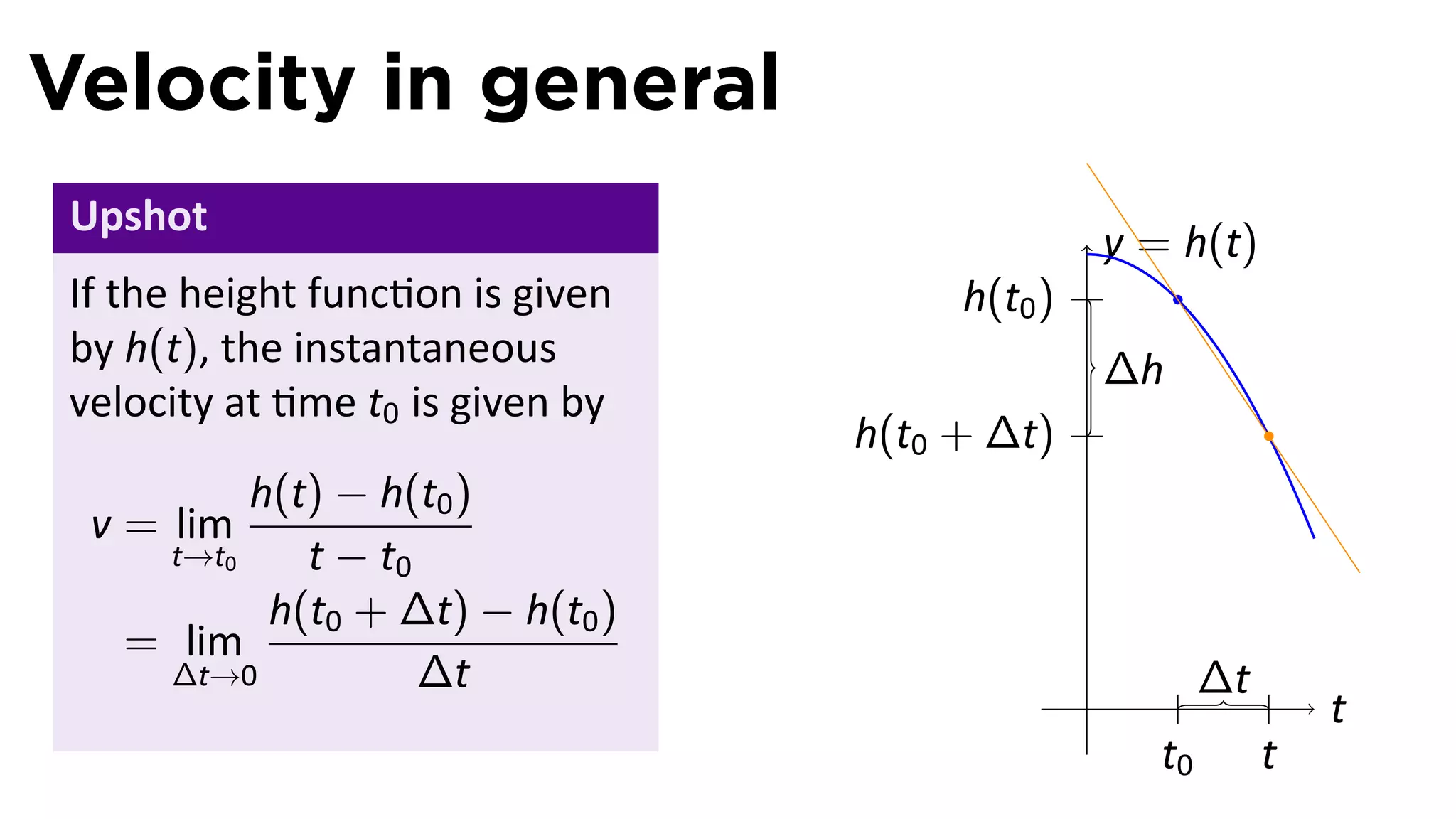
 Upshot
                                                    y = h(t)
 If the height func on is given        h(t0 )
 by h(t), the instantaneous                         ∆h
 velocity at me t0 is given by
                                  h(t0 + ∆t)
          h(t) − h(t0 )
  v = lim
     t→t0    t − t0
           h(t0 + ∆t) − h(t0 )
    = lim
     ∆t→0           ∆t                          .           ∆t
                                                                     t
                                                       t0        t
Population growth
Biological Rates of Change
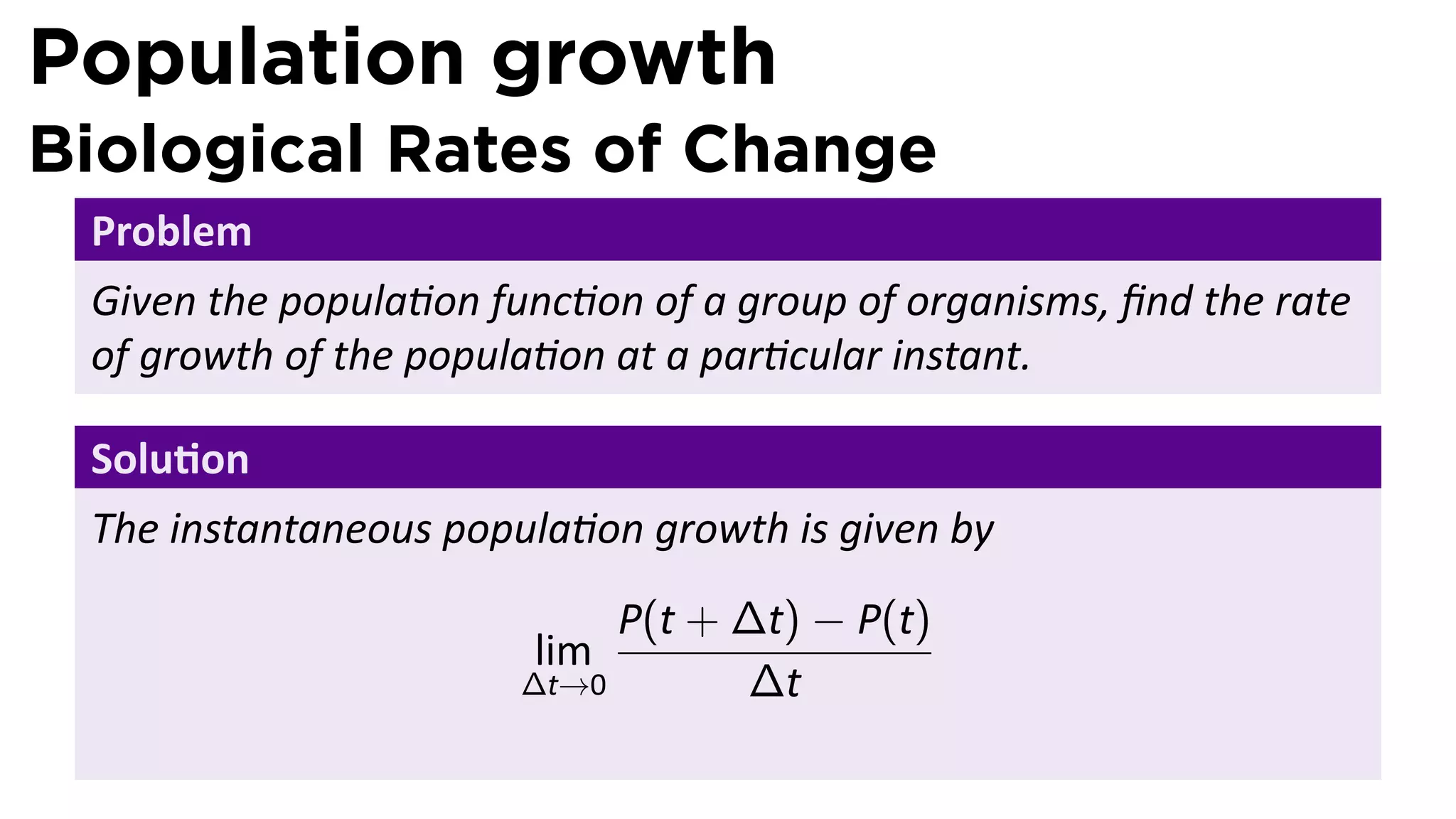
 Problem
 Given the popula on func on of a group of organisms, find the rate
 of growth of the popula on at a par cular instant.
Population growth example
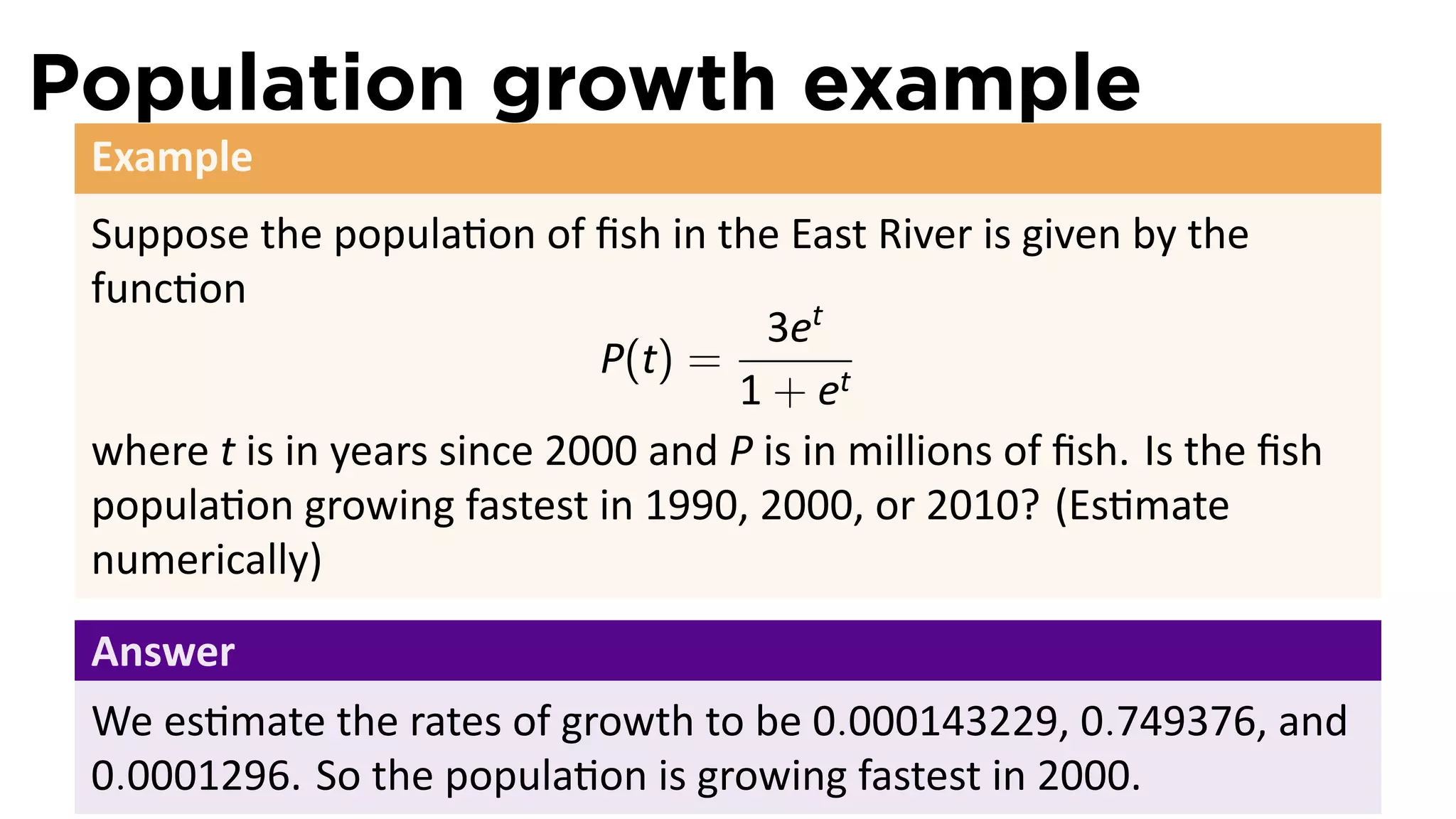
 Example
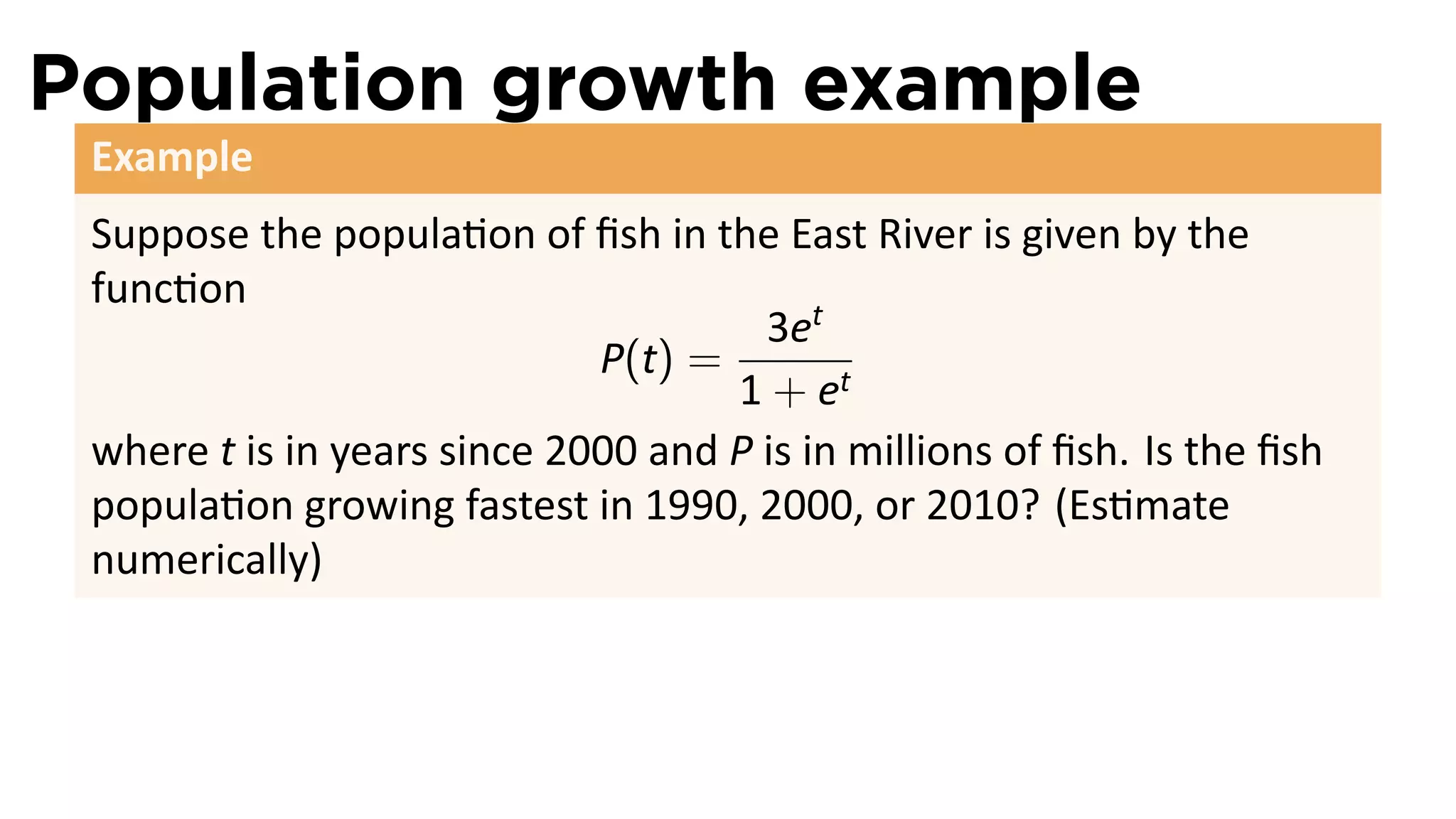
 Suppose the popula on of fish in the East River is given by the
 func on
                                      3et
                             P(t) =
                                    1 + et
 where t is in years since 2000 and P is in millions of fish. Is the fish
 popula on growing fastest in 1990, 2000, or 2010? (Es mate
 numerically)
Derivation
 Solu on
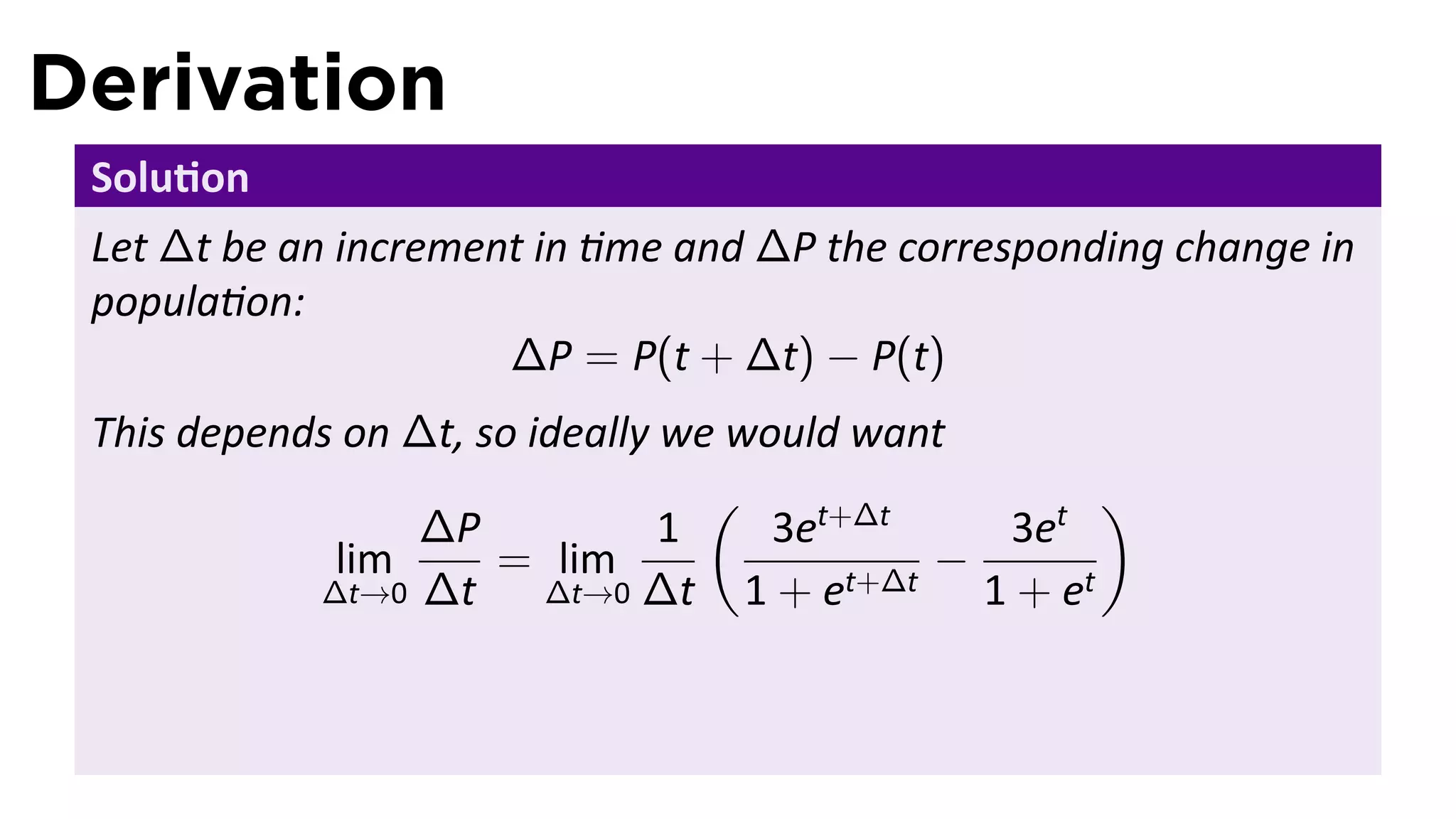
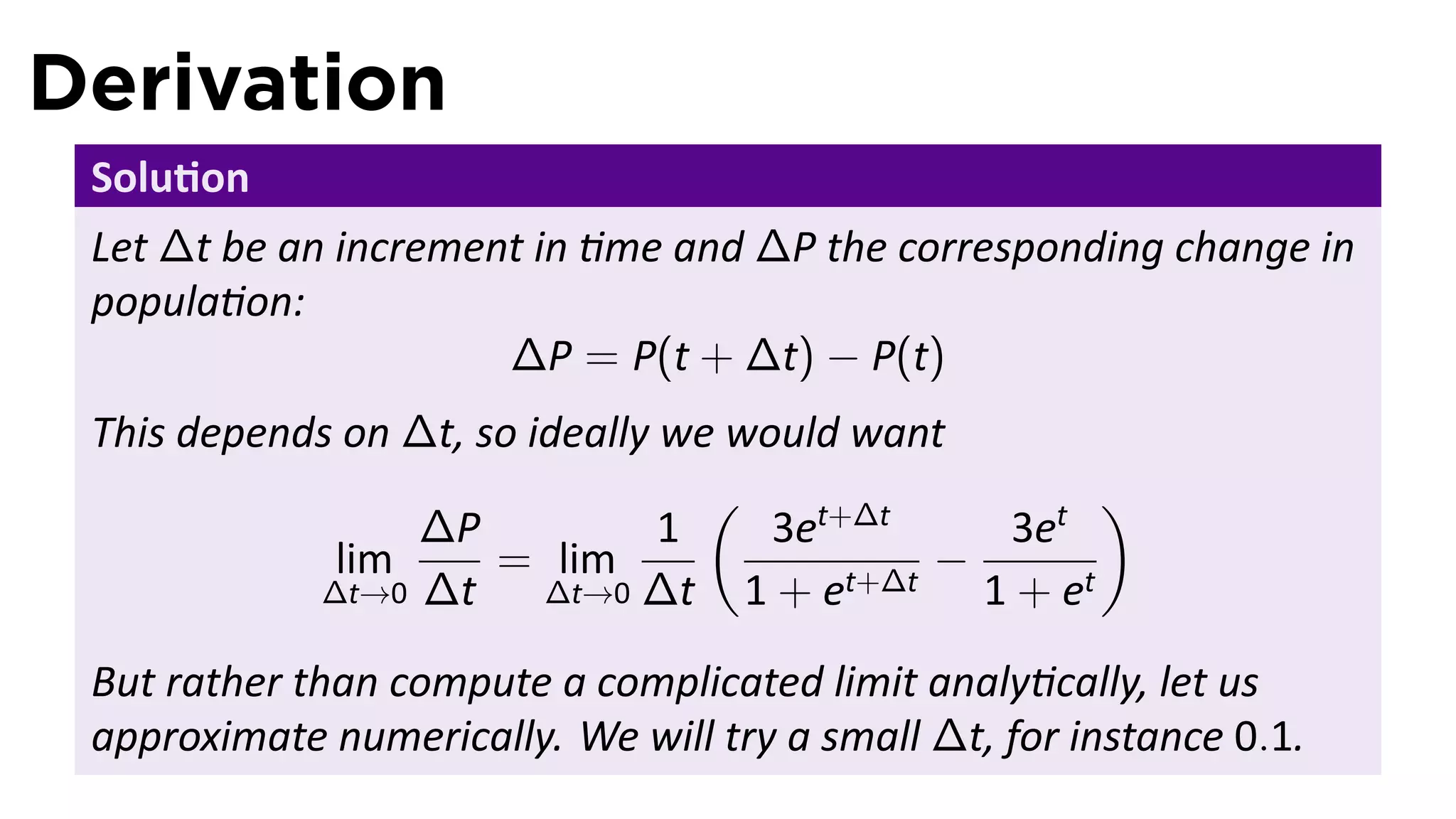
 Let ∆t be an increment in me and ∆P the corresponding change in
 popula on:
                      ∆P = P(t + ∆t) − P(t)
 This depends on ∆t, so ideally we would want
                                  (                  )
                 ∆P             1    3et+∆t    3et
             lim      = lim                  −
            ∆t→0 ∆t      ∆t→0 ∆t    1 + et+∆t 1 + et
Derivation
 Solu on
 Let ∆t be an increment in me and ∆P the corresponding change in
 popula on:
                      ∆P = P(t + ∆t) − P(t)
 This depends on ∆t, so ideally we would want
                                  (                  )
                 ∆P             1    3et+∆t    3et
             lim      = lim                  −
            ∆t→0 ∆t      ∆t→0 ∆t    1 + et+∆t 1 + et
 But rather than compute a complicated limit analy cally, let us
 approximate numerically. We will try a small ∆t, for instance 0.1.
Numerical evidence
 Solu on (Con nued)
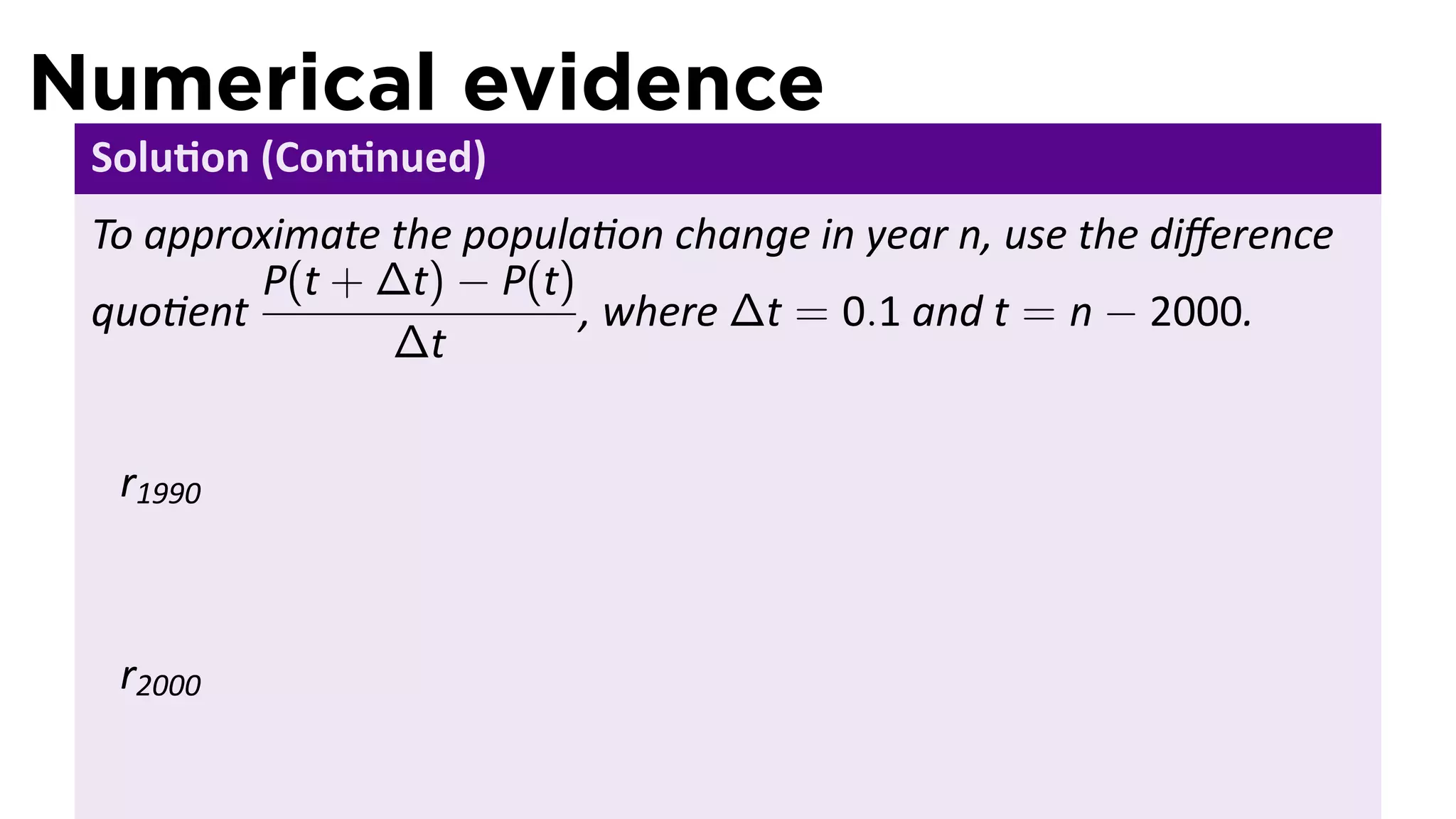
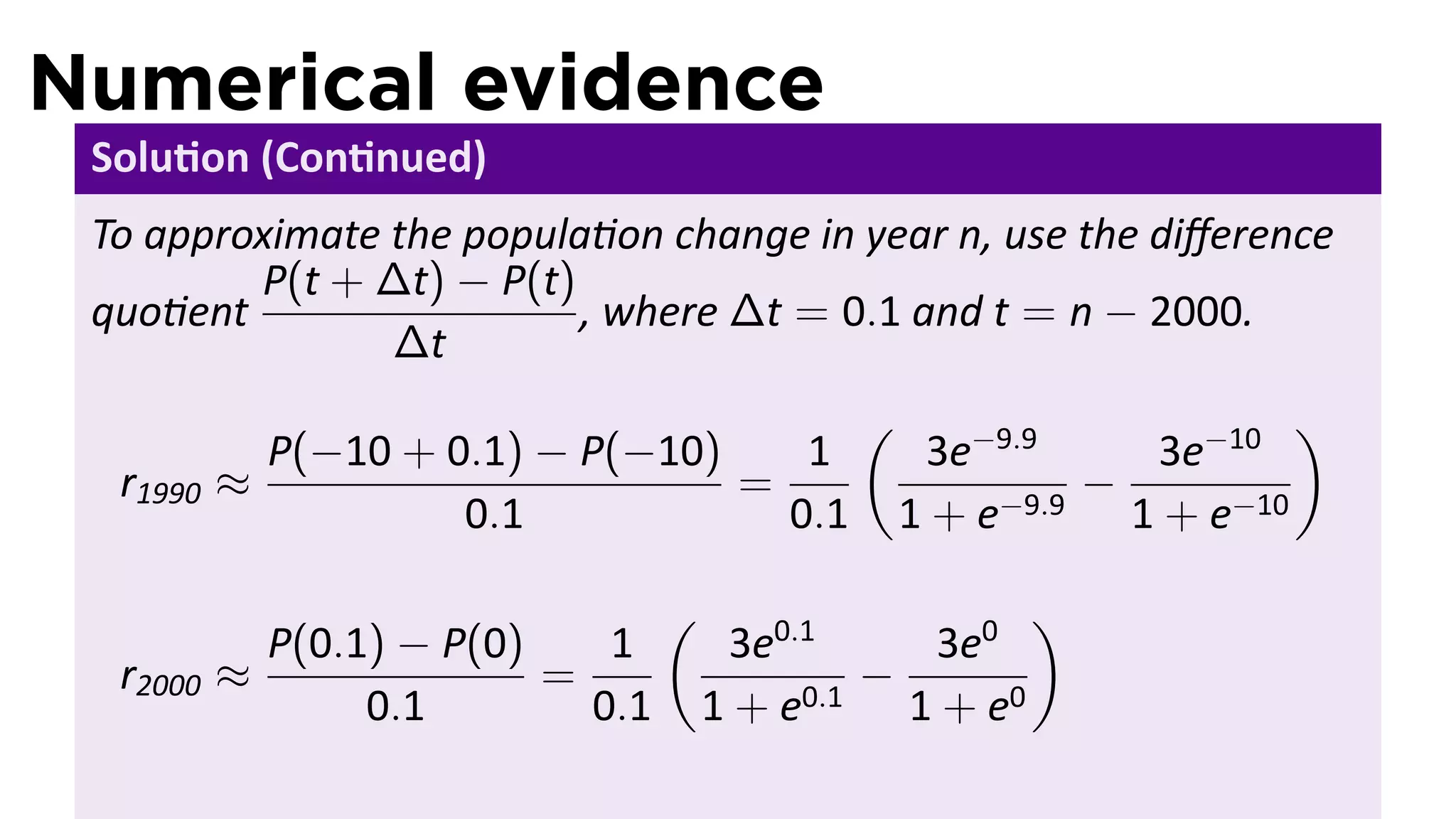
 To approximate the popula on change in year n, use the difference
         P(t + ∆t) − P(t)
 quo ent                  , where ∆t = 0.1 and t = n − 2000.
                ∆t


  r1990


  r2000
Numerical evidence
 Solu on (Con nued)
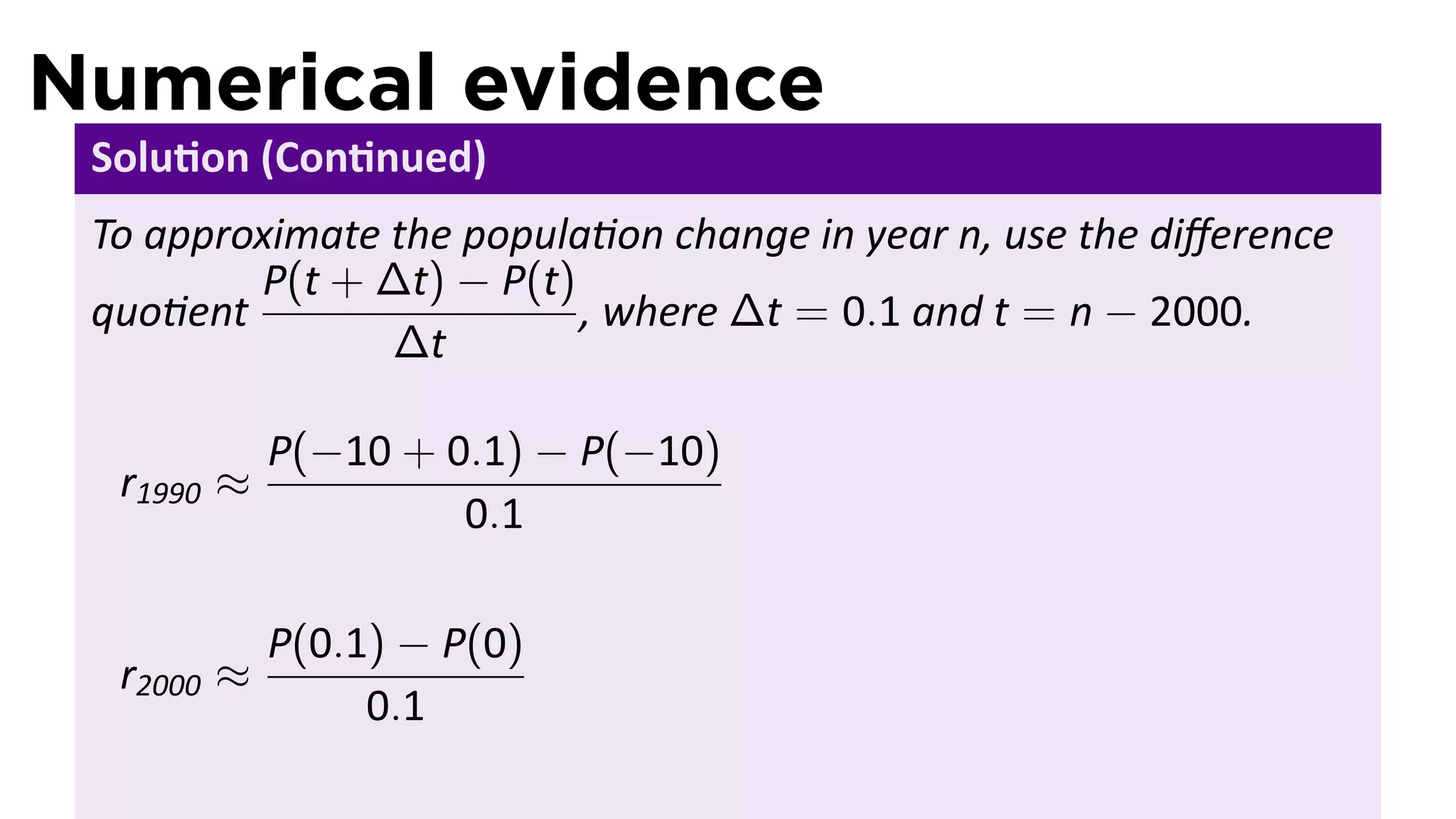
 To approximate the popula on change in year n, use the difference
         P(t + ∆t) − P(t)
 quo ent                  , where ∆t = 0.1 and t = n − 2000.
                ∆t

            P(−10 + 0.1) − P(−10)
  r1990 ≈
                     0.1

            P(0.1) − P(0)
  r2000 ≈
                 0.1
Numerical evidence
 Solu on (Con nued)
 To approximate the popula on change in year n, use the difference
         P(t + ∆t) − P(t)
 quo ent                  , where ∆t = 0.1 and t = n − 2000.
                ∆t
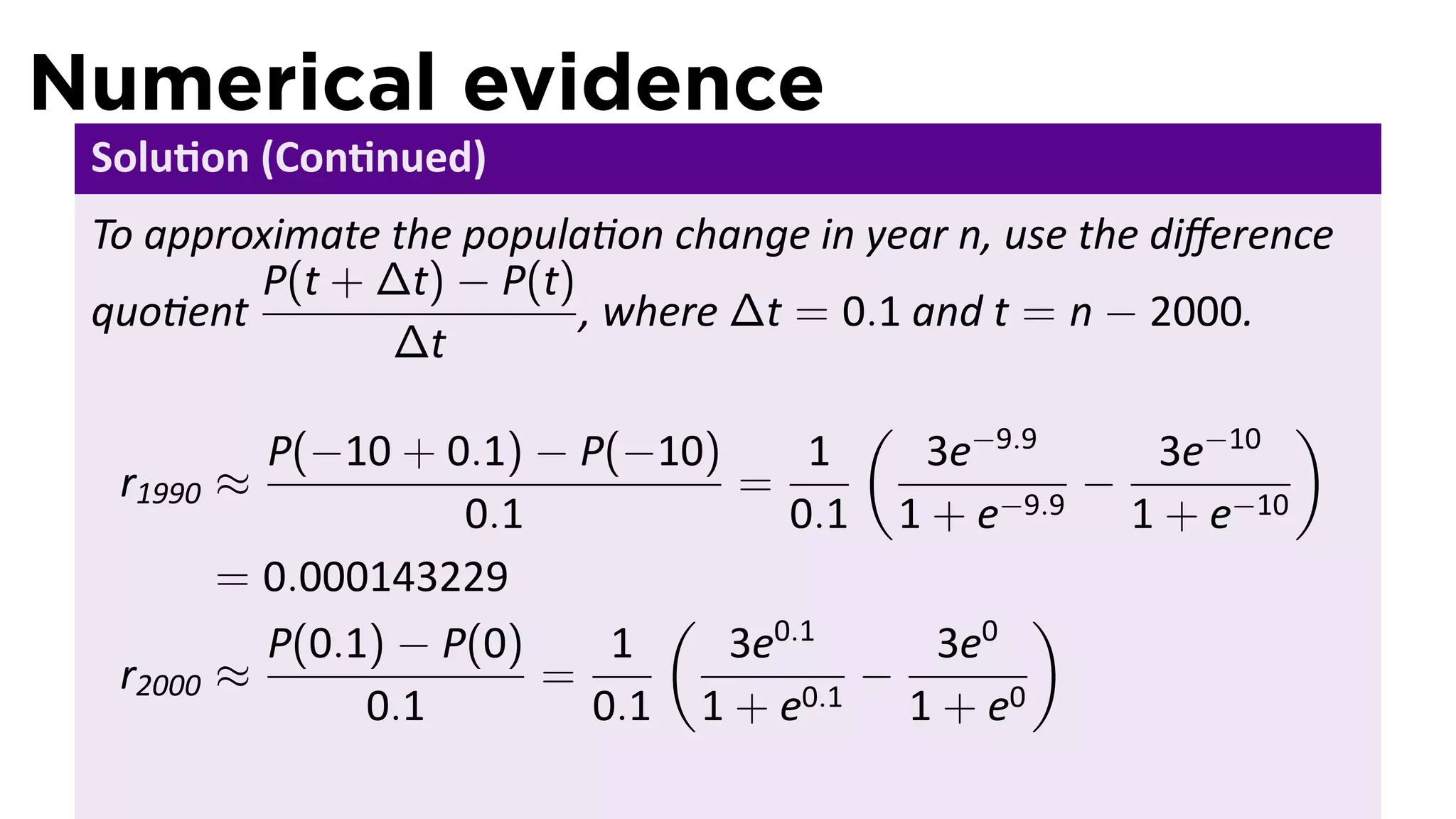
                                             (                        )
            P(−10 + 0.1) − P(−10)    1            3e−9.9    3e−10
  r1990   ≈                       =                       −
                     0.1            0.1          1 + e−9.9 1 + e−10

                                  (                     )
            P(0.1) − P(0)    1         3e0.1    3e0
  r2000   ≈               =                   −
                 0.1        0.1       1 + e0.1 1 + e0
Numerical evidence
 Solu on (Con nued)
 To approximate the popula on change in year n, use the difference
         P(t + ∆t) − P(t)
 quo ent                  , where ∆t = 0.1 and t = n − 2000.
                ∆t
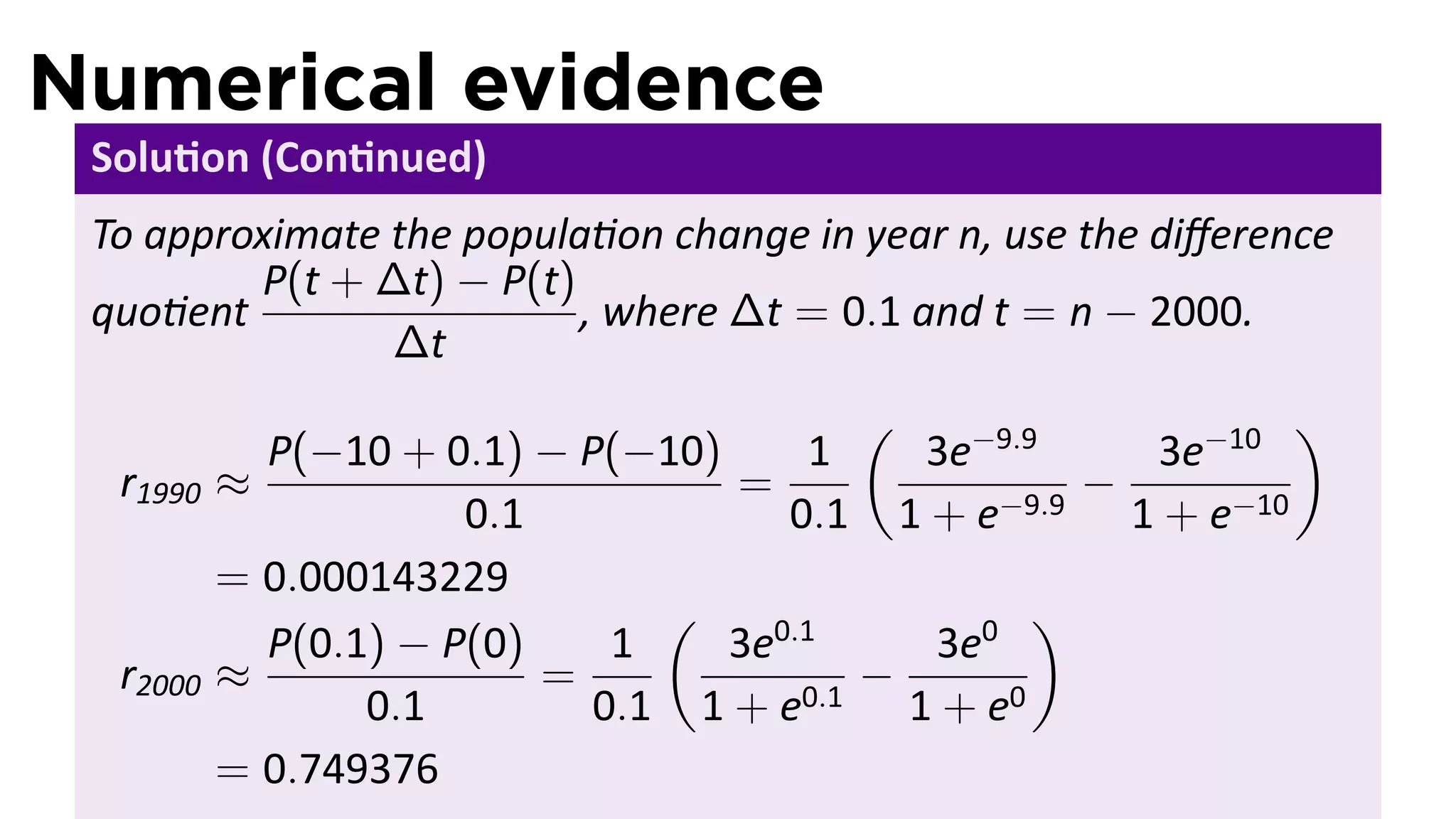
                                         (                  )
            P(−10 + 0.1) − P(−10)      1   3e−9.9    3e−10
  r1990   ≈                       =                −
                      0.1            0.1 1 + e−9.9 1 + e−10
          = 0.000143229
                               (                 )
            P(0.1) − P(0)    1    3e0.1    3e0
  r2000   ≈               =              −
                 0.1        0.1 1 + e0.1 1 + e0
Numerical evidence
 Solu on (Con nued)
 To approximate the popula on change in year n, use the difference
         P(t + ∆t) − P(t)
 quo ent                  , where ∆t = 0.1 and t = n − 2000.
                ∆t
                                         (                  )
            P(−10 + 0.1) − P(−10)      1   3e−9.9    3e−10
  r1990   ≈                       =                −
                      0.1            0.1 1 + e−9.9 1 + e−10
          = 0.000143229
                               (                 )
            P(0.1) − P(0)    1    3e0.1    3e0
  r2000   ≈               =              −
                 0.1        0.1 1 + e0.1 1 + e0
          = 0.749376
Solu on (Con nued)


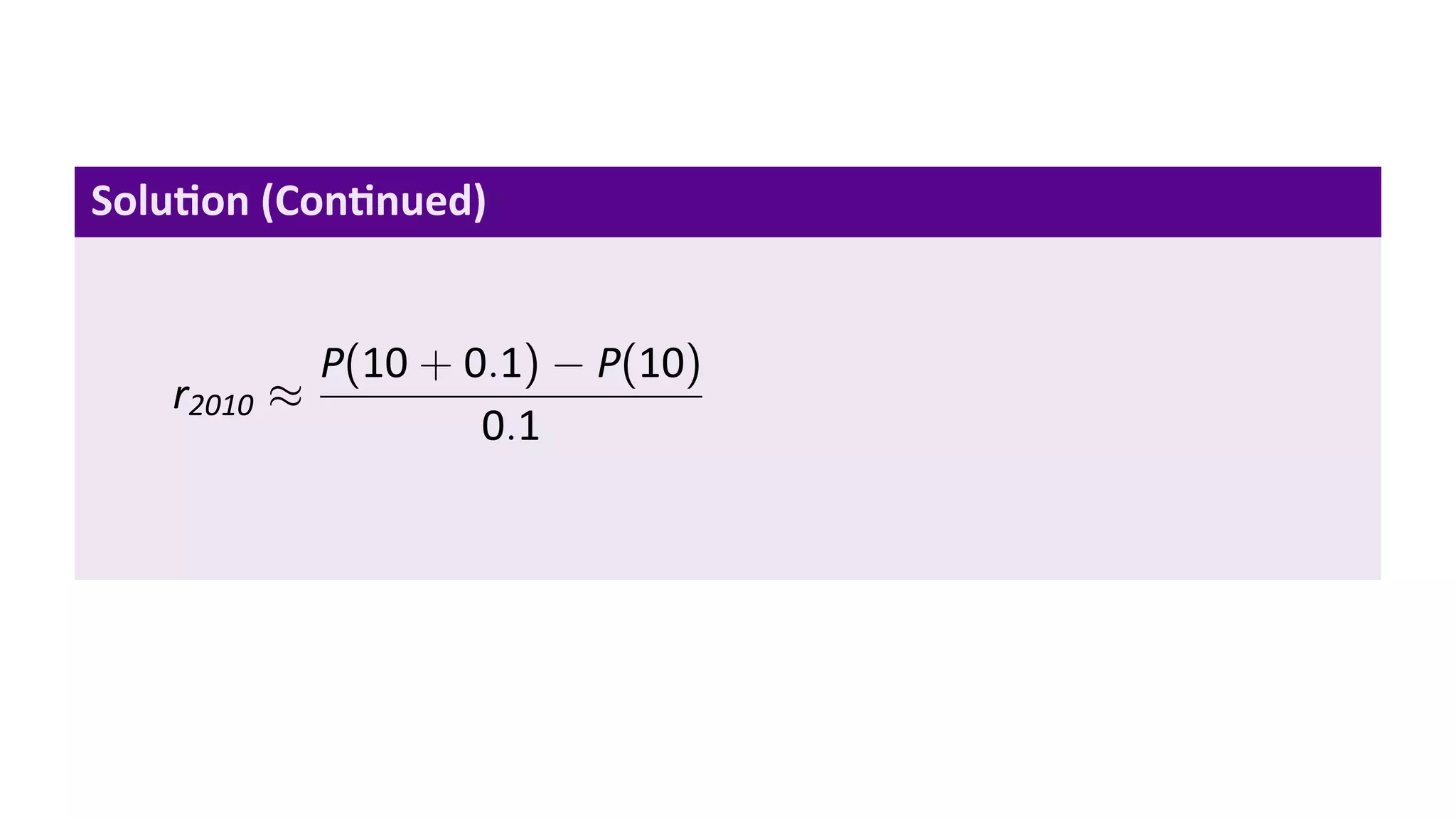
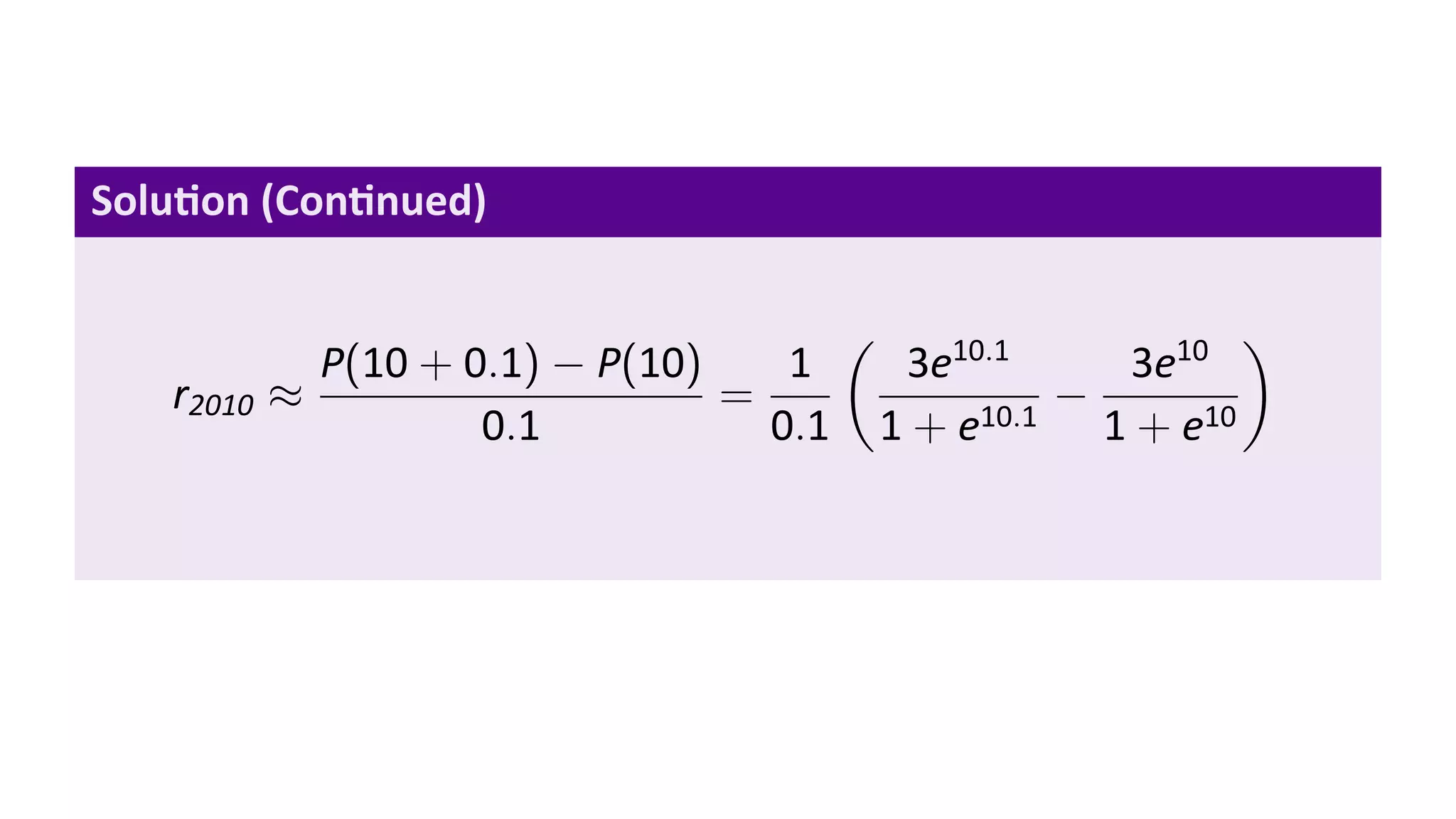
   r2010
Solu on (Con nued)


             P(10 + 0.1) − P(10)
   r2010 ≈
                     0.1
Solu on (Con nued)

                                         (                       )
             P(10 + 0.1) − P(10)    1         3e10.1    3e10
   r2010   ≈                     =                    −
                     0.1           0.1       1 + e10.1 1 + e10
Solu on (Con nued)

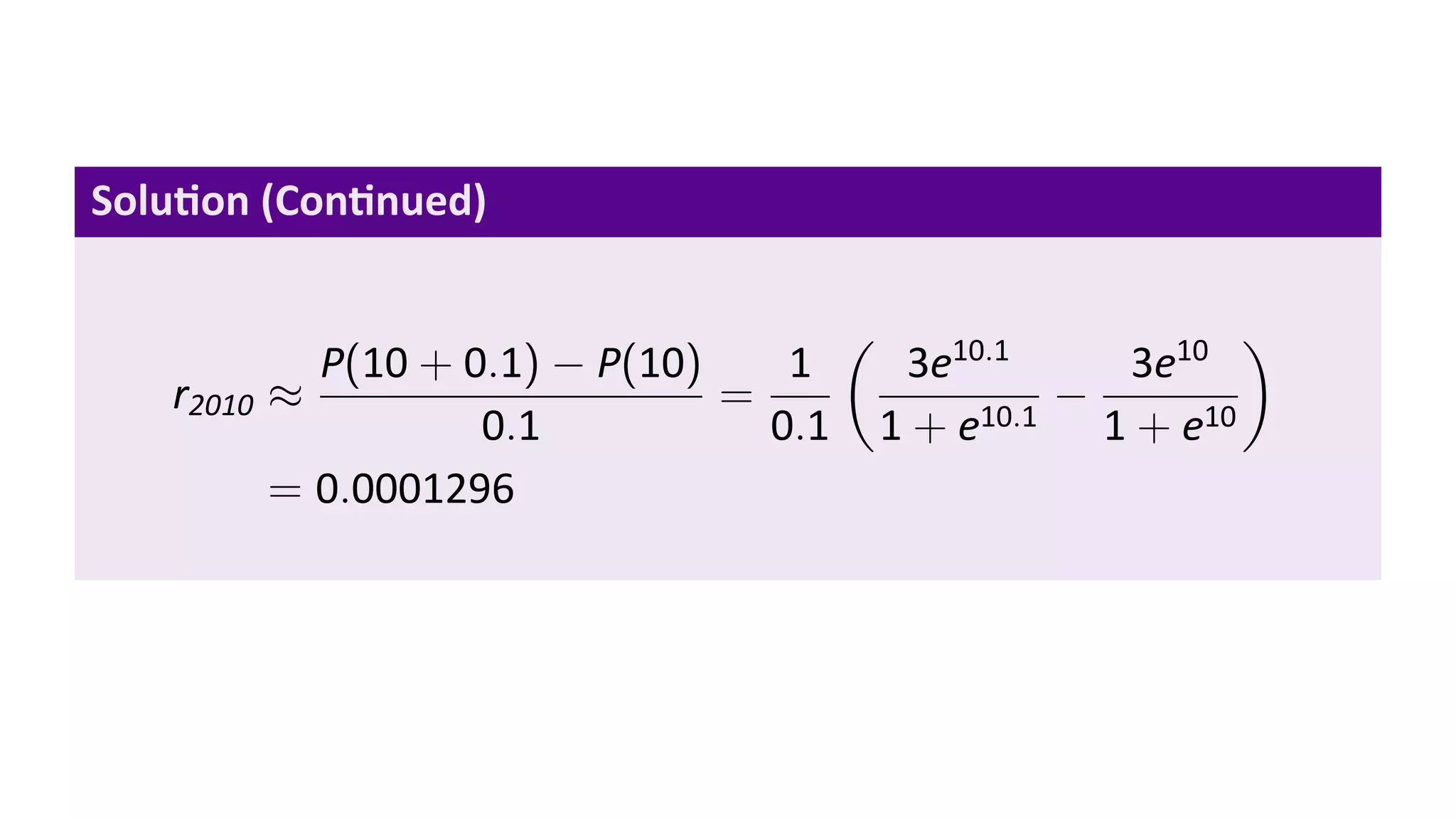
                                         (                       )
             P(10 + 0.1) − P(10)    1         3e10.1    3e10
   r2010   ≈                     =                    −
                     0.1           0.1       1 + e10.1 1 + e10
           = 0.0001296
Population growth example
 Example
 Suppose the popula on of fish in the East River is given by the
 func on
                                      3et
                             P(t) =
                                    1 + et
 where t is in years since 2000 and P is in millions of fish. Is the fish
 popula on growing fastest in 1990, 2000, or 2010? (Es mate
 numerically)
 Answer
 We es mate the rates of growth to be 0.000143229, 0.749376, and
 0.0001296. So the popula on is growing fastest in 2000.
Population growth
Biological Rates of Change
 Problem
 Given the popula on func on of a group of organisms, find the rate
 of growth of the popula on at a par cular instant.

 Solu on
 The instantaneous popula on growth is given by
                            P(t + ∆t) − P(t)
                       lim
                       ∆t→0       ∆t
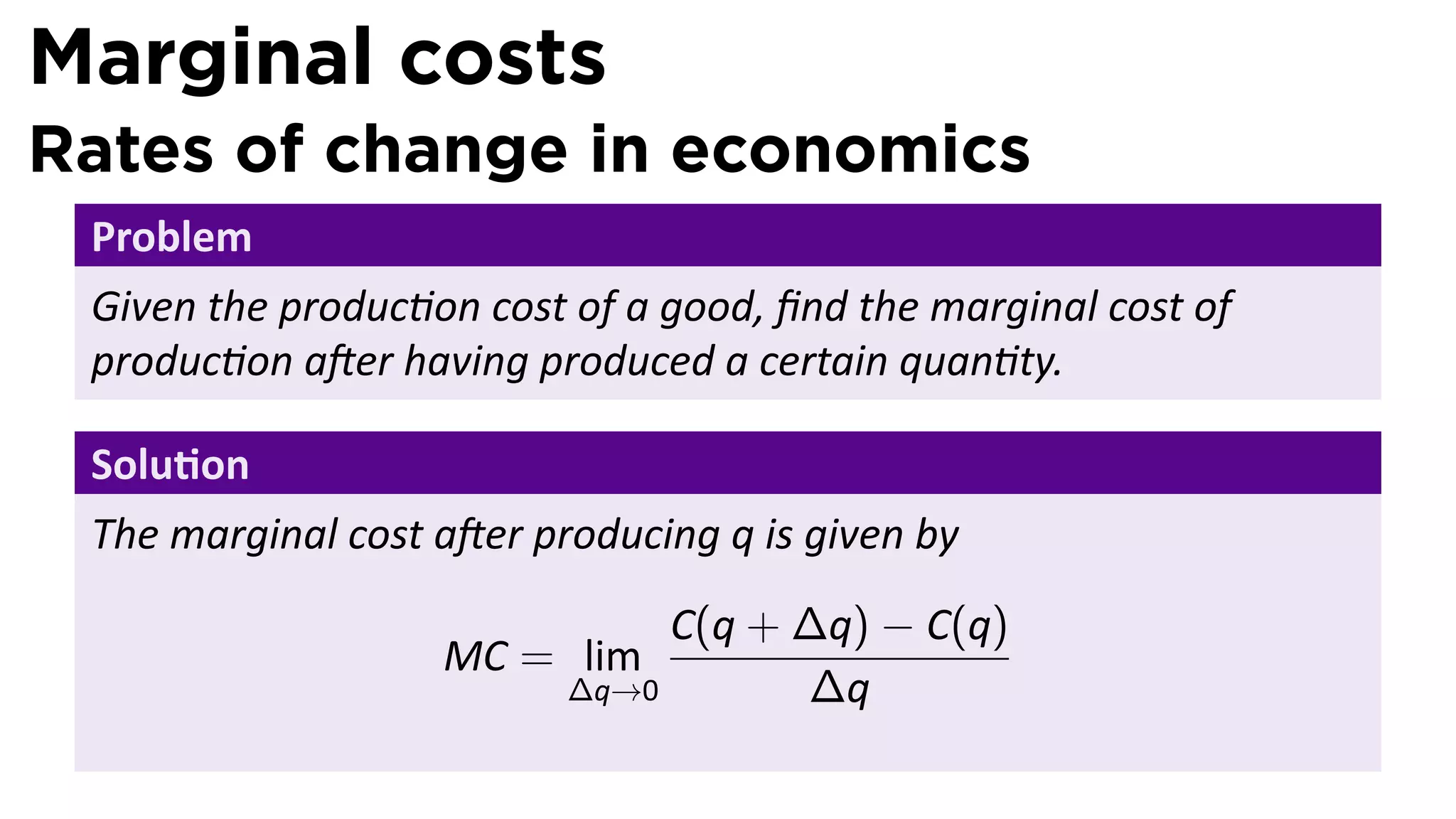
Marginal costs
Rates of change in economics
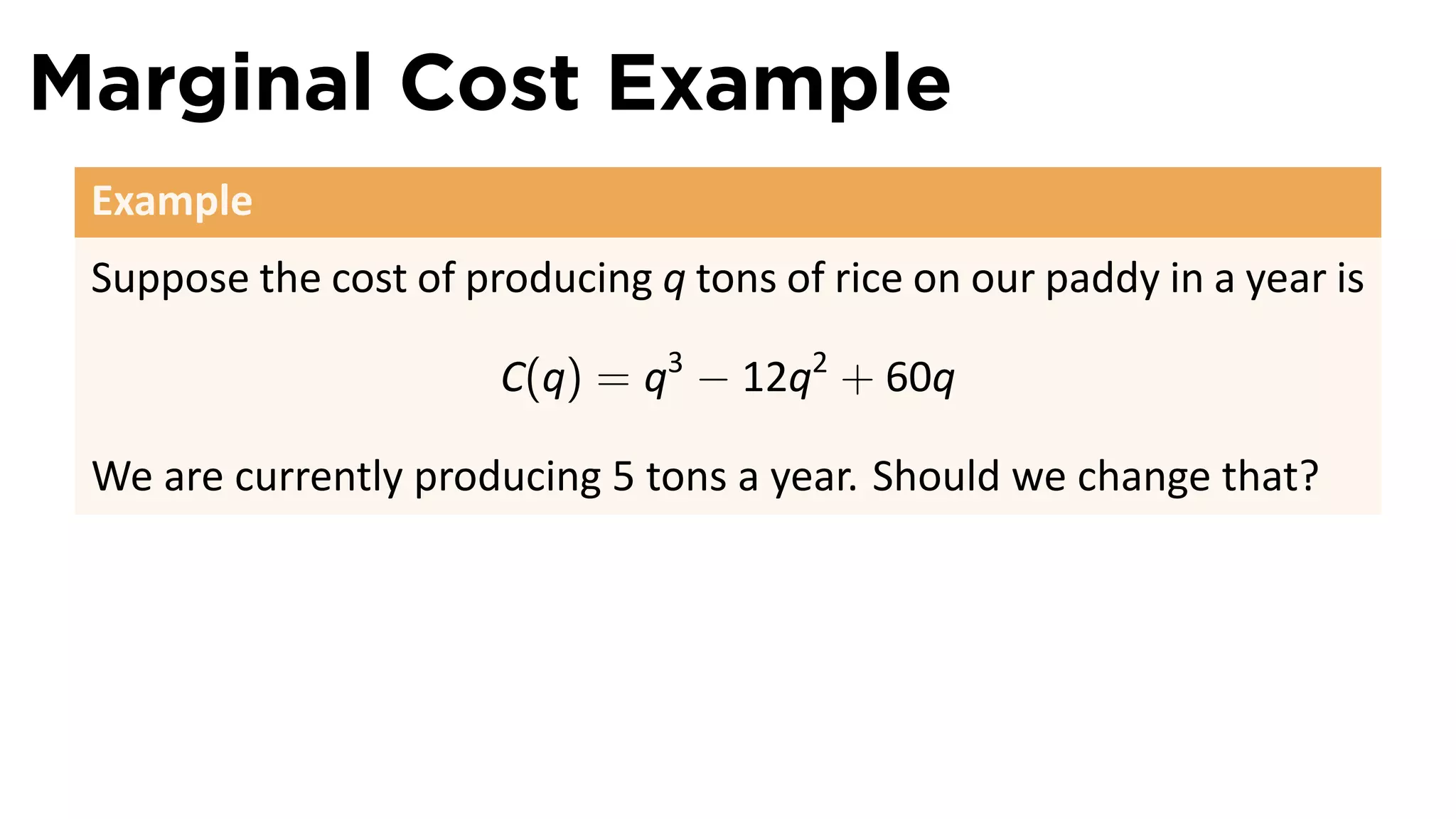
 Problem
 Given the produc on cost of a good, find the marginal cost of
 produc on a er having produced a certain quan ty.
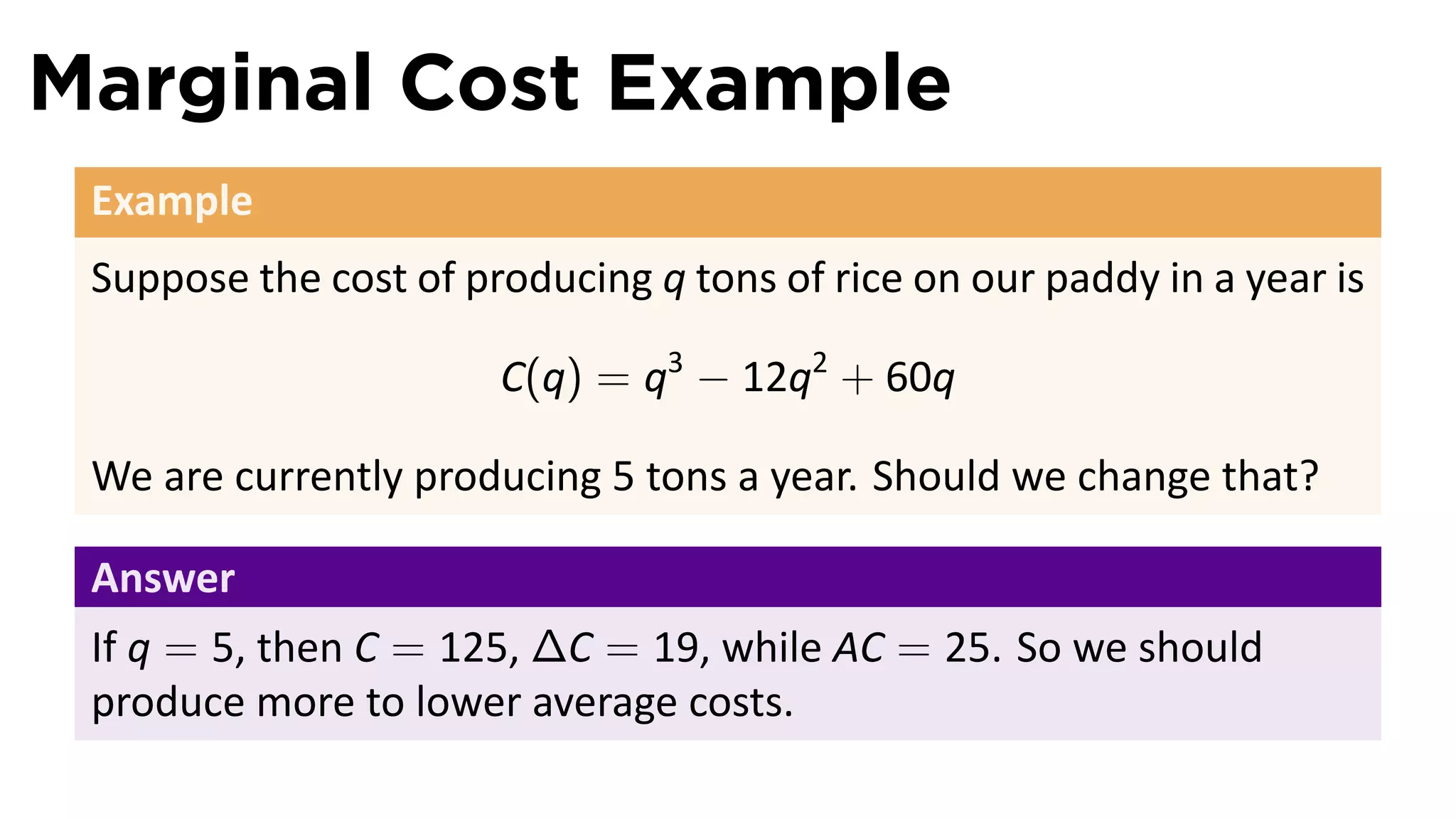
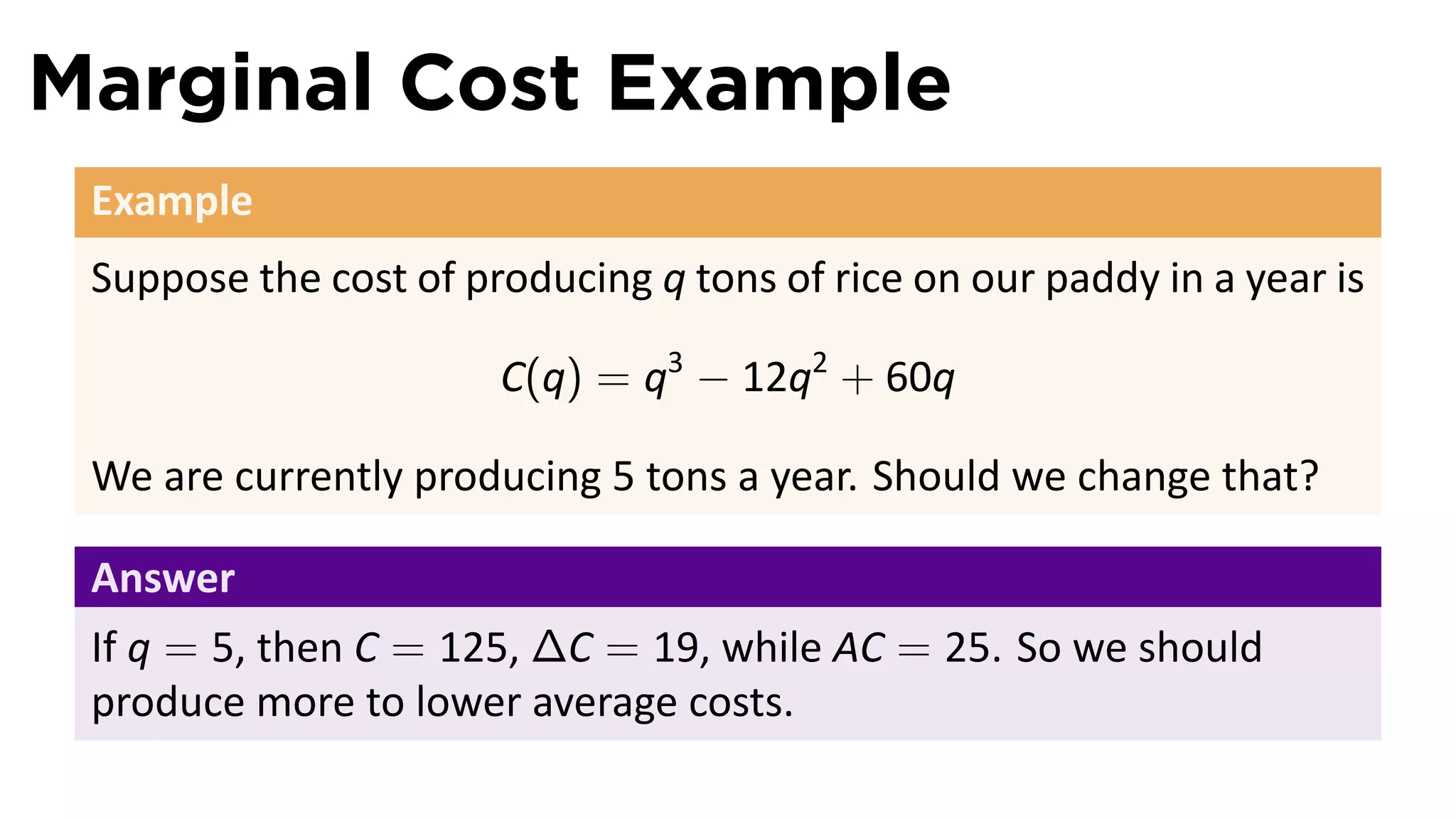
Marginal Cost Example
 Example
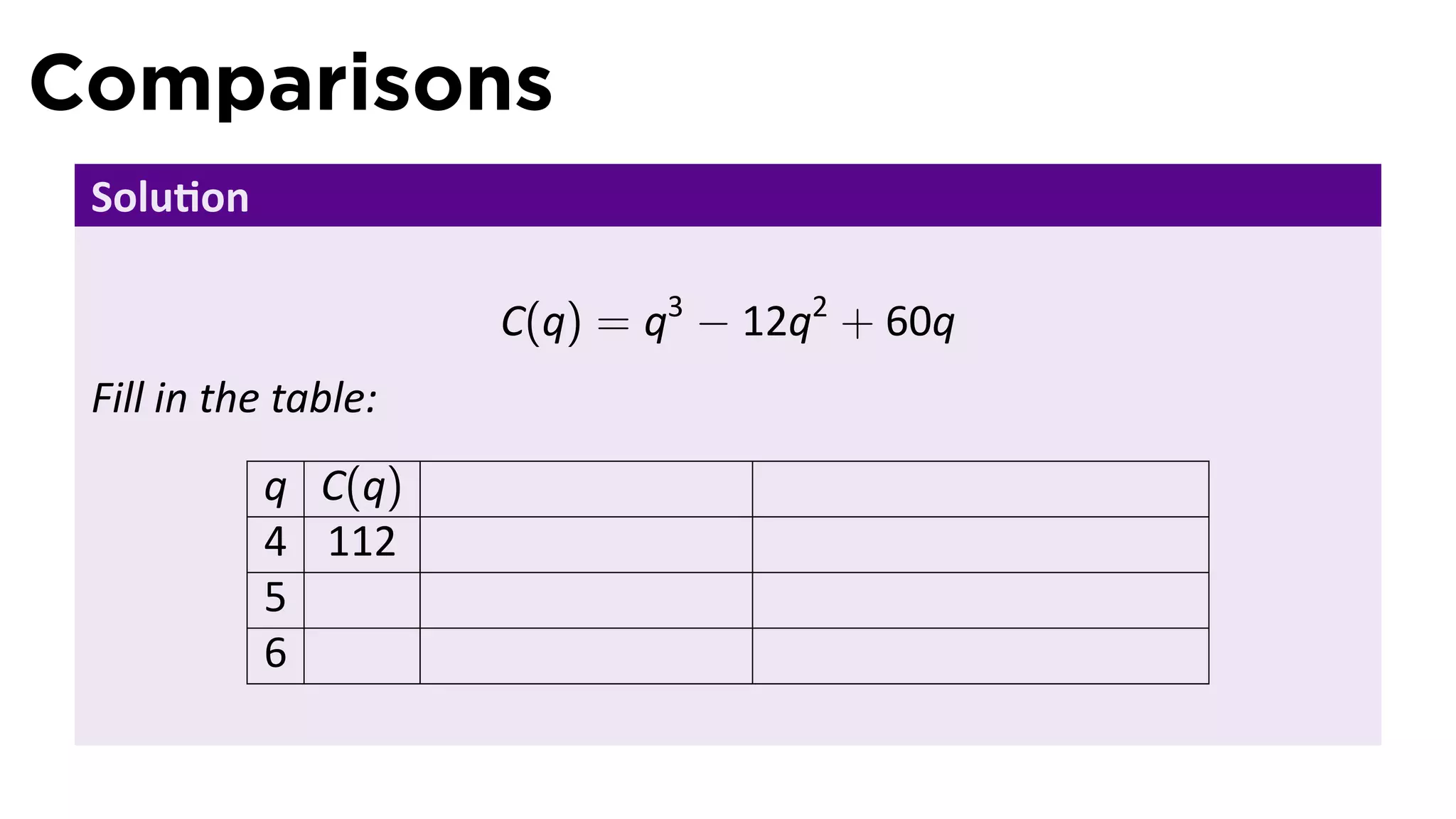
 Suppose the cost of producing q tons of rice on our paddy in a year is

                       C(q) = q3 − 12q2 + 60q

 We are currently producing 5 tons a year. Should we change that?
Marginal Cost Example
 Example
 Suppose the cost of producing q tons of rice on our paddy in a year is

                       C(q) = q3 − 12q2 + 60q

 We are currently producing 5 tons a year. Should we change that?

 Answer
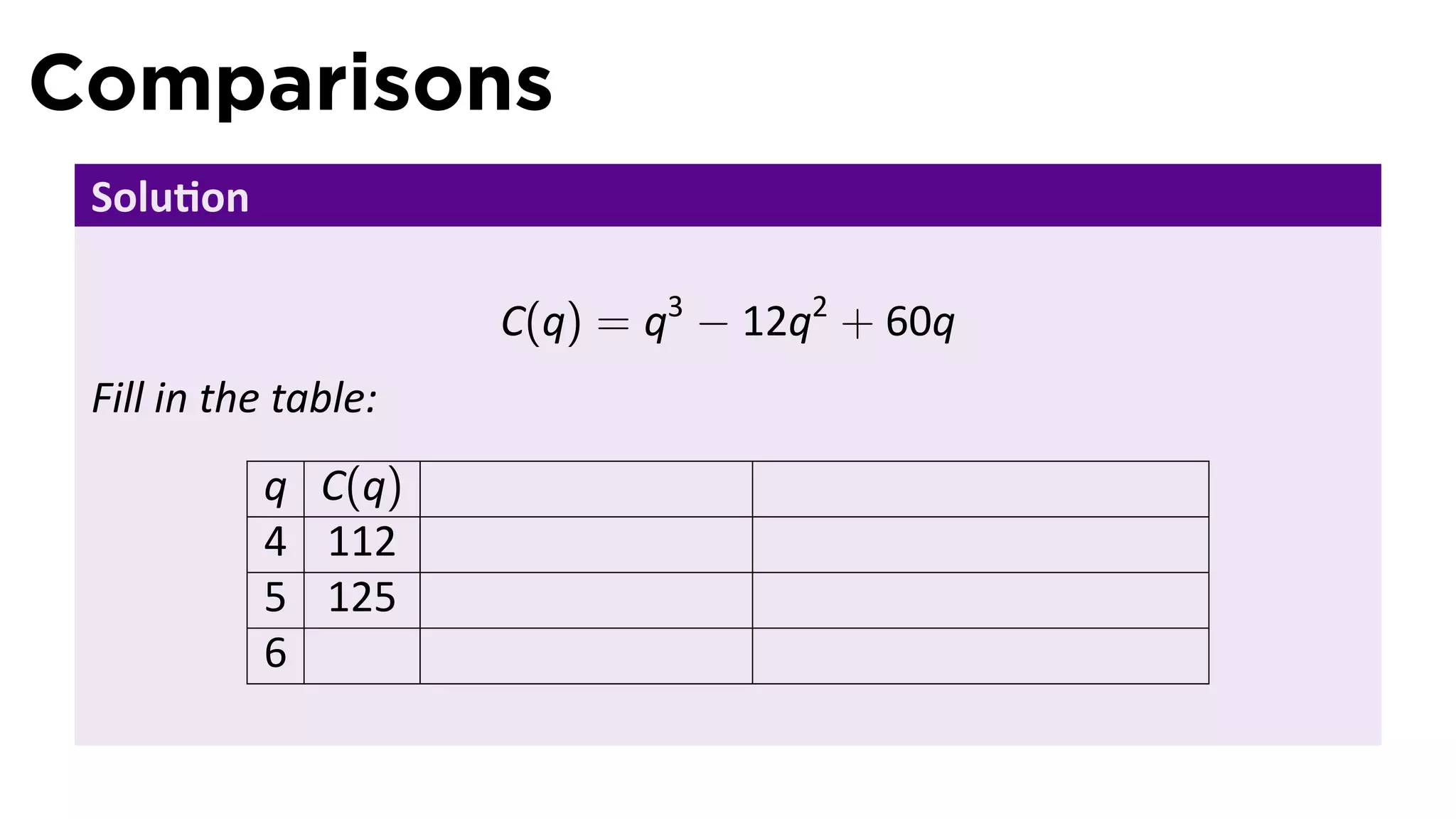
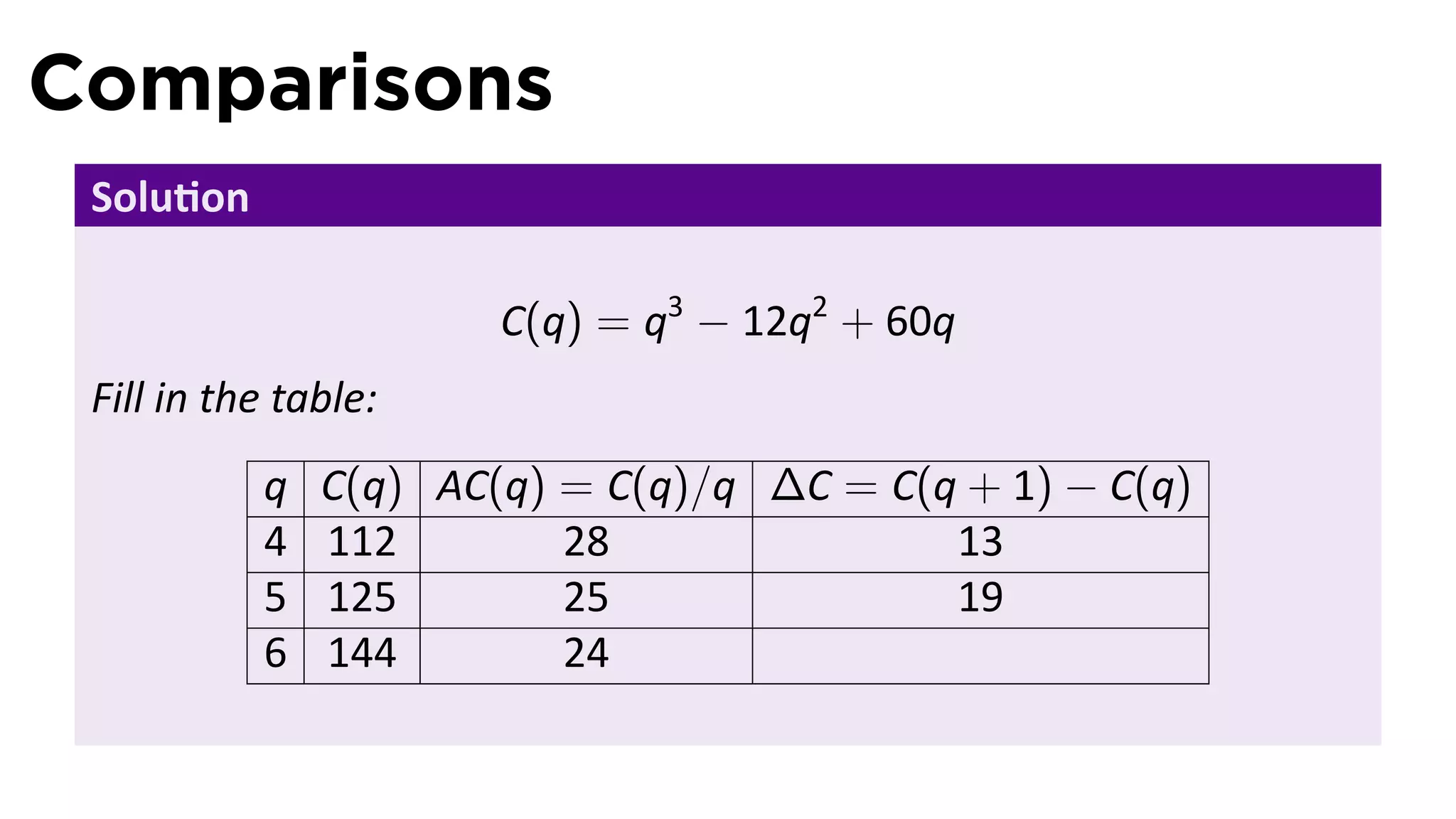
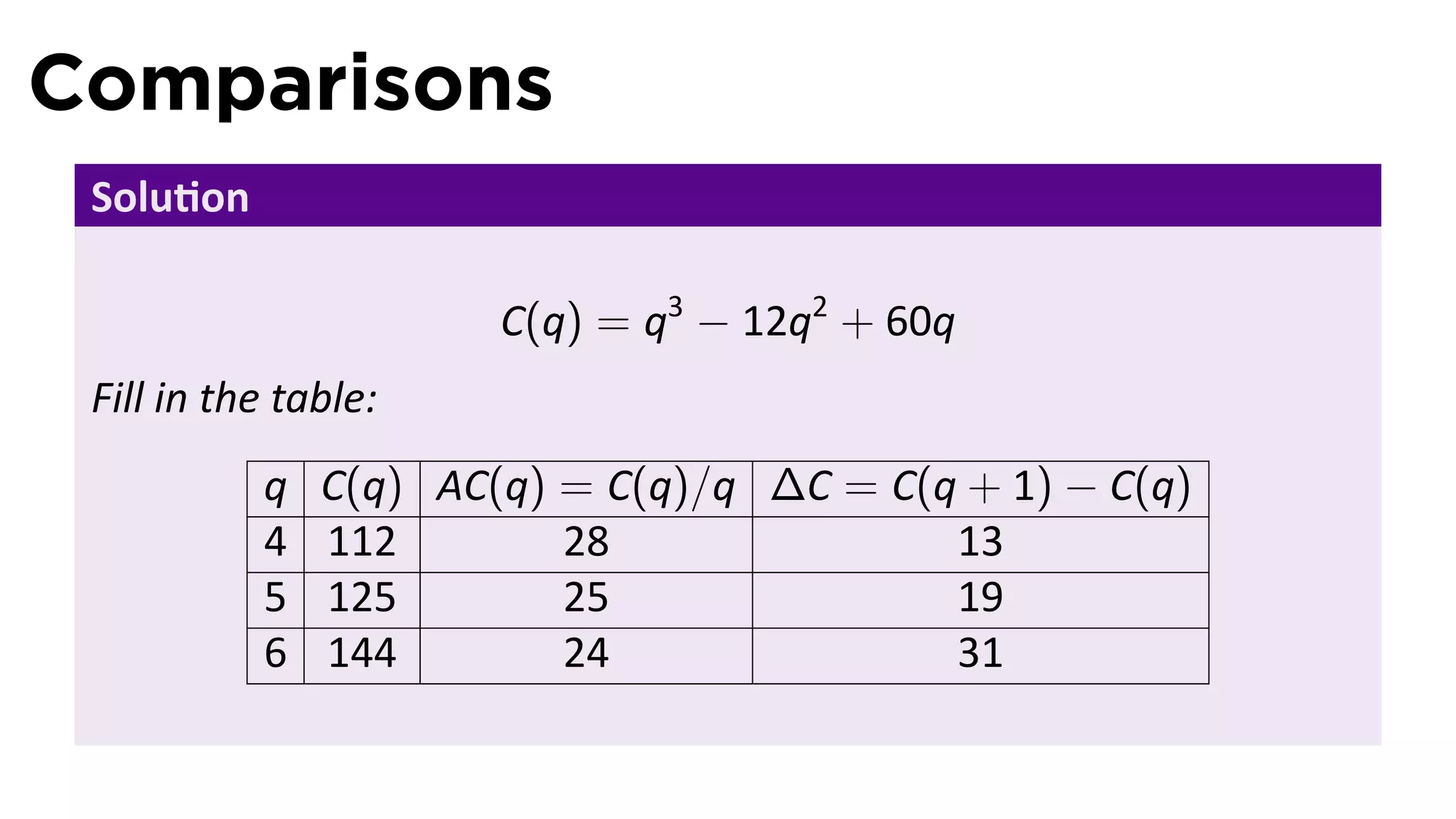
 If q = 5, then C = 125, ∆C = 19, while AC = 25. So we should
 produce more to lower average costs.
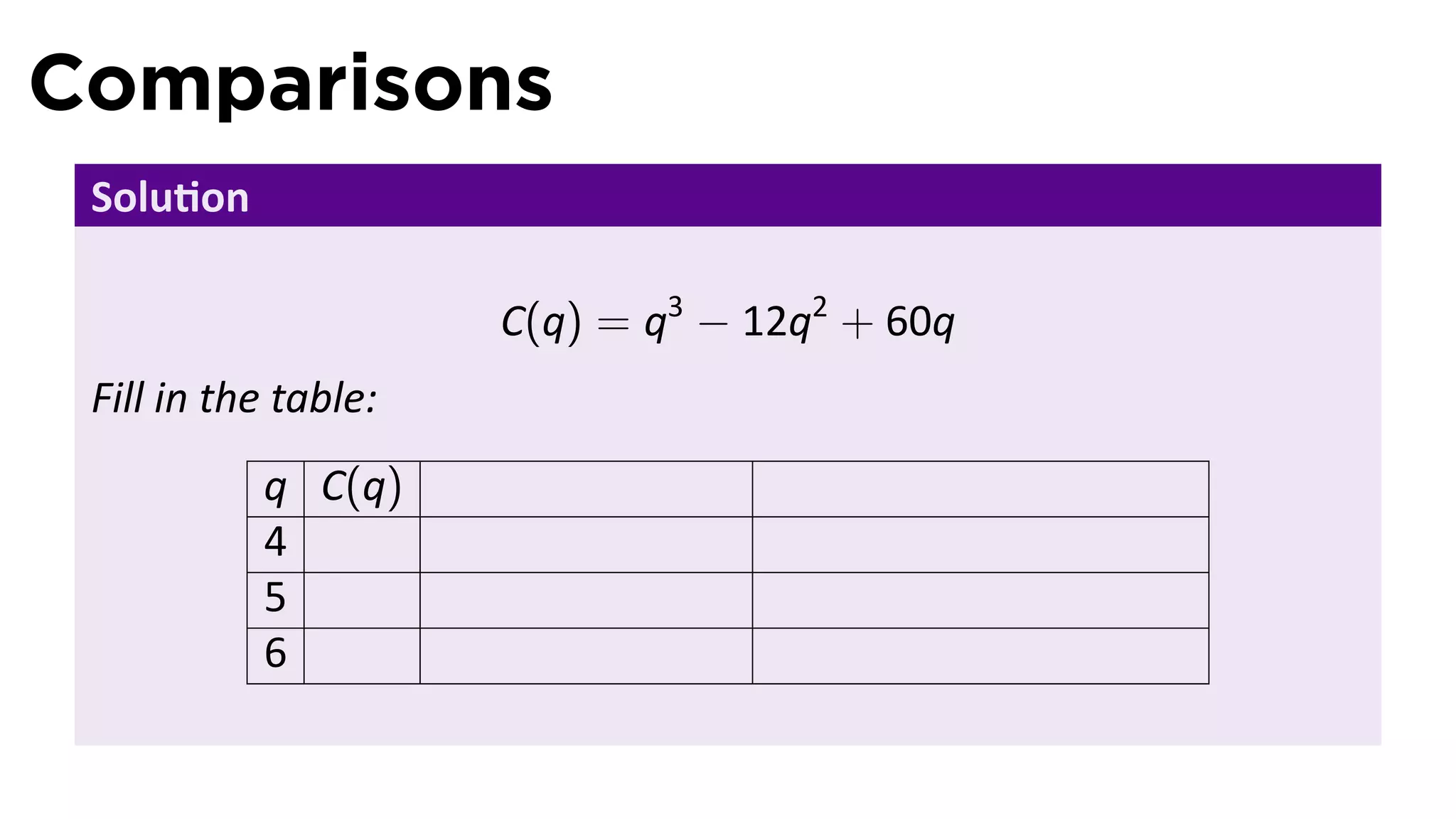
Comparisons
 Solu on

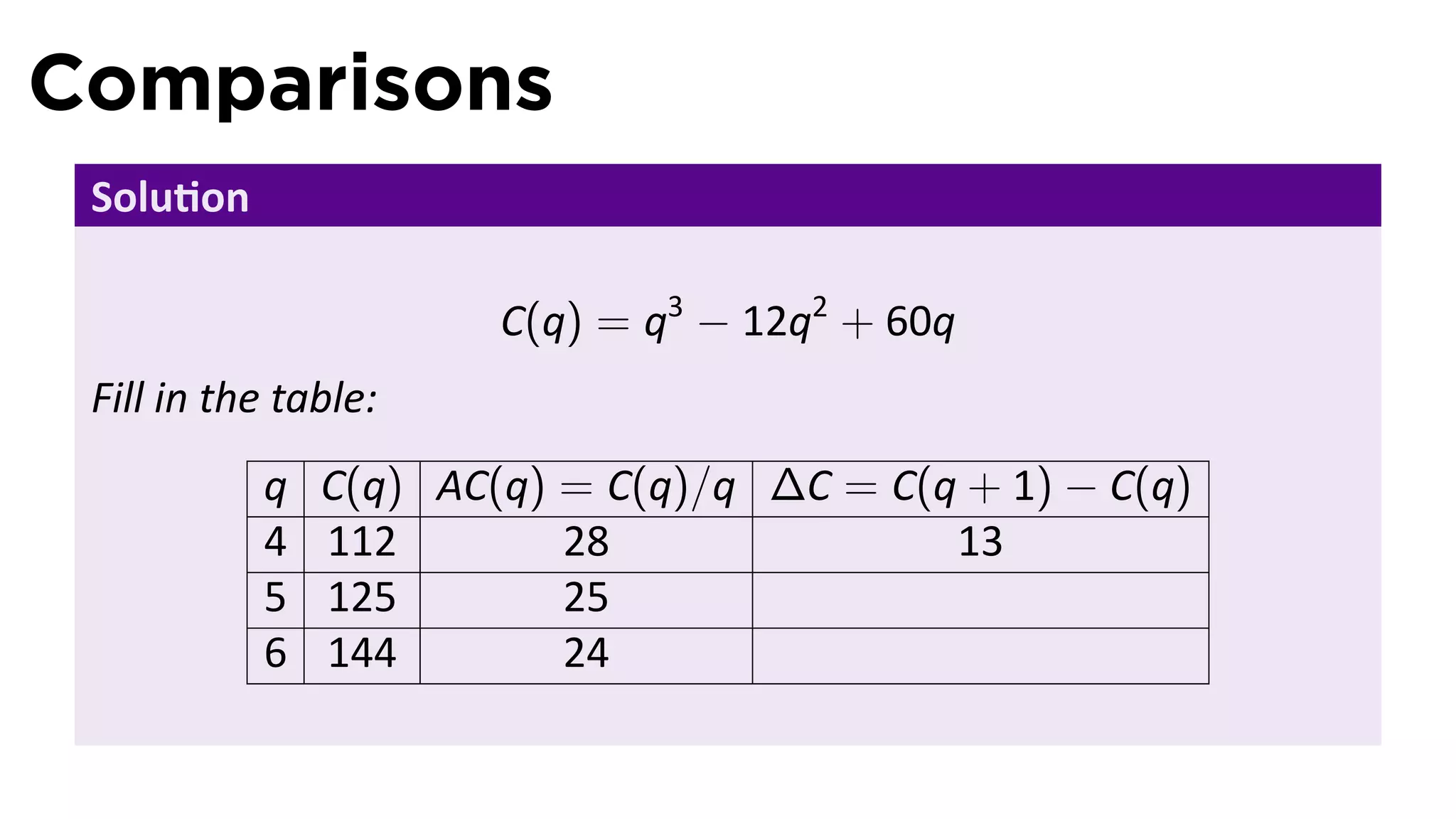
                      C(q) = q3 − 12q2 + 60q
 Fill in the table:
           q C(q)
           4
           5
           6
Comparisons
 Solu on

                      C(q) = q3 − 12q2 + 60q
 Fill in the table:
           q C(q)
           4 112
           5
           6
Comparisons
 Solu on

                      C(q) = q3 − 12q2 + 60q
 Fill in the table:
           q C(q)
           4 112
           5 125
           6
Comparisons
 Solu on

                      C(q) = q3 − 12q2 + 60q
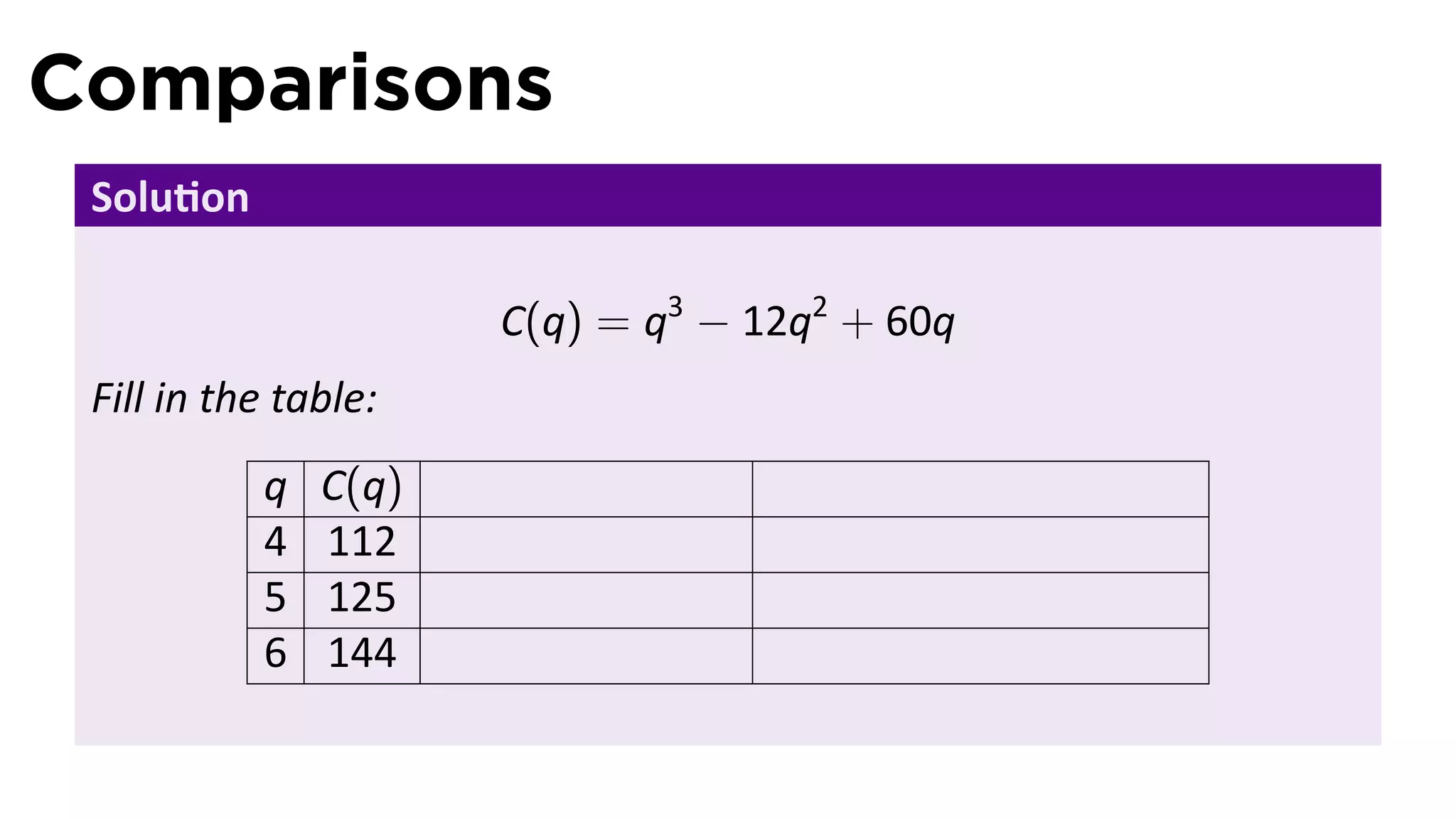
 Fill in the table:
           q   C(q)
           4   112
           5   125
           6   144
Comparisons
 Solu on

                       C(q) = q3 − 12q2 + 60q
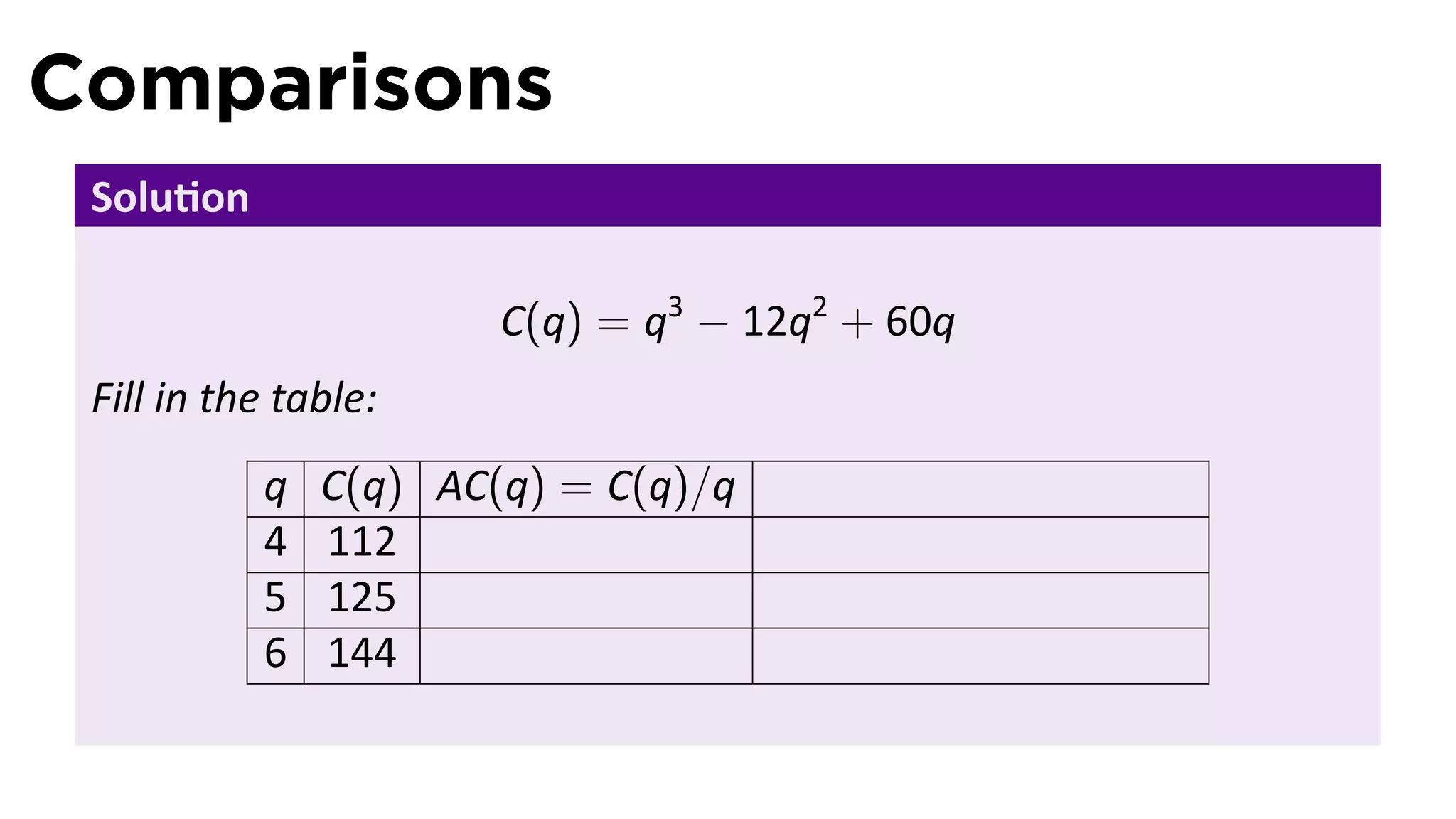
 Fill in the table:
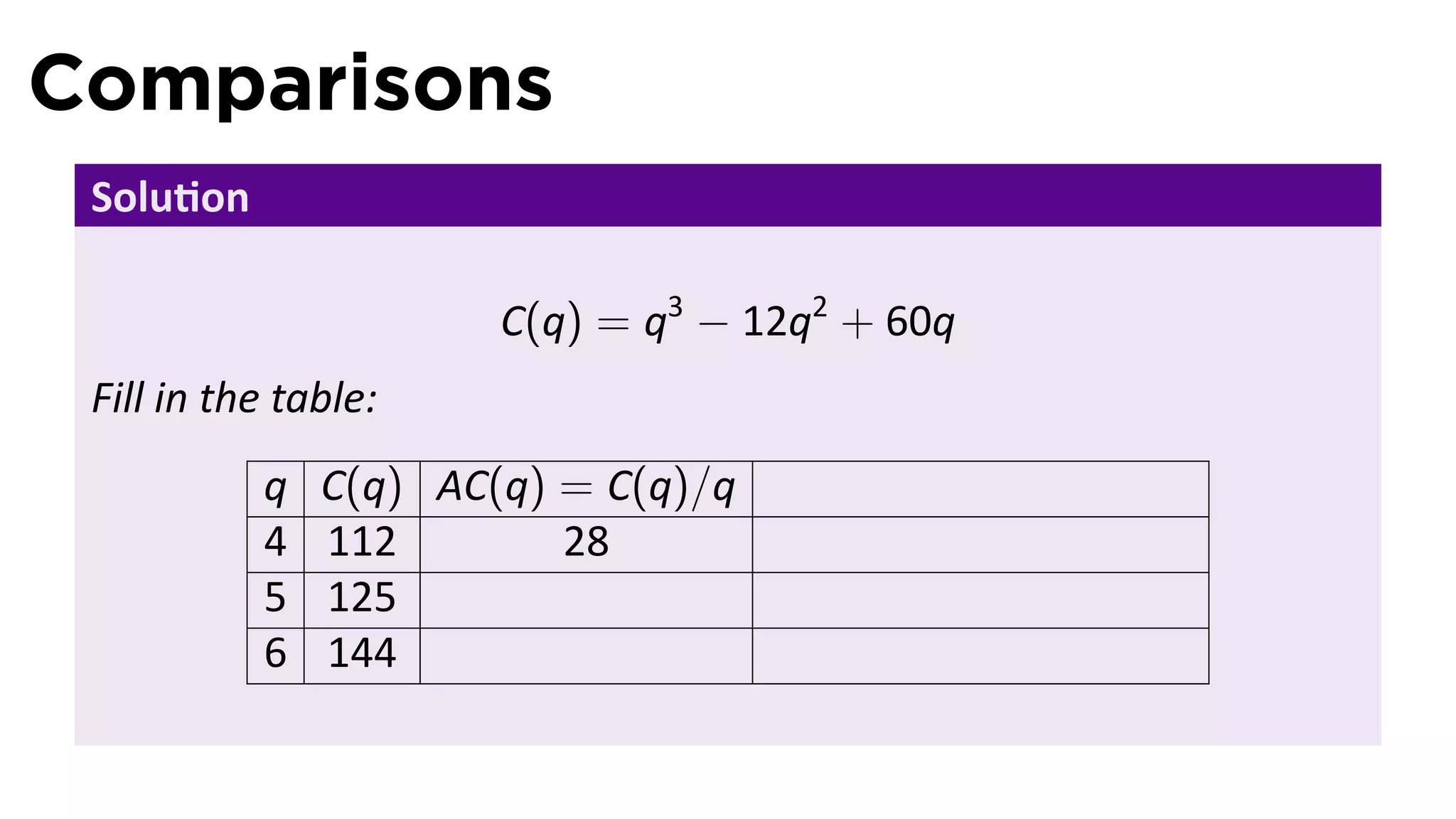
           q   C(q) AC(q) = C(q)/q
           4   112
           5   125
           6   144
Comparisons
 Solu on

                       C(q) = q3 − 12q2 + 60q
 Fill in the table:
           q   C(q) AC(q) = C(q)/q
           4   112        28
           5   125
           6   144
Comparisons
 Solu on

                       C(q) = q3 − 12q2 + 60q
 Fill in the table:
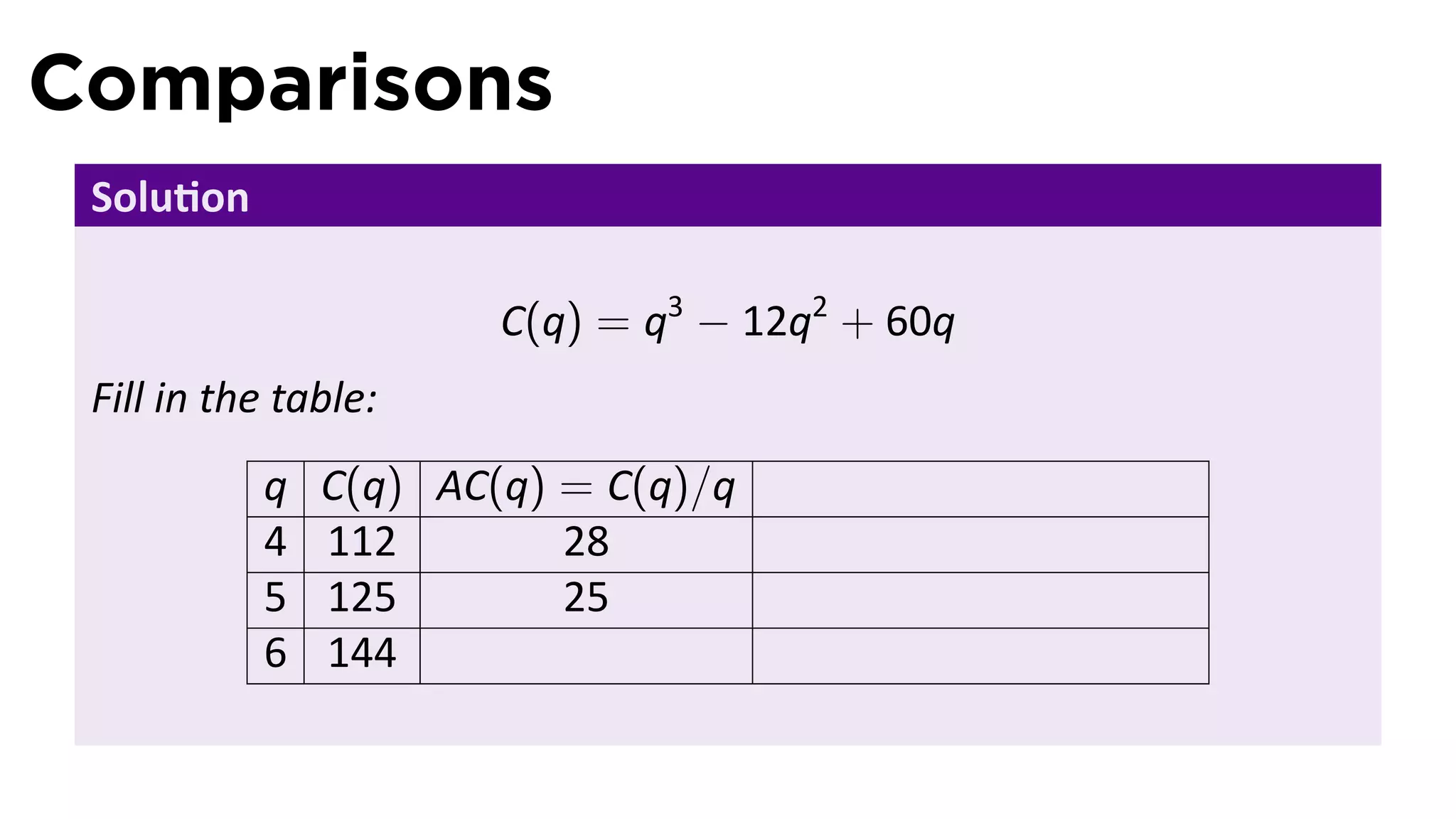
           q   C(q) AC(q) = C(q)/q
           4   112        28
           5   125        25
           6   144
Comparisons
 Solu on

                       C(q) = q3 − 12q2 + 60q
 Fill in the table:
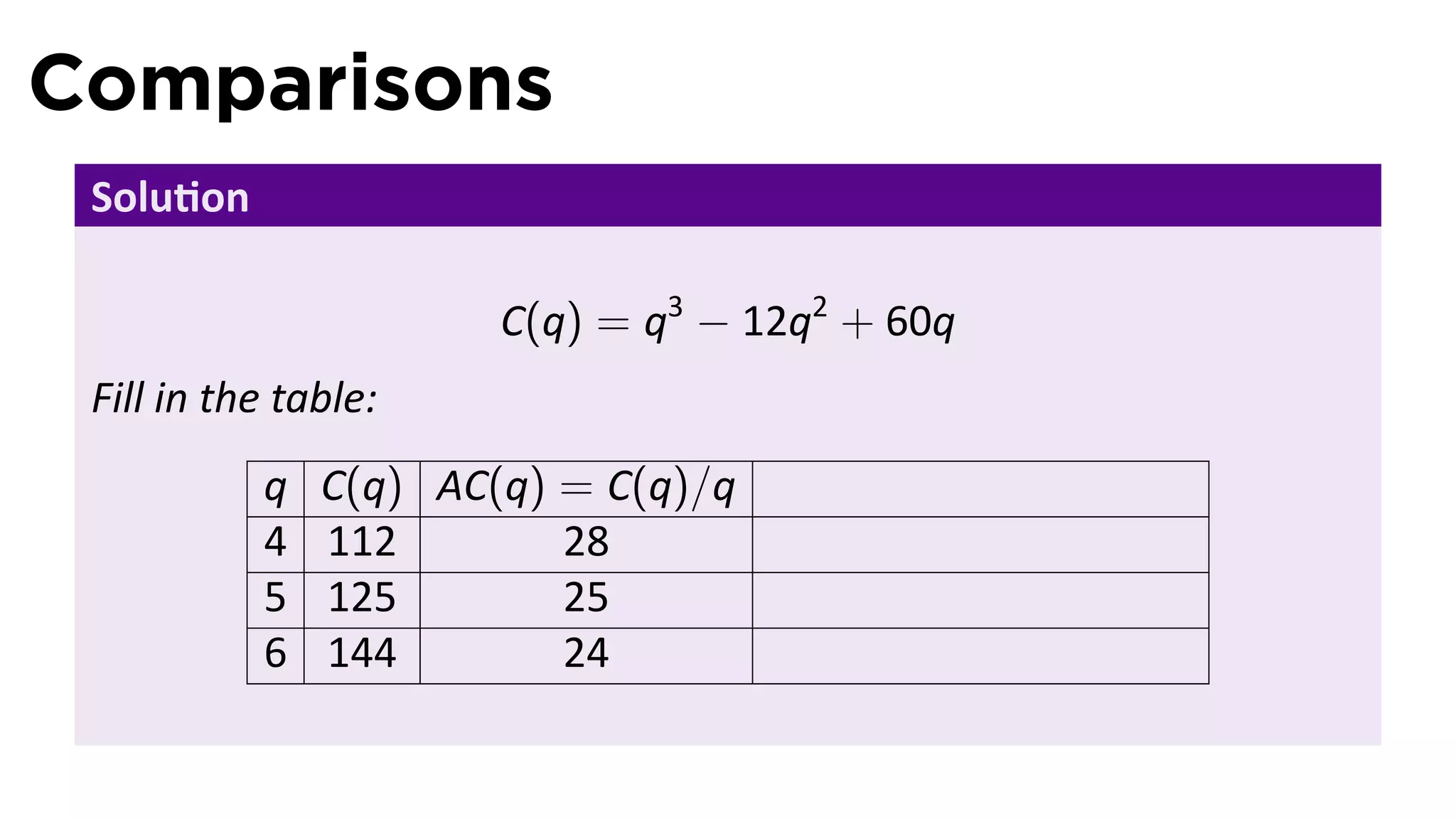
           q   C(q) AC(q) = C(q)/q
           4   112        28
           5   125        25
           6   144        24
Comparisons
 Solu on

                       C(q) = q3 − 12q2 + 60q
 Fill in the table:
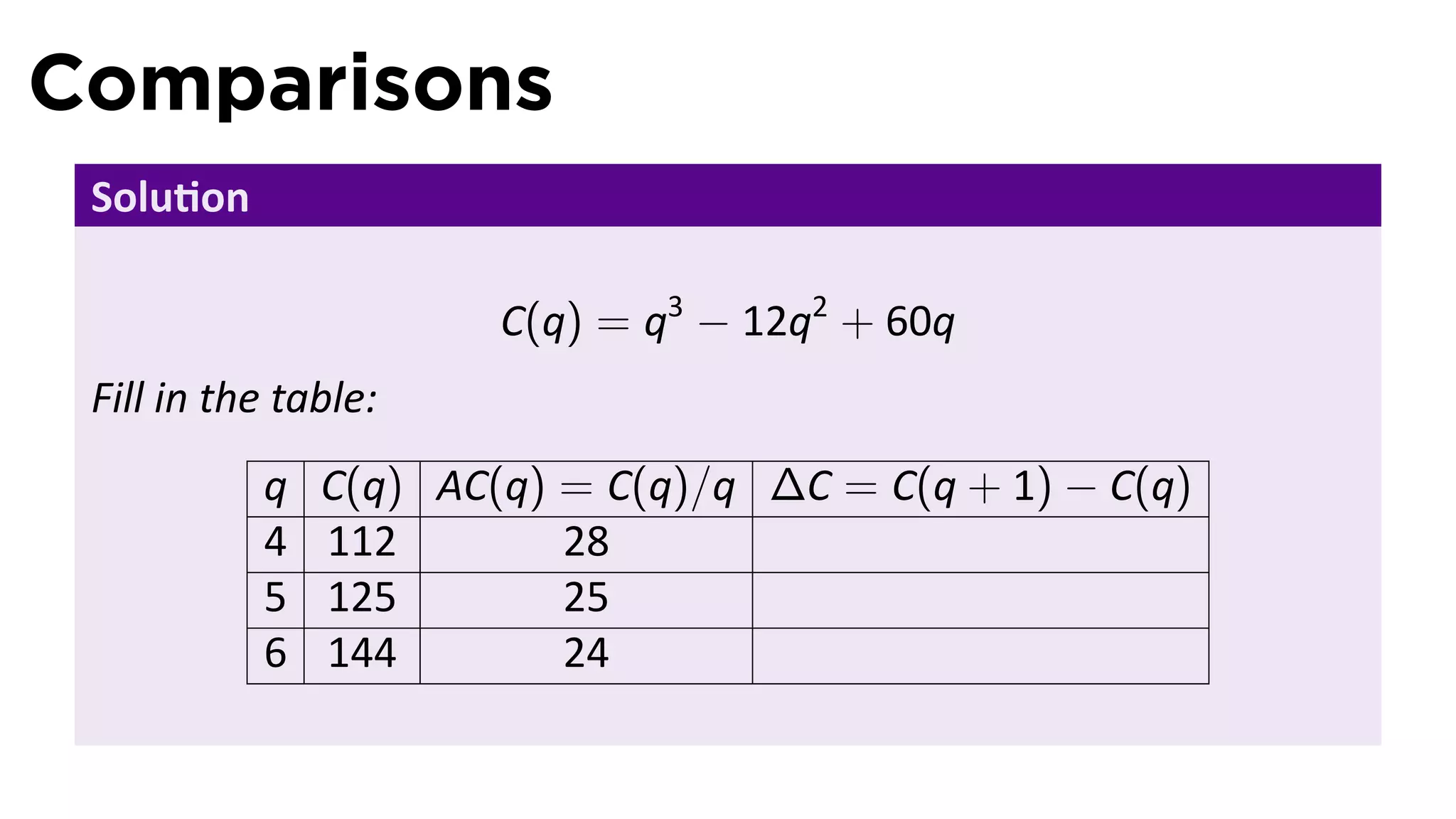
           q   C(q) AC(q) = C(q)/q ∆C = C(q + 1) − C(q)
           4   112        28
           5   125        25
           6   144        24
Comparisons
 Solu on

                       C(q) = q3 − 12q2 + 60q
 Fill in the table:
           q   C(q) AC(q) = C(q)/q ∆C = C(q + 1) − C(q)
           4   112        28               13
           5   125        25
           6   144        24
Comparisons
 Solu on

                       C(q) = q3 − 12q2 + 60q
 Fill in the table:
           q   C(q) AC(q) = C(q)/q ∆C = C(q + 1) − C(q)
           4   112        28               13
           5   125        25               19
           6   144        24
Comparisons
 Solu on

                       C(q) = q3 − 12q2 + 60q
 Fill in the table:
           q   C(q) AC(q) = C(q)/q ∆C = C(q + 1) − C(q)
           4   112        28               13
           5   125        25               19
           6   144        24               31
Marginal Cost Example
 Example
 Suppose the cost of producing q tons of rice on our paddy in a year is

                       C(q) = q3 − 12q2 + 60q

 We are currently producing 5 tons a year. Should we change that?

 Answer
 If q = 5, then C = 125, ∆C = 19, while AC = 25. So we should
 produce more to lower average costs.
Marginal costs
Rates of change in economics
 Problem
 Given the produc on cost of a good, find the marginal cost of
 produc on a er having produced a certain quan ty.

 Solu on
 The marginal cost a er producing q is given by
                               C(q + ∆q) − C(q)
                   MC = lim
                          ∆q→0       ∆q
Outline
 Rates of Change
    Tangent Lines
    Velocity
    Popula on growth
    Marginal costs
 The deriva ve, defined
    Deriva ves of (some) power func ons
    What does f tell you about f′ ?
 How can a func on fail to be differen able?
 Other nota ons
 The second deriva ve
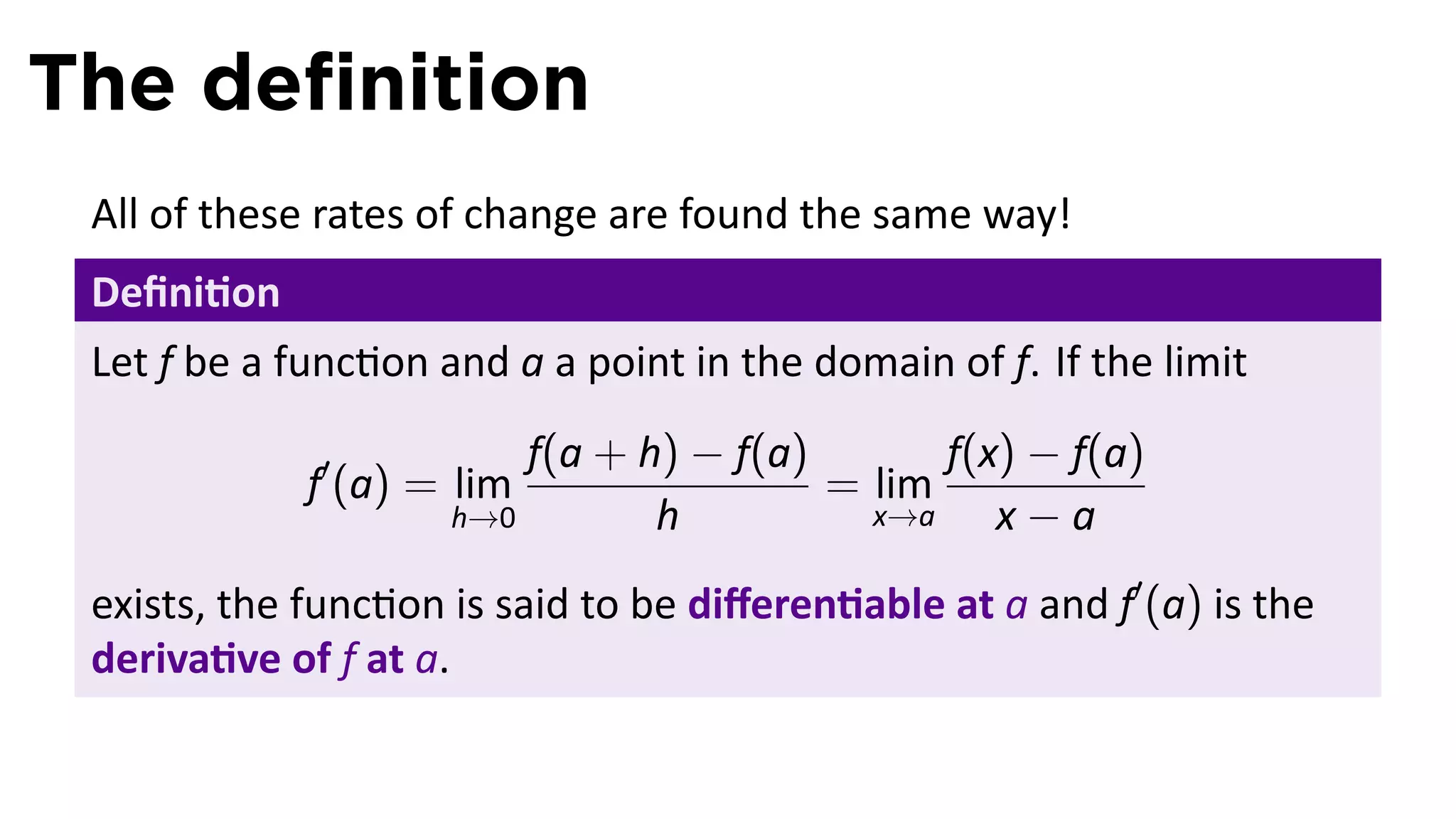
The definition
 All of these rates of change are found the same way!
The definition
 All of these rates of change are found the same way!
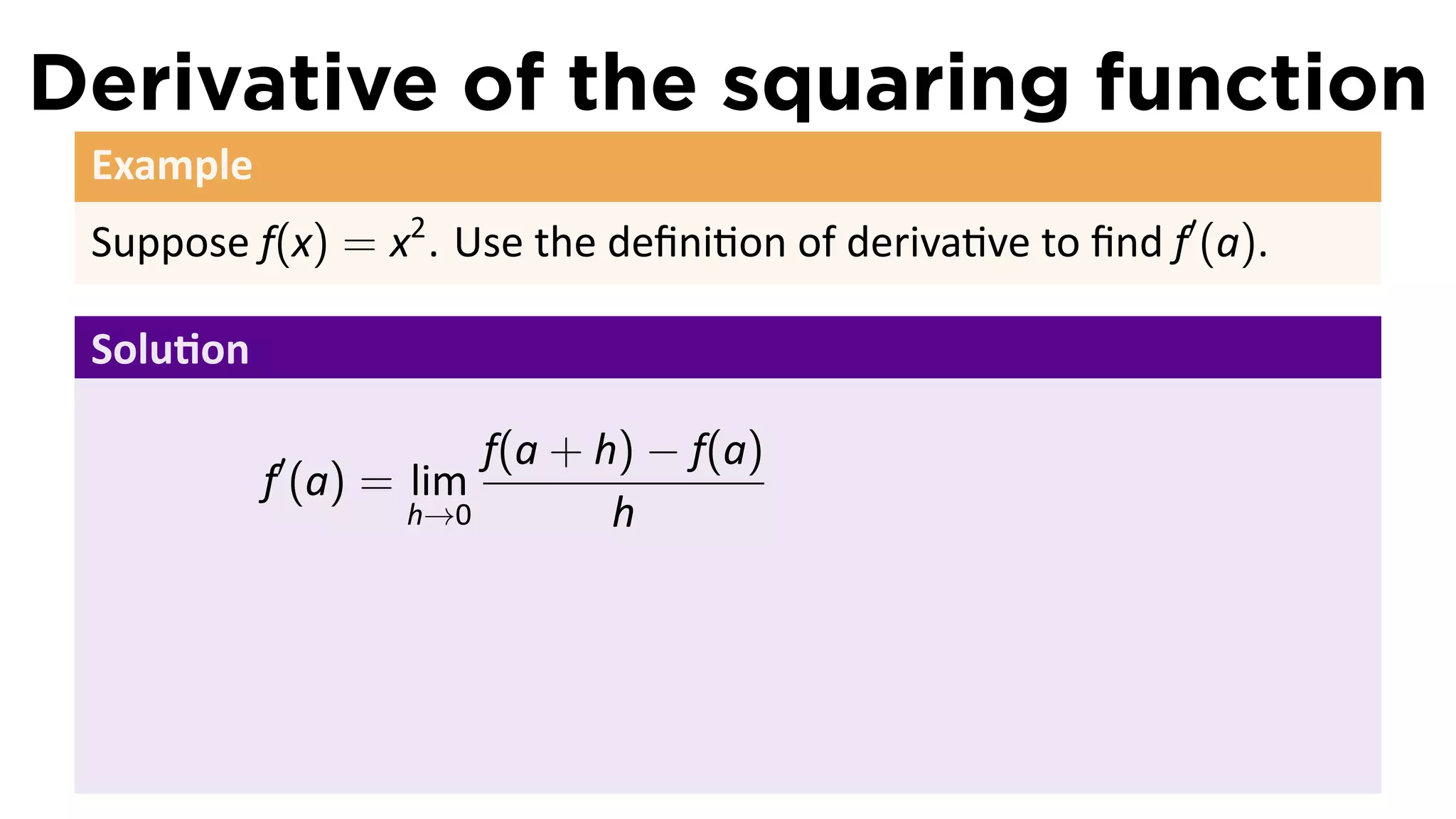
 Defini on
 Let f be a func on and a a point in the domain of f. If the limit
                         f(a + h) − f(a)       f(x) − f(a)
             f′ (a) = lim                = lim
                     h→0        h          x→a    x−a
 exists, the func on is said to be differen able at a and f′ (a) is the
 deriva ve of f at a.
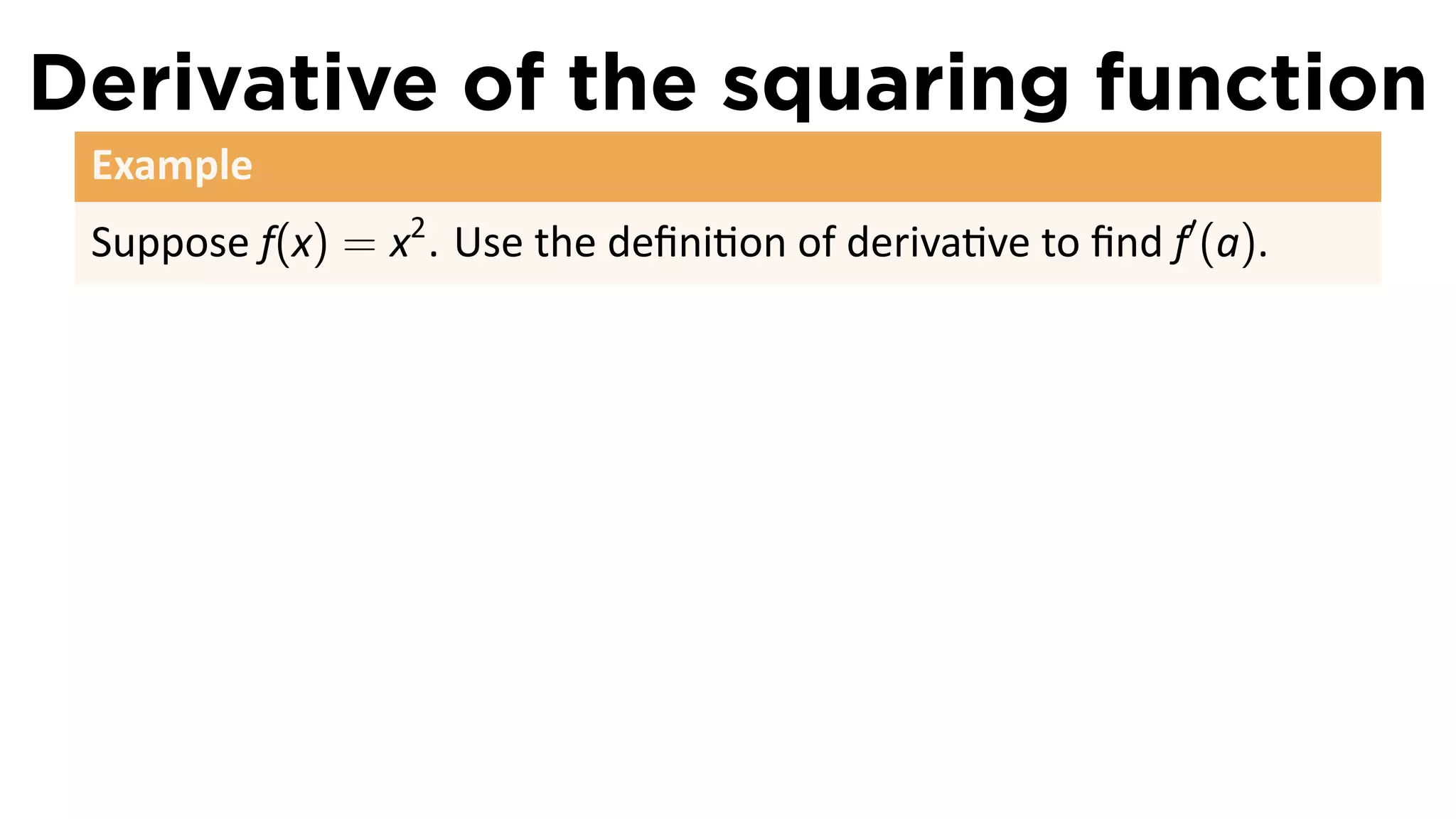
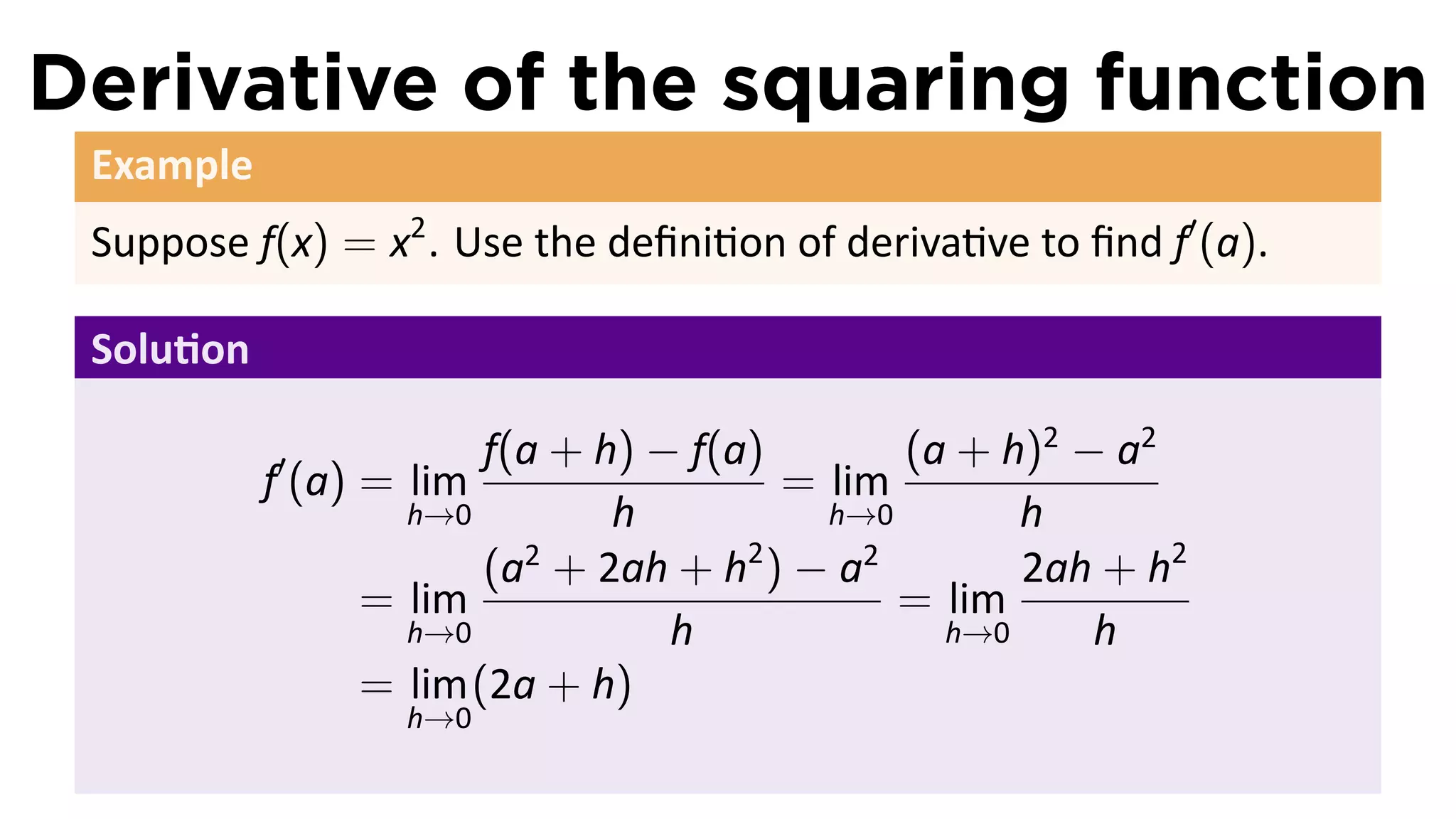
Derivative of the squaring function
 Example
 Suppose f(x) = x2 . Use the defini on of deriva ve to find f′ (a).
Derivative of the squaring function
 Example
 Suppose f(x) = x2 . Use the defini on of deriva ve to find f′ (a).

 Solu on

                       f(a + h) − f(a)
           f′ (a) = lim
                   h→0        h
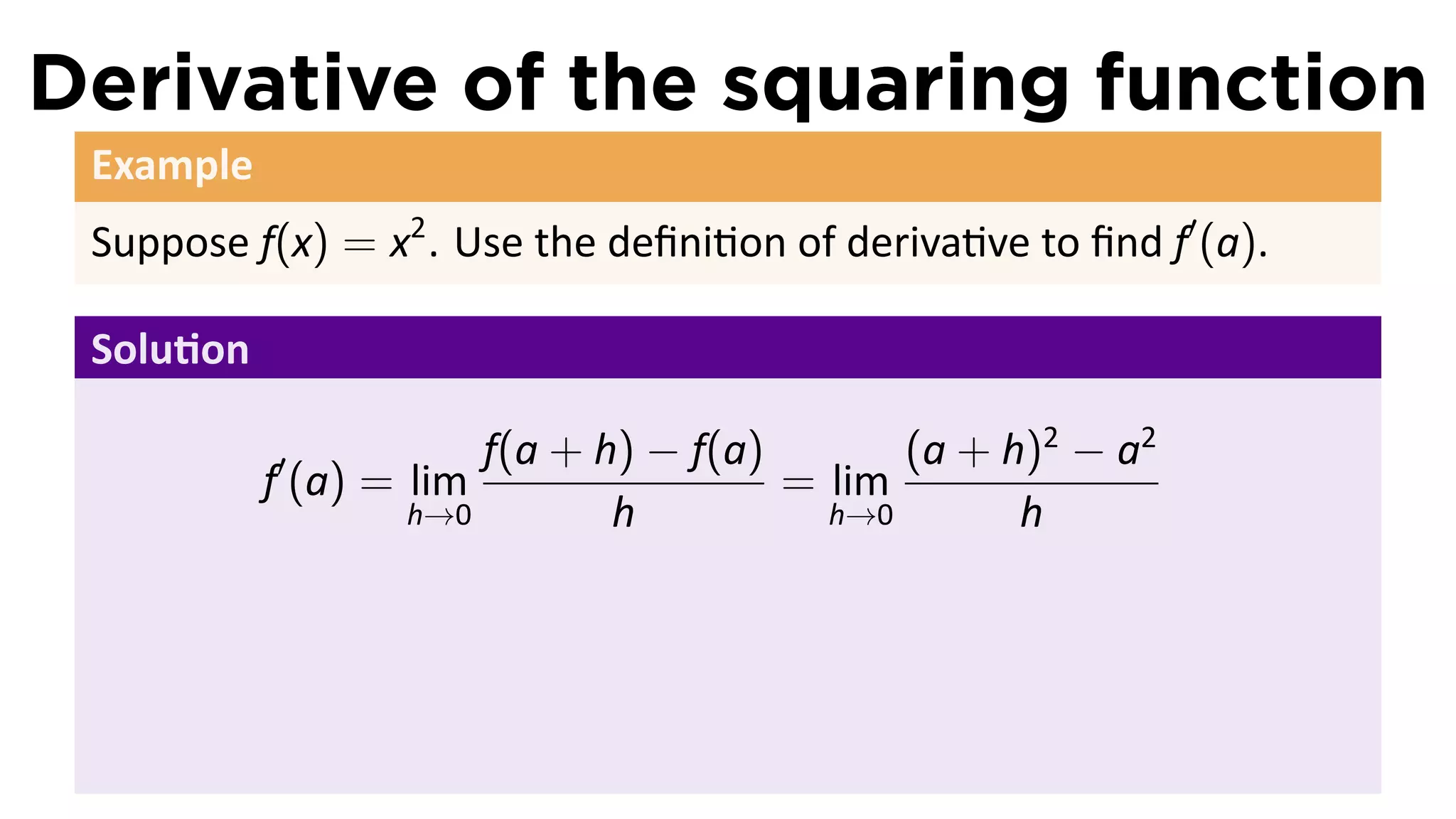
Derivative of the squaring function
 Example
 Suppose f(x) = x2 . Use the defini on of deriva ve to find f′ (a).

 Solu on

           ′           f(a + h) − f(a)       (a + h)2 − a2
           f (a) = lim                 = lim
                   h→0        h          h→0       h
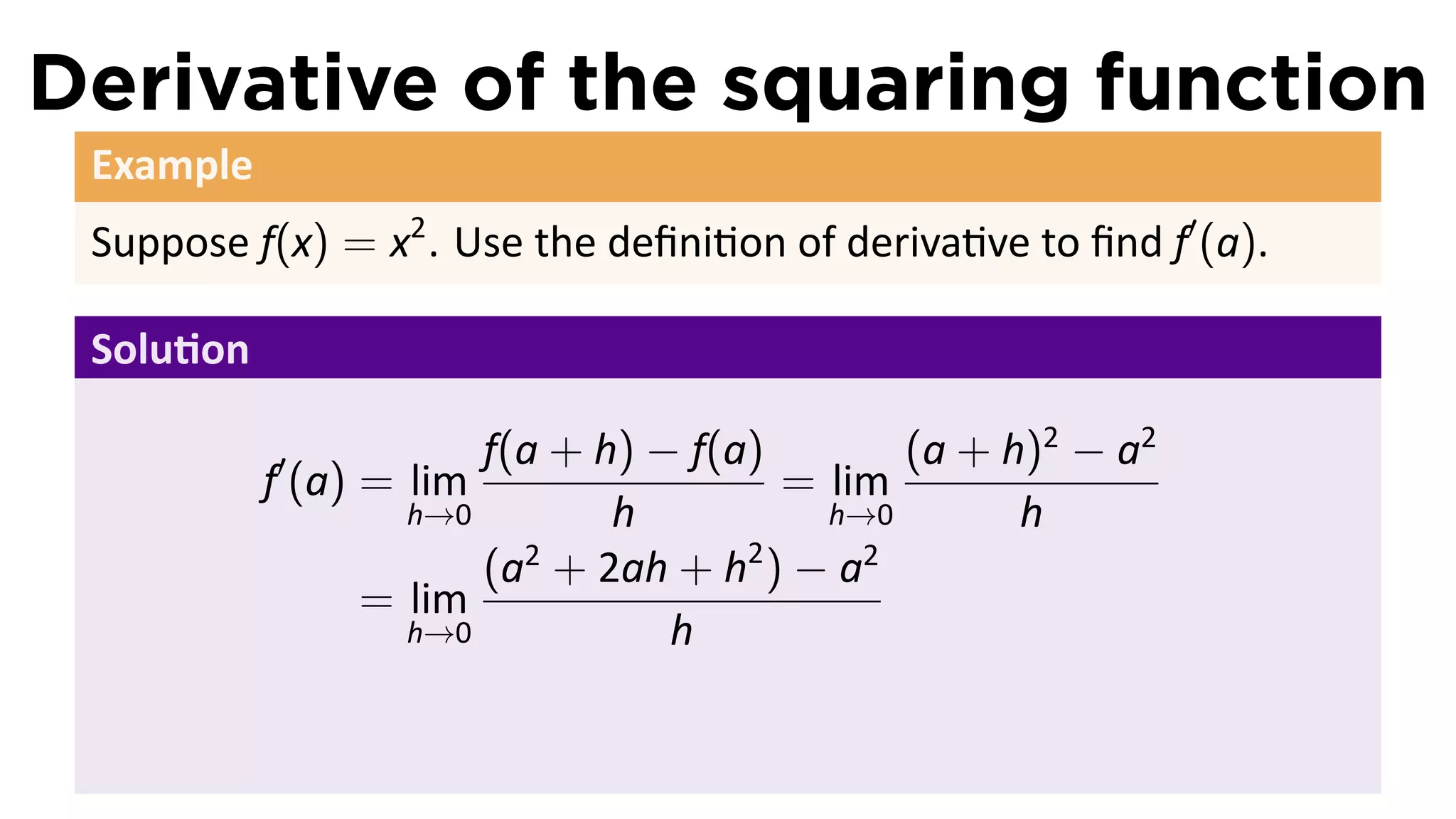
Derivative of the squaring function
 Example
 Suppose f(x) = x2 . Use the defini on of deriva ve to find f′ (a).

 Solu on

           ′           f(a + h) − f(a)       (a + h)2 − a2
           f (a) = lim                 = lim
                   h→0        h          h→0       h
                       (a + 2ah + h ) − a
                         2           2     2
                 = lim
                   h→0           h
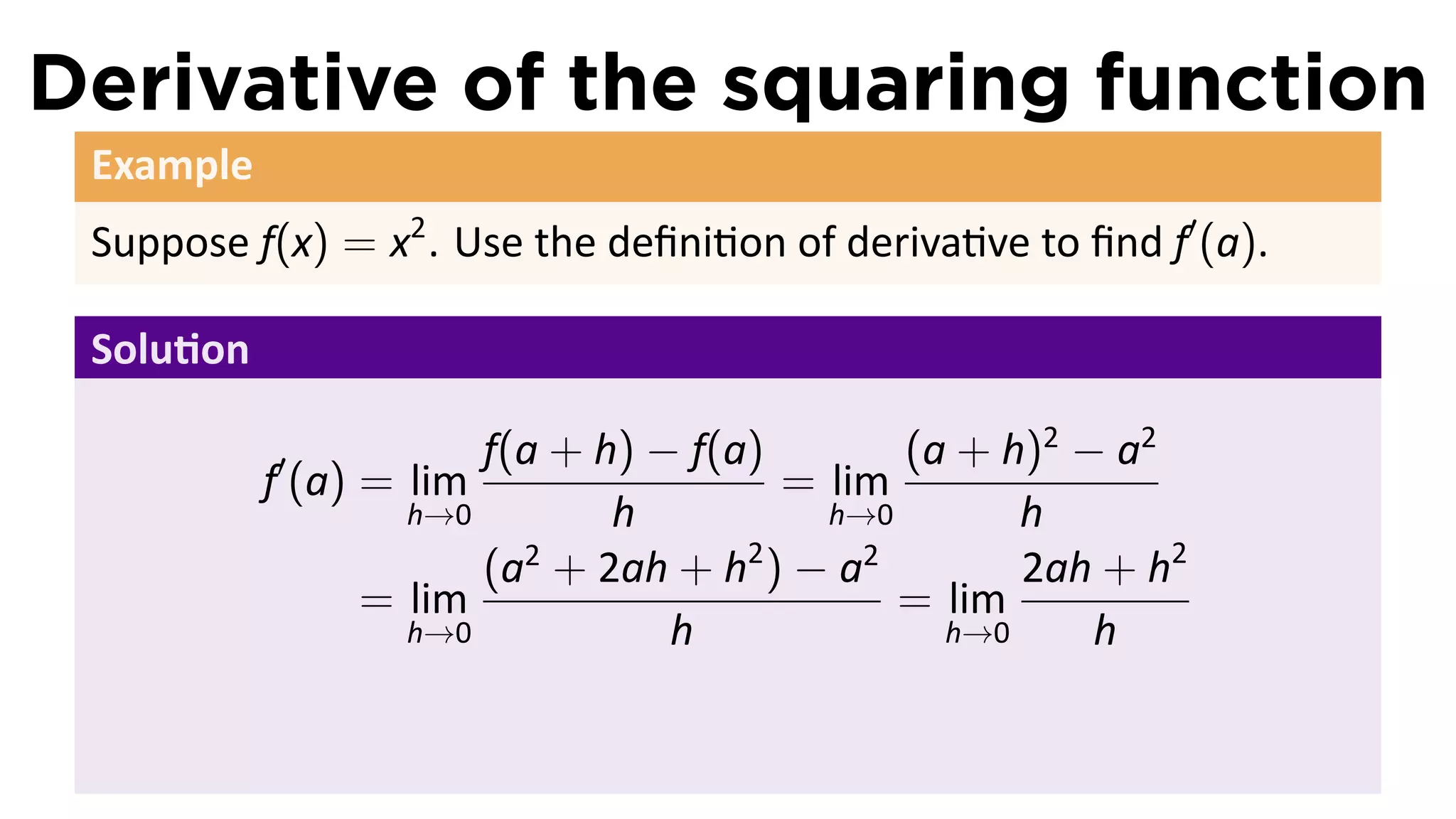
Derivative of the squaring function
 Example
 Suppose f(x) = x2 . Use the defini on of deriva ve to find f′ (a).

 Solu on

           ′           f(a + h) − f(a)       (a + h)2 − a2
           f (a) = lim                 = lim
                   h→0        h          h→0       h
                       (a + 2ah + h ) − a
                         2           2     2
                                                   2ah + h2
                 = lim                       = lim
                   h→0           h             h→0     h
Derivative of the squaring function
 Example
 Suppose f(x) = x2 . Use the defini on of deriva ve to find f′ (a).

 Solu on

           ′            f(a + h) − f(a)       (a + h)2 − a2
           f (a) = lim                  = lim
                   h→0         h          h→0       h
                        (a + 2ah + h ) − a
                          2           2     2
                                                    2ah + h2
                 = lim                        = lim
                   h→0            h             h→0     h
                 = lim (2a + h)
                  h→0
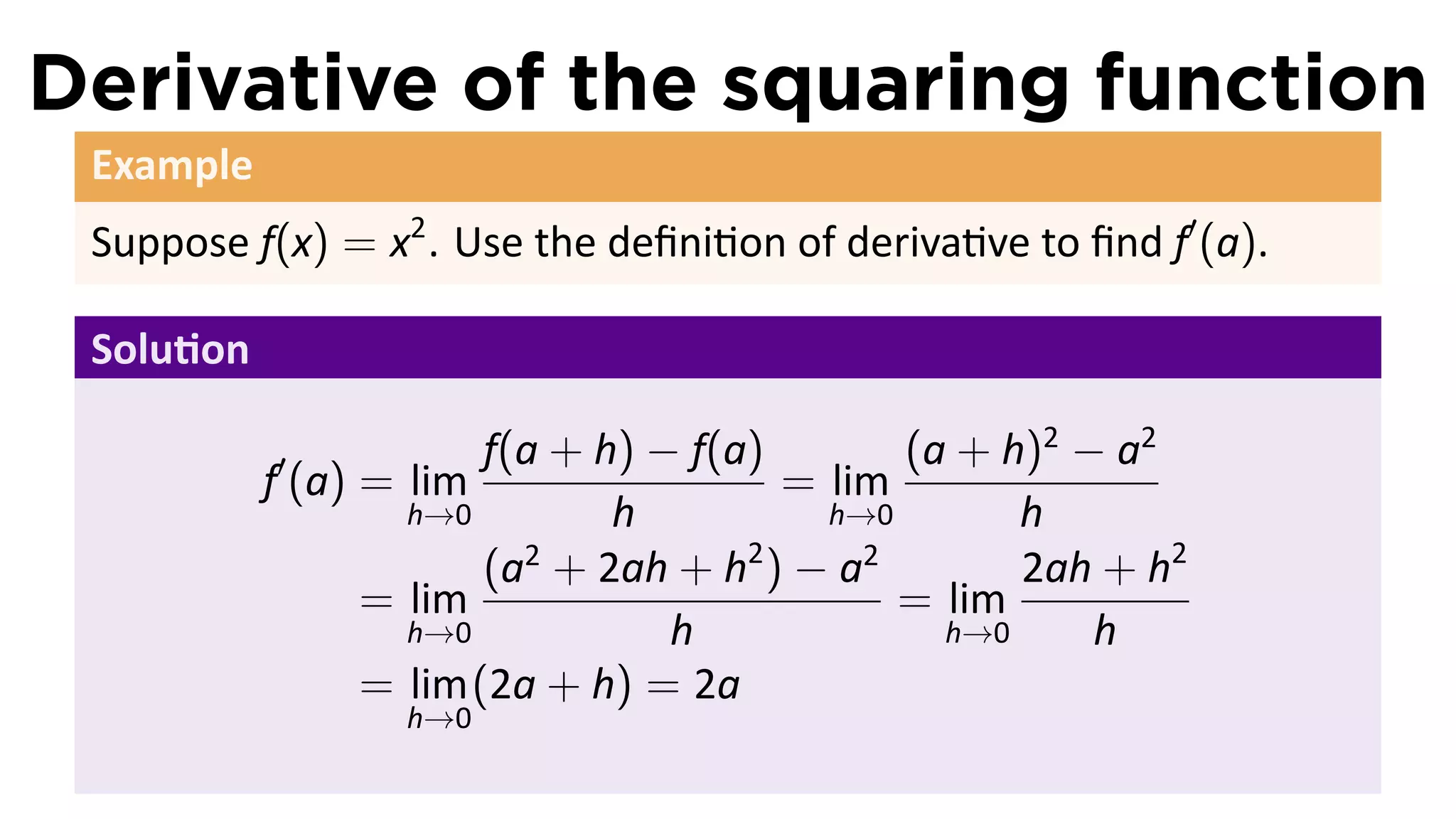
Derivative of the squaring function
 Example
 Suppose f(x) = x2 . Use the defini on of deriva ve to find f′ (a).

 Solu on

           ′            f(a + h) − f(a)       (a + h)2 − a2
           f (a) = lim                  = lim
                   h→0         h          h→0       h
                        (a + 2ah + h ) − a
                          2           2     2
                                                    2ah + h2
                 = lim                        = lim
                   h→0            h             h→0     h
                 = lim (2a + h) = 2a
                  h→0
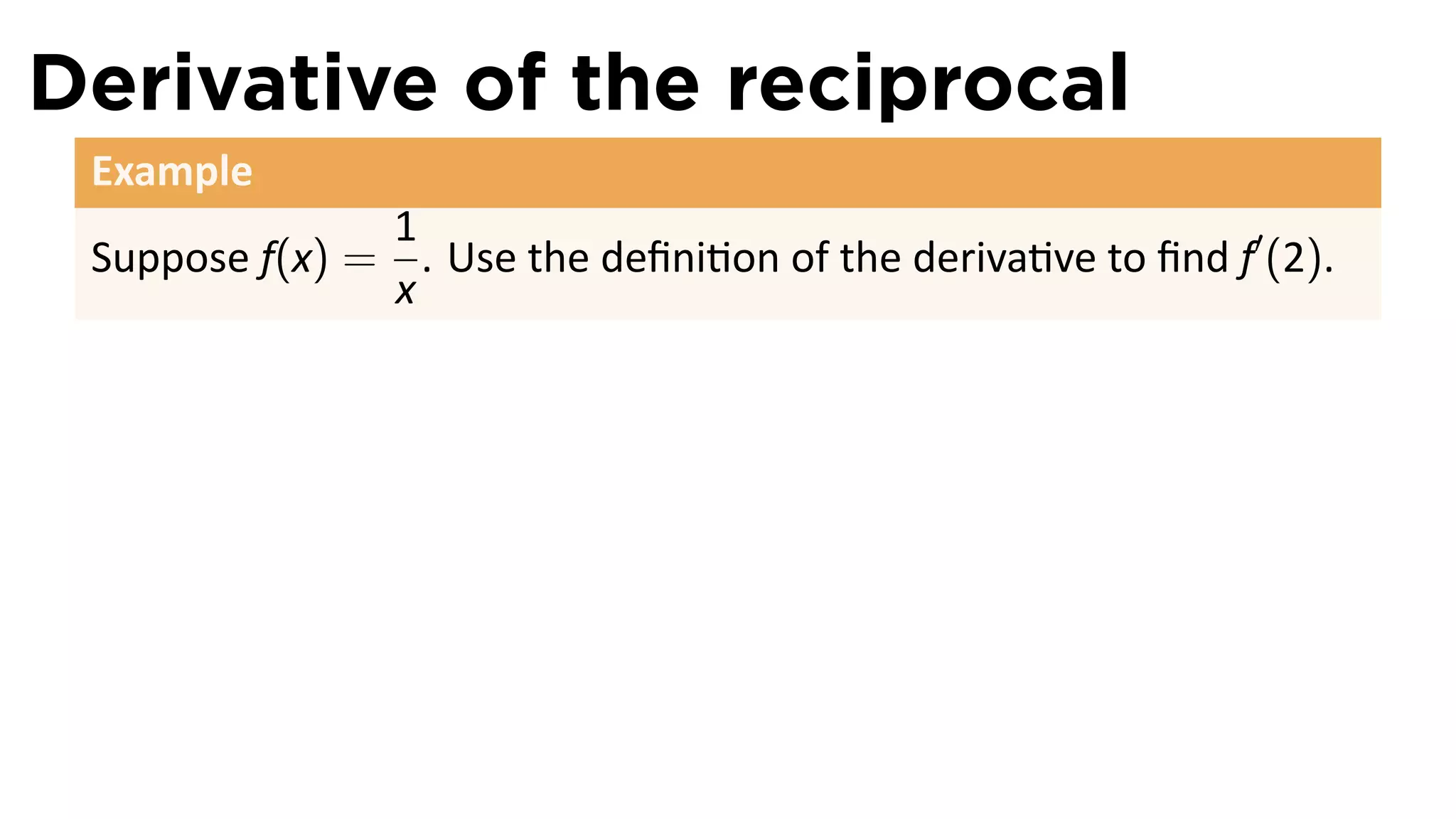
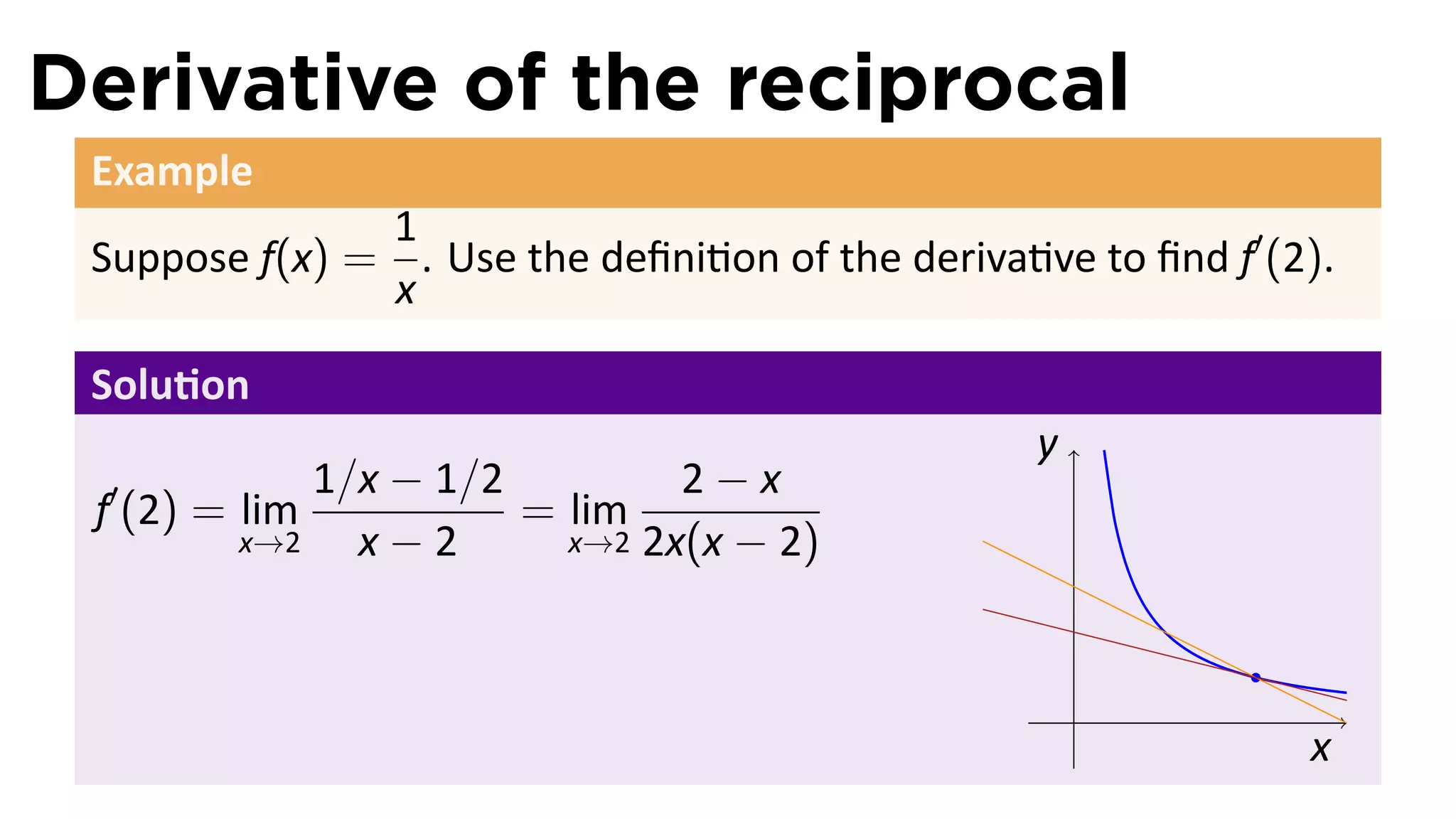
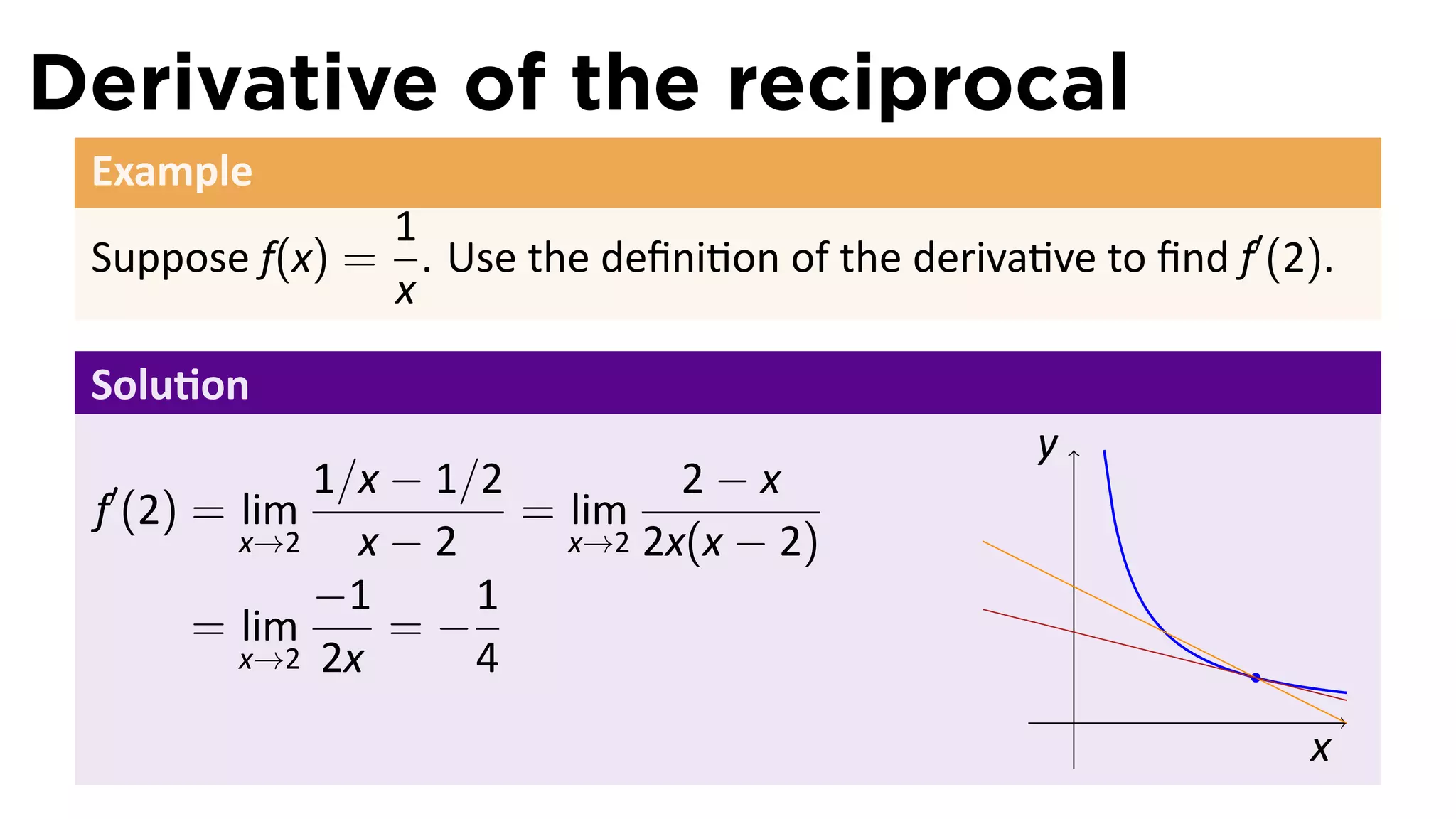
Derivative of the reciprocal
 Example
               1
 Suppose f(x) = . Use the defini on of the deriva ve to find f′ (2).
               x
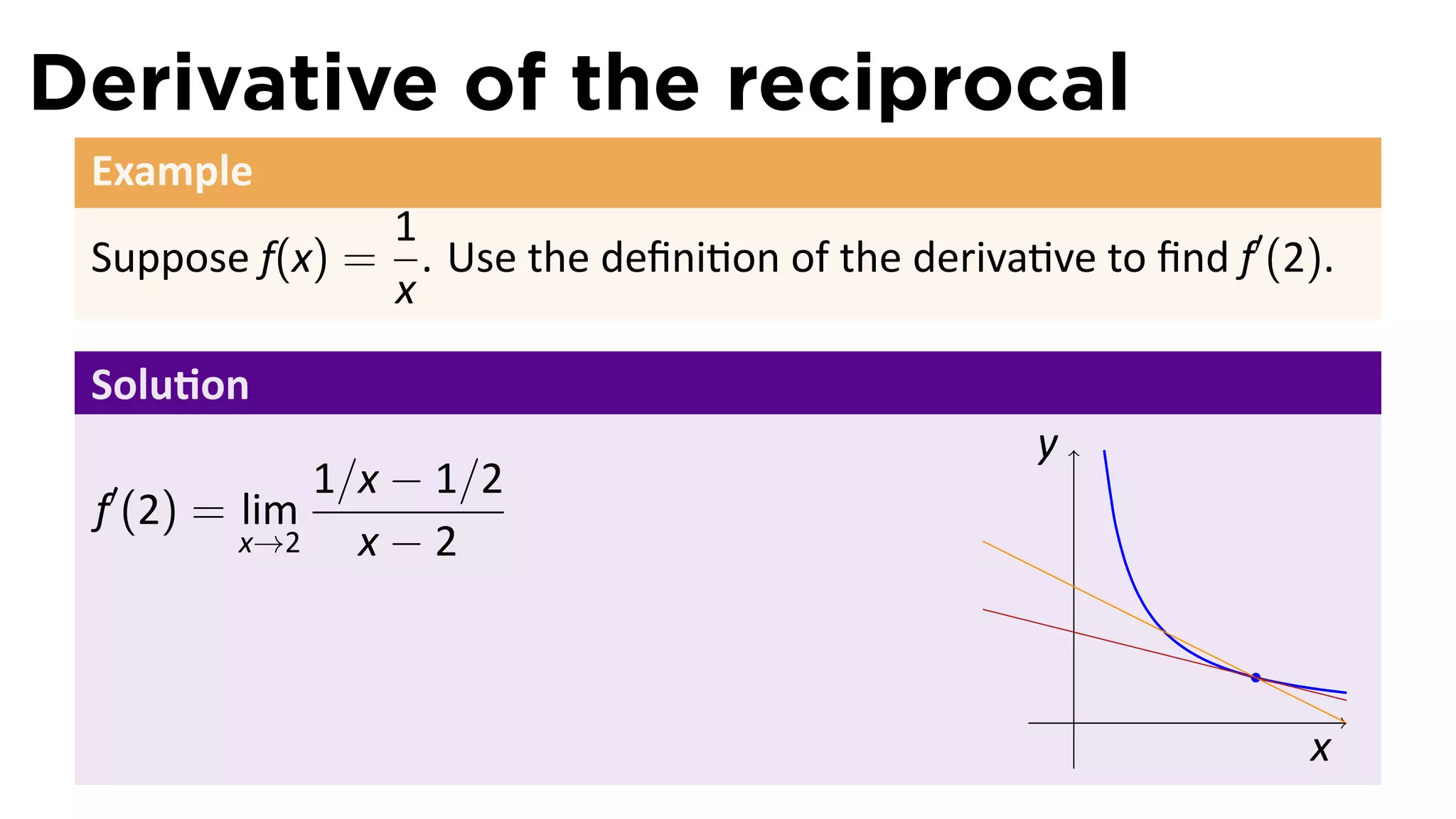
Derivative of the reciprocal
 Example
               1
 Suppose f(x) = . Use the defini on of the deriva ve to find f′ (2).
               x

 Solu on
                                                  y
              1/x − 1/2
 f′ (2) = lim
          x→2   x−2


                                                      .
                                                                x
Derivative of the reciprocal
 Example
               1
 Suppose f(x) = . Use the defini on of the deriva ve to find f′ (2).
               x

 Solu on
                                                  y
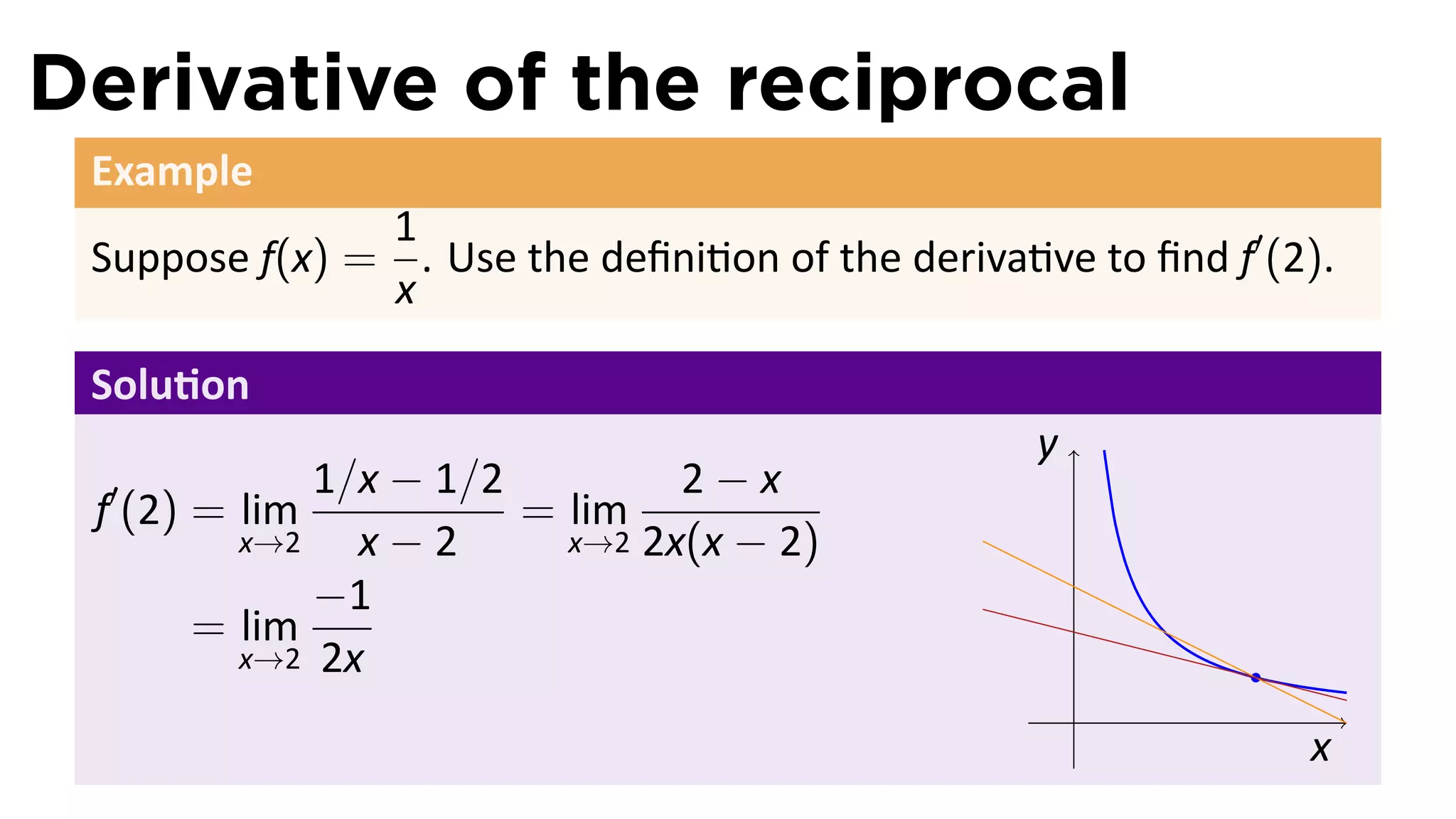
              1/x − 1/2         2−x
 f′ (2) = lim           = lim
          x→2   x−2       x→2 2x(x − 2)


                                                      .
                                                                x
Derivative of the reciprocal
 Example
               1
 Suppose f(x) = . Use the defini on of the deriva ve to find f′ (2).
               x

 Solu on
                                                  y
              1/x − 1/2         2−x
 f′ (2) = lim           = lim
          x→2   x−2       x→2 2x(x − 2)
              −1
        = lim
          x→2 2x
                                                      .
                                                                x
Derivative of the reciprocal
 Example
               1
 Suppose f(x) = . Use the defini on of the deriva ve to find f′ (2).
               x

 Solu on
                                                  y
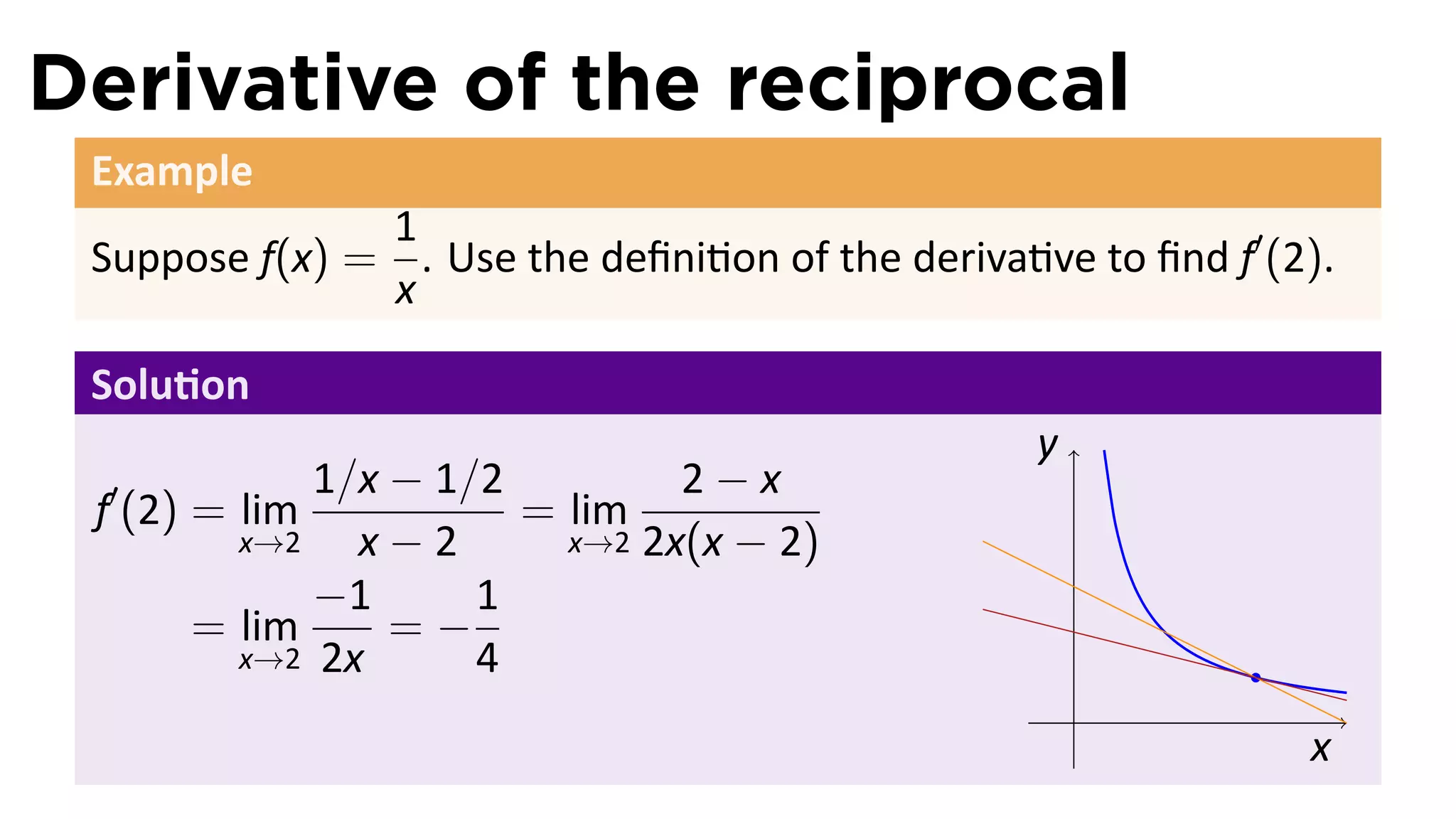
              1/x − 1/2         2−x
 f′ (2) = lim           = lim
          x→2   x−2       x→2 2x(x − 2)
              −1      1
        = lim     =−
          x→2 2x      4
                                                      .
                                                                x
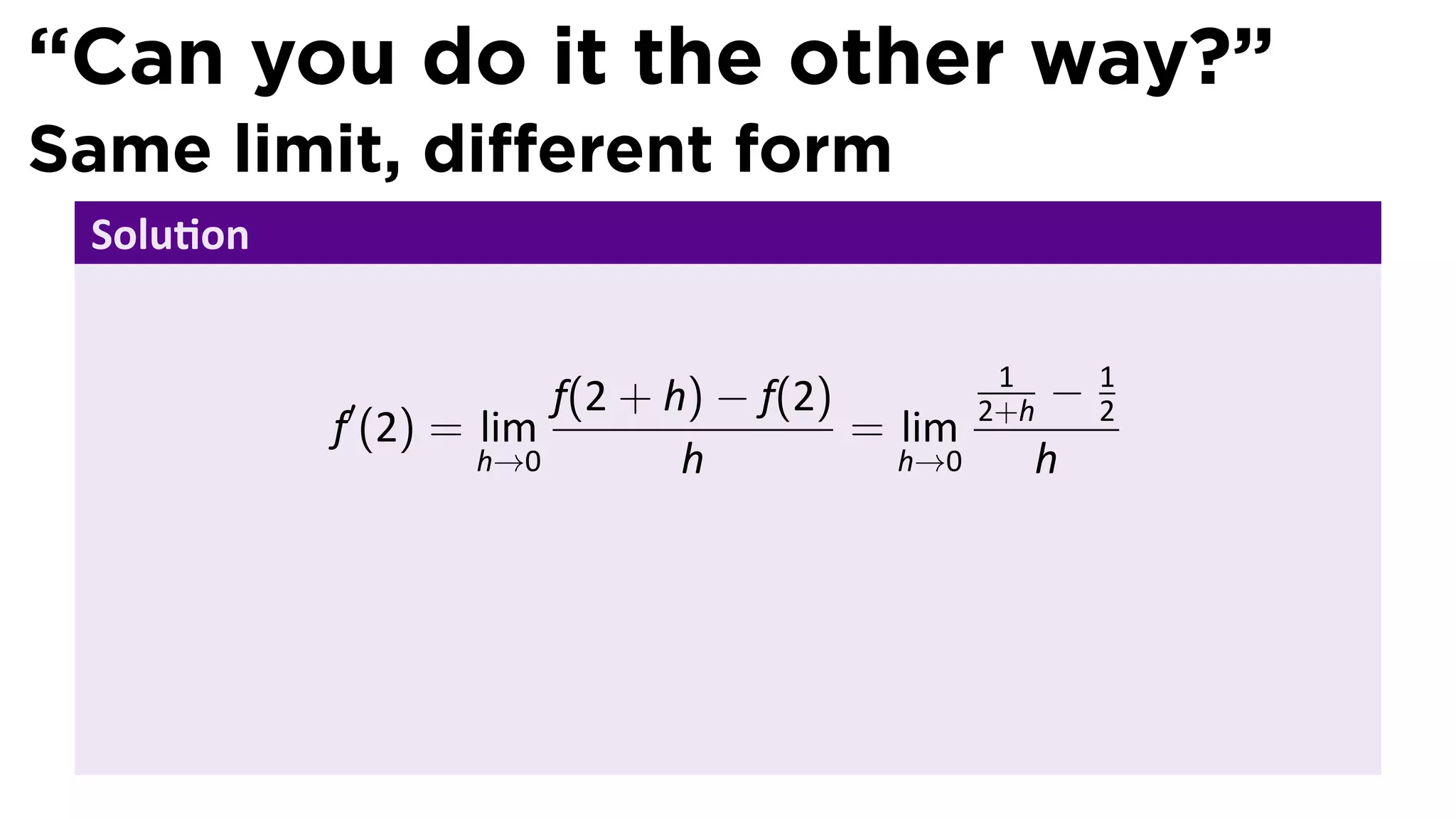
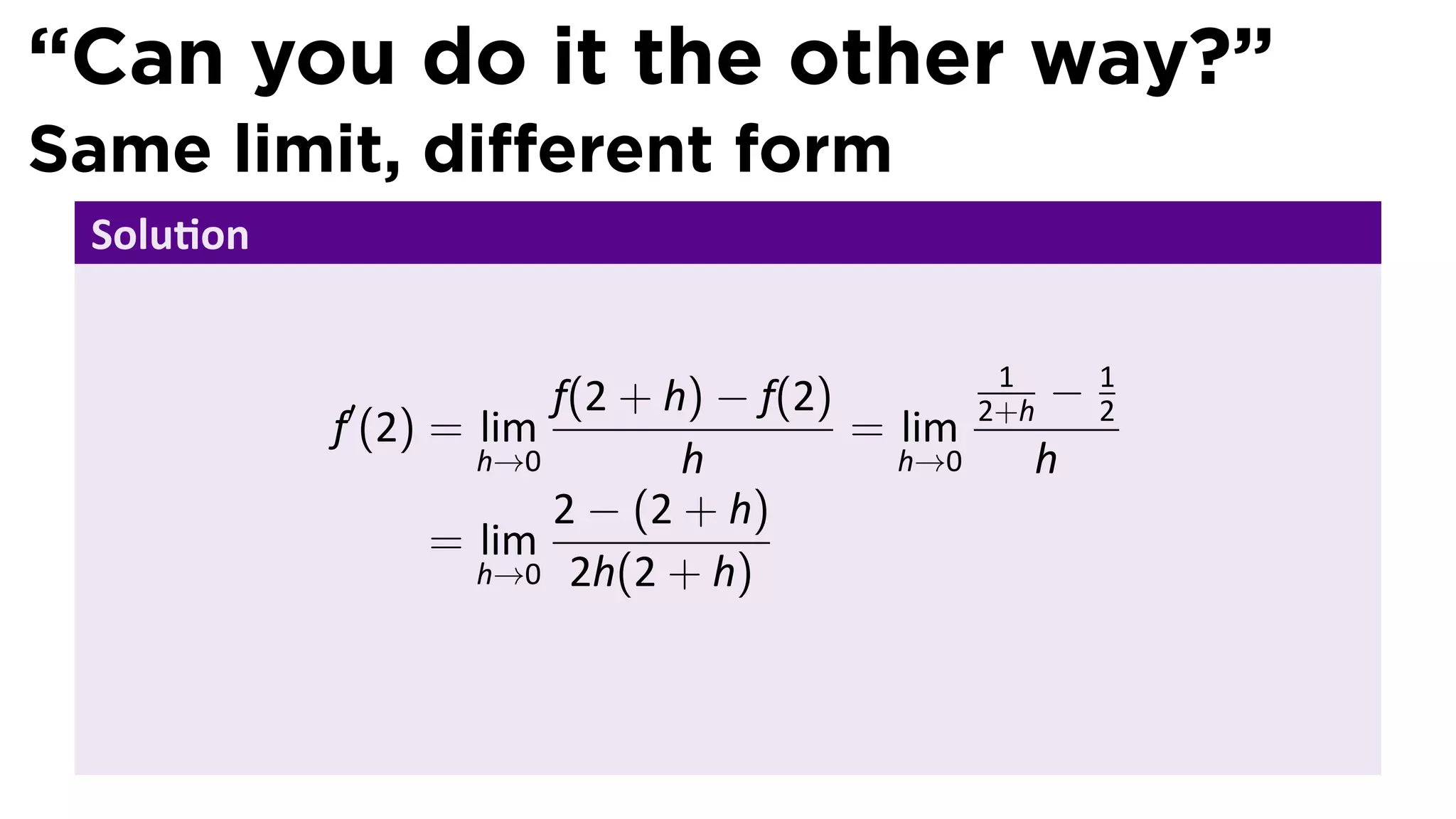
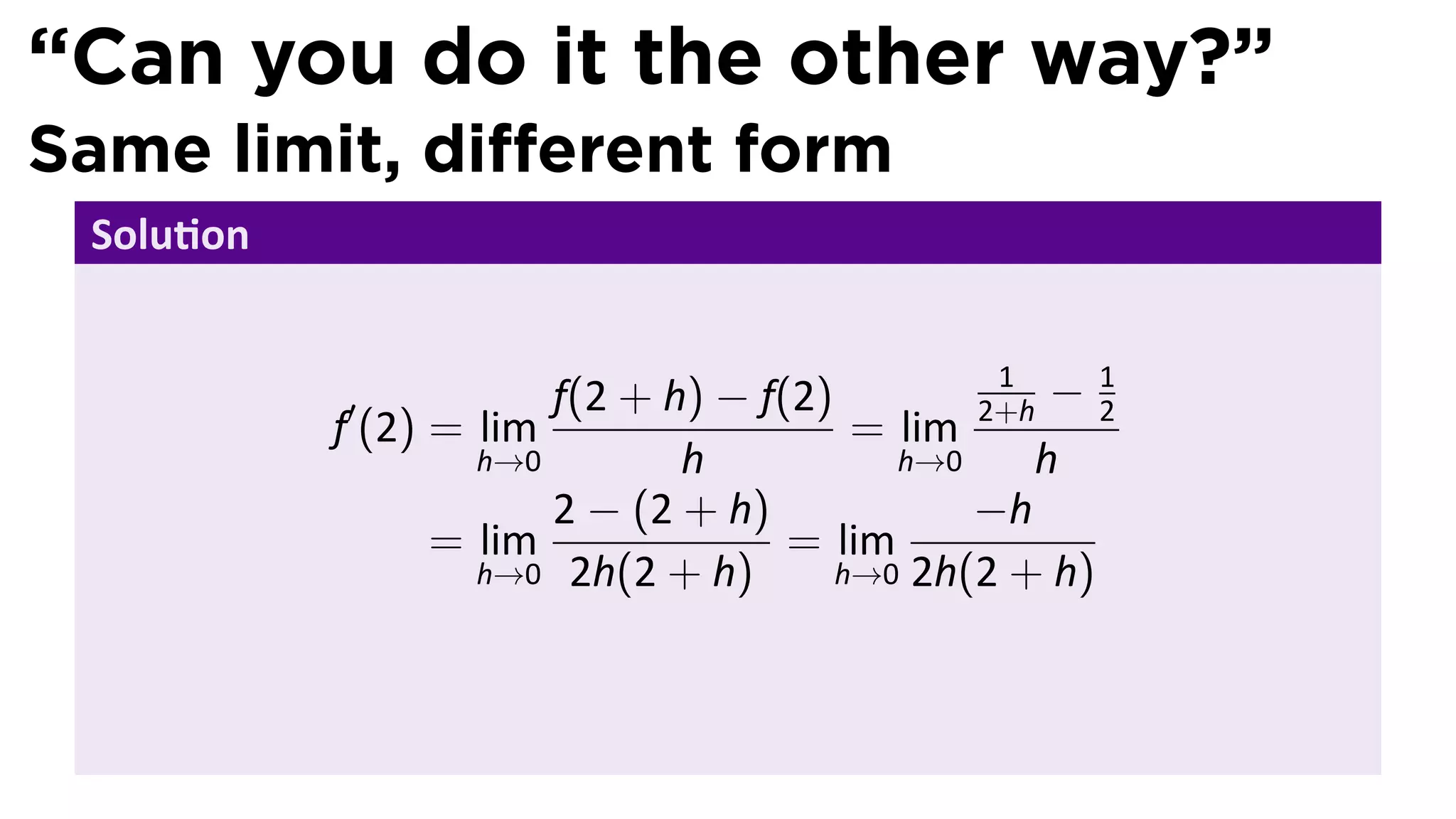
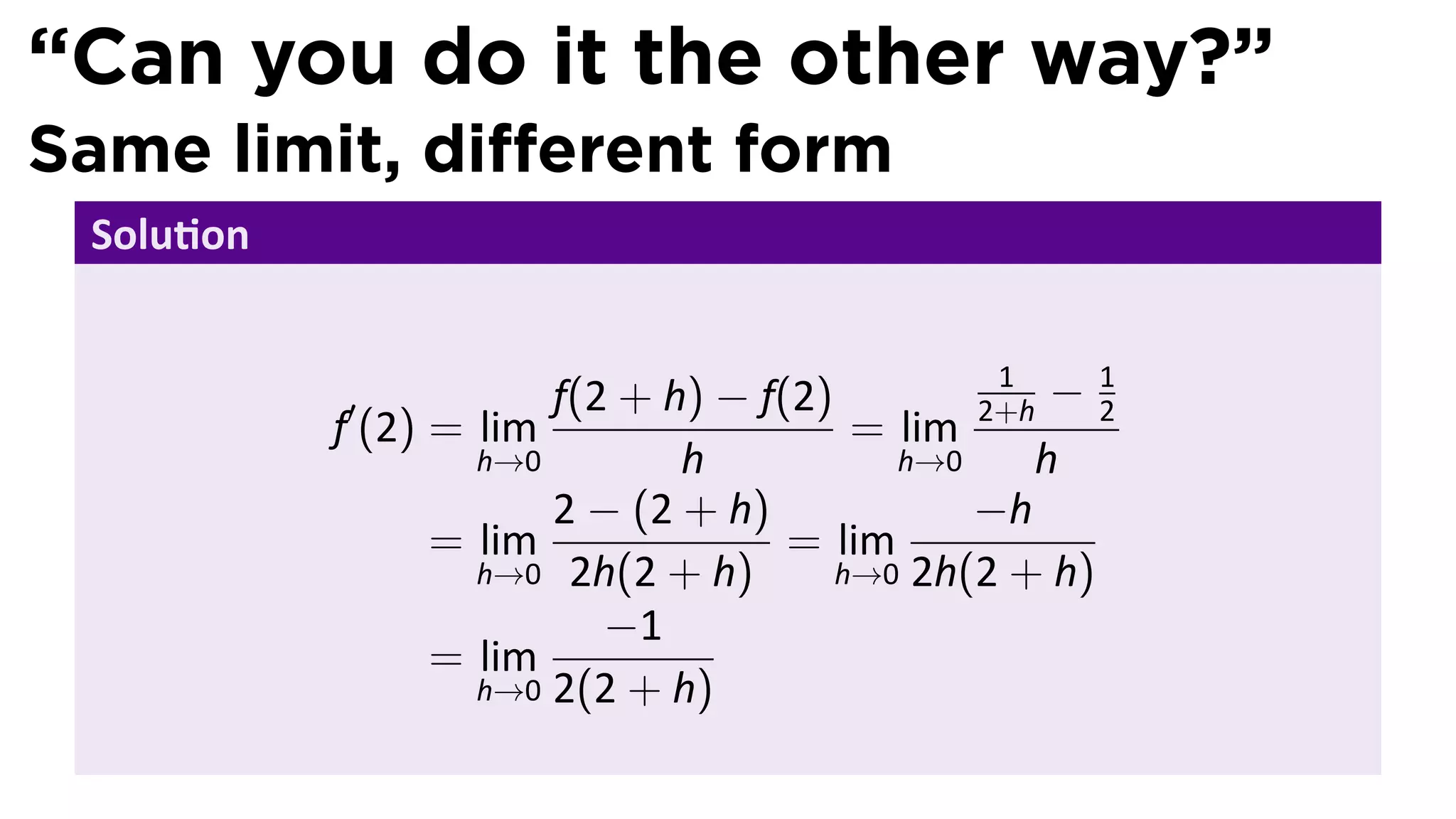
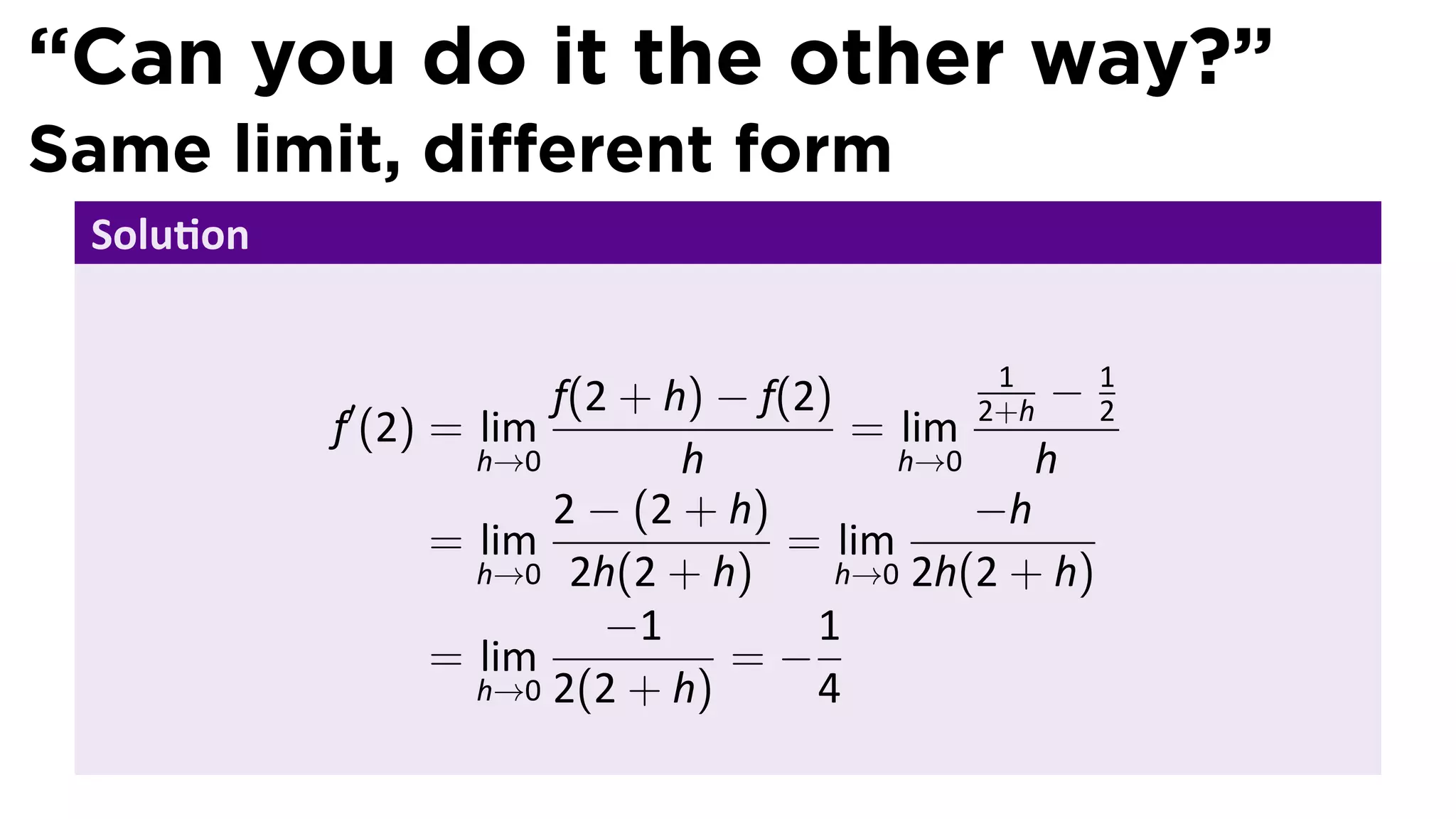
“Can you do it the other way?”
Same limit, different form
 Solu on


           ′           f(2 + h) − f(2)
                                                1
                                               2+h−   1
                                                      2
           f (2) = lim                 = lim
                   h→0        h          h→0     h
“Can you do it the other way?”
Same limit, different form
 Solu on


           ′           f(2 + h) − f(2)
                                                1
                                               2+h−   1
                                                      2
           f (2) = lim                 = lim
                   h→0        h          h→0     h
                       2 − (2 + h)
                 = lim
                   h→0 2h(2 + h)
“Can you do it the other way?”
Same limit, different form
 Solu on


                                              2+h − 2
                                               1     1
           ′           f(2 + h) − f(2)
           f (2) = lim                  = lim
                   h→0        h           h→0    h
                       2 − (2 + h)            −h
                 = lim              = lim
                   h→0 2h(2 + h)       h→0 2h(2 + h)
“Can you do it the other way?”
Same limit, different form
 Solu on


                                              2+h − 2
                                               1     1
           ′           f(2 + h) − f(2)
           f (2) = lim                  = lim
                   h→0        h           h→0    h
                       2 − (2 + h)            −h
                 = lim              = lim
                   h→0 2h(2 + h)       h→0 2h(2 + h)
                          −1
                 = lim
                   h→0 2(2 + h)
“Can you do it the other way?”
Same limit, different form
 Solu on


                                              2+h − 2
                                               1     1
           ′           f(2 + h) − f(2)
           f (2) = lim                  = lim
                   h→0        h           h→0    h
                       2 − (2 + h)            −h
                 = lim              = lim
                   h→0 2h(2 + h)       h→0 2h(2 + h)
                          −1         1
                 = lim          =−
                   h→0 2(2 + h)      4
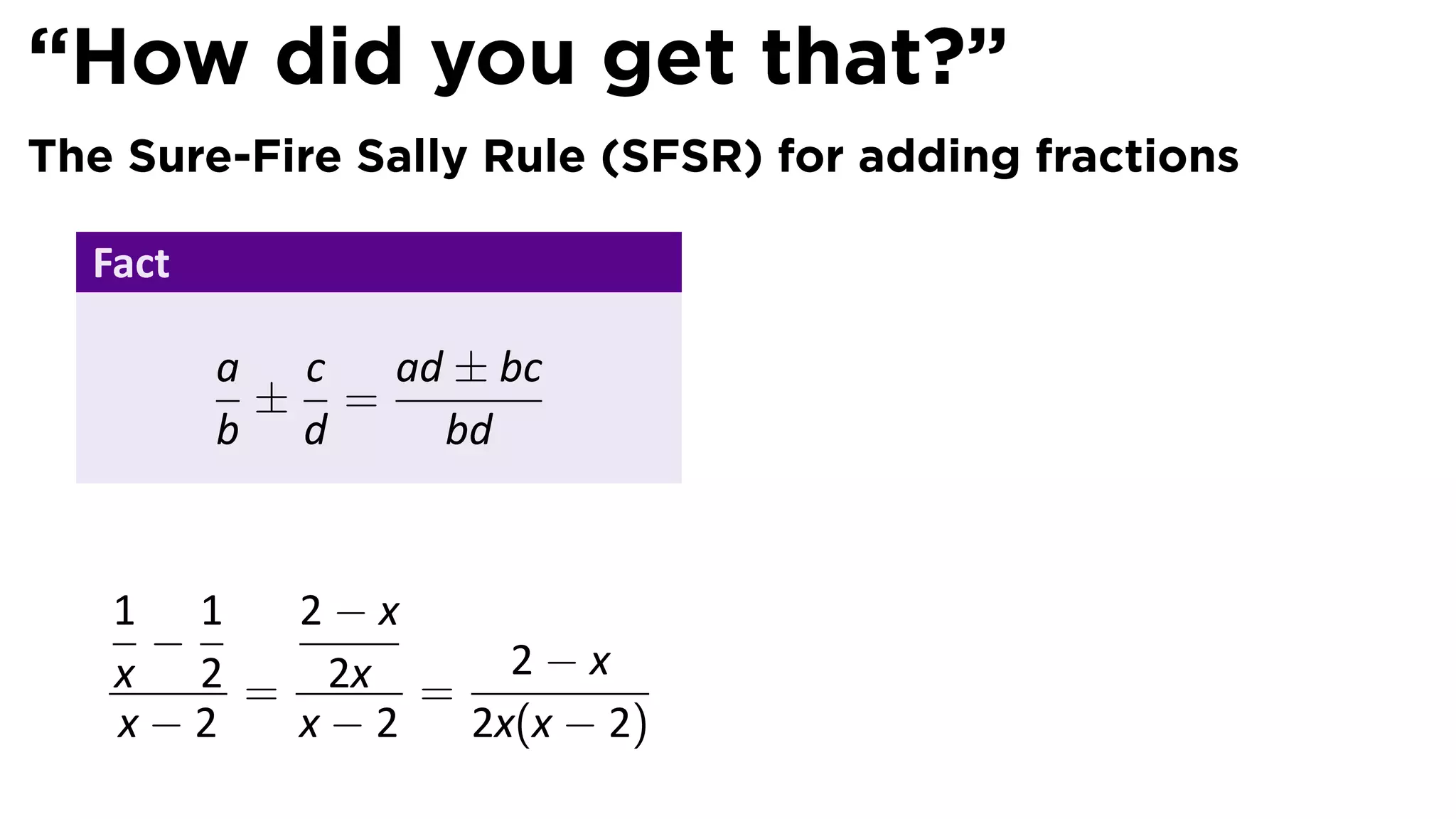
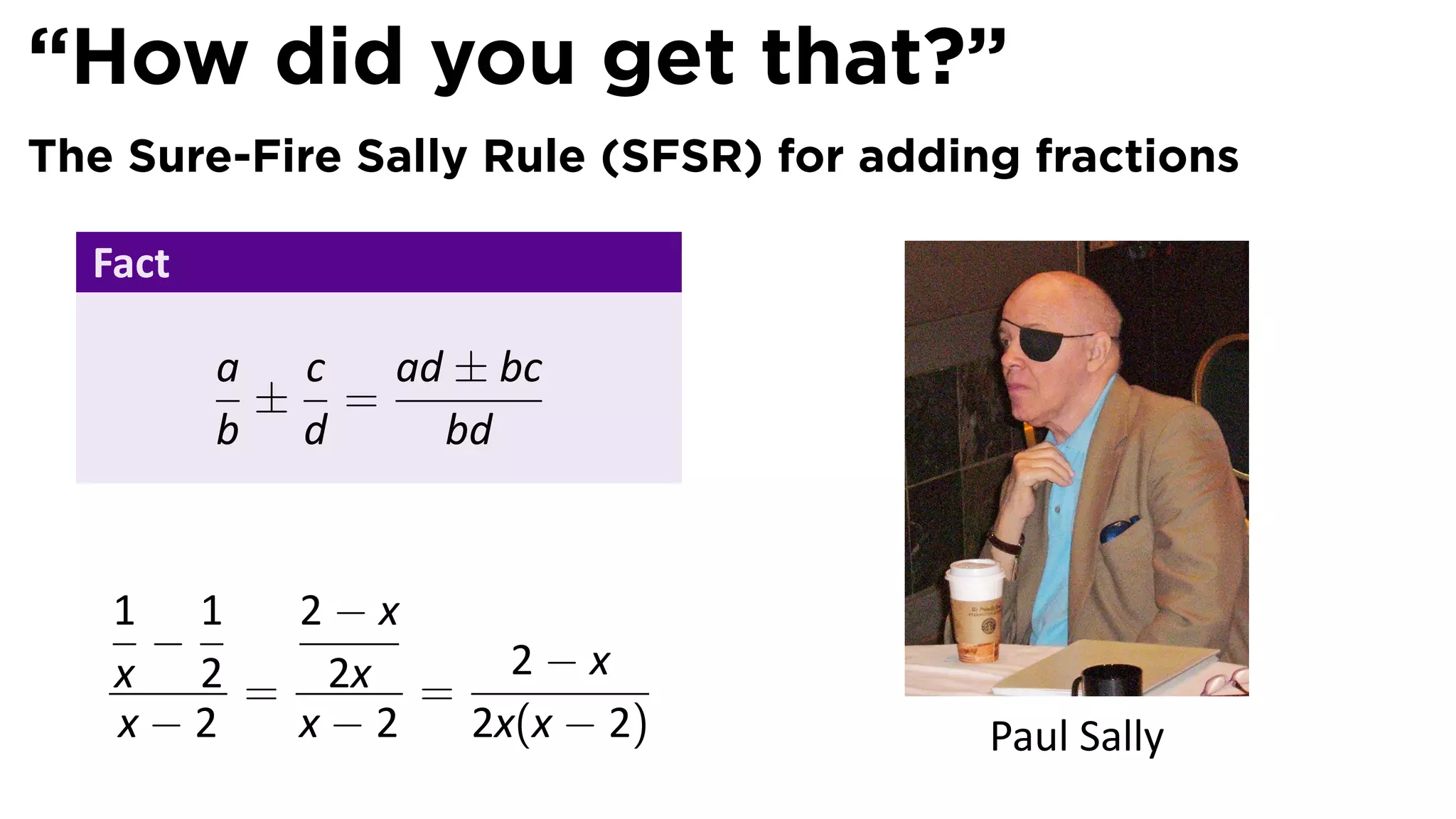
“How did you get that?”
The Sure-Fire Sally Rule (SFSR) for adding fractions

  Fact

         a c  ad ± bc
          ± =
         b d    bd


   1 1  2−x
    −
   x 2 = 2x = 2 − x
   x−2  x−2  2x(x − 2)
“How did you get that?”
The Sure-Fire Sally Rule (SFSR) for adding fractions

  Fact

         a c  ad ± bc
          ± =
         b d    bd


   1 1  2−x
    −
   x 2 = 2x = 2 − x
   x−2  x−2  2x(x − 2)                   Paul Sally
What does f tell you about f′?

   If f is a func on, we can compute the deriva ve f′ (x) at each
   point x where f is differen able, and come up with another
   func on, the deriva ve func on.
   What can we say about this func on f′ ?
What does f tell you about f′?

   If f is a func on, we can compute the deriva ve f′ (x) at each
   point x where f is differen able, and come up with another
   func on, the deriva ve func on.
   What can we say about this func on f′ ?
       If f is decreasing on an interval, f′ is nega ve (technically, nonposi ve)
       on that interval
Derivative of the reciprocal
 Example
               1
 Suppose f(x) = . Use the defini on of the deriva ve to find f′ (2).
               x

 Solu on
                                                  y
              1/x − 1/2         2−x
 f′ (2) = lim           = lim
          x→2   x−2       x→2 2x(x − 2)
              −1      1
        = lim     =−
          x→2 2x      4
                                                      .
                                                                x
What does f tell you about f′?

   If f is a func on, we can compute the deriva ve f′ (x) at each
   point x where f is differen able, and come up with another
   func on, the deriva ve func on.
   What can we say about this func on f′ ?
       If f is decreasing on an interval, f′ is nega ve (technically, nonposi ve)
       on that interval
       If f is increasing on an interval, f′ is posi ve (technically, nonnega ve)
       on that interval
Graphically and numerically
         y                              x2 − 22
                              x     m=
                                         x−2
                              3     5
    9                         2.5 4.5
                              2.1 4.1
  6.25                        2.01 4.01
                              limit 4
  4.41
4.0401
     4
3.9601
  3.61                        1.99 3.99
  2.25                        1.9 3.9
     1                        1.5 3.5
         .                x   1     3
             1 1.52.1 3
                 1.99
                 2.01
                 1.92.5
                   2
What does f tell you about f′?
 Fact
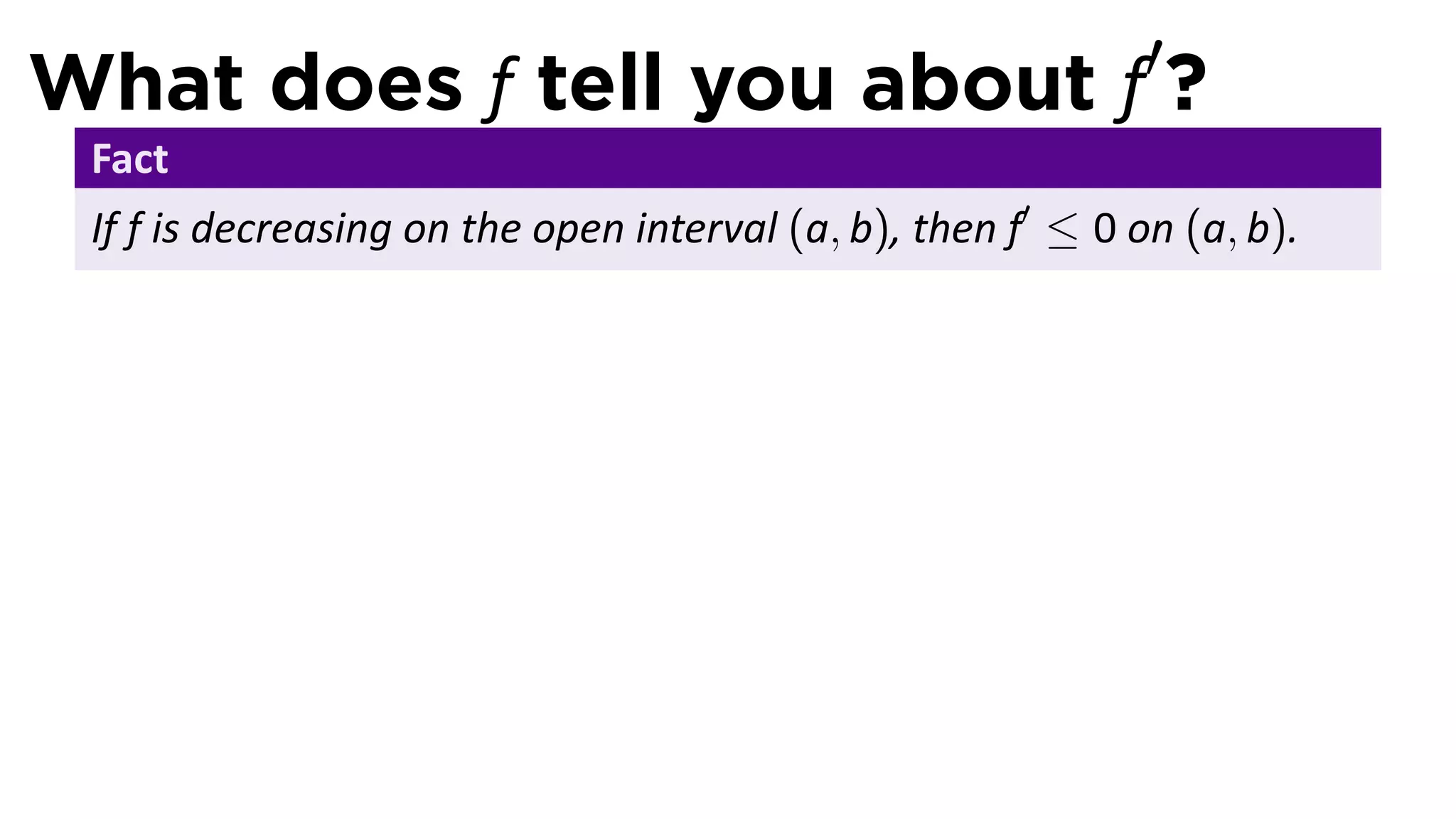
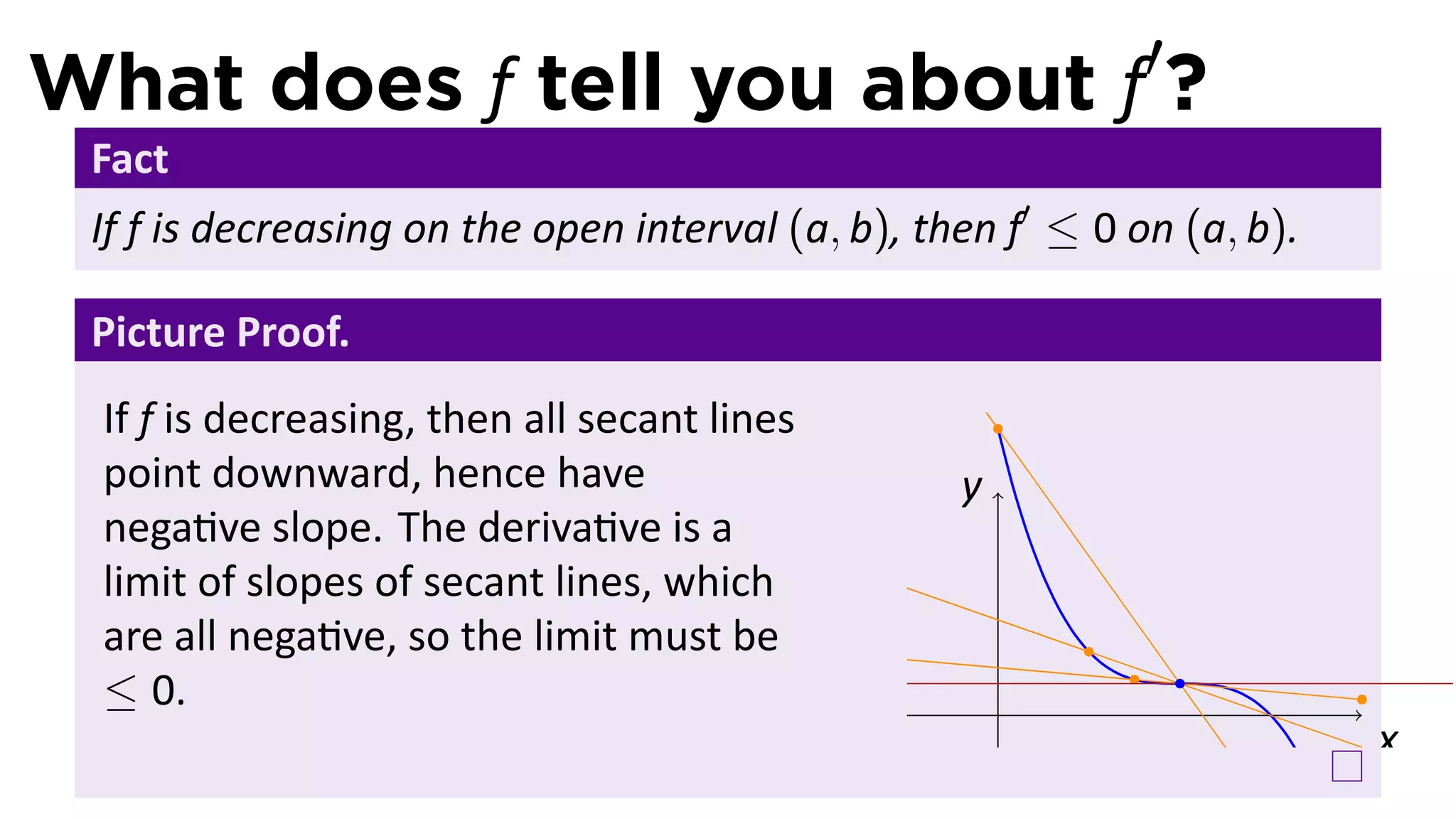
 If f is decreasing on the open interval (a, b), then f′ ≤ 0 on (a, b).
What does f tell you about f′?
 Fact
 If f is decreasing on the open interval (a, b), then f′ ≤ 0 on (a, b).

 Picture Proof.
 If f is decreasing, then all secant lines
 point downward, hence have                        y
 nega ve slope. The deriva ve is a
 limit of slopes of secant lines, which
 are all nega ve, so the limit must be
 ≤ 0.                                                  .
                                                                          x
What does f tell you about f′?
 Fact
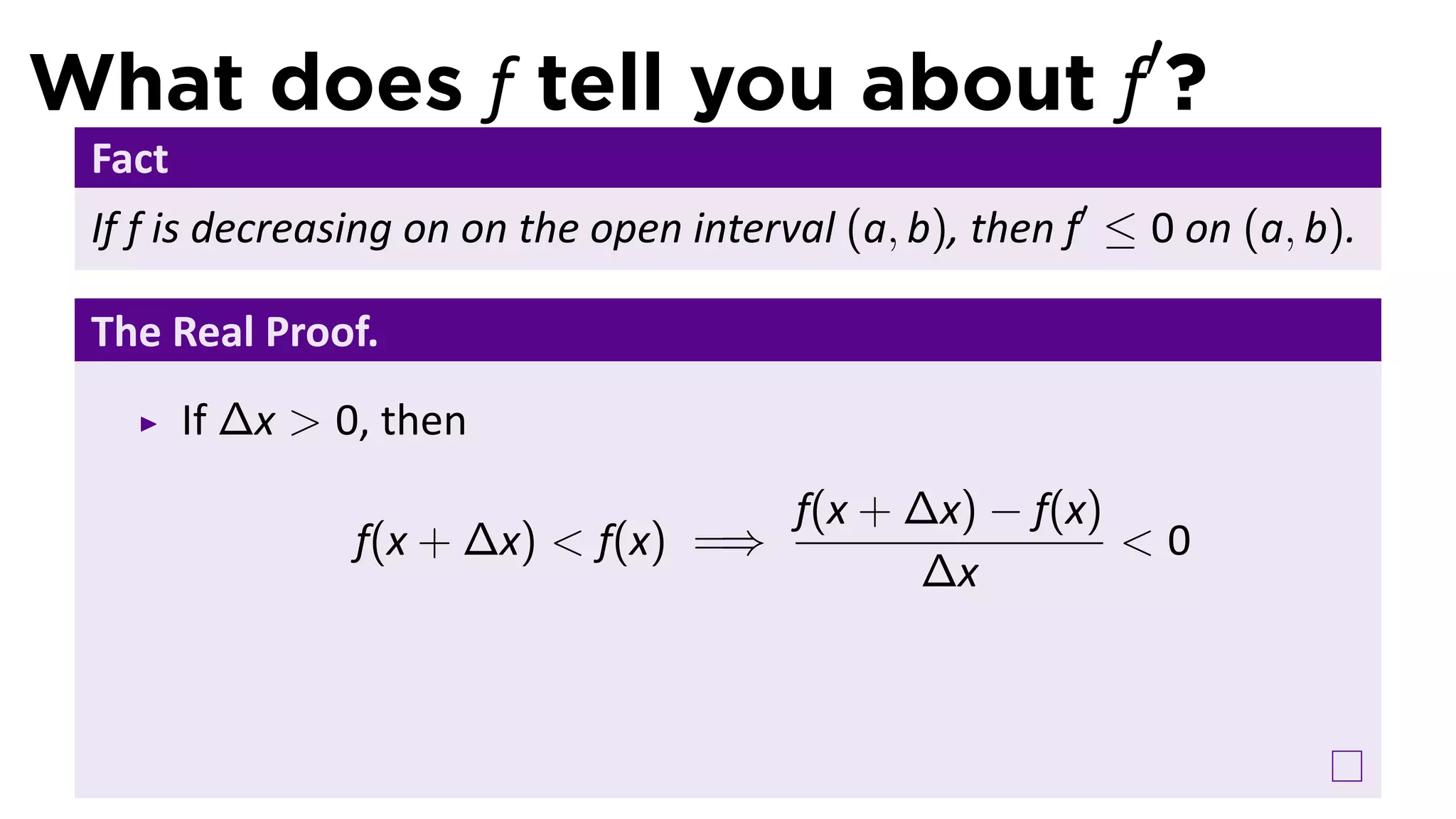
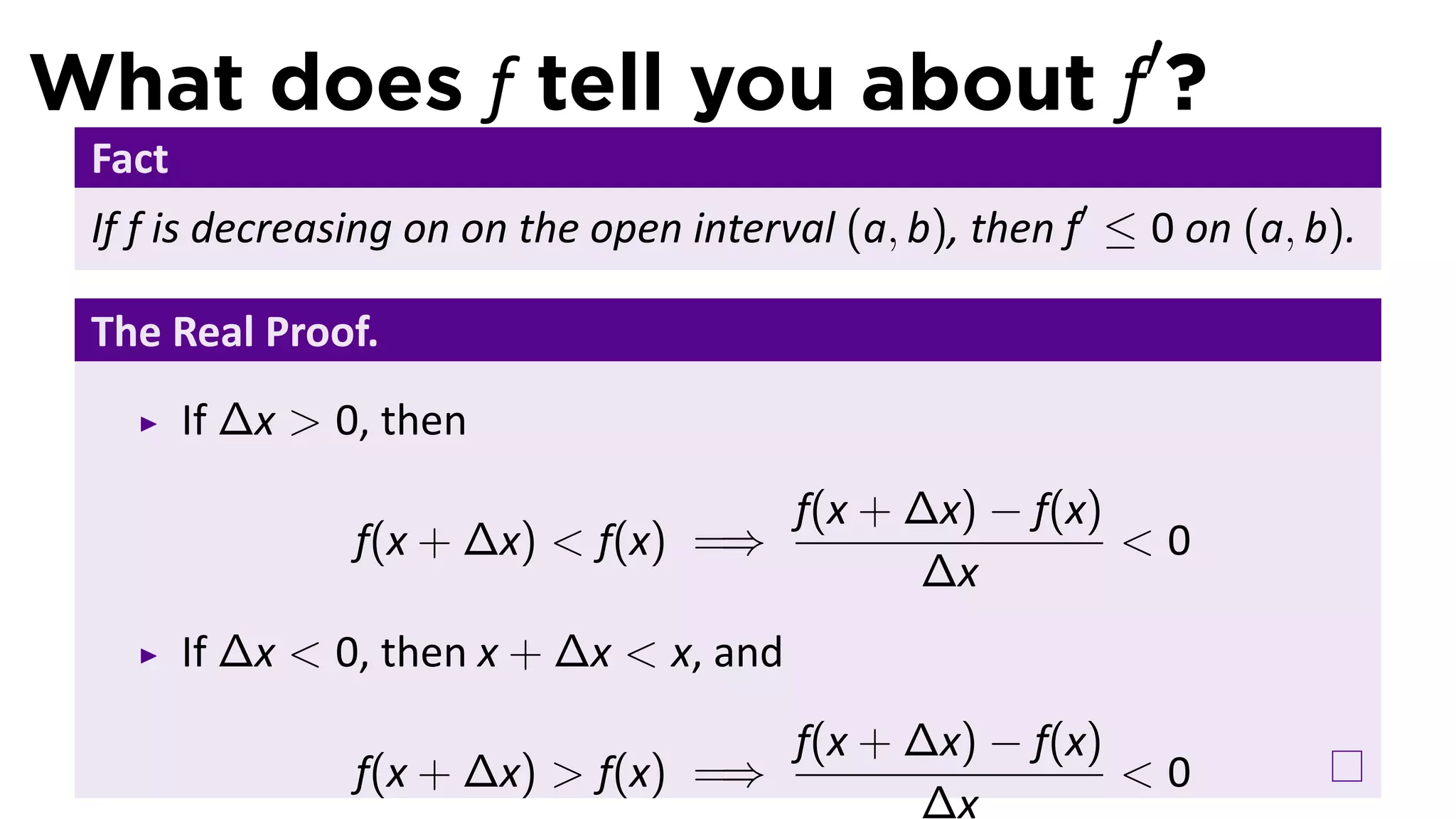
 If f is decreasing on on the open interval (a, b), then f′ ≤ 0 on (a, b).

 The Real Proof.
        If ∆x > 0, then
                                         f(x + ∆x) − f(x)
                 f(x + ∆x) < f(x) =⇒                      <0
                                               ∆x
What does f tell you about f′?
 Fact
 If f is decreasing on on the open interval (a, b), then f′ ≤ 0 on (a, b).

 The Real Proof.
        If ∆x > 0, then
                                          f(x + ∆x) − f(x)
                 f(x + ∆x) < f(x) =⇒                       <0
                                                ∆x
        If ∆x < 0, then x + ∆x < x, and
                                          f(x + ∆x) − f(x)
                 f(x + ∆x) > f(x) =⇒                       <0
                                                ∆x
What does f tell you about f′?
 Fact
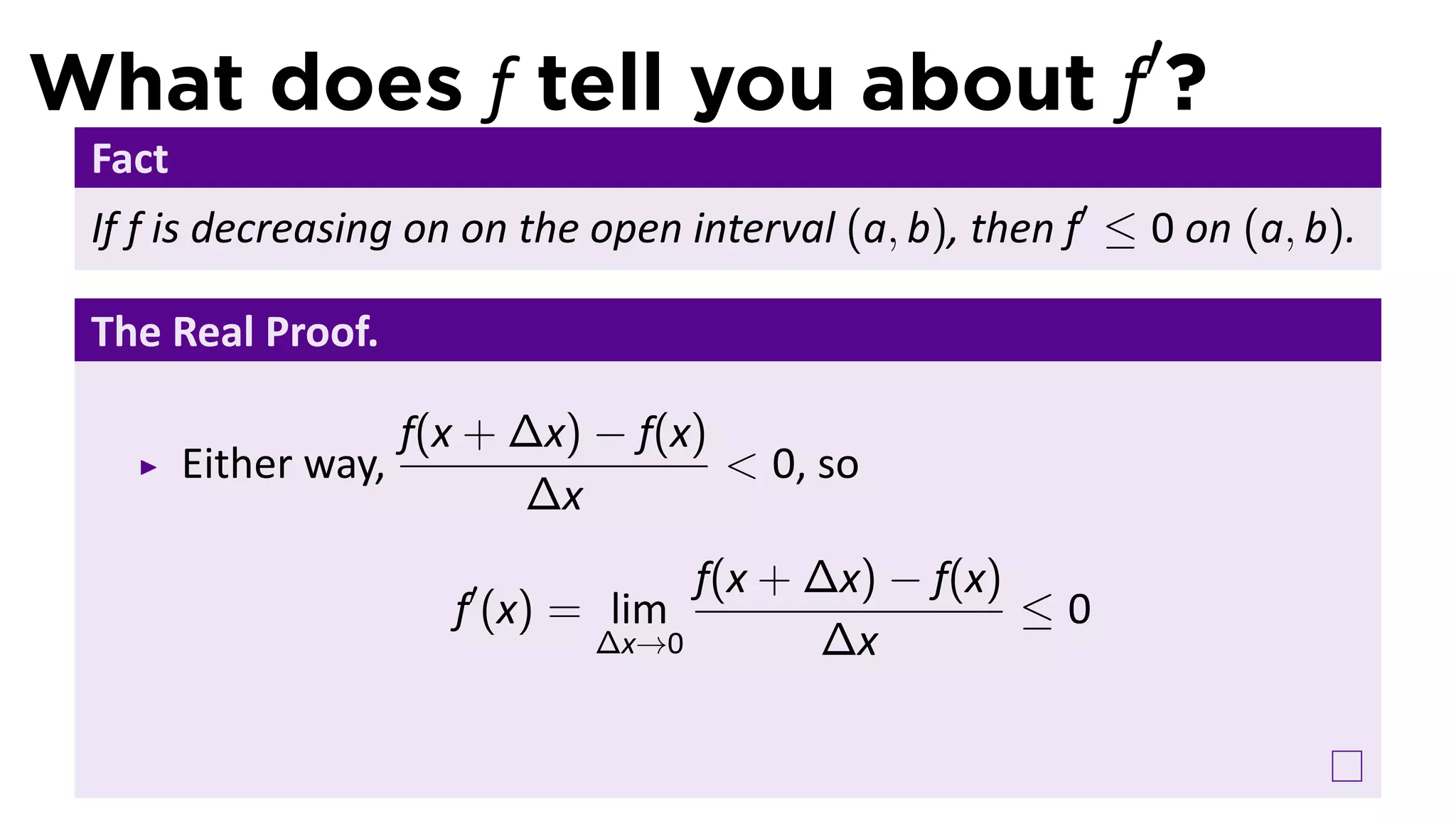
 If f is decreasing on on the open interval (a, b), then f′ ≤ 0 on (a, b).

 The Real Proof.

                      f(x + ∆x) − f(x)
        Either way,                    < 0, so
                            ∆x
                                     f(x + ∆x) − f(x)
                        f′ (x) = lim                  ≤0
                                ∆x→0       ∆x
Going the Other Way?

 Ques on
 If a func on has a nega ve deriva ve on an interval, must it be
 decreasing on that interval?
Going the Other Way?

 Ques on
 If a func on has a nega ve deriva ve on an interval, must it be
 decreasing on that interval?

 Answer
 Maybe.
Outline
 Rates of Change
    Tangent Lines
    Velocity
    Popula on growth
    Marginal costs
 The deriva ve, defined
    Deriva ves of (some) power func ons
    What does f tell you about f′ ?
 How can a func on fail to be differen able?
 Other nota ons
 The second deriva ve
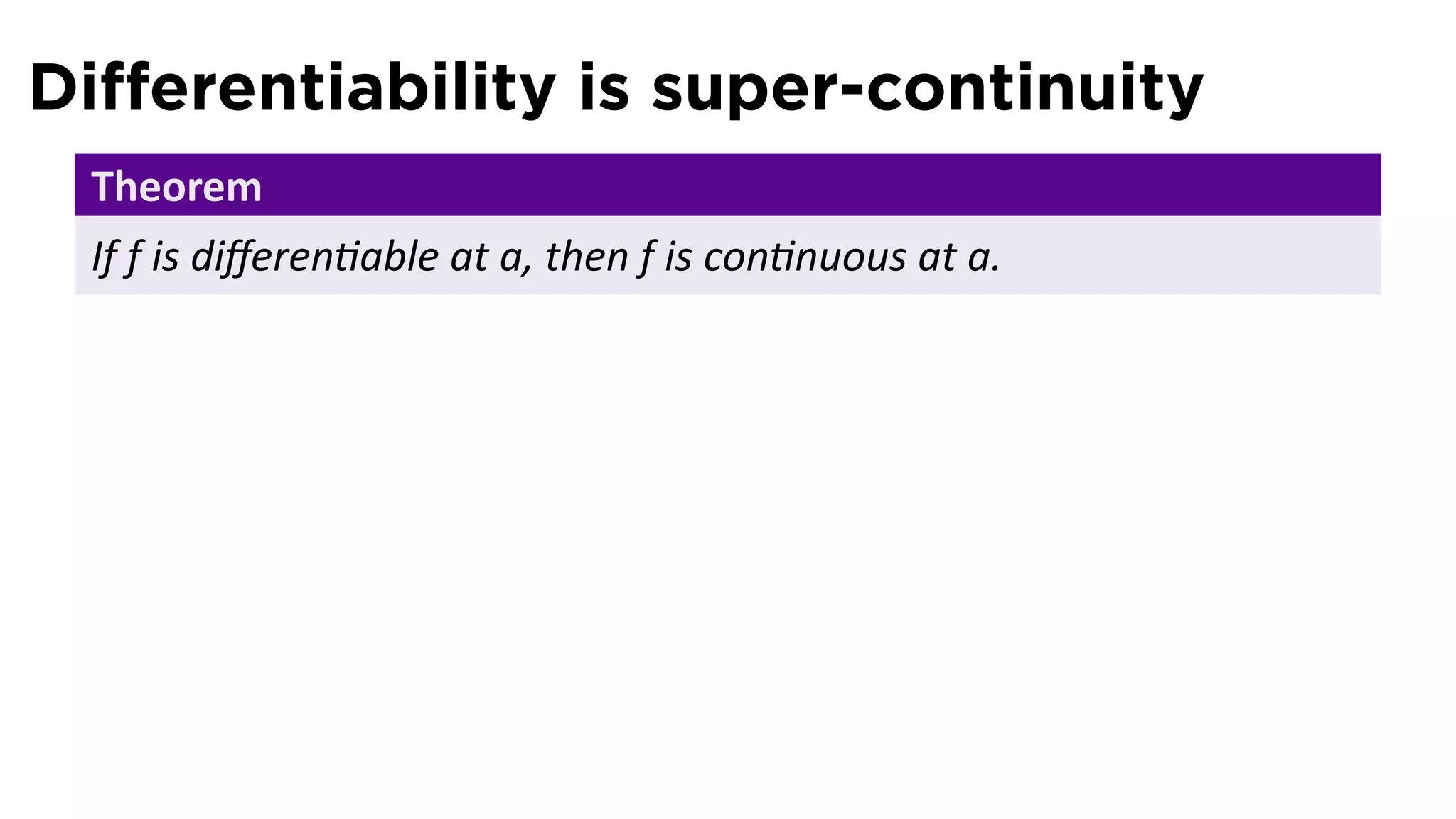
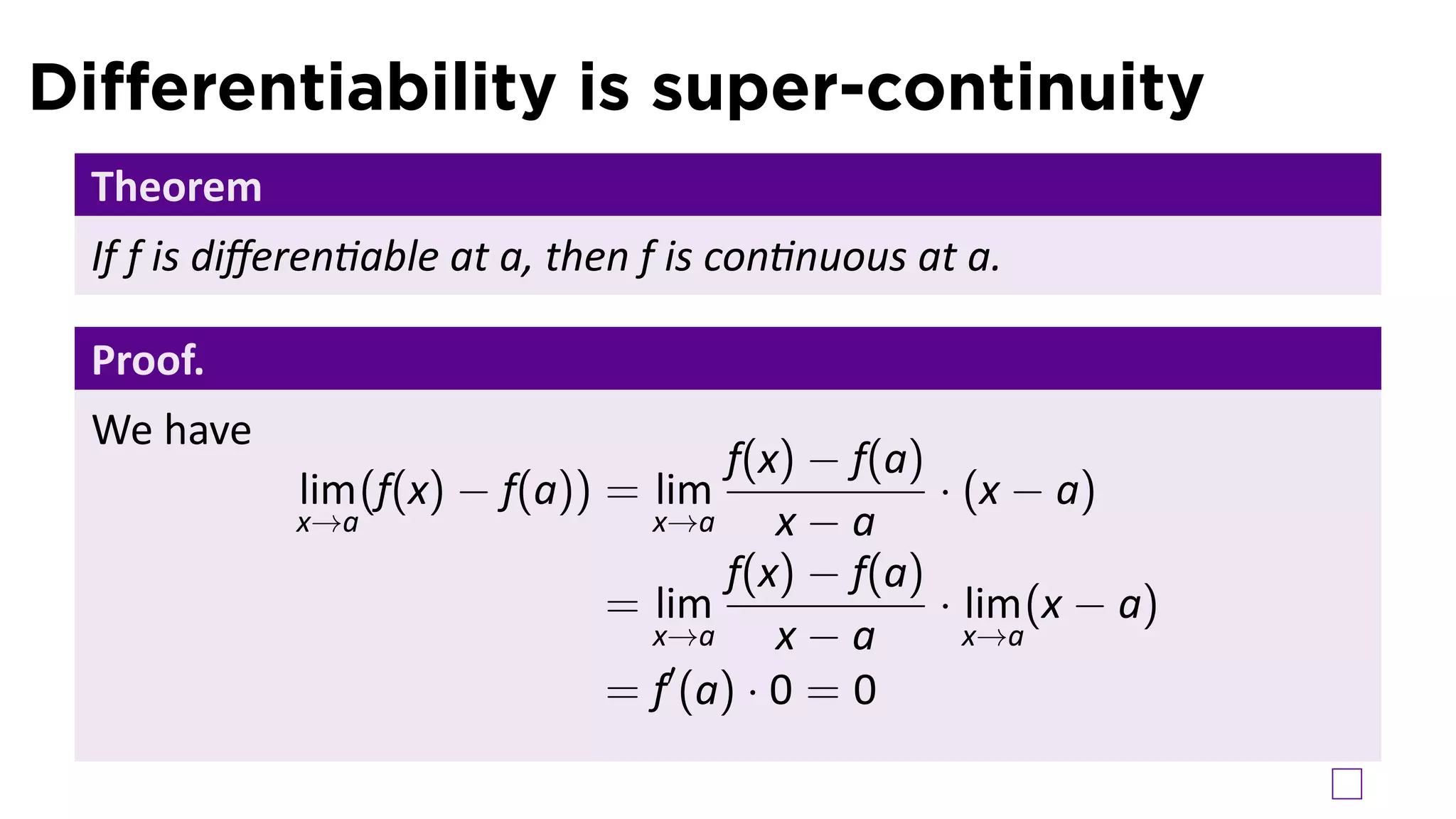
Differentiability is super-continuity
 Theorem
 If f is differen able at a, then f is con nuous at a.
Differentiability is super-continuity
 Theorem
 If f is differen able at a, then f is con nuous at a.

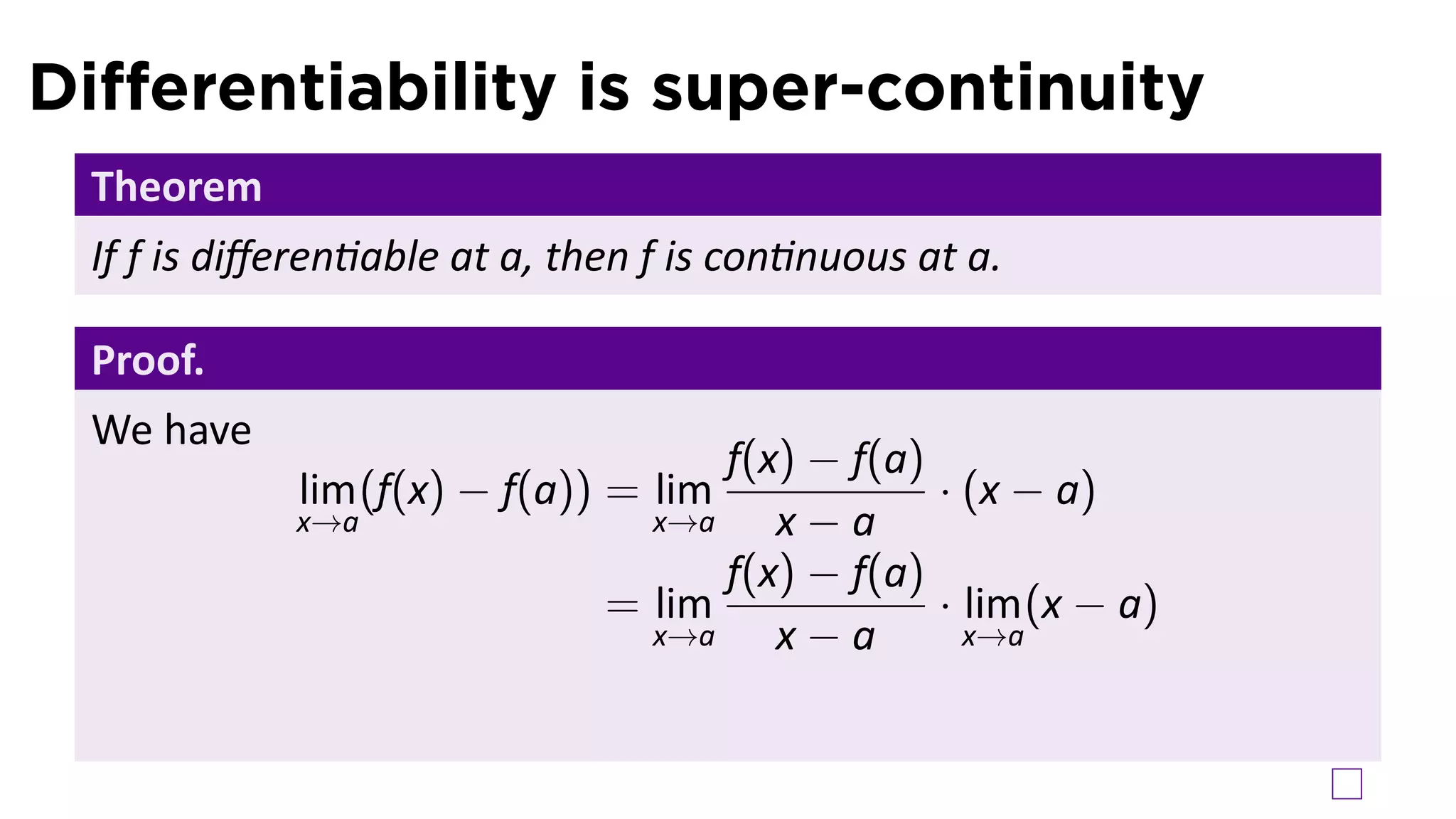
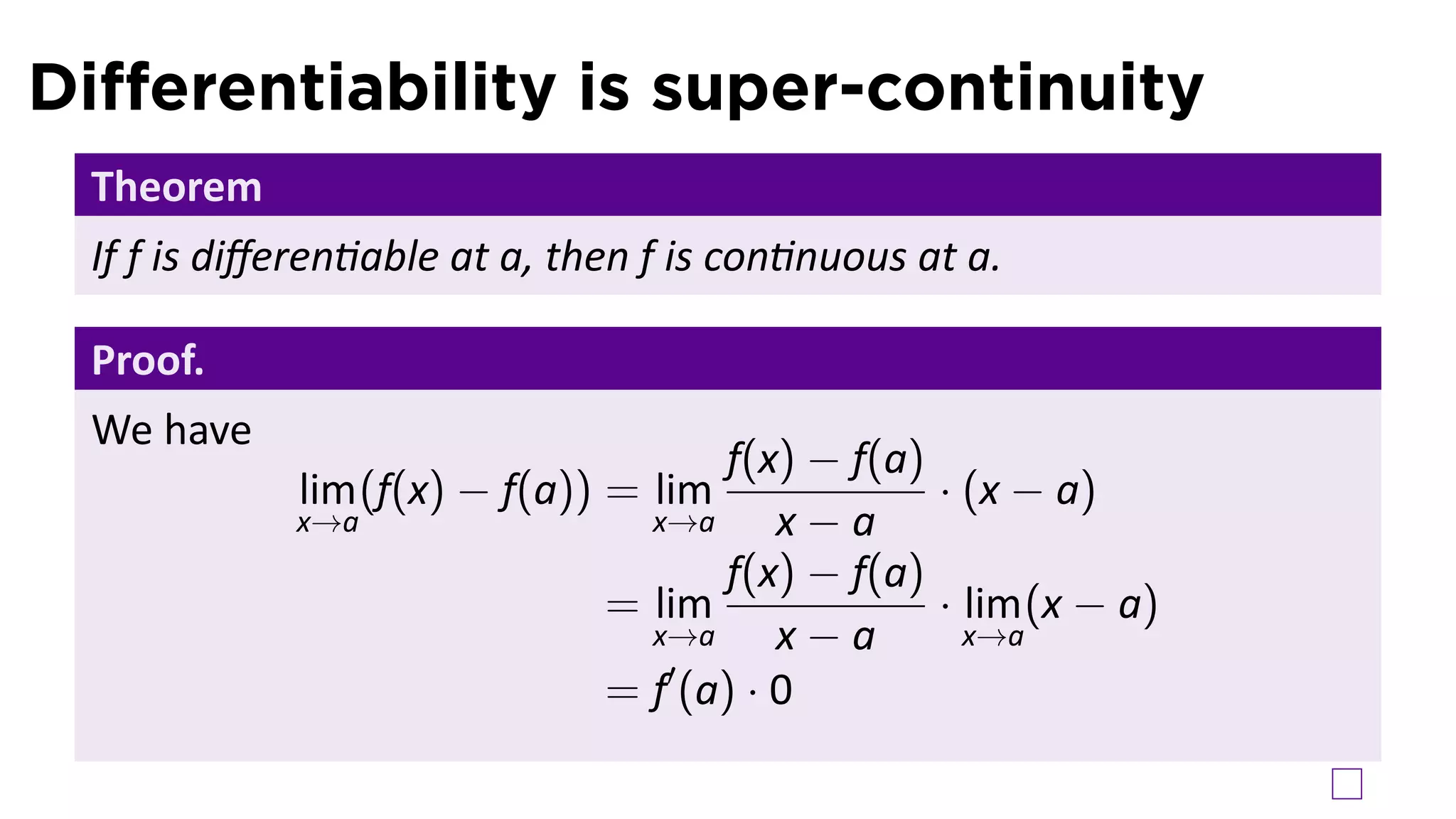
 Proof.
 We have
                                    f(x) − f(a)
            lim (f(x) − f(a)) = lim             · (x − a)
            x→a                 x→a    x−a
                                    f(x) − f(a)
                              = lim             · lim (x − a)
                                x→a    x−a        x→a
Differentiability is super-continuity
 Theorem
 If f is differen able at a, then f is con nuous at a.

 Proof.
 We have
                                    f(x) − f(a)
            lim (f(x) − f(a)) = lim             · (x − a)
            x→a                 x→a     x−a
                                    f(x) − f(a)
                              = lim             · lim (x − a)
                                x→a     x−a       x→a
                                 ′
                              = f (a) · 0
Differentiability is super-continuity
 Theorem
 If f is differen able at a, then f is con nuous at a.

 Proof.
 We have
                                    f(x) − f(a)
            lim (f(x) − f(a)) = lim             · (x − a)
            x→a                 x→a     x−a
                                    f(x) − f(a)
                              = lim             · lim (x − a)
                                x→a     x−a       x→a
                                 ′
                              = f (a) · 0 = 0
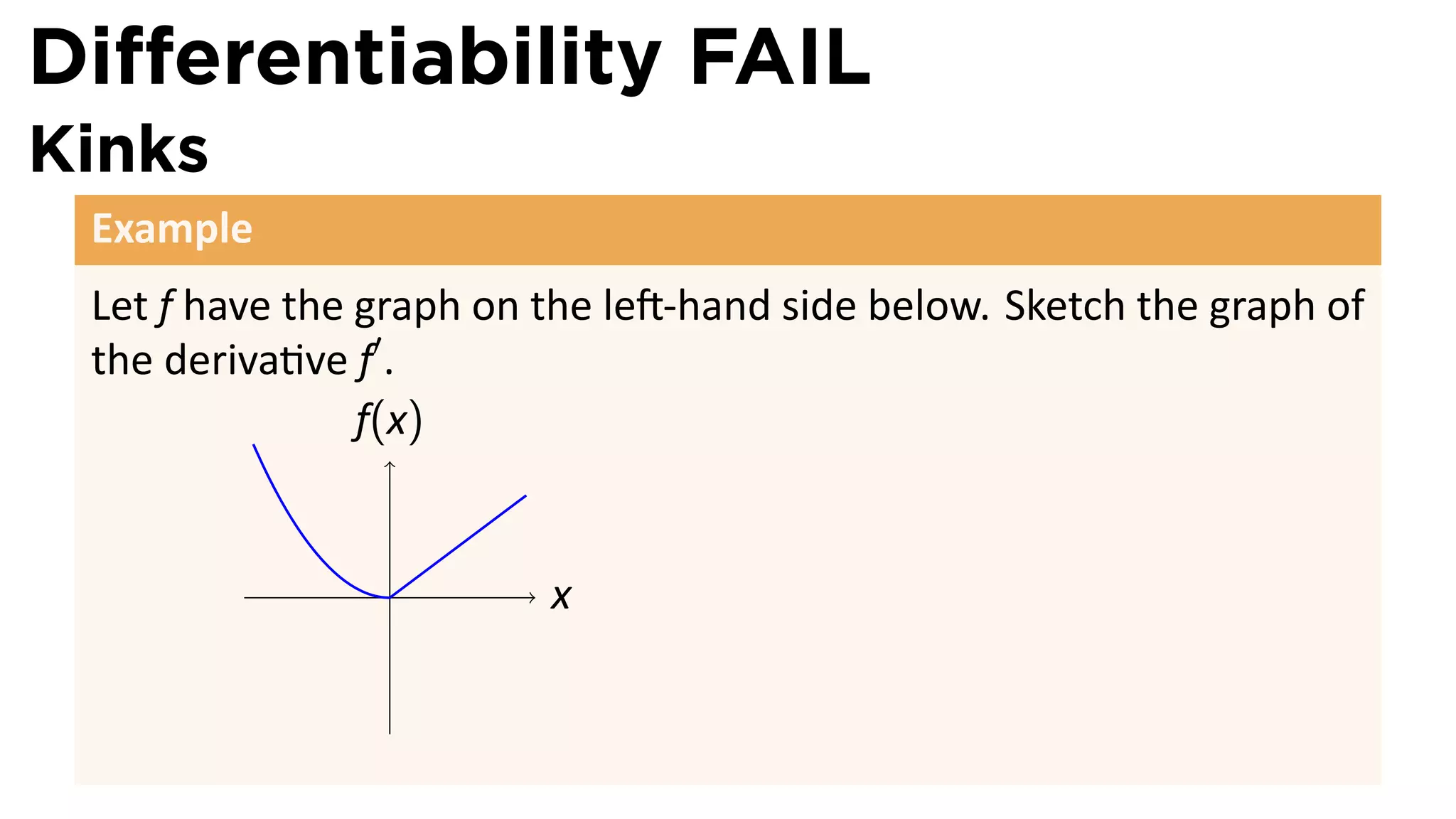
Differentiability FAIL
Kinks
 Example
 Let f have the graph on the le -hand side below. Sketch the graph of
 the deriva ve f′ .
                f(x)


                .        x
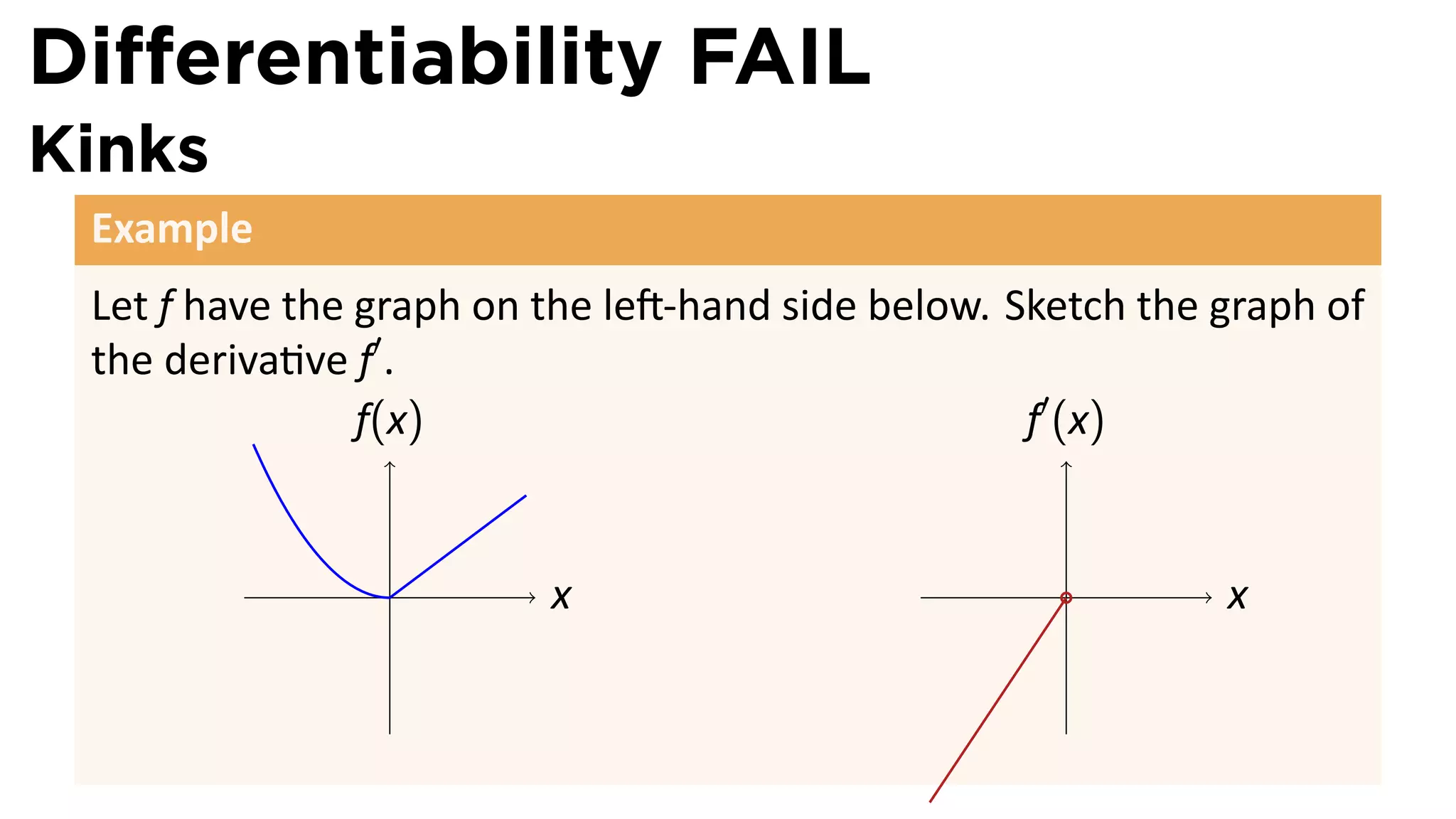
Differentiability FAIL
Kinks
 Example
 Let f have the graph on the le -hand side below. Sketch the graph of
 the deriva ve f′ .
                f(x)                               f′ (x)


                .        x                           .       x
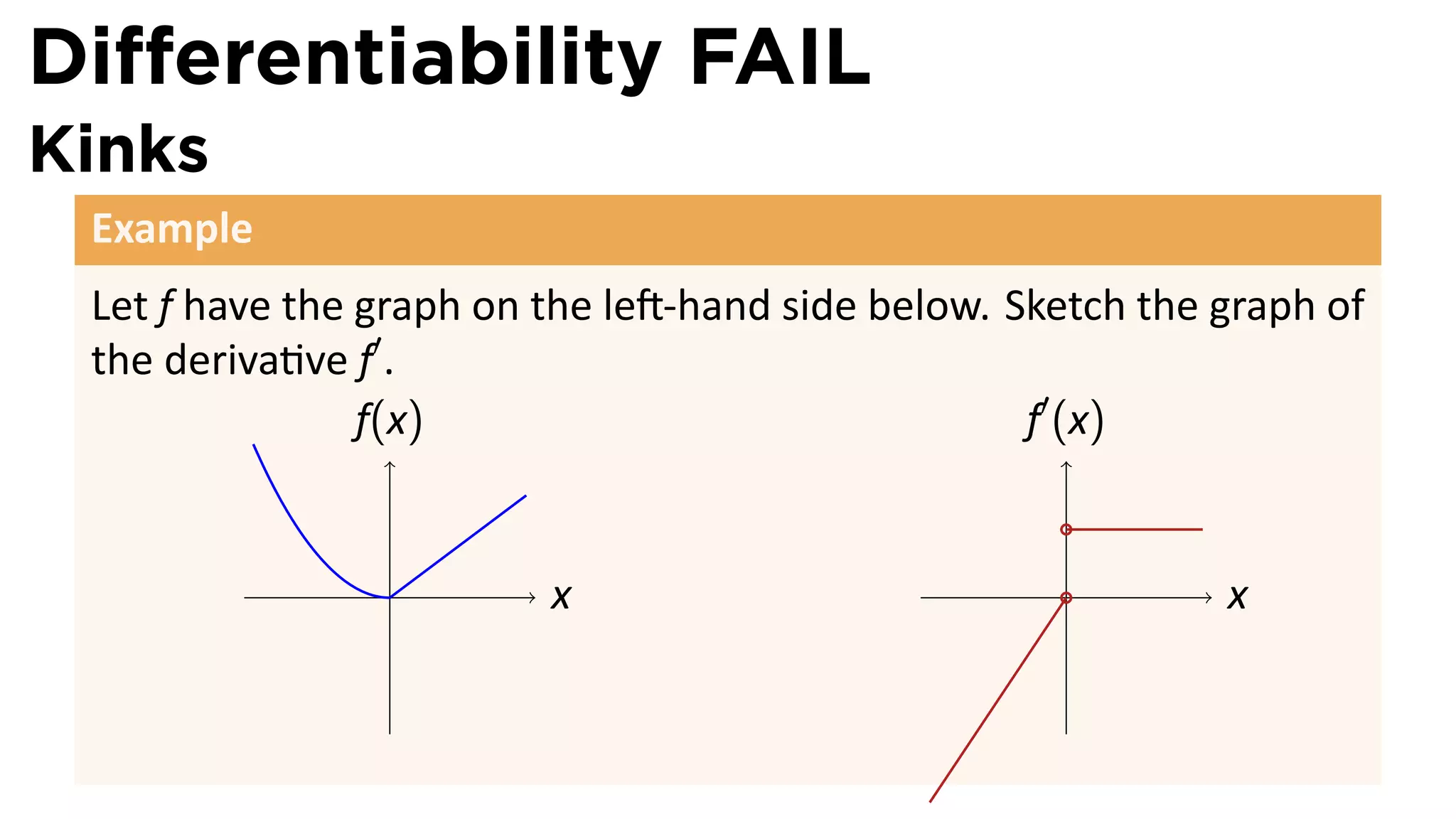
Differentiability FAIL
Kinks
 Example
 Let f have the graph on the le -hand side below. Sketch the graph of
 the deriva ve f′ .
                f(x)                               f′ (x)


                .        x                           .       x
Differentiability FAIL
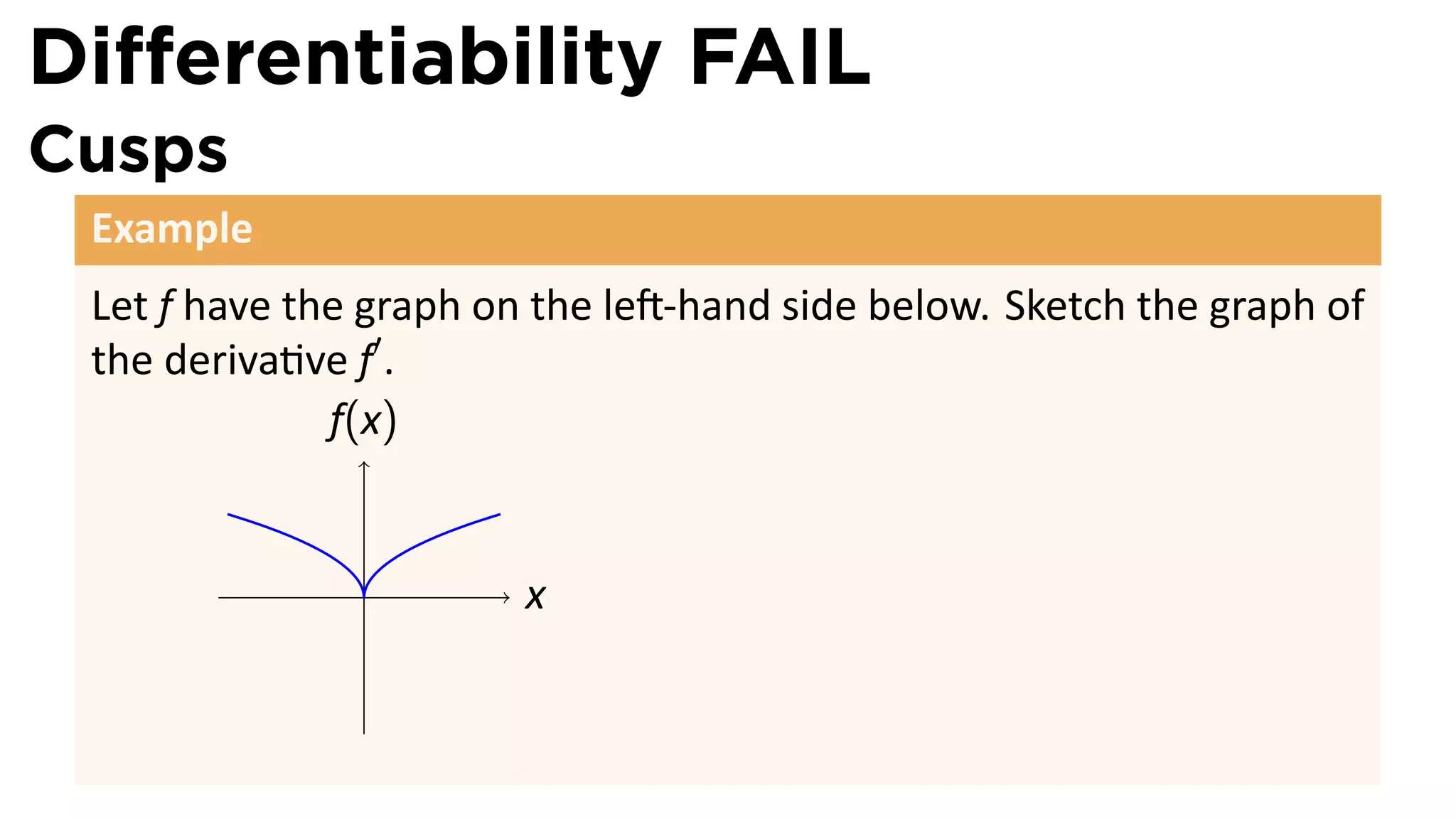
Cusps
 Example
 Let f have the graph on the le -hand side below. Sketch the graph of
 the deriva ve f′ .
              f(x)


               .        x
Differentiability FAIL
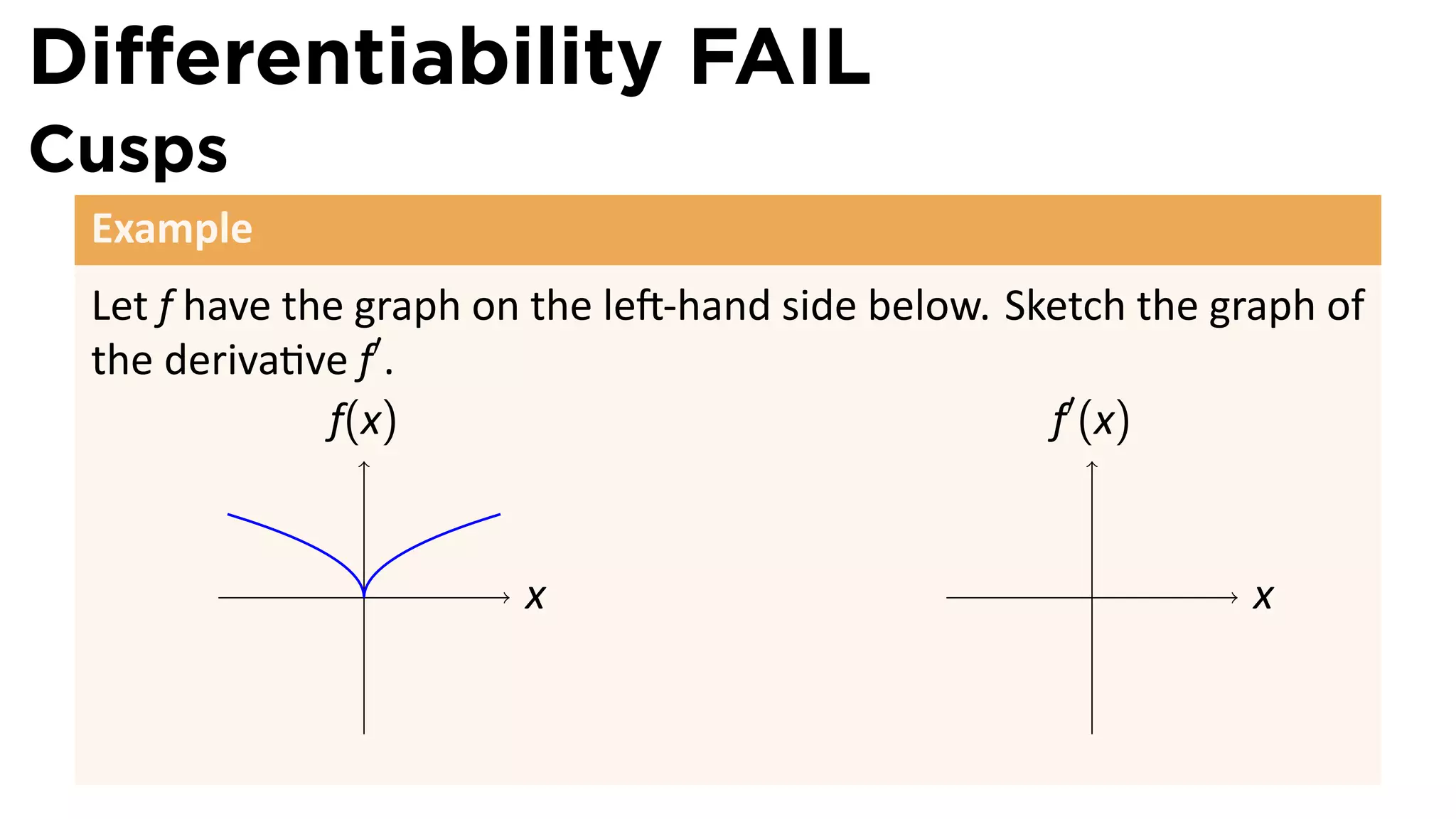
Cusps
 Example
 Let f have the graph on the le -hand side below. Sketch the graph of
 the deriva ve f′ .
              f(x)                                  f′ (x)


               .        x                             .        x
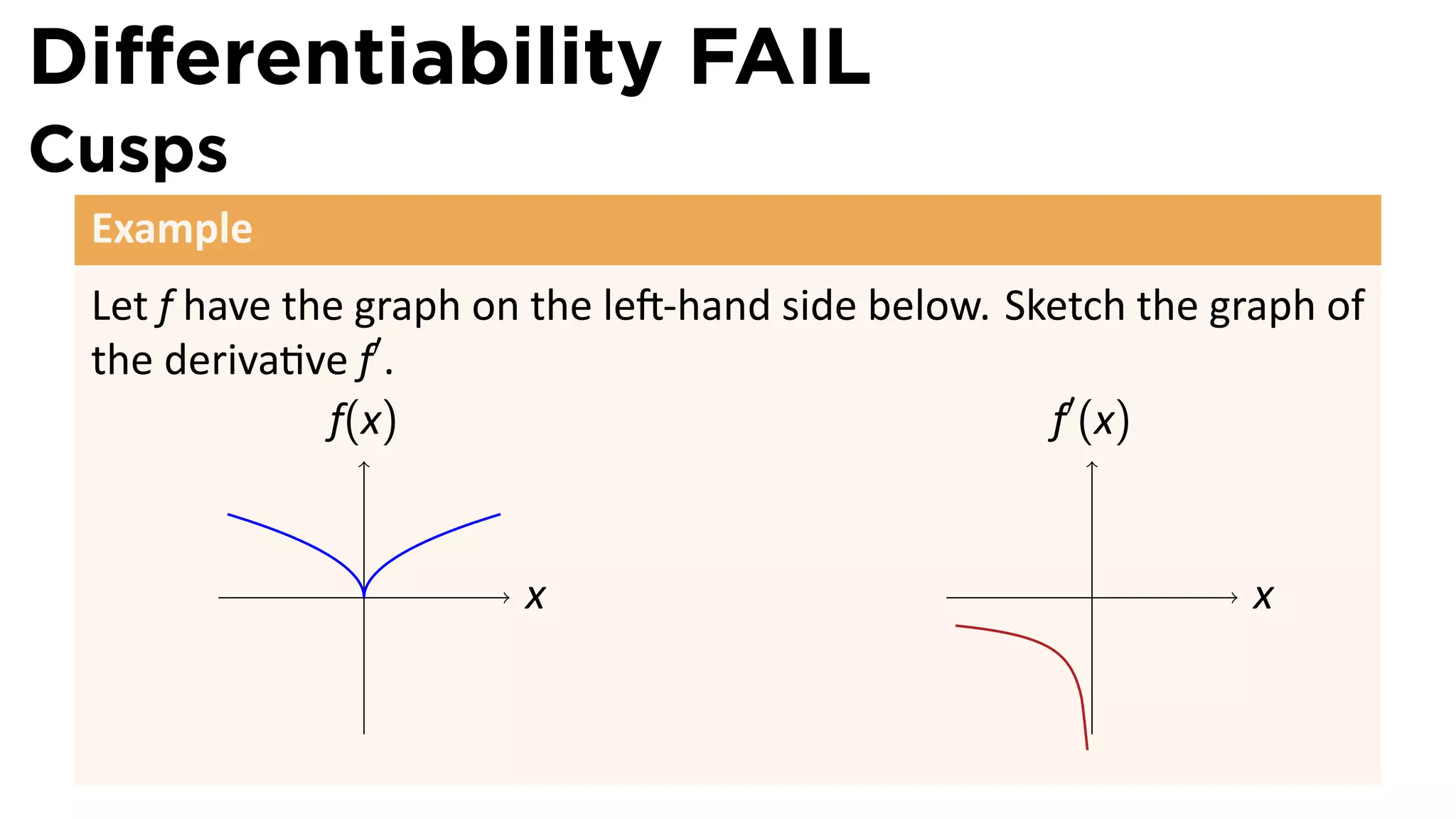
Differentiability FAIL
Cusps
 Example
 Let f have the graph on the le -hand side below. Sketch the graph of
 the deriva ve f′ .
              f(x)                                  f′ (x)


               .        x                             .        x
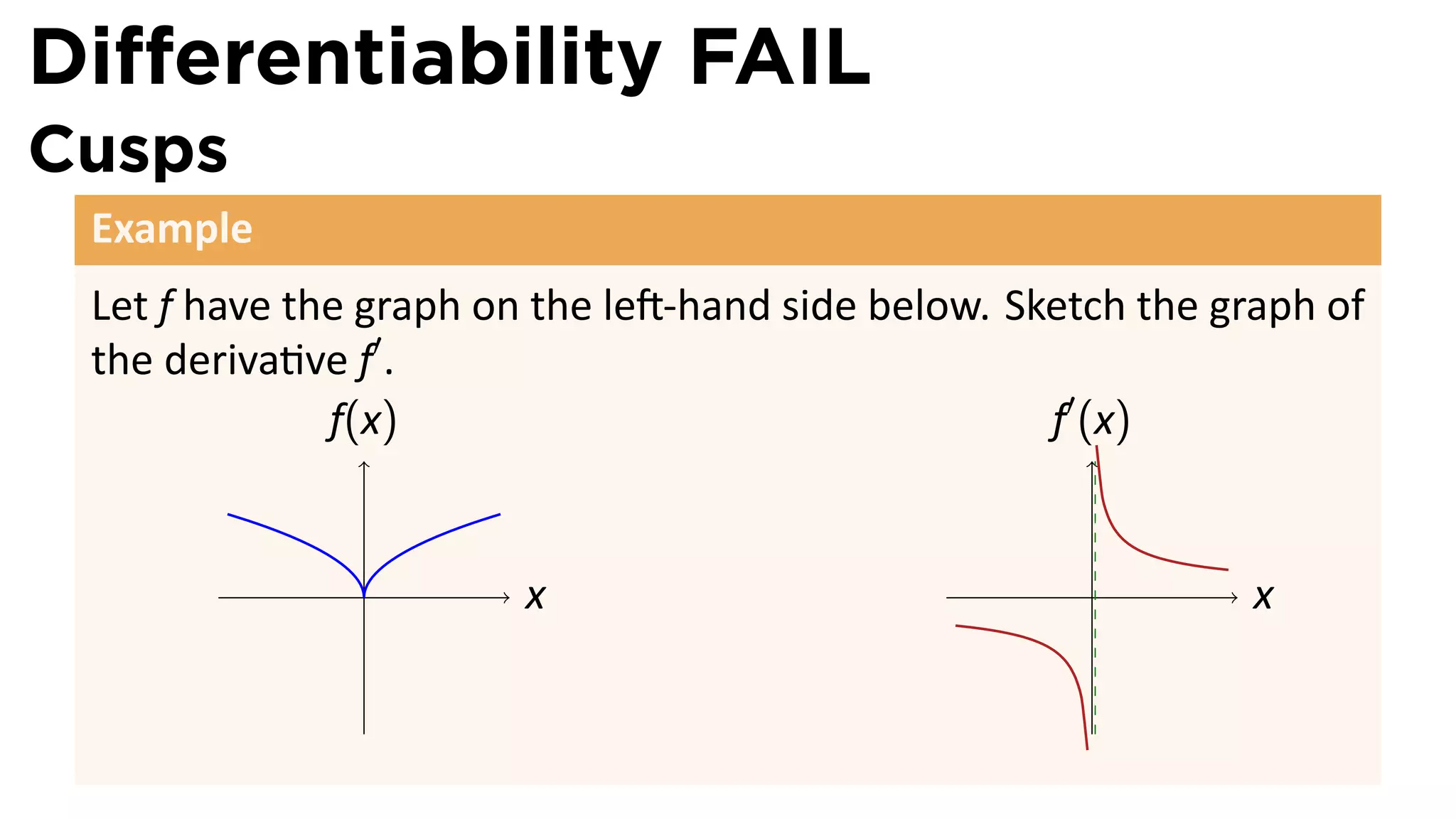
Differentiability FAIL
Cusps
 Example
 Let f have the graph on the le -hand side below. Sketch the graph of
 the deriva ve f′ .
              f(x)                                  f′ (x)


               .        x                             .        x
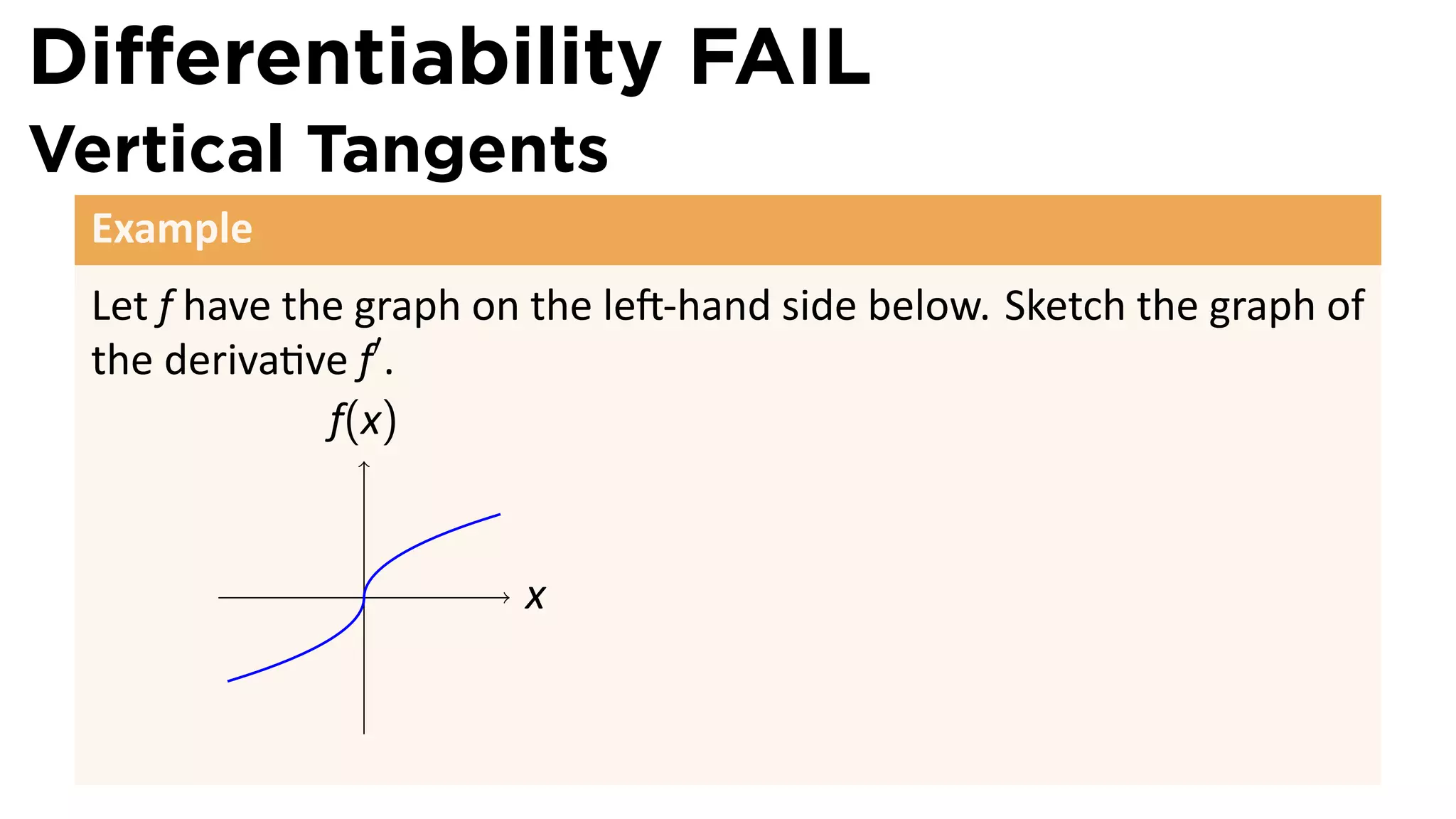
Differentiability FAIL
Vertical Tangents
 Example
 Let f have the graph on the le -hand side below. Sketch the graph of
 the deriva ve f′ .
              f(x)


               .        x
Differentiability FAIL
Vertical Tangents
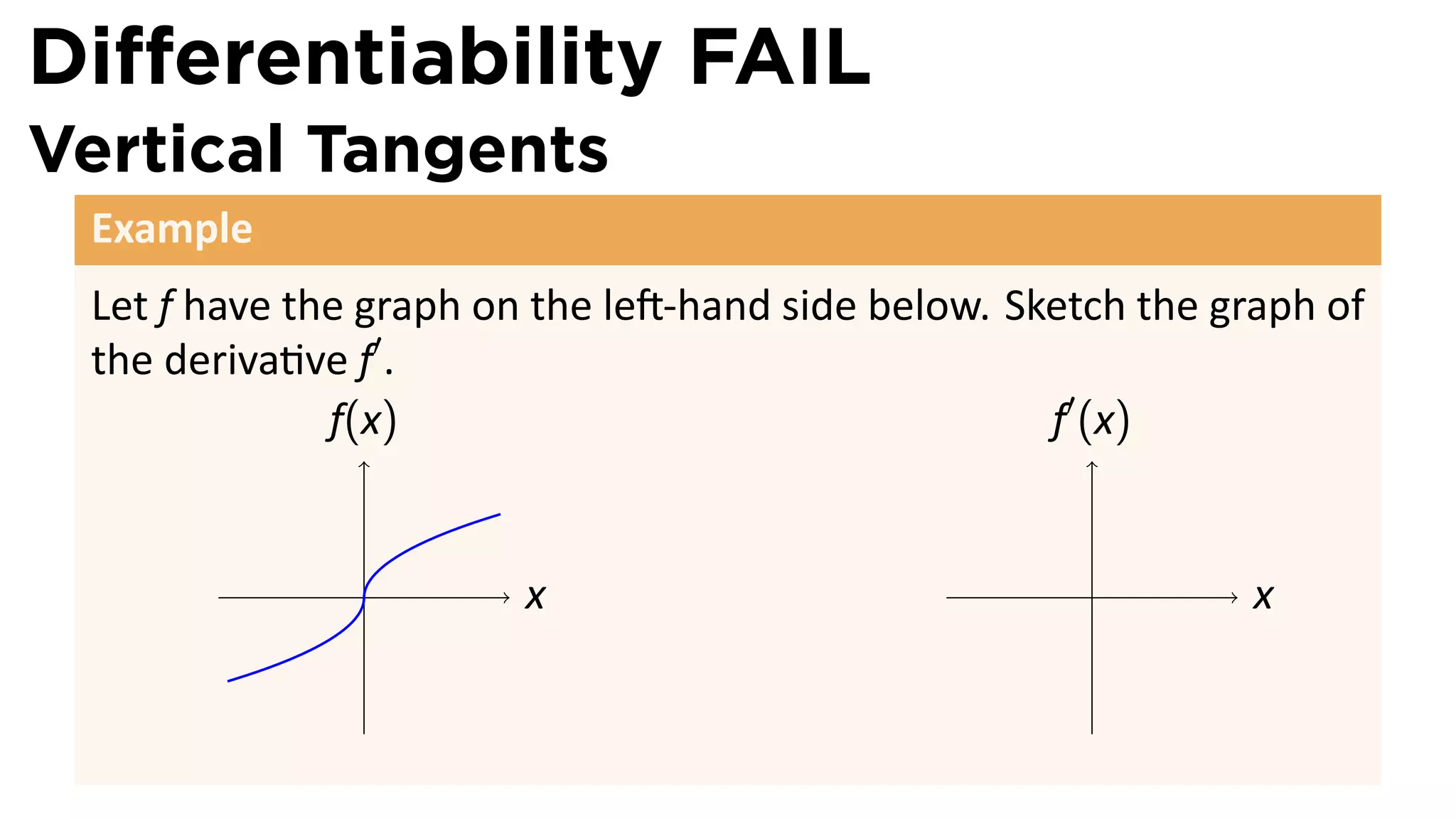
 Example
 Let f have the graph on the le -hand side below. Sketch the graph of
 the deriva ve f′ .
              f(x)                                  f′ (x)


               .        x                             .        x
Differentiability FAIL
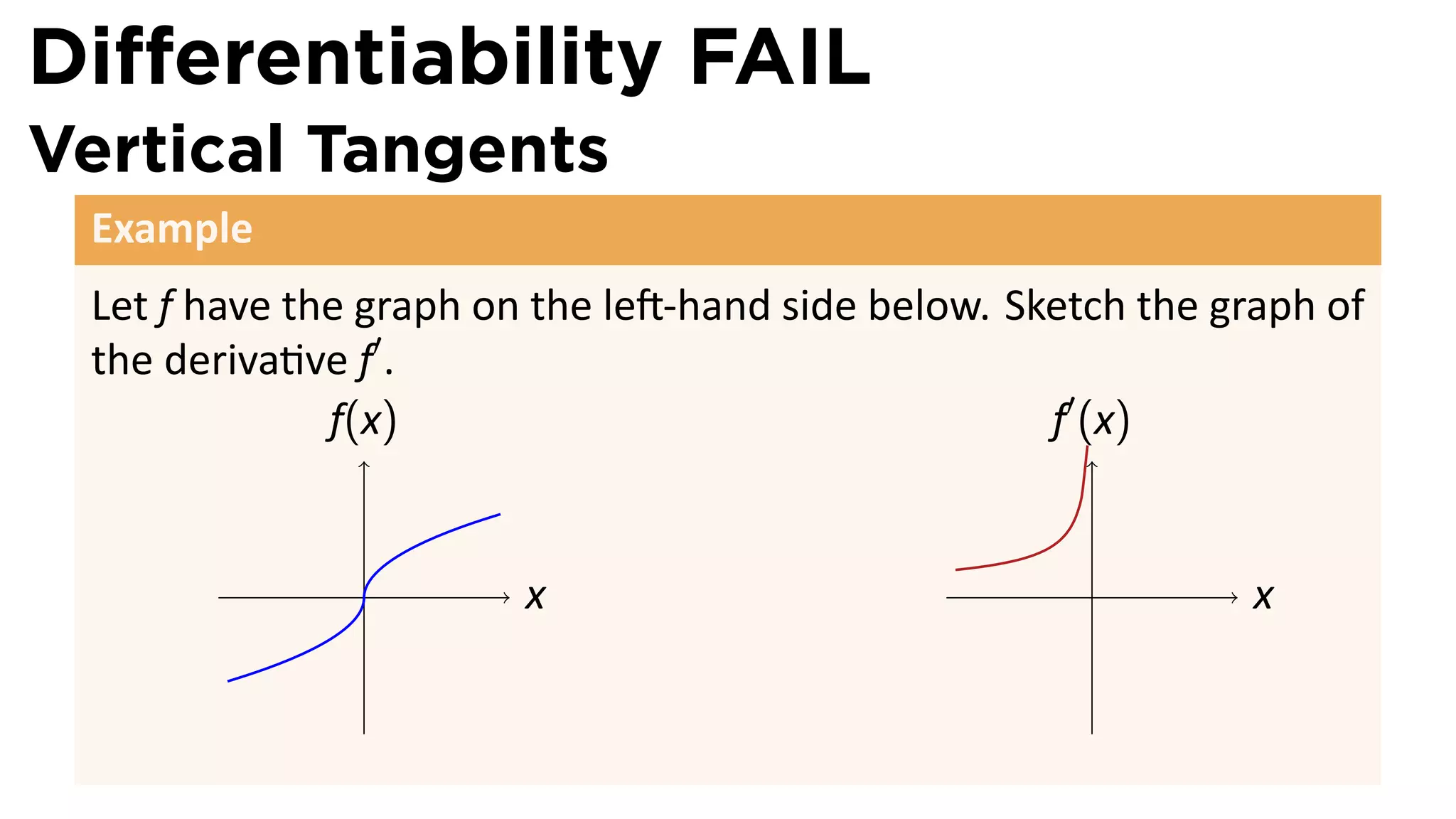
Vertical Tangents
 Example
 Let f have the graph on the le -hand side below. Sketch the graph of
 the deriva ve f′ .
              f(x)                                  f′ (x)


               .        x                             .        x
Differentiability FAIL
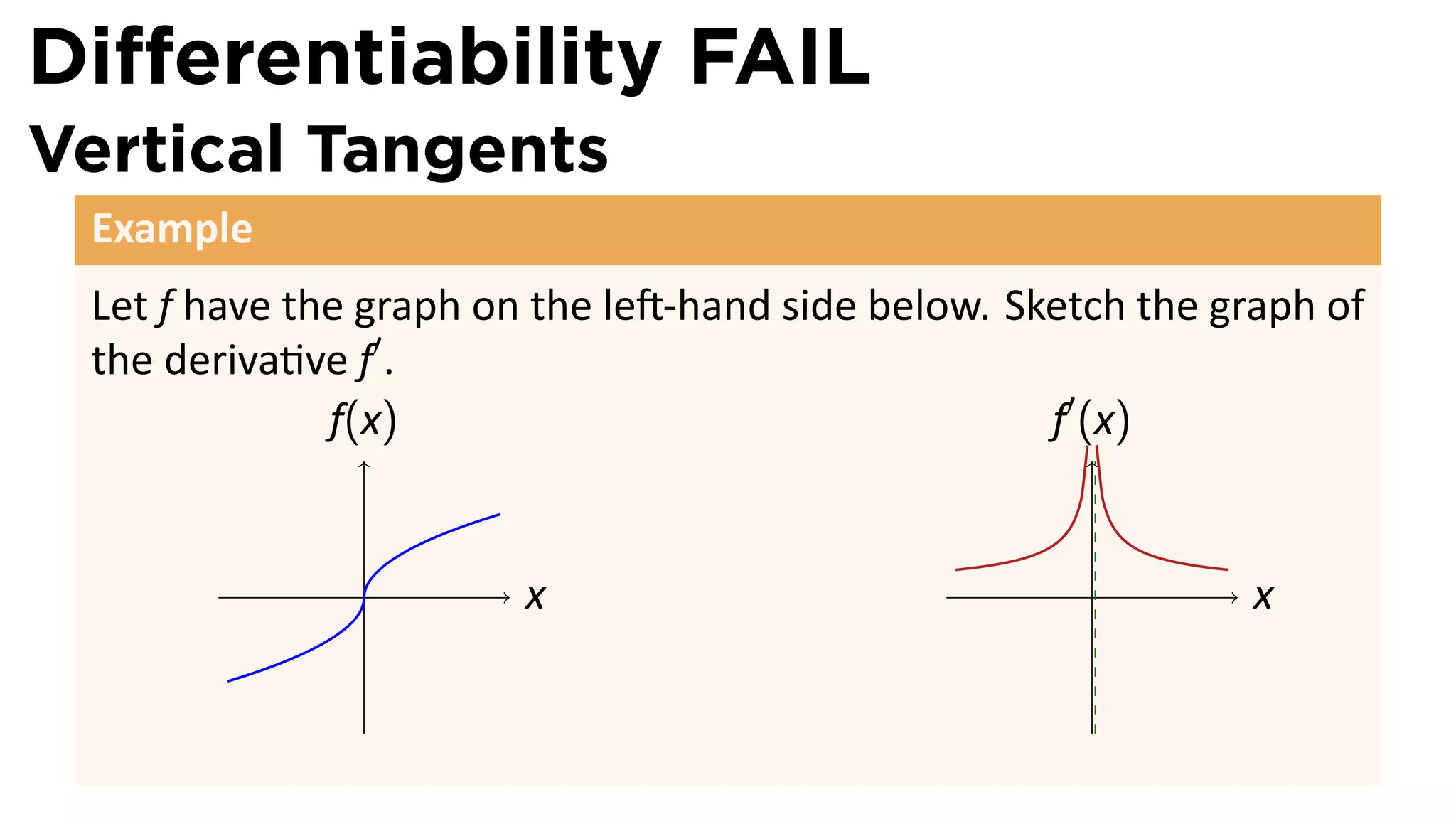
Vertical Tangents
 Example
 Let f have the graph on the le -hand side below. Sketch the graph of
 the deriva ve f′ .
              f(x)                                  f′ (x)


               .        x                             .        x
Differentiability FAIL
Weird, Wild, Stuff
 Example
              f(x)


                .       x


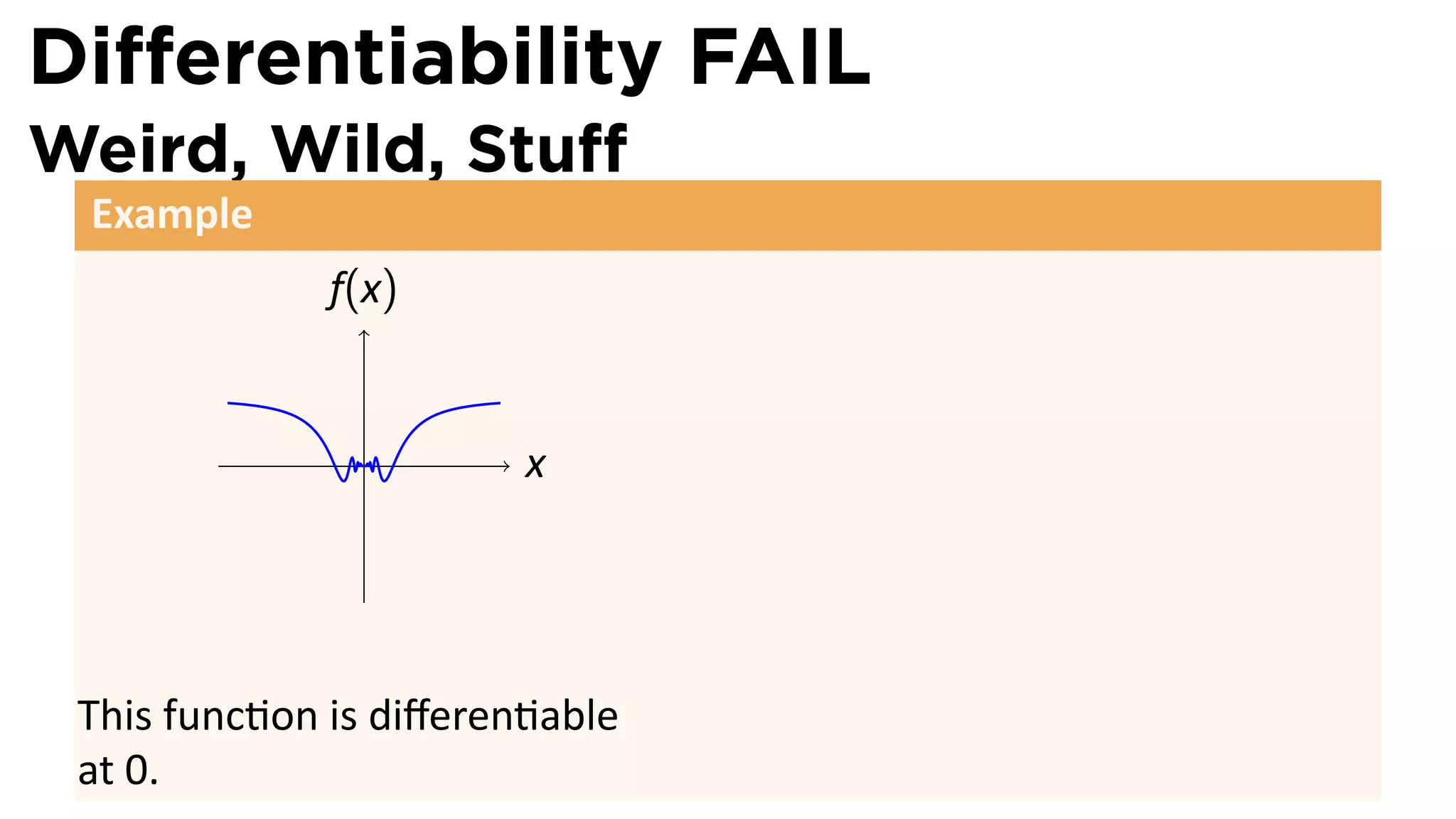
 This func on is differen able
 at 0.
Differentiability FAIL
Weird, Wild, Stuff
 Example
              f(x)              f′ (x)


                .       x          .     x


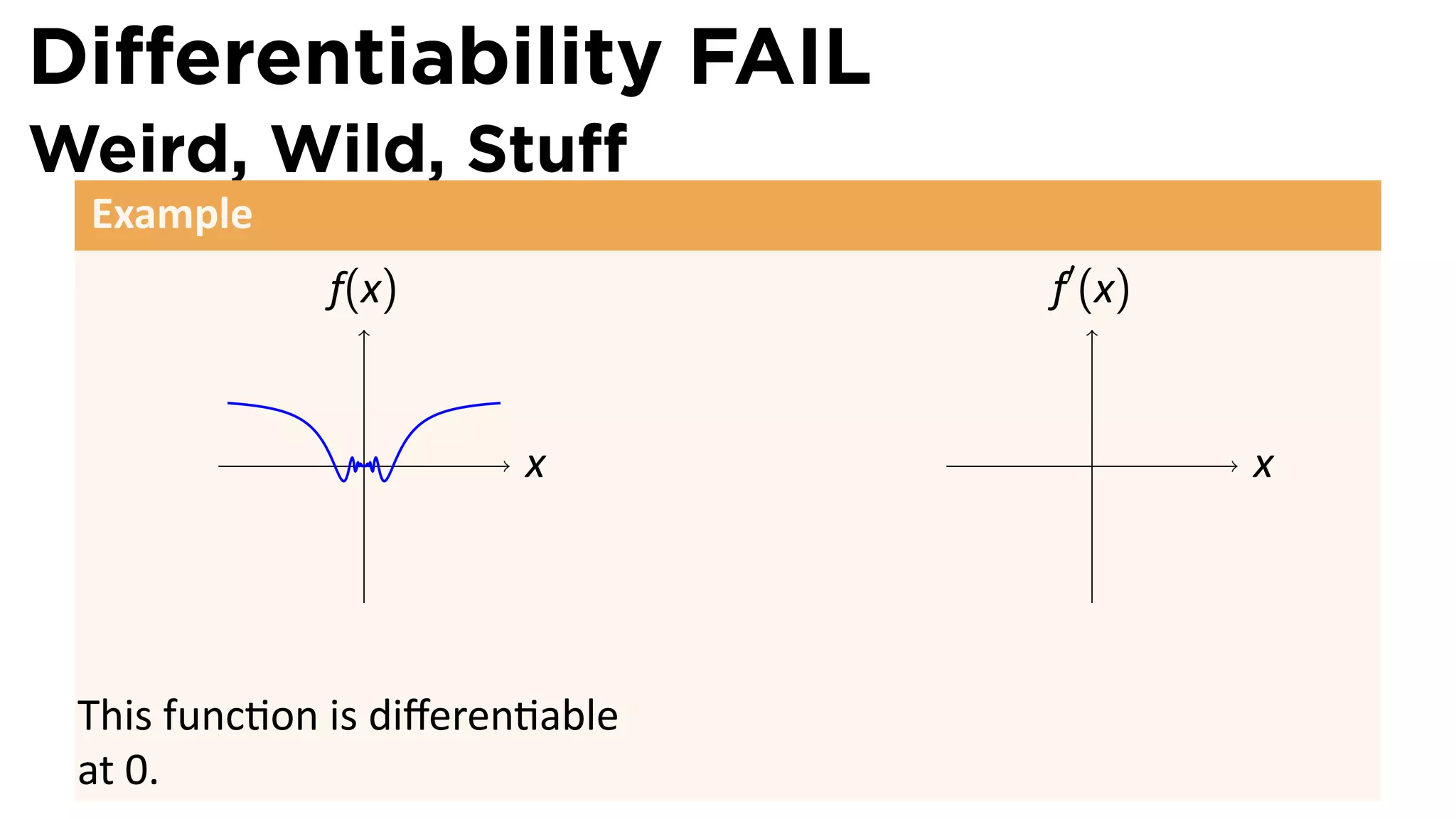
 This func on is differen able
 at 0.
Differentiability FAIL
Weird, Wild, Stuff
 Example
              f(x)              f′ (x)


                .       x          .     x


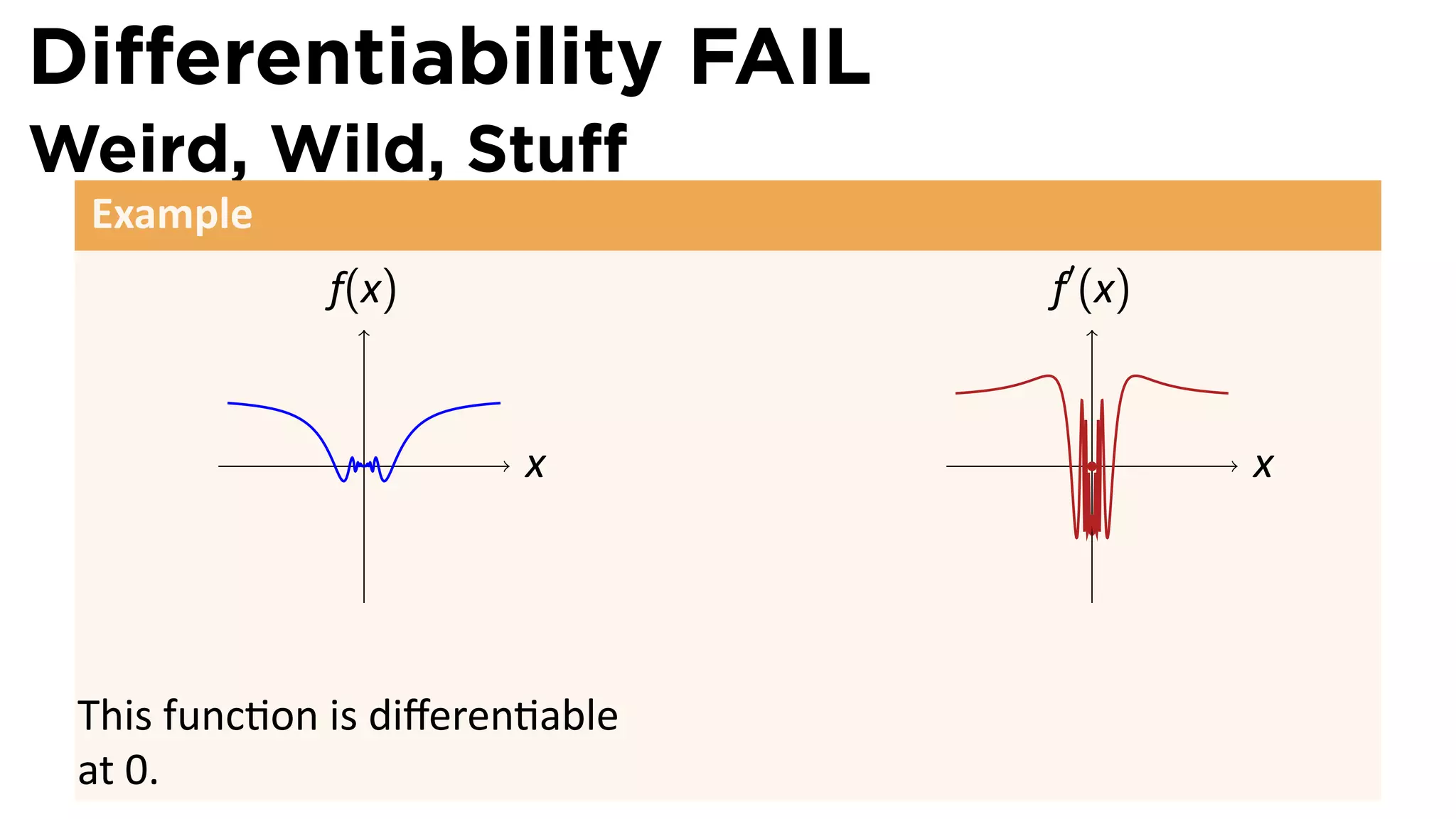
 This func on is differen able
 at 0.
Differentiability FAIL
Weird, Wild, Stuff
 Example
              f(x)                           f′ (x)


                .       x                       .          x


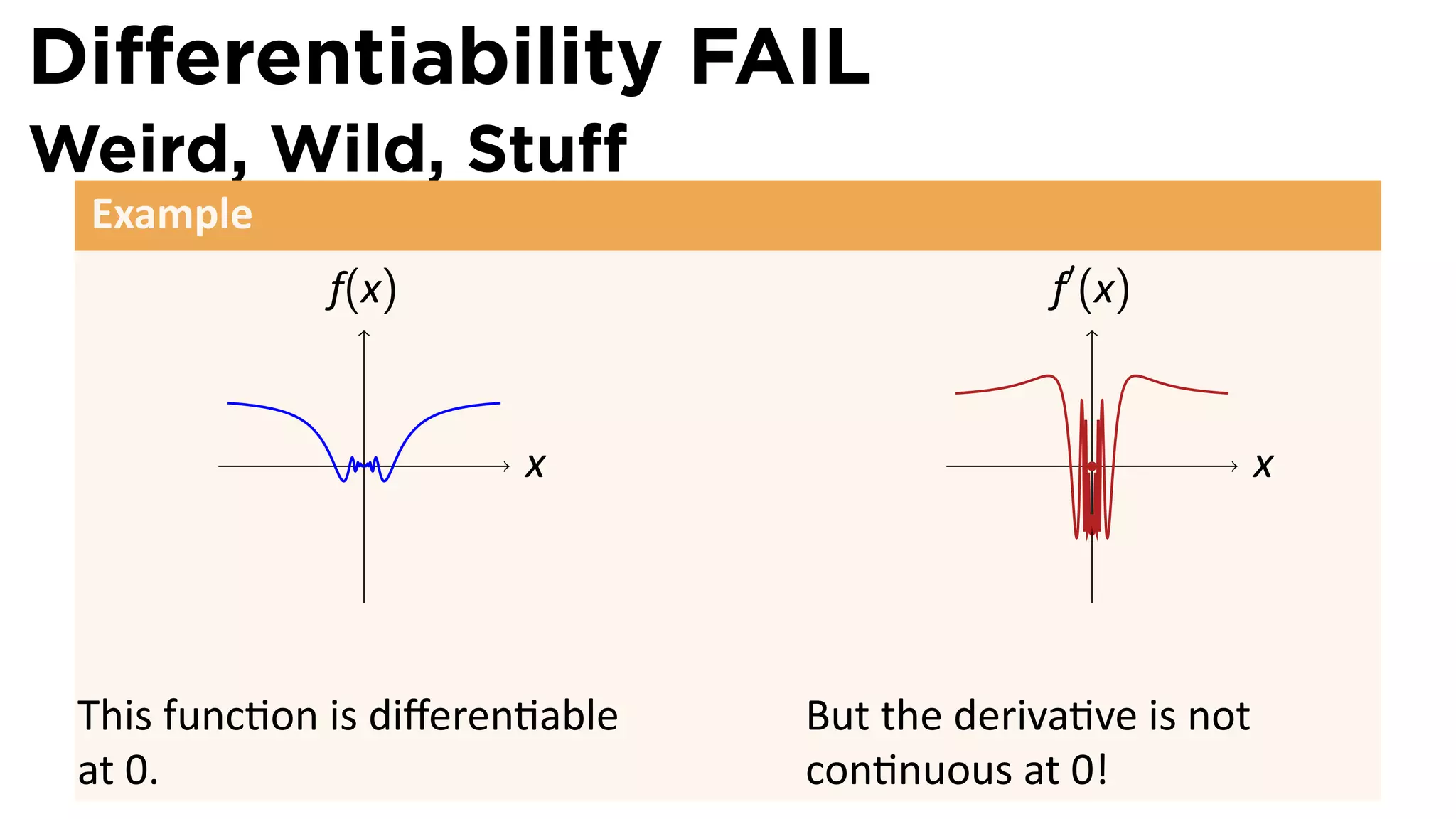
 This func on is differen able   But the deriva ve is not
 at 0.                          con nuous at 0!
Outline
 Rates of Change
    Tangent Lines
    Velocity
    Popula on growth
    Marginal costs
 The deriva ve, defined
    Deriva ves of (some) power func ons
    What does f tell you about f′ ?
 How can a func on fail to be differen able?
 Other nota ons
 The second deriva ve
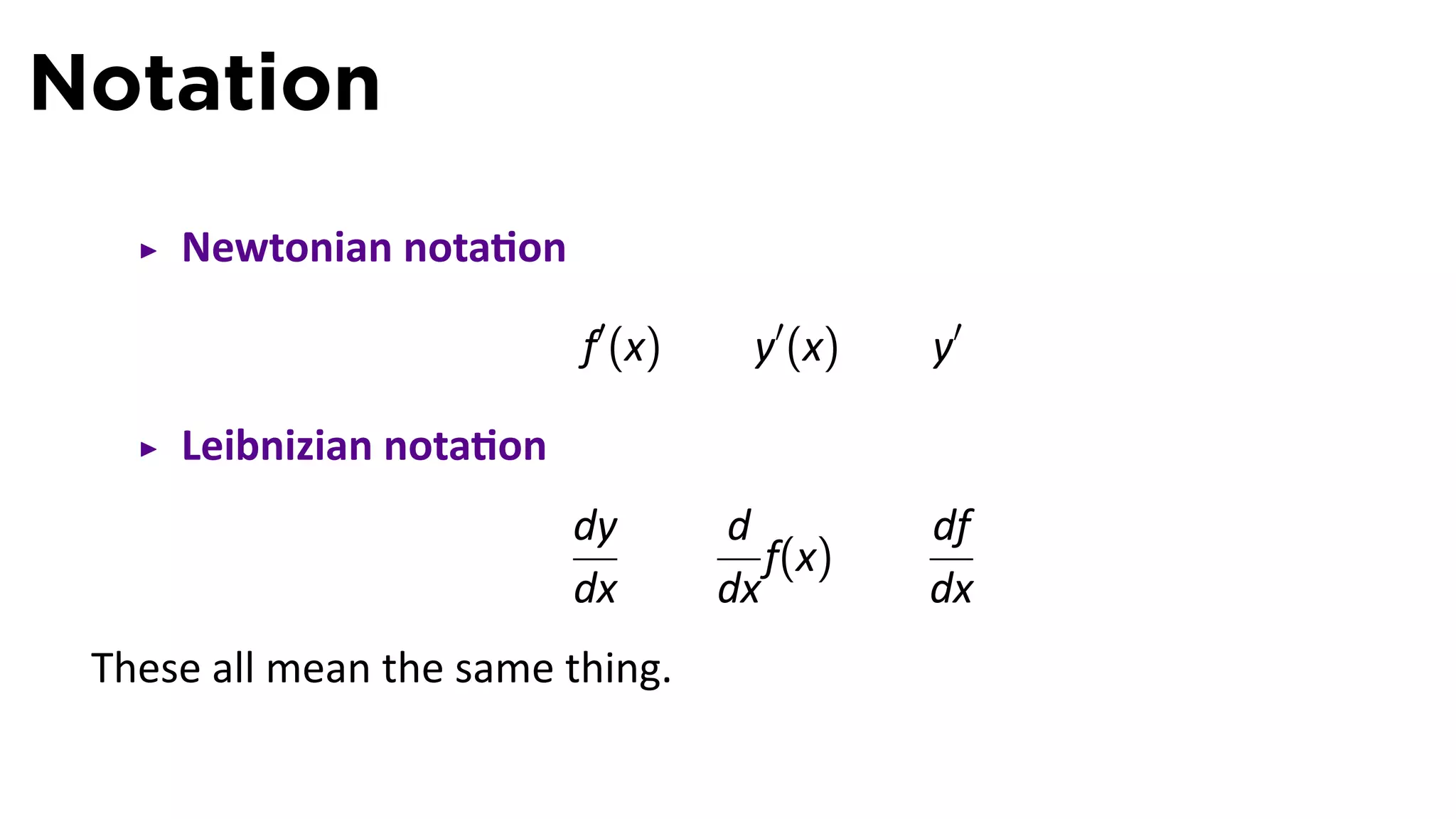
Notation
     Newtonian nota on

                          f′ (x)     y′ (x)   y′

     Leibnizian nota on
                          dy       d          df
                                      f(x)
                          dx       dx         dx
 These all mean the same thing.
Meet the Mathematician
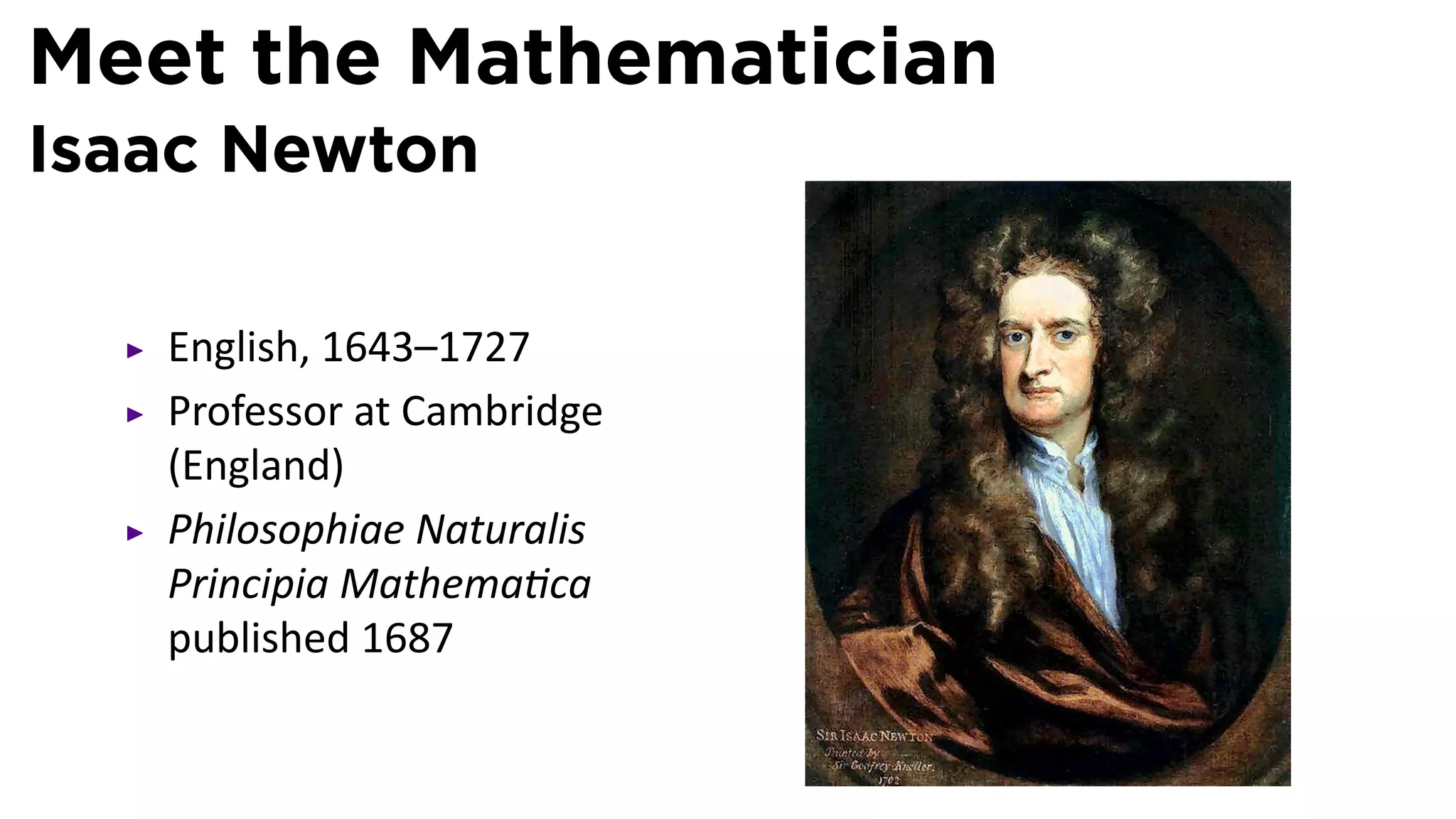
Isaac Newton

   English, 1643–1727
   Professor at Cambridge
   (England)
   Philosophiae Naturalis
   Principia Mathema ca
   published 1687
Meet the Mathematician
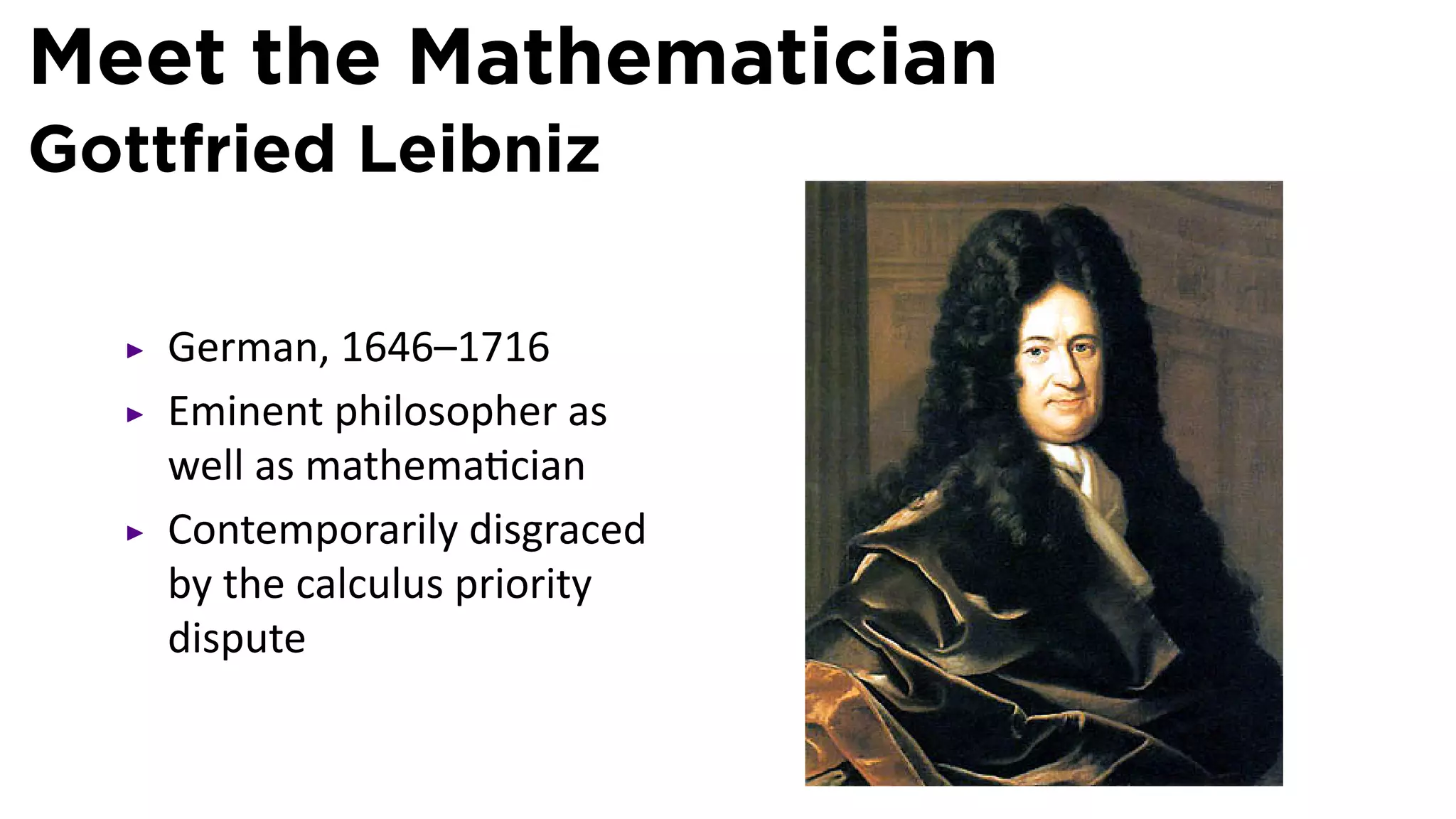
Gottfried Leibniz

    German, 1646–1716
    Eminent philosopher as
    well as mathema cian
    Contemporarily disgraced
    by the calculus priority
    dispute
Outline
 Rates of Change
    Tangent Lines
    Velocity
    Popula on growth
    Marginal costs
 The deriva ve, defined
    Deriva ves of (some) power func ons
    What does f tell you about f′ ?
 How can a func on fail to be differen able?
 Other nota ons
 The second deriva ve
The second derivative
 If f is a func on, so is f′ , and we can seek its deriva ve.

                                 f′′ = (f′ )′

 It measures the rate of change of the rate of change!
The second derivative
 If f is a func on, so is f′ , and we can seek its deriva ve.

                                 f′′ = (f′ )′

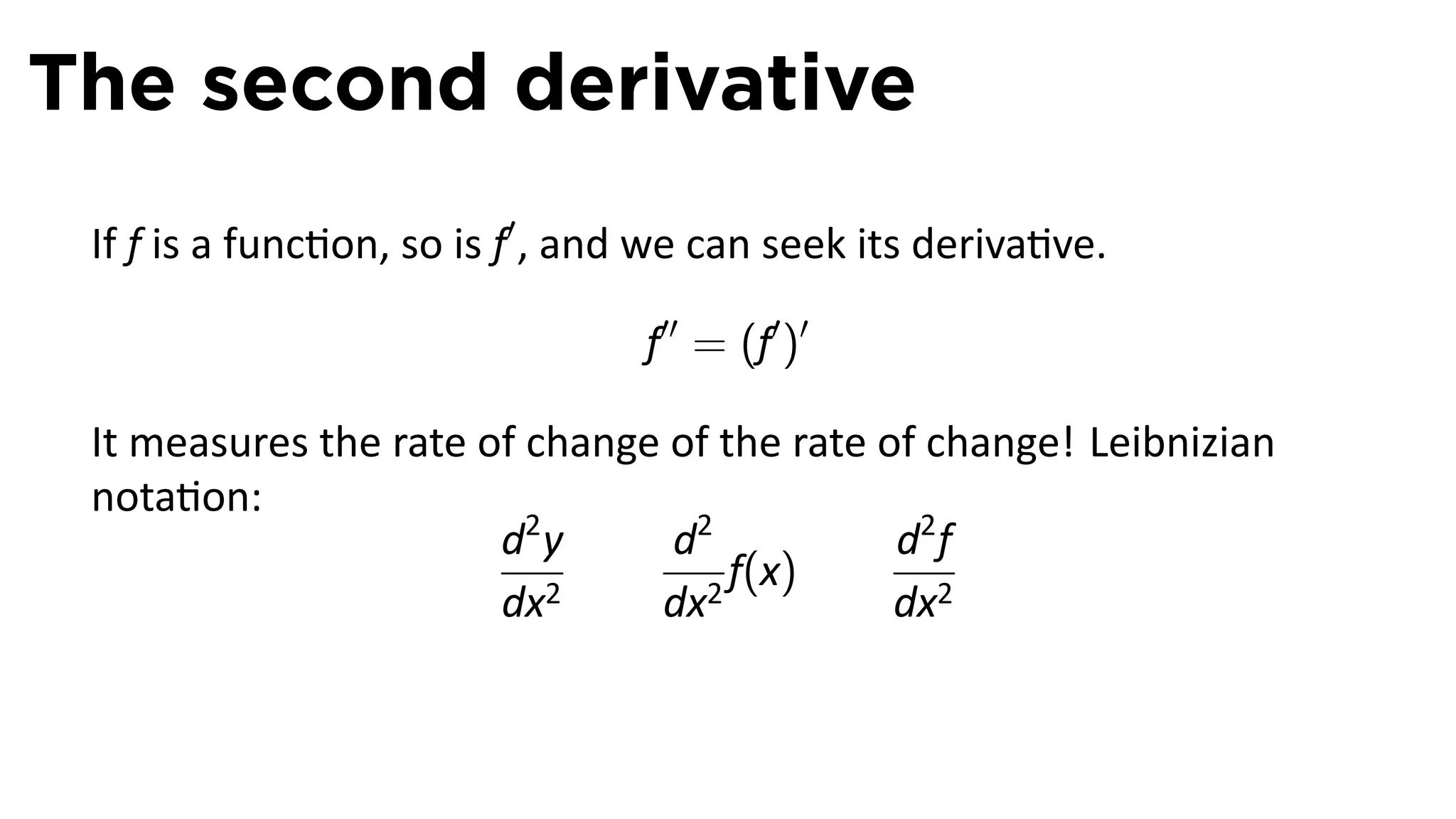
 It measures the rate of change of the rate of change! Leibnizian
 nota on:
                       d2 y     d2           d2 f
                                    f(x)
                       dx2     dx2           dx2
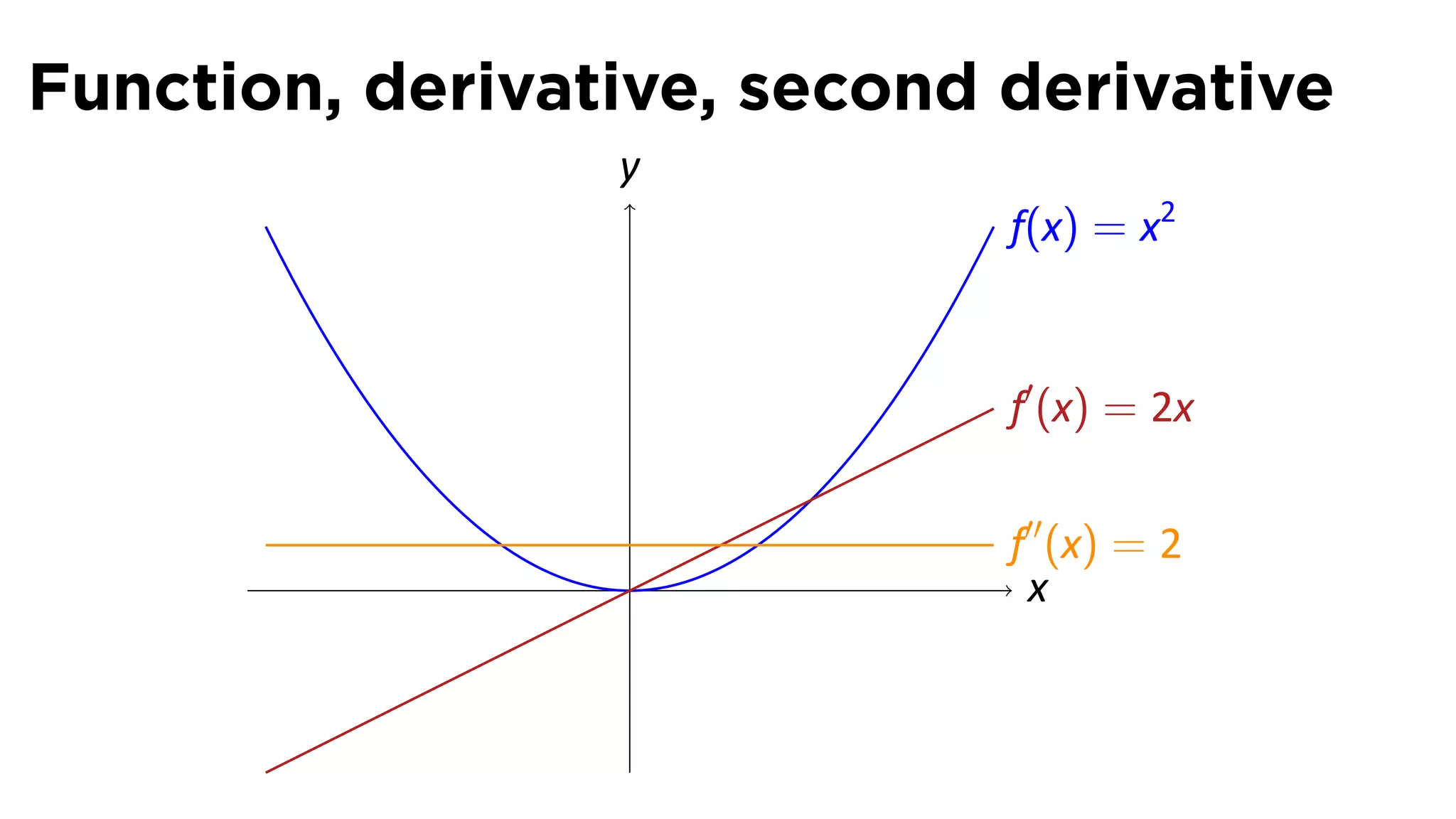
Function, derivative, second derivative
                 y
                             f(x) = x2


                             f′ (x) = 2x

                             f′′ (x) = 2
                 .            x
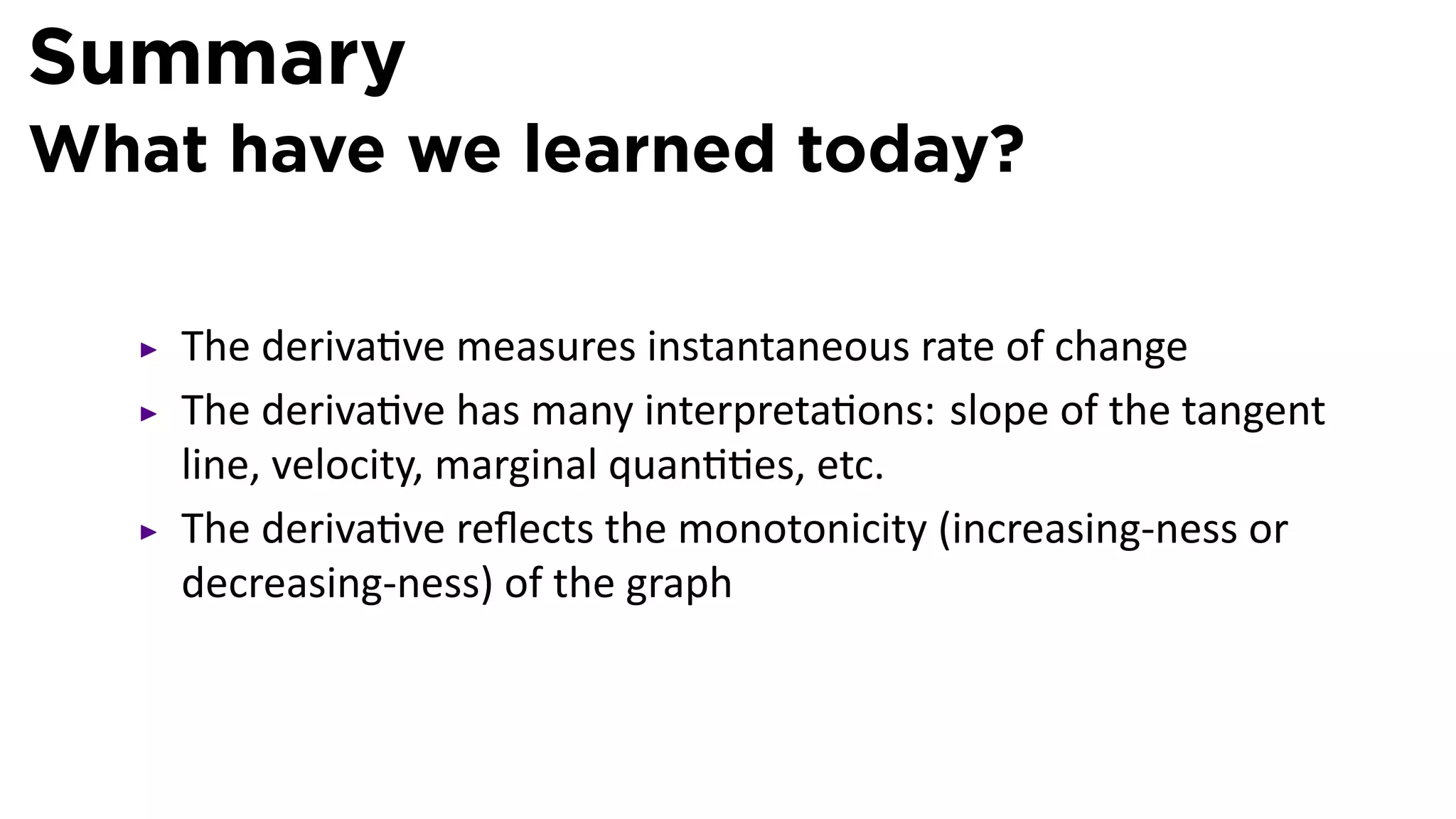
Summary
What have we learned today?

    The deriva ve measures instantaneous rate of change
    The deriva ve has many interpreta ons: slope of the tangent
    line, velocity, marginal quan es, etc.
    The deriva ve reflects the monotonicity (increasing-ness or
    decreasing-ness) of the graph

Lesson 7: The Derivative (slides)

  • 1.
    Sec on 2.1–2.2 The Deriva ve V63.0121.011: Calculus I Professor Ma hew Leingang New York University February 14, 2011 . NYUMathematics
  • 2.
    Announcements Quiz this week on Sec ons 1.1–1.4 No class Monday, February 21
  • 3.
    Objectives The Derivative Understand and state the defini on of the deriva ve of a func on at a point. Given a func on and a point in its domain, decide if the func on is differen able at the point and find the value of the deriva ve at that point. Understand and give several examples of deriva ves modeling rates of change in science.
  • 4.
    Objectives The Derivative asa Function Given a func on f, use the defini on of the deriva ve to find the deriva ve func on f’. Given a func on, find its second deriva ve. Given the graph of a func on, sketch the graph of its deriva ve.
  • 5.
    Outline Rates ofChange Tangent Lines Velocity Popula on growth Marginal costs The deriva ve, defined Deriva ves of (some) power func ons What does f tell you about f′ ? How can a func on fail to be differen able? Other nota ons The second deriva ve
  • 6.
    The tangent problem Ageometric rate of change Problem Given a curve and a point on the curve, find the slope of the line tangent to the curve at that point.
  • 7.
    A tangent problem Example Find the slope of the line tangent to the curve y = x2 at the point (2, 4).
  • 8.
    Graphically and numerically y x2 − 22 x m= x−2 4 . x 2
  • 9.
    Graphically and numerically y x2 − 22 x m= x−2 3 9 4 . x 2 3
  • 10.
    Graphically and numerically y x2 − 22 x m= x−2 3 5 9 4 . x 2 3
  • 11.
    Graphically and numerically y x2 − 22 x m= x−2 3 5 2.5 6.25 4 . x 2 2.5
  • 12.
    Graphically and numerically y x2 − 22 x m= x−2 3 5 2.5 4.5 6.25 4 . x 2 2.5
  • 13.
    Graphically and numerically y x2 − 22 x m= x−2 3 5 2.5 4.5 2.1 4.41 4 . x 2.1 2
  • 14.
    Graphically and numerically y x2 − 22 x m= x−2 3 5 2.5 4.5 2.1 4.1 4.41 4 . x 2.1 2
  • 15.
    Graphically and numerically y x2 − 22 x m= x−2 3 5 2.5 4.5 2.1 4.1 2.01 4.0401 4 . x 2.01 2
  • 16.
    Graphically and numerically y x2 − 22 x m= x−2 3 5 2.5 4.5 2.1 4.1 2.01 4.01 4.0401 4 . x 2.01 2
  • 17.
    Graphically and numerically y x2 − 22 x m= x−2 3 5 2.5 4.5 2.1 4.1 2.01 4.01 4 1 . x 1 1 2
  • 18.
    Graphically and numerically y x2 − 22 x m= x−2 3 5 2.5 4.5 2.1 4.1 2.01 4.01 4 1 . x 1 3 1 2
  • 19.
    Graphically and numerically y x2 − 22 x m= x−2 3 5 2.5 4.5 2.1 4.1 2.01 4.01 4 2.25 . 1.5 x 1 3 1.5 2
  • 20.
    Graphically and numerically y x2 − 22 x m= x−2 3 5 2.5 4.5 2.1 4.1 2.01 4.01 4 2.25 . 1.5 3.5 x 1 3 1.5 2
  • 21.
    Graphically and numerically y x2 − 22 x m= x−2 3 5 2.5 4.5 2.1 4.1 2.01 4.01 4 3.61 1.9 . 1.5 3.5 x 1 3 1.9 2
  • 22.
    Graphically and numerically y x2 − 22 x m= x−2 3 5 2.5 4.5 2.1 4.1 2.01 4.01 4 3.61 1.9 3.9 . 1.5 3.5 x 1 3 1.9 2
  • 23.
    Graphically and numerically y x2 − 22 x m= x−2 3 5 2.5 4.5 2.1 4.1 2.01 4.01 4 3.9601 1.99 1.9 3.9 . 1.5 3.5 x 1 3 1.99 2
  • 24.
    Graphically and numerically y x2 − 22 x m= x−2 3 5 2.5 4.5 2.1 4.1 2.01 4.01 4 3.9601 1.99 3.99 1.9 3.9 . 1.5 3.5 x 1 3 1.99 2
  • 25.
    Graphically and numerically y x2 − 22 x m= x−2 3 5 2.5 4.5 2.1 4.1 2.01 4.01 4 1.99 3.99 1.9 3.9 . 1.5 3.5 x 1 3 2
  • 26.
    Graphically and numerically y x2 − 22 x m= x−2 3 5 9 2.5 4.5 2.1 4.1 6.25 2.01 4.01 limit 4.41 4.0401 4 3.9601 3.61 1.99 3.99 2.25 1.9 3.9 1 1.5 3.5 . x 1 3 1 1.52.1 3 1.99 2.01 1.92.5 2
  • 27.
    Graphically and numerically y x2 − 22 x m= x−2 3 5 9 2.5 4.5 2.1 4.1 6.25 2.01 4.01 limit 4 4.41 4.0401 4 3.9601 3.61 1.99 3.99 2.25 1.9 3.9 1 1.5 3.5 . x 1 3 1 1.52.1 3 1.99 2.01 1.92.5 2
  • 28.
    The tangent problem Ageometric rate of change Problem Given a curve and a point on the curve, find the slope of the line tangent to the curve at that point. Solu on If the curve is given by y = f(x), and the point on the curve is (a, f(a)), then the slope of the tangent line is given by f(x) − f(a) mtangent = lim x→a x−a
  • 29.
    The velocity problem Kinematics—Physicalrates of change Problem Given the posi on func on of a moving object, find the velocity of the object at a certain instant in me.
  • 30.
    A velocity problem Example Dropa ball off the roof of the Silver Center so that its height can be described by h(t) = 50 − 5t2 where t is seconds a er dropping it and h is meters above the ground. How fast is it falling one second a er we drop it?
  • 31.
    Numerical evidence h(t) = 50 − 5t2 Fill in the table: h(t) − h(1) t vave = t−1 2 − 15
  • 32.
    Numerical evidence h(t) = 50 − 5t2 Fill in the table: h(t) − h(1) t vave = t−1 2 − 15 1.5
  • 33.
    Numerical evidence h(t) = 50 − 5t2 Fill in the table: h(t) − h(1) t vave = t−1 2 − 15 1.5 − 12.5
  • 34.
    Numerical evidence h(t) = 50 − 5t2 Fill in the table: h(t) − h(1) t vave = t−1 2 − 15 1.5 − 12.5 1.1
  • 35.
    Numerical evidence h(t) = 50 − 5t2 Fill in the table: h(t) − h(1) t vave = t−1 2 − 15 1.5 − 12.5 1.1 − 10.5
  • 36.
    Numerical evidence h(t) = 50 − 5t2 Fill in the table: h(t) − h(1) t vave = t−1 2 − 15 1.5 − 12.5 1.1 − 10.5 1.01
  • 37.
    Numerical evidence h(t) = 50 − 5t2 Fill in the table: h(t) − h(1) t vave = t−1 2 − 15 1.5 − 12.5 1.1 − 10.5 1.01 − 10.05
  • 38.
    Numerical evidence h(t) = 50 − 5t2 Fill in the table: h(t) − h(1) t vave = t−1 2 − 15 1.5 − 12.5 1.1 − 10.5 1.01 − 10.05 1.001
  • 39.
    Numerical evidence h(t) = 50 − 5t2 Fill in the table: h(t) − h(1) t vave = t−1 2 − 15 1.5 − 12.5 1.1 − 10.5 1.01 − 10.05 1.001 − 10.005
  • 40.
    A velocity problem Example Solu on Drop a ball off the roof of the The answer is (50 − 5t2 ) − 45 Silver Center so that its height can v = lim be described by t→1 t−1 h(t) = 50 − 5t2 where t is seconds a er dropping it and h is meters above the ground. How fast is it falling one second a er we drop it?
  • 41.
    A velocity problem Example Solu on Drop a ball off the roof of the The answer is (50 − 5t2 ) − 45 Silver Center so that its height can v = lim be described by t→1 t−1 5 − 5t2 = lim h(t) = 50 − 5t2 t→1 t − 1 where t is seconds a er dropping it and h is meters above the ground. How fast is it falling one second a er we drop it?
  • 42.
    A velocity problem Example Solu on Drop a ball off the roof of the The answer is (50 − 5t2 ) − 45 Silver Center so that its height can v = lim be described by t→1 t−1 5 − 5t2 = lim h(t) = 50 − 5t2 t→1 t − 1 5(1 − t)(1 + t) where t is seconds a er dropping = lim t→1 t−1 it and h is meters above the ground. How fast is it falling one second a er we drop it?
  • 43.
    A velocity problem Example Solu on Drop a ball off the roof of the The answer is (50 − 5t2 ) − 45 Silver Center so that its height can v = lim be described by t→1 t−1 5 − 5t2 = lim h(t) = 50 − 5t2 t→1 t − 1 5(1 − t)(1 + t) where t is seconds a er dropping = lim t→1 t−1 it and h is meters above the = (−5) lim(1 + t) t→1 ground. How fast is it falling one second a er we drop it?
  • 44.
    A velocity problem Example Solu on Drop a ball off the roof of the The answer is (50 − 5t2 ) − 45 Silver Center so that its height can v = lim be described by t→1 t−1 5 − 5t2 = lim h(t) = 50 − 5t2 t→1 t − 1 5(1 − t)(1 + t) where t is seconds a er dropping = lim t→1 t−1 it and h is meters above the = (−5) lim(1 + t) t→1 ground. How fast is it falling one second a er we drop it? = −5 · 2 = −10
  • 45.
    Velocity in general Upshot y = h(t) If the height func on is given h(t0 ) by h(t), the instantaneous ∆h velocity at me t0 is given by h(t0 + ∆t) h(t) − h(t0 ) v = lim t→t0 t − t0 h(t0 + ∆t) − h(t0 ) = lim ∆t→0 ∆t . ∆t t t0 t
  • 46.
    Population growth Biological Ratesof Change Problem Given the popula on func on of a group of organisms, find the rate of growth of the popula on at a par cular instant.
  • 47.
    Population growth example Example Suppose the popula on of fish in the East River is given by the func on 3et P(t) = 1 + et where t is in years since 2000 and P is in millions of fish. Is the fish popula on growing fastest in 1990, 2000, or 2010? (Es mate numerically)
  • 48.
    Derivation Solu on Let ∆t be an increment in me and ∆P the corresponding change in popula on: ∆P = P(t + ∆t) − P(t) This depends on ∆t, so ideally we would want ( ) ∆P 1 3et+∆t 3et lim = lim − ∆t→0 ∆t ∆t→0 ∆t 1 + et+∆t 1 + et
  • 49.
    Derivation Solu on Let ∆t be an increment in me and ∆P the corresponding change in popula on: ∆P = P(t + ∆t) − P(t) This depends on ∆t, so ideally we would want ( ) ∆P 1 3et+∆t 3et lim = lim − ∆t→0 ∆t ∆t→0 ∆t 1 + et+∆t 1 + et But rather than compute a complicated limit analy cally, let us approximate numerically. We will try a small ∆t, for instance 0.1.
  • 50.
    Numerical evidence Soluon (Con nued) To approximate the popula on change in year n, use the difference P(t + ∆t) − P(t) quo ent , where ∆t = 0.1 and t = n − 2000. ∆t r1990 r2000
  • 51.
    Numerical evidence Soluon (Con nued) To approximate the popula on change in year n, use the difference P(t + ∆t) − P(t) quo ent , where ∆t = 0.1 and t = n − 2000. ∆t P(−10 + 0.1) − P(−10) r1990 ≈ 0.1 P(0.1) − P(0) r2000 ≈ 0.1
  • 52.
    Numerical evidence Soluon (Con nued) To approximate the popula on change in year n, use the difference P(t + ∆t) − P(t) quo ent , where ∆t = 0.1 and t = n − 2000. ∆t ( ) P(−10 + 0.1) − P(−10) 1 3e−9.9 3e−10 r1990 ≈ = − 0.1 0.1 1 + e−9.9 1 + e−10 ( ) P(0.1) − P(0) 1 3e0.1 3e0 r2000 ≈ = − 0.1 0.1 1 + e0.1 1 + e0
  • 53.
    Numerical evidence Soluon (Con nued) To approximate the popula on change in year n, use the difference P(t + ∆t) − P(t) quo ent , where ∆t = 0.1 and t = n − 2000. ∆t ( ) P(−10 + 0.1) − P(−10) 1 3e−9.9 3e−10 r1990 ≈ = − 0.1 0.1 1 + e−9.9 1 + e−10 = 0.000143229 ( ) P(0.1) − P(0) 1 3e0.1 3e0 r2000 ≈ = − 0.1 0.1 1 + e0.1 1 + e0
  • 54.
    Numerical evidence Soluon (Con nued) To approximate the popula on change in year n, use the difference P(t + ∆t) − P(t) quo ent , where ∆t = 0.1 and t = n − 2000. ∆t ( ) P(−10 + 0.1) − P(−10) 1 3e−9.9 3e−10 r1990 ≈ = − 0.1 0.1 1 + e−9.9 1 + e−10 = 0.000143229 ( ) P(0.1) − P(0) 1 3e0.1 3e0 r2000 ≈ = − 0.1 0.1 1 + e0.1 1 + e0 = 0.749376
  • 55.
    Solu on (Connued) r2010
  • 56.
    Solu on (Connued) P(10 + 0.1) − P(10) r2010 ≈ 0.1
  • 57.
    Solu on (Connued) ( ) P(10 + 0.1) − P(10) 1 3e10.1 3e10 r2010 ≈ = − 0.1 0.1 1 + e10.1 1 + e10
  • 58.
    Solu on (Connued) ( ) P(10 + 0.1) − P(10) 1 3e10.1 3e10 r2010 ≈ = − 0.1 0.1 1 + e10.1 1 + e10 = 0.0001296
  • 59.
    Population growth example Example Suppose the popula on of fish in the East River is given by the func on 3et P(t) = 1 + et where t is in years since 2000 and P is in millions of fish. Is the fish popula on growing fastest in 1990, 2000, or 2010? (Es mate numerically) Answer We es mate the rates of growth to be 0.000143229, 0.749376, and 0.0001296. So the popula on is growing fastest in 2000.
  • 60.
    Population growth Biological Ratesof Change Problem Given the popula on func on of a group of organisms, find the rate of growth of the popula on at a par cular instant. Solu on The instantaneous popula on growth is given by P(t + ∆t) − P(t) lim ∆t→0 ∆t
  • 61.
    Marginal costs Rates ofchange in economics Problem Given the produc on cost of a good, find the marginal cost of produc on a er having produced a certain quan ty.
  • 62.
    Marginal Cost Example Example Suppose the cost of producing q tons of rice on our paddy in a year is C(q) = q3 − 12q2 + 60q We are currently producing 5 tons a year. Should we change that?
  • 63.
    Marginal Cost Example Example Suppose the cost of producing q tons of rice on our paddy in a year is C(q) = q3 − 12q2 + 60q We are currently producing 5 tons a year. Should we change that? Answer If q = 5, then C = 125, ∆C = 19, while AC = 25. So we should produce more to lower average costs.
  • 64.
    Comparisons Solu on C(q) = q3 − 12q2 + 60q Fill in the table: q C(q) 4 5 6
  • 65.
    Comparisons Solu on C(q) = q3 − 12q2 + 60q Fill in the table: q C(q) 4 112 5 6
  • 66.
    Comparisons Solu on C(q) = q3 − 12q2 + 60q Fill in the table: q C(q) 4 112 5 125 6
  • 67.
    Comparisons Solu on C(q) = q3 − 12q2 + 60q Fill in the table: q C(q) 4 112 5 125 6 144
  • 68.
    Comparisons Solu on C(q) = q3 − 12q2 + 60q Fill in the table: q C(q) AC(q) = C(q)/q 4 112 5 125 6 144
  • 69.
    Comparisons Solu on C(q) = q3 − 12q2 + 60q Fill in the table: q C(q) AC(q) = C(q)/q 4 112 28 5 125 6 144
  • 70.
    Comparisons Solu on C(q) = q3 − 12q2 + 60q Fill in the table: q C(q) AC(q) = C(q)/q 4 112 28 5 125 25 6 144
  • 71.
    Comparisons Solu on C(q) = q3 − 12q2 + 60q Fill in the table: q C(q) AC(q) = C(q)/q 4 112 28 5 125 25 6 144 24
  • 72.
    Comparisons Solu on C(q) = q3 − 12q2 + 60q Fill in the table: q C(q) AC(q) = C(q)/q ∆C = C(q + 1) − C(q) 4 112 28 5 125 25 6 144 24
  • 73.
    Comparisons Solu on C(q) = q3 − 12q2 + 60q Fill in the table: q C(q) AC(q) = C(q)/q ∆C = C(q + 1) − C(q) 4 112 28 13 5 125 25 6 144 24
  • 74.
    Comparisons Solu on C(q) = q3 − 12q2 + 60q Fill in the table: q C(q) AC(q) = C(q)/q ∆C = C(q + 1) − C(q) 4 112 28 13 5 125 25 19 6 144 24
  • 75.
    Comparisons Solu on C(q) = q3 − 12q2 + 60q Fill in the table: q C(q) AC(q) = C(q)/q ∆C = C(q + 1) − C(q) 4 112 28 13 5 125 25 19 6 144 24 31
  • 76.
    Marginal Cost Example Example Suppose the cost of producing q tons of rice on our paddy in a year is C(q) = q3 − 12q2 + 60q We are currently producing 5 tons a year. Should we change that? Answer If q = 5, then C = 125, ∆C = 19, while AC = 25. So we should produce more to lower average costs.
  • 77.
    Marginal costs Rates ofchange in economics Problem Given the produc on cost of a good, find the marginal cost of produc on a er having produced a certain quan ty. Solu on The marginal cost a er producing q is given by C(q + ∆q) − C(q) MC = lim ∆q→0 ∆q
  • 78.
    Outline Rates ofChange Tangent Lines Velocity Popula on growth Marginal costs The deriva ve, defined Deriva ves of (some) power func ons What does f tell you about f′ ? How can a func on fail to be differen able? Other nota ons The second deriva ve
  • 79.
    The definition Allof these rates of change are found the same way!
  • 80.
    The definition Allof these rates of change are found the same way! Defini on Let f be a func on and a a point in the domain of f. If the limit f(a + h) − f(a) f(x) − f(a) f′ (a) = lim = lim h→0 h x→a x−a exists, the func on is said to be differen able at a and f′ (a) is the deriva ve of f at a.
  • 81.
    Derivative of thesquaring function Example Suppose f(x) = x2 . Use the defini on of deriva ve to find f′ (a).
  • 82.
    Derivative of thesquaring function Example Suppose f(x) = x2 . Use the defini on of deriva ve to find f′ (a). Solu on f(a + h) − f(a) f′ (a) = lim h→0 h
  • 83.
    Derivative of thesquaring function Example Suppose f(x) = x2 . Use the defini on of deriva ve to find f′ (a). Solu on ′ f(a + h) − f(a) (a + h)2 − a2 f (a) = lim = lim h→0 h h→0 h
  • 84.
    Derivative of thesquaring function Example Suppose f(x) = x2 . Use the defini on of deriva ve to find f′ (a). Solu on ′ f(a + h) − f(a) (a + h)2 − a2 f (a) = lim = lim h→0 h h→0 h (a + 2ah + h ) − a 2 2 2 = lim h→0 h
  • 85.
    Derivative of thesquaring function Example Suppose f(x) = x2 . Use the defini on of deriva ve to find f′ (a). Solu on ′ f(a + h) − f(a) (a + h)2 − a2 f (a) = lim = lim h→0 h h→0 h (a + 2ah + h ) − a 2 2 2 2ah + h2 = lim = lim h→0 h h→0 h
  • 86.
    Derivative of thesquaring function Example Suppose f(x) = x2 . Use the defini on of deriva ve to find f′ (a). Solu on ′ f(a + h) − f(a) (a + h)2 − a2 f (a) = lim = lim h→0 h h→0 h (a + 2ah + h ) − a 2 2 2 2ah + h2 = lim = lim h→0 h h→0 h = lim (2a + h) h→0
  • 87.
    Derivative of thesquaring function Example Suppose f(x) = x2 . Use the defini on of deriva ve to find f′ (a). Solu on ′ f(a + h) − f(a) (a + h)2 − a2 f (a) = lim = lim h→0 h h→0 h (a + 2ah + h ) − a 2 2 2 2ah + h2 = lim = lim h→0 h h→0 h = lim (2a + h) = 2a h→0
  • 88.
    Derivative of thereciprocal Example 1 Suppose f(x) = . Use the defini on of the deriva ve to find f′ (2). x
  • 89.
    Derivative of thereciprocal Example 1 Suppose f(x) = . Use the defini on of the deriva ve to find f′ (2). x Solu on y 1/x − 1/2 f′ (2) = lim x→2 x−2 . x
  • 90.
    Derivative of thereciprocal Example 1 Suppose f(x) = . Use the defini on of the deriva ve to find f′ (2). x Solu on y 1/x − 1/2 2−x f′ (2) = lim = lim x→2 x−2 x→2 2x(x − 2) . x
  • 91.
    Derivative of thereciprocal Example 1 Suppose f(x) = . Use the defini on of the deriva ve to find f′ (2). x Solu on y 1/x − 1/2 2−x f′ (2) = lim = lim x→2 x−2 x→2 2x(x − 2) −1 = lim x→2 2x . x
  • 92.
    Derivative of thereciprocal Example 1 Suppose f(x) = . Use the defini on of the deriva ve to find f′ (2). x Solu on y 1/x − 1/2 2−x f′ (2) = lim = lim x→2 x−2 x→2 2x(x − 2) −1 1 = lim =− x→2 2x 4 . x
  • 93.
    “Can you doit the other way?” Same limit, different form Solu on ′ f(2 + h) − f(2) 1 2+h− 1 2 f (2) = lim = lim h→0 h h→0 h
  • 94.
    “Can you doit the other way?” Same limit, different form Solu on ′ f(2 + h) − f(2) 1 2+h− 1 2 f (2) = lim = lim h→0 h h→0 h 2 − (2 + h) = lim h→0 2h(2 + h)
  • 95.
    “Can you doit the other way?” Same limit, different form Solu on 2+h − 2 1 1 ′ f(2 + h) − f(2) f (2) = lim = lim h→0 h h→0 h 2 − (2 + h) −h = lim = lim h→0 2h(2 + h) h→0 2h(2 + h)
  • 96.
    “Can you doit the other way?” Same limit, different form Solu on 2+h − 2 1 1 ′ f(2 + h) − f(2) f (2) = lim = lim h→0 h h→0 h 2 − (2 + h) −h = lim = lim h→0 2h(2 + h) h→0 2h(2 + h) −1 = lim h→0 2(2 + h)
  • 97.
    “Can you doit the other way?” Same limit, different form Solu on 2+h − 2 1 1 ′ f(2 + h) − f(2) f (2) = lim = lim h→0 h h→0 h 2 − (2 + h) −h = lim = lim h→0 2h(2 + h) h→0 2h(2 + h) −1 1 = lim =− h→0 2(2 + h) 4
  • 98.
    “How did youget that?” The Sure-Fire Sally Rule (SFSR) for adding fractions Fact a c ad ± bc ± = b d bd 1 1 2−x − x 2 = 2x = 2 − x x−2 x−2 2x(x − 2)
  • 99.
    “How did youget that?” The Sure-Fire Sally Rule (SFSR) for adding fractions Fact a c ad ± bc ± = b d bd 1 1 2−x − x 2 = 2x = 2 − x x−2 x−2 2x(x − 2) Paul Sally
  • 100.
    What does ftell you about f′? If f is a func on, we can compute the deriva ve f′ (x) at each point x where f is differen able, and come up with another func on, the deriva ve func on. What can we say about this func on f′ ?
  • 101.
    What does ftell you about f′? If f is a func on, we can compute the deriva ve f′ (x) at each point x where f is differen able, and come up with another func on, the deriva ve func on. What can we say about this func on f′ ? If f is decreasing on an interval, f′ is nega ve (technically, nonposi ve) on that interval
  • 102.
    Derivative of thereciprocal Example 1 Suppose f(x) = . Use the defini on of the deriva ve to find f′ (2). x Solu on y 1/x − 1/2 2−x f′ (2) = lim = lim x→2 x−2 x→2 2x(x − 2) −1 1 = lim =− x→2 2x 4 . x
  • 103.
    What does ftell you about f′? If f is a func on, we can compute the deriva ve f′ (x) at each point x where f is differen able, and come up with another func on, the deriva ve func on. What can we say about this func on f′ ? If f is decreasing on an interval, f′ is nega ve (technically, nonposi ve) on that interval If f is increasing on an interval, f′ is posi ve (technically, nonnega ve) on that interval
  • 104.
    Graphically and numerically y x2 − 22 x m= x−2 3 5 9 2.5 4.5 2.1 4.1 6.25 2.01 4.01 limit 4 4.41 4.0401 4 3.9601 3.61 1.99 3.99 2.25 1.9 3.9 1 1.5 3.5 . x 1 3 1 1.52.1 3 1.99 2.01 1.92.5 2
  • 105.
    What does ftell you about f′? Fact If f is decreasing on the open interval (a, b), then f′ ≤ 0 on (a, b).
  • 106.
    What does ftell you about f′? Fact If f is decreasing on the open interval (a, b), then f′ ≤ 0 on (a, b). Picture Proof. If f is decreasing, then all secant lines point downward, hence have y nega ve slope. The deriva ve is a limit of slopes of secant lines, which are all nega ve, so the limit must be ≤ 0. . x
  • 107.
    What does ftell you about f′? Fact If f is decreasing on on the open interval (a, b), then f′ ≤ 0 on (a, b). The Real Proof. If ∆x > 0, then f(x + ∆x) − f(x) f(x + ∆x) < f(x) =⇒ <0 ∆x
  • 108.
    What does ftell you about f′? Fact If f is decreasing on on the open interval (a, b), then f′ ≤ 0 on (a, b). The Real Proof. If ∆x > 0, then f(x + ∆x) − f(x) f(x + ∆x) < f(x) =⇒ <0 ∆x If ∆x < 0, then x + ∆x < x, and f(x + ∆x) − f(x) f(x + ∆x) > f(x) =⇒ <0 ∆x
  • 109.
    What does ftell you about f′? Fact If f is decreasing on on the open interval (a, b), then f′ ≤ 0 on (a, b). The Real Proof. f(x + ∆x) − f(x) Either way, < 0, so ∆x f(x + ∆x) − f(x) f′ (x) = lim ≤0 ∆x→0 ∆x
  • 110.
    Going the OtherWay? Ques on If a func on has a nega ve deriva ve on an interval, must it be decreasing on that interval?
  • 111.
    Going the OtherWay? Ques on If a func on has a nega ve deriva ve on an interval, must it be decreasing on that interval? Answer Maybe.
  • 112.
    Outline Rates ofChange Tangent Lines Velocity Popula on growth Marginal costs The deriva ve, defined Deriva ves of (some) power func ons What does f tell you about f′ ? How can a func on fail to be differen able? Other nota ons The second deriva ve
  • 113.
    Differentiability is super-continuity Theorem If f is differen able at a, then f is con nuous at a.
  • 114.
    Differentiability is super-continuity Theorem If f is differen able at a, then f is con nuous at a. Proof. We have f(x) − f(a) lim (f(x) − f(a)) = lim · (x − a) x→a x→a x−a f(x) − f(a) = lim · lim (x − a) x→a x−a x→a
  • 115.
    Differentiability is super-continuity Theorem If f is differen able at a, then f is con nuous at a. Proof. We have f(x) − f(a) lim (f(x) − f(a)) = lim · (x − a) x→a x→a x−a f(x) − f(a) = lim · lim (x − a) x→a x−a x→a ′ = f (a) · 0
  • 116.
    Differentiability is super-continuity Theorem If f is differen able at a, then f is con nuous at a. Proof. We have f(x) − f(a) lim (f(x) − f(a)) = lim · (x − a) x→a x→a x−a f(x) − f(a) = lim · lim (x − a) x→a x−a x→a ′ = f (a) · 0 = 0
  • 117.
    Differentiability FAIL Kinks Example Let f have the graph on the le -hand side below. Sketch the graph of the deriva ve f′ . f(x) . x
  • 118.
    Differentiability FAIL Kinks Example Let f have the graph on the le -hand side below. Sketch the graph of the deriva ve f′ . f(x) f′ (x) . x . x
  • 119.
    Differentiability FAIL Kinks Example Let f have the graph on the le -hand side below. Sketch the graph of the deriva ve f′ . f(x) f′ (x) . x . x
  • 120.
    Differentiability FAIL Cusps Example Let f have the graph on the le -hand side below. Sketch the graph of the deriva ve f′ . f(x) . x
  • 121.
    Differentiability FAIL Cusps Example Let f have the graph on the le -hand side below. Sketch the graph of the deriva ve f′ . f(x) f′ (x) . x . x
  • 122.
    Differentiability FAIL Cusps Example Let f have the graph on the le -hand side below. Sketch the graph of the deriva ve f′ . f(x) f′ (x) . x . x
  • 123.
    Differentiability FAIL Cusps Example Let f have the graph on the le -hand side below. Sketch the graph of the deriva ve f′ . f(x) f′ (x) . x . x
  • 124.
    Differentiability FAIL Vertical Tangents Example Let f have the graph on the le -hand side below. Sketch the graph of the deriva ve f′ . f(x) . x
  • 125.
    Differentiability FAIL Vertical Tangents Example Let f have the graph on the le -hand side below. Sketch the graph of the deriva ve f′ . f(x) f′ (x) . x . x
  • 126.
    Differentiability FAIL Vertical Tangents Example Let f have the graph on the le -hand side below. Sketch the graph of the deriva ve f′ . f(x) f′ (x) . x . x
  • 127.
    Differentiability FAIL Vertical Tangents Example Let f have the graph on the le -hand side below. Sketch the graph of the deriva ve f′ . f(x) f′ (x) . x . x
  • 128.
    Differentiability FAIL Weird, Wild,Stuff Example f(x) . x This func on is differen able at 0.
  • 129.
    Differentiability FAIL Weird, Wild,Stuff Example f(x) f′ (x) . x . x This func on is differen able at 0.
  • 130.
    Differentiability FAIL Weird, Wild,Stuff Example f(x) f′ (x) . x . x This func on is differen able at 0.
  • 131.
    Differentiability FAIL Weird, Wild,Stuff Example f(x) f′ (x) . x . x This func on is differen able But the deriva ve is not at 0. con nuous at 0!
  • 132.
    Outline Rates ofChange Tangent Lines Velocity Popula on growth Marginal costs The deriva ve, defined Deriva ves of (some) power func ons What does f tell you about f′ ? How can a func on fail to be differen able? Other nota ons The second deriva ve
  • 133.
    Notation Newtonian nota on f′ (x) y′ (x) y′ Leibnizian nota on dy d df f(x) dx dx dx These all mean the same thing.
  • 134.
    Meet the Mathematician IsaacNewton English, 1643–1727 Professor at Cambridge (England) Philosophiae Naturalis Principia Mathema ca published 1687
  • 135.
    Meet the Mathematician GottfriedLeibniz German, 1646–1716 Eminent philosopher as well as mathema cian Contemporarily disgraced by the calculus priority dispute
  • 136.
    Outline Rates ofChange Tangent Lines Velocity Popula on growth Marginal costs The deriva ve, defined Deriva ves of (some) power func ons What does f tell you about f′ ? How can a func on fail to be differen able? Other nota ons The second deriva ve
  • 137.
    The second derivative If f is a func on, so is f′ , and we can seek its deriva ve. f′′ = (f′ )′ It measures the rate of change of the rate of change!
  • 138.
    The second derivative If f is a func on, so is f′ , and we can seek its deriva ve. f′′ = (f′ )′ It measures the rate of change of the rate of change! Leibnizian nota on: d2 y d2 d2 f f(x) dx2 dx2 dx2
  • 139.
    Function, derivative, secondderivative y f(x) = x2 f′ (x) = 2x f′′ (x) = 2 . x
  • 140.
    Summary What have welearned today? The deriva ve measures instantaneous rate of change The deriva ve has many interpreta ons: slope of the tangent line, velocity, marginal quan es, etc. The deriva ve reflects the monotonicity (increasing-ness or decreasing-ness) of the graph