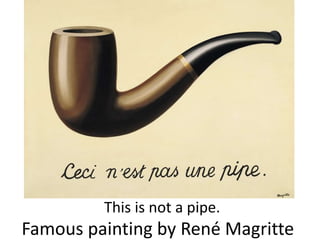
Famous painting by René Magritte
This is not a pipe.
Representation
and Gender stereotypes
To explore gender stereotypes
What is gender?
"Sex" refers to the biological and physiological
characteristics that define men and women.
"Gender" refers to the socially constructed roles,
behaviours, activities, and attributes that a given
society considers appropriate for men and women.
...and transgender should be part of this too.
Quick Question:
What was your most favourite toy as
a child?
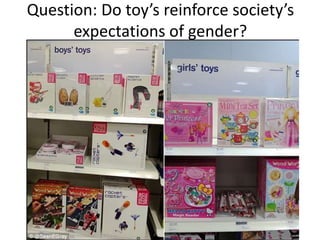
Question: Do toy’s reinforce society’s
expectations of gender?
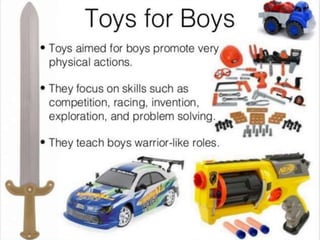
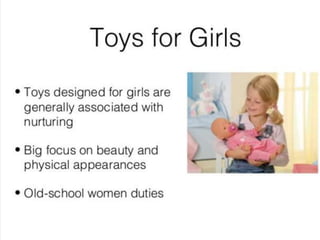
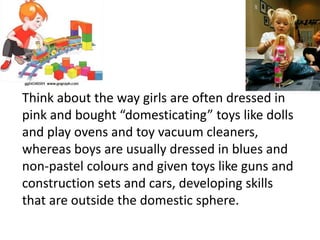
Think about the way girls are often dressed in
pink and bought “domesticating” toys like dolls
and play ovens and toy vacuum cleaners,
whereas boys are usually dressed in blues and
non-pastel colours and given toys like guns and
construction sets and cars, developing skills
that are outside the domestic sphere.
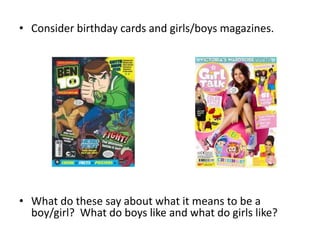
• Consider birthday cards and girls/boys magazines.
• What do these say about what it means to be a
boy/girl? What do boys like and what do girls like?
• Do you think this changes in men’s/women’s
magazines?
• Consider the contents of ‘men’s magazines’ and
‘women’s magazines’.
• What types of articles do they feature?
• What does this suggest is important about
men/women?
• What do you think about this?
• What does this tell us about society’s expectations?
Masculinity and femininity
Gender and representation of gender is tied up
with ideas of masculinity and femininity...
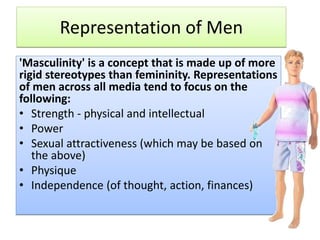
Representation of Men
'Masculinity' is a concept that is made up of more
rigid stereotypes than femininity. Representations
of men across all media tend to focus on the
following:
• Strength - physical and intellectual
• Power
• Sexual attractiveness (which may be based on
the above)
• Physique
• Independence (of thought, action, finances)
Representation of Men
• Male characters are often represented as
isolated, as not needing to rely on others (the
lone hero). If they submit to being part of a
family, it is often part of the resolution of a
narrative, rather than an integral factor in the
initial balance.
• It is interesting to note that the male physique
is becoming more important a part of
representations of masculinity.
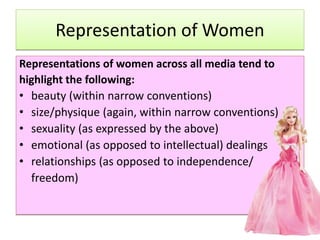
Representation of Women
Representations of women across all media tend to
highlight the following:
• beauty (within narrow conventions)
• size/physique (again, within narrow conventions)
• sexuality (as expressed by the above)
• emotional (as opposed to intellectual) dealings
• relationships (as opposed to independence/
freedom)
Representation of Women
• Women = stereotypically represented as being
part of a context (family, friends, colleagues)
and working/thinking together as part of a
team.
• In drama they tend to take the role of the
‘princess’/damsel in distress or the helper
(REMEMBER PROPP?) as they are an object
(passive, rather than active)
• Often their passivity leads to victimhood.
Ideologies
• Men act as ‘gate-keepers’ (Lewin, 1932) of the
media.
• Why is this important?
Homework: Research two ideological
theorists:
• Karl Marx – Identify and understand the terms
‘Bourgeoisie & Proletariat’ and how these link
to the media.
• Antonio Gramsci’s ‘Cultural Hegemony’ (how
does this link to Marxism and the media?)
• Include dates and summarise their theories –
do not just copy and paste.
• Post to your blog. Due Tuesday 2nd February
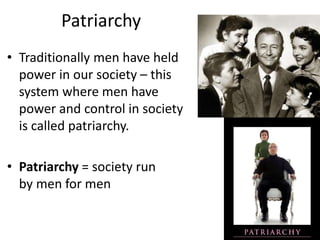
Patriarchy
• Traditionally men have held
power in our society – this
system where men have
power and control in society
is called patriarchy.
• Patriarchy = society run
by men for men
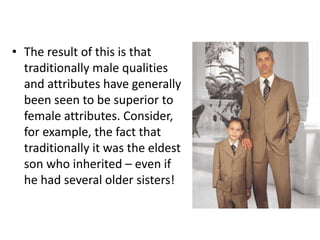
• The result of this is that
traditionally male qualities
and attributes have generally
been seen to be superior to
female attributes. Consider,
for example, the fact that
traditionally it was the eldest
son who inherited – even if
he had several older sisters!
• This was (and sometimes still is!) reflected in
the media, as most media companies were
run by men!
• Masculinity was often represented in ways
that were shown to be superior to feminine
qualities. Men were often shown to be more
important and powerful than women.
• Women were often shown in roles that suited
men and which kept them from challenging
men for power.
• In other words, the media showed men and
women how men wanted them to be!
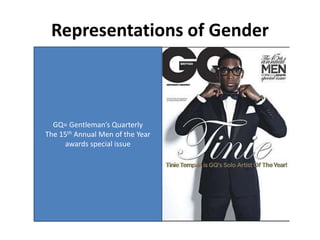
Representations of Gender
GQ= Gentleman’s Quarterly
The 15th Annual Men of the Year
awards special issue
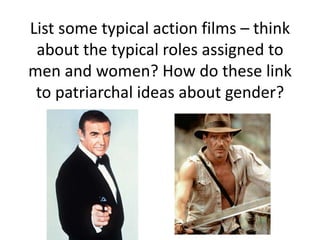
List some typical action films – think
about the typical roles assigned to
men and women? How do these link
to patriarchal ideas about gender?
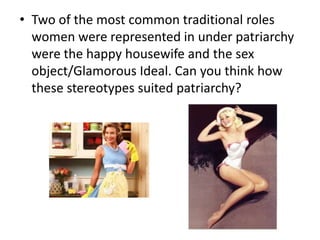
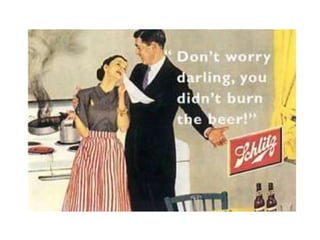
• Two of the most common traditional roles
women were represented in under patriarchy
were the happy housewife and the sex
object/Glamorous Ideal. Can you think how
these stereotypes suited patriarchy?
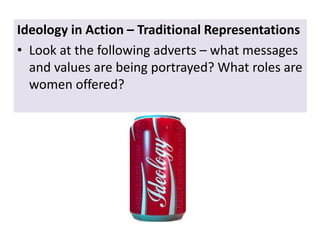
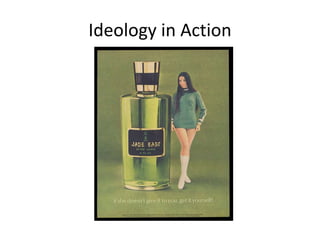
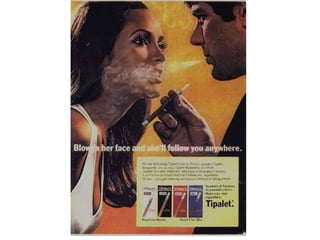
Ideology in Action – Traditional Representations
• Look at the following adverts – what messages
and values are being portrayed? What roles are
women offered?
Ideology in Action
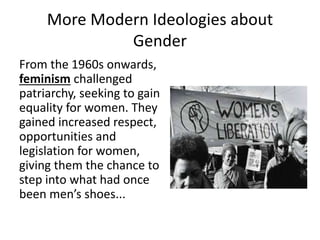
More Modern Ideologies about
Gender
From the 1960s onwards,
feminism challenged
patriarchy, seeking to gain
equality for women. They
gained increased respect,
opportunities and
legislation for women,
giving them the chance to
step into what had once
been men’s shoes...
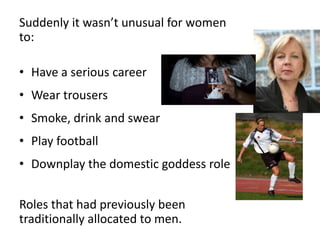
Suddenly it wasn’t unusual for women
to:
• Have a serious career
• Wear trousers
• Smoke, drink and swear
• Play football
• Downplay the domestic goddess role
Roles that had previously been
traditionally allocated to men.
Watch: Earp and Katz’s Tough Guise
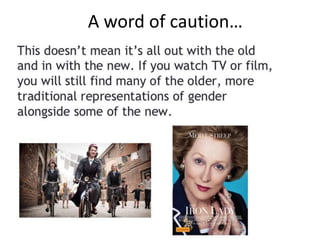
A word of caution…
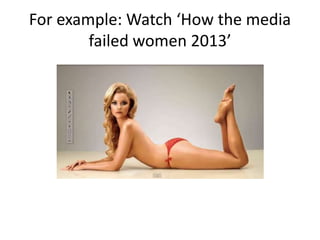
For example: Watch ‘How the media
failed women 2013’
Lesson 2 - Representation - Gender and stereotypes

Lesson 2 - Representation - Gender and stereotypes

  • 1.
    Famous painting byRené Magritte This is not a pipe.
  • 2.
    Representation and Gender stereotypes Toexplore gender stereotypes
  • 3.
    What is gender? "Sex"refers to the biological and physiological characteristics that define men and women. "Gender" refers to the socially constructed roles, behaviours, activities, and attributes that a given society considers appropriate for men and women. ...and transgender should be part of this too.
  • 4.
    Quick Question: What wasyour most favourite toy as a child?
  • 5.
    Question: Do toy’sreinforce society’s expectations of gender?
  • 8.
    Think about theway girls are often dressed in pink and bought “domesticating” toys like dolls and play ovens and toy vacuum cleaners, whereas boys are usually dressed in blues and non-pastel colours and given toys like guns and construction sets and cars, developing skills that are outside the domestic sphere.
  • 9.
    • Consider birthdaycards and girls/boys magazines. • What do these say about what it means to be a boy/girl? What do boys like and what do girls like?
  • 11.
    • Do youthink this changes in men’s/women’s magazines? • Consider the contents of ‘men’s magazines’ and ‘women’s magazines’. • What types of articles do they feature? • What does this suggest is important about men/women? • What do you think about this? • What does this tell us about society’s expectations?
  • 12.
    Masculinity and femininity Genderand representation of gender is tied up with ideas of masculinity and femininity...
  • 13.
    Representation of Men 'Masculinity'is a concept that is made up of more rigid stereotypes than femininity. Representations of men across all media tend to focus on the following: • Strength - physical and intellectual • Power • Sexual attractiveness (which may be based on the above) • Physique • Independence (of thought, action, finances)
  • 14.
    Representation of Men •Male characters are often represented as isolated, as not needing to rely on others (the lone hero). If they submit to being part of a family, it is often part of the resolution of a narrative, rather than an integral factor in the initial balance. • It is interesting to note that the male physique is becoming more important a part of representations of masculinity.
  • 15.
    Representation of Women Representationsof women across all media tend to highlight the following: • beauty (within narrow conventions) • size/physique (again, within narrow conventions) • sexuality (as expressed by the above) • emotional (as opposed to intellectual) dealings • relationships (as opposed to independence/ freedom)
  • 16.
    Representation of Women •Women = stereotypically represented as being part of a context (family, friends, colleagues) and working/thinking together as part of a team. • In drama they tend to take the role of the ‘princess’/damsel in distress or the helper (REMEMBER PROPP?) as they are an object (passive, rather than active) • Often their passivity leads to victimhood.
  • 17.
    Ideologies • Men actas ‘gate-keepers’ (Lewin, 1932) of the media. • Why is this important?
  • 18.
    Homework: Research twoideological theorists: • Karl Marx – Identify and understand the terms ‘Bourgeoisie & Proletariat’ and how these link to the media. • Antonio Gramsci’s ‘Cultural Hegemony’ (how does this link to Marxism and the media?) • Include dates and summarise their theories – do not just copy and paste. • Post to your blog. Due Tuesday 2nd February
  • 19.
    Patriarchy • Traditionally menhave held power in our society – this system where men have power and control in society is called patriarchy. • Patriarchy = society run by men for men
  • 20.
    • The resultof this is that traditionally male qualities and attributes have generally been seen to be superior to female attributes. Consider, for example, the fact that traditionally it was the eldest son who inherited – even if he had several older sisters!
  • 21.
    • This was(and sometimes still is!) reflected in the media, as most media companies were run by men! • Masculinity was often represented in ways that were shown to be superior to feminine qualities. Men were often shown to be more important and powerful than women. • Women were often shown in roles that suited men and which kept them from challenging men for power. • In other words, the media showed men and women how men wanted them to be!
  • 22.
    Representations of Gender GQ=Gentleman’s Quarterly The 15th Annual Men of the Year awards special issue
  • 23.
    List some typicalaction films – think about the typical roles assigned to men and women? How do these link to patriarchal ideas about gender?
  • 24.
    • Two ofthe most common traditional roles women were represented in under patriarchy were the happy housewife and the sex object/Glamorous Ideal. Can you think how these stereotypes suited patriarchy?
  • 25.
    Ideology in Action– Traditional Representations • Look at the following adverts – what messages and values are being portrayed? What roles are women offered?
  • 26.
  • 29.
    More Modern Ideologiesabout Gender From the 1960s onwards, feminism challenged patriarchy, seeking to gain equality for women. They gained increased respect, opportunities and legislation for women, giving them the chance to step into what had once been men’s shoes...
  • 30.
    Suddenly it wasn’tunusual for women to: • Have a serious career • Wear trousers • Smoke, drink and swear • Play football • Downplay the domestic goddess role Roles that had previously been traditionally allocated to men.
  • 35.
    Watch: Earp andKatz’s Tough Guise
  • 36.
    A word ofcaution…
  • 37.
    For example: Watch‘How the media failed women 2013’