Lesson 6
Independence
In 1775, Benjamin Franklin recalled, “…having more
than once travelled almost from one end of the
Continent to the other and kept a great variety of
company, eating drinking and conversing with them
freely, I never had heard in any conversation from
any person drunk or sober, the least expression of a
wish for a separation, or hint that such a thing
would be advantageous to America.”
From Benjamin Franklin to William Franklin:
Journal of Negotiations in London, 22 March 1775
https://founders.archives.gov/documents/Franklin/
01-21-02-0306
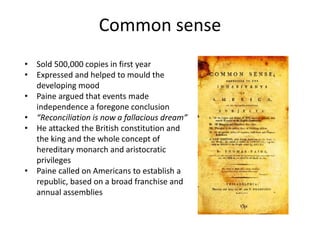
Common sense
• Sold 500,000 copies in first year
• Expressed and helped to mould the
developing mood
• Paine argued that events made
independence a foregone conclusion
• “Reconciliation is now a fallacious dream”
• He attacked the British constitution and
the king and the whole concept of
hereditary monarch and aristocratic
privileges
• Paine called on Americans to establish a
republic, based on a broad franchise and
annual assemblies
The need to declare independence
• In November 1775 congress had established a
Committee of Secret Correspondence to carry
on diplomacy with foreign nations and also
sent a delegate from Conneticut, silas deane
to france to obtain militay supplies
• Many believed that foreign aid would not be
forthcoming until america declared
independence
Calls for independence
“ I can assure you that the spirit of the people cries out for this
Declaration. The military, in particular, men and officers, are
outrageous on the subject. And a man of your excellent discernment
need not be told how dangerous it would be in our present
circumstances to dally with the spirit, or disappoint the expectations of
the bulk of the people. May not despair, anarchy, and finally,
submission, be the bitter fruits? I am firmly persuaded that they will.
In this persuasion, I most devoutly pray that you may not merely
recommend, but positively lay injunctions on your servants in Congress
to embrace a measure so necessary to our salvation.”
• CHARLES LEE ARGUES FOR INDEPENDENCE (1776)
• https://alphahistory.com/americanrevolution/charles-lee-
independence-1776/
The Halifax resolves
“…that the delegates for this Colony in the
Continental Congress be empowered to concur with
the other delegates of the other Colonies in
declaring independency and forming foreign
alliances… resolving to this Colony the sole and
exclusive right of forming a constitution and laws
for this Colony, and of appointing delegates from
time to time…”
• https://alphahistory.com/americanrevolution/hal
ifax-resolves-1776/
THE VIRGINIA BILL OF RIGHTS (1776)
• “That all men are by nature equally free and
independent, and have certain inherent rights,
of which, when they enter into a state of
society, they cannot by any compact, deprive
or divest their posterity; namely, the
enjoyment of life and liberty with the means of
acquiring and possessing property, and
pursuing and obtaining happiness and safety”.
• https://alphahistory.com/americanrevolution/
virginia-bill-of-rights-1776/
The situation in early 1776
“Rather than an inevitable ripening of difference, the
revolution violently wrenched reluctant colonists into a new
and uncertain future as an independent country.”
Alan taylor
American Revolutions: A Continental History, 1750-1804, by
Alan Taylor
IN CONGRESS, JULY 4, 1776
The unanimous Declaration of the thirteen united
States of America
When in the Course of human events it
becomes necessary for one people to dissolve
the political bands which have connected
them with another and to assume among the
powers of the earth, the separate and equal
station to which the Laws of Nature and of
Nature's God entitle them, a decent respect
to the opinions of mankind requires that
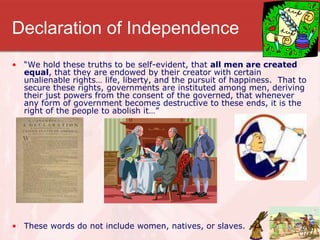
Declaration of Independence
• “We hold these truths to be self-evident, that all men are created
equal, that they are endowed by their creator with certain
unalienable rights… life, liberty, and the pursuit of happiness. That to
secure these rights, governments are instituted among men, deriving
their just powers from the consent of the governed, that whenever
any form of government becomes destructive to these ends, it is the
right of the people to abolish it…”
• These words do not include women, natives, or slaves.
The Enlightenment
• Enlightenment ideas of John Locke and Rousseau
strongly influenced the colonists
– Locke said everyone has natural rights and the power
of government is dervied from popular consent
• Paine’s pamphlet “Common Sense” (Jan 1776)
argued for independence
– Radical idea at the time
– Called for the creation of a republic (representative
government) based on the natural rights of the people
– Strongly influenced by the Enlightenment
Declaration of Independence
• Thomas Jefferson drfated the formal declaration
of independence
• Goals: Justify independence by listing grievances
against King George III
– Took out the one Jefferson wrote against slavery
• To rally support amongst the colonists
• To get assitance from foreign nations
• Broad appeal by declaring “unalienable rights”
(natural rights) and the power of government rest
with the people – popular soveriengty
Colonial unity?
• Patriots Loyalists
• Colonists who fought colonists loyal to
• agaunst The british britain – treated as
traitors/property
seized/harassed
• About 80,000 emigrated from the US
• Most colonists neutral or apathetic
Britain vs america
• Great britain was economically and miliraily
superior to the coonies
• Considerable loyalist opposition
• Weak government structure under the
continental congress
• Colonists had greater familiarity with the land
• Us eof guerilla warfare
• Resilient military and political leadership
• Ideoligical commitment
• Eventual support from european allies
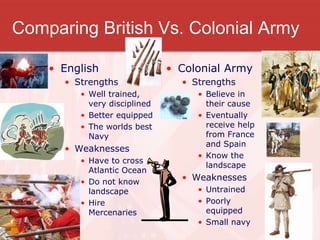
Comparing British Vs. Colonial Army
• English
• Strengths
• Well trained,
very disciplined
• Better equipped
• The worlds best
Navy
• Weaknesses
• Have to cross
Atlantic Ocean
• Do not know
landscape
• Hire
Mercenaries
• Colonial Army
• Strengths
• Believe in
their cause
• Eventually
receive help
from France
and Spain
• Know the
landscape
• Weaknesses
• Untrained
• Poorly
equipped
• Small navy
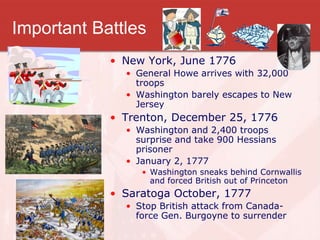
Important Battles
• New York, June 1776
• General Howe arrives with 32,000
troops
• Washington barely escapes to New
Jersey
• Trenton, December 25, 1776
• Washington and 2,400 troops
surprise and take 900 Hessians
prisoner
• January 2, 1777
• Washington sneaks behind Cornwallis
and forced British out of Princeton
• Saratoga October, 1777
• Stop British attack from Canada-
force Gen. Burgoyne to surrender

Lesson 6

  • 1.
  • 2.
    In 1775, BenjaminFranklin recalled, “…having more than once travelled almost from one end of the Continent to the other and kept a great variety of company, eating drinking and conversing with them freely, I never had heard in any conversation from any person drunk or sober, the least expression of a wish for a separation, or hint that such a thing would be advantageous to America.” From Benjamin Franklin to William Franklin: Journal of Negotiations in London, 22 March 1775 https://founders.archives.gov/documents/Franklin/ 01-21-02-0306
  • 3.
    Common sense • Sold500,000 copies in first year • Expressed and helped to mould the developing mood • Paine argued that events made independence a foregone conclusion • “Reconciliation is now a fallacious dream” • He attacked the British constitution and the king and the whole concept of hereditary monarch and aristocratic privileges • Paine called on Americans to establish a republic, based on a broad franchise and annual assemblies
  • 4.
    The need todeclare independence • In November 1775 congress had established a Committee of Secret Correspondence to carry on diplomacy with foreign nations and also sent a delegate from Conneticut, silas deane to france to obtain militay supplies • Many believed that foreign aid would not be forthcoming until america declared independence
  • 5.
    Calls for independence “I can assure you that the spirit of the people cries out for this Declaration. The military, in particular, men and officers, are outrageous on the subject. And a man of your excellent discernment need not be told how dangerous it would be in our present circumstances to dally with the spirit, or disappoint the expectations of the bulk of the people. May not despair, anarchy, and finally, submission, be the bitter fruits? I am firmly persuaded that they will. In this persuasion, I most devoutly pray that you may not merely recommend, but positively lay injunctions on your servants in Congress to embrace a measure so necessary to our salvation.” • CHARLES LEE ARGUES FOR INDEPENDENCE (1776) • https://alphahistory.com/americanrevolution/charles-lee- independence-1776/
  • 6.
    The Halifax resolves “…thatthe delegates for this Colony in the Continental Congress be empowered to concur with the other delegates of the other Colonies in declaring independency and forming foreign alliances… resolving to this Colony the sole and exclusive right of forming a constitution and laws for this Colony, and of appointing delegates from time to time…” • https://alphahistory.com/americanrevolution/hal ifax-resolves-1776/
  • 7.
    THE VIRGINIA BILLOF RIGHTS (1776) • “That all men are by nature equally free and independent, and have certain inherent rights, of which, when they enter into a state of society, they cannot by any compact, deprive or divest their posterity; namely, the enjoyment of life and liberty with the means of acquiring and possessing property, and pursuing and obtaining happiness and safety”. • https://alphahistory.com/americanrevolution/ virginia-bill-of-rights-1776/
  • 8.
    The situation inearly 1776 “Rather than an inevitable ripening of difference, the revolution violently wrenched reluctant colonists into a new and uncertain future as an independent country.” Alan taylor American Revolutions: A Continental History, 1750-1804, by Alan Taylor
  • 9.
    IN CONGRESS, JULY4, 1776 The unanimous Declaration of the thirteen united States of America When in the Course of human events it becomes necessary for one people to dissolve the political bands which have connected them with another and to assume among the powers of the earth, the separate and equal station to which the Laws of Nature and of Nature's God entitle them, a decent respect to the opinions of mankind requires that
  • 10.
    Declaration of Independence •“We hold these truths to be self-evident, that all men are created equal, that they are endowed by their creator with certain unalienable rights… life, liberty, and the pursuit of happiness. That to secure these rights, governments are instituted among men, deriving their just powers from the consent of the governed, that whenever any form of government becomes destructive to these ends, it is the right of the people to abolish it…” • These words do not include women, natives, or slaves.
  • 12.
    The Enlightenment • Enlightenmentideas of John Locke and Rousseau strongly influenced the colonists – Locke said everyone has natural rights and the power of government is dervied from popular consent • Paine’s pamphlet “Common Sense” (Jan 1776) argued for independence – Radical idea at the time – Called for the creation of a republic (representative government) based on the natural rights of the people – Strongly influenced by the Enlightenment
  • 13.
    Declaration of Independence •Thomas Jefferson drfated the formal declaration of independence • Goals: Justify independence by listing grievances against King George III – Took out the one Jefferson wrote against slavery • To rally support amongst the colonists • To get assitance from foreign nations • Broad appeal by declaring “unalienable rights” (natural rights) and the power of government rest with the people – popular soveriengty
  • 14.
    Colonial unity? • PatriotsLoyalists • Colonists who fought colonists loyal to • agaunst The british britain – treated as traitors/property seized/harassed • About 80,000 emigrated from the US • Most colonists neutral or apathetic
  • 15.
    Britain vs america •Great britain was economically and miliraily superior to the coonies • Considerable loyalist opposition • Weak government structure under the continental congress • Colonists had greater familiarity with the land • Us eof guerilla warfare • Resilient military and political leadership • Ideoligical commitment • Eventual support from european allies
  • 16.
    Comparing British Vs.Colonial Army • English • Strengths • Well trained, very disciplined • Better equipped • The worlds best Navy • Weaknesses • Have to cross Atlantic Ocean • Do not know landscape • Hire Mercenaries • Colonial Army • Strengths • Believe in their cause • Eventually receive help from France and Spain • Know the landscape • Weaknesses • Untrained • Poorly equipped • Small navy
  • 17.
    Important Battles • NewYork, June 1776 • General Howe arrives with 32,000 troops • Washington barely escapes to New Jersey • Trenton, December 25, 1776 • Washington and 2,400 troops surprise and take 900 Hessians prisoner • January 2, 1777 • Washington sneaks behind Cornwallis and forced British out of Princeton • Saratoga October, 1777 • Stop British attack from Canada- force Gen. Burgoyne to surrender

Editor's Notes

  • #2 Why did congress not declare independence until 1776?
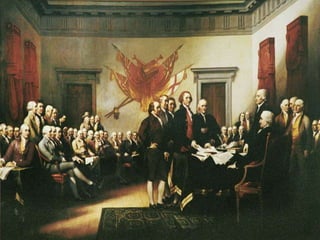
  • #12 This painting of the dec of ind by trumbull was begun in 1786 and not completed unitil the 1820’s It shows stan jeffeding in the centre from left to right john adams, roger sherman, robert livingston, thomas jefferson and benjamin franklin Given that turnbull did not witness the signing of the dec, to what extent is his painting a reliable source