Unit 4
Janelle Miller
  Us History
   Period 2
Section 1
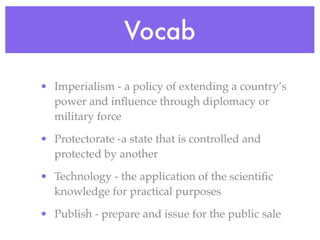
Vocab

• Imperialism - a policy of extending a country’s
  power and influence through diplomacy or
  military force

• Protectorate -a state that is controlled and
  protected by another

• Technology - the application of the scientific
  knowledge for practical purposes

• Publish - prepare and issue for the public sale
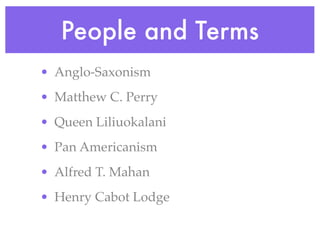
People and Terms
• Anglo-Saxonism
• Matthew C. Perry
• Queen Liliuokalani
• Pan Americanism
• Alfred T. Mahan
• Henry Cabot Lodge
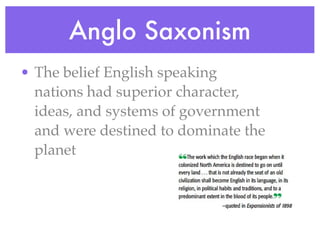
Anglo Saxonism
• The belief English speaking
  nations had superior character,
  ideas, and systems of government
  and were destined to dominate the
  planet
Matthew C. Perry
      • Ordered by President Millard
        Fillmore to go to Japan to
        negotiate a trade treaty

      • He showed up in Japan with 4
        warships that the Japanese
        had never seen before and
        they realized that they need to
        step it up if they were going to
        compete with the rest of the
        world
Queen Liliuokalani
      • Ascended to the Hawaiian
        Throne 1891
      • Disliked the American
        influences
      • In January 1983 she
        attempted to impose a new
        constitution that would
        have put her back in charge
        of the Hawaiian people
Pan Americanism


      • The idea that the United
        States and Latin America
        should work together
Alfred T. Mahan

      • Officer in the U.S.
        Navy
      • In 1980 he Published
        his book The Influence
        of Sea Power Upon
        History 1660-1783
Henry Cabot Lodge


        • He pushed the
          construction of a new
          navy along with Albert
          J. Beveridge
Section 2
Vocab
• Yellow Journalism - Journalism that is based
  on sensationalism and crude exaggeration

• Jingoism - extreme patriotism in the form of
  aggressive or warlike foreign policy

• Resources - a stock of supply of money,
  materials, staff, and other assists that can be
  drawn by a person or organization in order to
  function effectively

• Violated - break or fail to comply with

• Virtually - nearly, almost
People and Terms

• José Martí
• William Randolph Hearst
• Joseph Pulitzer
• Theodore Roosevelt
• Platt Amendment
José Martí

•   A writer and poet who was
    passionately committed to the cause
    of Cuban independence

•   While living in New York City in the
    1880s, Martí brought together
    different Cuban exile groups living in
    the United States

•   The groups raised funds from
    sympathetic Americans, purchased
    weapons, and trained their troops in
    preparation for an invasion of Cuba.
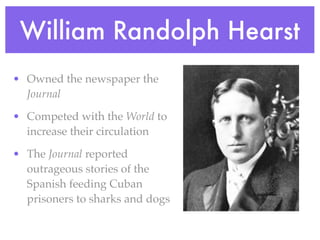
William Randolph Hearst
• Owned the newspaper the
  Journal

• Competed with the World to
  increase their circulation

• The Journal reported
  outrageous stories of the
  Spanish feeding Cuban
  prisoners to sharks and dogs
•            Joseph Pulitzer
• Owned the newspaper the
  World

• Competed with the Journal to
  increase their circulation

• The World described Cuba as
  a place with “blood on the
  road- sides, blood in the
  fields, blood on the
  doorsteps, blood, blood,
  blood!”
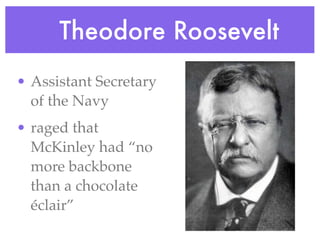
•     Theodore Roosevelt
• Assistant Secretary
  of the Navy
• raged that
  McKinley had “no
  more backbone
  than a chocolate
  éclair”
•             Platt Amendment
• (1) Cuba could not make any treaty with another
  nation that would weaken its independence or
  allow another foreign power to gain territory in
  Cuba

• (2) Cuba had to allow the United States to buy or
  lease naval stations in Cuba

• (3) Cuba’s debts had to be kept low to prevent
  foreign countries from landing troops to enforce
  payment

• (4) the United States would have the right to
  intervene to protect Cuban independence and
  keep order
Section 3
Vocab
•   Exploits - make full use of and derive benefit from

•   Sphere of influence - a country or area in which another country has
    power to affect developments although it has no formal authority

•   Open Door policy - a concept in foreign affairs, which usually refers
    to the policy around 1900 allowing multiple Imperial powers access to
    China, with none of them in control of that country

•   Tensions - mental or emotional strain

•   Intervene - come between so as to prevent or alter a result or course of
    events

•   Dollar Diplomacy - the use of a country's financial power to extend its
    international influence
People and Terms

• Boxer Rebellion
• “Great White Fleet”
• Hay- Pauncefote Treaty
• Roosevelt Corollary
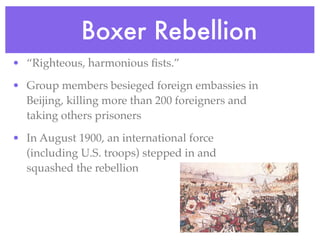
•            Boxer Rebellion
• “Righteous, harmonious fists.”

• Group members besieged foreign embassies in
  Beijing, killing more than 200 foreigners and
  taking others prisoners

• In August 1900, an international force
  (including U.S. troops) stepped in and
  squashed the rebellion
•        “Great White Fleet”
• 16 battleships of the new United States Navy

• In 1907 President Roosevelt sent it on a voyage
  around the world to showcase the nation’s
  military might

• The tour made a stop in Japan to demonstrate
  that the United States could and would
  uphold its interests in Asia
• Hay- Pauncefote Treaty

• Gave the United States the
  exclusive right to build and
  control any proposed canal
  through Central America
•        Roosevelt Corollary
• It was put in place to prevent European
  nations from sending troops to the Caribbean
  or Central America

• The United States would intervene in Latin
  American affairs when necessary to maintain
  stability in the Western Hemisphere

Unit 4

  • 1.
    Unit 4 Janelle Miller Us History Period 2
  • 2.
  • 3.
    Vocab • Imperialism -a policy of extending a country’s power and influence through diplomacy or military force • Protectorate -a state that is controlled and protected by another • Technology - the application of the scientific knowledge for practical purposes • Publish - prepare and issue for the public sale
  • 4.
    People and Terms •Anglo-Saxonism • Matthew C. Perry • Queen Liliuokalani • Pan Americanism • Alfred T. Mahan • Henry Cabot Lodge
  • 5.
    Anglo Saxonism • Thebelief English speaking nations had superior character, ideas, and systems of government and were destined to dominate the planet
  • 6.
    Matthew C. Perry • Ordered by President Millard Fillmore to go to Japan to negotiate a trade treaty • He showed up in Japan with 4 warships that the Japanese had never seen before and they realized that they need to step it up if they were going to compete with the rest of the world
  • 7.
    Queen Liliuokalani • Ascended to the Hawaiian Throne 1891 • Disliked the American influences • In January 1983 she attempted to impose a new constitution that would have put her back in charge of the Hawaiian people
  • 8.
    Pan Americanism • The idea that the United States and Latin America should work together
  • 9.
    Alfred T. Mahan • Officer in the U.S. Navy • In 1980 he Published his book The Influence of Sea Power Upon History 1660-1783
  • 10.
    Henry Cabot Lodge • He pushed the construction of a new navy along with Albert J. Beveridge
  • 11.
  • 12.
    Vocab • Yellow Journalism- Journalism that is based on sensationalism and crude exaggeration • Jingoism - extreme patriotism in the form of aggressive or warlike foreign policy • Resources - a stock of supply of money, materials, staff, and other assists that can be drawn by a person or organization in order to function effectively • Violated - break or fail to comply with • Virtually - nearly, almost
  • 13.
    People and Terms •José Martí • William Randolph Hearst • Joseph Pulitzer • Theodore Roosevelt • Platt Amendment
  • 14.
    José Martí • A writer and poet who was passionately committed to the cause of Cuban independence • While living in New York City in the 1880s, Martí brought together different Cuban exile groups living in the United States • The groups raised funds from sympathetic Americans, purchased weapons, and trained their troops in preparation for an invasion of Cuba.
  • 15.
    William Randolph Hearst •Owned the newspaper the Journal • Competed with the World to increase their circulation • The Journal reported outrageous stories of the Spanish feeding Cuban prisoners to sharks and dogs
  • 16.
    Joseph Pulitzer • Owned the newspaper the World • Competed with the Journal to increase their circulation • The World described Cuba as a place with “blood on the road- sides, blood in the fields, blood on the doorsteps, blood, blood, blood!”
  • 17.
    Theodore Roosevelt • Assistant Secretary of the Navy • raged that McKinley had “no more backbone than a chocolate éclair”
  • 18.
    Platt Amendment • (1) Cuba could not make any treaty with another nation that would weaken its independence or allow another foreign power to gain territory in Cuba • (2) Cuba had to allow the United States to buy or lease naval stations in Cuba • (3) Cuba’s debts had to be kept low to prevent foreign countries from landing troops to enforce payment • (4) the United States would have the right to intervene to protect Cuban independence and keep order
  • 19.
  • 20.
    Vocab • Exploits - make full use of and derive benefit from • Sphere of influence - a country or area in which another country has power to affect developments although it has no formal authority • Open Door policy - a concept in foreign affairs, which usually refers to the policy around 1900 allowing multiple Imperial powers access to China, with none of them in control of that country • Tensions - mental or emotional strain • Intervene - come between so as to prevent or alter a result or course of events • Dollar Diplomacy - the use of a country's financial power to extend its international influence
  • 21.
    People and Terms •Boxer Rebellion • “Great White Fleet” • Hay- Pauncefote Treaty • Roosevelt Corollary
  • 22.
    Boxer Rebellion • “Righteous, harmonious fists.” • Group members besieged foreign embassies in Beijing, killing more than 200 foreigners and taking others prisoners • In August 1900, an international force (including U.S. troops) stepped in and squashed the rebellion
  • 23.
    “Great White Fleet” • 16 battleships of the new United States Navy • In 1907 President Roosevelt sent it on a voyage around the world to showcase the nation’s military might • The tour made a stop in Japan to demonstrate that the United States could and would uphold its interests in Asia
  • 24.
    • Hay- PauncefoteTreaty • Gave the United States the exclusive right to build and control any proposed canal through Central America
  • 25.
    Roosevelt Corollary • It was put in place to prevent European nations from sending troops to the Caribbean or Central America • The United States would intervene in Latin American affairs when necessary to maintain stability in the Western Hemisphere