
APUSH Review: Key Concept 5.2,
Revised (Most up-to-date version)
Everything You Need To Know About Key
Concept 5.2 To Succeed In APUSH
Key Concept 5.2
“Intensified by expansion and Deepening regional
divisions, debates over slavery and other economic,
cultural, and political issues led the nation into civil war.”
Pg. 55
Big Idea Questions:
Why did various government actions regarding the
issue of slavery fail?
Why did the election of 1860 lead to secession by
South Carolina and other states?
Key Concept 5.2, I
“Ideological and economic differences over slavery produced an
array of diverging responses from Americans in the North and the
South.”
A) 2 Economies:
North - manufacturing that relied on free labor
South - agriculture - reliant on slavery
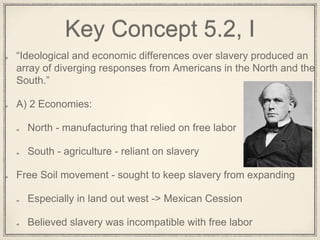
Free Soil movement - sought to keep slavery from expanding
Especially in land out west -> Mexican Cession
Believed slavery was incompatible with free labor
Key Concept 5.2, I
B) Abolitionist movement:
Comprised of whites and blacks, small percentage of population in the North
Tactics used by the abolitionist movement:
Moral arguments - incompatible with “natural rights” and “all men are created equal”
Assisting slaves’ escapes - Underground RR
Willingness to use violence - John Brown @ Harpers Ferry
C) Arguments used to defend slavery:
Racial doctrines - African Americans, like Native Americans before, were seen as
“savages”
Slavery was a “Positive Good”
Constitution - believed slavery protected states’ rights and slavery (slaves were deemed
as property in Dred Scott, property can’t be taken away)
Key Concept 5.2, II
“Debates over slavery came to dominate
political discussions in the 1850s,
culminating in the bitter election of 1860 and
the secession of Southern states.”
A) Mexican Cession -> debates over slavery
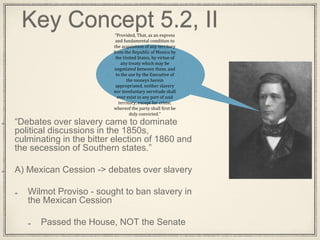
Wilmot Proviso - sought to ban slavery in
the Mexican Cession
Passed the House, NOT the Senate
“Provided, That, as an express
and fundamental condition to
the acquisition of any territory
from the Republic of Mexico by
the United States, by virtue of
any treaty which may be
negotiated between them, and
to the use by the Executive of
the moneys herein
appropriated, neither slavery
nor involuntary servitude shall
ever exist in any part of said
territory, except for crime,
whereof the party shall first be
duly convicted.”
Key Concept 5.2, II
B) Attempts to resolve slavery issue in the territories
Courts:
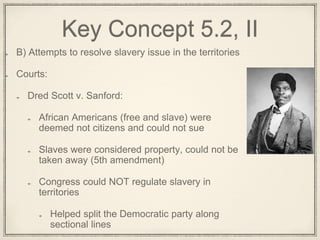
Dred Scott v. Sanford:
African Americans (free and slave) were
deemed not citizens and could not sue
Slaves were considered property, could not be
taken away (5th amendment)
Congress could NOT regulate slavery in
territories
Helped split the Democratic party along
sectional lines
Key Concept 5.2, II
B) Attempts to resolve slavery issue in the territories
National Leaders:
Compromise of 1850 (Douglass and Clay)
Major Parts:
CA was added as a free state - (tips balance in favor of free states)
Slave trade was abolished in D.C.
Popular Sovereignty in Mexican Cession
More strict fugitive slave law -> personal liberty laws in the North
Kansas-Nebraska Act (Douglass)
Allowed for popular sovereignty in KS and NB - expectation was KS would be slave, NB
would be free
Overturned the MO Compromise
Helped lead to the creation of the Republican Party
Key Concept 5.2, II
C) End of the Second Party System:
Declined due to issues over slavery and anti-
immigration sentiments
Led to the emergence of sectional parties (see
election of 1860)
Republican Party emerged in the North
Made up of Free-Soilers and former Whigs
Lincoln’s platform in 1860 was the
NONEXTENSION of slavery
Key Concept 5.2, II
D) Election of 1860 - Lincoln wins on a free-soil
platform, without a SINGLE Southern electoral
vote from the South
He did NOT want to end slavery, but keep it from
spreading
Immediate cause of the Civil War
South Carolina secedes on December 20,
1860, many states follow shortly after
Test Tips
Multiple-Choice and Short Answer
Reasons for the decline of the Second Party System
Characteristics of the abolitionist movement
Compromise of 1850, Kansas-Nebraska Act, and the
Dred Scott decision
Essay Topics:
Government actions that sought to settle the issue of
slavery

Apush review-key-concept-5.2-revised-most-up-to-date-version-

  • 1.
    APUSH Review: KeyConcept 5.2, Revised (Most up-to-date version) Everything You Need To Know About Key Concept 5.2 To Succeed In APUSH
  • 2.
    Key Concept 5.2 “Intensifiedby expansion and Deepening regional divisions, debates over slavery and other economic, cultural, and political issues led the nation into civil war.” Pg. 55 Big Idea Questions: Why did various government actions regarding the issue of slavery fail? Why did the election of 1860 lead to secession by South Carolina and other states?
  • 3.
    Key Concept 5.2,I “Ideological and economic differences over slavery produced an array of diverging responses from Americans in the North and the South.” A) 2 Economies: North - manufacturing that relied on free labor South - agriculture - reliant on slavery Free Soil movement - sought to keep slavery from expanding Especially in land out west -> Mexican Cession Believed slavery was incompatible with free labor
  • 4.
    Key Concept 5.2,I B) Abolitionist movement: Comprised of whites and blacks, small percentage of population in the North Tactics used by the abolitionist movement: Moral arguments - incompatible with “natural rights” and “all men are created equal” Assisting slaves’ escapes - Underground RR Willingness to use violence - John Brown @ Harpers Ferry C) Arguments used to defend slavery: Racial doctrines - African Americans, like Native Americans before, were seen as “savages” Slavery was a “Positive Good” Constitution - believed slavery protected states’ rights and slavery (slaves were deemed as property in Dred Scott, property can’t be taken away)
  • 5.
    Key Concept 5.2,II “Debates over slavery came to dominate political discussions in the 1850s, culminating in the bitter election of 1860 and the secession of Southern states.” A) Mexican Cession -> debates over slavery Wilmot Proviso - sought to ban slavery in the Mexican Cession Passed the House, NOT the Senate “Provided, That, as an express and fundamental condition to the acquisition of any territory from the Republic of Mexico by the United States, by virtue of any treaty which may be negotiated between them, and to the use by the Executive of the moneys herein appropriated, neither slavery nor involuntary servitude shall ever exist in any part of said territory, except for crime, whereof the party shall first be duly convicted.”
  • 6.
    Key Concept 5.2,II B) Attempts to resolve slavery issue in the territories Courts: Dred Scott v. Sanford: African Americans (free and slave) were deemed not citizens and could not sue Slaves were considered property, could not be taken away (5th amendment) Congress could NOT regulate slavery in territories Helped split the Democratic party along sectional lines
  • 7.
    Key Concept 5.2,II B) Attempts to resolve slavery issue in the territories National Leaders: Compromise of 1850 (Douglass and Clay) Major Parts: CA was added as a free state - (tips balance in favor of free states) Slave trade was abolished in D.C. Popular Sovereignty in Mexican Cession More strict fugitive slave law -> personal liberty laws in the North Kansas-Nebraska Act (Douglass) Allowed for popular sovereignty in KS and NB - expectation was KS would be slave, NB would be free Overturned the MO Compromise Helped lead to the creation of the Republican Party
  • 8.
    Key Concept 5.2,II C) End of the Second Party System: Declined due to issues over slavery and anti- immigration sentiments Led to the emergence of sectional parties (see election of 1860) Republican Party emerged in the North Made up of Free-Soilers and former Whigs Lincoln’s platform in 1860 was the NONEXTENSION of slavery
  • 9.
    Key Concept 5.2,II D) Election of 1860 - Lincoln wins on a free-soil platform, without a SINGLE Southern electoral vote from the South He did NOT want to end slavery, but keep it from spreading Immediate cause of the Civil War South Carolina secedes on December 20, 1860, many states follow shortly after
  • 10.
    Test Tips Multiple-Choice andShort Answer Reasons for the decline of the Second Party System Characteristics of the abolitionist movement Compromise of 1850, Kansas-Nebraska Act, and the Dred Scott decision Essay Topics: Government actions that sought to settle the issue of slavery