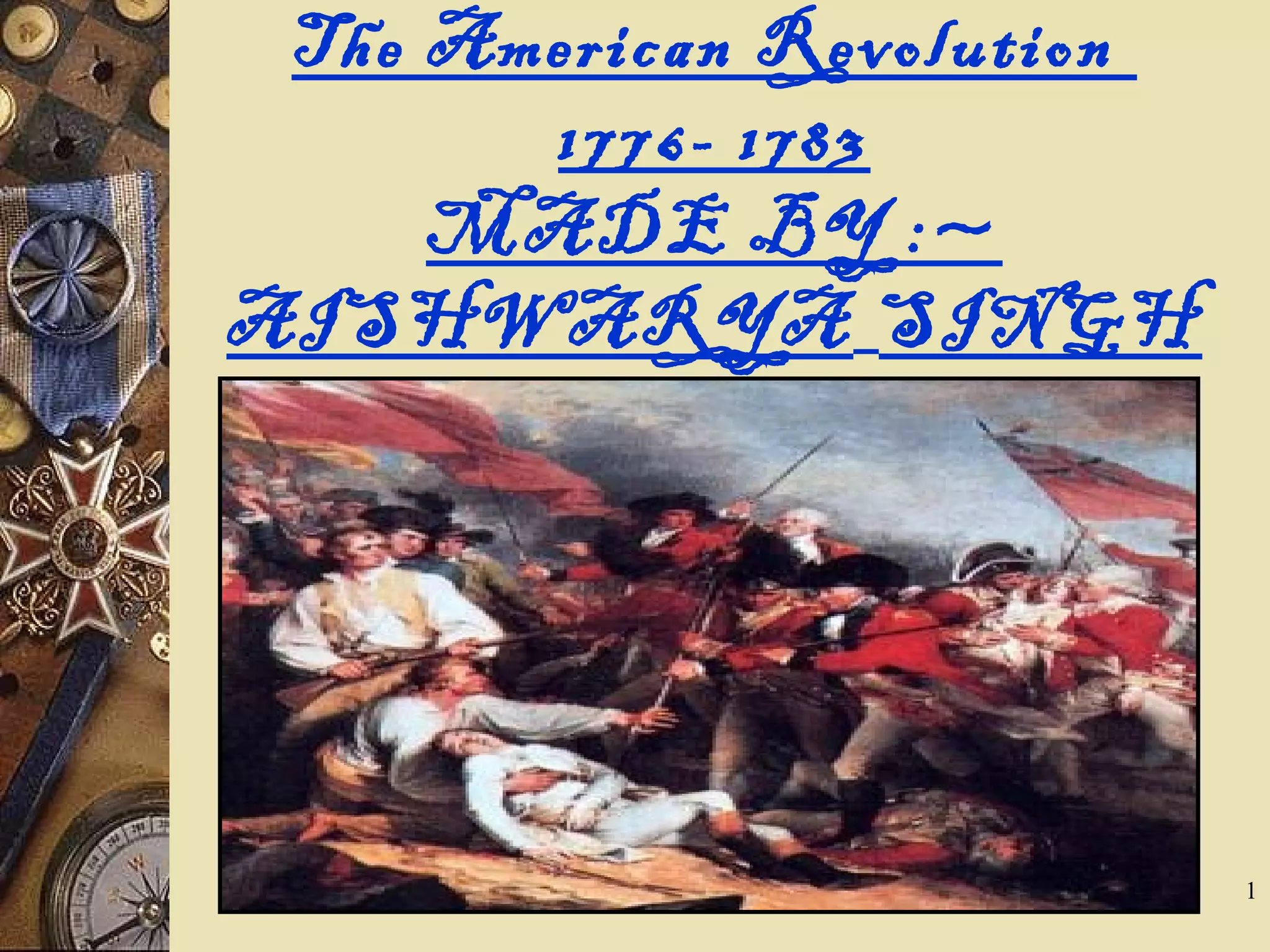
The American Revolution
1776- 1783
MADE BY :~
AISHWARYA SINGH
1
The Revolutionary Era
 “No Turning Back:” 1774-1776
 Declaration of Independence, 1776
 The Contenders
 Early Years of War
 Turning Points
 War and Society
 Conclusions, 1783
2
The Road To War
 The Sons of Liberty organized chapters
across the north, opposed what they
considered British abuses
 Broke “salutary neglect”
 Differences: high taxes and abuses vs.
payment for war, not following rules,
cost of government
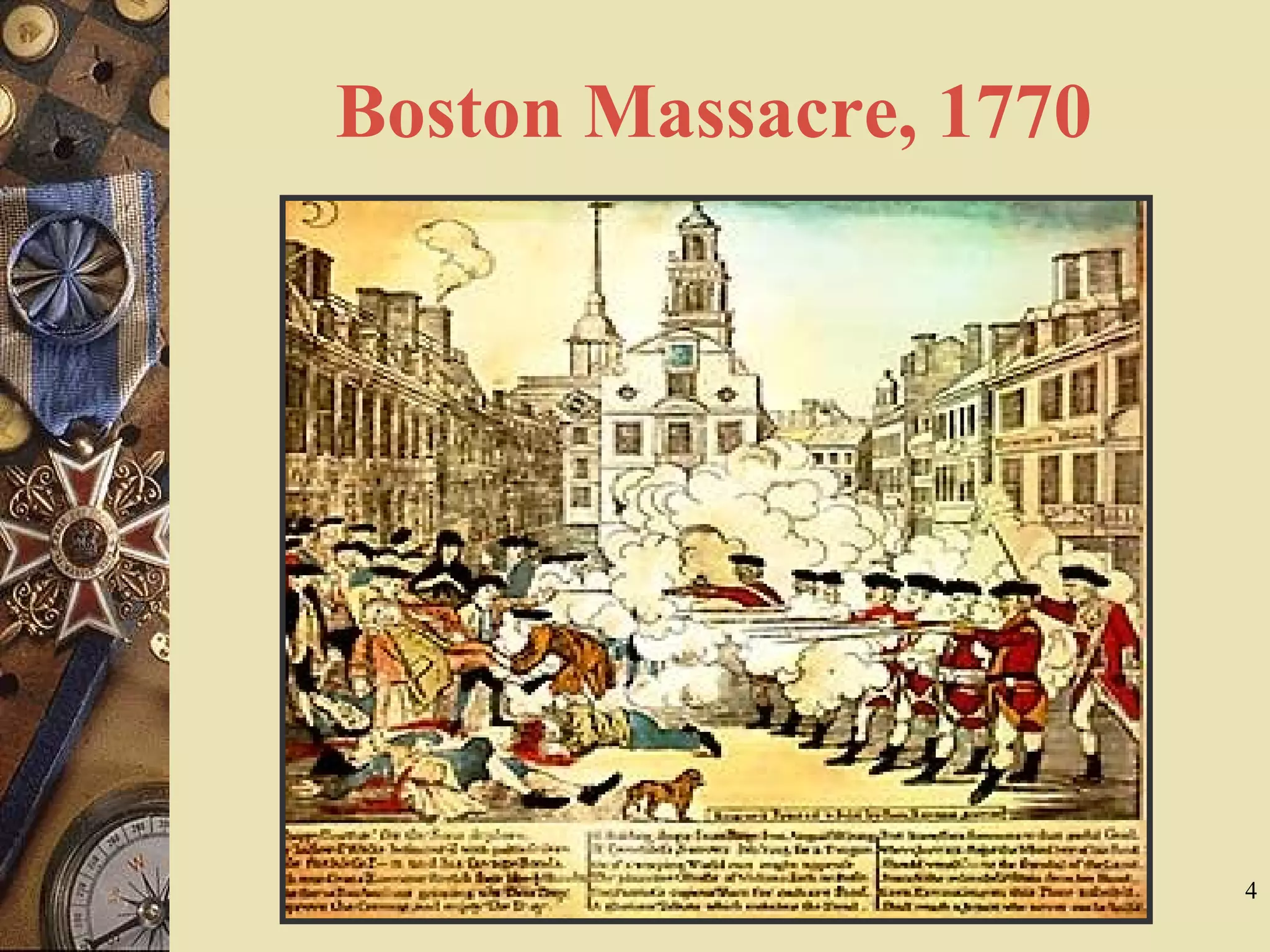
 Boston Massacre, 1770
 Committees of Correspondence
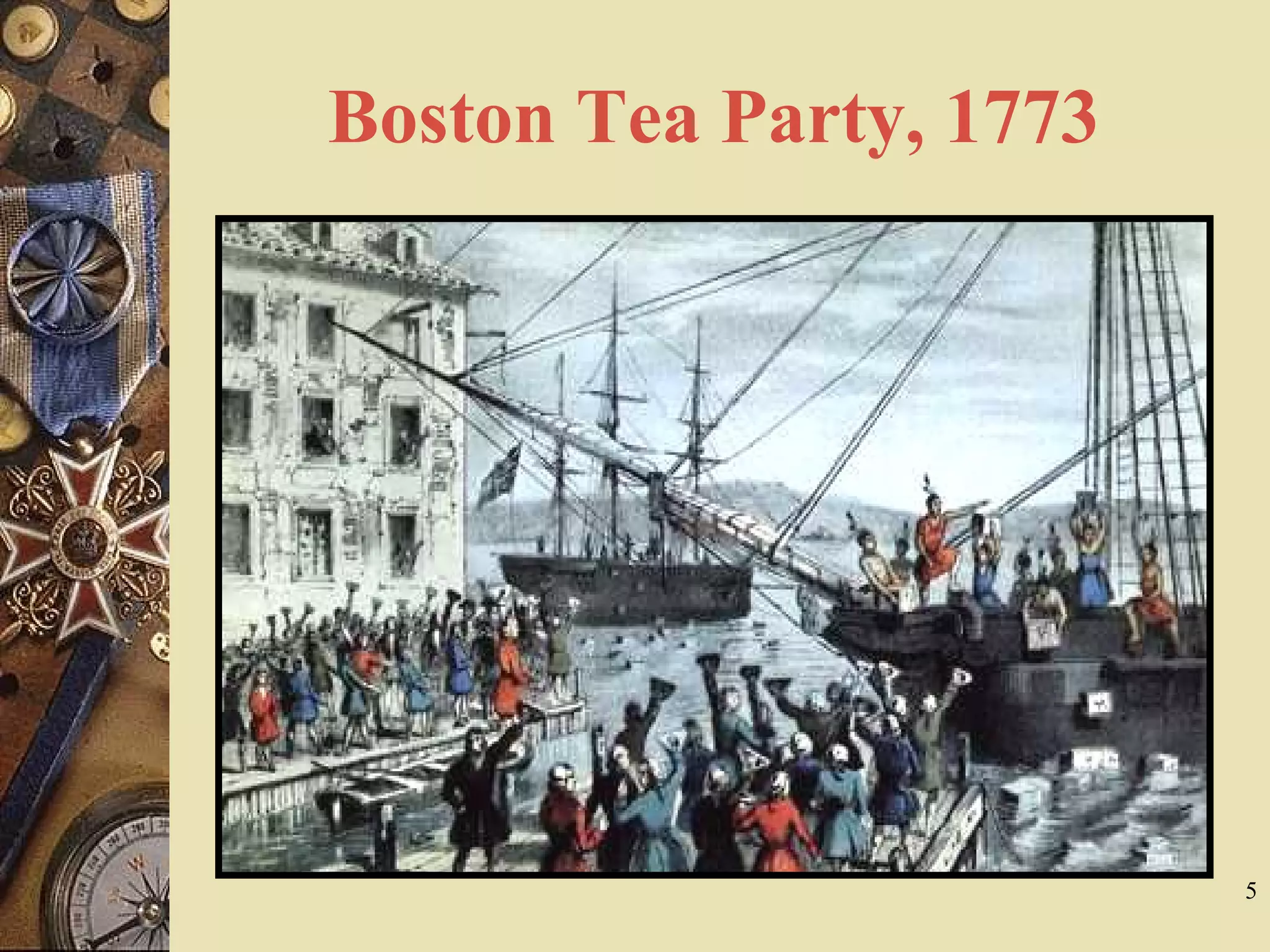
 Tea Tax and Boston Tea Party, 1773
3
Boston Massacre, 1770
4
Boston Tea Party, 1773
5
No Turning Back, 1774-6
-British reacted to Boston Tea Party
A). “Intolerable Acts” 1774
1). Mass. Charter; Boston Port;
2). Gen. Thomas Gage in Mass
3). Quebec
-1st
Continental Congress, 1774
A. Did not want war
B. Committed crown
C. Boycotts & Unity
6
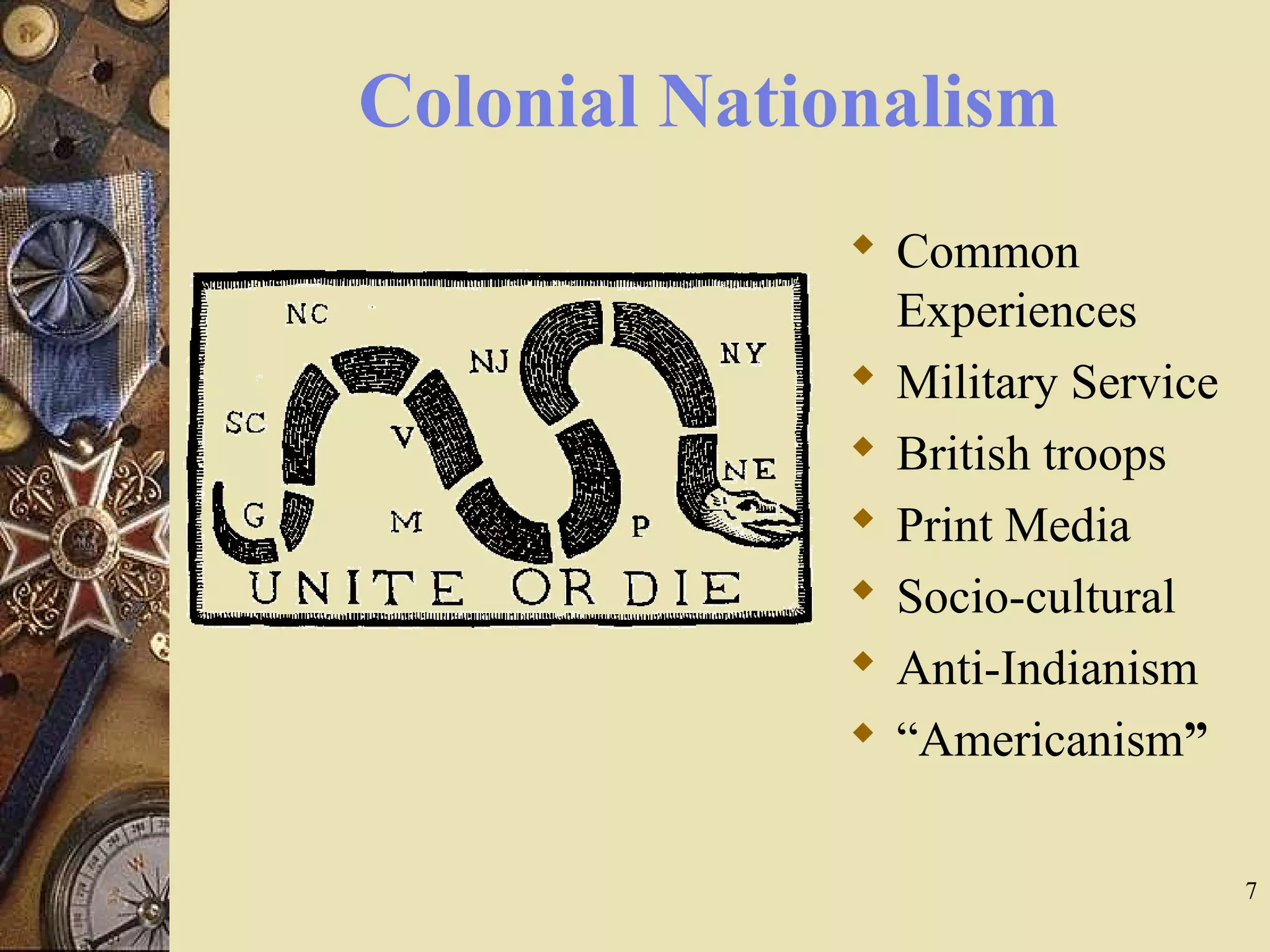
Colonial Nationalism
 Common
Experiences
 Military Service
 British troops
 Print Media
 Socio-cultural
 Anti-Indianism
 “Americanism”
7
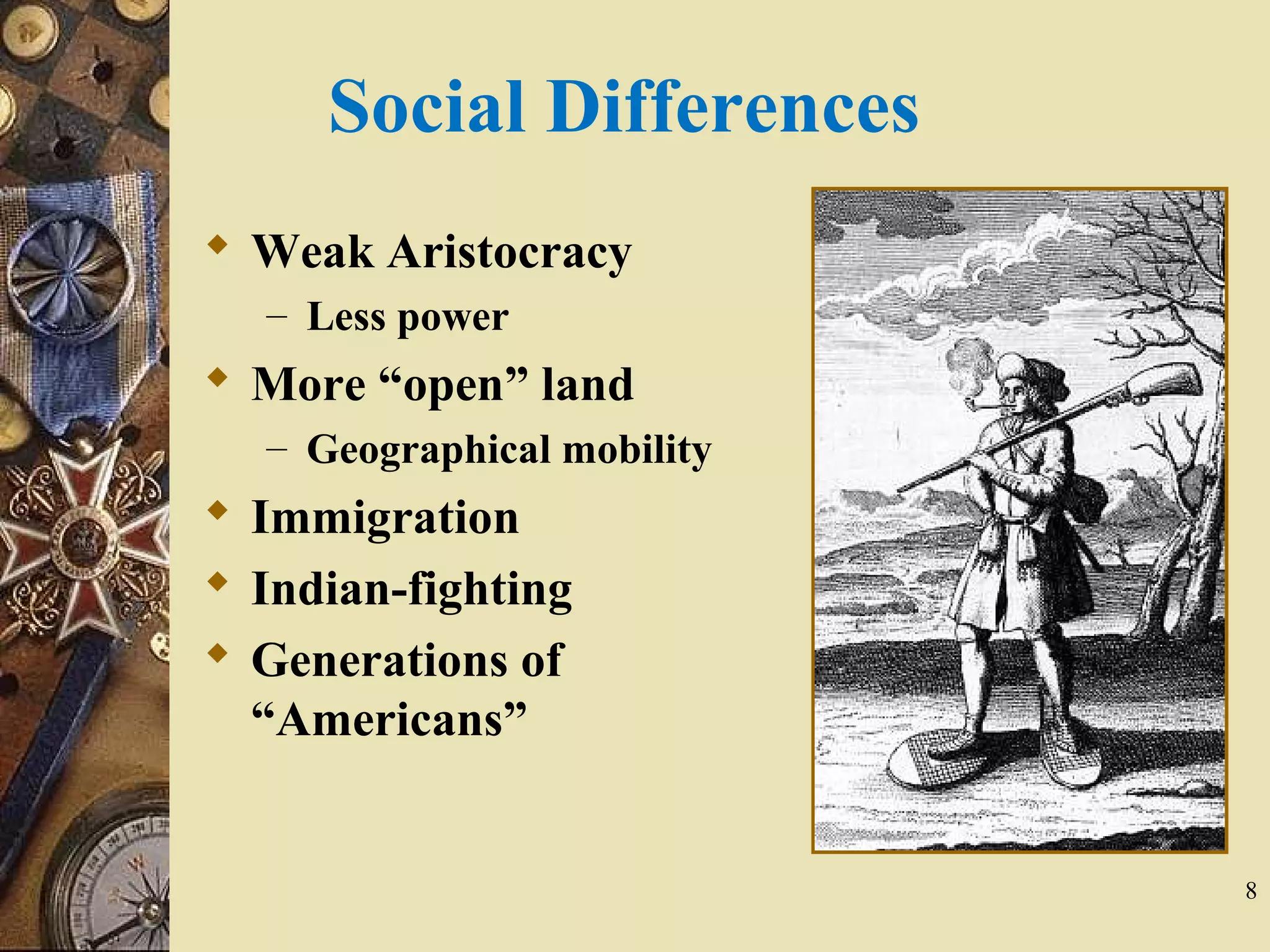
Social Differences
 Weak Aristocracy
– Less power
 More “open” land
– Geographical mobility
 Immigration
 Indian-fighting
 Generations of
“Americans”
8
No Turning Back, 1774-6
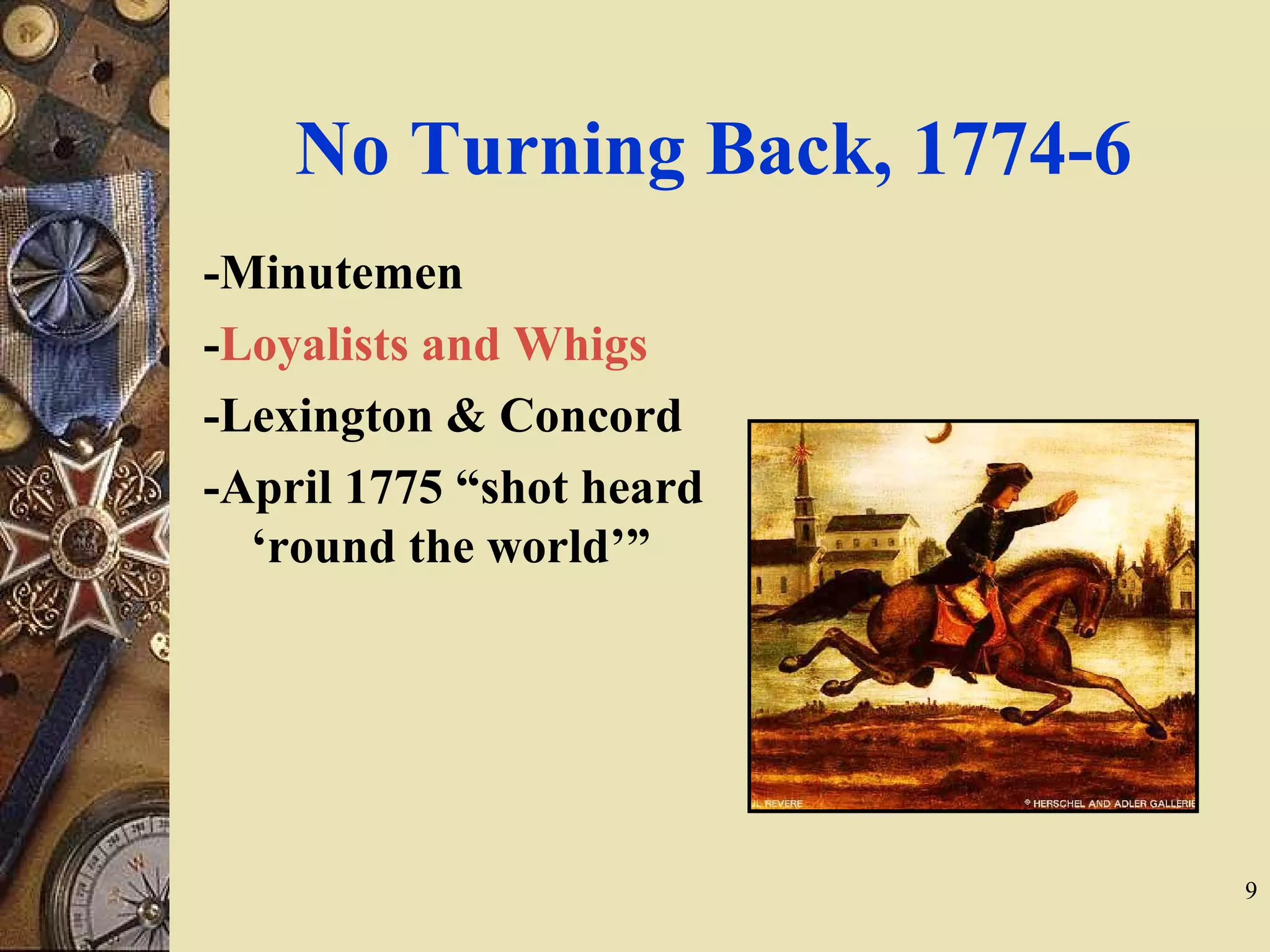
-Minutemen
-Loyalists and Whigs
-Lexington & Concord
-April 1775 “shot heard
‘round the world’”
9
No Turning Back, 1774-6
-The Second Continental Congress, 1775
A). “National Gov’t”
B). Olive Branch Petition
C). “Declaration of the Causes and Necessity
of Taking up Arms”
D). George Washington
10
Revolutionary Propaganda
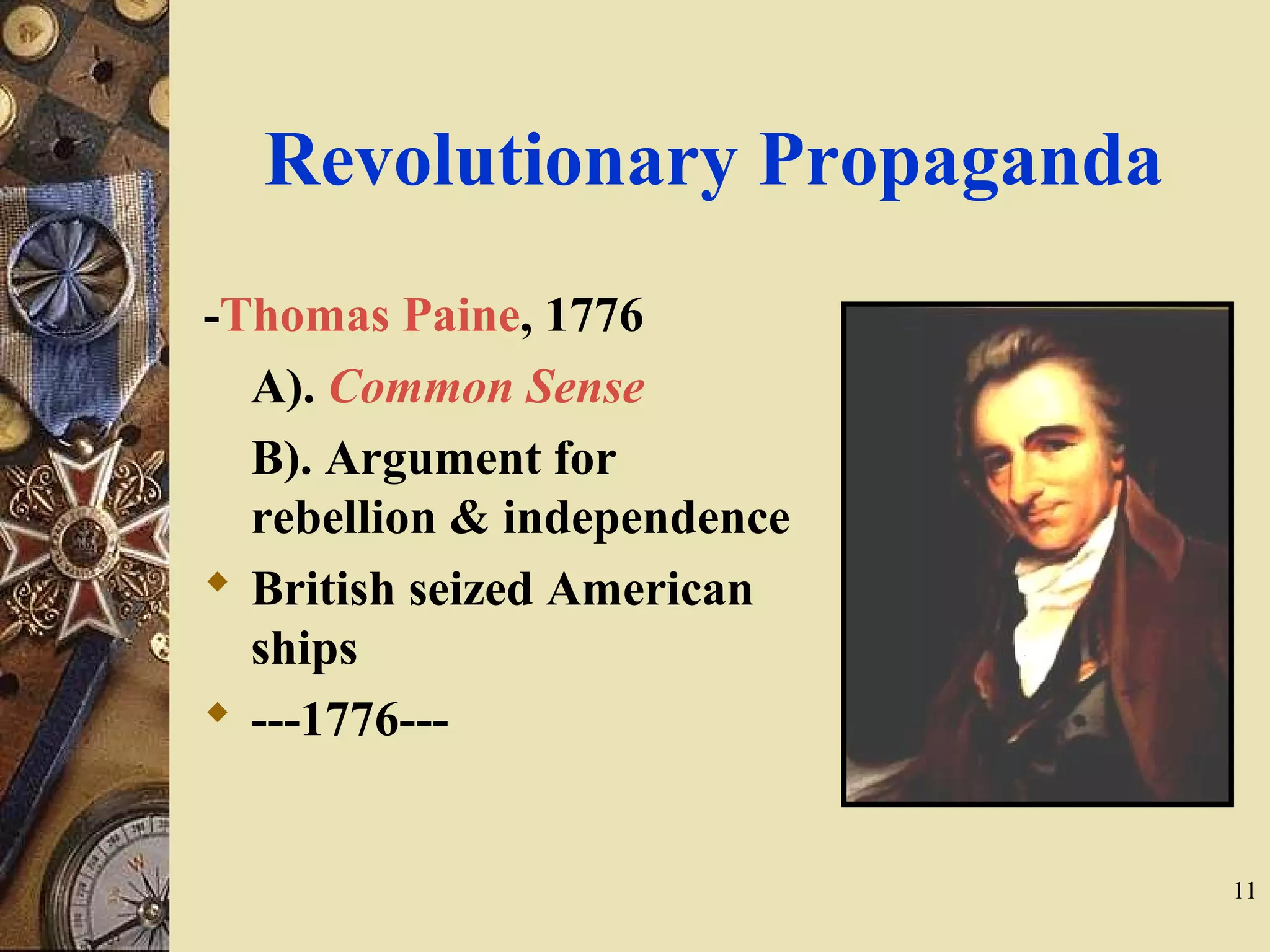
-Thomas Paine, 1776
A). Common Sense
B). Argument for
rebellion & independence
 British seized American
ships
 ---1776---
11
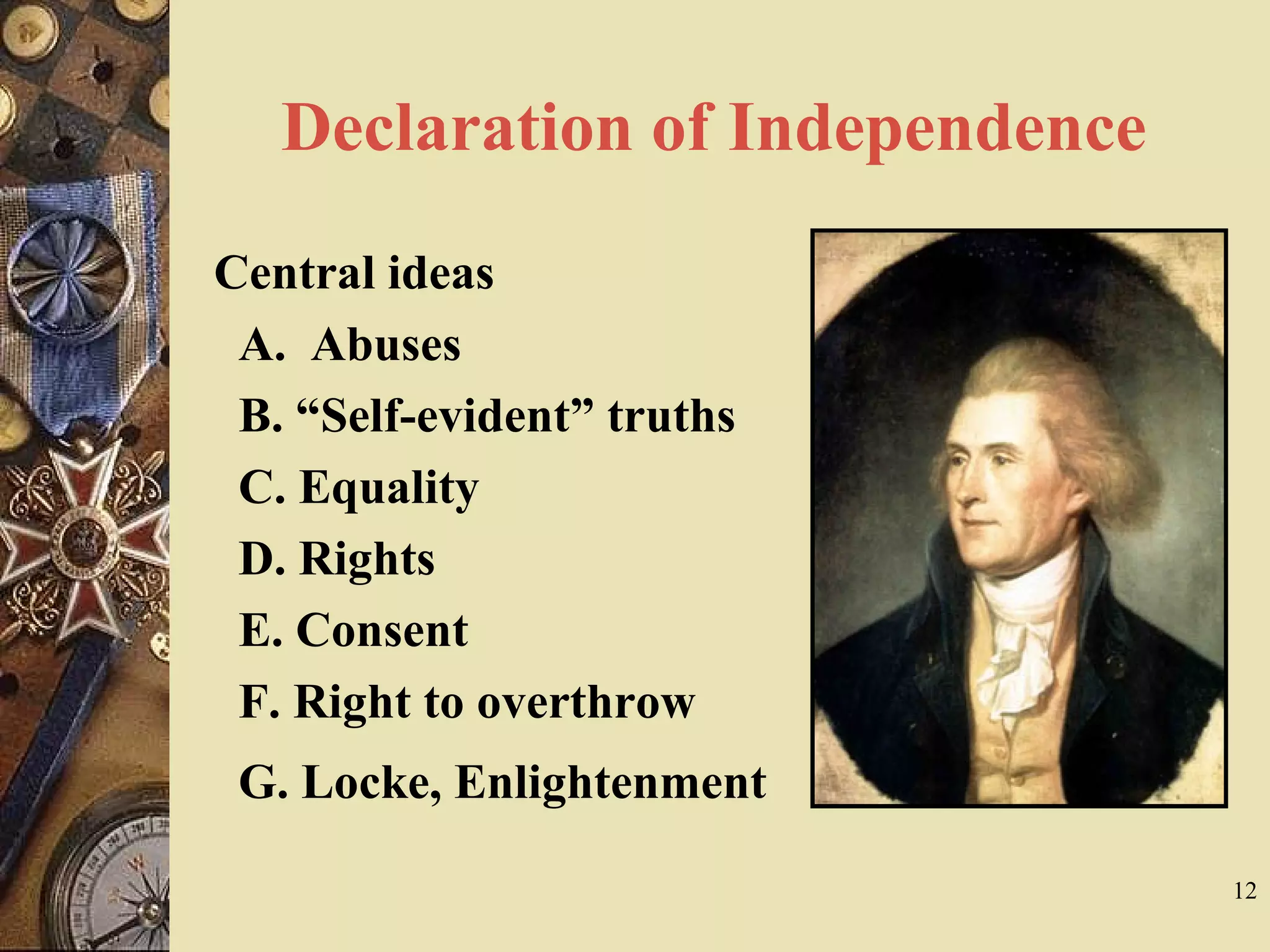
Declaration of Independence
Central ideas
A. Abuses
B. “Self-evident” truths
C. Equality
D. Rights
E. Consent
F. Right to overthrow
G. Locke, Enlightenment
12
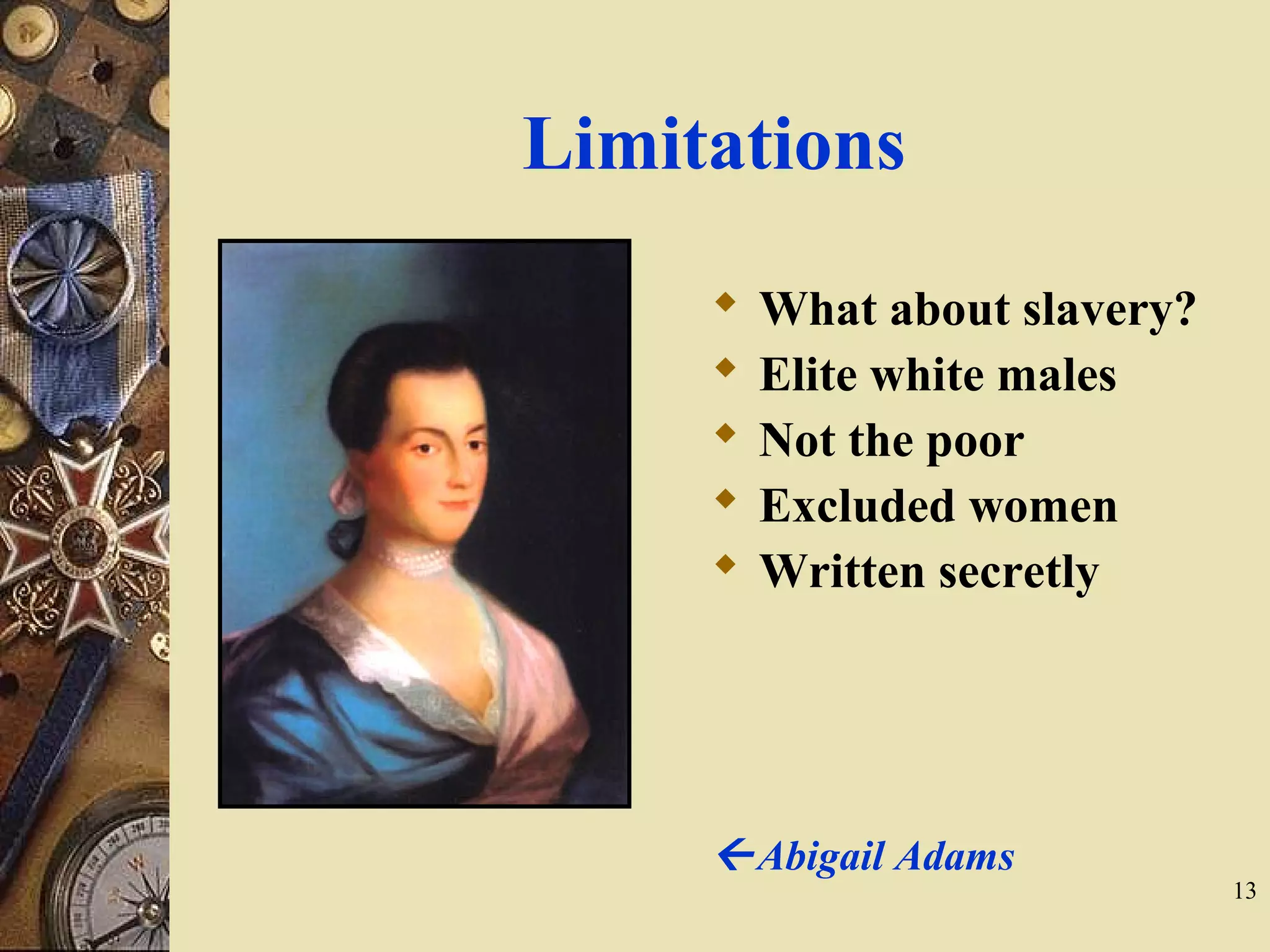
Limitations
 What about slavery?
 Elite white males
 Not the poor
 Excluded women
 Written secretly
Abigail Adams
13
The Contenders
Britain
-Wealth
-Confidence
-Professional Army
-Firepower
-Navy
-Distance & supplies
Colonists
-Home turf
-Defensive War
-French
-Dispersed population
-Size of region
-Local noncombatants
14
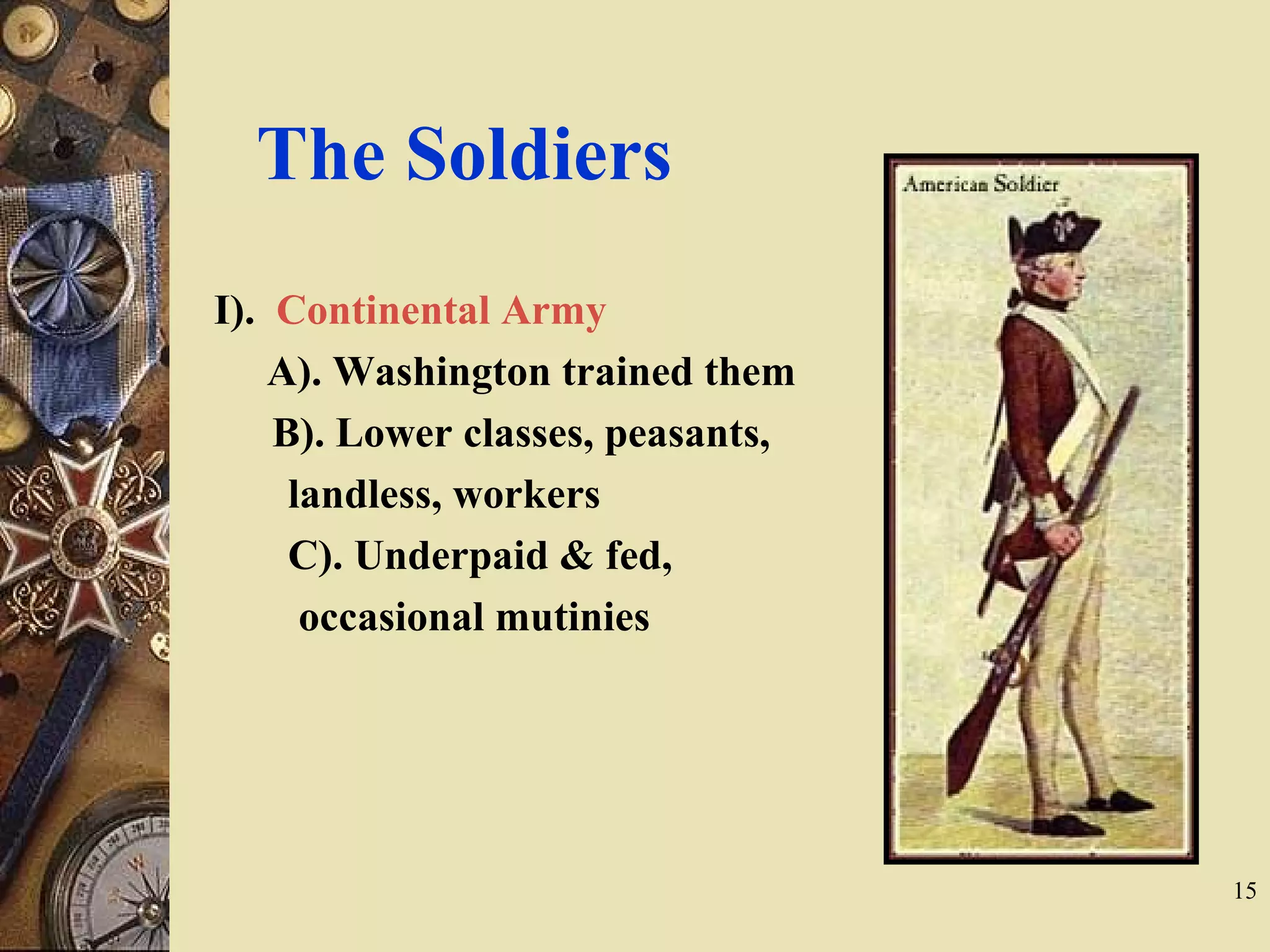
The Soldiers
I). Continental Army
A). Washington trained them
B). Lower classes, peasants,
landless, workers
C). Underpaid & fed,
occasional mutinies
15
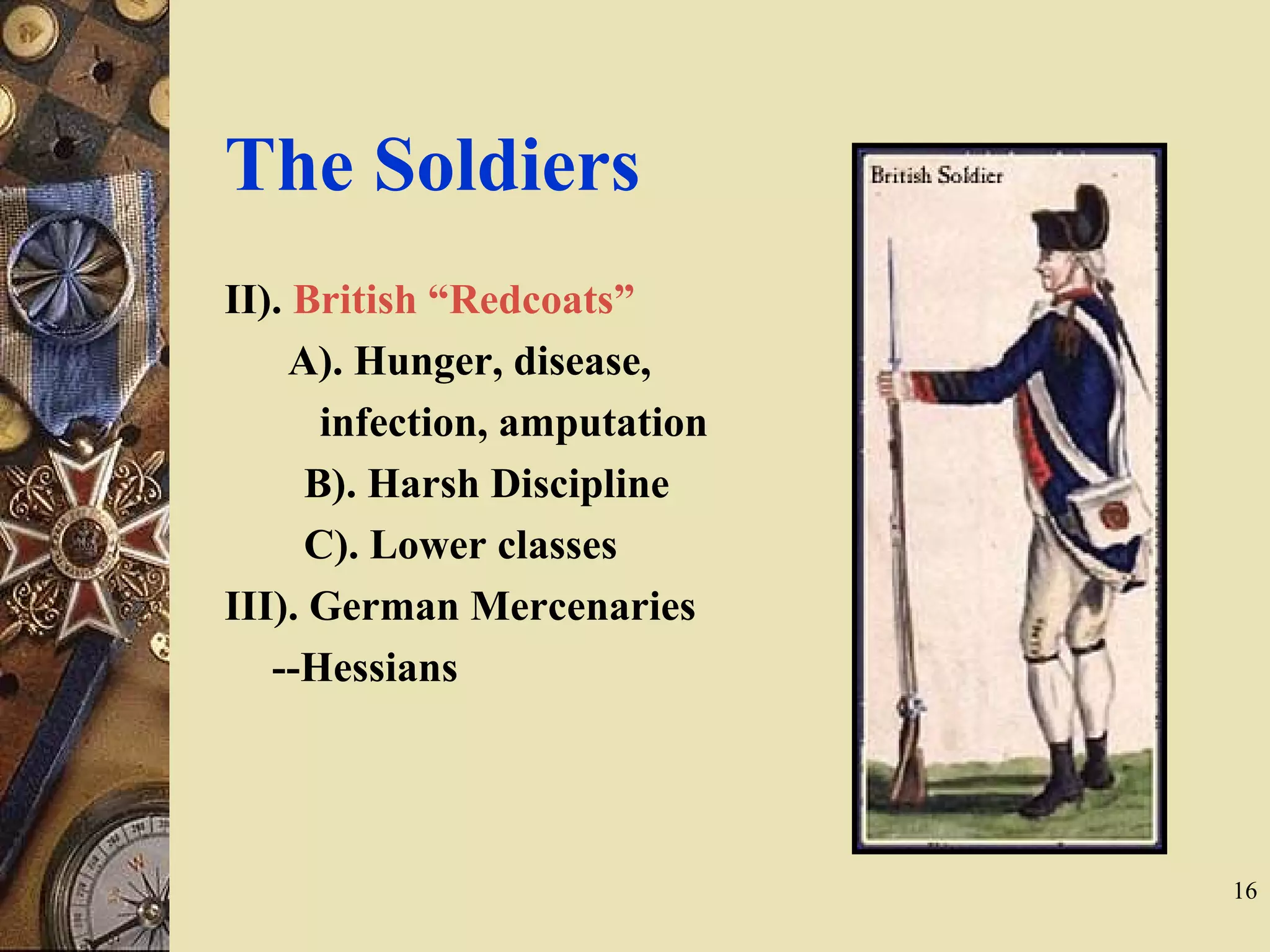
The Soldiers
II). British “Redcoats”
A). Hunger, disease,
infection, amputation
B). Harsh Discipline
C). Lower classes
III). German Mercenaries
--Hessians
16
A Poor Man Fights a Rich
Man’s War
 Committees of Correspondence ordered
townsmen to register for the Continental
Army
 Refusal resulted in imprisonment
 Elites could buy their way out of service
for themselves, their sons and friends
 John Adams: 30% oppose and 30% do not
care about the Revolution
17
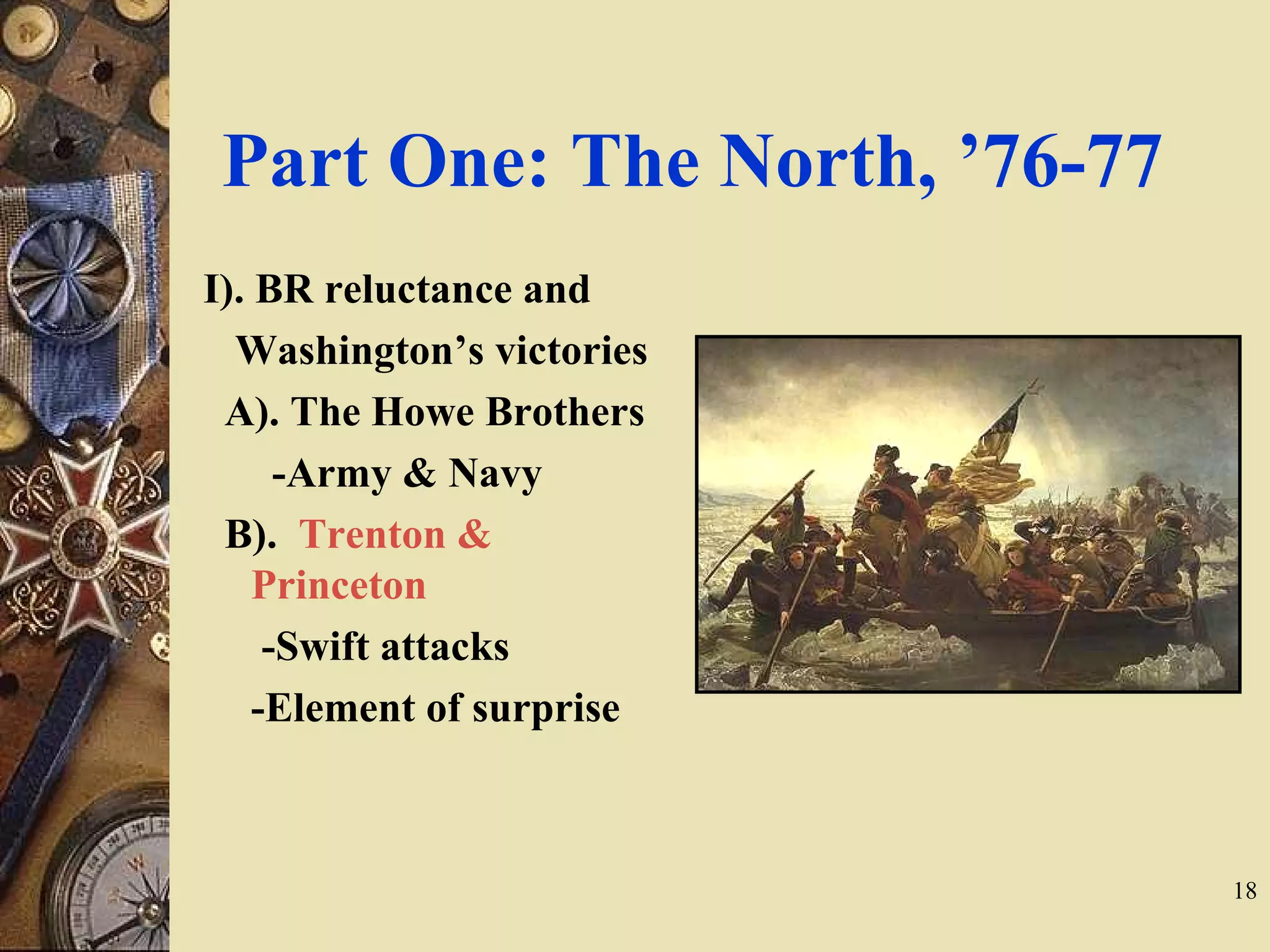
Part One: The North, ’76-77
I). BR reluctance and
Washington’s victories
A). The Howe Brothers
-Army & Navy
B). Trenton &
Princeton
-Swift attacks
-Element of surprise
18
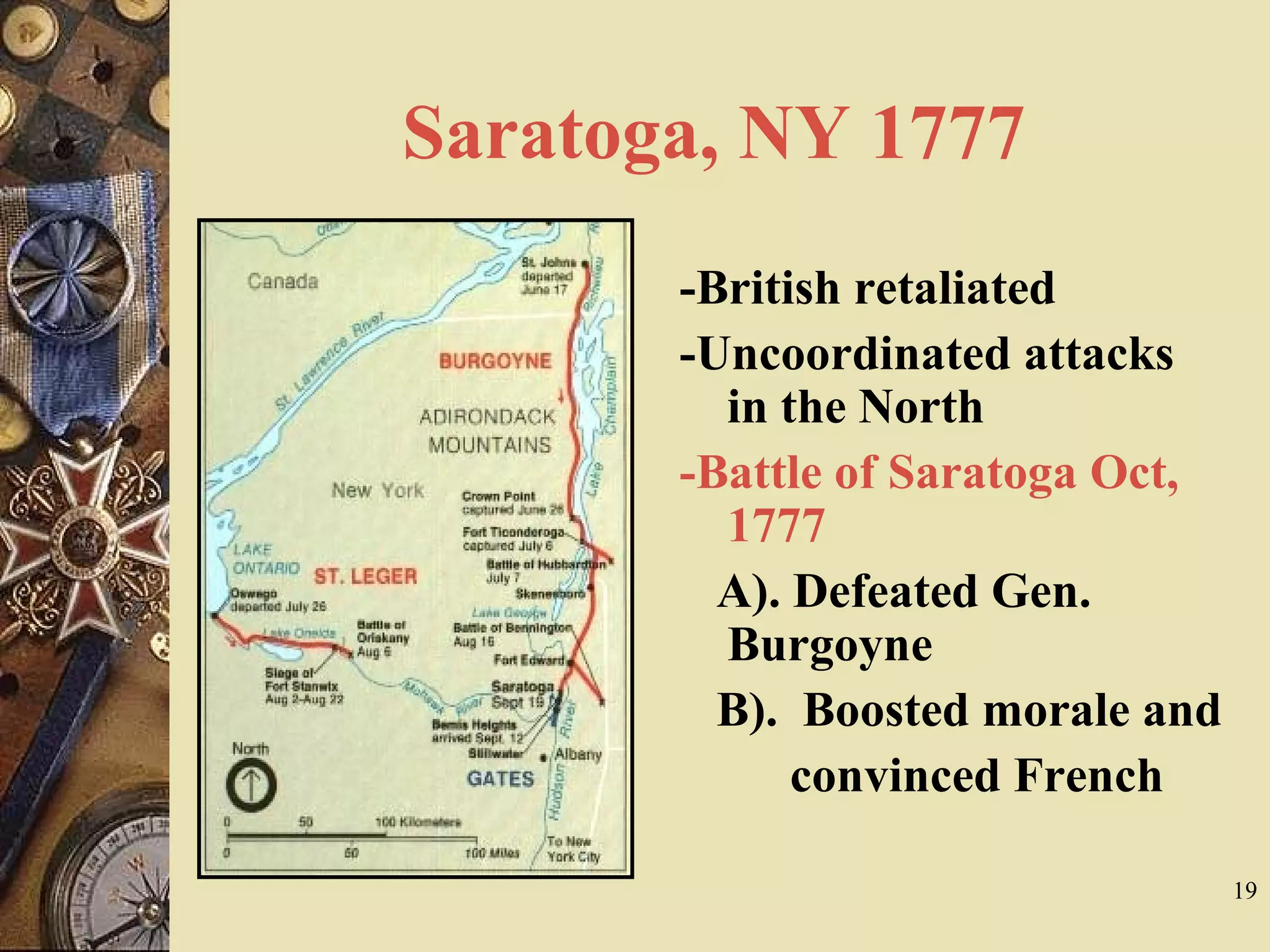
Saratoga, NY 1777
-British retaliated
-Uncoordinated attacks
in the North
-Battle of Saratoga Oct,
1777
A). Defeated Gen.
Burgoyne
B). Boosted morale and
convinced French
19
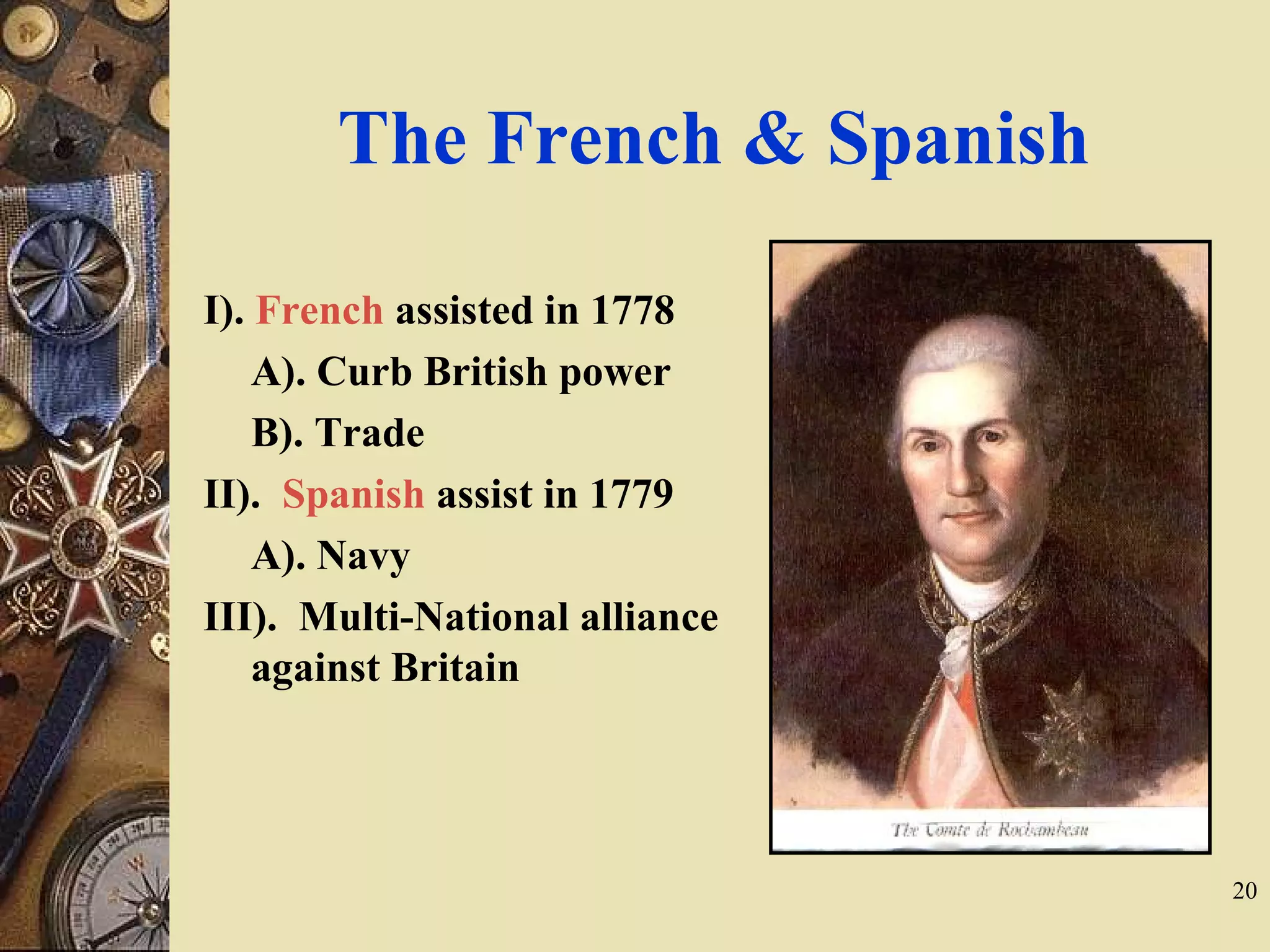
The French & Spanish
I). French assisted in 1778
A). Curb British power
B). Trade
II). Spanish assist in 1779
A). Navy
III). Multi-National alliance
against Britain
20
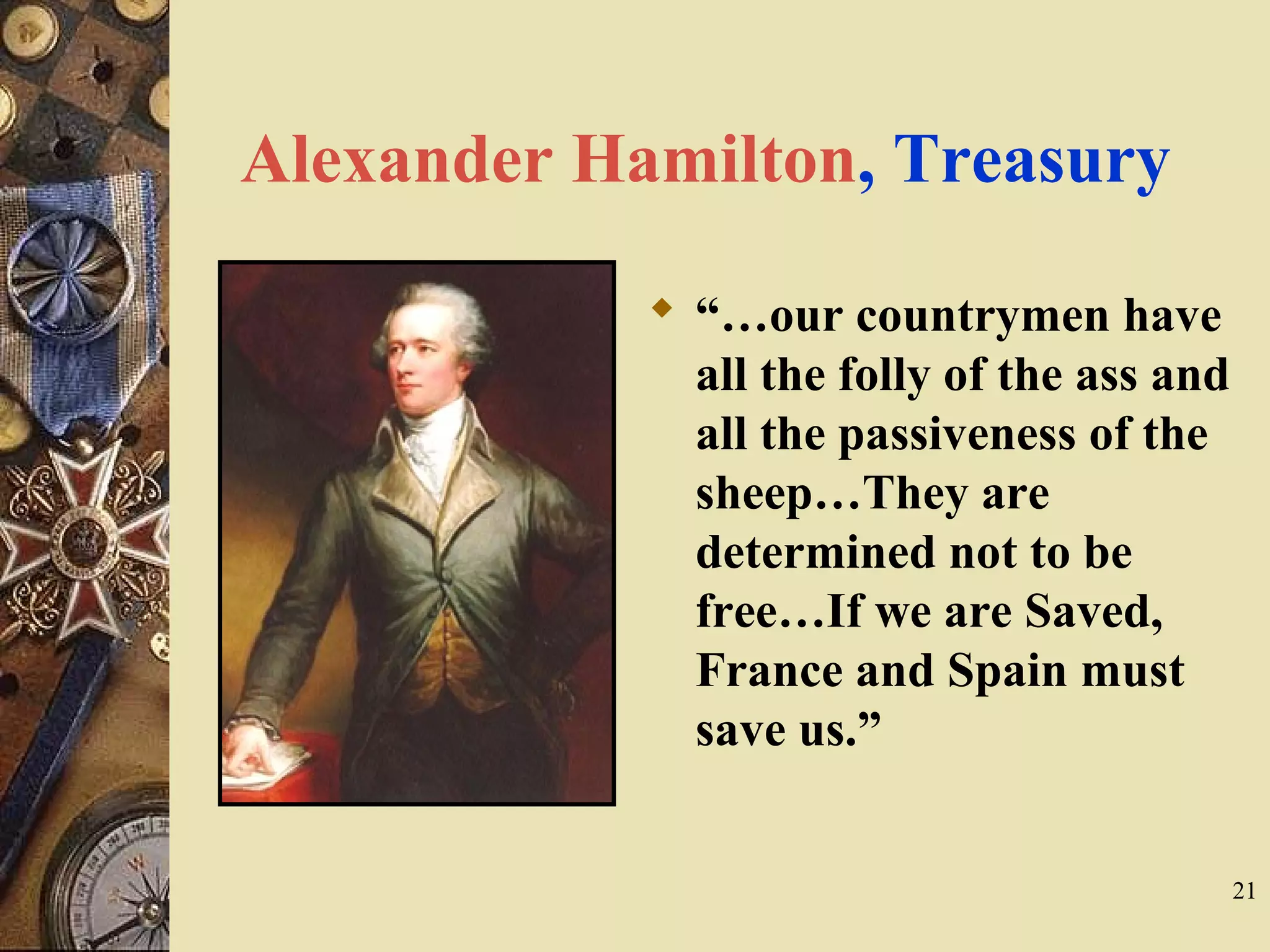
Alexander Hamilton, Treasury
 “…our countrymen have
all the folly of the ass and
all the passiveness of the
sheep…They are
determined not to be
free…If we are Saved,
France and Spain must
save us.”
21
Part Two: South & West,
1778 - 81
I). The South
A). Tory support
B). British victories
1). Replaced Howe with Henry Clinton
2). Charleston, S.C. (Dec. 1779)
a). Biggest American defeat
b). Try to control south
22
Part Three: The End, 1781-83
I). General Clinton in the South
-Concentrated British troops
II). Gen. Nathaniel Greene attacked Cornwallis
at Cowpens (SC), Jan ’81
-Fake surrender & surprise attack
III). British failed to hold rural areas
-Supply lines
-American defensive war
23
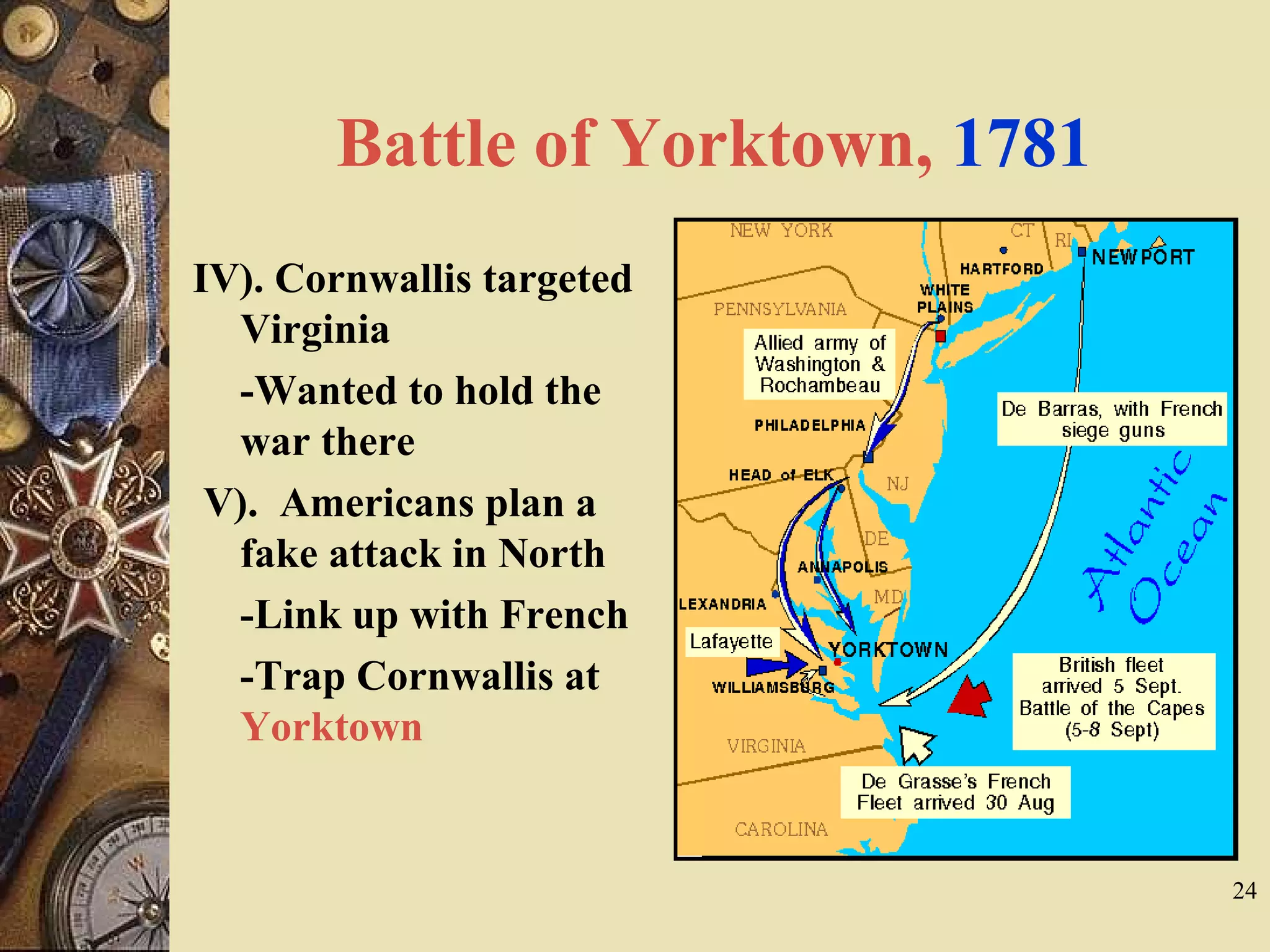
Battle of Yorktown, 1781
IV). Cornwallis targeted
Virginia
-Wanted to hold the
war there
V). Americans plan a
fake attack in North
-Link up with French
-Trap Cornwallis at
Yorktown
24
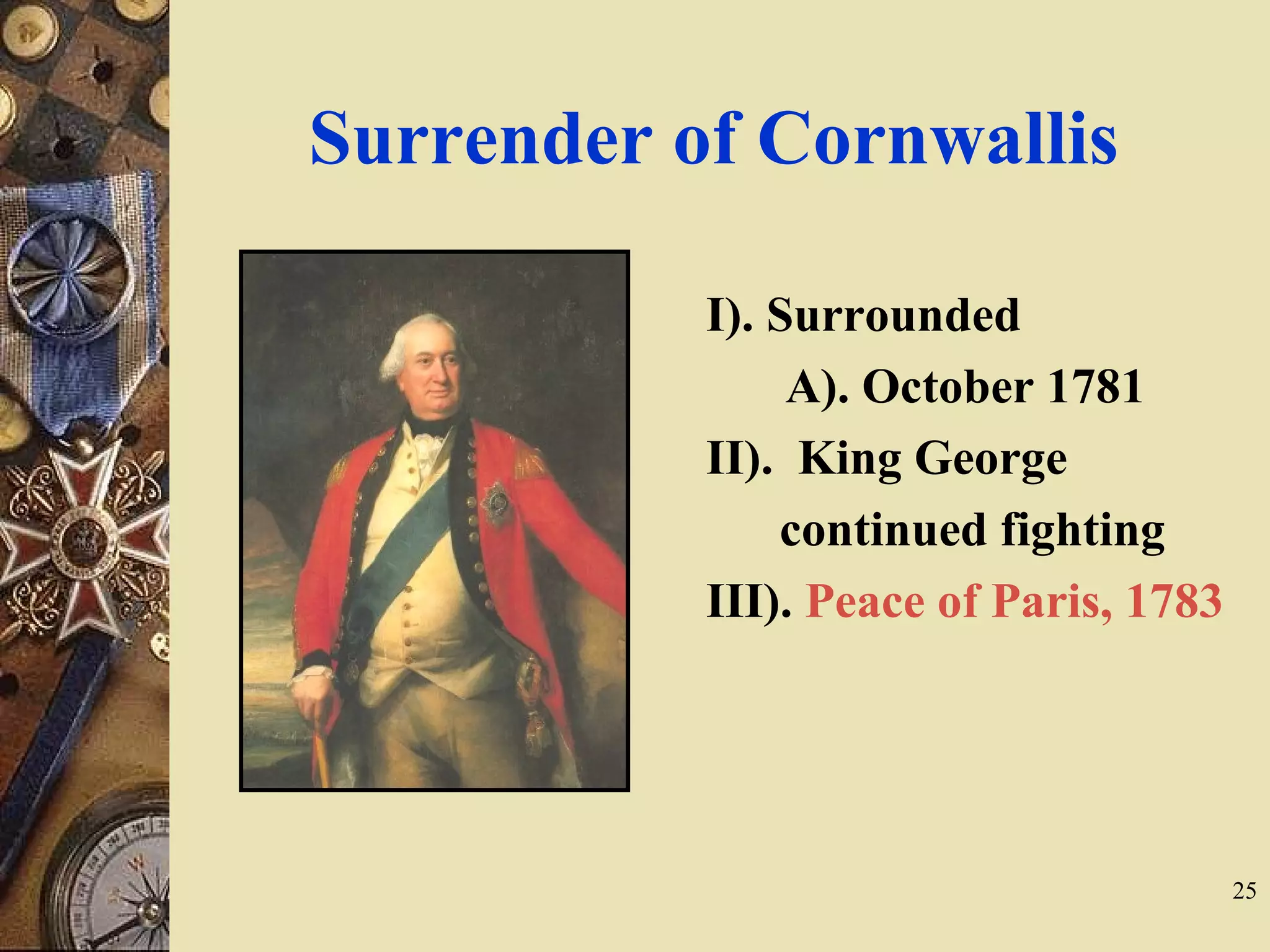
Surrender of Cornwallis
I). Surrounded
A). October 1781
II). King George
continued fighting
III). Peace of Paris, 1783
25
Peace of Paris, 1783
I). B. Franklin, J. Adams, John Jay
A). Accept Independence
B). Boundaries (181)
C). SP gained FL
D). Forfeit land & property (except Lord
Fairfax)
E). Fishing rights
II). Indian Nations
A). Inside U.S. & Indian policy
26
How did it happen?
British arrogance
Leadership
French assistance
Distance
Familiarity
Non-combatants
Defensive War
Dispersed population
27
Joseph Plumb Martin, 1830
 “When we engaged in the service we were
promised the following articles for a ration . . .
But we never received what was allowed us.
Oftentimes I had gone one, two, three and even
four days without a morsel. We were also
promised six dollars and two thirds a month,
and how did we fare in this particular? It was
scarcely enough to procure a dinner.”
 Was he just a whiner, ordid he have a valid
complaint?
28
Continued…
 “The country was rigorous in exacting
my compliance to my engagements, but
equally careless in performing her
contracts with me; and why so? One
reason was because she had all the
power in her own hands, and I had not.
Such things ought not to be.”
 Did the country owe him anything, or
was he supposed to be fighting for his
own independence, too?
29
 “I now bid farewell to the service. When
those who engaged to serve during the war
enlisted, they were promised a hundred acres
of land each. When the country had drained
the last drop of service it could screw out of
the poor soldiers, they were turned adrift
like old worn-out horses, and nothing said
about land to pasture them upon. The truth
was, none cared for them; the country was
served . . . and that was all that was deemed
necessary.”
 If he was correct, what problems might the
new government have with citizens who felt
abused? 30
Rebellions Within the Rebellion
 December 1781: over 400 Penn militia
marched on Congress in Philadelphia to
protest lack of pay, hunger, treatment.
 1782: 200 New Jersey militia protested,
Washington sent 600, hanged two
 Near civil war in Maryland, Delaware, North
and South Carolina, Georgia
31
Women & African Americans
 Worked in camps on the lines
 Molly Pitcher
 Spies, messengers
 Promises of freedom
 5,000 for U.S., workers, few soldiers
 Rarely armed
 South feared of rebellions
32
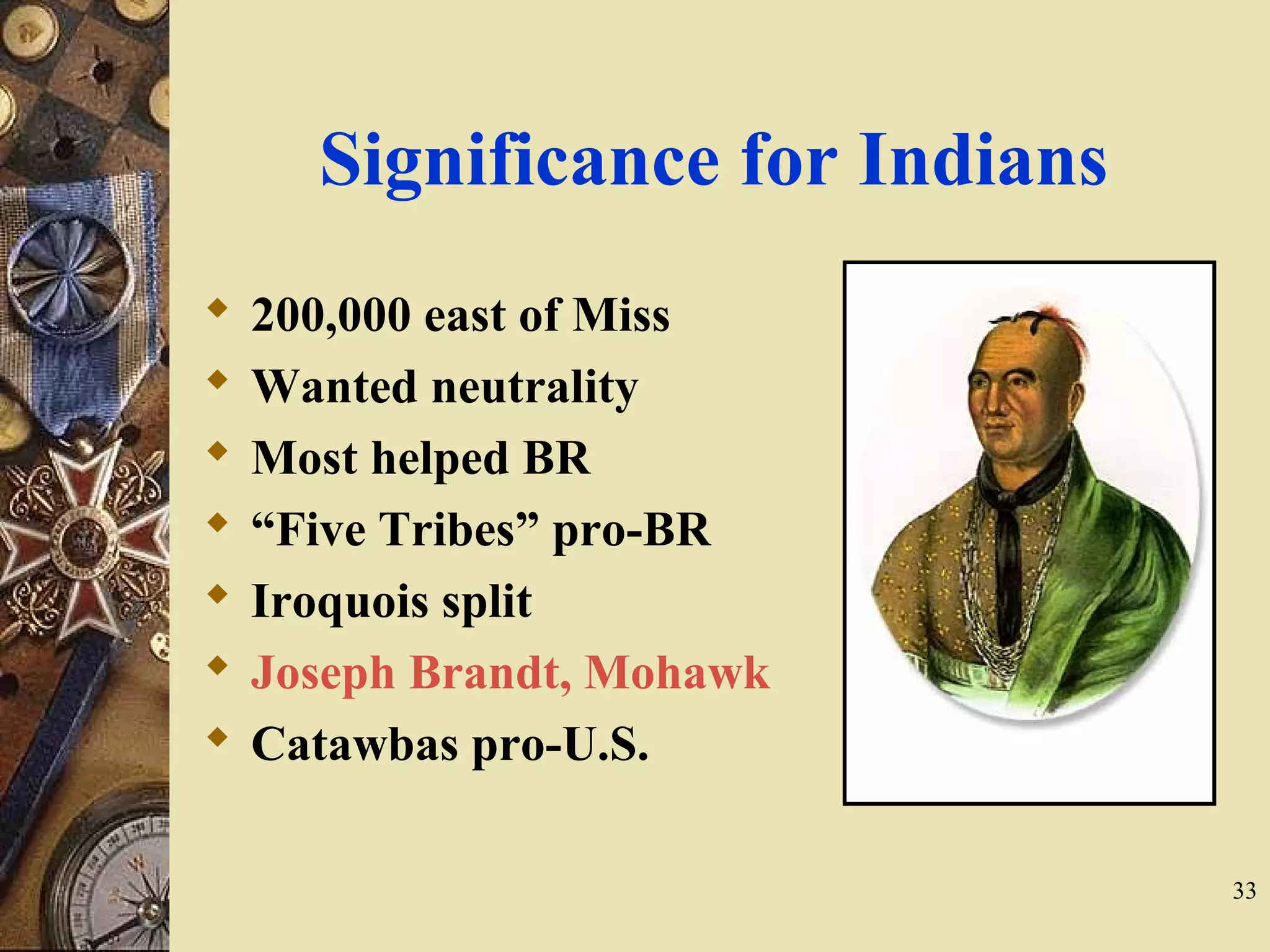
Significance for Indians
 200,000 east of Miss
 Wanted neutrality
 Most helped BR
 “Five Tribes” pro-BR
 Iroquois split
 Joseph Brandt, Mohawk
 Catawbas pro-U.S.
33
Legacy for Indians
 Generally thought it was not their war
 War for liberty and independence took liberty
and independence away from Indians
 War against colonial oppression led to
colonization and oppression of Indians by the
U.S. government
 Soldiers paid with Indian land, not free land
 Indians erased from history due to Paris Peace
Treaty and the idea that the war was fought
ONLY between colonists and British
34
General Conclusions
 70% of those signing the Declaration held
offices in British colonial government
 Class dimensions during War
 Shift from British control to control by new
American elites
 Strengthened southern slavery
 War for political ideals, philosophy
 Created—slowly—possibilities for groups to
express their grievances and struggle for
equality.
 Thank you. 35

Aishwarya singh

  • 1.
    The American Revolution 1776-1783 MADE BY :~ AISHWARYA SINGH 1
  • 2.
    The Revolutionary Era “No Turning Back:” 1774-1776  Declaration of Independence, 1776  The Contenders  Early Years of War  Turning Points  War and Society  Conclusions, 1783 2
  • 3.
    The Road ToWar  The Sons of Liberty organized chapters across the north, opposed what they considered British abuses  Broke “salutary neglect”  Differences: high taxes and abuses vs. payment for war, not following rules, cost of government  Boston Massacre, 1770  Committees of Correspondence  Tea Tax and Boston Tea Party, 1773 3
  • 4.
  • 5.
  • 6.
    No Turning Back,1774-6 -British reacted to Boston Tea Party A). “Intolerable Acts” 1774 1). Mass. Charter; Boston Port; 2). Gen. Thomas Gage in Mass 3). Quebec -1st Continental Congress, 1774 A. Did not want war B. Committed crown C. Boycotts & Unity 6
  • 7.
    Colonial Nationalism  Common Experiences Military Service  British troops  Print Media  Socio-cultural  Anti-Indianism  “Americanism” 7
  • 8.
    Social Differences  WeakAristocracy – Less power  More “open” land – Geographical mobility  Immigration  Indian-fighting  Generations of “Americans” 8
  • 9.
    No Turning Back,1774-6 -Minutemen -Loyalists and Whigs -Lexington & Concord -April 1775 “shot heard ‘round the world’” 9
  • 10.
    No Turning Back,1774-6 -The Second Continental Congress, 1775 A). “National Gov’t” B). Olive Branch Petition C). “Declaration of the Causes and Necessity of Taking up Arms” D). George Washington 10
  • 11.
    Revolutionary Propaganda -Thomas Paine,1776 A). Common Sense B). Argument for rebellion & independence  British seized American ships  ---1776--- 11
  • 12.
    Declaration of Independence Centralideas A. Abuses B. “Self-evident” truths C. Equality D. Rights E. Consent F. Right to overthrow G. Locke, Enlightenment 12
  • 13.
    Limitations  What aboutslavery?  Elite white males  Not the poor  Excluded women  Written secretly Abigail Adams 13
  • 14.
    The Contenders Britain -Wealth -Confidence -Professional Army -Firepower -Navy -Distance& supplies Colonists -Home turf -Defensive War -French -Dispersed population -Size of region -Local noncombatants 14
  • 15.
    The Soldiers I). ContinentalArmy A). Washington trained them B). Lower classes, peasants, landless, workers C). Underpaid & fed, occasional mutinies 15
  • 16.
    The Soldiers II). British“Redcoats” A). Hunger, disease, infection, amputation B). Harsh Discipline C). Lower classes III). German Mercenaries --Hessians 16
  • 17.
    A Poor ManFights a Rich Man’s War  Committees of Correspondence ordered townsmen to register for the Continental Army  Refusal resulted in imprisonment  Elites could buy their way out of service for themselves, their sons and friends  John Adams: 30% oppose and 30% do not care about the Revolution 17
  • 18.
    Part One: TheNorth, ’76-77 I). BR reluctance and Washington’s victories A). The Howe Brothers -Army & Navy B). Trenton & Princeton -Swift attacks -Element of surprise 18
  • 19.
    Saratoga, NY 1777 -Britishretaliated -Uncoordinated attacks in the North -Battle of Saratoga Oct, 1777 A). Defeated Gen. Burgoyne B). Boosted morale and convinced French 19
  • 20.
    The French &Spanish I). French assisted in 1778 A). Curb British power B). Trade II). Spanish assist in 1779 A). Navy III). Multi-National alliance against Britain 20
  • 21.
    Alexander Hamilton, Treasury “…our countrymen have all the folly of the ass and all the passiveness of the sheep…They are determined not to be free…If we are Saved, France and Spain must save us.” 21
  • 22.
    Part Two: South& West, 1778 - 81 I). The South A). Tory support B). British victories 1). Replaced Howe with Henry Clinton 2). Charleston, S.C. (Dec. 1779) a). Biggest American defeat b). Try to control south 22
  • 23.
    Part Three: TheEnd, 1781-83 I). General Clinton in the South -Concentrated British troops II). Gen. Nathaniel Greene attacked Cornwallis at Cowpens (SC), Jan ’81 -Fake surrender & surprise attack III). British failed to hold rural areas -Supply lines -American defensive war 23
  • 24.
    Battle of Yorktown,1781 IV). Cornwallis targeted Virginia -Wanted to hold the war there V). Americans plan a fake attack in North -Link up with French -Trap Cornwallis at Yorktown 24
  • 25.
    Surrender of Cornwallis I).Surrounded A). October 1781 II). King George continued fighting III). Peace of Paris, 1783 25
  • 26.
    Peace of Paris,1783 I). B. Franklin, J. Adams, John Jay A). Accept Independence B). Boundaries (181) C). SP gained FL D). Forfeit land & property (except Lord Fairfax) E). Fishing rights II). Indian Nations A). Inside U.S. & Indian policy 26
  • 27.
    How did ithappen? British arrogance Leadership French assistance Distance Familiarity Non-combatants Defensive War Dispersed population 27
  • 28.
    Joseph Plumb Martin,1830  “When we engaged in the service we were promised the following articles for a ration . . . But we never received what was allowed us. Oftentimes I had gone one, two, three and even four days without a morsel. We were also promised six dollars and two thirds a month, and how did we fare in this particular? It was scarcely enough to procure a dinner.”  Was he just a whiner, ordid he have a valid complaint? 28
  • 29.
    Continued…  “The countrywas rigorous in exacting my compliance to my engagements, but equally careless in performing her contracts with me; and why so? One reason was because she had all the power in her own hands, and I had not. Such things ought not to be.”  Did the country owe him anything, or was he supposed to be fighting for his own independence, too? 29
  • 30.
     “I nowbid farewell to the service. When those who engaged to serve during the war enlisted, they were promised a hundred acres of land each. When the country had drained the last drop of service it could screw out of the poor soldiers, they were turned adrift like old worn-out horses, and nothing said about land to pasture them upon. The truth was, none cared for them; the country was served . . . and that was all that was deemed necessary.”  If he was correct, what problems might the new government have with citizens who felt abused? 30
  • 31.
    Rebellions Within theRebellion  December 1781: over 400 Penn militia marched on Congress in Philadelphia to protest lack of pay, hunger, treatment.  1782: 200 New Jersey militia protested, Washington sent 600, hanged two  Near civil war in Maryland, Delaware, North and South Carolina, Georgia 31
  • 32.
    Women & AfricanAmericans  Worked in camps on the lines  Molly Pitcher  Spies, messengers  Promises of freedom  5,000 for U.S., workers, few soldiers  Rarely armed  South feared of rebellions 32
  • 33.
    Significance for Indians 200,000 east of Miss  Wanted neutrality  Most helped BR  “Five Tribes” pro-BR  Iroquois split  Joseph Brandt, Mohawk  Catawbas pro-U.S. 33
  • 34.
    Legacy for Indians Generally thought it was not their war  War for liberty and independence took liberty and independence away from Indians  War against colonial oppression led to colonization and oppression of Indians by the U.S. government  Soldiers paid with Indian land, not free land  Indians erased from history due to Paris Peace Treaty and the idea that the war was fought ONLY between colonists and British 34
  • 35.
    General Conclusions  70%of those signing the Declaration held offices in British colonial government  Class dimensions during War  Shift from British control to control by new American elites  Strengthened southern slavery  War for political ideals, philosophy  Created—slowly—possibilities for groups to express their grievances and struggle for equality.  Thank you. 35