REPRESENTATION
Preparation for Exam Question 1b: Lesson 1 & 2
Lesson 1
Watch video
https://www.youtube.com/watch?v=ViJeLdaSWVQ
Media informs us
Media forms our identity
Starter Questions & Discussion
 Reflection: Explain what makes up your identity
and which facets of your identity are most
important to you (sex, race, ethnicity, age, socio-
economic class, sexual orientation, nationality,
religion, etc.).
 What do we mean by representation?
 Why is representation important?
KEY CONCEPT POINTS:
 If you take a video you have made for coursework, you will
almost certainly have people in it. If your topic is
REPRESENTATION, then your task is to look at how those
representations work in your video.
 How does your video construct a representation of:
• Social class/status
• Ability/disability
• Gender
• Sexuality
• National or regional identity
• Race
• Ethnicity
 You will need to refer to some critics who have written about
representation or theories of media representation and
attempt to apply those (or argue with them).
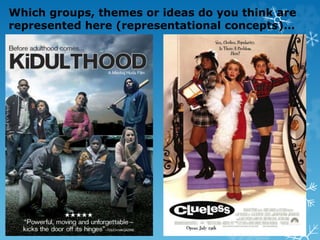
Which groups, themes or ideas do you think are
represented here (representational concepts)…
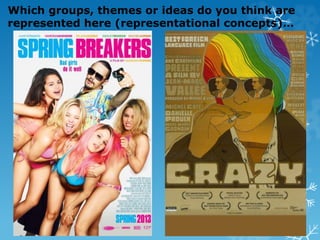
Which groups, themes or ideas do you think are
represented here (representational concepts)…
Example Exam Question
(b) Apply the concept of representation to one
of your coursework productions. [25]
Representation…
…is the process by which the media presents the
‘real world’ to an audience.
Media texts construct meanings about the world – a picture, a
film, a television programme or a newspaper article re-presents
the world to help audiences make sense of it.
Questions to consider when looking at representation:
 who is doing the representing? – a question about
production.
 What is being represented and how is this done? – a
question about textuality.
 How are representations understood by audiences? – a
question about reception.
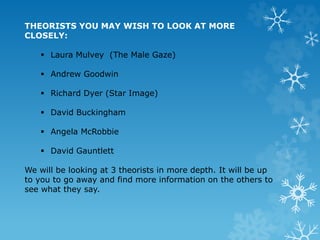
THEORISTS YOU MAY WISH TO LOOK AT MORE
CLOSELY:
 Laura Mulvey (The Male Gaze)
 Andrew Goodwin
 Richard Dyer (Star Image)
 David Buckingham
 Angela McRobbie
 David Gauntlett
We will be looking at 3 theorists in more depth. It will be up
to you to go away and find more information on the others to
see what they say.
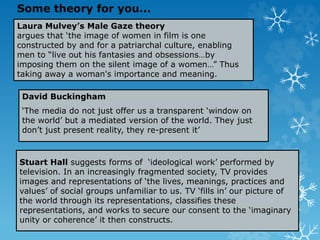
Laura Mulvey’s Male Gaze theory
argues that ‘the image of women in film is one
constructed by and for a patriarchal culture, enabling
men to “live out his fantasies and obsessions…by
imposing them on the silent image of a women…” Thus
taking away a woman's importance and meaning.
David Buckingham
‘The media do not just offer us a transparent ‘window on
the world’ but a mediated version of the world. They just
don’t just present reality, they re-present it’
Stuart Hall suggests forms of ‘ideological work’ performed by
television. In an increasingly fragmented society, TV provides
images and representations of ‘the lives, meanings, practices and
values’ of social groups unfamiliar to us. TV ‘fills in’ our picture of
the world through its representations, classifies these
representations, and works to secure our consent to the ‘imaginary
unity or coherence’ it then constructs.
Some theory for you...
https://www.youtube.com/watch?v=C8azftM5puI
Video for the film
‘Jennifer’s Body’
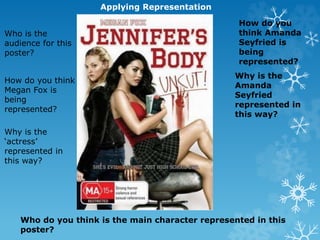
Applying Representation
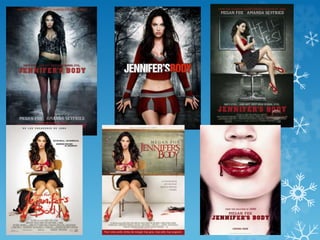
Who is the
audience for this
poster?
How do you think
Megan Fox is
being
represented?
Why is the
‘actress’
represented in
this way?
How do you
think Amanda
Seyfried is
being
represented?
Why is the
Amanda
Seyfried
represented in
this way?
Who do you think is the main character represented in this
poster?
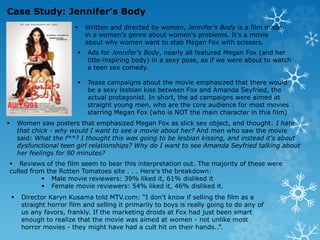
 Written and directed by women, Jennifer's Body is a film made
in a women's genre about women's problems. It's a movie
about why women want to stab Megan Fox with scissors.
 Ads for Jennifer's Body, nearly all featured Megan Fox (and her
title-inspiring body) in a sexy pose, as if we were about to watch
a teen sex comedy.
 Tease campaigns about the movie emphasized that there would
be a sexy lesbian kiss between Fox and Amanda Seyfried, the
actual protagonist. In short, the ad campaigns were aimed at
straight young men, who are the core audience for most movies
starring Megan Fox (who is NOT the main character in this film)
 Women saw posters that emphasized Megan Fox as slick sex object, and thought: I hate
that chick - why would I want to see a movie about her? And men who saw the movie
said: What the f**? I thought this was going to be lesbian kissing, and instead it's about
dysfunctional teen girl relationships? Why do I want to see Amanda Seyfried talking about
her feelings for 90 minutes?
 Reviews of the film seem to bear this interpretation out. The majority of these were
culled from the Rotten Tomatoes site . . . Here's the breakdown:
 Male movie reviewers: 39% liked it, 61% disliked it
 Female movie reviewers: 54% liked it, 46% disliked it.
 Director Karyn Kusama told MTV.com: “I don't know if selling the film as a
straight horror film and selling it primarily to boys is really going to do any of
us any favors, frankly. If the marketing droids at Fox had just been smart
enough to realize that the movie was aimed at women - not unlike most
horror movies - they might have had a cult hit on their hands..”.
Case Study: Jennifer’s Body
Michel Foucault: Rather than audiences or viewers
coming to the television screen with already-formed
identities, television genres….actually help to inform
the identity in question.
Alison Griffiths: stereotypes as rigid, simplistic, over
determined and inherently false…they misrepresented
people’s ‘lived identities’ by falling back upon narrowly
conceived preconceptions of racial, cultural and gendered
difference, thus perpetuating myths about social, cultural
and racial groups.
Richard Dyer: ‘The ideological work of stereotyping
involves closing down the range of possible meanings,
making fast, firm, and separate what is in reality fluid’
Some theory for you...
Watch trailer for The Breakfast Club
https://www.youtube.com/watch?v=dkX8J-
FKndE
Stereotypes
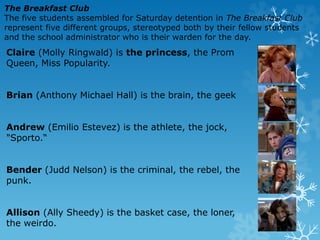
Claire (Molly Ringwald) is the princess, the Prom
Queen, Miss Popularity.
Brian (Anthony Michael Hall) is the brain, the geek
Andrew (Emilio Estevez) is the athlete, the jock,
"Sporto.“
Bender (Judd Nelson) is the criminal, the rebel, the
punk.
Allison (Ally Sheedy) is the basket case, the loner,
the weirdo.
The Breakfast Club
The five students assembled for Saturday detention in The Breakfast Club
represent five different groups, stereotyped both by their fellow students
and the school administrator who is their warden for the day.
Stereotypes
 Stereotypes are used to enable an audience to instantly
identify and understand the meaning of a text. Stereotypes
are an extreme form of representation . Certain aspects are
focussed on and exaggerated.
 In texts, stereotypes are characters who are ‘types’ rather
than complex people.
 Stereotypes are usually negative representations and most
have a lot of assumptions.
 Stereotyping is often evident when there is a power
imbalance between members of society. Relations from men
and women, for example, could encourage the development
of stereotypes on both sides. In the same way,
disadvantaged minority groups (ethnicity, disability) often
have stereotypes associated with them.
Questions:
 What is a stereotype?
 How do we identify them? And what do they tell
us?
 Is it important to be aware of stereotypes in the
media? Why or why not?
Quick Video task on STEREOTYPES
Watch the video for the trailer for the movie
‘Jerry Maguire’ starring Tom Cruise, twice.
Make a quick list of all the stereotypes you can see on
both viewings.
https://www.youtube.com/watch?v=D4pb2JuU6Y4
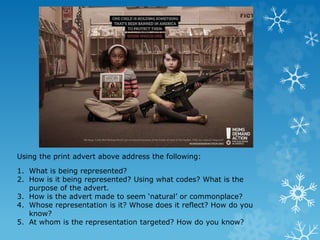
Using the print advert above address the following:
1. What is being represented?
2. How is it being represented? Using what codes? What is the
purpose of the advert.
3. How is the advert made to seem ‘natural’ or commonplace?
4. Whose representation is it? Whose does it reflect? How do you
know?
5. At whom is the representation targeted? How do you know?
Watch the short video on
‘The Male Gaze’
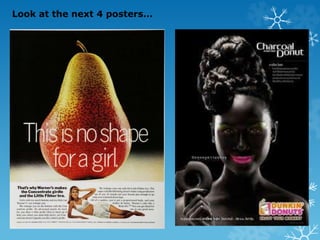
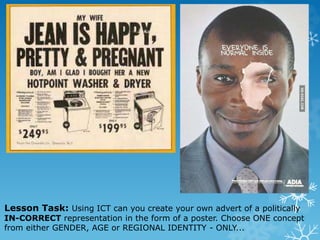
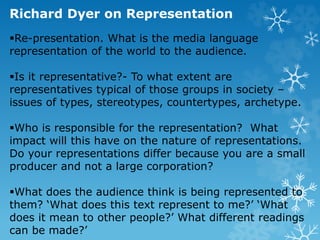
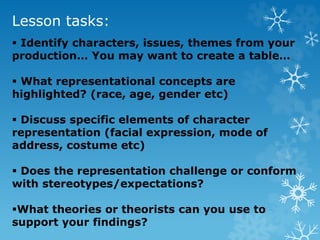
Look at the next 4 posters…
Lesson Task: Using ICT can you create your own advert of a politically
IN-CORRECT representation in the form of a poster. Choose ONE concept
from either GENDER, AGE or REGIONAL IDENTITY - ONLY...
Richard Dyer on Representation
Re-presentation. What is the media language
representation of the world to the audience.
Is it representative?- To what extent are
representatives typical of those groups in society –
issues of types, stereotypes, countertypes, archetype.
Who is responsible for the representation? What
impact will this have on the nature of representations.
Do your representations differ because you are a small
producer and not a large corporation?
What does the audience think is being represented to
them? ‘What does this text represent to me?’ ‘What
does it mean to other people?’ What different readings
can be made?’
Lesson tasks:
 Identify characters, issues, themes from your
production… You may want to create a table…
 What representational concepts are
highlighted? (race, age, gender etc)
 Discuss specific elements of character
representation (facial expression, mode of
address, costume etc)
 Does the representation challenge or conform
with stereotypes/expectations?
What theories or theorists can you use to
support your findings?
REPRESENTATION
Preparation for Exam Question 1b: Lesson 1 & 2
Lesson 2: Essay Planning
REMINDER OF KEY CONCEPT POINTS:
 If you take a video you have made for coursework, you will
almost certainly have people in it. If your topic is
REPRESENTATION, then your task is to look at how those
representations work in your video.
 How does your video construct a representation of:
• Social class/status
• Ability/disability
• Gender
• Sexuality
• National or regional identity
• Race
• Ethnicity
 You will need to refer to some critics who have written about
representation or theories of media representation and attempt
to apply those (or argue with them).
SECTION A: Theoretical Evaluation of Production
1 (b) In question 1(b) you must write about one of your media
productions.
(b) Apply the concept of representation to one of your coursework
productions. [25]
Example Exam Question
How might you now go about planning for
this question?
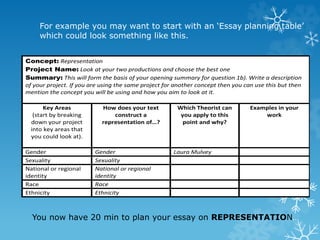
For example you may want to start with an ‘Essay planning table’
which could look something like this.
Concept: Representation
Project Name: Look at your two productions and choose the best one
Summary: This will form the basis of your opening summary for question 1b). Write a description
of your project. If you are using the same project for another concept then you can use this but then
mention the concept you will be using and how you aim to look at it.
Key Areas
(start by breaking
down your project
into key areas that
you could look at).
How does your text
construct a
representation of…?
Which Theorist can
you apply to this
point and why?
Examples in your
work
Gender Gender Laura Mulvey
Sexuality Sexuality
National or regional
identity
National or regional
identity
Race Race
Ethnicity Ethnicity
You now have 20 min to plan your essay on REPRESENTATION…
(b) Apply the concept of representation to one of your coursework
productions. [25]
Now using your lesson plan attempt
the question:
….You have 30 mins
Good luck!
HOMEWORK TASK:
 Take a look at your media theorists hand-out.
Research other theories that may use to apply to
your texts. Find quotes for each theorist you
research:
 Laura Mulvey (The Male Gaze)
 Andrew Goodwin
 Richard Dyer (Star Image)
 David Buckingham
 Angela McRobbie
 David Gauntlett

Lesson 5 Representation

  • 1.
    REPRESENTATION Preparation for ExamQuestion 1b: Lesson 1 & 2 Lesson 1
  • 2.
  • 3.
    Starter Questions &Discussion  Reflection: Explain what makes up your identity and which facets of your identity are most important to you (sex, race, ethnicity, age, socio- economic class, sexual orientation, nationality, religion, etc.).  What do we mean by representation?  Why is representation important?
  • 4.
    KEY CONCEPT POINTS: If you take a video you have made for coursework, you will almost certainly have people in it. If your topic is REPRESENTATION, then your task is to look at how those representations work in your video.  How does your video construct a representation of: • Social class/status • Ability/disability • Gender • Sexuality • National or regional identity • Race • Ethnicity  You will need to refer to some critics who have written about representation or theories of media representation and attempt to apply those (or argue with them).
  • 5.
    Which groups, themesor ideas do you think are represented here (representational concepts)…
  • 6.
    Which groups, themesor ideas do you think are represented here (representational concepts)…
  • 7.
    Example Exam Question (b)Apply the concept of representation to one of your coursework productions. [25]
  • 8.
    Representation… …is the processby which the media presents the ‘real world’ to an audience. Media texts construct meanings about the world – a picture, a film, a television programme or a newspaper article re-presents the world to help audiences make sense of it. Questions to consider when looking at representation:  who is doing the representing? – a question about production.  What is being represented and how is this done? – a question about textuality.  How are representations understood by audiences? – a question about reception.
  • 9.
    THEORISTS YOU MAYWISH TO LOOK AT MORE CLOSELY:  Laura Mulvey (The Male Gaze)  Andrew Goodwin  Richard Dyer (Star Image)  David Buckingham  Angela McRobbie  David Gauntlett We will be looking at 3 theorists in more depth. It will be up to you to go away and find more information on the others to see what they say.
  • 10.
    Laura Mulvey’s MaleGaze theory argues that ‘the image of women in film is one constructed by and for a patriarchal culture, enabling men to “live out his fantasies and obsessions…by imposing them on the silent image of a women…” Thus taking away a woman's importance and meaning. David Buckingham ‘The media do not just offer us a transparent ‘window on the world’ but a mediated version of the world. They just don’t just present reality, they re-present it’ Stuart Hall suggests forms of ‘ideological work’ performed by television. In an increasingly fragmented society, TV provides images and representations of ‘the lives, meanings, practices and values’ of social groups unfamiliar to us. TV ‘fills in’ our picture of the world through its representations, classifies these representations, and works to secure our consent to the ‘imaginary unity or coherence’ it then constructs. Some theory for you...
  • 11.
  • 12.
    Applying Representation Who isthe audience for this poster? How do you think Megan Fox is being represented? Why is the ‘actress’ represented in this way? How do you think Amanda Seyfried is being represented? Why is the Amanda Seyfried represented in this way? Who do you think is the main character represented in this poster?
  • 14.
     Written anddirected by women, Jennifer's Body is a film made in a women's genre about women's problems. It's a movie about why women want to stab Megan Fox with scissors.  Ads for Jennifer's Body, nearly all featured Megan Fox (and her title-inspiring body) in a sexy pose, as if we were about to watch a teen sex comedy.  Tease campaigns about the movie emphasized that there would be a sexy lesbian kiss between Fox and Amanda Seyfried, the actual protagonist. In short, the ad campaigns were aimed at straight young men, who are the core audience for most movies starring Megan Fox (who is NOT the main character in this film)  Women saw posters that emphasized Megan Fox as slick sex object, and thought: I hate that chick - why would I want to see a movie about her? And men who saw the movie said: What the f**? I thought this was going to be lesbian kissing, and instead it's about dysfunctional teen girl relationships? Why do I want to see Amanda Seyfried talking about her feelings for 90 minutes?  Reviews of the film seem to bear this interpretation out. The majority of these were culled from the Rotten Tomatoes site . . . Here's the breakdown:  Male movie reviewers: 39% liked it, 61% disliked it  Female movie reviewers: 54% liked it, 46% disliked it.  Director Karyn Kusama told MTV.com: “I don't know if selling the film as a straight horror film and selling it primarily to boys is really going to do any of us any favors, frankly. If the marketing droids at Fox had just been smart enough to realize that the movie was aimed at women - not unlike most horror movies - they might have had a cult hit on their hands..”. Case Study: Jennifer’s Body
  • 15.
    Michel Foucault: Ratherthan audiences or viewers coming to the television screen with already-formed identities, television genres….actually help to inform the identity in question. Alison Griffiths: stereotypes as rigid, simplistic, over determined and inherently false…they misrepresented people’s ‘lived identities’ by falling back upon narrowly conceived preconceptions of racial, cultural and gendered difference, thus perpetuating myths about social, cultural and racial groups. Richard Dyer: ‘The ideological work of stereotyping involves closing down the range of possible meanings, making fast, firm, and separate what is in reality fluid’ Some theory for you...
  • 16.
    Watch trailer forThe Breakfast Club https://www.youtube.com/watch?v=dkX8J- FKndE Stereotypes
  • 17.
    Claire (Molly Ringwald)is the princess, the Prom Queen, Miss Popularity. Brian (Anthony Michael Hall) is the brain, the geek Andrew (Emilio Estevez) is the athlete, the jock, "Sporto.“ Bender (Judd Nelson) is the criminal, the rebel, the punk. Allison (Ally Sheedy) is the basket case, the loner, the weirdo. The Breakfast Club The five students assembled for Saturday detention in The Breakfast Club represent five different groups, stereotyped both by their fellow students and the school administrator who is their warden for the day.
  • 18.
    Stereotypes  Stereotypes areused to enable an audience to instantly identify and understand the meaning of a text. Stereotypes are an extreme form of representation . Certain aspects are focussed on and exaggerated.  In texts, stereotypes are characters who are ‘types’ rather than complex people.  Stereotypes are usually negative representations and most have a lot of assumptions.  Stereotyping is often evident when there is a power imbalance between members of society. Relations from men and women, for example, could encourage the development of stereotypes on both sides. In the same way, disadvantaged minority groups (ethnicity, disability) often have stereotypes associated with them.
  • 19.
    Questions:  What isa stereotype?  How do we identify them? And what do they tell us?  Is it important to be aware of stereotypes in the media? Why or why not? Quick Video task on STEREOTYPES Watch the video for the trailer for the movie ‘Jerry Maguire’ starring Tom Cruise, twice. Make a quick list of all the stereotypes you can see on both viewings. https://www.youtube.com/watch?v=D4pb2JuU6Y4
  • 20.
    Using the printadvert above address the following: 1. What is being represented? 2. How is it being represented? Using what codes? What is the purpose of the advert. 3. How is the advert made to seem ‘natural’ or commonplace? 4. Whose representation is it? Whose does it reflect? How do you know? 5. At whom is the representation targeted? How do you know?
  • 21.
    Watch the shortvideo on ‘The Male Gaze’
  • 22.
    Look at thenext 4 posters…
  • 23.
    Lesson Task: UsingICT can you create your own advert of a politically IN-CORRECT representation in the form of a poster. Choose ONE concept from either GENDER, AGE or REGIONAL IDENTITY - ONLY...
  • 24.
    Richard Dyer onRepresentation Re-presentation. What is the media language representation of the world to the audience. Is it representative?- To what extent are representatives typical of those groups in society – issues of types, stereotypes, countertypes, archetype. Who is responsible for the representation? What impact will this have on the nature of representations. Do your representations differ because you are a small producer and not a large corporation? What does the audience think is being represented to them? ‘What does this text represent to me?’ ‘What does it mean to other people?’ What different readings can be made?’
  • 25.
    Lesson tasks:  Identifycharacters, issues, themes from your production… You may want to create a table…  What representational concepts are highlighted? (race, age, gender etc)  Discuss specific elements of character representation (facial expression, mode of address, costume etc)  Does the representation challenge or conform with stereotypes/expectations? What theories or theorists can you use to support your findings?
  • 26.
    REPRESENTATION Preparation for ExamQuestion 1b: Lesson 1 & 2 Lesson 2: Essay Planning
  • 27.
    REMINDER OF KEYCONCEPT POINTS:  If you take a video you have made for coursework, you will almost certainly have people in it. If your topic is REPRESENTATION, then your task is to look at how those representations work in your video.  How does your video construct a representation of: • Social class/status • Ability/disability • Gender • Sexuality • National or regional identity • Race • Ethnicity  You will need to refer to some critics who have written about representation or theories of media representation and attempt to apply those (or argue with them).
  • 28.
    SECTION A: TheoreticalEvaluation of Production 1 (b) In question 1(b) you must write about one of your media productions. (b) Apply the concept of representation to one of your coursework productions. [25] Example Exam Question How might you now go about planning for this question?
  • 29.
    For example youmay want to start with an ‘Essay planning table’ which could look something like this. Concept: Representation Project Name: Look at your two productions and choose the best one Summary: This will form the basis of your opening summary for question 1b). Write a description of your project. If you are using the same project for another concept then you can use this but then mention the concept you will be using and how you aim to look at it. Key Areas (start by breaking down your project into key areas that you could look at). How does your text construct a representation of…? Which Theorist can you apply to this point and why? Examples in your work Gender Gender Laura Mulvey Sexuality Sexuality National or regional identity National or regional identity Race Race Ethnicity Ethnicity You now have 20 min to plan your essay on REPRESENTATION…
  • 30.
    (b) Apply theconcept of representation to one of your coursework productions. [25] Now using your lesson plan attempt the question: ….You have 30 mins Good luck!
  • 31.
    HOMEWORK TASK:  Takea look at your media theorists hand-out. Research other theories that may use to apply to your texts. Find quotes for each theorist you research:  Laura Mulvey (The Male Gaze)  Andrew Goodwin  Richard Dyer (Star Image)  David Buckingham  Angela McRobbie  David Gauntlett