REPRESENTATION
Dominant Ideologies
• Stereotypes are ‘socially constructed’ and exist as
  ‘myths’ and are neither ‘true’ nor ‘false’ but simply a
  reflection of dominant ideologies.
  Stereotypes can be. reinforced challenged or even
  constructed by the media through representation
• The group of ideas that make up the dominant ideology in
  Britain are not something that remains static- they change
  as new ideas enter the are encountered and people
  discuss them. For example one of the dominant
  ideologies in Britain is that youths are thugs; there is an
  anti-youth culture
Changing representations – Countertypes
• In the Sci-Fi blockbuster film Independence Day there is a character
  played by Will Smith who is clearly intended to be a positive and
  strong hero. As such, he goes against many of the previous negative
  stereotypes of black people in American films. In one crucial scene
  from the film we see him responding to the danger of an alien's attack
  by simply kicking it.
• In another blockbuster Sci-Fi film - Mars Attacks - there is also a
  black hero who also responds to the attack of a bunch of aliens by
  punching one of them. Both of these films were made virtually
  simultaneously.
• The directors wanted a change from the ‘norm’ and they have in fact
  created a new positive stereotype, a countertype
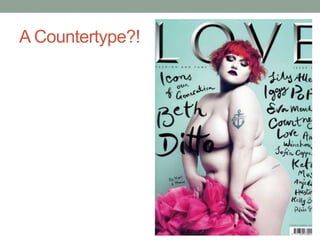
• A counter-stereotype is the reverse of a stereotype. Although
  counter-stereotypes arise in opposition to stereotypes, they may
  eventually become stereotypes themselves if they are too popular.
Returning to Mediation
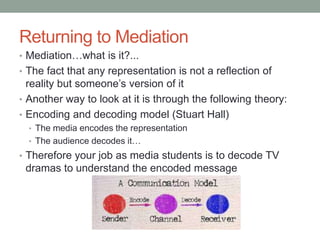
• Mediation…what is it?...
• The fact that any representation is not a reflection of
  reality but someone’s version of it
• Another way to look at it is through the following theory:
• Encoding and decoding model (Stuart Hall)
  • The media encodes the representation
  • The audience decodes it…
• Therefore your job as media students is to decode TV
 dramas to understand the encoded message
Activity 1a
Draw a table with the following headings and compile a list of what you
consider to be characteristics/adjectives that reflect each gender
(strong, dependent, fragrant, vein, soft etc)

• Male                                   • Female
Activity 1b
Add to your table a list of objects you associate with each gender


• Male                                    • Female
Feminine Representation
• Feminism
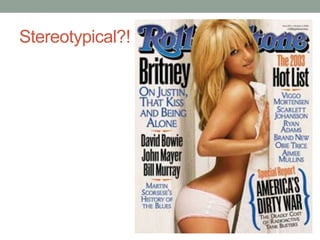
• Representations of women across all media tend to highlight
 the following:
  •   beauty (within narrow conventions)
  •   size/physique (again, within narrow conventions)
  •   sexuality (as expressed by the above)
  •   emotional (as opposed to intellectual) dealings
  •   relationships (as opposed to independence/freedom)
• Women are often represented as being part of a context
  (family, friends, colleagues) and working/thinking as part of a
  team.
• In drama, they tend to take the role of helper (Propp) or object,
  passive rather than active.
• Men are still represented as TV drama characters up to 3 times
  more frequently than women.
Stereotypical?!
A Countertype?!
Masculine Representation
• 'Masculinity' is a concept that is made up of more rigid
 stereotypes than femininity. Representations of men
 across all media tend to focus on the following:
  • Strength - physical and intellectual
  • Power
  • Sexual attractiveness (which may be based on the above)
  • Physique
  • Independence (of thought, action)
• Male characters are often represented as isolated, as not
  needing to rely on others (the lone hero).
• If they submit to being part of a family, it is often part of
  the resolution of a narrative, rather than an integral factor
  in the initial equilibrium.
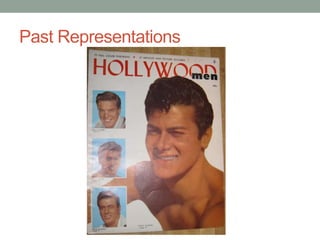
Past Representations
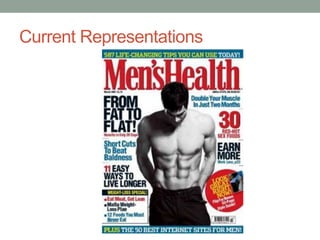
Current Representations
Reinforcing Gender Stereotypes
• In advertising
Activity 2
• Write down a list of the different technical approaches that
 might be used to construct stereotypical representations
 of gender:
  • Camera shots, angle, movement and position
  • Mise en scene
  • Sound
  • Editing
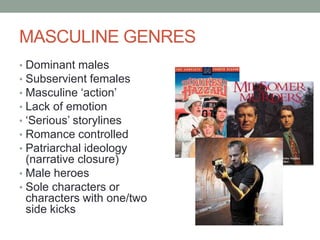
MASCULINE GENRES
• Dominant males
• Subservient females
• Masculine ‘action’
• Lack of emotion
• ‘Serious’ storylines
• Romance controlled
• Patriarchal ideology
  (narrative closure)
• Male heroes
• Sole characters or
  characters with one/two
  side kicks
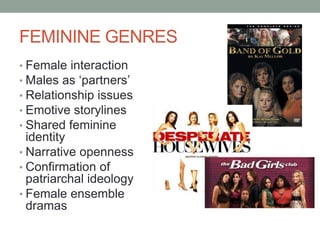
FEMININE GENRES
• Female interaction
• Males as ‘partners’
• Relationship issues
• Emotive storylines
• Shared feminine
  identity
• Narrative openness
• Confirmation of
  patriarchal ideology
• Female ensemble
  dramas
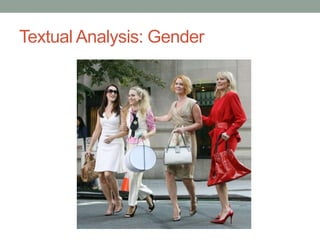
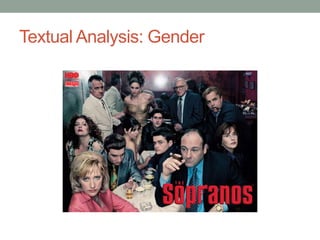
Textual Analysis: Gender

TV Drama - Representation & Gender Introduction

  • 1.
  • 2.
    Dominant Ideologies • Stereotypesare ‘socially constructed’ and exist as ‘myths’ and are neither ‘true’ nor ‘false’ but simply a reflection of dominant ideologies. Stereotypes can be. reinforced challenged or even constructed by the media through representation • The group of ideas that make up the dominant ideology in Britain are not something that remains static- they change as new ideas enter the are encountered and people discuss them. For example one of the dominant ideologies in Britain is that youths are thugs; there is an anti-youth culture
  • 3.
    Changing representations –Countertypes • In the Sci-Fi blockbuster film Independence Day there is a character played by Will Smith who is clearly intended to be a positive and strong hero. As such, he goes against many of the previous negative stereotypes of black people in American films. In one crucial scene from the film we see him responding to the danger of an alien's attack by simply kicking it. • In another blockbuster Sci-Fi film - Mars Attacks - there is also a black hero who also responds to the attack of a bunch of aliens by punching one of them. Both of these films were made virtually simultaneously. • The directors wanted a change from the ‘norm’ and they have in fact created a new positive stereotype, a countertype • A counter-stereotype is the reverse of a stereotype. Although counter-stereotypes arise in opposition to stereotypes, they may eventually become stereotypes themselves if they are too popular.
  • 4.
    Returning to Mediation •Mediation…what is it?... • The fact that any representation is not a reflection of reality but someone’s version of it • Another way to look at it is through the following theory: • Encoding and decoding model (Stuart Hall) • The media encodes the representation • The audience decodes it… • Therefore your job as media students is to decode TV dramas to understand the encoded message
  • 5.
    Activity 1a Draw atable with the following headings and compile a list of what you consider to be characteristics/adjectives that reflect each gender (strong, dependent, fragrant, vein, soft etc) • Male • Female
  • 6.
    Activity 1b Add toyour table a list of objects you associate with each gender • Male • Female
  • 7.
    Feminine Representation • Feminism •Representations of women across all media tend to highlight the following: • beauty (within narrow conventions) • size/physique (again, within narrow conventions) • sexuality (as expressed by the above) • emotional (as opposed to intellectual) dealings • relationships (as opposed to independence/freedom) • Women are often represented as being part of a context (family, friends, colleagues) and working/thinking as part of a team. • In drama, they tend to take the role of helper (Propp) or object, passive rather than active. • Men are still represented as TV drama characters up to 3 times more frequently than women.
  • 8.
  • 9.
  • 11.
    Masculine Representation • 'Masculinity'is a concept that is made up of more rigid stereotypes than femininity. Representations of men across all media tend to focus on the following: • Strength - physical and intellectual • Power • Sexual attractiveness (which may be based on the above) • Physique • Independence (of thought, action) • Male characters are often represented as isolated, as not needing to rely on others (the lone hero). • If they submit to being part of a family, it is often part of the resolution of a narrative, rather than an integral factor in the initial equilibrium.
  • 12.
  • 13.
  • 14.
  • 15.
    Activity 2 • Writedown a list of the different technical approaches that might be used to construct stereotypical representations of gender: • Camera shots, angle, movement and position • Mise en scene • Sound • Editing
  • 16.
    MASCULINE GENRES • Dominantmales • Subservient females • Masculine ‘action’ • Lack of emotion • ‘Serious’ storylines • Romance controlled • Patriarchal ideology (narrative closure) • Male heroes • Sole characters or characters with one/two side kicks
  • 17.
    FEMININE GENRES • Femaleinteraction • Males as ‘partners’ • Relationship issues • Emotive storylines • Shared feminine identity • Narrative openness • Confirmation of patriarchal ideology • Female ensemble dramas
  • 18.
  • 19.