GENRE
Preparation for Exam Question 1b: Lesson 5 & 6
Lesson 1
Starter Questions & Discussion
 What do we mean by genre?
 Individually make a list of the different
genres and subgenres you can think of? (5
min)
 Now pair up and compare notes and
upgrade the individual lists. (5 min)
 Why is genre important?
Example Exam Question
1(b) Apply the concept of genre to one of
your coursework productions.[25]
Genre…
‘Genre’ is a critical tool that helps us study texts and
audience responses to texts by dividing them into
categories based on common elements.
Questions to consider when looking at genre:
 What is the genre of your text?
 How would the audience or media institutions know
this?
 What other genres are contained within your text?
KEY CONCEPT POINTS:
 In GENRE, your task is identifying genre and subgenre in your
work and looking at how genre affects your work.
 You should not just cover generic conventions of the particular sub-
genre of their product but should include ideas about how genres
develop/evolve (in relation to your text) and how institutions use
genre to target audiences.
 Your analysis of your text will need to set in relation to the forms
and conventions shown in other such texts. But it should not simply
comprise a list of those conventions.
 You will need to understand the concept of genre theory and
familiarise yourself with key genre theorists.
 You will need a basic understanding of how to categorise and
evaluate your coursework against genre theory.
The idea of genre then, could be described in the following ways:
It is a way the audiences recognise and understand certain films.
A film will show the characteristics expected from a particular
genre in order for it to be classified as a member of that particular
genre.
The film industry will use the idea of genre when deciding what
films to finance and also how to publicise and market the film.
Frequently, people choose to go to the movies to see a certain type
of film.
Popular genres include:
•Action
•Comedy
•Western
•Science-fiction
•Horror
•Musicals
Genres are used by industry officials in deciding what kinds of
films to make and as a simple way to characterize film.
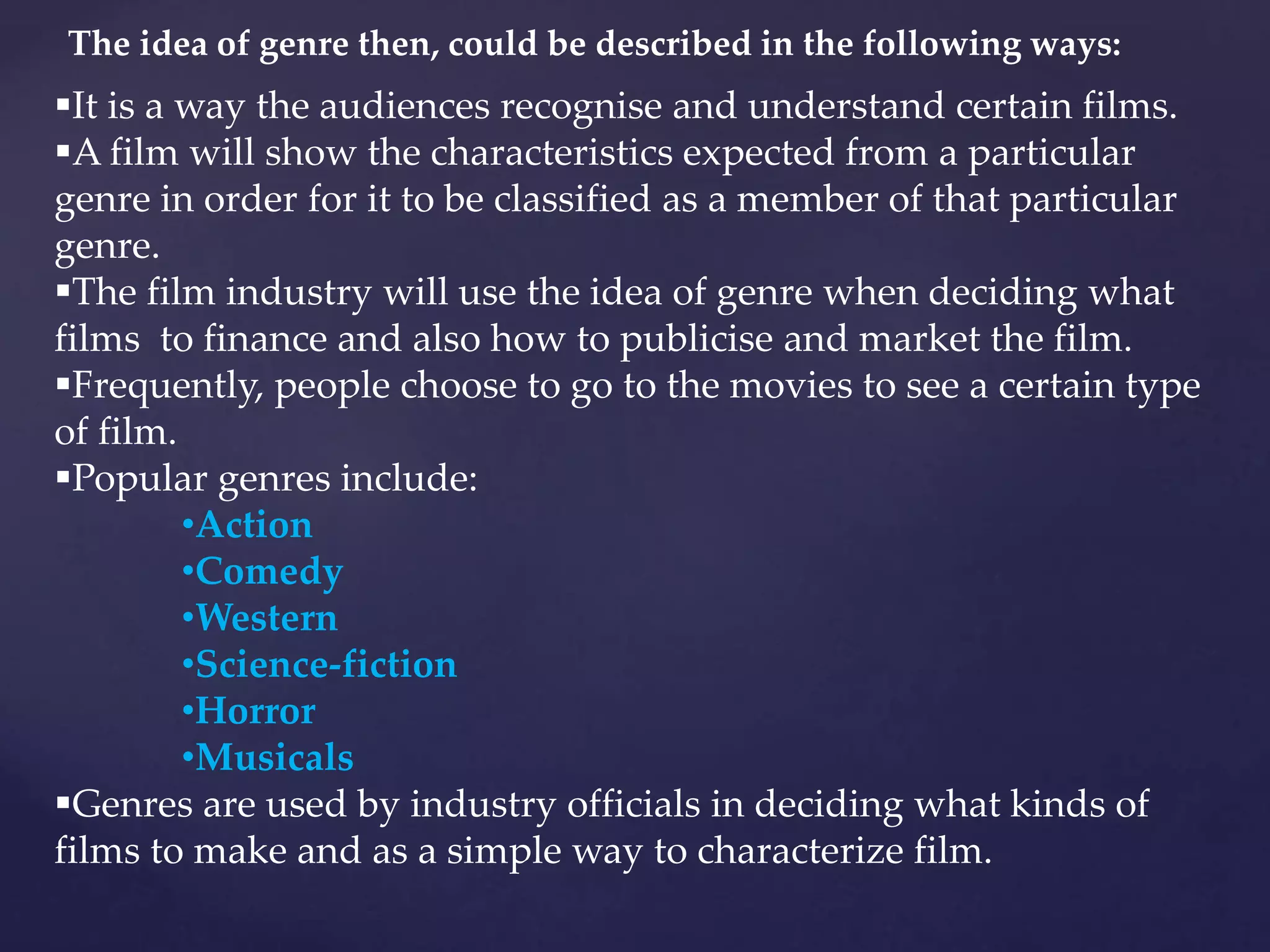
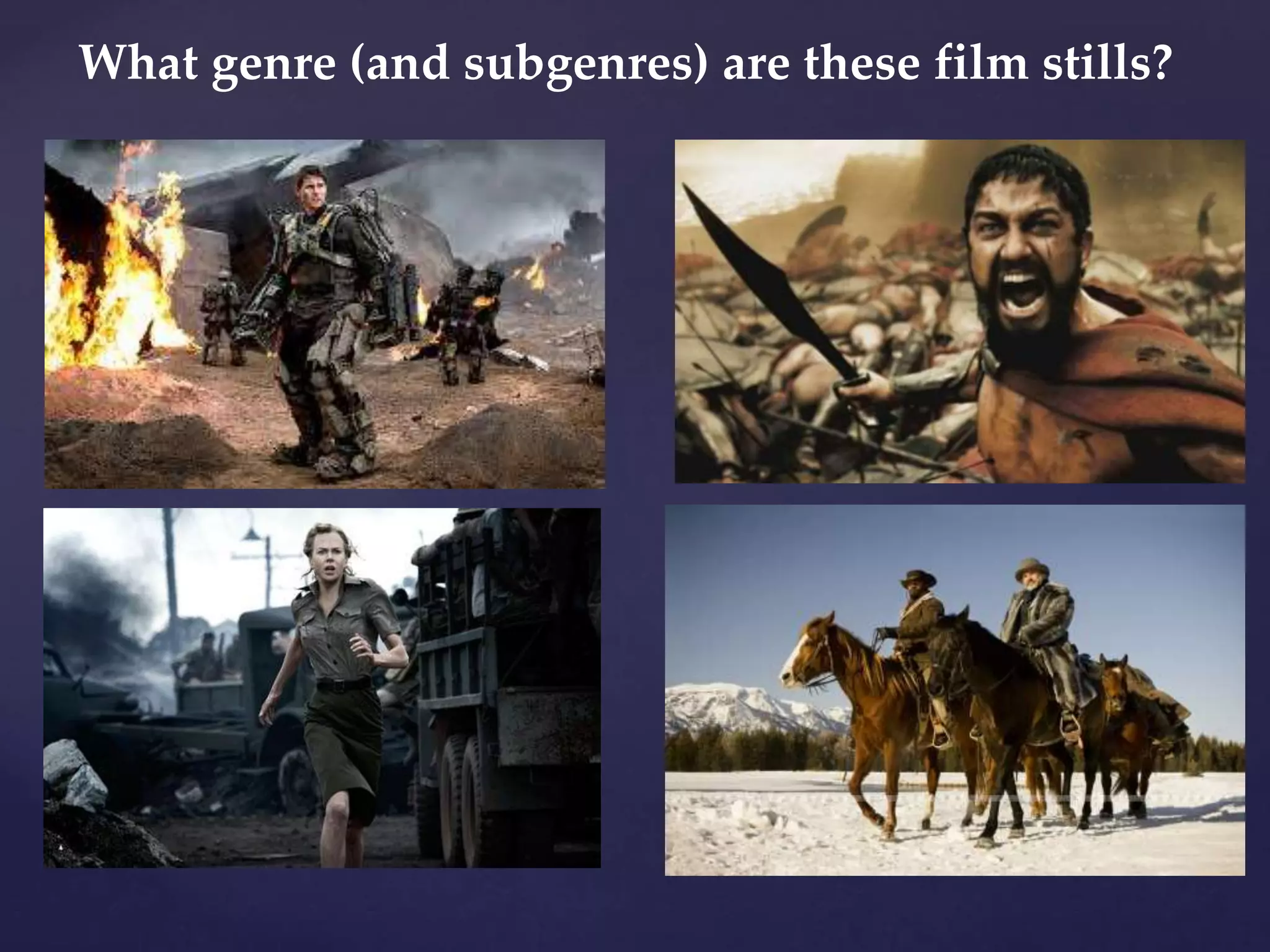
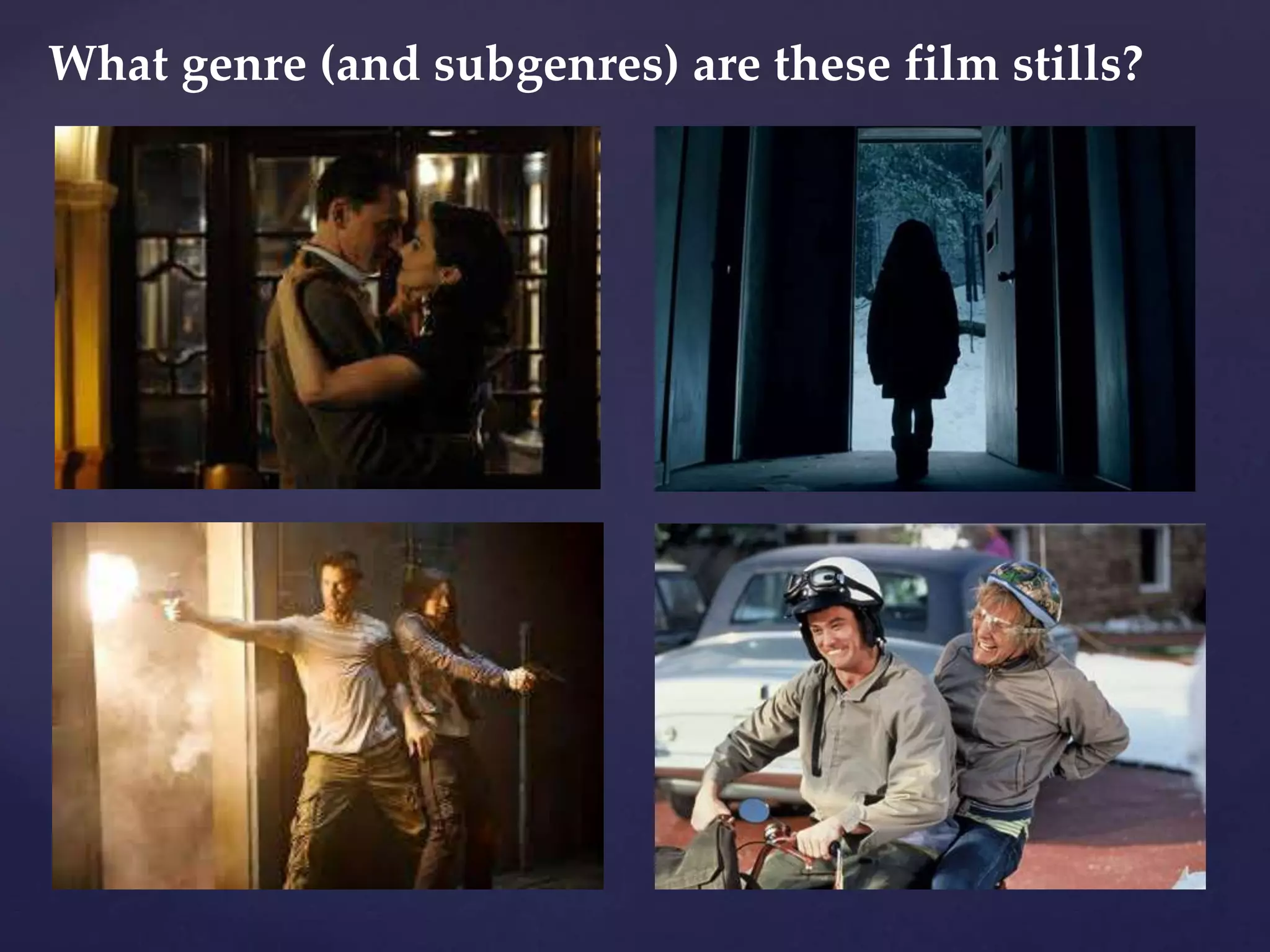
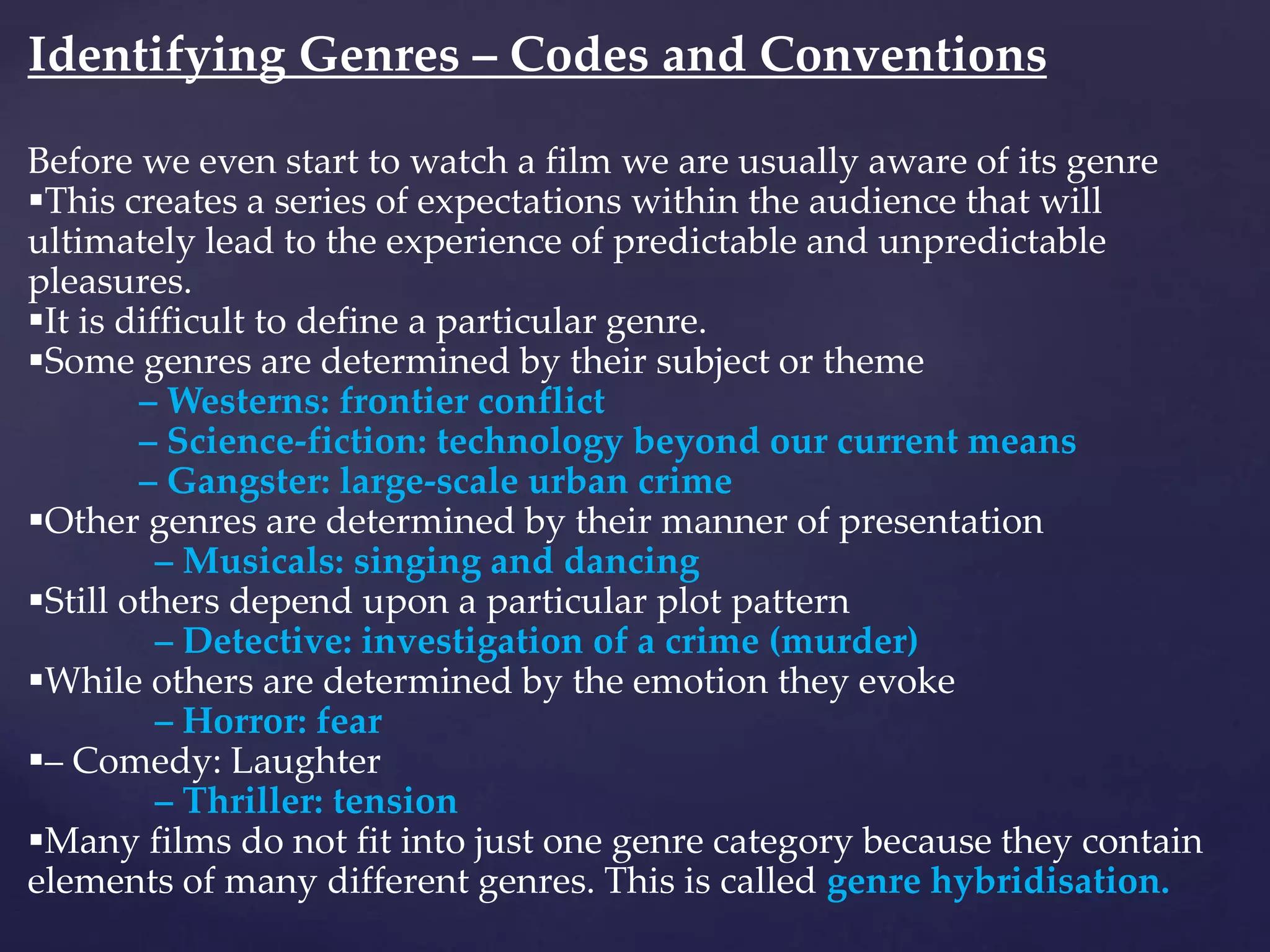
What genre (and subgenres) are these film stills?
Identifying Genres – Codes and Conventions
Before we even start to watch a film we are usually aware of its genre
This creates a series of expectations within the audience that will
ultimately lead to the experience of predictable and unpredictable
pleasures.
It is difficult to define a particular genre.
Some genres are determined by their subject or theme
– Westerns: frontier conflict
– Science-fiction: technology beyond our current means
– Gangster: large-scale urban crime
Other genres are determined by their manner of presentation
– Musicals: singing and dancing
Still others depend upon a particular plot pattern
– Detective: investigation of a crime (murder)
While others are determined by the emotion they evoke
– Horror: fear
– Comedy: Laughter
– Thriller: tension
Many films do not fit into just one genre category because they contain
elements of many different genres. This is called genre hybridisation.
THEORISTS YOU MAY WISH TO LOOK AT MORE CLOSELY:
 John Fiske – genre as ‘convenience’ for producers and
audiences
 Henry Jenkins – genre constantly ‘breaks rules’ e.g. evolving
hybridization
 John Hartley – genre is interpreted culturally
 Daniel Chandler – genre is too restricting
 Steve Neale – genre as repetition and difference
 David Buckingham – genre in constant process of
negotiation and change
 Jason Mittell – industry uses genre commercially
 Barry Keith Grant - on sub genres
 Rick Altman – genre offers audiences a ‘set of pleasures’
We will be looking at some of these theorists in more depth. It will
be up to you to go away and find more information on the others to
see what they say.
Further Definition
‘Genre’ is a critical tool that helps us study texts and
audience responses to texts by dividing them into
categories based on common elements.
Daniel Chandler (2001) details that the word genre comes
from the word for 'kind' or 'class'. The term is widely used
in rhetoric, literary theory, media theory to refer to a
“distinctive type of ‘text’”.
All genres have sub genres (genre within a genre).
This means that they are divided up into more specific
categories. Barry Keith Grant (1995) suggests that this
allows audiences to identify them specifically by their
familiar and what become recognisable characteristics.
Jason Mittell (2001) argues that industries use genre to sell
products to audiences. Media producers use familiar codes
and conventions that very often make references to their
audience knowledge of society, other texts.
Genre also allows audiences to make choices about what
products they want to consume through acceptance in order to
fulfil a particular pleasure.
Theorist Rick Altman (1999) argues that genre offers audiences
‘a set of pleasures’.
This can also be linked to Denis McQuail’s (1972) theory on
‘uses and gratifications’ of media texts for audiences.
Basically, the genre of your text will have provided your
demographic/subculture with some satisfaction upon their
consumption.
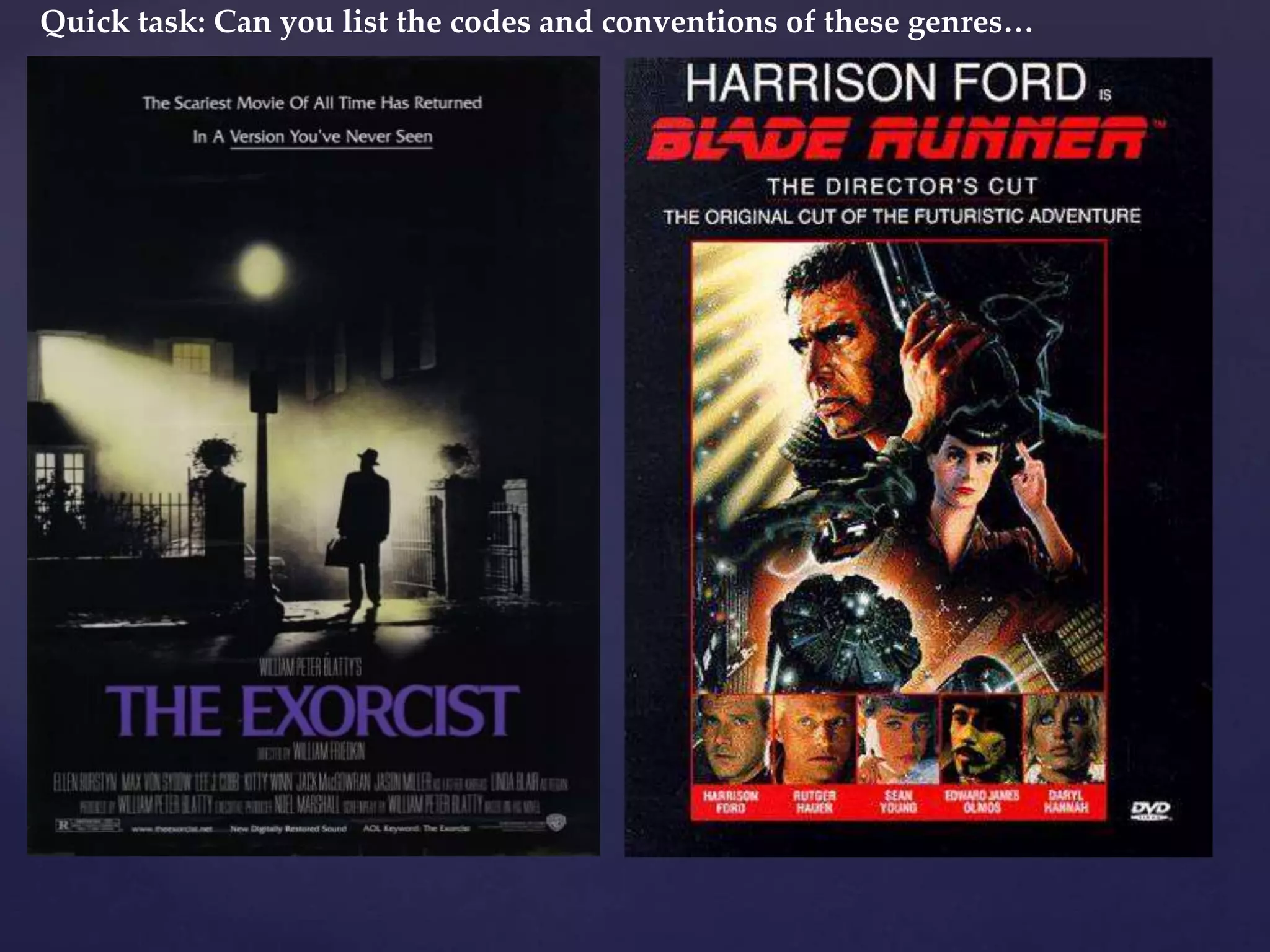
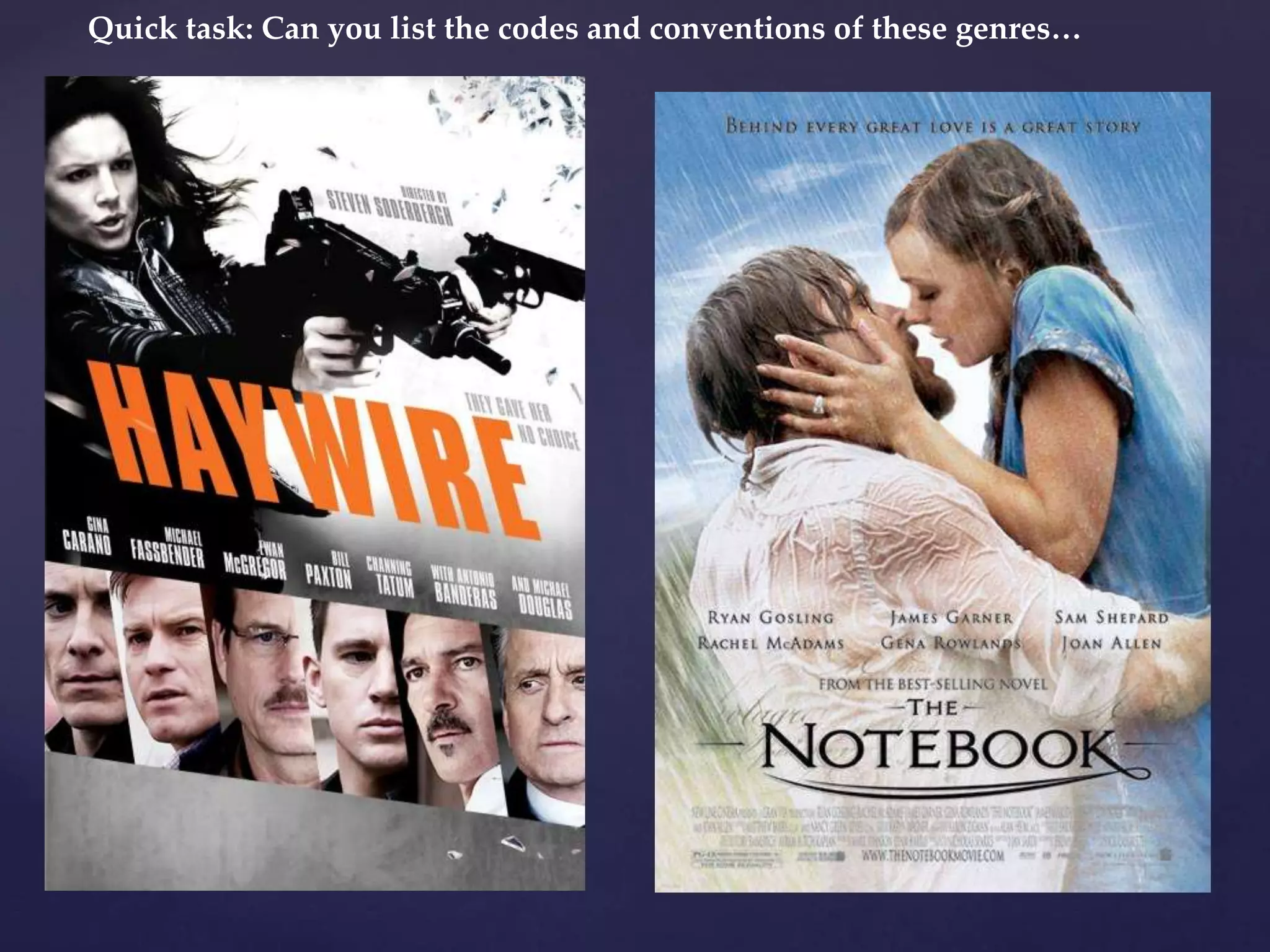
Quick task: Can you list the codes and conventions of these genres…
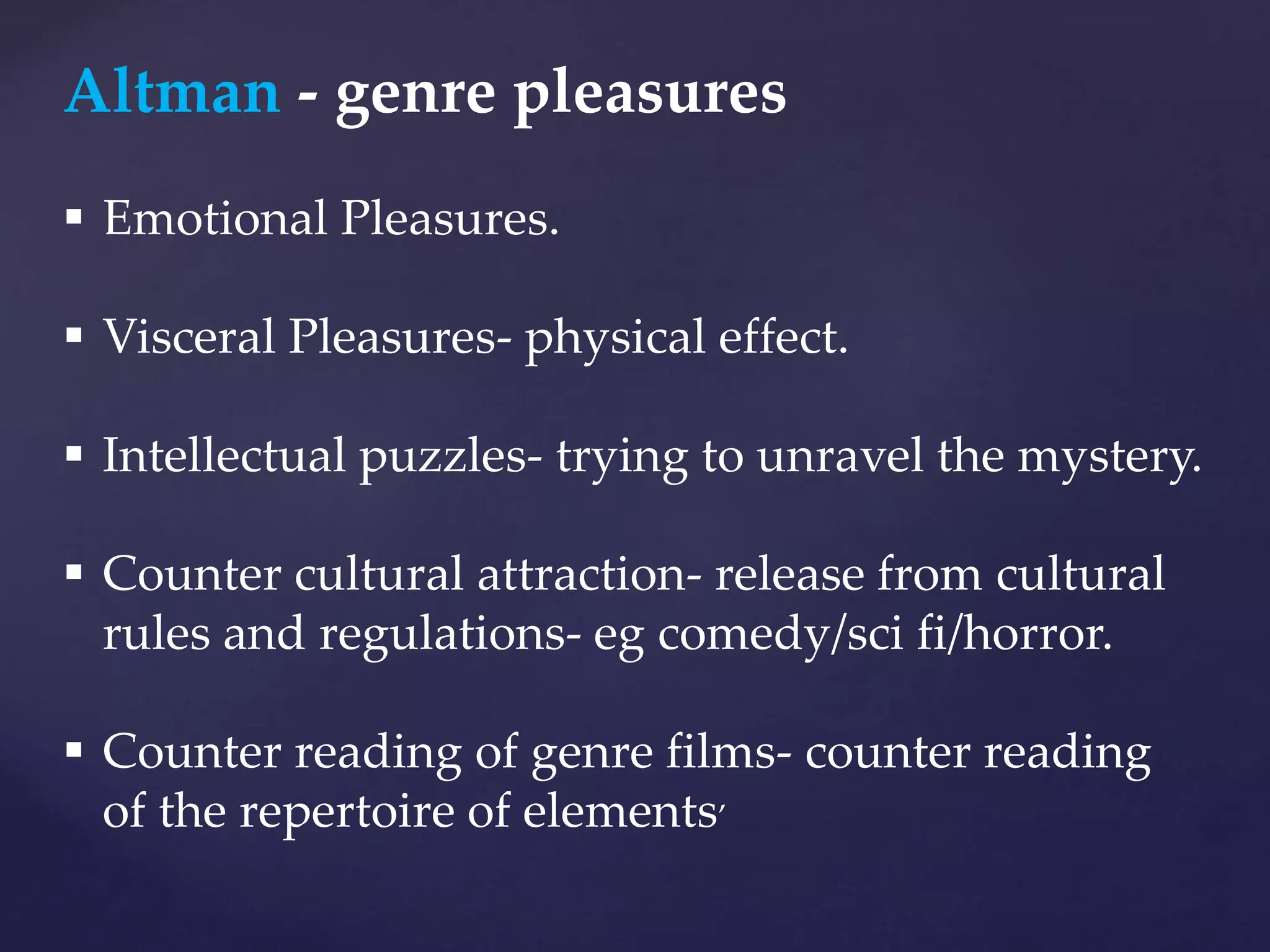
Altman - genre pleasures
 Emotional Pleasures.
 Visceral Pleasures- physical effect.
 Intellectual puzzles- trying to unravel the mystery.
 Counter cultural attraction- release from cultural
rules and regulations- eg comedy/sci fi/horror.
 Counter reading of genre films- counter reading
of the repertoire of elements’
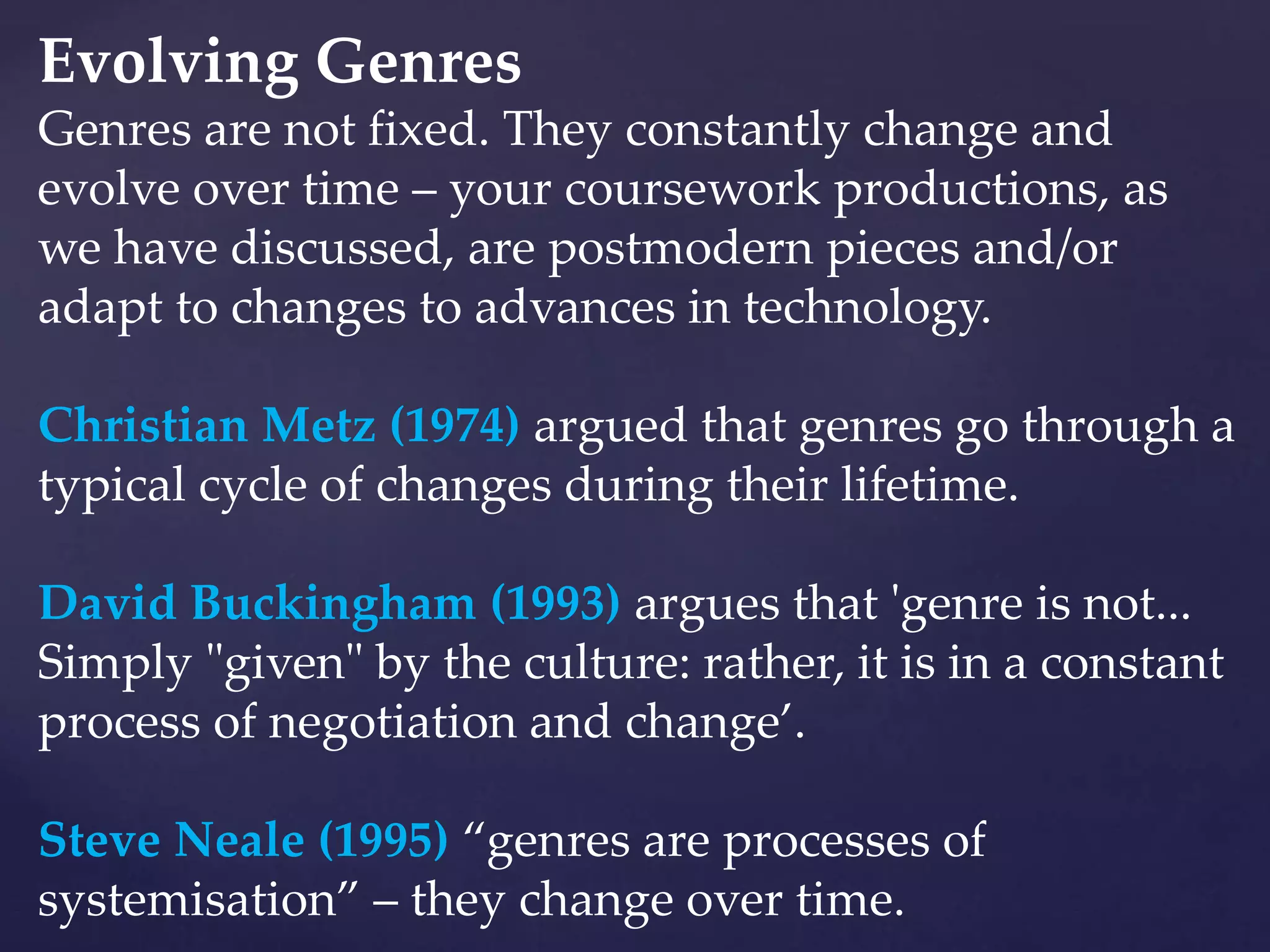
Evolving Genres
Genres are not fixed. They constantly change and
evolve over time – your coursework productions, as
we have discussed, are postmodern pieces and/or
adapt to changes to advances in technology.
Christian Metz (1974) argued that genres go through a
typical cycle of changes during their lifetime.
David Buckingham (1993) argues that 'genre is not...
Simply "given" by the culture: rather, it is in a constant
process of negotiation and change’.
Steve Neale (1995) “genres are processes of
systemisation” – they change over time.
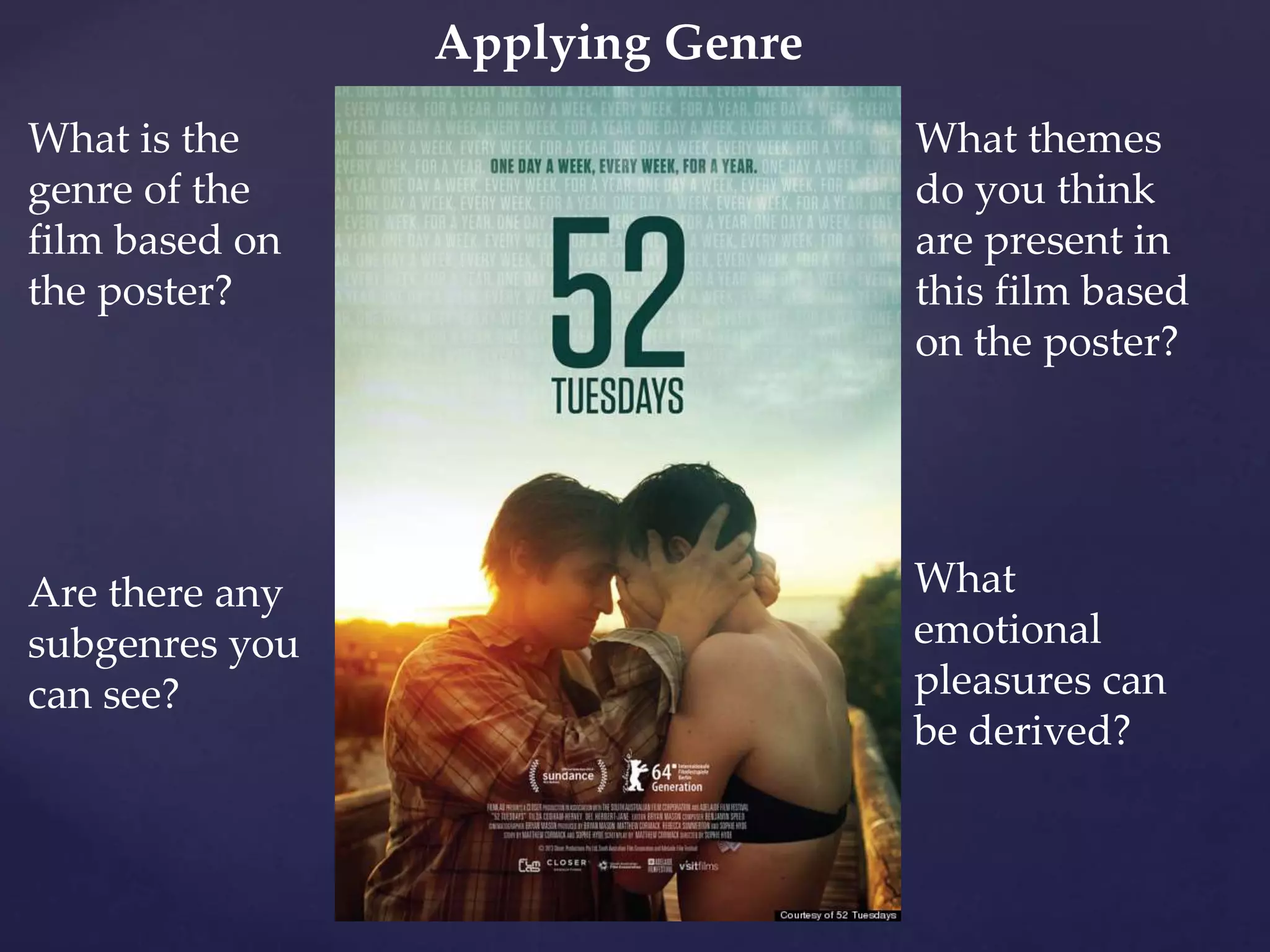
Applying Genre
What is the
genre of the
film based on
the poster?
Are there any
subgenres you
can see?
What themes
do you think
are present in
this film based
on the poster?
What
emotional
pleasures can
be derived?
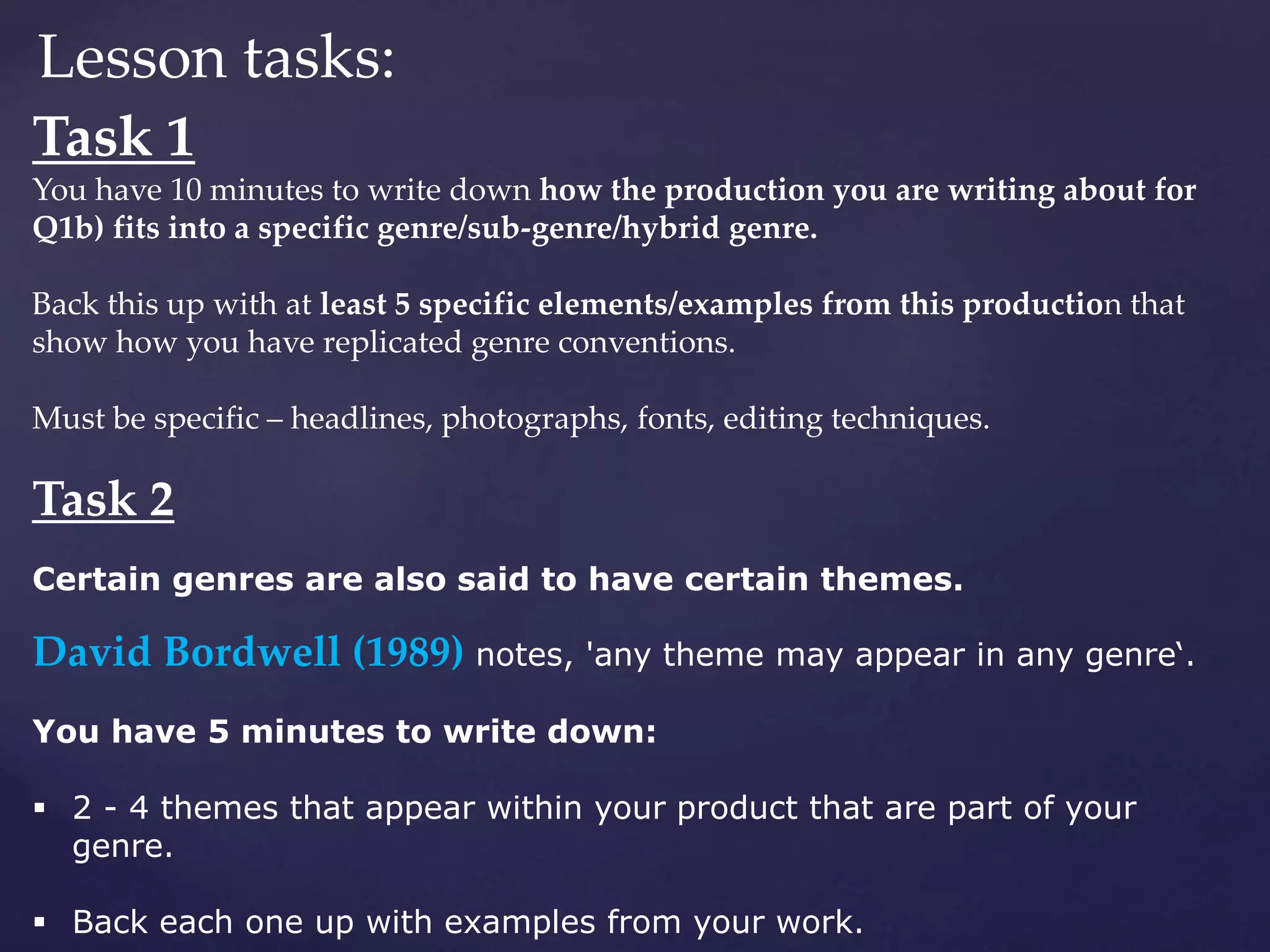
Lesson tasks:
Task 1
You have 10 minutes to write down how the production you are writing about for
Q1b) fits into a specific genre/sub-genre/hybrid genre.
Back this up with at least 5 specific elements/examples from this production that
show how you have replicated genre conventions.
Must be specific – headlines, photographs, fonts, editing techniques.
Task 2
Certain genres are also said to have certain themes.
David Bordwell (1989) notes, 'any theme may appear in any genre‘.
You have 5 minutes to write down:
 2 - 4 themes that appear within your product that are part of your
genre.
 Back each one up with examples from your work.
GENRE
Preparation for Exam Question 1b: Lesson 5 & 6
Lesson 2: Essay Planning
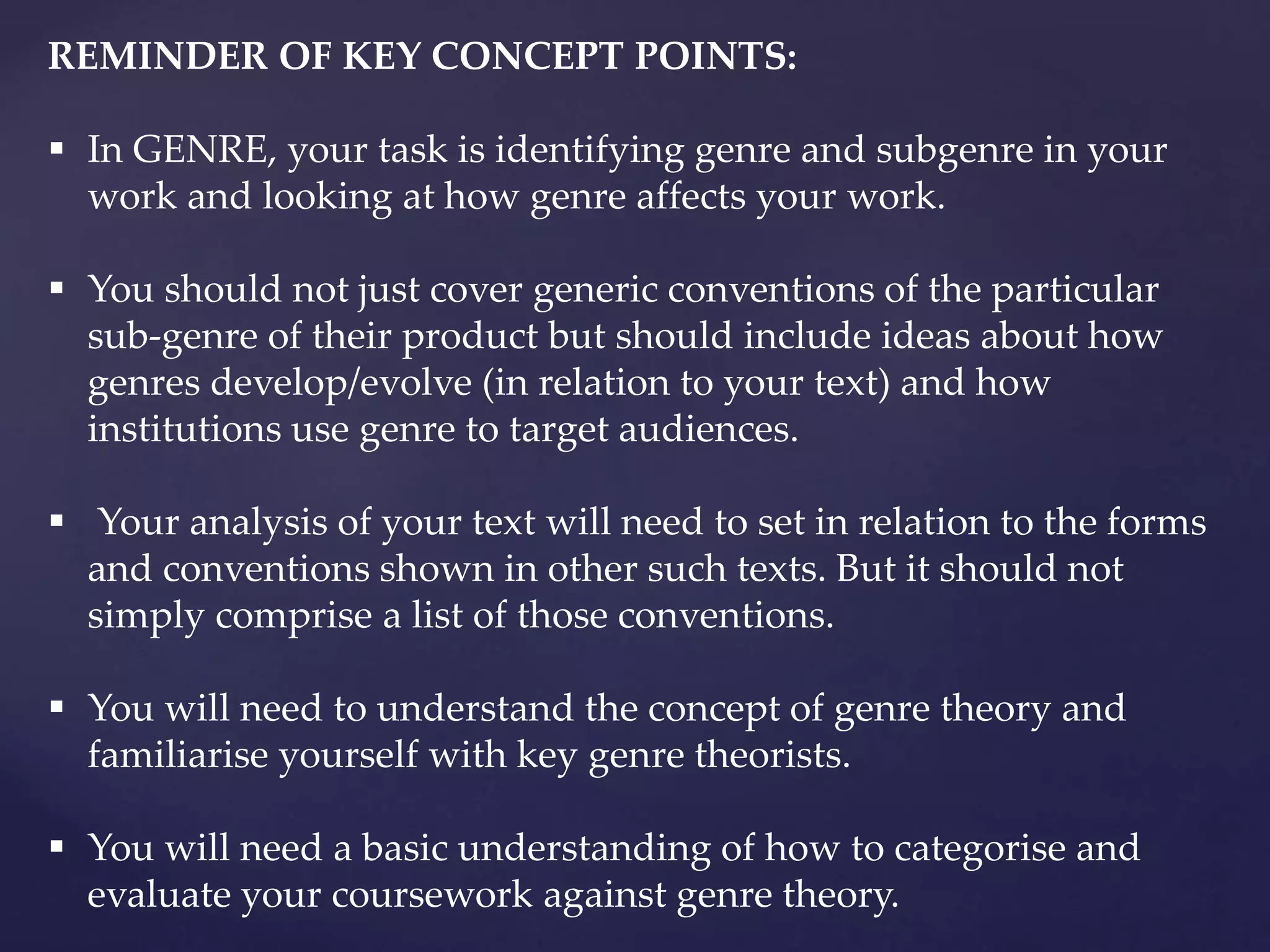
REMINDER OF KEY CONCEPT POINTS:
 In GENRE, your task is identifying genre and subgenre in your
work and looking at how genre affects your work.
 You should not just cover generic conventions of the particular
sub-genre of their product but should include ideas about how
genres develop/evolve (in relation to your text) and how
institutions use genre to target audiences.
 Your analysis of your text will need to set in relation to the forms
and conventions shown in other such texts. But it should not
simply comprise a list of those conventions.
 You will need to understand the concept of genre theory and
familiarise yourself with key genre theorists.
 You will need a basic understanding of how to categorise and
evaluate your coursework against genre theory.
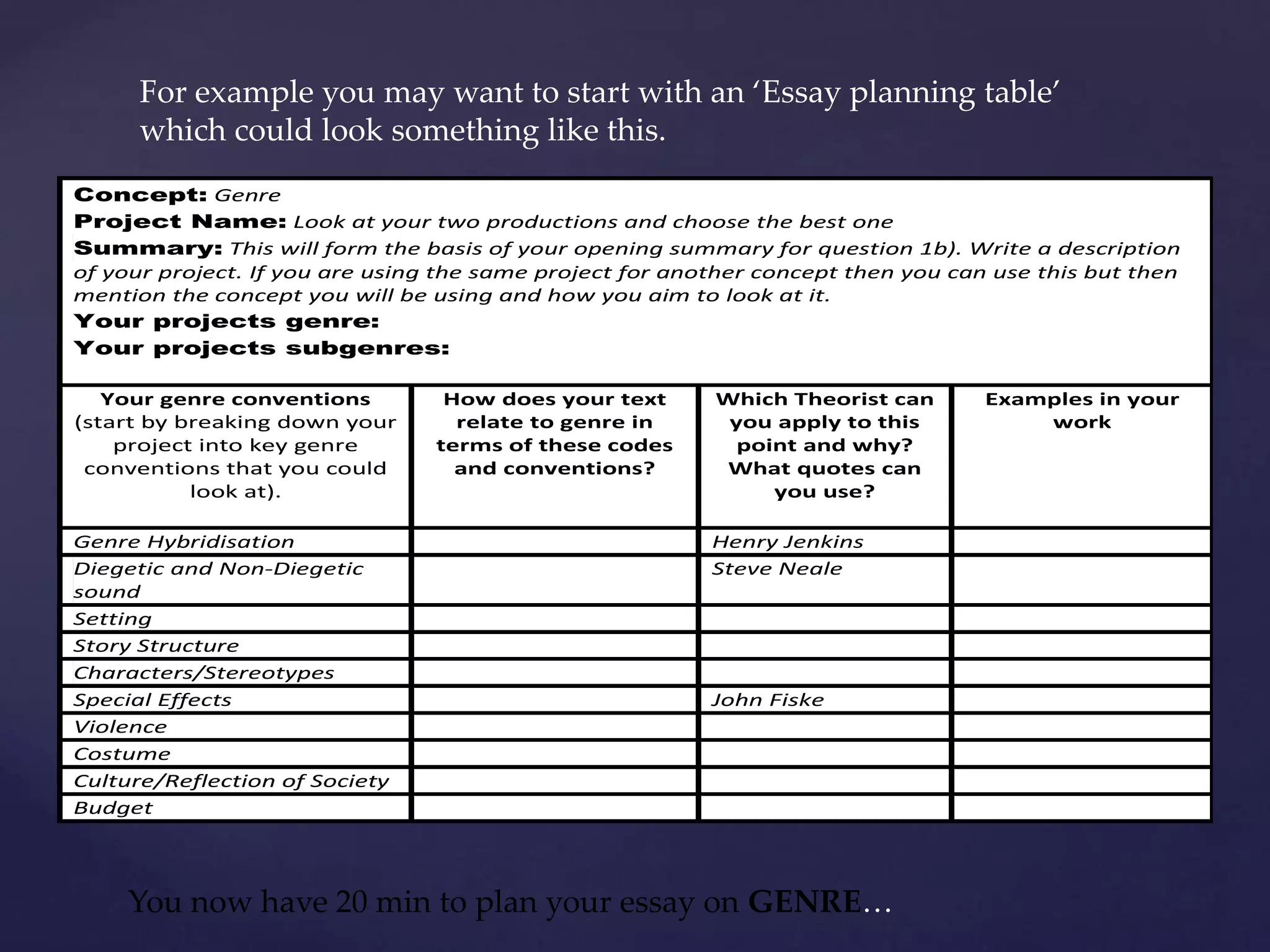
For example you may want to start with an ‘Essay planning table’
which could look something like this.
You now have 20 min to plan your essay on GENRE…
Concept: Genre
Project Name: Look at your two productions and choose the best one
Summary: This will form the basis of your opening summary for question 1b). Write a description
of your project. If you are using the same project for another concept then you can use this but then
mention the concept you will be using and how you aim to look at it.
Your projects genre:
Your projects subgenres:
Your genre conventions
(start by breaking down your
project into key genre
conventions that you could
look at).
How does your text
relate to genre in
terms of these codes
and conventions?
Which Theorist can
you apply to this
point and why?
What quotes can
you use?
Examples in your
work
Genre Hybridisation Henry Jenkins
Diegetic and Non-Diegetic
sound
Steve Neale
Setting
Story Structure
Characters/Stereotypes
Special Effects John Fiske
Violence
Costume
Culture/Reflection of Society
Budget
1(b) Apply the concept of genre to one of your
coursework productions. [25]
Now using your lesson plan attempt the question:
….You have 30 mins
Good luck!
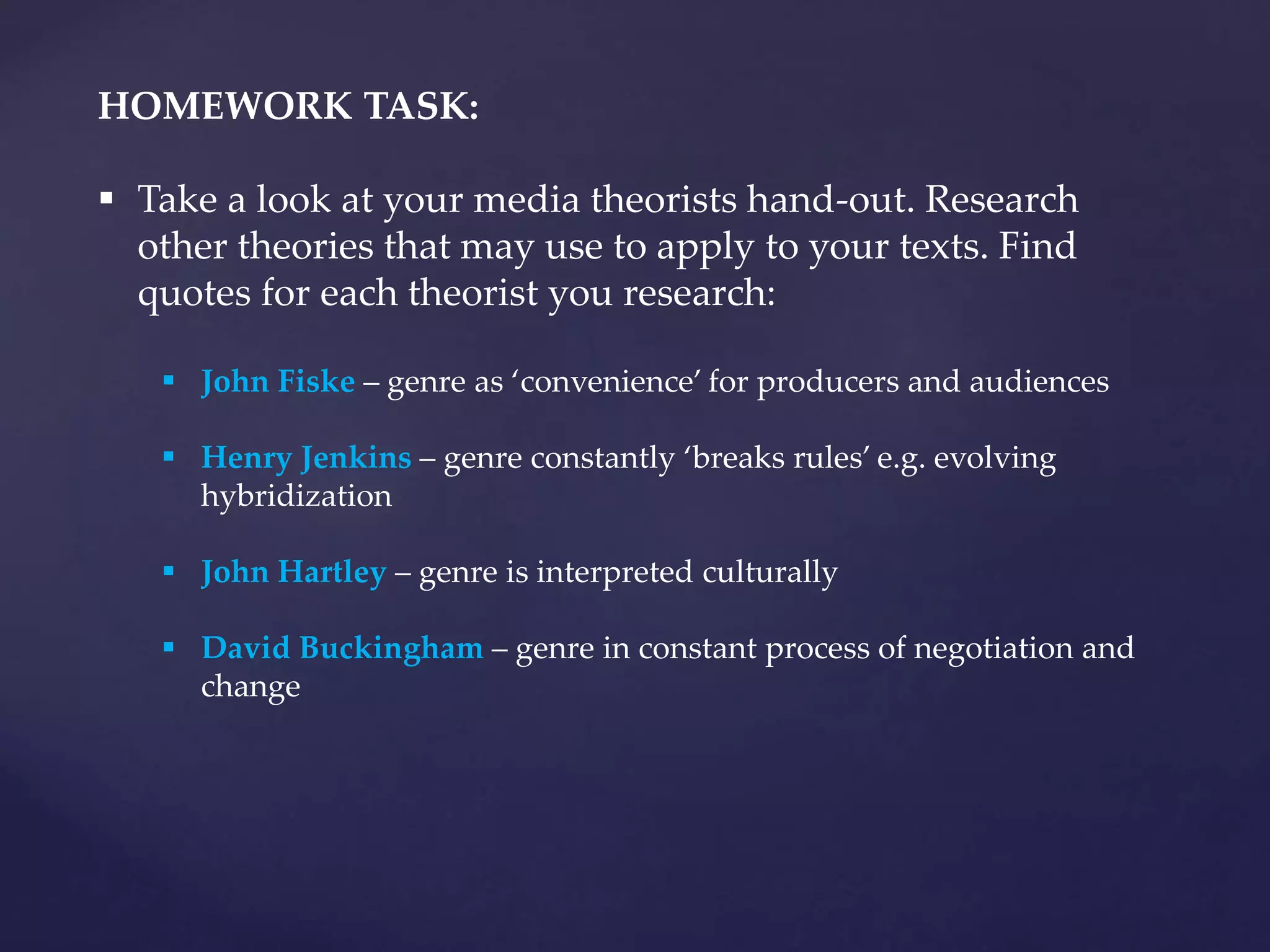
HOMEWORK TASK:
 Take a look at your media theorists hand-out. Research
other theories that may use to apply to your texts. Find
quotes for each theorist you research:
 John Fiske – genre as ‘convenience’ for producers and audiences
 Henry Jenkins – genre constantly ‘breaks rules’ e.g. evolving
hybridization
 John Hartley – genre is interpreted culturally
 David Buckingham – genre in constant process of negotiation and
change

Lesson 3-4 genre - q1b)

  • 1.
    GENRE Preparation for ExamQuestion 1b: Lesson 5 & 6 Lesson 1
  • 2.
    Starter Questions &Discussion  What do we mean by genre?  Individually make a list of the different genres and subgenres you can think of? (5 min)  Now pair up and compare notes and upgrade the individual lists. (5 min)  Why is genre important?
  • 3.
    Example Exam Question 1(b)Apply the concept of genre to one of your coursework productions.[25]
  • 4.
    Genre… ‘Genre’ is acritical tool that helps us study texts and audience responses to texts by dividing them into categories based on common elements. Questions to consider when looking at genre:  What is the genre of your text?  How would the audience or media institutions know this?  What other genres are contained within your text?
  • 5.
    KEY CONCEPT POINTS: In GENRE, your task is identifying genre and subgenre in your work and looking at how genre affects your work.  You should not just cover generic conventions of the particular sub- genre of their product but should include ideas about how genres develop/evolve (in relation to your text) and how institutions use genre to target audiences.  Your analysis of your text will need to set in relation to the forms and conventions shown in other such texts. But it should not simply comprise a list of those conventions.  You will need to understand the concept of genre theory and familiarise yourself with key genre theorists.  You will need a basic understanding of how to categorise and evaluate your coursework against genre theory.
  • 6.
    The idea ofgenre then, could be described in the following ways: It is a way the audiences recognise and understand certain films. A film will show the characteristics expected from a particular genre in order for it to be classified as a member of that particular genre. The film industry will use the idea of genre when deciding what films to finance and also how to publicise and market the film. Frequently, people choose to go to the movies to see a certain type of film. Popular genres include: •Action •Comedy •Western •Science-fiction •Horror •Musicals Genres are used by industry officials in deciding what kinds of films to make and as a simple way to characterize film.
  • 7.
    What genre (andsubgenres) are these film stills?
  • 8.
    What genre (andsubgenres) are these film stills?
  • 9.
    Identifying Genres –Codes and Conventions Before we even start to watch a film we are usually aware of its genre This creates a series of expectations within the audience that will ultimately lead to the experience of predictable and unpredictable pleasures. It is difficult to define a particular genre. Some genres are determined by their subject or theme – Westerns: frontier conflict – Science-fiction: technology beyond our current means – Gangster: large-scale urban crime Other genres are determined by their manner of presentation – Musicals: singing and dancing Still others depend upon a particular plot pattern – Detective: investigation of a crime (murder) While others are determined by the emotion they evoke – Horror: fear – Comedy: Laughter – Thriller: tension Many films do not fit into just one genre category because they contain elements of many different genres. This is called genre hybridisation.
  • 10.
    THEORISTS YOU MAYWISH TO LOOK AT MORE CLOSELY:  John Fiske – genre as ‘convenience’ for producers and audiences  Henry Jenkins – genre constantly ‘breaks rules’ e.g. evolving hybridization  John Hartley – genre is interpreted culturally  Daniel Chandler – genre is too restricting  Steve Neale – genre as repetition and difference  David Buckingham – genre in constant process of negotiation and change  Jason Mittell – industry uses genre commercially  Barry Keith Grant - on sub genres  Rick Altman – genre offers audiences a ‘set of pleasures’ We will be looking at some of these theorists in more depth. It will be up to you to go away and find more information on the others to see what they say.
  • 11.
    Further Definition ‘Genre’ isa critical tool that helps us study texts and audience responses to texts by dividing them into categories based on common elements. Daniel Chandler (2001) details that the word genre comes from the word for 'kind' or 'class'. The term is widely used in rhetoric, literary theory, media theory to refer to a “distinctive type of ‘text’”. All genres have sub genres (genre within a genre). This means that they are divided up into more specific categories. Barry Keith Grant (1995) suggests that this allows audiences to identify them specifically by their familiar and what become recognisable characteristics.
  • 12.
    Jason Mittell (2001)argues that industries use genre to sell products to audiences. Media producers use familiar codes and conventions that very often make references to their audience knowledge of society, other texts. Genre also allows audiences to make choices about what products they want to consume through acceptance in order to fulfil a particular pleasure. Theorist Rick Altman (1999) argues that genre offers audiences ‘a set of pleasures’. This can also be linked to Denis McQuail’s (1972) theory on ‘uses and gratifications’ of media texts for audiences. Basically, the genre of your text will have provided your demographic/subculture with some satisfaction upon their consumption.
  • 13.
    Quick task: Canyou list the codes and conventions of these genres…
  • 14.
    Quick task: Canyou list the codes and conventions of these genres…
  • 15.
    Altman - genrepleasures  Emotional Pleasures.  Visceral Pleasures- physical effect.  Intellectual puzzles- trying to unravel the mystery.  Counter cultural attraction- release from cultural rules and regulations- eg comedy/sci fi/horror.  Counter reading of genre films- counter reading of the repertoire of elements’
  • 16.
    Evolving Genres Genres arenot fixed. They constantly change and evolve over time – your coursework productions, as we have discussed, are postmodern pieces and/or adapt to changes to advances in technology. Christian Metz (1974) argued that genres go through a typical cycle of changes during their lifetime. David Buckingham (1993) argues that 'genre is not... Simply "given" by the culture: rather, it is in a constant process of negotiation and change’. Steve Neale (1995) “genres are processes of systemisation” – they change over time.
  • 17.
    Applying Genre What isthe genre of the film based on the poster? Are there any subgenres you can see? What themes do you think are present in this film based on the poster? What emotional pleasures can be derived?
  • 18.
    Lesson tasks: Task 1 Youhave 10 minutes to write down how the production you are writing about for Q1b) fits into a specific genre/sub-genre/hybrid genre. Back this up with at least 5 specific elements/examples from this production that show how you have replicated genre conventions. Must be specific – headlines, photographs, fonts, editing techniques. Task 2 Certain genres are also said to have certain themes. David Bordwell (1989) notes, 'any theme may appear in any genre‘. You have 5 minutes to write down:  2 - 4 themes that appear within your product that are part of your genre.  Back each one up with examples from your work.
  • 19.
    GENRE Preparation for ExamQuestion 1b: Lesson 5 & 6 Lesson 2: Essay Planning
  • 20.
    REMINDER OF KEYCONCEPT POINTS:  In GENRE, your task is identifying genre and subgenre in your work and looking at how genre affects your work.  You should not just cover generic conventions of the particular sub-genre of their product but should include ideas about how genres develop/evolve (in relation to your text) and how institutions use genre to target audiences.  Your analysis of your text will need to set in relation to the forms and conventions shown in other such texts. But it should not simply comprise a list of those conventions.  You will need to understand the concept of genre theory and familiarise yourself with key genre theorists.  You will need a basic understanding of how to categorise and evaluate your coursework against genre theory.
  • 21.
    For example youmay want to start with an ‘Essay planning table’ which could look something like this. You now have 20 min to plan your essay on GENRE… Concept: Genre Project Name: Look at your two productions and choose the best one Summary: This will form the basis of your opening summary for question 1b). Write a description of your project. If you are using the same project for another concept then you can use this but then mention the concept you will be using and how you aim to look at it. Your projects genre: Your projects subgenres: Your genre conventions (start by breaking down your project into key genre conventions that you could look at). How does your text relate to genre in terms of these codes and conventions? Which Theorist can you apply to this point and why? What quotes can you use? Examples in your work Genre Hybridisation Henry Jenkins Diegetic and Non-Diegetic sound Steve Neale Setting Story Structure Characters/Stereotypes Special Effects John Fiske Violence Costume Culture/Reflection of Society Budget
  • 22.
    1(b) Apply theconcept of genre to one of your coursework productions. [25] Now using your lesson plan attempt the question: ….You have 30 mins Good luck!
  • 23.
    HOMEWORK TASK:  Takea look at your media theorists hand-out. Research other theories that may use to apply to your texts. Find quotes for each theorist you research:  John Fiske – genre as ‘convenience’ for producers and audiences  Henry Jenkins – genre constantly ‘breaks rules’ e.g. evolving hybridization  John Hartley – genre is interpreted culturally  David Buckingham – genre in constant process of negotiation and change