African
   Independence
     Vocabulary


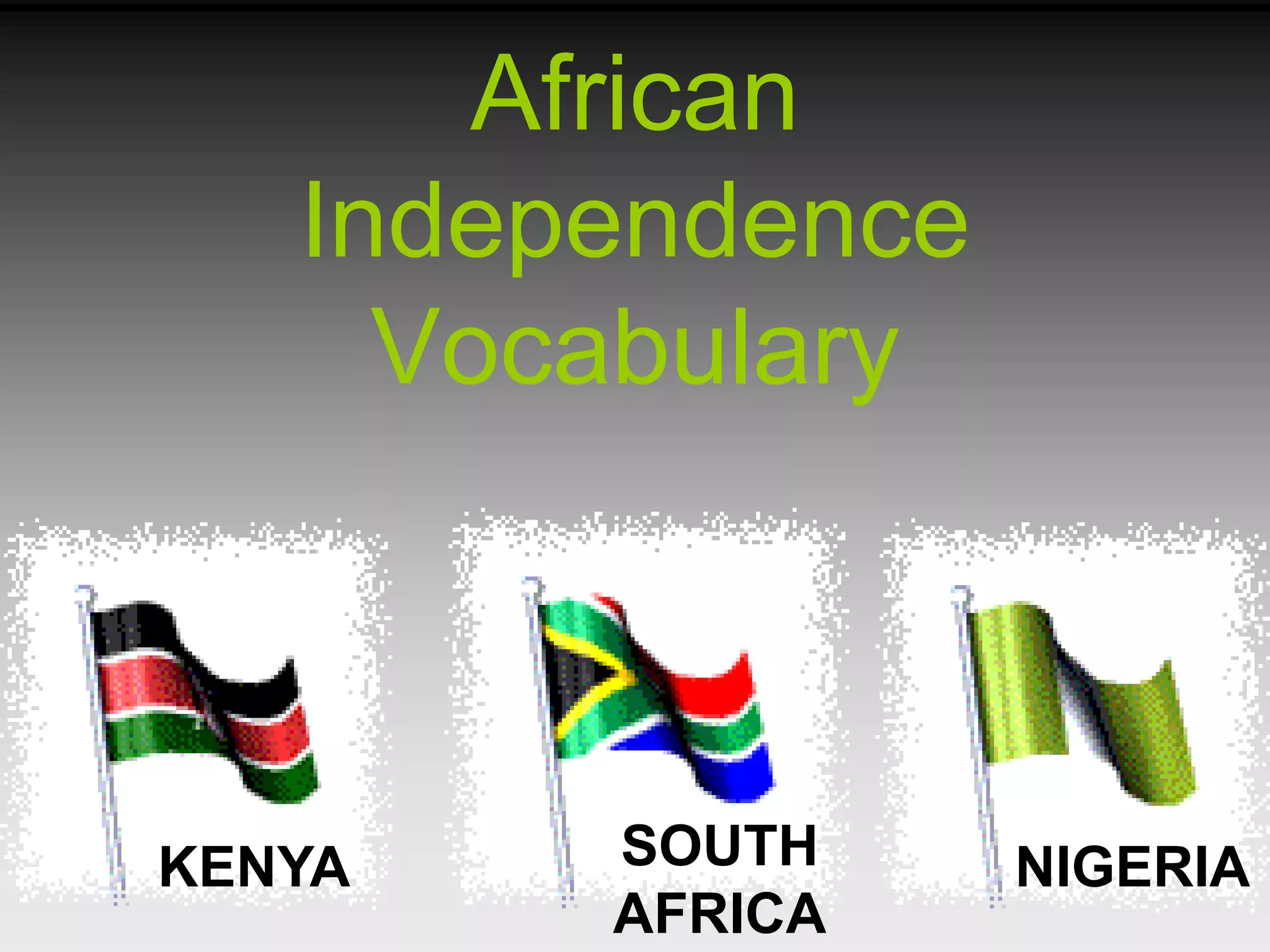
KENYA   SOUTH     NIGERIA
        AFRICA
Definition               Example


Non-example   Picture or Last Word
SS7H1 The student will analyze
continuity and change in Africa leading
          to the 21st century.
a. Explain how the European partitioning across Africa
    contributed to conflict, civil war, and artificial
    political boundaries.
b. Explain how nationalism led to independence in
    South Africa, Kenya, and Nigeria.
c. Explain the creation and end of apartheid in South
    Africa and the roles of Nelson Mandela and F.W.de
    Klerk.
d. Explain the impact of the Pan-African movement.
Independence
               (definition)
• Becoming a free country
• When the citizens or natives of a country
  are in control of their government
Independence
                       (examples)

• French Revolution – freedom from the monarchy
  (rule by one person, like a king)
• American Revolution – freedom from British rule
• War of Mexican Independence – freedom from
  Spanish rule
• Kenyan rebellion – violent rebellion against colonial
  rule, Jomo Kenyatta & the Mau Mau
• Nigerian - peaceful independence movement
• South Africa - independent from British in 1961, but
  non-whites did not have equal rights (Apartheid)
Independence
           (non-examples)


• colonial rule – of Africa, the
  Americas
• Dictatorships - ex. Saddam
  Hussein (Iraq), Omar Bashir
  (Sudan)
Nationalism
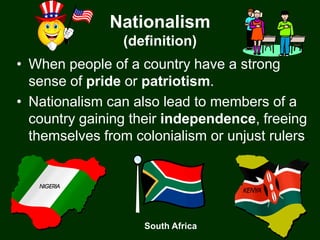
                 (definition)
• When people of a country have a strong
  sense of pride or patriotism.
• Nationalism can also lead to members of a
  country gaining their independence, freeing
  themselves from colonialism or unjust rulers.


                    South Africa
Nationalism
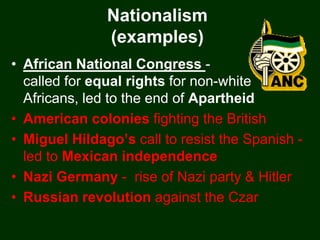
               (examples)
• African National Congress -
  called for equal rights for non-white
  Africans, led to the end of Apartheid
• American colonies fighting the British
• Miguel Hildago’s call to resist the Spanish -
  led to Mexican independence
• Nazi Germany - rise of Nazi party & Hitler
• Russian revolution against the Czar
Non-examples

• Some African tribal leaders - bribed (for
  money, land, power) by colonial rulers
  to help them
• Tory party members - Americans loyal
  to the British empire & didn’t want the
  U.S. to be independent
Pan-Africanism
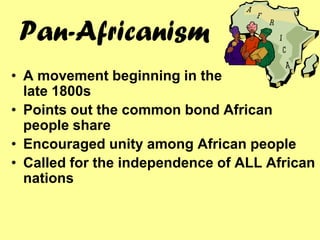
• A movement beginning in the
  late 1800s
• Points out the common bond African
  people share
• Encouraged unity among African people
• Called for the independence of ALL African
  nations
Pan-Africanism
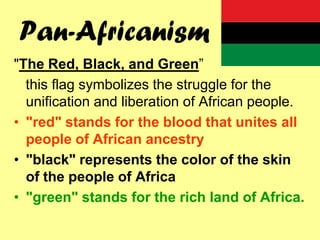
"The Red, Black, and Green”
  this flag symbolizes the struggle for the
  unification and liberation of African people.
• "red" stands for the blood that unites all
  people of African ancestry
• "black" represents the color of the skin
  of the people of Africa
• "green" stands for the rich land of Africa.
Pan-Africanism (examples)
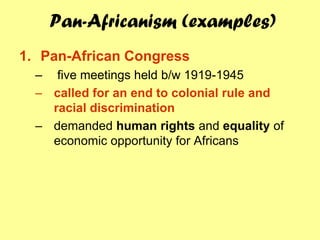
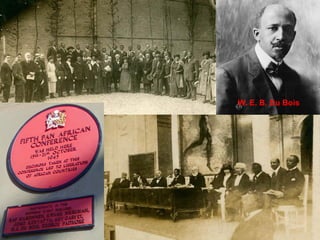
1. Pan-African Congress
  – five meetings held b/w 1919-1945
  – called for an end to colonial rule and
    racial discrimination
  – demanded human rights and equality of
    economic opportunity for Africans
W. E. B. Du Bois
Pan-Africanism (examples)
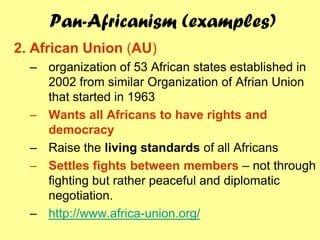
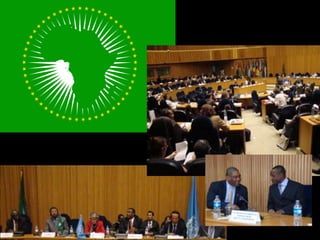
2. African Union (AU)
  – organization of 53 African states established in
    2002 from similar Organization of Afrian Union
    that started in 1963
  – Wants all Africans to have rights and
    democracy
  – Raise the living standards of all Africans
  – Settles fights between members – not through
    fighting but rather peaceful and diplomatic
    negotiation.
  – http://www.africa-union.org/
Pan-Africanism
            (non-examples)
• Civil war in Sudan
• Apartheid – blacks in South Africa did
  not have the same rights as whites
• Rwanda – civil war b/w Hutu & Tutsi
  (ethnic groups)
What did you learn?

1. What is the difference between
   nationalism and Pan-Africanism?
You have two choices for your
          final box…
1. You can draw a picture/illustration that
   shows the meaning of each vocabulary
   word.
     •   It must be accurate
     •   It must be neat
     •   You must take your time
2. Complete a last word summary for each
   vocabulary word
     •   See the board for example

African History 2

  • 1.
    African Independence Vocabulary KENYA SOUTH NIGERIA AFRICA
  • 2.
    Definition Example Non-example Picture or Last Word
  • 3.
    SS7H1 The studentwill analyze continuity and change in Africa leading to the 21st century. a. Explain how the European partitioning across Africa contributed to conflict, civil war, and artificial political boundaries. b. Explain how nationalism led to independence in South Africa, Kenya, and Nigeria. c. Explain the creation and end of apartheid in South Africa and the roles of Nelson Mandela and F.W.de Klerk. d. Explain the impact of the Pan-African movement.
  • 4.
    Independence (definition) • Becoming a free country • When the citizens or natives of a country are in control of their government
  • 5.
    Independence (examples) • French Revolution – freedom from the monarchy (rule by one person, like a king) • American Revolution – freedom from British rule • War of Mexican Independence – freedom from Spanish rule • Kenyan rebellion – violent rebellion against colonial rule, Jomo Kenyatta & the Mau Mau • Nigerian - peaceful independence movement • South Africa - independent from British in 1961, but non-whites did not have equal rights (Apartheid)
  • 6.
    Independence (non-examples) • colonial rule – of Africa, the Americas • Dictatorships - ex. Saddam Hussein (Iraq), Omar Bashir (Sudan)
  • 7.
    Nationalism (definition) • When people of a country have a strong sense of pride or patriotism. • Nationalism can also lead to members of a country gaining their independence, freeing themselves from colonialism or unjust rulers. South Africa
  • 8.
    Nationalism (examples) • African National Congress - called for equal rights for non-white Africans, led to the end of Apartheid • American colonies fighting the British • Miguel Hildago’s call to resist the Spanish - led to Mexican independence • Nazi Germany - rise of Nazi party & Hitler • Russian revolution against the Czar
  • 9.
    Non-examples • Some Africantribal leaders - bribed (for money, land, power) by colonial rulers to help them • Tory party members - Americans loyal to the British empire & didn’t want the U.S. to be independent
  • 10.
    Pan-Africanism • A movementbeginning in the late 1800s • Points out the common bond African people share • Encouraged unity among African people • Called for the independence of ALL African nations
  • 11.
    Pan-Africanism "The Red, Black,and Green” this flag symbolizes the struggle for the unification and liberation of African people. • "red" stands for the blood that unites all people of African ancestry • "black" represents the color of the skin of the people of Africa • "green" stands for the rich land of Africa.
  • 12.
    Pan-Africanism (examples) 1. Pan-AfricanCongress – five meetings held b/w 1919-1945 – called for an end to colonial rule and racial discrimination – demanded human rights and equality of economic opportunity for Africans
  • 13.
    W. E. B.Du Bois
  • 14.
    Pan-Africanism (examples) 2. AfricanUnion (AU) – organization of 53 African states established in 2002 from similar Organization of Afrian Union that started in 1963 – Wants all Africans to have rights and democracy – Raise the living standards of all Africans – Settles fights between members – not through fighting but rather peaceful and diplomatic negotiation. – http://www.africa-union.org/
  • 16.
    Pan-Africanism (non-examples) • Civil war in Sudan • Apartheid – blacks in South Africa did not have the same rights as whites • Rwanda – civil war b/w Hutu & Tutsi (ethnic groups)
  • 17.
    What did youlearn? 1. What is the difference between nationalism and Pan-Africanism?
  • 18.
    You have twochoices for your final box… 1. You can draw a picture/illustration that shows the meaning of each vocabulary word. • It must be accurate • It must be neat • You must take your time 2. Complete a last word summary for each vocabulary word • See the board for example