Power:
Meaning, Dimensions, Types
and Consequences
Objectives:
At the end of the lesson, the students should be able
to:
1. Define power;
2. Identify the nature, types, and consequences of power;
3. Explain the nature, dimensions, types and
consequences of power; and
4. Explain how power is exercised in different situations.
POWER
•Power is the capability to control and influence
people’s behaviour as well as the capability to
direct the paths and result of events (Oxford
University Press, 2015)
•It can be perceived as good or bad, just or unjust,
and its exercise is accepted and acknowledged
since the beginning of time.
•Power may be expressed as Upward, where the
leader or superior influences the members or
subordinates; or it may be expressed as Downward,
where the members or subordinates influence
decisions of their leader or superior (Bukowski and
Rajagopalan, 2000)
Natures of Power
POWER OVER
The ability to dominate another person or a
group.
Usually comes from force or threat.
POWER TO
The ability to do something on one’s own
(sources: intellect, resources, knowledge, stamina
and etc.)38
POWER WITH
Is similar also to “power to” in that it reflects
ability
The ability to work with others to get
something done by cooperation
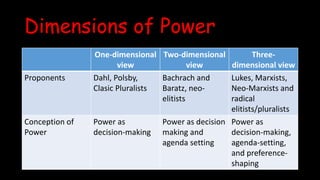
Dimensions of Power
One-dimensional
view
Two-dimensional
view
Three-
dimensional view
Proponents Dahl, Polsby,
Clasic Pluralists
Bachrach and
Baratz, neo-
elitists
Lukes, Marxists,
Neo-Marxists and
radical
elitists/pluralists
Conception of
Power
Power as
decision-making
Power as decision
making and
agenda setting
Power as
decision-making,
agenda-setting,
and preference-
shaping
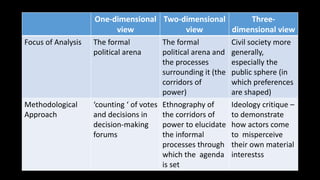
One-dimensional
view
Two-dimensional
view
Three-
dimensional view
Focus of Analysis The formal
political arena
The formal
political arena and
the processes
surrounding it (the
corridors of
power)
Civil society more
generally,
especially the
public sphere (in
which preferences
are shaped)
Methodological
Approach
‘counting ‘ of votes
and decisions in
decision-making
forums
Ethnography of
the corridors of
power to elucidate
the informal
processes through
which the agenda
is set
Ideology critique –
to demonstrate
how actors come
to misperceive
their own material
interestss
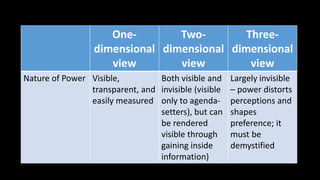
One-
dimensional
view
Two-
dimensional
view
Three-
dimensional
view
Nature of Power Visible,
transparent, and
easily measured
Both visible and
invisible (visible
only to agenda-
setters), but can
be rendered
visible through
gaining inside
information)
Largely invisible
– power distorts
perceptions and
shapes
preference; it
must be
demystified
The Three Faces of Power
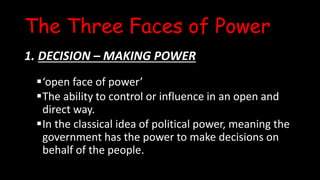
1. DECISION – MAKING POWER
‘open face of power’
The ability to control or influence in an open and
direct way.
In the classical idea of political power, meaning the
government has the power to make decisions on
behalf of the people.
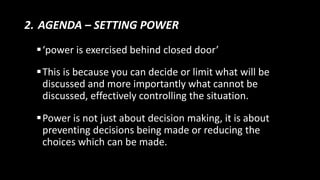
2. AGENDA – SETTING POWER
‘power is exercised behind closed door’
This is because you can decide or limit what will be
discussed and more importantly what cannot be
discussed, effectively controlling the situation.
Power is not just about decision making, it is about
preventing decisions being made or reducing the
choices which can be made.
3. IDEOLOGICAL POWER
‘power to shape desires’
It seeks to identify “the means though which power
influences, shapes and determines conceptions of
necessities, possibilities and strategies of challenge
in situation of conflict.”
Taxonomy of Power
- in 1959, John French and Bertman
Raven created the six (6) bases of power to
power to understand the influence of a
leader.
Coercive Power
- Involves the usage of threat to make people
do what one desires. In the organization set up,
it translate into threatening someone to
transfer, firing, demotions, etc. it basically
forces people to submit to one’s demand for
the fear of losing something.
Reward Power
- Uses rewards, perks, new projects or training
opportunities, better roles and monetary benefits to
influence people.
- However an interesting aspect of this type of power is
that, it is not powerful enough in itself, as decisions
related to rewards do not rest solely with the person
promising them, because in an organizations, a lot of
other people come into play like senior managers and
board.
Legitimate Power
- this power emanates from an official
position held by someone, be it an organization,
bureaucracy or government and etc. The duration
of this power is short lived as a person can use it
only till the time he/she holds the position, as
well as, the scope of the power is small as it is
strictly defined by the position held.
Informational Power
- power that comes from access to and
control over information.
- information is a form of influence and social
power by providing information to a person
resulting them to think and act in different way.
Expert Power
- this is a personal kind of power which owes
its genesis to the skills and expertise possessed by
an individual, which is higher quality and not
easily available.
Referent Power
- wielded by celebrities and film stars as they
have huge following amongst masses, who like
them, identify with them and follow them. Hence,
they exert lasting influence on a large number of
people for a large number of decisions; like what
car to buy, to which candidate to choose for a
higher office in the country.
POLITICS AND GOVERNANCE
-by Lito A. Peñaflor
Karyl O. Peñaflor
Other Types of
Power
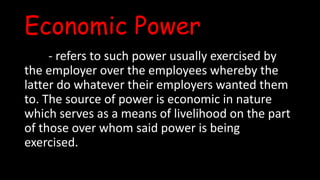
Economic Power
- refers to such power usually exercised by
the employer over the employees whereby the
latter do whatever their employers wanted them
to. The source of power is economic in nature
which serves as a means of livelihood on the part
of those over whom said power is being
exercised.
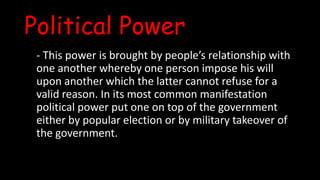
Political Power
- This power is brought by people’s relationship with
one another whereby one person impose his will
upon another which the latter cannot refuse for a
valid reason. In its most common manifestation
political power put one on top of the government
either by popular election or by military takeover of
the government.
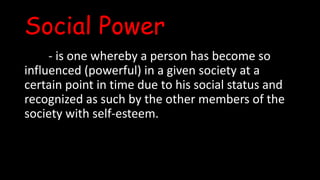
Social Power
- is one whereby a person has become so
influenced (powerful) in a given society at a
certain point in time due to his social status and
recognized as such by the other members of the
society with self-esteem.
Authority
- is the power accruing due to one’s position
in the government. The power in this regards is
co-extensive with one’s office as different
government offices have various degrees of
authority (power).
Military Power
- This power is brought about by the military
forces of a given country. Hence, this power is
co-extensive with the strength of that country’s
defense. Anyway, this can be augmented by
civilian defense forces.
Jurisdiction
- refers to such power of the court to try
cases and impose its judgement. This is subject to
the laws that determine the degree and manner
of its exercise as well as the persons over whom
the same could be exercised.
Consequences
of Power
Compliance
Refers to the readiness or act of agreeing to do
something.
1. Compliance with the order may occur if it is perceived to
be within the leader’s scope of authority.
2. Compliance is most likely to happen if the reward is
something valued by the target person.
Commitment
- is an even more desirable outcome because of he
trust and emotional pledge that it causes. It is
perceived as loyalty or a sense of dedication or
devotion.
- commitment is more likely to be the
consequence of powers used are referent and expert.
Resistance
means to refuse or to oppose.
It is most likely the outcome when coercive power
is used in hostile or manipulative way. It is best to
use coercion power in preventing behaviour that is
harmful to the society and to the well-being of the
people such as illegal and violent activities.
(Heywood, 2007)
Conformity
Power is abused by compliance with the
standards set by the society. People are often
quick to conform just to please others.
Sometime in 1960, Stanley Milgram studied conformity to the
authority. The participant were paid by the researcher to take a
researcher to take a certain role. The participant (as teacher) was
told to shock the participant (as learner) whenever an incorrect
answer were given. In the study the participant (learner) were
confederate who pretend to be hurt by the electric shock. He
told the participant (teachers) that they will not be held liable to
whatever happen to the participant (learners) and that he
needed their help to complete his experiment. The result ended
up that all participant are willing to administer up to 300 volts.,
and 65% were willing to go up 450 volts.

POWER.pptx

  • 1.
  • 2.
    Objectives: At the endof the lesson, the students should be able to: 1. Define power; 2. Identify the nature, types, and consequences of power; 3. Explain the nature, dimensions, types and consequences of power; and 4. Explain how power is exercised in different situations.
  • 3.
    POWER •Power is thecapability to control and influence people’s behaviour as well as the capability to direct the paths and result of events (Oxford University Press, 2015) •It can be perceived as good or bad, just or unjust, and its exercise is accepted and acknowledged since the beginning of time.
  • 4.
    •Power may beexpressed as Upward, where the leader or superior influences the members or subordinates; or it may be expressed as Downward, where the members or subordinates influence decisions of their leader or superior (Bukowski and Rajagopalan, 2000)
  • 5.
    Natures of Power POWEROVER The ability to dominate another person or a group. Usually comes from force or threat. POWER TO The ability to do something on one’s own (sources: intellect, resources, knowledge, stamina and etc.)38
  • 6.
    POWER WITH Is similaralso to “power to” in that it reflects ability The ability to work with others to get something done by cooperation
  • 7.
    Dimensions of Power One-dimensional view Two-dimensional view Three- dimensionalview Proponents Dahl, Polsby, Clasic Pluralists Bachrach and Baratz, neo- elitists Lukes, Marxists, Neo-Marxists and radical elitists/pluralists Conception of Power Power as decision-making Power as decision making and agenda setting Power as decision-making, agenda-setting, and preference- shaping
  • 8.
    One-dimensional view Two-dimensional view Three- dimensional view Focus ofAnalysis The formal political arena The formal political arena and the processes surrounding it (the corridors of power) Civil society more generally, especially the public sphere (in which preferences are shaped) Methodological Approach ‘counting ‘ of votes and decisions in decision-making forums Ethnography of the corridors of power to elucidate the informal processes through which the agenda is set Ideology critique – to demonstrate how actors come to misperceive their own material interestss
  • 9.
    One- dimensional view Two- dimensional view Three- dimensional view Nature of PowerVisible, transparent, and easily measured Both visible and invisible (visible only to agenda- setters), but can be rendered visible through gaining inside information) Largely invisible – power distorts perceptions and shapes preference; it must be demystified
  • 10.
    The Three Facesof Power 1. DECISION – MAKING POWER ‘open face of power’ The ability to control or influence in an open and direct way. In the classical idea of political power, meaning the government has the power to make decisions on behalf of the people.
  • 11.
    2. AGENDA –SETTING POWER ‘power is exercised behind closed door’ This is because you can decide or limit what will be discussed and more importantly what cannot be discussed, effectively controlling the situation. Power is not just about decision making, it is about preventing decisions being made or reducing the choices which can be made.
  • 12.
    3. IDEOLOGICAL POWER ‘powerto shape desires’ It seeks to identify “the means though which power influences, shapes and determines conceptions of necessities, possibilities and strategies of challenge in situation of conflict.”
  • 13.
    Taxonomy of Power -in 1959, John French and Bertman Raven created the six (6) bases of power to power to understand the influence of a leader.
  • 14.
    Coercive Power - Involvesthe usage of threat to make people do what one desires. In the organization set up, it translate into threatening someone to transfer, firing, demotions, etc. it basically forces people to submit to one’s demand for the fear of losing something.
  • 15.
    Reward Power - Usesrewards, perks, new projects or training opportunities, better roles and monetary benefits to influence people. - However an interesting aspect of this type of power is that, it is not powerful enough in itself, as decisions related to rewards do not rest solely with the person promising them, because in an organizations, a lot of other people come into play like senior managers and board.
  • 16.
    Legitimate Power - thispower emanates from an official position held by someone, be it an organization, bureaucracy or government and etc. The duration of this power is short lived as a person can use it only till the time he/she holds the position, as well as, the scope of the power is small as it is strictly defined by the position held.
  • 17.
    Informational Power - powerthat comes from access to and control over information. - information is a form of influence and social power by providing information to a person resulting them to think and act in different way.
  • 18.
    Expert Power - thisis a personal kind of power which owes its genesis to the skills and expertise possessed by an individual, which is higher quality and not easily available.
  • 19.
    Referent Power - wieldedby celebrities and film stars as they have huge following amongst masses, who like them, identify with them and follow them. Hence, they exert lasting influence on a large number of people for a large number of decisions; like what car to buy, to which candidate to choose for a higher office in the country.
  • 20.
    POLITICS AND GOVERNANCE -byLito A. Peñaflor Karyl O. Peñaflor Other Types of Power
  • 21.
    Economic Power - refersto such power usually exercised by the employer over the employees whereby the latter do whatever their employers wanted them to. The source of power is economic in nature which serves as a means of livelihood on the part of those over whom said power is being exercised.
  • 22.
    Political Power - Thispower is brought by people’s relationship with one another whereby one person impose his will upon another which the latter cannot refuse for a valid reason. In its most common manifestation political power put one on top of the government either by popular election or by military takeover of the government.
  • 23.
    Social Power - isone whereby a person has become so influenced (powerful) in a given society at a certain point in time due to his social status and recognized as such by the other members of the society with self-esteem.
  • 24.
    Authority - is thepower accruing due to one’s position in the government. The power in this regards is co-extensive with one’s office as different government offices have various degrees of authority (power).
  • 25.
    Military Power - Thispower is brought about by the military forces of a given country. Hence, this power is co-extensive with the strength of that country’s defense. Anyway, this can be augmented by civilian defense forces.
  • 26.
    Jurisdiction - refers tosuch power of the court to try cases and impose its judgement. This is subject to the laws that determine the degree and manner of its exercise as well as the persons over whom the same could be exercised.
  • 27.
  • 28.
    Compliance Refers to thereadiness or act of agreeing to do something. 1. Compliance with the order may occur if it is perceived to be within the leader’s scope of authority. 2. Compliance is most likely to happen if the reward is something valued by the target person.
  • 29.
    Commitment - is aneven more desirable outcome because of he trust and emotional pledge that it causes. It is perceived as loyalty or a sense of dedication or devotion. - commitment is more likely to be the consequence of powers used are referent and expert.
  • 30.
    Resistance means to refuseor to oppose. It is most likely the outcome when coercive power is used in hostile or manipulative way. It is best to use coercion power in preventing behaviour that is harmful to the society and to the well-being of the people such as illegal and violent activities. (Heywood, 2007)
  • 31.
    Conformity Power is abusedby compliance with the standards set by the society. People are often quick to conform just to please others.
  • 32.
    Sometime in 1960,Stanley Milgram studied conformity to the authority. The participant were paid by the researcher to take a researcher to take a certain role. The participant (as teacher) was told to shock the participant (as learner) whenever an incorrect answer were given. In the study the participant (learner) were confederate who pretend to be hurt by the electric shock. He told the participant (teachers) that they will not be held liable to whatever happen to the participant (learners) and that he needed their help to complete his experiment. The result ended up that all participant are willing to administer up to 300 volts., and 65% were willing to go up 450 volts.