GENRE
THE CONTROLLING CONCEPT
WHAT IS GENRE?
Genre is a way of classifying a text to help us to identify it so
that we can:
• Create it - e.g the director of a film
• Consume it - e.g as an audience
• Understand it - e.g. as a media student
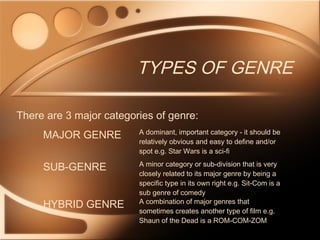
TYPES OF GENRE
There are 3 major categories of genre:
MAJOR GENRE A dominant, important category - it should be
relatively obvious and easy to define and/or
spot e.g. Star Wars is a sci-fi
SUB-GENRE A minor category or sub-division that is very
closely related to its major genre by being a
specific type in its own right e.g. Sit-Com is a
sub genre of comedy
HYBRID GENRE A combination of major genres that
sometimes creates another type of film e.g.
Shaun of the Dead is a ROM-COM-ZOM
HYBRIDS
Many high-concept films are hybrids.
The “Kill Bill” series (2003) is a good example of messing with
generic expectations. Tarantino has produced a film
compromised of no less than 5 different genres including Kung
Fu, Spaghetti Western, grind-house cinema which he blends
together to create a unique and highly post-modern text.
HYBRIDS
Hybrids offer the audience a challenge as they often lead you
down a generic path e.g. you feel like you are watching a teen pic
etc then you are unexpectedly presented with a series of different
conventions that suggest a different genre e.g. a horror.
In an industry that is flooded with films of similar genres, hybrid
allow audiences a break from the norm, providing them with a
more unique viewing experience.
THE TYPICALS OF
GENRE
Genres are said to be made up of a series ‘typical’
characteristics:
• Narrative - similar (sometimes formulaic) plots and structures
based around predictable situations, scenarios, conflicts and
resolutions.
• Characterisation - similar types of characters often stereotyped
within their roles, behaviour and personal qualities. Can also be
typified by particular actors
• Setting - Both geographical and historical
THE TYPICALS OF
GENRE
• Iconography - Familiar images and objects that have developed
over time and experience e.g. Stetsons and Colt 45’s for
Westerns, Tailored suits for gangsters
• Filmic Techniques - Stylistic conventions of camerawork, light,
sound, editing etc
• Basic Themes - Subject matter pertaining to the main motivation
for the story e.g. good overcomes evil, America beats everyone
in war
THE TYPICALS OF
GENRE
Genre is therefore seen to be the ‘controlling’ concept in relation to
MIGRAINE as it often determines the aesthetic of a text (media
language), audience expectations (audience), narrative context
(narrative), messages and values within a text (ideology and
representation).
It is vital that you make an attempt to establish the genre of a text in
order to link this to other aspects of your analysis.
HOW DO WE USE THE
CONCEPT OF GENRE?
Both audience and producers may use the concept of genre for
different purposes:
• Particular audiences like certain types of films
• it helps us to analyse films and to see how they are constructed
and marketed
• to give a film an identity
• to attract a mainstream audience
• to target a specific niche audience
HOW DO WE USE THE
CONCEPT OF GENRE?
• to inform an audience of the type of narrative and characters
• to sell the film
• to play with the variations of a formula that works
• to deliver an audience to advertisers
• to meet audience expectations
• to define, create and utilise stars
• to assist writers to sell a text to producers
• to make a text ‘safe’ for its audience
HOW DO WE
RECOGNISE
GENRES?
We identify genre by looking for their generic codes and
conventions – these are the signifiers that have been established
over time and are commonly associated with that particular genre.
Once we recognise the codes and conventions of a text, we are able
to make certain assumptions about its characteristics including those
of narrative and setting.
GENRE AND
AUDIENCES
Genre is an important aspect of targeting audiences.
You may often find that producers make similar genre films at certain
periods due to trends in the film industry e.g. teen horror of the late
1990s. Studio executives do not want to be left out and therefore
jump on the bandwagon in order to tap into the current market.
GENRE AND
AUDIENCES
So what does this tell us?
• Genre is one way of packaging, presenting and selling a major film
• Fans of particular genres are likely to consume films of a similar
genre
• Genres offer stability and safety as we become established with
their conventions
GENRE AND
AUDIENCES
It is almost possible to predict the audience for a particular genre.
Who do you believe the audience are for the following genres:
HORROR
WESTERN
ROMANCE
WAR
CARTOONS
GENRE AND
AUDIENCES
These are, of course, generalisations – it is perfectly possible for
older people to enjoy horror films or for women to want to see war
films.
The point is that producers need to get a return on their investment
and as long as they can make an attempt to target a specific
audience then they will hope to break even at least.
DO GENRES
CHANGE?
It is important to understand that genres do evolve in order to adapt
to changing circumstances including:
• changes in the audience’s attitudes, values and beliefs
• new technology
• film industry changes
• a shift in paradigms or ideology
THE HORROR GENRE
The Horror genre is a good example of how genres evolve to suit
their audiences and society of the time. For example, “Psycho” was
aimed at an adult audience. By the time “Halloween” was released
in the 1970s, the primary audience was teenagers. This can be
linked to the context of society at this time when teenagers were
gaining more freedoms, due to more money and parents that had
grown up in the ‘Swingin’ Sixties’. This gave them considerable
disposable income which filmmakers and producers were interested
in targeting.
THE HORROR GENRE
The horror genre also saw a decline during the 1980s with the arrival
of domestic video facilities. Many horror movies such as A
nightmare on Elm Street were deemed to have a negative effect on
their audiences, spawning copycat behaviour.
Many horrors became associated with ‘video nasties’ (Child’s Play
being strongly associated with the Jamie Bulger murder in 1993) and
were often demonised by the press. In the 1990s, however, the
horror saw a revival with the combination of teen antics and slasher
gore fusing to create the successful Scream Trilogy.
GENRE: A SUMMARY
When considering genre, remember the following points:
• Genres are generally recognised by their codes and conventions
• Genres offer both audience and institution stability and greater
understanding
• Genres do change to adapt to changes in society
• It is possible that genres can be blended together to become a
hybrid or bricolage (a new genre altogther)
:)

Genre

  • 1.
  • 2.
    WHAT IS GENRE? Genreis a way of classifying a text to help us to identify it so that we can: • Create it - e.g the director of a film • Consume it - e.g as an audience • Understand it - e.g. as a media student
  • 3.
    TYPES OF GENRE Thereare 3 major categories of genre: MAJOR GENRE A dominant, important category - it should be relatively obvious and easy to define and/or spot e.g. Star Wars is a sci-fi SUB-GENRE A minor category or sub-division that is very closely related to its major genre by being a specific type in its own right e.g. Sit-Com is a sub genre of comedy HYBRID GENRE A combination of major genres that sometimes creates another type of film e.g. Shaun of the Dead is a ROM-COM-ZOM
  • 4.
    HYBRIDS Many high-concept filmsare hybrids. The “Kill Bill” series (2003) is a good example of messing with generic expectations. Tarantino has produced a film compromised of no less than 5 different genres including Kung Fu, Spaghetti Western, grind-house cinema which he blends together to create a unique and highly post-modern text.
  • 5.
    HYBRIDS Hybrids offer theaudience a challenge as they often lead you down a generic path e.g. you feel like you are watching a teen pic etc then you are unexpectedly presented with a series of different conventions that suggest a different genre e.g. a horror. In an industry that is flooded with films of similar genres, hybrid allow audiences a break from the norm, providing them with a more unique viewing experience.
  • 6.
    THE TYPICALS OF GENRE Genresare said to be made up of a series ‘typical’ characteristics: • Narrative - similar (sometimes formulaic) plots and structures based around predictable situations, scenarios, conflicts and resolutions. • Characterisation - similar types of characters often stereotyped within their roles, behaviour and personal qualities. Can also be typified by particular actors • Setting - Both geographical and historical
  • 7.
    THE TYPICALS OF GENRE •Iconography - Familiar images and objects that have developed over time and experience e.g. Stetsons and Colt 45’s for Westerns, Tailored suits for gangsters • Filmic Techniques - Stylistic conventions of camerawork, light, sound, editing etc • Basic Themes - Subject matter pertaining to the main motivation for the story e.g. good overcomes evil, America beats everyone in war
  • 8.
    THE TYPICALS OF GENRE Genreis therefore seen to be the ‘controlling’ concept in relation to MIGRAINE as it often determines the aesthetic of a text (media language), audience expectations (audience), narrative context (narrative), messages and values within a text (ideology and representation). It is vital that you make an attempt to establish the genre of a text in order to link this to other aspects of your analysis.
  • 9.
    HOW DO WEUSE THE CONCEPT OF GENRE? Both audience and producers may use the concept of genre for different purposes: • Particular audiences like certain types of films • it helps us to analyse films and to see how they are constructed and marketed • to give a film an identity • to attract a mainstream audience • to target a specific niche audience
  • 10.
    HOW DO WEUSE THE CONCEPT OF GENRE? • to inform an audience of the type of narrative and characters • to sell the film • to play with the variations of a formula that works • to deliver an audience to advertisers • to meet audience expectations • to define, create and utilise stars • to assist writers to sell a text to producers • to make a text ‘safe’ for its audience
  • 11.
    HOW DO WE RECOGNISE GENRES? Weidentify genre by looking for their generic codes and conventions – these are the signifiers that have been established over time and are commonly associated with that particular genre. Once we recognise the codes and conventions of a text, we are able to make certain assumptions about its characteristics including those of narrative and setting.
  • 12.
    GENRE AND AUDIENCES Genre isan important aspect of targeting audiences. You may often find that producers make similar genre films at certain periods due to trends in the film industry e.g. teen horror of the late 1990s. Studio executives do not want to be left out and therefore jump on the bandwagon in order to tap into the current market.
  • 13.
    GENRE AND AUDIENCES So whatdoes this tell us? • Genre is one way of packaging, presenting and selling a major film • Fans of particular genres are likely to consume films of a similar genre • Genres offer stability and safety as we become established with their conventions
  • 14.
    GENRE AND AUDIENCES It isalmost possible to predict the audience for a particular genre. Who do you believe the audience are for the following genres: HORROR WESTERN ROMANCE WAR CARTOONS
  • 15.
    GENRE AND AUDIENCES These are,of course, generalisations – it is perfectly possible for older people to enjoy horror films or for women to want to see war films. The point is that producers need to get a return on their investment and as long as they can make an attempt to target a specific audience then they will hope to break even at least.
  • 16.
    DO GENRES CHANGE? It isimportant to understand that genres do evolve in order to adapt to changing circumstances including: • changes in the audience’s attitudes, values and beliefs • new technology • film industry changes • a shift in paradigms or ideology
  • 17.
    THE HORROR GENRE TheHorror genre is a good example of how genres evolve to suit their audiences and society of the time. For example, “Psycho” was aimed at an adult audience. By the time “Halloween” was released in the 1970s, the primary audience was teenagers. This can be linked to the context of society at this time when teenagers were gaining more freedoms, due to more money and parents that had grown up in the ‘Swingin’ Sixties’. This gave them considerable disposable income which filmmakers and producers were interested in targeting.
  • 18.
    THE HORROR GENRE Thehorror genre also saw a decline during the 1980s with the arrival of domestic video facilities. Many horror movies such as A nightmare on Elm Street were deemed to have a negative effect on their audiences, spawning copycat behaviour. Many horrors became associated with ‘video nasties’ (Child’s Play being strongly associated with the Jamie Bulger murder in 1993) and were often demonised by the press. In the 1990s, however, the horror saw a revival with the combination of teen antics and slasher gore fusing to create the successful Scream Trilogy.
  • 19.
    GENRE: A SUMMARY Whenconsidering genre, remember the following points: • Genres are generally recognised by their codes and conventions • Genres offer both audience and institution stability and greater understanding • Genres do change to adapt to changes in society • It is possible that genres can be blended together to become a hybrid or bricolage (a new genre altogther)
  • 20.